




Karsten Wenzlaff, Advisor
August 26th, 2025
Karsten Wenzlaff is a Crowdfunding and Fintech Expert from Germany. He is Secretary-General of Digit[...]


Apr 2, 2026 | NCFA Fintech Market Activity | Banking And Credit, Regulation And Policy

Image: Freepik/rawpixel.com
On April 2, 2026, Italy’s competition authority (AGCM) fined Revolut group €11 million for unfair commercial practices tied to investment disclosures, payment account restrictions, and communication around Italian versus Lithuanian IBANs.
These fines come at a time when Revolut has grown into a bigger and more profitable company, and trying to look more like a primary banking platform than a fast growing fintech. In late March, Revolut reported $2.3B in profit before tax for 2025 with 68.3 million customers and $6B in revenue. Regulators expect more from a company with that type of scale; clarity, conduct, and professional account handling.
Regarding the IBAN issue,, the AGCM said Revolut didn't provide clear and exhaustive information on the requirements and timing for obtaining an Italian IBAN instead of a Lithuanian one. Revolut’s Italy account documentation now identifies Revolut Bank UAB Italian branch details and says the information sheet took effect on March 30, 2026. For a fintech trying to become more embedded in everyday banking, local account setup and customer communication are not side issues, and are important for trust and primary account use.
Revolut said it strongly disagrees with the findings and plans to appeal in the Italian courts. The company said the decision would have no impact on operations or its financial position. That response may settle investors in the short term, but its a sign that once a fintech reaches bank like scale, regulators stop looking only at growth and product breadth. They look much harder at how claims are framed, how restrictions are handled, and whether customers understand what they are actually getting.
Fractional investing, account controls, and local account migration can look like product details when a company is small. At scale, they become conduct risk. Italy’s decision shows how quickly those details can become costly once a fintech evolves deeper into the center of consumer finance.
When a fintech starts to look more like a primary bank, which becomes harder to defend at scale: aggressive growth tactics or unclear customer communication?
 The National Crowdfunding & Fintech Association (NCFA Canada) is a financial innovation ecosystem that provides education, market intelligence, industry stewardship, networking and funding opportunities and services to thousands of community members and works closely with industry, government, partners and affiliates to create a vibrant and innovative fintech and funding industry in Canada. Decentralized and distributed, NCFA is engaged with global stakeholders and helps incubate projects and investment in fintech, alternative finance, crowdfunding, peer-to-peer finance, payments, digital assets and tokens, artificial intelligence, blockchain, cryptocurrency, regtech, and insurtech sectors. Join Canada's Fintech & Funding Community today FREE! Or become a contributing member and get perks. For more information, please visit: www.ncfacanada.org
 |  |  |
|---|---|---|
 |  |  |
Apr 1, 2026 | NCFA Insight | Innovation Policy And Funding
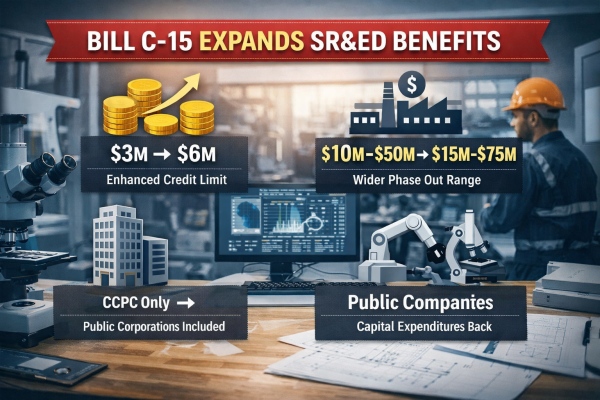
On Mar 26, 2026, Bill C-15 received Royal Assent. Alongside Canada’s new digital finance framework, it also puts major Budget 2025 SR&ED changes into law. The enhanced 35% SR&ED credit now applies on up to $6M of qualifying expenditures, up from $3M. The taxable capital phase out range widens to $15M to $75M, up from $10M to $50M. Eligible Canadian public corporations can now access the enhanced credit, and capital expenditures become eligible again.
| Change | Before | After | Why It Matters |
|---|---|---|---|
| Enhanced 35% expenditure ceiling | $3M | $6M | Companies can keep the higher credit rate on another $3M of qualifying work, which improves cash flow for teams already spending heavily on product and engineering. |
| Taxable capital phase out range | $10M to $50M | $15M to $75M | More growing firms can qualify for the enhanced regime longer instead of losing support too early. |
| Enhanced credit access | Mainly CCPC focused | Includes eligible Canadian public corporations | Some listed Canadian firms with real product and R&D intensity can now claim richer support instead of falling outside the enhanced lane. |
| Capital expenditures | Not eligible | Eligible again | This impacts firms that need equipment, testing environments, and technical infrastructure, not just payroll, to build. |
The biggest gains go to qualifying companies already spending heavily on development and infrastructure. That may include payments firms building fraud and risk systems, regtech firms developing compliance tooling, AI firms training and testing models, and data infrastructure companies investing ahead of revenue. Early stage teams with smaller claims still benefit, but the larger payoff goes to companies that were already hitting the old ceiling or losing support as they grew.
The program is stronger, but it still rewards discipline. Claims still depend on technical records, project detail, and the ability to show eligible experimental work. Companies with weak documentation simply won't capture the full benefit.
Two simple examples:
A Canadian payments company with $5M in eligible SR&ED spending used to reach the enhanced ceiling at $3M. Under the new rules, another $2M of that spend qualifies for the enhanced rate. That doesn't fix product market fit, but it can reduce cash burn and make it easier to keep engineering teams in place.
A public company building AI driven compliance software may now benefit in two ways at once. It can access the enhanced credit if it qualifies, and it can include eligible capital costs tied to technical build out. That makes the program more relevant to how software and infrastructure firms actually spend.
Bill C-15 makes SR&ED more useful for companies with real development spend. The ceiling doubles to $6M, the phase out range widens, public company access expands, and capital costs come back into scope. For Canadian fintech and AI builders, that can extend runway and support more product development work.
The National Crowdfunding & Fintech Association (NCFA Canada) is a financial innovation ecosystem that provides education, market intelligence, industry stewardship, networking and funding opportunities and services to thousands of community members and works closely with industry, government, partners and affiliates to create a vibrant and innovative fintech and funding industry in Canada. Decentralized and distributed, NCFA is engaged with global stakeholders and helps incubate projects and investment in fintech, alternative finance, crowdfunding, peer-to-peer finance, payments, digital assets and tokens, artificial intelligence, blockchain, cryptocurrency, regtech, and insurtech sectors. Join Canada's Fintech & Funding Community today FREE! Or become a contributing member and get perks. For more information, please visit: www.ncfacanada.org
| | |
|---|---|---|
| | |
Apr 1, 2026 | NCFA Fintech Market Activity | Embedded Finance Platforms And Partnerships, Payments And Money Movement

On March 31, 2026, Reuters exclusively reported TikTok's Brazil license applications. The company applied for one license to issue electronic money for prepaid accounts and payments and another to operate as a direct credit company, enabling lending without taking public deposits.
TikTok already has the reach with more than 131 million users in Brazil. Most fintechs spend years trying to build that kind of distribution. TikTok already has it. The harder part is turning that audience reach into payment, wallet use, and trust in a credit product.
Brazil's payment system also gives TikTok a strong foundation to build on. Pix reached nearly 170 million users and BRL 11 trillion in transactions in 2024. The domestic payment rail is already there so the battleground is who controls checkout, the wallet, the customer relationship, and eventually the credit layer inside social commerce.
If TikTok can connect discovery, commerce, payments, and lending into a single flow, it starts to look less like a social app with a wallet and more like a commerce platform with financial rails built in. The upside is clear. Payments can reduce checkout friction. Credit can lift conversion, change seller economics, and pull more transactions into the platform.
The trust question is harder. A social platform can add financial rails faster than a normal fintech can add distribution, but it still has to prove that users, merchants, and regulators trust the same platform to handle money as well as attention. That challenge is real when, especially when platforms can face backlash after changing how users think abut their service scope, data usage or activity will be used, as seen in Bluesky’s data use backlash.
The old approach was to build a financial product and then fight and claw for users. TikTok is trying the reverse. It already has the users. Now it wants the financial plumbing, much like Elon Musk's super app push for X. That in itself makes the licensing outcome worth watching for fintech founders, banks, acquirers, and payment firms already operating in Brazil.
The open question is whether a social platform can turn payments and credit into a real commerce edge without drawing heavier scrutiny as it grows. If it can, Brazil may become a clear example of platform distribution beating out traditional financial distribution.
When a platform already reaches 131 million users, does the edge in finance come from the product itself or from owning the customer before the first payment starts?
The National Crowdfunding & Fintech Association (NCFA Canada) is a financial innovation ecosystem that provides education, market intelligence, industry stewardship, networking and funding opportunities and services to thousands of community members and works closely with industry, government, partners and affiliates to create a vibrant and innovative fintech and funding industry in Canada. Decentralized and distributed, NCFA is engaged with global stakeholders and helps incubate projects and investment in fintech, alternative finance, crowdfunding, peer-to-peer finance, payments, digital assets and tokens, artificial intelligence, blockchain, cryptocurrency, regtech, and insurtech sectors. Join Canada's Fintech & Funding Community today FREE! Or become a contributing member and get perks. For more information, please visit: www.ncfacanada.org
| | |
|---|---|---|
| | |
April 1, 2026

The Bitelity broker further reveals its core concept through the development of a web-based trading infrastructure, emphasizing that browser-based solutions are becoming the foundation of modern trading, providing users with maximum flexibility, security, and stability. In this context, trading via web interfaces is not merely an alternative to traditional applications, but a полноцен technological standard that enables seamless and simultaneous access to multiple markets without the need to install additional software. This is especially important in the context of growing demands for cybersecurity and operational speed.
At the same time, the Bitelity platform is positioned as one of the fastest and most stable solutions on the market, offering users the ability to execute trades efficiently with just a few clicks, while maintaining high order execution accuracy and access to a wide range of analytical tools that go beyond standard mobile and desktop solutions. This creates a modern and intelligent trading environment focused on maximum convenience and performance.
A key advantage of the web platform is the absence of any installation requirement, which not only simplifies the onboarding process but also significantly reduces potential risks associated with downloading third-party software. Users are not required to grant access to personal data or system resources of their device, and the likelihood of malware infection is eliminated, collectively increasing trust in the platform and making the trading process more secure.
Additionally, the lack of installation means no strain on device memory and complete independence from its technical specifications, making the platform a universal tool accessible from any device with an internet connection. An important element of this concept is full compatibility and remote access, allowing users to connect to their trading account at any time, monitor market changes, and respond promptly regardless of their location—whether in a workspace or at home.
Thus, Bitelity creates a flexible interaction model in which the trader is not tied to a specific device and can freely manage their investments. This is especially relevant in dynamic financial markets, where timing plays a crucial role. Special attention is also given to eliminating limitations associated with relying solely on mobile applications, since dependence on a single device may lead to loss of access in case of loss or technical issues. In contrast, the web platform ensures continuity by allowing login from any device connected to the network, guaranteeing constant access to trading operations and reducing stress related to possible technical failures.
Another important advantage is the platform’s operational stability, achieved through a unified interface and identical functionality regardless of the device used. This provides users with a familiar and intuitive environment without the need to adapt to different software versions, which distinguishes the web solution from traditional approaches where differences between mobile and desktop applications can complicate the trading process. In the case of Bitelity, this issue is eliminated through interface and logic unification, ensuring a smooth user experience and minimizing the likelihood of errors.
Taken together, all these characteristics form a solid technological foundation that supports the platform’s core idea: to provide users with the most accessible, secure, and efficient tool for operating in financial markets. Every detail is aimed at enhancing convenience and reliability, and it is precisely this integration of speed, stability, and universality that allows the Bitelity web platform to be considered the central element of the entire ecosystem—combining the advantages of modern technology with the practical needs of traders. This creates the conditions for confident and uninterrupted trading in any situation, regardless of external factors, thereby strengthening the company’s overall direction toward creating long-term value for clients through technological excellence and a thoughtfully designed user experience.
The National Crowdfunding & Fintech Association (NCFA Canada) is a financial innovation ecosystem that provides education, market intelligence, industry stewardship, networking and funding opportunities and services to thousands of community members and works closely with industry, government, partners and affiliates to create a vibrant and innovative fintech and funding industry in Canada. Decentralized and distributed, NCFA is engaged with global stakeholders and helps incubate projects and investment in fintech, alternative finance, crowdfunding, peer-to-peer finance, payments, digital assets and tokens, artificial intelligence, blockchain, cryptocurrency, regtech, and insurtech sectors. Join Canada's Fintech & Funding Community today FREE! Or become a contributing member and get perks. For more information, please visit: www.ncfacanada.org
| | |
|---|---|---|
| | |
Mar 30, 2026 | NCFA Insight | Regulation And Policy, Digital Assets

On Mar 26, 2026, Bill C-25 was introduced to amend the Canada Elections Act (download 45 page Bill C-25 PDF). The bill blocks third parties from accepting contributions made in cryptoassets, prepaid payment products, or money orders for partisan activity, election advertising, or surveys. If received, those funds must be returned, destroyed, or converted and handed to the Receiver General.
Anonymous contributions are prohibited. Foreign sourced funds, property, and services are prohibited. Regulated expenses must be funded by Canadian individuals, with a limited exception allowing a third party to use its own funds only when prior year contributions are 10% or less of revenue. Disclosure also tightens. Once a contributor exceeds $200, reporting must include name, address, amount, and timing.
In practice, this closes most of the remaining paths for political money that cannot be clearly attributed.
The bill does not regulate crypto markets. It removes funding methods that make source of funds and identity harder to verify. Crypto sits alongside instruments that break clean audit trails.
This is consistent with how Canadian regulators already handle higher risk flows. When identity or intent cannot be confirmed, access gets restricted. That same pressure showed up in rules applied to donation crowdfunding platforms and in guidance on bitcoin ATMs, where operators are expected to treat even smaller transactions within a broader AML framework.
Political finance applies that standard without exception.
This is a political funding rule, and doesn't apply to general payments or everyday crypto use.
It does show how regulators act when attribution cannot be optional. Funding must be tied to identifiable sources, supported by records, and capable of audit.
Failures to meet that bar already carry real consequences. Major AML breakdowns at large institutions and advances in detection, including AI driven money laundering techniques and shell company structures, show how quickly expectations are rising.
Bill C-25 is focused on political funding. Money used in elections must be attributable, traceable, and tied to identifiable Canadian sources. Fintech and financial institutions dealing with Canadian election flows must be able to prove who sent the money, where it came from, and how it moved, otherwise they'll soon be under pressure.
The National Crowdfunding & Fintech Association (NCFA Canada) is a financial innovation ecosystem that provides education, market intelligence, industry stewardship, networking and funding opportunities and services to thousands of community members and works closely with industry, government, partners and affiliates to create a vibrant and innovative fintech and funding industry in Canada. Decentralized and distributed, NCFA is engaged with global stakeholders and helps incubate projects and investment in fintech, alternative finance, crowdfunding, peer-to-peer finance, payments, digital assets and tokens, artificial intelligence, blockchain, cryptocurrency, regtech, and insurtech sectors. Join Canada's Fintech & Funding Community today FREE! Or become a contributing member and get perks. For more information, please visit: www.ncfacanada.org
| | |
|---|---|---|
| | |
Mar 30, 2026 | NCFA Insight | Payments And Money Movement

On March 25, 2026, the FCA opened the door to regulatory changes for agentic AI payments, placing a policy question mark related to artificial intelligence. If software can autonomously initiate and execute payments, the industry needs to better understand the answer to a basic legal question. Who actually gives consent?
Under UK payment consent requirements, a payment transaction counts as authorized only if the payer has given consent, and that starts from a human payer. The FCA’s approach to payment services goes further and requires that consent is clear, specific, and informed. That framework works for card payments, standing orders, recurring mandates, and merchant initiated transactions. It becomes much harder to apply when an AI agent interprets a goal, selects a payee, and decides when to act.
The real question is whether current rules can still pinpoint when consent actually happens. Today’s framework assumes a person is involved at the moment a payment is made. The FCA says authentication confirms the user is legitimate and has approved the transaction. It also requires strong customer authentication when someone initiates a payment or takes an action that could increase fraud risk. That logic breaks down when software makes decisions on its own. Current payment authentication guidance does not fit well with autonomous AI agents.
This becomes clearer when you look at how mandates work today.
Once a user sets up a mandate, some payments can go through without repeated authentication. But there is a limit. If a payment falls outside what the user originally approved, it becomes unauthorized unless the user steps in and updates the mandate. That gives fintech builders a clear boundary. The safest near term model for agentic payments is not full autonomy. It is controlled delegation. Users set the rules, and the AI operates inside them.
If a payment goes beyond what the user approved, it is treated as unauthorized. Under UK payment consent requirements, a payment provider needs the customer’s consent. Under unauthorized payment refund rules, providers must refund those transactions quickly, usually by the next business day, unless they have reason to suspect fraud. That puts pressure on payment firms, wallets, and embedded finance providers. If the approval model is weak, liability grows quickly and these rules leave very little room for error.
This affects Canadian fintech operators too. The UK is not just talking about AI in payments. It is updating the rules around it. In February 2026, the UK published a three year UK payments modernization plan, and UK payments roadmap for fintechs shows how regulators are lining up changes across retail payments, open banking, and digital assets. Agentic AI payments are now part of that wider regulatory perimeter push.
What's the takeaway for founders and product leaders? Don't present agentic AI as something that can give consent on its own. Build systems where the user sets clear limits, can cancel approval easily, and can trigger extra checks when a payment falls outside the rules. That fits much better with how regulators already treat mandates, authentication, and unauthorized payments. It also lowers risk as these systems grow.
For regulators, as AI agents start handling payments, the issue is not the activity itself, but how decisions are made. The FCA is now considering whether existing rules need to change, as some uses fit within current frameworks, while others raise questions around consent, authentication, and liability.
First, consent. Today’s framework requires a clear moment where the user approves a payment. If an AI decides when and how to pay, that moment becomes unclear. Regulators need to define what counts as valid consent when software acts on its own.
Second, authentication. Strong customer authentication is built around a user actively approving a transaction. If payments happen without that step each time, regulators need to decide when authentication still applies and when it can rely on pre-approved rules in the age of agentic payments.
Third, liability. If a payment goes wrong, current rules say the provider must refund unauthorized transactions quickly. But if an AI acts within a system the user set up, it is not always clear who is responsible. Regulators need to decide who pays when an agent acts outside what the user intended.
If AI agents start making payments at scale, who actually controls the money flow? The user, the platform, or the system that defines the rules behind it?
The National Crowdfunding & Fintech Association (NCFA Canada) is a financial innovation ecosystem that provides education, market intelligence, industry stewardship, networking and funding opportunities and services to thousands of community members and works closely with industry, government, partners and affiliates to create a vibrant and innovative fintech and funding industry in Canada. Decentralized and distributed, NCFA is engaged with global stakeholders and helps incubate projects and investment in fintech, alternative finance, crowdfunding, peer-to-peer finance, payments, digital assets and tokens, artificial intelligence, blockchain, cryptocurrency, regtech, and insurtech sectors. Join Canada's Fintech & Funding Community today FREE! Or become a contributing member and get perks. For more information, please visit: www.ncfacanada.org
| | |
|---|---|---|
| | |
Mar 30, 2026 | NCFA Insight | Regulation And Policy

On Mar 26, 2026, Bill C-15 received Royal Assent. The law completes Canada’s consumer-driven banking legislative framework and creates a regulated space for stablecoins. The Department of Finance confirms that directly. The Bank of Canada also confirms it will take on two new mandates, including the supervision of stablecoin issuers and oversight of the framework for consumer-driven banking.
The real change isn't that Canada suddenly discovered digital finance, but rather that political will has now cleared the legislative hurdle.
Canada now has a clearer institutional map for three linked parts of digital finance: payment service providers, stablecoins, and consumer-directed data sharing. Payment supervision was recently already in place under the Retail Payment Activities Act.
That reduces one kind of uncertainty. Companies no longer need to guess whether Canada intends to regulate these areas. The answer is yes. The remaining uncertainty is operational, so how the rules will work, how supervision will be applied, how fast the framework will be implemented, and whether the final design is practical enough for real products and real users.
The law is in force, but the working rulebook is still being built. The Bank of Canada will help develop regulations, supervisory policies, and operational frameworks, while engaging industry as the system moves toward implementation.
The core stablecoin model is already visible. Issuers are expected to operate with 1:1 reserves in high quality liquid assets, support at par redemption, and meet ongoing supervisory and disclosure expectations. The remaining uncertainty is how these requirements translate into daily compliance, reporting, and supervision.
Consumer-driven banking is going forward under a split structure where the Financial Consumer Agency of Canada handles accreditation, participant oversight, and consumer protection, while the Bank of Canada sets and oversees the technical standards that systems will need to meet. The direction is clear, but execution depends on how these layers work together. Companies will need to meet accreditation requirements while building to technical standards at the same time. The risk is not uncertainty about the framework, but having to clear more than one gate before a product can go live.
Lastly, the execution risk is how quickly outstanding detailed rules take to arrive, and how difficult they are to meet in practice. If those answers come slowly, Canada will have a legal framework but real momentum will take a hit. If they come quickly and cleanly, related Canadian fintech models will become easier to build, partner, and price.
Good for competition and investment. Clearer rules helps more than vague ambition does. Foreign firms, infrastructure providers, and capital partners can assess Canada more easily when they can see which activities are in scope, who supervises them, and what the implementation path looks like. That alone doesn't guarantee a wave of new investment. Market size, compliance cost, tax treatment, and speed of execution still matter. But a clear regulatory perimeter is better than a half-built one.
For fintechs, the upside is clarity. The cost is higher discipline. Stablecoin and consumer-data products will need stronger controls, cleaner records, and more formal partner arrangements earlier in the build process. This helps firms that already build for regulated environments. It slows firms that rely on loose structures or hope to sort out compliance later. The gap between policy design and real payment usage is already visible in stablecoin data showing a payments reality gap, where payment use still lags trading and treasury activity.
For banks and larger financial institutions, the law creates a more defined path to engage with stablecoins and consumer-driven banking under a supervised framework. That helps internal decision-making. It also raises responsibility. Institutions will need stronger oversight of how these products connect to payments, treasury, customer channels, and third-party infrastructure.
For infrastructure and vendor firms, this raises the standard for what counts as a viable solution. Auditability, resilience, data controls, and supervisory readiness become buying criteria, not optional features. Vendors that cannot support regulated deployment will struggle to win larger Canadian mandates.
For Canada’s financial services landscape, the likely effect is a clearer split between firms that can operate under supervision and firms that cannot. That may improve trust and reduce noise. It will also be an advantage for participants that already have stronger governance, legal support, and operational depth.
The priority is to prepare, not wait. Companies should identify where payment stablecoins and consumer-directed data already sit in their products, map the third parties those flows depend on, and test whether those setups can meet supervision. The detailed rules are still coming, but teams that engage early will understand the direction sooner and adjust faster.
For years, progress in stablecoins and consumer-driven banking depended on political will. Bill C-15 clears that hurdle. The framework is now in law.
Canadian digital finance is now onto execution. Regulations, supervisory expectations, and operating standards will decide whether firms can build and scale in Canada without delay. Bill C-15 sets the direction. Execution will decide how much actually gets built.
The National Crowdfunding & Fintech Association (NCFA Canada) is a financial innovation ecosystem that provides education, market intelligence, industry stewardship, networking and funding opportunities and services to thousands of community members and works closely with industry, government, partners and affiliates to create a vibrant and innovative fintech and funding industry in Canada. Decentralized and distributed, NCFA is engaged with global stakeholders and helps incubate projects and investment in fintech, alternative finance, crowdfunding, peer-to-peer finance, payments, digital assets and tokens, artificial intelligence, blockchain, cryptocurrency, regtech, and insurtech sectors. Join Canada's Fintech & Funding Community today FREE! Or become a contributing member and get perks. For more information, please visit: www.ncfacanada.org
| | |
|---|---|---|
| | |


August 26th, 2025

January 4th, 2024

June 1st, 2021

September 9th, 2020

July 9th, 2018

January 3rd, 2018

September 25th, 2017

June 20th, 2017

May 10th, 2017

December 14th, 2016