




Karsten Wenzlaff, Advisor
August 26th, 2025
Karsten Wenzlaff is a Crowdfunding and Fintech Expert from Germany. He is Secretary-General of Digit[...]


March 29, 2026

Image: Unsplash/Priscilla Du Preez
Retail shrinkage — the industry term for inventory loss through theft, fraud, and administrative error — costs global retailers hundreds of billions of dollars annually. Within that figure, return fraud has grown into one of the most consistently underestimated line items. Unlike shoplifting, which is immediately visible and operationally disruptive, return fraud is quiet. It enters through the customer service desk, processed by a staff member under time pressure, usually accepted to maintain a positive customer interaction, and absorbed as a cost of doing business. Organized retail crime operations have identified this as a reliable revenue stream, and the scale of exploitation has grown accordingly.
The technology capable of changing this dynamic is retail identity verification: a systematic process of confirming the identity of customers at specific transaction touchpoints — most critically the returns desk — using automated document scanning rather than relying on staff judgment or paper-based log systems. When a fraudulent returner knows their identity is captured and matched against a return history database, the economics of the fraud change. The deterrent effect operates before any individual transaction is evaluated, and the audit trail it creates enables pattern detection that no manual system can replicate at the speed or scale required.
What is also important here is that return fraud does not operate in isolation. The same individuals and organized groups responsible for fraudulent returns are frequently responsible for the theft that enables those returns. Stolen merchandise returned for cash or store credit creates a clean revenue cycle for organized retail crime. That’s why identity verification at the returns desk intercepts not just the return itself but the downstream incentive that makes the preceding theft financially worthwhile.
Retail identity verification is the practice of confirming a customer’s identity at a point-of-sale or service transaction using a machine-readable identity document. In the returns context specifically, it means capturing the returning customer’s name and identity document details — typically via OCR, or Optical Character Recognition, the technology that extracts text from photographed documents — and recording that data against the return transaction in the retailer’s system.
In other words, it replaces the manual alternative — a staff member writing a customer’s name and address on a paper return form, or typing it into a terminal — with an automated scan that is faster, more accurate, and creates a structured, searchable record. The identity data captured is not used to authorize or deny the individual transaction in isolation. Its value lies in the cumulative pattern it reveals: a single customer attempting multiple no-receipt returns across locations, or a rotating group of individuals returning the same high-value items across store clusters.
Apart from this, retail identity verification in the age-restricted sales context serves a different but related function. Capturing identity at the point of sale for alcohol, tobacco, vaping products, or lottery tickets creates a documented compliance record that protects the retailer in the event of a licensing inspection or underage sale allegation. Thanks to this, a single scanning infrastructure can serve both loss prevention and compliance functions simultaneously, reducing the cost per use case when deployed across a multi-function retail operation.
The most widely used document capture methods are MRZ reading — the Machine Readable Zone, a standardized two-line strip at the bottom of passports and many national identity cards — PDF417 barcode scanning from the reverse of driving licences, and front-of-card OCR for documents without machine-readable zones. A capable retail scanning solution should handle all three, covering the range of documents customers are likely to present across the retailer’s operating region.
Understanding why manual return controls consistently fail is essential context for designing an effective automated alternative. The failure modes are structural, not simply the result of inadequate staff training.
The majority of return fraud operates through the no-receipt return pathway. Retailers offering goodwill returns without a receipt — a policy designed to serve legitimate customers who have lost their proof of purchase — inadvertently create a channel through which stolen merchandise can be converted to cash or credit without any connection to the original transaction. From a financial perspective, restricting no-receipt returns too aggressively damages customer satisfaction and increases returns friction for honest customers. Capturing identity at the no-receipt return point resolves the dilemma: the policy can remain customer-friendly while the identity record creates the accountability that deters systematic abuse.
Organized retail crime groups exploit the siloed nature of most retail loss prevention systems. An individual executing multiple returns at different store locations generates no alert in any single store’s records, even if their cumulative return volume is clearly abusive. Identity capture linked to a centralized return history database changes this dynamic entirely: the pattern that is invisible store-by-store becomes immediately visible at the network level. These mechanics boost the detection rate for organized cross-location fraud without requiring any change to individual store return policies.
Return desk staff are typically trained to prioritise customer experience and process transactions efficiently. Challenging a customer on a suspicious return requires judgment, confidence, and a willingness to create conflict — qualities that vary significantly across individuals and that diminish under queue pressure. Automated identity capture removes the judgment element: the scan is a standard part of the process applied to every return, not a discretionary challenge that a staff member must decide to initiate. This positively affects consistency and removes the interpersonal friction that causes staff to avoid challenging transactions they should be questioning.
Identity verification at the point of sale delivers its strongest returns in specific retail contexts. Here’s when the investment is most clearly justified:
When evaluating identity verification solutions for retail deployment, pay attention to the following criteria:
Implementing identity verification in a retail returns workflow requires attention to three dimensions simultaneously: the technical integration, the operational process design, and the customer communication approach. Neglecting any one of these dimensions will limit the effectiveness of the others.

Image Unsplash, Simon Hattinga Verschure
Before any technology is deployed, it is crucial to define precisely when identity capture is required: all returns without a receipt, all returns above a defined transaction value, all returns in specific high-risk product categories, or some combination. This policy decision shapes the entire implementation — the workflow design, the staff training, and the customer communication. We recommend starting with a narrowly defined scope — no-receipt returns above a value threshold — rather than attempting to capture identity on every return transaction from the outset, as this allows the team to refine the process before extending it.
The most operationally sensitive element of identity verification at the returns desk is not the technology — it is how staff present the requirement to customers. A customer who understands that identity capture is a standard policy applied consistently to all no-receipt returns is significantly more likely to comply without conflict than one who perceives it as a personal accusation. Staff training should include a specific, practiced script for introducing the scan request, handling common objections, and escalating to a supervisor when a customer refuses. It will be helpful to role-play these interactions during training rather than relying on written guidance alone.
Displaying clear signage at the returns desk indicating that identity may be required for no-receipt returns serves two functions simultaneously. First of all, it sets customer expectations before the interaction begins, reducing the likelihood of conflict when the scan is requested. Secondly, it functions as a deterrent in its own right: a fraudulent returner who sees that identity will be captured may elect not to proceed with the transaction before any staff interaction occurs. Given this, the signage itself delivers measurable loss prevention value at zero incremental operational cost.
Return fraud and organized retail theft are not problems that goodwill policies and staff vigilance can solve at scale. The economics favour the fraudster in any system where returns are processed on trust, where no identity record is created, and where pattern detection requires manual cross-referencing of paper logs. Retail identity verification changes those economics by creating a structured identity record at the transaction point, aggregating that data centrally, and making cross-location and cross-time patterns immediately visible to loss prevention teams.
The implementation investment is modest relative to the shrinkage it addresses. A well-deployed system pays for itself within the first promotional season it covers by reducing the no-receipt return abuse that concentrates around high-value product launches and seasonal promotions. Apart from this, the compliance value it delivers for age-restricted product categories converts what might otherwise be a single-purpose loss prevention tool into a shared infrastructure investment with returns across multiple operational functions. Given this, retailers evaluating their loss prevention strategy should treat identity verification at the returns desk not as a future consideration but as a near-term priority.
 The National Crowdfunding & Fintech Association (NCFA Canada) is a financial innovation ecosystem that provides education, market intelligence, industry stewardship, networking and funding opportunities and services to thousands of community members and works closely with industry, government, partners and affiliates to create a vibrant and innovative fintech and funding industry in Canada. Decentralized and distributed, NCFA is engaged with global stakeholders and helps incubate projects and investment in fintech, alternative finance, crowdfunding, peer-to-peer finance, payments, digital assets and tokens, artificial intelligence, blockchain, cryptocurrency, regtech, and insurtech sectors. Join Canada's Fintech & Funding Community today FREE! Or become a contributing member and get perks. For more information, please visit: www.ncfacanada.org
 |  |  |
|---|---|---|
 |  |  |
March 27, 2026 | NCFA Fintech Whisperer Weekly Intelligence | Digital Assets Blockchain And Tokenization, Regulation And Policy, Payments And Market Infrastructure, Risk Compliance And Regtech

Image: Freepik
This live weekly NCFA intelligence page tracks financial technology developments that significantly affect how fintechs build, sell, raise capital, and operate under scrutiny. Coverage prioritizes Canada and includes global events that directly influence competitive conditions, market access, and execution realities across fintech sectors. This page will be updated throughout the week with market movers in a live format and then each week we'll close the prior week's contents in prep for the upcoming week, and continue on a rolling basis. (Missed prior week's Fintech Whisperer? (December 6-12, 2025, December 13-19, 2025, January 1-9, 2026, January 10-16, 2026, January 17-23, 2026, January 24-30, 2026, January 31-February 6, 2026, February 7-13, 2026, February 14-20, 2026, February 21-27, 2026, February 28-March 6, 2026, March 7-13, 2026, March 14-20, 2026).
The RBA is moving past short pilots. The focus now is how tokenised money works with existing settlement systems and what holds up under real use.
The SEC is narrowing one regulator facing CAT access path in the name of cost savings while keeping other query methods in place. That doesn't change trading rules, but it can change how efficiently regulators search market activity and build surveillance cases, and to that extent there are some concerns around reduced oversight.
Fully paid lending goes from exemption based programs to a standard rule set. Dealers need to update inventory funding structures and controls before the effective date.
Tokenization is now being discussed inside the core U.S. capital markets policy process, with major market infrastructure and exchange voices at the table. That raises the odds that tokenized securities will be treated as a market structure question tied to trading, clearing, settlement, and custody, not only as a digital asset issue.
Lynn Martin, President, NYSE Group: “As we explore how tokenization can enhance capital markets, it is critical that new infrastructure is developed in a way that preserves the trust, transparency, and protections investors expect. Securitize brings deep experience in digital asset infrastructure and transfer agency, making them a strong partner in helping design this next generation of market structure.”
India is moving from payment expansion to payment control. Fraud liability, cyber resilience, cross border authorisation, and switching now sit closer to the centre of the next build cycle for banks, payment firms, and fintech infrastructure providers.
Visa is getting into the infrastructure layer. Privacy has been one of the main blockers for banks and large financial institutions using shared blockchain systems. If that barrier starts to fall, onchain payments, settlement, and treasury activity can move closer to core financial market infrastructure.
FMI oversight expectations set the operating floor for payments and clearing infrastructure, which can flow through to participant requirements, vendor controls, and resilience planning.
This brings tokenized cash into live institutional money movement. It's a major Canadian bank using tokenized cash to support real margin, collateral, and settlement flows on a continuous basis. Tokenized money is moving deeper into market infrastructure and gives regulated institutions a way to move value when markets need it 24/7, not only during banking hours.
Deloitte and Stablecorp are building integration paths for financial institutions to use QCAD inside existing systems. The work targets clearing, treasury, and cross-border flows, but no deployments or pilots have been confirmed yet. Treat this as a signal that stablecoin infrastructure is being wired into bank workflows ahead of regulatory clarity.
This closes a multi phase refresh and sets a new baseline for dealer compliance interpretation across UMIR topics, which can flow into policy mapping, training, and vendor rule logic.
Bill C-15 puts stablecoins, payments, and consumer-driven banking under a more unified central bank structure. Firms now need to plan for supervision across digital money and data-sharing models, not treat them as separate tracks.
Event contracts are now included in a defined Canadian dealer framework. Firms need to clear product design, compliance, and notification before going live.
AI assisted authorisations and automated reporting feeds can shorten approval timelines and change how supervision picks up issues from live data.
Sarah Pritchard, Deputy Chief Executive, Financial Conduct Authority: “We want to see more people getting supported, who aren’t currently, and a market that innovates and offers tailored services to meet differing consumer needs.”
Dealers and fintech vendors that support eDiscovery, recordkeeping, surveillance, and investigation response workflows now have a clear CIRO baseline for data handling, metadata preservation, and production process design.
Courts are beginning to test whether engagement led product design itself can create liability at scale. If that theory survives, the impact reaches beyond social media. Any digital product that depends on compulsive use patterns, especially where minors or vulnerable users are involved, faces legal scrutiny and compliance costs.
August 6 update: A New Mexico court ordered Meta to establish a US$567M abatement fund, bringing the financial remedies in the case to US$942M, and imposed youth-safety requirements covering age assurance, teen usage and notifications, adult-minor contact controls and AI-chatbot interactions involving minors. Meta plans to appeal.
As more execution flows move through automated and intermediated channels, CIRO is making it clearer who is responsible, how orders must be marked, and what supervision has to look like. That raises the operating standard for dealers, trading desks, legal and compliance teams, and firms providing marketplace access. Electronic access remains open, but responsibility for supervision, order marking, and control cannot blur as more parties exist between the client and the marketplace.
This raises the risk that sports prediction markets face a direct statutory limit before the category settles into a stable regulatory path. Congress is now testing whether these contracts belong inside federal market infrastructure or back inside state gambling rules. Important for exchanges, prediction market operators, legal teams, and investors betting on event contracts as a durable product category.
This series puts AI governance in focus for banks and fintechs, especially around model risk, cybersecurity controls, and how supervisors assess AI driven decisioning inside core workflows.
China is using tax data, regulated data sharing, and specific technologies to push more SME credit through banks. That is a lending infrastructure signal, not just a blockchain headline.
Regulators are setting clearer boundaries, and infrastructure is moving into production at the same time. That combination raises the cost of getting it wrong and shortens the window to get it right. Teams need working controls, real vendor oversight, and systems that hold up under load before scaling anything customer facing. NCFA offers various curated resources to help founders and investors stay current on developments that impact fintech markets, subscribe to NCFA weekly newsletter updates, view a rundown of current fintech news and insights, or dive into the latest fintech industry research.
The National Crowdfunding & Fintech Association (NCFA Canada) is a financial innovation ecosystem that provides education, market intelligence, industry stewardship, networking and funding opportunities and services to thousands of community members and works closely with industry, government, partners and affiliates to create a vibrant and innovative fintech and funding industry in Canada. Decentralized and distributed, NCFA is engaged with global stakeholders and helps incubate projects and investment in fintech, alternative finance, crowdfunding, peer-to-peer finance, payments, digital assets and tokens, artificial intelligence, blockchain, cryptocurrency, regtech, and insurtech sectors. Join Canada's Fintech & Funding Community today FREE! Or become a contributing member and get perks. For more information, please visit: www.ncfacanada.org
| | |
|---|---|---|
| | |
Mar 26, 2026 | NCFA Insight | Artificial Intelligence And Data

On March 1, 2026, CodeWall, a security research firm focused on AI systems, privately reported security gaps to McKinsey. The firm said its agent found 22 unauthenticated endpoints, then chained a SQL injection issue and other weaknesses to gain read and write access across the production environment. CodeWall said the reachable data included 46.5 million chat messages, 728,000 files, 57,000 user accounts, 384,000 AI assistants, and 94,000 workspaces. It also said prompts, model configurations, and RAG related data were reachable.
On March 2, 2026, McKinsey acknowledged the findings and patched the unauthenticated endpoints the same day.
On March 9, 2026, CodeWall publicly shared research on vulnerabilities in McKinsey’s internal AI platform Lilli.
On March 11, McKinsey released this statement about the vulnerability and that a third party forensic review found no evidence that unauthorized parties accessed client data or client confidential information.
Public API documentation appears to have exposed a map of the system. Some endpoints reportedly required no authentication. One of them allegedly allowed database manipulation through JSON keys, which opened the door to SQL injection. From there, CodeWall said it could determine live production data and reach much deeper parts of the platform.
This incident doesn't point first to a model failure. It points to ordinary application security weaknesses around an AI system that had become deeply embedded in internal work.
McKinsey didn't confirm the full scale of the researcher claims. Instead, it focused on the response. The company said it fixed the issue quickly and found no evidence that unauthorized parties accessed client data or client confidential information.
Having said that, the reported scale of reachable internal material was large enough to raise questions about internal knowledge exposure, employee work patterns, and intellectual property concentration in one system.
CodeWall said prompt and configuration layers were reachable. If true, it means a bad actor could have potentially altered how the system retrieves information or generates answers. In an internal AI tool, that can create wrong outputs that look normal to staff.
That's where this type of incident becomes more useful for fintechs and financial firms. A publicly visible outage gets noticed whereas quietly altered outputs may not. In regulated environments, that can affect approvals, reviews, client treatment, policy interpretation, and internal decision support before anyone spots the pattern.
Banks, lenders, insurers, wealth firms, and fintechs are building similar internal AI layers right now. They connect those tools to policy documents, research, support logs, internal files, and customer related workflows because it saves time and helps staff move faster.
But that convenience comes with risk given that AI often pulls sensitive access into one place. If permissions are weak, endpoints are exposed, or prompt controls aren't protected, one internal tool can become a wider point of failure.
A key lesson founders and operators should take from this case, is to ask whether the application around it is locked down, whether prompts and retrieval rules are treated as sensitive assets, whether permissions are tight, and whether anyone has tested the system the way an attacker would.
Enterprise AI doesn't erase old security mistakes. It can magnify them by concentrating data, access, and trust inside a single interface.
The National Crowdfunding & Fintech Association (NCFA Canada) is a financial innovation ecosystem that provides education, market intelligence, industry stewardship, networking and funding opportunities and services to thousands of community members and works closely with industry, government, partners and affiliates to create a vibrant and innovative fintech and funding industry in Canada. Decentralized and distributed, NCFA is engaged with global stakeholders and helps incubate projects and investment in fintech, alternative finance, crowdfunding, peer-to-peer finance, payments, digital assets and tokens, artificial intelligence, blockchain, cryptocurrency, regtech, and insurtech sectors. Join Canada's Fintech & Funding Community today FREE! Or become a contributing member and get perks. For more information, please visit: www.ncfacanada.org
| | |
|---|---|---|
| | |
March 26, 2026

Image: Pixabay/tourque
There has been considerable discussion in recent years about gaming licenses from the Malta Gaming Authority (MGA) and whether they still hold value in an increasingly regulated world. With Canada’s provincial markets moving toward their own regulatory frameworks, some players question whether this license matters anymore. The possibility of more provinces following Ontario’s lead and introducing their own licensing systems has led some to believe that international MGA licenses will soon become unnecessary for Canadian players.
However, the reality is more nuanced. In practice, MGA licensed casinos remain some of the most commonly used and trusted platforms among Canadian players. For those looking into their options, websites like MGAcasinos.ca are dedicated to helping players find the best MGA casino sites in Canada. This website offers a list of online casinos that have a proven track record of player protection, fair gaming standards, and high-quality gaming features.
In this article, we’ll take a closer look at why the MGA license still holds strong value in the Canadian market and why so many players continue to prefer it across Canada.
The MGA is the government body responsible for regulating gambling in Malta. It was established in 2001, and Malta became one of the first countries in the European Union to formally regulate online gaming back in 2004. That head start gave the regulator decades to build out one of the most respected licensing frameworks in the industry.
It operates under Malta’s Gaming Act, which came into full effect in August 2018 after a major overhaul of the country’s gambling laws. Today, it oversees both land-based and online operators, sets the standards they must follow, and has the authority to issue fines, suspend licenses, or cancel them altogether when operators fall short.
What sets the MGA apart from lesser-known licensing bodies is the level of scrutiny involved. Operators must pass background checks, demonstrate financial stability, meet technical requirements, and implement responsible gambling measures before they can receive a license.
Ongoing compliance is expected, not just during the application stage. In practice, this means licenses are not automatically renewed. Recent figures reported by Next.io show that multiple operators applied for renewals, and not all were approved, reflecting the regulator’s continued oversight and willingness to deny extensions where standards are not met.
Canadian players have a lot of options when it comes to online gambling, but MGA licensed casinos consistently stand out. The reasons go beyond simply being internationally licensed. Here’s a clear breakdown of why these platforms are so popular among Canadian players:
Outside Ontario, most Canadian provinces don’t have fully regulated markets for private online casinos. Provincial lottery corporations offer their own platforms, but these options are limited. Additionally, most provinces haven’t established a licensing system for private operators.
As a result, many players turn to internationally licensed sites for more choice and flexibility. This is why Canadian players frequently encounter MGA licensed casinos, as these platforms are widely available and well-established, making them a natural choice for players seeking quality online gaming.
The MGA has been around for many years now and is well known among online casino players in Canada. This long presence has helped build familiarity and trust, so many players already recognise what to expect from it. Because of that, these licensed casinos are often preferred over other jurisdictions, not just for compliance reasons, but because players feel confident using platforms they already know.
Licensed casinos under the MGA have to follow strict player protection rules designed to keep players safe. This includes:
MGA casinos partner with some of the biggest software providers in the industry, including NetEnt, Microgaming, and Evolution Gaming. This means Canadian players have access to thousands of high-quality slot titles, table games, and live dealer experiences. The variety and innovation available at these casinos often surpass what provincial platforms can offer.
Canadian players benefit from a wide range of payment methods at MGA casinos, including:
Withdrawals are often faster, and the variety ensures players can deposit and play in ways that are convenient and secure.
MGA casinos are known for offering competitive welcome bonuses, free spins, cashback, and loyalty programs. Compared to provincial platforms, these promotions are generally more varied, giving players extra value and incentives to try new games.
Many MGA licensed casinos are run by established international brands that seek long-term growth rather than short-term profits. Because the MGA is a highly respected regulator, this attracts reputable companies, which in turn gives Canadian players access to stable, trustworthy platforms. For players, this means these casinos are less likely to disappear suddenly and more likely to offer consistent service, fair games, and reliable payouts over time.
The MGA makes it straightforward to verify whether a casino actually holds a valid license. Here is how to check:
The Malta Gaming Authority has built a reputation as one of the more rigorous online gaming regulators in the world, and that is why Canadian players frequently encounter MGA licensed casinos when looking for options outside provincial platforms.
These casinos offer Canadian players a winning combination of safety, fairness, and variety. With strict regulatory oversight, secure transactions and protections for players, it is no wonder these casinos are so popular. Whether you are a casual gamer or a high-stakes player, exploring MGA licensed platforms can help you find trusted options and enjoy peace of mind while playing.
The National Crowdfunding & Fintech Association (NCFA Canada) is a financial innovation ecosystem that provides education, market intelligence, industry stewardship, networking and funding opportunities and services to thousands of community members and works closely with industry, government, partners and affiliates to create a vibrant and innovative fintech and funding industry in Canada. Decentralized and distributed, NCFA is engaged with global stakeholders and helps incubate projects and investment in fintech, alternative finance, crowdfunding, peer-to-peer finance, payments, digital assets and tokens, artificial intelligence, blockchain, cryptocurrency, regtech, and insurtech sectors. Join Canada's Fintech & Funding Community today FREE! Or become a contributing member and get perks. For more information, please visit: www.ncfacanada.org
| | |
|---|---|---|
| | |
Mar 25, 2026 | NCFA Insight | Regulation And Policy, Capital Markets And Market Infrastructure
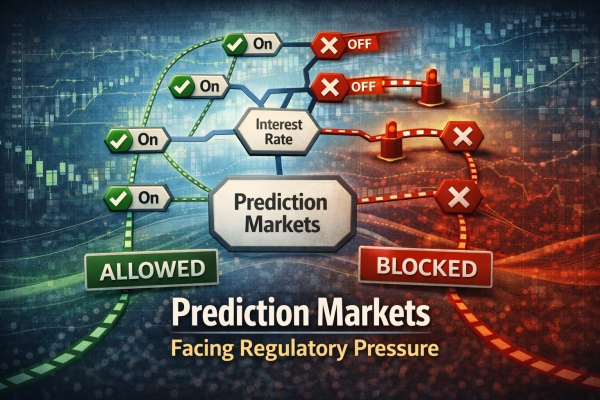
Sports volume built the business. Now rules, surveillance, and product limits will decide who lasts. On March 23, 2026, a bipartisan Senate bill moved to ban sports and casino style contracts on CFTC registered prediction market venues. The Senate release said a March Madness winner contract had already passed $100M in trading volume and that Super Bowl prediction market volume topped $1B in 2026.
Those numbers explain why prediction markets are now under direct pressure from lawmakers. Prediction markets are no longer fringe. They now sit in a fight over who regulates them, which contracts stay allowed, and whether the business still works under tighter rules.
Sports helped prediction markets reach a wide audience fast, but that same growth put them in direct competition with state regulated sportsbooks and tribal gaming interests. The Prediction Market Senate bill to ban sports contracts is aimed straight at that overlap. It would prohibit any CFTC registered entity from listing contracts that closely resemble a sports bet or a casino style game. If it advances, sports contracts would be the first part of the business to take a hit. That in itself wouldn't kill prediction markets, but it would force a reset around contracts that look more like economic, financial, or commercial forecasting and less like entertainment wagering.
Sports contracts brought scale, attention, and league partnerships. NCFA looked at that earlier when the NHL partnered with Kalshi and Polymarket. Sports now look like the part of the business most likely to trigger a stronger federal and state response.
Polymarket and Kalshi tightened their controls on the same day. On March 23, Polymarket tightened its market integrity rules across both its DeFi venue and its CFTC regulated US exchange. The updated rules ban trading on stolen confidential information, illegal tips, and outcomes a trader can influence.
Kalshi added candidate and athlete trading bans covering political candidates, athletes, referees, coaches, and team staff, and introduced a whistleblower feature to tighten insider risk controls.
These aren't minor changes. They prove Kalshi and Polymarket understand that insider risk is now a live issue. Prediction markets want to be treated as financial infrastructure, but financial infrastructure has to show it can police insiders, document rules, and respond fast when abuse appears. NCFA covered that tension earlier when prediction markets started pricing geopolitical events.
Canada is taking a narrower approach. The Globe and Mail reported today that Wealthsimple cleared a regulatory hurdle to offer forecast contracts in Canada, but only for economic indicators, financial markets, and climate trends. Sports and election contracts are out. Wealthsimple is the second firm to receive this approval in Canada, after Interactive Brokers Canada.
Interactive Brokers Canada has positioned contracts around government, economic, finance, and climate events, not sports books in a different wrapper. The product is already live in Canada on that basis.
Wealthsimple now brings local retail distribution, stronger brand reach, and a better chance of testing whether forecast contracts can find a market here without leaning on the sports volume that pushed the US fight into the open.
Can a prediction market still grow once sports contracts face a ban, insider screening gets tighter, and compliance costs rise? Some firms may adapt by leaning into macro, rates, inflation, climate, earnings, and other information markets. Others may find that the most profitable contracts were also the ones most likely to trigger a crackdown.
The CFTC is also reviewing the rules. On March 12 2026, the CFTC opened an Advance Notice of Proposed Rulemaking on prediction markets and asked for public comment on which event contracts may be contrary to the public interest, how current rules apply, and what changes may be needed. That means this fight is not limited to one Senate bill or one week of headlines. The federal rule in the U.S. is now under review.
For Canadian dealers, fintechs, and market operators, there is room to build forecast products here, but the lane is narrower than in the US.
Prediction markets already proved they can attract users and volume. The next test is whether prediction markets can still grow once product limits tighten, regulators draw a harder line around what is allowed, and compliance demands rise.
The National Crowdfunding & Fintech Association (NCFA Canada) is a financial innovation ecosystem that provides education, market intelligence, industry stewardship, networking and funding opportunities and services to thousands of community members and works closely with industry, government, partners and affiliates to create a vibrant and innovative fintech and funding industry in Canada. Decentralized and distributed, NCFA is engaged with global stakeholders and helps incubate projects and investment in fintech, alternative finance, crowdfunding, peer-to-peer finance, payments, digital assets and tokens, artificial intelligence, blockchain, cryptocurrency, regtech, and insurtech sectors. Join Canada's Fintech & Funding Community today FREE! Or become a contributing member and get perks. For more information, please visit: www.ncfacanada.org
| | |
|---|---|---|
| | |
March 24, 2026
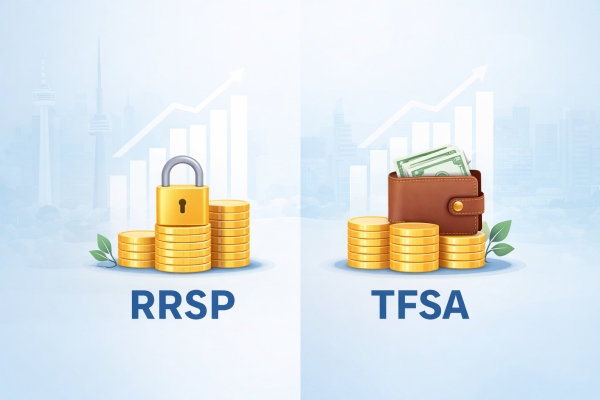
If you're a high-earning Canadian trying to build wealth, you've likely been told to "max out your RRSP" or "use your TFSA first." The advice often sounds definitive - but rarely accounts for your actual situation. Both accounts offer powerful tax advantages, yet they work in fundamentally different ways. Choosing between them isn't just a tax question; it's a behavioral and strategic one that depends on your income trajectory, spending patterns, and psychological relationship with money.
Understanding how RRSPs and TFSAs actually function - and how your brain responds to each - can help you make smarter decisions that stick.
The Registered Retirement Savings Plan (RRSP) is a tax-deferred account. Contributions reduce your taxable income in the year you make them, and your investments grow tax-free inside the account. You pay tax only when you withdraw, ideally in retirement when your income - and tax rate - are lower. For 2024, the contribution limit is 18% of your previous year's earned income, up to $31,560. [1]
The Tax-Free Savings Account (TFSA) works differently. You contribute with after-tax dollars - no immediate deduction - but all growth and withdrawals are completely tax-free, forever. The 2024 contribution limit is $7,000, with cumulative room of $95,000 if you've been eligible since the TFSA launched in 2009. [2]
Both accounts shelter investment gains from annual taxation, which is their shared superpower. The difference lies in when you pay tax and how withdrawals affect your future finances.
The classic rule of thumb: if your tax rate is higher now than it will be in retirement, the RRSP wins. If your rate will be the same or higher later, the TFSA is better. [3]
For high earning $150,000+ in provinces like Ontario, the combined federal-provincial marginal rate can exceed 43%. [4] An RRSP contribution at that rate delivers an immediate, substantial tax refund. If you withdraw in retirement at a 30% rate, you've effectively earned a permanent tax arbitrage.
But here's where it gets nuanced. RRSP withdrawals count as income, which can trigger clawbacks of Old Age Security (OAS) benefits and affect other income-tested programs. The OAS recovery tax kicks in once your income exceeds approximately $90,000, reducing benefits by 15 cents for every dollar over the threshold. [5]
TFSA withdrawals, by contrast, are invisible to the tax system. They don't affect OAS, GIS, or any means-tested benefit. For retirees who want flexibility and predictability, this can be worth more than the upfront RRSP deduction. [6]
Tax optimization assumes you'll actually invest the RRSP refund - not spend it. Research on windfall spending shows that unexpected money, including tax refunds, is often treated as "found money" and spent rather than saved. [7]
If you contribute $10,000 to your RRSP and receive a $4,000 refund, the math only works if that $4,000 goes back into investments. If it funds a vacation or lifestyle upgrade, you've diluted the RRSP's advantage significantly.
There's also the mental accounting problem. Behavioral research shows that people treat money differently depending on which "mental account" it sits in. [8] RRSP funds feel locked away (and largely are, due to withholding taxes on early withdrawal), which can be protective. TFSA funds feel more accessible, which can lead to premature withdrawals for non-emergencies.
Research from the Financial Consumer Agency of Canada found that many TFSA holders use their accounts primarily for short-term savings rather than long-term investing - missing the compounding benefits the account was designed for. [9]
Rather than treating this as an either/or question, most HENRYs benefit from using both accounts strategically. Here's a simplified decision framework:
Prioritize RRSP when: your marginal tax rate is high (above 40%), you're confident your retirement rate will be lower, and you have the discipline to reinvest the refund. Also consider RRSP contributions if you're planning to use the Home Buyers' Plan (HBP), which allows first-time buyers to withdraw up to $60,000 tax-free for a home purchase. [10]
Prioritize TFSA when: you're in a lower tax bracket now but expect higher earnings later, you want flexibility for mid-life goals (since withdrawals don't trigger tax or penalties), or you're already maximizing RRSP contributions and have additional savings capacity.
Use both when: you can afford to maximize contributions to each. The combined annual room (RRSP + TFSA + the newer FHSA for first-time home buyers) can exceed $40,000 - a powerful wealth-building engine if used consistently. [11]
Contributing to RRSP in a low-income year. If you're between jobs or earning less than usual, the deduction is worth less. Consider contributing to your TFSA instead and saving RRSP room for higher-earning years.
Ignoring employer matching. If your employer offers RRSP matching, that's an immediate 50–100% return on your contribution. Always capture the full match before directing money elsewhere.
Using TFSA as a savings account. Parking TFSA funds in a low-interest savings account wastes the tax shelter. Long-term data shows that diversified equity portfolios dramatically outperform cash over decades - and the TFSA's tax-free growth makes it ideal for higher-return investments. [12]
Over-contributing. The CRA charges a 1% monthly penalty on excess TFSA contributions. Track your room carefully, especially if you've made withdrawals (which restore room the following year, not immediately).
How PsyFi helps you optimize - and stick with - your strategy
Knowing the difference between RRSPs and TFSAs is one thing. Consistently making the right contributions - and avoiding the behavioral traps that derail good intentions - is another.
Personalized nudges: Reminders to contribute before deadlines, prompts to reinvest refunds, and alerts when you're approaching contribution limits.
Behavioral insights: Understand your money personality and how it affects decisions like "Should I tap my TFSA for this expense?"
Progress tracking: See how your registered accounts are growing over time, with visual cues that reinforce consistent behavior.
The best tax strategy is the one you actually follow. https://www.psyfiapp.com/ helps make that easier.
3: https://www.wealthsimple.com/en-ca/learn/rrsp-vs-tfsa
4: https://www.taxtips.ca/taxrates/on.htm
6: https://www.wealthsimple.com/en-ca/learn/oas-clawback-explained
7: https://www.nber.org/digest/mar09/did-2008-tax-rebates-stimulate-spending
8: https://www.behavioraleconomics.com/resources/mini-encyclopedia-of-be/mental-accounting/
12: https://www.rbcgam.com/en/ca/learn-plan/investment-basics/the-hidden-cost-of-too-much-cash/detail
The National Crowdfunding & Fintech Association (NCFA Canada) is a financial innovation ecosystem that provides education, market intelligence, industry stewardship, networking and funding opportunities and services to thousands of community members and works closely with industry, government, partners and affiliates to create a vibrant and innovative fintech and funding industry in Canada. Decentralized and distributed, NCFA is engaged with global stakeholders and helps incubate projects and investment in fintech, alternative finance, crowdfunding, peer-to-peer finance, payments, digital assets and tokens, artificial intelligence, blockchain, cryptocurrency, regtech, and insurtech sectors. Join Canada's Fintech & Funding Community today FREE! Or become a contributing member and get perks. For more information, please visit: www.ncfacanada.org
| | |
|---|---|---|
| | |
Mar 24, 2026 | NCFA Feature | AI Finance And Data Governance
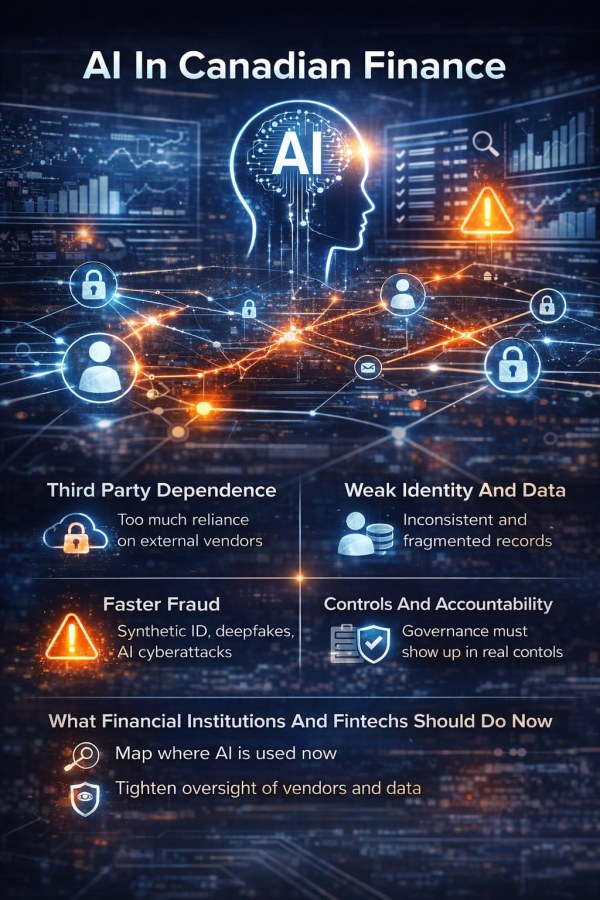
On Mar 23 2026, OSFI and the Global Risk Institute published the FIFAI II final report based on four workshops held between May and November 2025. More than 170 participants took part across banks, insurers, asset managers, fintechs, vendors, regulators, academics, and consumer voices.
The report confirms that AI adoption is here, citing 72% AI use at work in financial services and 75% organizational support for AI. While AI is already in use. The real issue is what still limits its use in regulated decisions and customer outcomes.
The series covered four areas that affect operational, prudential, consumer, and system-wide risk at the same time. Full report and framework: FIFAI II final report and AGILE framework PDF
One of the clearest takeaways is that AI will not spread across finance at the same speed. The first gains will come in internal functions such as fraud detection, surveillance, reporting, cyber defence, and operations. Those areas already have strong data, measurable outputs, and clearer accountability.
Customer-facing decisions are different. Underwriting, advice, product recommendations, and self-serve tools carry more pressure around explainability, fairness, consent, and complaints handling.
AI powered Canadian finance will likely grow faster in control functions than in customer-facing decisions.
The report treats third party AI as more than a procurement issue. It highlights growing dependence on external providers for models, infrastructure, and data, along with limited visibility into how those systems work and who sits behind them.
It's important because a failure, outage, or change in access at one provider can affect more than one function at the same time. Fraud controls, underwriting tools, customer service, and risk monitoring can all be exposed together. The financial stability workshop adds to that concern by linking third party dependency to concentration and system level risk.
Banks, insurers, and fintechs will need stronger oversight of models and providers, better audit access, tested fallback plans, and clearer visibility into the wider supply chain behind key AI services.
AI is improving both offence and defence. The final report points to synthetic identity, deepfakes, voice spoofing, AI assisted cyberattacks, fraud as a service, and disinformation. It notes a sharp rise in deepfake attacks and growing concern about voice verification as AI voice cloning improves.
This reality changes the operating environment. Static controls lose value faster when attack tools get cheaper, stronger, and easier to use. Manual review and occasional rule updates will not be enough. Firms will need faster detection, stronger identity controls, better information sharing, and systems that can adjust while attacks are happening.
Data problems come up across the whole series, but the larger issue is bigger than data quality alone. Weak identity and fragmented data still limit how far AI can go in regulated finance. The report points to inconsistent data, incomplete records, fragmented platforms, offshore storage concerns, and weak data lineage as barriers to both efficiency and safety.
The report doesn't mince words on identity. Canada still doesn't have a widely adopted secure digital identity layer. That leaves onboarding, authentication, consumer channels, remote work, and agent based systems more exposed than they should be. If identity and data remains weak, AI will keep working best in narrower internal use cases and face more limits in customer facing execution.
The final report introduces the AGILE framework as part of its overall findings, which stands for Awareness, Guardrails, Innovation, Learning, and Ecosystem Resiliency. The framework calls for stronger governance and oversight, stronger data and risk controls, continued investment in technology and talent, and deeper public private collaboration.
AI oversight cannot remain just at the strategy level. If AI is used in lending, fraud, underwriting, complaints, or customer recommendations, governance has to show up in controls, evidence, escalation, and accountability. In regulated finance, that's what turns AI use from experimentation into something firms can defend and scale.
The workshop series points to a practical sequence:
First, identify where AI already impacts decisions and controls.
Second, separate the use cases that can scale now from the ones that still need stronger explainability and customer safeguards.
Third, tighten vendor oversight before dependency grows further.
Fourth, invest more in identity, data lineage (origin and how it's used and updated), and real time fraud controls.
Fifth, show boards stronger evidence instead of high level claims and broad assurance language.
The report also carries a warning worth taking seriously. Firms that move too slowly can fall behind on productivity, resilience, and customer expectations while still facing external AI enabled threats. One participant line stands out: “The biggest risk is not doing enough.”
Canada’s national AI strategy work has focused heavily on trust, safety, and responsible adoption. That is necessary, but this workshop series adds something more useful for operators. It shows where AI use slows once it enters regulated finance: concentrated provider risk, weak identity, fragmented data, explainability pressure, fraud risk, and unclear accountability.
There's a call to action policy lesson here too. Canada doesn't just need AI ambition and adoption. It needs stronger execution layers around Digital ID, data governance, third party oversight, and information sharing if it wants regulated financial AI to scale beyond contained pilots.
The OSFI and GRI workshop series is useful because it takes a holistic approach to identifying and adapting to AI risks in finance. AI is already inside financial systems. The advantage now goes to firms that can prove control, trust, and accountability in live decisions.
The National Crowdfunding & Fintech Association (NCFA Canada) is a financial innovation ecosystem that provides education, market intelligence, industry stewardship, networking and funding opportunities and services to thousands of community members and works closely with industry, government, partners and affiliates to create a vibrant and innovative fintech and funding industry in Canada. Decentralized and distributed, NCFA is engaged with global stakeholders and helps incubate projects and investment in fintech, alternative finance, crowdfunding, peer-to-peer finance, payments, digital assets and tokens, artificial intelligence, blockchain, cryptocurrency, regtech, and insurtech sectors. Join Canada's Fintech & Funding Community today FREE! Or become a contributing member and get perks. For more information, please visit: www.ncfacanada.org
| | |
|---|---|---|
| | |


August 26th, 2025

January 4th, 2024

June 1st, 2021

September 9th, 2020

July 9th, 2018

January 3rd, 2018

September 25th, 2017

June 20th, 2017

May 10th, 2017

December 14th, 2016