




Karsten Wenzlaff, Advisor
August 26th, 2025
Karsten Wenzlaff is a Crowdfunding and Fintech Expert from Germany. He is Secretary-General of Digit[...]


Competition | Oct 31, 2025

Today, the Competition Bureau of Canada released a new draft of "Anti-Competitive Conduct and Agreements Enforcement Guidelines" for the public and stakeholder consultation to be submitted by January 29, 2026. These guidelines are part of a larger effort to modernize how Canada enforces competition law, which directly affects fintechs, startups, and any business working to scale in today’s digital economy.
The proposed guidance updates how the Bureau will interpret and enforce sections 75 to 79 and 90.1 (see Competition Act text), including key areas such as:
- Refusals to deal and exclusive arrangements
- Market restrictions and tied selling
- Abuse of dominance
- Civil agreements between competitors that may restrict competition
It also consolidates older enforcement materials, including the now superseded 'Price Maintenance Guidelines' and 'Abuse of Dominance Guidelines' into a single updated document that reflects legislative amendments made between 2022 and 2025.
For fintechs, platform businesses, and other high-growth ventures, this kind of regulatory clarity matters. Whether you are entering a data-sharing agreement, challenging a gatekeeping incumbent, or navigating pricing structures, clearer enforcement guidance reduces ambiguity and legal exposure.
The draft guidelines account for several recent reforms to the Competition Act, including:
- A restructured test for abuse of dominance
- New scrutiny on certain business collaborations (even when parties are not direct competitors)
- An expanded ability for multiple provisions to apply in a single enforcement case
According to the Bureau, these updates are designed to reflect how competition issues appear in evolving markets, including digital services and platform ecosystems.
In prior consultations, public feedback has directly influenced how the Bureau created its final guidance, whether on wage-fixing, platform conduct, or innovation impacts. Stakeholder input has led to more usable, grounded enforcement tools that reflect market realities.
This consultation is substantive. If your business model depends on partnerships, licensing, data access, or competition with larger players, this consultation is worth your attention.
 The National Crowdfunding & Fintech Association (NCFA Canada) is a financial innovation ecosystem that provides education, market intelligence, industry stewardship, networking and funding opportunities and services to thousands of community members and works closely with industry, government, partners and affiliates to create aa vibrant and innovative fintech and funding industry in Canada. Decentralized and distributed, NCFA is engaged with global stakeholders and helps incubate projects and investment in fintech, alternative finance, crowdfunding, peer-to-peer finance, payments, digital assets and tokens, artificial intelligence, blockchain, cryptocurrency, regtech, and insurtech sectors. Join Canada's Fintech & Funding Community today FREE! Or become a contributing member and get perks. For more information, please visit: www.ncfacanada.org
 |  |  |
|---|---|---|
 |  |  |
Fintech | Oct 30, 2025
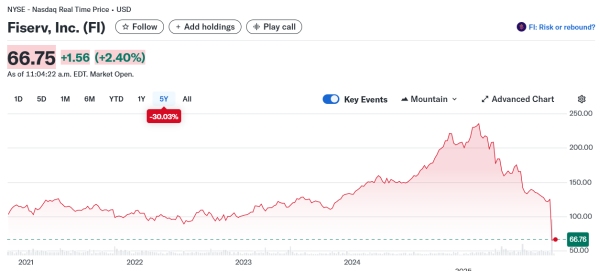
Image: Fiserv (FI) (Yahoo Finance Chart, Oct 31, 2025)
What triggered Fiserv’s record stock crash?
On October 29 2025, Fiserv Inc.’s stock plunged 44 percent in a single trading day after management sharply cut revenue and earnings forecasts. The Forbes report confirmed that guidance for full year organic revenue dropped to roughly 3.5% to 4.5% (down from 10%), and adjusted earnings per share fell to about $8.50 to $8.60 (previous range near $10.25).
Outlets called it the company's worst trading day on record, while Reuters reported that roughly $30 billion USD in market value was wiped out.
The Financial Times reported that some of Fiserv’s problems came from its business in Argentina. The company had invested heavily there to grow its payments and merchant services, but rising inflation and unstable policies hurt results.
Yahoo Finance verified that quarterly adjusted earnings were $2.04 per share on $4.92 billion in revenue, both falling short of analyst estimates, and that management’s revised guidance signalled weaker growth into 2026.
The speed and scale of the decline caught analysts off guard and the abrupt reversal in management guidance spooked investor confidence more than the revenue miss itself.
The credibility hit reflects a governance gap and not a market anomaly. Canadian financial institutions face a similar risk. When boards and risk teams depend too much on vendors’ optimistic projections, they can be caught off guard when results fall short. Honest forecasts, active oversight, and clear accountability are essential to maintain trust.
The slowdown of Fiserv’s merchant processing as noted by Reuters, raised red flags because it showed how much of the global financial ecosystem depends on a handful of vendors for core services.
Canadian credit unions and regional banks operate within similar limits, relying on few providers for payments, fraud monitoring, and digital banking infrastructure. A major vendor’s disruption could ripple through daily operations.
Fintechs should avoid relying on a single provider for critical services. Where possible, they should use multiple vendors or include clear backup and continuity plans in core contracts. A stable vendor network is now part of staying resilient, not just managing costs.
MarketWatch linked Fiserv’s current struggles to its 2019 First Data merger, which left the company with high debt and overlapping systems.
Many Canadian institutions are undergoing similar digital transformations. The Fiserv experience shows that modernization without aligned governance and risk planning can backfire.
Further with respect to Argentina, expanding into fast growing but unpredictable markets can look appealing, but without strong local plans and risk controls, it can backfire when conditions change.
Banks should aim to strike the balance between innovation, cutting costs, and building long term strength. Fintechs on the other hand need to be realistic and transparent with financial reporting and growth goals. Making promises that can’t be met damages trust faster than any technical problem.
Fiserv is undergoing a strategic reset. In a release, the Fiserv appointed Paul Todd as CFO effective October 31, named Takis Georgakopoulos and Dhivya Suryadevara as co-presidents effective December 1, and refreshed its board under new independent chair Gordon Nixon. Two directors will step down on January 1 2026 as part of a governance overhaul. Whether these measures restore confidence remains uncertain.
The National Crowdfunding & Fintech Association (NCFA Canada) is a financial innovation ecosystem that provides education, market intelligence, industry stewardship, networking and funding opportunities and services to thousands of community members and works closely with industry, government, partners and affiliates to create aa vibrant and innovative fintech and funding industry in Canada. Decentralized and distributed, NCFA is engaged with global stakeholders and helps incubate projects and investment in fintech, alternative finance, crowdfunding, peer-to-peer finance, payments, digital assets and tokens, artificial intelligence, blockchain, cryptocurrency, regtech, and insurtech sectors. Join Canada's Fintech & Funding Community today FREE! Or become a contributing member and get perks. For more information, please visit: www.ncfacanada.org
| | |
|---|---|---|
| | |
Oct 30, 2025

Estonia has become one of the most attractive EU hubs for crypto businesses: digital-first processes, e-Residency, and clear MiCA-aligned rules make it ideal for launching compliant exchanges, wallets and custody services.
Thanks to this, obtaining a crypto license in Estonia is profitable, fast, and legal.
Prifinance leverages this environment to deliver end-to-end support - from company formation and AML/KYC frameworks to regulatory communication and post-authorization compliance.
|
Advantages of working with Prifinance |
Numbers |
| Experience in international consulting | 30 years |
| Completed projects | 10,000+ |
| Crypto licenses obtained | 400+ |
| Supported jurisdictions | 40 |
| Successful cases on complex requirements (including MiCA) | 100+ |
| Lawyers, auditors, and consultants | 100+ |
This track record ensures brand reliability and practical experience when you scale in Europe.
A MiCA-compliant Estonian license (CASP/VASP) gives lawful access to the EU market with passporting rights, clear consumer protections, and harmonised reporting requirements. You need this license when your project: accepts fiat/crypto from users, offers custody or wallet services, executes crypto-to-fiat or crypto-to-crypto trades, processes remittances, or markets token sales to EU residents.
Beyond legal permission, the license demonstrates institutional-grade governance - strict KYC, continuous transaction monitoring, secure IT architecture, and appointed compliance officers - which improves access to banking, liquidity partners and institutional clients. These elements are crucial at launch and become non-negotiable as trading volumes, AML scrutiny, or institutional relationships grow.
Why Estonia - practical benefits
We prioritise your brand and market credibility from day one. That means not only preparing an application that satisfies regulators, but also shaping how counterparties and clients perceive you: professional legal structure, transparent ownership, robust compliance policies, auditor-ready documentation, and clear public-facing materials.
Our offering includes: company incorporation in Estonia, preparation of AML/KYC and internal control manuals, recruitment and registration of key personnel, technical security checklists, liaising with the FIU/FSA, and post-license support. By pairing compliance with marketable governance, we help your brand convert regulatory compliance into a competitive asset.
Prifinance works with major banking and fintech partners and maintains long-term relationships with thousands of international clients.
Our partners include leading financial and technology companies such as CIM Banque, Commerzbank, Payoneer, OCBC Bank, Binance, Mashreq, Odav Print, Montify, and Blockchain Life.
Our client feedback and case experience show smooth licensing processes and effective post-license support - a practical advantage when regulators request clarifications or audits.
Visit https://prifinance.com/en/cryptocurrency-license/ to request a tailored licensing plan, get a cost estimate, and start the application process: Prifinance provides full-cycle support for Estonia CASP/VASP applications and post-authorization compliance. Send a request through our site to receive a personalized proposal.
The National Crowdfunding & Fintech Association (NCFA Canada) is a financial innovation ecosystem that provides education, market intelligence, industry stewardship, networking and funding opportunities and services to thousands of community members and works closely with industry, government, partners and affiliates to create aa vibrant and innovative fintech and funding industry in Canada. Decentralized and distributed, NCFA is engaged with global stakeholders and helps incubate projects and investment in fintech, alternative finance, crowdfunding, peer-to-peer finance, payments, digital assets and tokens, artificial intelligence, blockchain, cryptocurrency, regtech, and insurtech sectors. Join Canada's Fintech & Funding Community today FREE! Or become a contributing member and get perks. For more information, please visit: www.ncfacanada.org
| | |
|---|---|---|
| | |
Regulation | Oct 27, 2025

Image courtesy of AI
On October 7, 2025, SEC Chair Paul Atkins talked about major changes to the Wells process in an SEC keynote address to the A A Sommer Jr Lecture at Fordham School of Law, including a new enforcement framework built around due process and transparency. Atkins described the Wells process as a safeguard that prevents the Commission from becoming “policeman, prosecutor, judge, and jury all in one.” He also emphasized that enforcement should focus on actual misconduct and investor harm rather than minor or technical violations.
The reforms include doubling the time allowed for responses, expanding access to testimony and investigative materials, and offering meetings with senior enforcement leadership before a recommendation is made. A BakerHostetler analysis and Dechert commentary confirm that these measures address years of criticism that the process was opaque, one-sided and unfair.
By aligning the Wells process with constitutional principles of fairness and proportionality, the SEC is signaling a more predictable approach that could encourage compliance and reduce costly disputes.
Few sectors highlight the importance of fair process more than digital assets. In 2024 and 2025, the SEC issued several Wells notices that dominated headlines and influenced global sentiment toward crypto markets (aka regulatory crackdown). NCFA covered how these actions impacted both perception and investment, such as the various Wells notices received that preceded litigation to Coinbase (March 2023), Robinhood (May 2024), and Uniswap Labs (April 2024), each becaming examples of what critics called “regulation by enforcement.”
The market reaction was usually immediate and swift. Share prices fell sharply after each announcement, venture funding slowed, and token listings became more conservative. The consistent theme across these cases was the lack of procedural clarity, leaving firms to interpret opaque standards that often changed after the fact. Not all inquiries ended with penalties. The SEC’s decision to close its stablecoin investigation in the Paxos BUSD (July 2024), suggested that avoiding enforcement was possible in limited cases.
Atkins planned changes come amid an administration that has declared support for digital assets and innovation and issued a series of policy reversals and case dismissals since taking office, including a full unconditional pardon for Binance founder, CZ most recently. The new government enacted the country's first comprehensive stablecoin law, the GENIUS Act, forming a statutory foundation for reserve-backed tokens. In February 2025, U.S. crypto czar Sacks outlined a coordinated plan for risk based supervision and technology neutral rules. Together these measures announced by the SEC signal a coordinated push by the administration toward fairness, predictability and genuine regulatory clarity.
Two weeks after Atkins’ address, as reported by Politico, the Trump administration announced plans to nominate Michael Selig as chair of the Commodity Futures Trading Commission who brings experience in digital asset policy and his focus on aligning derivatives oversight with technological modernization.
If confirmed, Selig’s appointment could enhance coordination between the CFTC and SEC on digital assets and tokenized products. A combined regulatory environment based on fairness, due process, and interagency cooperation that could stabilize U.S. market confidence after years of policy divergence and frustrated investors and innovators.
Regulatory predictability is essential for innovation and investment. When enforcement processes are clear and timelines are known, firms can allocate resources more effectively between compliance and product development (and not moving goal posts).
The Wells process reforms and the CFTC nomination together are clear signs that the days of regulating crypto by fear and enforcement are over. If implemented as anticipated, these policies could restore the trust between market participants and regulators, a prerequisite for sustainable capital formation. Impacted fintech leader should update internal playbooks to reflect the new Wells response timeline, including the opportunity for earlier meetings and white paper submissions.
Boards can establish governance protocols based on four week response periods and expect data-driven engagement with enforcement staff. For investors, a fairer U.S. digital asset environment could deepen capital pipelines and improve valuations in the digital finance sector.
For continued updates on regulatory developments and their implications for fintech and digital markets, subscribe to NCFA’s weekly newsletter for verified analysis and insights.
The National Crowdfunding & Fintech Association (NCFA Canada) is a financial innovation ecosystem that provides education, market intelligence, industry stewardship, networking and funding opportunities and services to thousands of community members and works closely with industry, government, partners and affiliates to create aa vibrant and innovative fintech and funding industry in Canada. Decentralized and distributed, NCFA is engaged with global stakeholders and helps incubate projects and investment in fintech, alternative finance, crowdfunding, peer-to-peer finance, payments, digital assets and tokens, artificial intelligence, blockchain, cryptocurrency, regtech, and insurtech sectors. Join Canada's Fintech & Funding Community today FREE! Or become a contributing member and get perks. For more information, please visit: www.ncfacanada.org
| | |
|---|---|---|
| | |
AI | Oct 27, 2025

Image: Introducing Vibe coding in Google AI Studio (Google Blog)
On October 26, 2025, Google announcing the intro of vibe coding in Google AI Studio, a new tool that lets developers and creators use artificial intelligence to speed up software development using a mix of natural language and code. The feature is available on Google’s Gemini models, which can understand text, images, and data all at once. The idea behind vibe coding is almost like a magical pill. That is turn a detailed description of what you want to build into a working app or prototype in minutes instead of weeks.
For fintech innovators, startups and established financial institutions, it sounds like a major breakthrough given they are constantly under the gun to launch new digital services quickly to remain relevant and competitive. Vibe coding tools in theory, could make it easier to create the latest innovative solutions without hiring expensive engineering teams. But the same qualities that make it fast and flexible also raise difficult questions about privacy, data handling, and reliability when used inside regulated environments.
Vibe coding was created for builders who want to experiment without having to code everything from scratch. Inside Google AI Studio, users can describe an idea and the system automatically produces the code and interface. It works for both experienced developers and business teams who may not have deep technical skills.
That accessibility and speed of 'idea-to-prototype' is what makes it so interesting for fintechs. A startup could create an interactive demo for investors or customers overnight. A mid-sized financial institution could use it to prototype internal compliance dashboards. Even regulators could use it to explore AI tools that help monitor market risks. The experience feels less like traditional coding and more like collaborating with a digital assistant that understands what you are trying to achieve.
Financial data is among the most sensitive information in any digital system. Google’s documentation for AI security on Google Cloud describes several layers of protection, including encryption, access control, and a zero data retention option that prevents user prompts or outputs from being stored for training. The company has also rolled out AI Protection service, which helps organizations monitor and control how their AI systems interact with code and data.
Those protections are encouraging, but they depend on how a company configures its environment. The free version of AI Studio likely won't include the same protections as enterprise deployments. Unless a fintech uses Google Cloud’s managed enterprise tools with clear data governance terms, prompts and logs could still be visible to Google’s systems. This means that even simple mistakes, such as entering customer information into a test prompt, could create compliance risks.
Canadian fintechs face additional expectations under PIPEDA, OSFI’s Cyber Risk Guidelines, and FINTRAC’s data-handling rules. Any platform that processes or even touches production data must comply with encryption standards, data residency, and audit requirements.
Tools like vibe coding should be treated as development sandboxes, not as live environments for real financial transactions or personal data.
The biggest concern is not Google’s infrastructure but how the tool is used. A recent security study referenced by TechRadar found that almost half of AI-generated code samples contained security flaws.
In the trenches of a financial system, even small weakness could expose customer accounts or transaction records. Because vibe coding relies on natural language, a poorly written prompt could create vulnerabilities with unintended code or API access. Read about demos versus production
Fintechs should assume that every piece of AI code generated needs to be reviewed by a real human and pass full security testing before it's deployed. Teams should separate test environments from live systems and avoid entering any confidential or regulated data into AI development tools. Also, the same rules that apply to cloud security and 3rd party vendor management should also be applied here.
Before experimenting with vibe coding for fintechs and financial institutions, companies should confirm that their account includes enterprise security controls and written commitments on data storage, encryption, and model training exclusions.
Developers should be trained to understand prompt hygiene and privacy responsibilities. Firms should also document where and how AI tools are used in the software development process to maintain compliance with internal and external audits.
For Canadian firms, the above security practices should align with OSFI’s guidance on 3rd party technology risks, which emphasizes focus on resilience, accountability, and transparency in AI systems.
As AI systems evolve and mature, the future points to a day where developers (or any visionary that can type a prompt) can build software solutions via conversations rather than code (the ultimate communicative wrapper).
But for companies that handle financial or personal data with real obligations, governance and risk management should be on high alert. If used responsibly and with greater advancements, vibe coding could lower the cost of innovation, help startups scale faster, and give established institutions more agility in how they design financial services. Want some inspiration? Check out Google's AI Studio app gallery.
The National Crowdfunding & Fintech Association (NCFA Canada) is a financial innovation ecosystem that provides education, market intelligence, industry stewardship, networking and funding opportunities and services to thousands of community members and works closely with industry, government, partners and affiliates to create aa vibrant and innovative fintech and funding industry in Canada. Decentralized and distributed, NCFA is engaged with global stakeholders and helps incubate projects and investment in fintech, alternative finance, crowdfunding, peer-to-peer finance, payments, digital assets and tokens, artificial intelligence, blockchain, cryptocurrency, regtech, and insurtech sectors. Join Canada's Fintech & Funding Community today FREE! Or become a contributing member and get perks. For more information, please visit: www.ncfacanada.org
| | |
|---|---|---|
| | |
Compliance Enforcement | Oct 24, 2025

Image: Freepik/Rawpixel.com
On October 16 2025, Reuters reported that the Financial Transactions and Reports Analysis Centre of Canada (FINTRAC) imposed a penalty of C$176,960,190 on Xeltox Enterprises Ltd., which operates as Cryptomus (formerly Certa Payments Ltd), for serious failures to file required reports under Canada’s anti-money-laundering regime. The decision was announced publicly on October 22 2025 after a compliance examination under the Proceeds of Crime (Money Laundering) and Terrorist Financing Act. FINTRAC described it as the largest penalty in its history.
FINTRAC found that Cryptomus failed to submit suspicious transaction reports on 1,068 separate occasions during July 2024 when there were reasonable grounds to suspect links to money laundering or terrorist activity financing. It also failed to comply with a Ministerial Directive, did not maintain or update written compliance policies approved by a senior officer, and failed to assess and document the risk of money-laundering offences within its operations.
The examination also revealed that Cryptomus did not file a notification of changes to its registration information and failed to report 1,518 large virtual-currency transactions above $10,000 in July 2024. These breaches were linked to laundering proceeds from crimes including child sexual abuse material, fraud, ransomware payments, and sanctions evasion. Cryptomus had already been barred by the British Columbia Securities Commission from securities trading earlier in 2025.
Sarah Paquet, Director and Chief Executive Officer, FINTRAC:
“We are committed to working with our domestic partners and international allies to protect the safety of Canadians and the security of Canada’s economy. Given that numerous violations in this case were connected to trafficking in child sexual abuse material, fraud, ransomware payments and sanctions evasion, FINTRAC was compelled to take this unprecedented enforcement action.”
FINTRAC confirmed that in 2024–25 it issued 23 Notices of Violation of non-compliance, the largest number in a single year since it received legislative authority to levy penalties in 2008. Those penalties totalled more than $25 million before the Cryptomus case. With enforcement ramping up, it appears the agency’s oversight is widening to include both traditional financial institutions and virtual asset service providers.
As FINTRAC noted in its statement, the rapid expansion of Canada’s virtual-currency sector also brings higher risks of money laundering, terrorist financing, and sanctions evasion. The agency said strong compliance frameworks are essential to protect Canadians and safeguard the financial system.
While the fine demonstrates that Canada can act decisively after a compliance failure, it also raises questions about how proactive oversight can become. FINTRAC’s review was retrospective, relying on an examination of past activity. With digital asset volumes growing and transactions moving across borders instantly, regulators need stronger real-time tools, data sharing systems, and cooperation between provincial, federal, and global agencies.
Effective supervision must keep pace with the speed and anonymity of crypto markets without discouraging legitimate fintech innovation. For the Canadian fintech community, understand that compliance is vital for sustained growth and is a competitive necessity. Firms that verify client identities, maintain risk assessments, and document transactions can not only avoid enforcement but also build trust with users and partners.
The National Crowdfunding & Fintech Association (NCFA Canada) is a financial innovation ecosystem that provides education, market intelligence, industry stewardship, networking and funding opportunities and services to thousands of community members and works closely with industry, government, partners and affiliates to create aa vibrant and innovative fintech and funding industry in Canada. Decentralized and distributed, NCFA is engaged with global stakeholders and helps incubate projects and investment in fintech, alternative finance, crowdfunding, peer-to-peer finance, payments, digital assets and tokens, artificial intelligence, blockchain, cryptocurrency, regtech, and insurtech sectors. Join Canada's Fintech & Funding Community today FREE! Or become a contributing member and get perks. For more information, please visit: www.ncfacanada.org
| | |
|---|---|---|
| | |
Crypto | Oct 24, 2025

Image courtesy of AI
On October 23, 2025, as reported by AP News U.S. President Donald Trump issued a full and unconditional pardon to Changpeng Zhao, a Canadian citizen and founder of Binance, the world’s largest crypto exchange. The decision cleared Zhao’s 2023 conviction under U.S. anti–money laundering and sanctions laws.
According to the White House, Trump “exercised his constitutional authority” to issue the pardon, describing Zhao’s prosecution as part of “the Biden Administration’s war on cryptocurrency.” The news arrived amid a record Bitcoin record high above $120,000 earlier in July, showing renewed investor optimism in the digital asset market.
The pardon comes as global regulators assess how to balance enforcement with innovation. For Canadian fintechs, it raises questions about regulatory predictability and competitiveness. Under the current U.S. administration, regulatory enforcement appears more forgiving toward large crypto platforms, which could influence global investment decisions.
In Canada, regulators fined Binance $6 million CAD for anti–money laundering violations and Binance compliance failures in Canada.
The pardon reintroduces uncertainty over how enforcement consistency (or inconsistency) impacts capital allocation and market trust. Transparent, consistent oversight is still vital to sustaining trust and access to global markets.
Zhao’s Canadian citizenship links Canada directly to one of the most influential figures in crypto. After serving nearly four months in prison and paying a $50 million fine, Zhao retained his stake in Binance while appointing Richard Teng as CEO.
In a statement, Zhao said he was “deeply grateful for today’s pardon and to President Trump for upholding America’s commitment to fairness, innovation, and justice,” adding that he would “do everything we can to help make America the Capital of Crypto.”
As the perceived regulatory risk lowers in the U.S. due to regulatory clarity, there's renewed optimism among institutional investors. For Canadian investors, a more predictable U.S. outlook could improve confidence in cross-border partnerships if compliance frameworks remain strong.
With the pardon now in place, Binance may renew expansion in the U.S. under current CEO Richard Teng who has emphasized compliance, transparency, and rebuilding trust with regulators worldwide. Analysts note that the pardon “could pave the way for the firm’s return and reintegration into the American market.”
The Trump pardon of Changpeng Zhao is another key moment in the global crypto narrative. For Canada, it highlights the importance of credible, consistent oversight as markets respond to pro-crypto U.S. policy signals. Renewed institutional attention to digital assets could open doors for compliant fintechs, but long-term success will depend on maintaining transparency, sound governance, and global coordination.
The National Crowdfunding & Fintech Association (NCFA Canada) is a financial innovation ecosystem that provides education, market intelligence, industry stewardship, networking and funding opportunities and services to thousands of community members and works closely with industry, government, partners and affiliates to create aa vibrant and innovative fintech and funding industry in Canada. Decentralized and distributed, NCFA is engaged with global stakeholders and helps incubate projects and investment in fintech, alternative finance, crowdfunding, peer-to-peer finance, payments, digital assets and tokens, artificial intelligence, blockchain, cryptocurrency, regtech, and insurtech sectors. Join Canada's Fintech & Funding Community today FREE! Or become a contributing member and get perks. For more information, please visit: www.ncfacanada.org
| | |
|---|---|---|
| | |


August 26th, 2025

January 4th, 2024

June 1st, 2021

September 9th, 2020

July 9th, 2018

January 3rd, 2018

September 25th, 2017

June 20th, 2017

May 10th, 2017

December 14th, 2016