




Karsten Wenzlaff, Advisor
August 26th, 2025
Karsten Wenzlaff is a Crowdfunding and Fintech Expert from Germany. He is Secretary-General of Digit[...]


AI Agent Research | Nov 10, 2025

Image: McKinsey and Google Cloud AI in Finance 2025 report covers
November 2025 research from McKinsey's The State of AI in 2025 and Google's The ROI of AI in Financial Services reveal that the way banks measure value from AI is changing. Instead of chasing fast gains from early generative tools, the financial sector is moving toward agentic AI platforms that produce steady operational returns and stronger control over risk and cost.
Google’s global financial services study found that 77% of firms report positive ROI from generative AI this year, matching last year’s figure. The data point indicates that the return base has stabilized after an initial surge (not stagnation or decline). Among responders reporting higher revenue, 51% saw growth (6%-10%), while 30% achieved gains above 10%. These numbers dipped slightly year over year, pointing to a normalization phase as programs scale.
The same study found that:
Spending priorities have shifted decisively:
McKinsey’s global findings confirm this rotation:
High performers stand out whose choices correlate directly with both revenue growth and cost reductions.
Benefits are appearing fastest in software engineering, IT, customer service, and marketing. The McKinsey report found that organizations deploying AI across these functions experienced:
• Average productivity gains of 15%-30% in service and technology teams
• Cost decreases of up to 12% in customer operations and risk processing
• Deployment cycles reduced to three to six months, down from an average of twelve months in 2023
• Revenue growth between 6%-10% for over half of financial institutions using AI in production
• Improved fraud detection accuracy by up to 20%, especially among banks integrating multi-agent risk models
Organizations combining workflow redesign with governance and human oversight achieve higher and more consistent ROI than those focused only on model performance.
According to Google and McKinsey's 2025 AI in finance research reports, AI has entered a new phase. The early boom in generative tools has given way to a steadier phase of operational performance driven by agents. The majority of institutions are already realizing returns, but the next iteration of value capture will come from how well they govern, measure, and scale these systems. Canada’s Opportunity In Efficient Reasoning AI its competitive edge, using discipline, design, and data to turn intelligence into growth.
 The National Crowdfunding & Fintech Association (NCFA Canada) is a financial innovation ecosystem that provides education, market intelligence, industry stewardship, networking and funding opportunities and services to thousands of community members and works closely with industry, government, partners and affiliates to create a vibrant and innovative fintech and funding industry in Canada. Decentralized and distributed, NCFA is engaged with global stakeholders and helps incubate projects and investment in fintech, alternative finance, crowdfunding, peer-to-peer finance, payments, digital assets and tokens, artificial intelligence, blockchain, cryptocurrency, regtech, and insurtech sectors. Join Canada's Fintech & Funding Community today FREE! Or become a contributing member and get perks. For more information, please visit: www.ncfacanada.org
 |  |  |
|---|---|---|
 |  |  |
Artificial Intelligence | Nov 7, 2025
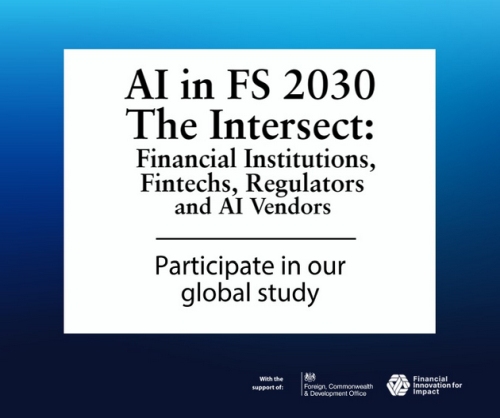
On November 4, 2025 the Cambridge Centre for Alternative Finance (CCAF) at Cambridge Judge Business School launched the AI in Financial Services 2030 Global Survey in collaboration with the World Bank, International Monetary Fund, Bank for International Settlements, and the World Economic Forum.
The National Crowdfunding & Fintech Association of Canada (NCFA) is happy to support this initiative as a survey partner inviting all professionals working in fintechs, banks, and other financial institutions to share their insights on how artificial intelligence is being planned, adopted, and managed across the sector. The survey takes about 25 minutes and explores governance, strategy, technology use, risk, and expectations for how AI will influence financial services by 2030.
This global initiative aims to build the most complete evidence base on AI’s real-world use in financial services. Findings will inform international policy and guide how innovation and regulation can support trust, access to capital, and sustainable growth.
By contributing, respondents will help ensure that fintech perspectives and diverse experiences are reflected in the data driving decisions at both policy and industry levels. The results will provide valuable benchmarks for AI adoption and readiness across different markets and institutions.
Take part in the Industry Survey for Fintechs and Financial Institutions: Access the AI in Financial Services 2030 Industry Survey
Other versions of the survey are available for regulators and AI vendors.
AI is moving incredibly fast, and this study gives everyone in the financial sector a chance to ground the conversation in real data and practical experience. By taking part, you’re helping ensure that future innovation in finance is guided by insight, accountability, and inclusion, values shared across the NCFA community.
The National Crowdfunding & Fintech Association (NCFA Canada) is a financial innovation ecosystem that provides education, market intelligence, industry stewardship, networking and funding opportunities and services to thousands of community members and works closely with industry, government, partners and affiliates to create a vibrant and innovative fintech and funding industry in Canada. Decentralized and distributed, NCFA is engaged with global stakeholders and helps incubate projects and investment in fintech, alternative finance, crowdfunding, peer-to-peer finance, payments, digital assets and tokens, artificial intelligence, blockchain, cryptocurrency, regtech, and insurtech sectors. Join Canada's Fintech & Funding Community today FREE! Or become a contributing member and get perks. For more information, please visit: www.ncfacanada.org
| | |
|---|---|---|
| | |
Federal Budget 2025 | Nov 5, 2025

Image courtesy of AI
On November 4, 2025, the Government of Canada tabled Budget 2025, announcing targeted investments in several fintech and related sectors of interest including open banking, digital assets, artificial intelligence, and venture capital to strengthen national competitiveness and expand innovation.
NCFA welcomes these measures that taken together, form a coordinated strategy to modernize Canada’s financial system and accelerate technology adoption across sectors. While there are many parts to the 493 page PDF document designed to modernize government, stimulate investment and support key sectors of the economy (especially those being adversely impacted by the weight of Washington's tariff policy), this article focuses on 6 select areas of the budget.
Budget 2025 confirms that Canada will move forward with the Consumer-Driven Banking Act to establish a national open banking framework. Oversight will rest with the Bank of Canada, which receives $19.3 million over two years to build and supervise the system. The $36.9 million previously allocated to the Financial Consumer Agency of Canada (FCAC) will be reprofiled to align with this transition. To support cybersecurity and national security functions, $25.7 million over five years and $5 million ongoing are provided to CSIS and the RCMP.
The government also commits that Canadians will not be subject to fees when accessing and sharing their financial data under the new regime. This right will be included in federal privacy legislation to protect consumers from banks charging for data portability.
Timeline:
The data access fee ban effectively aligns Canada with the UK and Australia, where accredited fintechs can access user-permitted financial data without paying incumbent banks, creating a more level playing field for startups.
Firms should focus on accreditation, API readiness, and user consent ecosystems now, while anticipating the full rollout with data portability and write-access functionality expected in 2027. The Bank of Canada’s new role brings institutional authority to open banking, aligning Canada’s model with prudential oversight practices seen in advanced financial systems.
Budget 2025 introduces a federal framework for fiat-backed stablecoins to protect consumers and ensure financial stability. Issuers must maintain adequate reserves, provide redemption rights, and follow strict disclosure and audit rules. The Bank of Canada will oversee compliance and receive $10 million over two years starting in 2026–27, with ongoing costs of about $5 million annually recovered from issuers. The Retail Payment Activities Act will be amended to extend oversight to payment service providers dealing in prescribed stablecoins.
This is Canada's first major step towards integrating digital assets within regulated finance. Fintechs and payment firms can soon align product design with national standards for reserve management and risk controls. The framework signals Canada’s preference for stablecoins backed by traditional assets and issued under domestic supervision, distinguishing it from more permissive global approaches.
Budget 2025 strengthens financial system integrity by modernizing the Proceeds of Crime (Money Laundering) and Terrorist Financing Act and the Personal Information Protection and Electronic Documents Act. The updates ban cash transactions over $10,000, prohibit third-party cash deposits, and authorize real-time information sharing through the new Integrated Money Laundering Intelligence Partnership. FINTRAC is added to the Financial Institutions Supervisory Committee, expanding coordination with the Bank of Canada, OSFI, and the Department of Finance.
This overhaul moves compliance toward continuous data exchange rather than static reporting. For regtech and fintech firms, it expands the market for monitoring, analytics, and automation tools. By embedding FINTRAC directly within the supervisory structure, the government is creating a multi-agency model similar to the UK’s Joint Money Laundering Intelligence Taskforce. These measures are foundational to supporting open banking and payments modernization safely.
Budget 2025 commits $925.6 million over five years starting in 2025–26 to build sovereign public AI infrastructure, including a Canadian sovereign cloud for compute capacity. Of this, $800 million comes from reallocated funds. The new Minister of Artificial Intelligence and Digital Innovation will coordinate partnerships with industry and direct investments through the Canada Infrastructure Bank. Statistics Canada receives $25 million over six years and $4.5 million ongoing for AI and digital measurement programs.
The budget also reforms the Scientific Research and Experimental Development (SR&ED) tax incentive. The annual enhanced credit limit rises from $4.5 million to $6 million, and companies can elect pre-claim approval for faster reimbursements, reducing average processing from 180 days to 90 days by April 2026.
This is the largest coordinated investment in Canada’s digital productivity to date. Sovereign compute and AI infrastructure will help domestic firms train and deploy large models while maintaining data residency. The SR&ED reform improves liquidity during tight capital cycles for startups, software developers, and AI ventures by accelerating access to refundable credits. These changes directly respond to longstanding calls from the innovation community for faster turnaround and broader eligibility for digital R&D.
To expand the growth capital ecosystem, Budget 2025 allocates $1 billion over three years starting in 2026–27 to the Business Development Bank of Canada (BDC) for the Venture and Growth Capital Catalyst Initiative. This fund will leverage pension and institutional investment to scale up Canadian venture capital and support new, diverse fund managers. Additional measures include:
These measures help close gaps between early-stage funding and commercialization. The Catalyst Initiative could attract more private capital into growth-stage companies, while IP and R&D supports strengthen Canada’s intangible economy. For fintechs, this capital mobilization aligns with efforts to improve scaling conditions, enabling firms to move beyond domestic pilots into global markets. By expanding the Canada Growth Fund Venture Program and the Venture Capital Catalyst Initiative, Ottawa is trying to fill the scale-up gap where private funding has been slow to follow through.
Budget 2025 targets long-standing consumer frustrations with high fees, slow transfers, and limited access to funds. The government will review ATM and Interac e-Transfer fees charged by federally regulated institutions and will report on corrective actions in 2026.
By spring 2026, the government will also ban investment and registered account transfer fees, which average $150 per account, and mandate faster, transparent transfers. Fintechs such as Wealthsimple and Questrade have supported these measures for years, arguing they will remove switching barriers and increase competition.
Consumer access to deposited funds will also improve. The Bank Act will be amended to raise immediate access for cheque deposits from $100 to $150, close the gap between in-person and digital deposits, and shorten cheque-hold times by raising the threshold for early release from $1,500 upward.
To strengthen competition, the public-holding threshold for smaller banks and credit unions will double from $2 billion to $4 billion, supported by a new voluntary code of conduct on brokered deposit access and fair distribution.
These reforms respond directly to public frustration with high account transfer costs, after firms like Wealthsimple and Questrade called for faster, cheaper asset portability. Lower fees, faster access to money, and easier account switching will force incumbents to compete on value. Fintech companies gain room to build better portability and payments solutions within a simpler and more open regulatory landscape.
Budget 2025 delivers the clearest roadmap for a more competitive financial services sector and digital economy. Open banking, AI, and venture capital measures finally intersect within a national policy framework designed to increase innovation and resilience. The obvious challenge now is delivery and execution. Timelines must hold, interoperability standards must stay open, and public-private coordination must translate funding into outcomes. Canada has a window to jump-start competitiveness by executing on what has already been announced rather than starting new consultations. The need is there. The foundation is set. It's now time to build and execute Canada.
Subscribe to NCFA Canada’s weekly newsletter for news, analysis and updates on fintech innovation, policy, and funding.
The National Crowdfunding & Fintech Association (NCFA Canada) is a financial innovation ecosystem that provides education, market intelligence, industry stewardship, networking and funding opportunities and services to thousands of community members and works closely with industry, government, partners and affiliates to create a vibrant and innovative fintech and funding industry in Canada. Decentralized and distributed, NCFA is engaged with global stakeholders and helps incubate projects and investment in fintech, alternative finance, crowdfunding, peer-to-peer finance, payments, digital assets and tokens, artificial intelligence, blockchain, cryptocurrency, regtech, and insurtech sectors. Join Canada's Fintech & Funding Community today FREE! Or become a contributing member and get perks. For more information, please visit: www.ncfacanada.org
| | |
|---|---|---|
| | |
Nov 6, 2025

Image: Freepik
Reviews on the internet can be the difference between success and failure for an organization. They have become a crucial part of how consumers evaluate and decide on brands. Each company should pay careful attention to online reviews.
The modern day consumer trusts online reviews just as much as personal suggestions. Positive feedback increases trust and attracts potential buyers. If you do not take care, negative reviews could damage your brand's reputation. Understanding how to handle reviews is essential to ensure online success.
Manually managing the reviews isn't easy and can become overwhelming. Nowadays, businesses use software for online review management. The tools collect reviews across multiple sites into one dashboard. They assist you in monitoring responses, analyzing, and responding to reviews efficiently.
A good software for online review management provides automation as well as real-time alerts. The software allows quick resolution of negative reviews and thank happy customers. The quick response will help ensure your reputation on the internet. All reviews being all in one location helps save time and energy which makes it simpler to identify trends and problems.
Advanced platforms can also provide analytics. They can show which topics pop on the top of their list, analyze customer sentiment, and highlight areas. Certain tools allow you to solicit new reviews from happy clients. The result is that your profile stays current and positive.
The reviews on websites are open and are permanent. Prospective customers frequently read reviews before making a decision. One bad review could turn away buyers, but the majority of positive reviews will boost sales. The company must concentrate on review management to safeguard their reputation.
Reviews provide feedback directly about the products as well as services. Companies can gain insight into what is working and improve upon. By responding to customer reviews, you show the value of customer reviews. This builds trust and increases trust and loyalty. The proper review management turns feedback into business growth.
Yotpo is the best alternative for managing reviews on the web. It comes with extensive features to allow review management simple and effective. Yotpo collects reviews from a variety of sources and puts them on one dashboard. Companies can effortlessly monitor the feedback, reply to it, and analyse all reviews.
Yotpo stands out due to its automation tools. It automatically requests reviews immediately after purchase, providing an ongoing flow of feedback. Yotpo lets you show reviews on your site which increases trust as well as increasing conversion rates. Yotpo's analytics tools allow you to keep track of customer sentiment and spot trends to help you make better business choices.
Integration integration with eCommerce platforms is easy. Yotpo connects to major shopping carts, which makes setting up simple. Yotpo's moderation functions help in removing fake as well as fake reviews.
There are many tools that offer Digital Reputation Management, but not all of them are created equal. Some tools focus on gathering feedback while others offer more comprehensive analytics. Yotpo offers both and provides complete tools to manage and review reviews.
Some tools might not have automation as well as real-time alerts. The result is slower responses to feedback that is negative. Yotpo's software for online review management has stood out due to its innovative features. Its integration and customization options makes it a good fit to fit any size business.
Yotpo is also an extensive moderation as well as reporting tools. This ensures that only genuine reviews are published and allow brands to assess the effects of review reviews on sales. Regarding online review management, Yotpo's comprehensive approach makes it the perfect choice for those seeking to increase and secure their reputation.
The Yotpo makes it easier to collect, organize and publish online reviews. It makes requests easier and accumulates reviews in one location. Brands are able to monitor reviews across platforms, respond rapidly, and then analyze patterns.
Yotpo's analytics aid in digital reputation management by tracking customer sentiment. The company's integration to eCommerce platforms as well as sophisticated moderation makes it different. Most businesses will find that Yotpo is the top choice of software for online review management.
The Trustpilot provides a reliable platform for collecting testimonials from actual customers. The dashboard is simple to use, and it provides the most basic analytics. Brands are able to reply to reviews directly, inciting greater engagement.
Trustpilot's platform for public use helps increase the transparency of digital reputation management. Customers can read real reviews and improve brand credibility.
The Birdeye collects reviews from more than 150 websites into one dashboard. The platform provides tools to monitor responses, soliciting review updates. Automated features allow brands to reduce time.
Birdeye's analytics and reports help with digital reputation management by identifying the trends that are most prevalent and those areas where there is room to improve. The user-friendly interface works for businesses of any size.
The Podium concentrates on helping businesses gather reviews through texts. This improves the rate of response and guarantees constant feedback. It also allows two-way communication for direct contact with the customer.
The Podium software for online review management offers sentiment analysis and reporting. These tools can help brands safeguard and boost their reputation online.
The ReviewTrackers consolidates reviews from different review sites. It provides instant notifications as well as an integrated dashboard which makes managing more productive. Brands can make use of analytics to identify problems and potential opportunities.
ReviewTrackers aids in digital reputation management by allowing prompt response to customer feedback. The features for tracking are beneficial in improving service reputation.
The Reputation.com offers enterprise-level software for online review management. It streamlines review requests and gathers feedback from different sources. Brands can make use of dashboards for monitoring sentiment and performance.
Their digital reputation management tools include analytics reports, analytics, as well as competitive benchmarking. Brands with large footprints as well as franchises reap in the most significant way from these functions.
The Sprout Social combines review management along with other social media tools. It organizes mentions, reviews as well as messages into one mailbox. Brands are able to interact with their users across multiple social media platforms.
The Sprout Social analytics aid in tracking online sentiment and also overall brand reputation. This is ideal for companies needing review or social management of media.
Google My Business lets brands control reviews appearing in the search results as well as maps. Businesses are able to reply to reviews and update their details effortlessly. It's completely free and widely utilized.
Even though it is basic, Google My Business remains essential to digital reputation management. Local companies especially profit from its reach as well as its simplicity.
The Grade.us can customize review campaigns for acquisition. Companies can manage requests via text messages and email. Its platform collects reviews from a variety of sites to allow an easy and efficient following.
Grade.us assists with digital reputation management by encouraging positive feedback and addressing negative reviews in the early stages. The company's reporting tools help brands measure the impact.
The Capterra is a specialist in reviews of software in helping B2B businesses build their credibility. Capterra is a safe place where customers can leave comprehensive reviews.
Capterra's software for online review management is easy to use but highly effective for both tech as well as SaaS companies. With its focus on transparency, it boosts digital reputation management in the software sector.
Yotpo is a leader in software for online review management using its integrated platform. Automated features collect reviews easily and ensure a constant supply of feedback. The integrated dashboard allows you to monitor and respond to reviews. Yotpo's analytics and moderation tools go beyond the basics of management and provide deep insight.
Yotpo's integration with the most popular eCommerce platforms gives it more versatility and scope. Companies can show trusted reviews in the areas where customers shop while also assisting with digital reputation management. The system's moderation makes sure that only real reviews are displayed, safeguarding your company from being sucked into spam or fake reviews.
Different platforms could offer comparable features, but Yotpo's blend with automation, analytics, and user-friendliness sets the platform distinct. If you're serious about expanding your business and securing their online presence, Yotpo is the clear top choice in software for online review management.
The management of online reviews is crucial for the business's success. It is essential to choose the right software for online review management for example, such as Yotpo helps streamline feedback and assists with digital reputation management. Through automation and analytics companies can increase trust as well as improve service and ensure a robust online reputation.
The National Crowdfunding & Fintech Association (NCFA Canada) is a financial innovation ecosystem that provides education, market intelligence, industry stewardship, networking and funding opportunities and services to thousands of community members and works closely with industry, government, partners and affiliates to create a vibrant and innovative fintech and funding industry in Canada. Decentralized and distributed, NCFA is engaged with global stakeholders and helps incubate projects and investment in fintech, alternative finance, crowdfunding, peer-to-peer finance, payments, digital assets and tokens, artificial intelligence, blockchain, cryptocurrency, regtech, and insurtech sectors. Join Canada's Fintech & Funding Community today FREE! Or become a contributing member and get perks. For more information, please visit: www.ncfacanada.org
| | |
|---|---|---|
| | |
Stablecoins | Nov 4, 2025

On October 28, 2025, Visa CEO Ryan McInerney told investors in a Visa Q4 earnings call (22 page PDF) that the company is adding support for four stablecoins operating on four distinct blockchains across two currencies, with conversion to more than 25 fiat currencies. He said Visa’s stablecoin-linked card spend has quadrupled over the past year, with monthly settlement volumes reaching an annualized $2.5 billion. So now we can all expect to have access to embedded digital currency settlement directly into its global treasury and FX systems.
Visa’s public Onchain Analytics Dashboard reports more than US $9.6 trillion in adjusted transaction volume, over 10 billion transactions, and an average stablecoin supply above US $221 billion across Ethereum, Solana, Polygon, and Avalanche. The numbers confirm that fiat-backed stablecoins are already a growing part of daily global payments.
Based on Visa’s earlier pilot programs using USDC on Ethereum and Solana, it is reasonable to expect these networks to be among the four blockchains involved, though earnings call transcript doesn't name specific stablecoins or chains.
Visa’s expansion is a transition from testing digital currency settlement to making it part of its core infrastructure. The company is linking stablecoins to its global treasury and FX networks, allowing conversion between digital assets and traditional currencies without adding new intermediaries. So stablecoins will become programmable tools for cross-border settlement and liquidity management.
Ryan McInerney, Visa CEO:
“We are adding support for four stablecoins, running on four unique blockchains, representing two currencies, that we can accept and convert to over 25 traditional fiat currencies. Our digital currency work builds on our core competencies — connecting buyers and sellers, securing payments, and enabling interoperability across currencies and networks.”
Fintechs and financial institutions should take notice because Visa is not just planning to accept stablecoins as a form of payment, it's building a bridge between regulated banking infrastructure and onchain finance. Visa’s integration also provides a compliance template that shows how large-scale financial networks can handle digital assets safely within existing frameworks.
Visa’s financial results strengthen the case why stablecoin settlement is strategically important. According to Visa’s investor materials, cross-border payment volume grew 10% year over year in Q4 2025, driven by travel and international eCommerce. Total revenue reached US $9.2 billion, up 9%, with payment volume increasing 8% on a constant-dollar basis.
Stablecoins fit naturally into this picture. They can move value instantly across borders, reducing settlement friction and costs for businesses that operate in multiple currencies. For enterprises, corporates, and fintechs, Visa’s model offers a regulated approach to use stablecoins for treasury, payroll, and remittances at scale.
Visa’s partnerships with digital wallets, neobanks, and blockchain platforms extend its reach into Web3 commerce while maintaining the dispute resolution and identity safeguards that make card networks trusted globally.
McInerney emphasized continued collaboration with policymakers and central banks to ensure that new payment models meet regulatory expectations while delivering tangible economic benefits.
For Canada, Visa's approach of blending real world payments with programmable finance is a framework offering lessons on how to connect open banking, digital money regulation, and cross-border innovation at scale and under clear governance.
The National Crowdfunding & Fintech Association (NCFA Canada) is a financial innovation ecosystem that provides education, market intelligence, industry stewardship, networking and funding opportunities and services to thousands of community members and works closely with industry, government, partners and affiliates to create a vibrant and innovative fintech and funding industry in Canada. Decentralized and distributed, NCFA is engaged with global stakeholders and helps incubate projects and investment in fintech, alternative finance, crowdfunding, peer-to-peer finance, payments, digital assets and tokens, artificial intelligence, blockchain, cryptocurrency, regtech, and insurtech sectors. Join Canada's Fintech & Funding Community today FREE! Or become a contributing member and get perks. For more information, please visit: www.ncfacanada.org
| | |
|---|---|---|
| | |
Banking Regulation | Nov 4, 2025

On November 3, 2025, Questrade officially entered the banking sector. The company received federal approval from the Office of the Superintendent of Financial Institutions to open Questbank, one of the few new Schedule I banks authorized in Canada in the past two decades. The approval was confirmed through the Canada Gazette publication of Questbank incorporation.
This is significant as Questrade evolves from an investment brokerage into a full service digital bank. It adds a new competitor to a market long dominated by Canada’s largest institutions and will hopefully advance innovation, inclusion, and national competitiveness in the country.
After six years of preparation, OSFI approved Questrade’s bank license on November 3 2025, granting an Order of Commencement and Carrying on of Business under the Bank Act. The approval allows Questbank to accept deposits and issue loans under federal oversight.
The decision aligns with priorities set out in the OSFI Strategic Plan 2024–2027, which focuses on stability and responsible modernization. Licensing a fintech type of institution signals that regulators are confident digital firms can meet Canada’s prudential standards while helping to diversify and strengthen the banking system.
A Bank of Canada study on market concentration shows that Canada’s Big Six control over 93% of total banking assets, one of the highest levels in the G7. This concentration limits competition and slows innovation. The entry of Questbank introduces a new competitor focused on digital experience, transparency, and affordability.
Current market data indicate that Questrade manages more than $85 billion in client assets, giving Questbank the scale to compete with mid-tier lenders from day one. Its digital first model could reduce overhead and improve pricing for both savers and borrowers. In a country where banking profits exceed $60 billion annually, new entrants are needed to expand access and encourage modernization.
For Canadians, the launch of Questbank could make it easier to manage money in one place. People who already invest through Questrade will be able to bank, borrow, and save using a single digital platform. This integration may lower fees and increase transparency.
For policymakers, the development shows both progress and remaining friction. Only a handful of Schedule I banks have launched since 2000, and the approval process remains lengthy (see Santander Bank 5 years to get license). A more flexible licensing approach could allow other qualified fintechs to join the system while maintaining strong oversight. Countries including the United Kingdom and Singapore have implemented phased authorization programs for digital banks, allowing limited early operations before full licensing. A similar framework in Canada could help attract investment and skilled talent while supporting responsible innovation.
Questrade’s success also underlines the importance of governance. The company’s record of compliance and consumer protection likely strengthened its application and sets a precedent for fintechs seeking federal status.
Questrade plans to roll out Questbank publicly in 2026, combining savings, lending, and investment services under one regulated brand. The achievement shows that innovation and oversight can advance together to build a more inclusive and efficient financial system.
It confirms that fintechs investing in trust, governance, and compliance can now better compete directly with established banks. Questrade’s path from brokerage to federally regulated institution offers a roadmap for how collaboration with regulators can fuel growth and improve Canada’s competitiveness in global finance.
Q: What exactly did OSFI approve on November 3 2025?
A: On that date, OSFI issued an Order of Commencement and Carrying on of Business, authorising Questbank to begin operations as a Schedule I bank under Canada’s Bank Act. Verified by Reuters reporting on November 3 2025.
Q: When was Questbank officially incorporated?
A: The federal government issued letters patent on March 29 2025, as published in the Canada Gazette.
Q: How large is Questrade’s current business?
A: The company manages more than CAD 85 billion in client assets, based on publicly reported data.
Q: Why is this move important for Canadian fintech?
A: Because Canada’s Big Six banks still control roughly 93% of banking assets, Questbank’s approval brings fresh competition and shows fintech innovation can thrive under federal regulation.
Image generated by AI
The National Crowdfunding & Fintech Association (NCFA Canada) is a financial innovation ecosystem that provides education, market intelligence, industry stewardship, networking and funding opportunities and services to thousands of community members and works closely with industry, government, partners and affiliates to create a vibrant and innovative fintech and funding industry in Canada. Decentralized and distributed, NCFA is engaged with global stakeholders and helps incubate projects and investment in fintech, alternative finance, crowdfunding, peer-to-peer finance, payments, digital assets and tokens, artificial intelligence, blockchain, cryptocurrency, regtech, and insurtech sectors. Join Canada's Fintech & Funding Community today FREE! Or become a contributing member and get perks. For more information, please visit: www.ncfacanada.org
| | |
|---|---|---|
| | |
AI Licensing | Nov 3, 2025

Image: Freepik/rawpixel.com
On October 31 2025, Getty Images and Perplexity announced a global multi-year agreement that gives Perplexity permission to display Getty’s creative and editorial photos within its AI search tools. The partnership uses Getty’s API to bring licensed images directly into Perplexity’s results with clear credits and links to the original source.
It’s one of the first major deals between an AI company and a content rights holder, an example of how licensing can help AI platforms respect creators while improving the quality of what users see.
Jessica Chan, Head of Content and Publisher Partnerships at Perplexity:
“Getty Images shares our belief that the future of AI‑powered discovery requires respecting the creators behind the content. Attribution and accuracy are fundamental to how people should understand the world in an age of AI"
Perplexity has faced several plagiarism and scraping allegations during the past year, including incidents involving Getty photos that appeared without license. The new agreement resolves those issues by providing legitimate access under clear terms.
Nick Unsworth, Vice President Strategic Development at Getty Images:
"This agreement paves the way for a productive and collaborative partnership between our companies, where we will work together to improve attribution of our contributors' work and Getty Images’ high‑quality creative and editorial content will enhance Perplexity’s platform.”
Attribution does not grant any rights, and any reuse or commercial application still requires a separate license from Getty Images. There is no indication of sublicensing or user-level permissions in any official material.
The Perplexity–Getty deal is a win-win where a structured licensing partnership can strengthen trust and reduce copyright exposure while improving the user experience. For Getty, the deal adds a new business stream in AI search.
For Perplexity, it helps rebuild credibility after a year of public criticism while following through on stronger commitment to transparency and proper credit for creators. This partnership also builds on the company’s earlier initiative to share value with content creators through its 80/20 revenue-sharing program for publishers.
Being transparent about where information comes from builds confidence with users and regulators. As Canada develops its own rules for AI and copyright, partnerships like this one show how respecting creators can go hand in hand with innovation.
The National Crowdfunding & Fintech Association (NCFA Canada) is a financial innovation ecosystem that provides education, market intelligence, industry stewardship, networking and funding opportunities and services to thousands of community members and works closely with industry, government, partners and affiliates to create a vibrant and innovative fintech and funding industry in Canada. Decentralized and distributed, NCFA is engaged with global stakeholders and helps incubate projects and investment in fintech, alternative finance, crowdfunding, peer-to-peer finance, payments, digital assets and tokens, artificial intelligence, blockchain, cryptocurrency, regtech, and insurtech sectors. Join Canada's Fintech & Funding Community today FREE! Or become a contributing member and get perks. For more information, please visit: www.ncfacanada.org
| | |
|---|---|---|
| | |


August 26th, 2025

January 4th, 2024

June 1st, 2021

September 9th, 2020

July 9th, 2018

January 3rd, 2018

September 25th, 2017

June 20th, 2017

May 10th, 2017

December 14th, 2016