




Karsten Wenzlaff, Advisor
August 26th, 2025
Karsten Wenzlaff is a Crowdfunding and Fintech Expert from Germany. He is Secretary-General of Digit[...]


Nov 18, 2025

Image: Pexels/Ark Films, Toronto skyline at night
Online casinos have become a major part of Canada’s entertainment landscape. Millions of Canadians now enjoy digital slot machines, poker tables, and live dealer games from their personal devices. But what many players don’t realize is that Canada’s online gambling industry operates under some of the strictest regulations in the world.
Far from being a “wild west,” the Canadian online casino market is built on a foundation of consumer protection, fairness, and transparency. These strict on online casino Canada ensures that every spin, shuffle, or bet happens in a secure and trustworthy environment.
In this guide, we’ll break down what these regulations mean, who enforces them, and how they protect you as a player.
Canada’s approach to online gambling is unique. There’s no single federal law that governs all online casinos. Instead, regulation largely happens at the provincial level, meaning each province decides how it handles online gambling within its borders.
For example, Ontario has its own regulated market managed by iGaming Ontario, launched in 2022. It allows private operators to apply for licenses and offer online casino games under strict oversight. British Columbia, Quebec, and Manitoba operate their own government-run casino platforms. Other provinces rely on offshore operators but still encourage players to choose licensed, responsible sites.
While the rules vary, the underlying goal is the same across Canada, to protect players and ensure fair, responsible gaming.
Online casinos that want to legally operate in Canada must obtain proper licensing and comply with rigorous standards. In Ontario, that means approval from both the Alcohol and Gaming Commission of Ontario (AGCO) and iGaming Ontario.
To receive a license, an operator must meet requirements. That covers financial stability, where Casinos must prove they have the financial resources to operate responsibly and pay winnings promptly. Fair gaming systems, where every game must use Random Number Generator (RNG) technology tested by independent labs like eCOGRA or GLI to ensure outcomes are truly random.
Data protection is a key aspect as operators must use advanced encryption and cybersecurity measures to safeguard player information. There needs to be Responsible gambling tools, as Licensed casinos must offer deposit limits, time-outs, and self-exclusion options to prevent problem gambling. Lastly there needs to advertising ethics. Marketing must be honest, age-appropriate, and never target vulnerable or underage individuals.
In other provinces, government-operated casinos follow similar standards, even if the licensing structure looks different. The consistent theme across all systems is player safety and fairness above profit.
One of the most important rules Canadian online casinos must follow is verifying who’s playing. Every legal platform requires users to prove their age and identity before gambling.
Players must be at least 19 years old in most provinces (18 in Alberta, Manitoba, and Quebec). During registration, casinos use secure digital verification tools to confirm a player’s age, location, and identity.
This system isn’t just about legality; it’s also about protecting consumers from fraud and preventing minors from gambling online.
Canadian regulators take responsible gambling extremely seriously. Licensed casinos must promote healthy gaming habits and actively help players stay in control.
Some of the standard responsible-gaming requirements include:
These measures aren’t optional; they’re built into the framework of every approved online casino in Canada.
Fairness is at the core of any trustworthy online casino. To be approved in Canada, all casino games must undergo independent testing before they go live. The key to providing fair chances is through the use of Random Number generators (RNGs) as they produce unpredictable outcomes meaning that there are no patterns in any shuffles or outcomes.
Additionally, casinos must publish the Return to Player (RTP) percentage of each game. RTP shows the long-term average payout rate, for instance, a slot with an RTP of 96% pays back an average of $96 for every $100 wagered over time. By law, this information must be transparent and accessible to players.
Canada’s strict gambling regulations also focus on financial integrity and security. Licensed operators must comply with federal anti-money laundering laws overseen by the Financial Transactions and Reports Analysis Centre of Canada (FINTRAC).
This means casinos must Verify the source of funds used by players, Monitor transactions for suspicious activity and report large or unusual payments.
Combined with advanced encryption technologies (such as SSL), these measures ensure that both player funds and personal data remain protected.
Transparency doesn’t stop at licensing. Canadian regulators actively monitor licensed casinos and provide avenues for player complaints.
If a player believes a game was unfair or a payout delayed, they can file a complaint directly with the regulatory body, such as AGCO in Ontario. Regulators have the authority to audit casinos, issue fines, or even revoke licenses if an operator fails to comply with the rules.
This level of oversight is what keeps the industry accountable and gives players peace of mind when choosing a Canadian-licensed casino.
The strict requirements placed on Canada’s online casinos aren’t there to make things harder, they exist to protect players and maintain trust. In an era where digital entertainment is growing rapidly, these safeguards ensure that Canadian players can enjoy casino games safely, knowing they’re treated fairly, and their money is secure.
By choosing a licensed Canadian online casino, you are not just playing a game, you are supporting a transparent, well-regulated industry that values integrity and responsibly.
 The National Crowdfunding & Fintech Association (NCFA Canada) is a financial innovation ecosystem that provides education, market intelligence, industry stewardship, networking and funding opportunities and services to thousands of community members and works closely with industry, government, partners and affiliates to create a vibrant and innovative fintech and funding industry in Canada. Decentralized and distributed, NCFA is engaged with global stakeholders and helps incubate projects and investment in fintech, alternative finance, crowdfunding, peer-to-peer finance, payments, digital assets and tokens, artificial intelligence, blockchain, cryptocurrency, regtech, and insurtech sectors. Join Canada's Fintech & Funding Community today FREE! Or become a contributing member and get perks. For more information, please visit: www.ncfacanada.org
 |  |  |
|---|---|---|
 |  |  |
Stablecoin Regulations | Nov 17, 2025

AI generated image
On November 10 2025, the Bank of England released a proposed regulatory regime for sterling denominated systemic stablecoins for consultation. The paper explains how large scale issuers designated as systemic would be required to back customer balances, manage reserves and operate safely within the United Kingdom financial system. These rules apply only when HM Treasury designates an issuer as systemic.
Smaller issuers remain active in the market under the Financial Conduct Authority rules and may transition into the systemic framework if they grow to a scale that could influence the wider financial system.
The consultation is the most detailed update to United Kingdom stablecoin policy since HM Treasury released draft cryptoasset legislation in April 2025, and establishes a clear structure for how systemic digital money could function safely in day to day payments.
The consultation explains how systemic stablecoins must be backed and why this structure matters for safety in everyday payments. Issuers must hold at least 40% of reserves as deposits at the Bank of England. The remaining portion, up to 60%, can be invested in short term United Kingdom government securities. This mix offers strong protection and keeps the reserve simple and transparent.
The Bank of England also outlines a transition period for new issuers. In the early stages, they may place up to 95% of backing assets in government debt before moving toward the long term structure. This step is meant to support early growth while maintaining a high level of safety.
All backing assets must sit in a statutory trust that always matches the value of coins in circulation. This requirement protects customer funds and reduces the risk of shortfalls during periods of stress. It also creates a clear line between the issuer’s own balance sheet and the assets that support the stablecoin.
The proposed regime introduces requirements for how backing assets are held and protected. The consultation sets out the expectation that backing assets sit in a segregated trust structure with protections similar to client asset rules. This mix of central bank deposits and short term government securities is intended to provide strong protection for customer funds while allowing issuers to generate modest returns needed to support operations.
Institutions holding backing assets would also need to meet operational resilience standards and demonstrate they can respond to stress conditions without interruption to customer redemptions.
Systemic stablecoin issuers would operate under prudential requirements similar to other payment system operators. The consultation notes that the Bank of England would supervise major issuers to ensure continuing safety, strong risk controls and effective recovery planning.
The focus is on preventing operational failure in a systemically important payment instrument. The combination of required reserve composition and Bank of England supervision is designed to manage the risks associated with large scale issuance of digital money in everyday payments.
Issuers that reach systemic scale would be supervised in the same framework applied to other major payment firms. The regime outlines how stablecoins can connect to payment rails in the United Kingdom while meeting resilience expectations. The Bank of England highlights the importance of maintaining continuity of payments even during stress events, which is a central consideration in the proposed framework.
The Bank of England is accepting written submissions on the consultation. Responses can be provided directly through the consultation portal hosted by the Bank of England.
The consultation is a major advancement toward integrating large scale stablecoins into the formal financial system. It provides clear expectations for how issuers can operate safely with trusted backing, operational resilience and strong central bank supervision while supporting innovation in payments.
Canada continues to develop its own approach to digital assets and stablecoin oversight. The Retail Payment Activities Act is already in effect and sets expectations for payment service providers. Budget 2025 confirmed that federal authorities are developing a national framework for stablecoins and the Bank of Canada will administer it with publication expected in 2026. As other jurisdictions advance their own frameworks, coordinated and transparent regulation will remain important for financial stability and consumer protection.
The National Crowdfunding & Fintech Association (NCFA Canada) is a financial innovation ecosystem that provides education, market intelligence, industry stewardship, networking and funding opportunities and services to thousands of community members and works closely with industry, government, partners and affiliates to create a vibrant and innovative fintech and funding industry in Canada. Decentralized and distributed, NCFA is engaged with global stakeholders and helps incubate projects and investment in fintech, alternative finance, crowdfunding, peer-to-peer finance, payments, digital assets and tokens, artificial intelligence, blockchain, cryptocurrency, regtech, and insurtech sectors. Join Canada's Fintech & Funding Community today FREE! Or become a contributing member and get perks. For more information, please visit: www.ncfacanada.org
| | |
|---|---|---|
| | |
AI Innovation | Nov 17, 2025

AI generated image
On November 13 2025, OpenAI launched group chats in ChatGPT, a pilot feature that allows multiple users and ChatGPT to share one conversation in pursuit of 'shared intelligence'. The pilot began in Japan, New Zealand, South Korea, and Taiwan across Free, Go, Plus, and Pro plans. The company OpenAI says the feature makes it easy for people to collaborate with each other and with ChatGPT in the same conversation.
Group chats support up to twenty (20) participants with image generation, file sharing, search, and voice input. The system uses GPT 5.1 Auto to select the best model for each prompt. OpenAI confirmed that personal ChatGPT memory is never shared and that group interactions remain separate from private conversations.
Shared intelligence could change how teams capture and process information. According to a 2025 analysis of generative AI productivity and economic potential, integrated AI systems already improve knowledge worker output by 15% to 30% across major sectors. When teams include AI directly in discussion, duplication can drop, consensus can form faster, and complete records of decisions can be created automatically.
For fintechs, this can mean faster product design, simpler compliance, and clearer investor communication.
The change also raises questions about accountability. When AI helps a team reach conclusions, who owns the reasoning and who confirms its accuracy?
The implications extend beyond efficiency. The way AI interacts in a group may influence which ideas get attention. Teams should keep transparency in mind so AI remains a guide and not an unseen decision maker.
Canada explored rules for transparency fairness and accountability in the Artificial Intelligence and Data Act which was part of Bill C-27 but it didn't pass before Parliament prorogued so the framework is not in force. NCFA Canada's article on EU AI transparency rules explains how new European transparency requirements can inform Canadian policy discussions. The rise of multi participant AI spaces like group chats brings these questions forward in practical ways.
OpenAI explains in the announcement that group chats are separate from private conversations and that each person controls who can join see the history or leave at any time. However, the company hasn't stated whether or not combined group chats will be used to improve future models (read: yes, of course it will).
For fintech firms and regulators alike this latest innovation creates a new conversation about privacy and shared decision tools. It could also prompt review by agencies such as the Office of the Superintendent of Financial Institutions and the Canadian Securities Administrators on the expectations for audit consent and oversight in shared AI environments where many people view the same model output at the same time.
Shared intelligence can support teamwork but it also introduces risks. Research shows that digital tools can increase group pressure when an automated system gives the first idea, people may follow it instead of challenging it.
This has been highlighted in a 2024 review on digital collaboration bias (for GenZ) which found that automated cues can influence group judgment. When AI participates in a group, a confident early answer can impact the scope and direction of discussion. In business and policy settings this can lead to faster but sometimes weaker reasoning. In regulated sectors such as financial technology, groupthink sparks questions about traceability and clarity and who owns the final decision.
While OpenAI keeps group chats separate from personal memory, uses invitations, and gives people control over the tools, these steps can't replace good human practice (just yet). Teams should still help themselves by asking for different views, inviting questions, and noting why choices were made when AI is involved. This helps keep decisions strong and makes sure people stay responsible for the final choice.
The arrival of group chats in ChatGPT is an early pilot of shared intelligence where people and AI reason together in a transparent social setting.
As AI moves from a private assistant to a group collaborator, it's time for Canada and global stakeholders to ensure shared intelligence is designed in such a way that it strengthens collective decision-making and trust in both the process and outcome.
The National Crowdfunding & Fintech Association (NCFA Canada) is a financial innovation ecosystem that provides education, market intelligence, industry stewardship, networking and funding opportunities and services to thousands of community members and works closely with industry, government, partners and affiliates to create a vibrant and innovative fintech and funding industry in Canada. Decentralized and distributed, NCFA is engaged with global stakeholders and helps incubate projects and investment in fintech, alternative finance, crowdfunding, peer-to-peer finance, payments, digital assets and tokens, artificial intelligence, blockchain, cryptocurrency, regtech, and insurtech sectors. Join Canada's Fintech & Funding Community today FREE! Or become a contributing member and get perks. For more information, please visit: www.ncfacanada.org
| | |
|---|---|---|
| | |
Bank of Canada Research | Nov 14, 2025
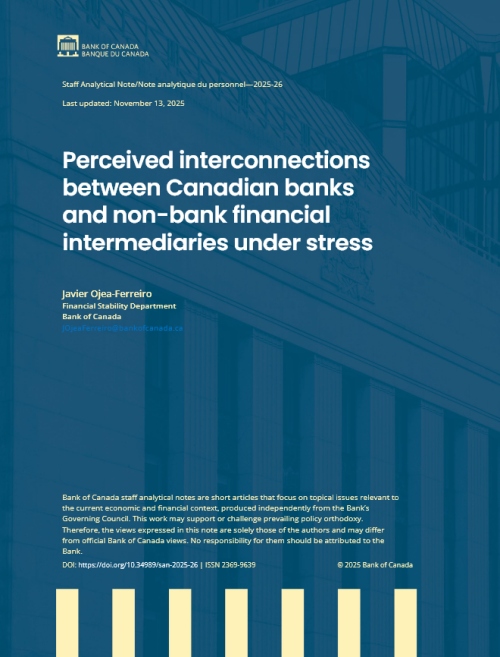
Image: Perceived interconnections between banks and NBFIs (Bank of Canada Staff Report, November 2025)
On November 13 2025, the Bank of Canada Staff published Analytical Note 2025-26 titled, "Perceived interconnections between Canadian banks and non-bank financial intermediaries under stress" (16 page PDF), that examines how stress spreads between banks and non-bank financial intermediaries (NBFIs) such as investment and mortgage funds. While the research found that market-based linkages between banks and non-banks have grown much stronger over the past decade, it offers no specific policy steps.
For Canada’s fintech and regulatory communities, that leaves room to build smarter transparency and data-driven tools that improve resilience while encouraging innovation.
The Bank used a market-based metric called the ratio of tail sensitivities to track how often banks and NBFIs experience stress at the same time. In simple terms, it measures how likely both sectors are to face sharp losses together when markets turn volatile.
Before the pandemic, that overlap was around 60%, meaning stress in one sector often stayed contained. During 2020 (Covid-19), the overlap jumped to almost 90%, showing that both banks and NBFIs were hit by the same shocks at once.
Post Covid-19, it has stayed above 70%. This signals that Canada’s financial system now behaves more like a single network where investor confidence, liquidity, and risk pricing can ripple quickly across different parts of the market.
The analysis relies on market indicators such as price changes and co-movement ratios. These signals show how banks and non-banks react to market stress, but they don't track the underlying funding flows, repo exposure, or off balance sheet commitments that reveal how those stresses move in practice. The Bank acknowledges that data gaps make it hard to see how financial stress truly spreads between institutions.
The research measures perceived connections through statistical patterns rather than verified, real time data linkages. That distinction matters. Without deeper, connected data, it is harder to see where vulnerabilities are forming or how quickly they could spread. Closing that gap doesn't necessarily require new regulation but better tools and shared information that improve resilience while encouraging innovation.
Regulators already monitor funding and liquidity in near real time, but the Bank of Canada notes that current data still do not explain how financial stress moves between different parts of the system. The missing piece is insight into how one market’s strain can quickly affect another’s ability to function.
For example, if liquidity tightens in the mortgage or bond market, investment funds might sell assets to meet investor redemptions. Those sales can push down prices, reducing the value of collateral that banks use for their own lending and funding. Within hours, what starts as a localized funding issue can spread to other sectors that rely on those same assets. Economists have long modelled this type of stress transmission, but those models depend on historical or aggregated data. They show how shocks can travel but not how fast they move in real time.
RegTech innovation could help close this gap. Shared data platforms, digital reporting tools, and secure analytics could give both regulators and market participants a clearer view of where risks are forming. Instead of expediting new rules, the opportunity is better information that allows for faster, better, data-driven action. Fintechs can play a leading role by designing systems that make oversight smarter, not heavier, while strengthening confidence across the financial system.
If Canada wants to maintain stability and support innovation, it needs visibility into where financial pressure builds. The Bank of Canada's findings show that perceived connections already move markets but without deeper real-time data access, those perceptions could harden into real stress events. The opportunity is to turn perception into understanding and make transparency Canada’s real advantage.
The National Crowdfunding & Fintech Association (NCFA Canada) is a financial innovation ecosystem that provides education, market intelligence, industry stewardship, networking and funding opportunities and services to thousands of community members and works closely with industry, government, partners and affiliates to create a vibrant and innovative fintech and funding industry in Canada. Decentralized and distributed, NCFA is engaged with global stakeholders and helps incubate projects and investment in fintech, alternative finance, crowdfunding, peer-to-peer finance, payments, digital assets and tokens, artificial intelligence, blockchain, cryptocurrency, regtech, and insurtech sectors. Join Canada's Fintech & Funding Community today FREE! Or become a contributing member and get perks. For more information, please visit: www.ncfacanada.org
| | |
|---|---|---|
| | |
AI | Nov 13, 2025

In October 2025, the Center for Security and Emerging Technology (CSET) released a report called, "The Mechanisms of AI Harm", that breaks down how artificial intelligence can cause harm through predictable pathways. The study found that most failures stem not from malicious use but from system design, biased data, and weak oversight.
CSET warns that as AI systems spread through banking, healthcare, and infrastructure, the harm becomes self-reinforcing. Each model learns from the last, compounding flaws over time. The problem is not bad actors but feedback loops that quietly scale risk. Governance is lagging behind by years, while the pace of model deployment grows monthly.
In Detroit, a police facial recognition system wrongly identified Robert Williams, leading to a false arrest that eroded public trust in the technology meant to improve safety.
An MIT article found that error rates for darker-skinned women reached 34% compared with less than 1 % for lighter-skinned men. These disparities reveal structural bias baked into training data and feedback systems.
Across Europe, the EU AI Act now treats such failures as foreseeable harms requiring traceability and documentation.
In the United States, federal regulators have begun enforcement actions against companies using opaque algorithmic decisions.
Canada’s proposed Artificial Intelligence and Data Act (AIDA) remains under parliamentary review and was impacted by prorogation in January 2025, leaving gaps between good intentions and enforceability, read the death of AIDA. Policymakers now are debating how AI accountability should evolve.
Many Canadian financial institutions already use machine learning to underwrite credit, detect fraud, and screen clients. Yet few publicly document how models are tested for bias or explainability. The Office of the Superintendent of Financial Institutions (OSFI) Guideline E-23 on Model Risk Management (2027) outlines how financial institutions should govern advanced analytics and AI models, including validation, bias testing, and accountability expectations, but without enforcement the framework still relies on internal discretion.
Regulators acknowledge the need for governance but lack consistent mechanisms to test, benchmark, or verify models across industries. The result is a patchwork system where AI tools can operate with little external visibility. Each institution assumes its safeguards are sufficient, even though no one has a full view of the risk landscape.
CSET’s model shows harm accumulates when oversight is fragmented. A 2024 OSFI-FCAC Risk Report on AI Uses and Risks at Federally Regulated Financial Institutions found that many financial institutions rely on third-party AI systems without full audit access or validation rights, which means models can change without regulators or even clients knowing. These dependencies create silent risk channels within the financial ecosystem.
And in Europe, a Europol “Facing reality? Law enforcement and the challenge of deepfakes” report cautions that deep-fake technology is proliferating rapidly and posing new risks for fraud, misinformation, and market manipulation. Each failure feeds the next, so it creates a feedback loop of risk spreading across jurisdictions and markets.
Regulators and financial institutions have a limited window to close the governance gap before public trust erodes. The real challenge is not whether to slow innovation, but how to steer it responsibly. CSET’s findings suggest that effective AI governance must protect stakeholders while allowing systems to improve and scale safely. Overregulation can push innovation into unregulated spaces, but weak oversight leaves markets exposed to preventable harm.
CSET’s framework shows that AI harm grows from feedback loops where technical design, human behaviour, and oversight interact. Preventing harm means building governance that evolves at the same pace as the systems it regulates. The question is not whether AI will cause harm, but whether leaders will move fast enough to limit it. Accountability cannot be automated. It must be led.
The National Crowdfunding & Fintech Association (NCFA Canada) is a financial innovation ecosystem that provides education, market intelligence, industry stewardship, networking and funding opportunities and services to thousands of community members and works closely with industry, government, partners and affiliates to create a vibrant and innovative fintech and funding industry in Canada. Decentralized and distributed, NCFA is engaged with global stakeholders and helps incubate projects and investment in fintech, alternative finance, crowdfunding, peer-to-peer finance, payments, digital assets and tokens, artificial intelligence, blockchain, cryptocurrency, regtech, and insurtech sectors. Join Canada's Fintech & Funding Community today FREE! Or become a contributing member and get perks. For more information, please visit: www.ncfacanada.org
| | |
|---|---|---|
| | |
Token Sales | Nov 13, 2025

Image: Freepik/diana.grytsku
On November 10, 2025 Coinbase announced the launch of its new 2025 end-to-end token sales platform, with the goal is to make token launches more open, fair, and easy to understand, while helping projects build real communities and stable markets. The news is the return of U.S. retail access to public token sales for the first time since 2018, triggered by both market demand and a pro-crypto U.S. Securities and Exchange Commission (SEC) who now says that most crypto tokens are not securities, a complete pivot from the Gensler years when regulators focused mainly on enforcement.
Coinbase’s new model aims to redefine how tokens are launched and distributed by emphasizing fairness, compliance, and long-term project stability. Instead of fast paced selling campaigns that reward a small group of insiders and large buyers, Coinbase is implementing an algorithm that fills smaller requests first, giving retail users increased access to participate. Similarly, here you can find Coinbase black friday deals. This sale window remains open for a set period, usually about a week, and then once closed, allocations are finalized. This ensures a balanced distribution and greater transparency in how tokens reach users.
Every issuer must share verified information about its team, tokenomics, and goals before the sale begins. Coinbase requires a 6 month lock-up period for issuers and their affiliates, which prevents early sell-offs and maintains market trust. These requirements strengthen accountability and align with the platform’s focus on transparent and compliant token issuance.
Coinbase’s design also rewards true community participation. Users who hold tokens beyond the first 30 days receive higher priority in future sales, discouraging short-term speculation (a type of loyalty benefit). For issuers, the model offers exposure to Coinbase’s global retail base and a transparent way to build exchange liquidity over time.
Coinbase has confirmed that Monad (MON) will be the first project to use the new platform, with its token sale scheduled for November 17–22, 2025. A key test of how a compliant, exchange led distribution can work in practice.
The design directly addresses problems seen during the 2017–2018 ICO boom, when many projects raised funds without meeting disclosure or compliance standards. Coinbase’s structured, transparent model supports fair access for users while maintaining clear accountability for issuers.
| Component | ICO Era (2017–2018) | Coinbase Model (2025) |
| Regulatory Clarity | Operated in uncertain areas with little oversight. Many projects later faced SEC actions | Built under SEC guidance that most tokens are not securities, supported by clear disclosures and verified governance |
| Access and Distribution | First-come systems rewarded speed and capital. Retail participation declined as regulators tightened oversight after widespread enforcement against unregistered ICOs, leading most platforms to limit token sales to accredited investors | Algorithm fills smaller requests first, expanding access and allowing U.S. retail buyers to join under defined limits |
| Issuer Accountability | Founders could sell immediately after launch and there were few restrictions or audits | 6 month issuer lock-up and Coinbase approval for any resale, keeping incentives aligned with buyers |
| Market Integrity | Tokens often listed quickly and traded on hype, leading to volatile price swings | Sales connect directly to Coinbase’s exchange roadmap, adding structure and steady liquidity over time |
| User Protection | Few safeguards or verified disclosures; frequent fraud cases | Verified project details, transparent sale process, and checks that reward real users over short-term traders |
Coinbase’s token sale model operates under the U.S. Securities and Exchange Commission’s current interpretation that most tokens are not securities when issued transparently and tied to legitimate network utility. This approach aligns with the SEC’s Project Crypto initiative, which promotes responsible innovation, fair access, and clear disclosure standards for digital assets.
In contrast, Canada maintains a more restrictive policy framework. Under current Canadian rules, most token sales are considered securities offerings unless they clearly fall outside investment contract criteria. The foundational guidance remains the CSA Staff Notice 46-308 – Securities Law Implications for Offerings of Tokens, which sets out how tokens may qualify as securities depending on their structure, purpose, and how they are marketed to participants.
Also, the Canadian Securities Administrators hosts an investor advisory titled Buying and Selling Crypto Assets, which cautions that token sales and trading platforms must comply with registration and disclosure requirements. Unlike the U.S., where retail investors are now permitted to participate in regulated public token sales, Canadian participation remains limited to accredited or exempt investors.
It's clear that the two markets are taking different paths. The United States is moving toward a system that rewards transparency and practical utility, while Canada’s framework continues to prioritize investor protection via restriction. Over time, Canada may need to modernize its regulatory approach to encourage innovation and maintain competitiveness in the global digital asset economy.
It was also recently discovered that Coinbase is moving it's legal incorporation from Delaware to Texas, as detailed in a report on the company’s shift to Texas corporate law. Texas offers a more innovation-friendly business environment and growing digital asset economy. Overall, Coinbase's new token sale model could help define how token distribution evolves worldwide, offering a practical roadmap for compliance with retail access.
The National Crowdfunding & Fintech Association (NCFA Canada) is a financial innovation ecosystem that provides education, market intelligence, industry stewardship, networking and funding opportunities and services to thousands of community members and works closely with industry, government, partners and affiliates to create a vibrant and innovative fintech and funding industry in Canada. Decentralized and distributed, NCFA is engaged with global stakeholders and helps incubate projects and investment in fintech, alternative finance, crowdfunding, peer-to-peer finance, payments, digital assets and tokens, artificial intelligence, blockchain, cryptocurrency, regtech, and insurtech sectors. Join Canada's Fintech & Funding Community today FREE! Or become a contributing member and get perks. For more information, please visit: www.ncfacanada.org
| | |
|---|---|---|
| | |
Nov 11, 2025

Image: Freepik/pch.vector
Family law can be one of the most challenging areas of life to navigate. Whether it involves separation, divorce, child custody disputes, or property settlement, dealing with legal issues affecting your family is emotionally taxing. It is essential to have professional guidance from experts who understand not only the law but also the personal and emotional complexities that come with these matters. This is where Certified family lawyers Springwood come in, providing support, advice, and representation to help you manage family legal issues with clarity and confidence.
A family lawyer is not just someone who prepares legal documents. They are your advisor, advocate, and guide through potentially stressful times. Their role is to ensure that your rights are protected, your interests are represented, and that you can make informed decisions with confidence.
Family law covers a wide range of legal matters related to relationships and family structures. This includes issues such as divorce, child custody, parenting arrangements, spousal support, property settlement, and domestic violence matters. Each case is unique, and the laws governing these issues can be complex. Consulting Certified family lawyers Springwood ensures that you receive accurate legal advice tailored to your individual circumstances.
Family law is not solely about legal proceedings; it also focuses on resolving disputes in a way that considers the emotional well-being of all involved, particularly children. Certified family lawyers provide guidance on both the legal and practical aspects of family issues, helping you make decisions that are in your best interests and the best interests of your family.
Not all family lawyers have the same level of experience or qualifications. Certified family lawyers are recognised for their expertise in family law and their commitment to maintaining high professional standards. They possess the knowledge and experience necessary to handle complex legal issues and offer solutions that reflect best practices in the field.
Selecting Certified family lawyers Springwood ensures that you are working with professionals who have a proven track record in handling family law cases. Their certification is a reflection of their dedication, skill, and knowledge, which can provide peace of mind during challenging times.
Choosing a lawyer in your local area has several advantages. Local lawyers have a deep understanding of the regional legal system, including local courts, procedures, and professionals who can support your case. They can navigate local requirements efficiently and are readily available for consultations or urgent matters.
By engaging Certified family lawyers Springwood, you benefit from professionals who are familiar with the specific practices and expectations of local courts. This knowledge can make a significant difference in the outcome of your case and ensures smoother communication throughout the legal process.
Family law covers many areas, and it is important to select a lawyer whose expertise matches your needs. Some lawyers specialise in divorce and property settlements, while others focus on parenting disputes or domestic violence cases. For cases involving complicated financial arrangements or high-value assets, specialised knowledge is crucial to ensure fair and thorough handling.
Certified family lawyers also bring experience in mediation, negotiation, and collaborative law approaches. They understand how to resolve disputes in ways that minimise conflict and reduce the emotional impact on all parties involved. Choosing the right lawyer for your specific situation can make the process more manageable and lead to better outcomes.
Effective communication is essential in family law matters. The legal process often involves multiple meetings, correspondence, and court appearances. A lawyer who communicates clearly and promptly can make a significant difference in how you experience your case.
Certified family lawyers Springwood are trained to explain complex legal matters in a straightforward and understandable way. They listen to your concerns, answer questions, and keep you informed about progress. This approach helps you feel supported and confident as you navigate legal decisions and ensures that you are fully aware of your options at every stage.
One of the most important roles of a family lawyer is to help you understand your legal rights and options. Many people entering family law matters are unsure of what is legally possible or the implications of their choices. Certified family lawyers provide clarity and guidance, explaining potential outcomes and the pros and cons of different approaches.
They can advise you on how to protect your interests, whether through negotiation, mediation, or court proceedings. By understanding your rights and options, you can make informed decisions that align with your goals and protect your future.
Not all family law issues need to be resolved in court. Mediation, negotiation, and collaborative law are increasingly popular alternatives that can save time, reduce stress, and preserve relationships. These methods encourage cooperation and allow parties to reach mutually acceptable agreements without resorting to litigation.
Certified family lawyers are skilled in alternative dispute resolution techniques and can guide you through these processes. They ensure that any agreements are fair, legally binding, and in compliance with relevant laws. Engaging a lawyer with experience in these approaches can make the resolution process smoother and more amicable.
When children are involved, family law matters become even more sensitive. Decisions regarding custody, parenting arrangements, and visitation must prioritise the best interests of the child. Certified family lawyers provide guidance on creating arrangements that support the child’s well-being while balancing the rights of each parent.
They help prepare parenting plans, advise on compliance with court orders, and represent your interests in disputes related to child custody and support. Their expertise ensures that children are considered at every stage, and that solutions promote stability, safety, and emotional support.
Dividing assets and property can be one of the most complicated aspects of family law. Certified family lawyers help clients navigate these issues with precision and care. They ensure that property and financial matters are addressed fairly, taking into account contributions, needs, and future obligations.
Lawyers can assist in negotiations, agreements, and court applications related to property settlement. Their goal is to achieve a fair outcome that protects your financial security while resolving disputes efficiently and effectively.
Family lawyers also provide assistance in situations involving domestic violence or abuse. They can guide you through legal protections such as restraining orders, intervention orders, or other court measures designed to ensure safety. Certified family lawyers understand the sensitive nature of these cases and handle them with discretion, urgency, and professionalism.
By seeking expert legal support, you can protect yourself and your loved ones while navigating the legal system with confidence.
One of the most effective ways to handle family law matters is to plan ahead. Early legal advice helps you understand your position, explore options, and prepare for potential outcomes. Certified family lawyers Springwood can guide you through preventive steps, document preparation, and strategic planning to ensure that your interests are safeguarded.
Taking a proactive approach can reduce the likelihood of disputes escalating and provide you with a clearer path forward during challenging times.
Trust is a crucial component when working with a family lawyer. Legal matters involving family are deeply personal, and it is essential to feel comfortable with the professional representing you. Certified family lawyers combine expertise with empathy, creating an environment where you can discuss sensitive matters openly and receive thoughtful guidance.
A lawyer who listens, communicates effectively, and respects your concerns can help you feel confident in your decisions and supported throughout the legal journey.
Selecting the right lawyer involves careful consideration. Look for certification, experience, local knowledge, and a client-focused approach. Ask about their experience with cases similar to yours, their communication style, and their approach to dispute resolution. By conducting consultations and asking questions, you can determine which lawyer is the best fit for your needs.
Choosing Certified family lawyers Springwood ensures that you have access to legal professionals who are competent, reliable, and committed to achieving positive outcomes while supporting your well-being.
Family law matters can be complicated, stressful, and emotionally challenging. Working with Certified family lawyers Springwood provides the guidance and support you need to navigate these issues effectively. From divorce and child custody to property settlement and protective measures, a qualified family lawyer can help you understand your options, protect your rights, and reach solutions that work for your family.
Investing in the right legal support is an investment in your peace of mind and your future. With expert guidance, clear communication, and professional representation, you can move through family law challenges with confidence and clarity, knowing that your interests are being safeguarded every step of the way

Jennifer Aguirre
Jennifer Aguirre is an experienced SEO Specialist and Content Writer at Justice Network | Australia, where she helps businesses enhance their online presence through strategic SEO and high-quality, engaging content. With a keen eye for detail and a passion for crafting content that resonates, Jennifer combines technical SEO knowledge with creative storytelling to drive traffic, improve search rankings, and deliver measurable results. She is committed to helping brands communicate effectively online while staying ahead in the ever-evolving digital landscape.
The National Crowdfunding & Fintech Association (NCFA Canada) is a financial innovation ecosystem that provides education, market intelligence, industry stewardship, networking and funding opportunities and services to thousands of community members and works closely with industry, government, partners and affiliates to create a vibrant and innovative fintech and funding industry in Canada. Decentralized and distributed, NCFA is engaged with global stakeholders and helps incubate projects and investment in fintech, alternative finance, crowdfunding, peer-to-peer finance, payments, digital assets and tokens, artificial intelligence, blockchain, cryptocurrency, regtech, and insurtech sectors. Join Canada's Fintech & Funding Community today FREE! Or become a contributing member and get perks. For more information, please visit: www.ncfacanada.org
| | |
|---|---|---|
| | |


August 26th, 2025

January 4th, 2024

June 1st, 2021

September 9th, 2020

July 9th, 2018

January 3rd, 2018

September 25th, 2017

June 20th, 2017

May 10th, 2017

December 14th, 2016