




Karsten Wenzlaff, Advisor
August 26th, 2025
Karsten Wenzlaff is a Crowdfunding and Fintech Expert from Germany. He is Secretary-General of Digit[...]


Cybersecurity | Oct 14, 2025

Image: Freepik
The 2025 Nobel Prize in Economics was awarded to Joel Mokyr, Philippe Aghion, and Peter Howitt for showing that economies grow when they reward new ideas, open competition, and constant renewal. Their work (and recognition) explains why some economies continue to grow while others stall, or how innovation drives prosperity.
Joel Mokyr’s research reveals that progress depends on how societies treat knowledge. When Europe opened up to new ideas, rulers across Europe competed to attract inventors, scientists, and thinkers. They funded experiments, founded academies, and allowed freedom to publish and debate. This open culture created trust and collaboration, which led to faster discovery. Insight is that innovation takes off when knowledge is shared, incentives are aligned with progress, and institutions reward learning rather than control.
Philippe Aghion and Peter Howitt built the modern model that explains how this process sustains itself. Their work on creative destruction shows that growth happens when new firms and technologies replace outdated ones. Productivity increases even as some firms exit the market. They demonstrated that competition and innovation are not opposites but partners. Economies that encourage entry and tolerate failure grow faster because resources move to better ideas. Insight is that protection slows progress, but experimentation drives renewal.
Sounds familiar, right?
A popular LinkedIn post by a specialist in regulatory policy Martyn Hopper, interpreted these Nobel insights into a practical framework for today's economies. In his aptly titled LinkedIn post, “Regulating for Growth”.
Hopper explained that innovation only turns into prosperity when three things work together:
When these conditions are in place, disruption becomes productive renewal. When they are missing, it produces dislocation, stagnation, and political frustration.
Hopper’s key insight reframes regulation itself. He says the real challenge is not cutting rules but designing them to direct energy toward innovation rather than rent-extraction (read: siphoning off profits for benefit).
Regulation is the architecture that decides who can participate, how capital flows, and whether progress is rewarded or resisted. It determines whether a system produces creation or protection, renewal or capture. This makes regulation one of the most powerful economic tools for growth.
As Canada has it's back up against the wall in terms of innovation and competition policy (despite recent shifting winds), the Nobel findings and Hopper's sensibilities, business leaders and policymakers have clear takeways.
The best performing economies are those that combine competitive markets with policies that support transition. For policymakers, the lesson is that regulation must make innovation easier, not riskier. It must reward entry and experimentation, ensure fair access to finance, and help communities absorb change. Sustained success comes from openness, agility, and willingness to reinvest in new ideas. Remember, a system without the ability to expel old and add new will eventually die on the vine.
Growth is designed through the choices made about who can compete, how ideas are financed, and how regulation treats innovation. When those choices are right, economies attract investment, scale technology faster, and sustain higher productivity.
For Canada’s fintech and financial innovation community, these insights are especially timely. NCFA’s advocacy for proportionate rules, open and fair competition, and technology-driven productivity and inclusion innovation aligns directly with the Nobel research and Hopper’s interpretation.
Canada's challenge is evolving from purely risk management towards opportunity design. Regulators can accelerate innovation by creating flexible entry routes for new players, supporting data-driven compliance, and directing finance toward startups and scale-ups that drive transformation.
It's about injecting newness and opportunity which in turn will build resilience. When innovation is supported by sound regulation, it strengthens the economy’s ability to adapt, protects consumers, and expands access to capital.
Fintech, open banking, and AI can be powerful enablers of this change if the regulatory system is built for learning and collaboration rather than delay and protectionism.
The Nobel Committee recognized that growth doesn't happen by accident. It's built through systems that enable innovation, reward competition, and manage transition. Martyn Hopper’s framework shows what that looks like in practice. Smart regulation channels capital to new ideas, supports those affected by change, and keeps markets open for renewal. For Canada’s fintech sector, this is the roadmap to back that turns creative disruption into long-term competitiveness, productivity, and inclusion.
 The National Crowdfunding & Fintech Association (NCFA Canada) is a financial innovation ecosystem that provides education, market intelligence, industry stewardship, networking and funding opportunities and services to thousands of community members and works closely with industry, government, partners and affiliates to create aa vibrant and innovative fintech and funding industry in Canada. Decentralized and distributed, NCFA is engaged with global stakeholders and helps incubate projects and investment in fintech, alternative finance, crowdfunding, peer-to-peer finance, payments, digital assets and tokens, artificial intelligence, blockchain, cryptocurrency, regtech, and insurtech sectors. Join Canada's Fintech & Funding Community today FREE! Or become a contributing member and get perks. For more information, please visit: www.ncfacanada.org
 |  |  |
|---|---|---|
 |  |  |
Oct 14, 2025
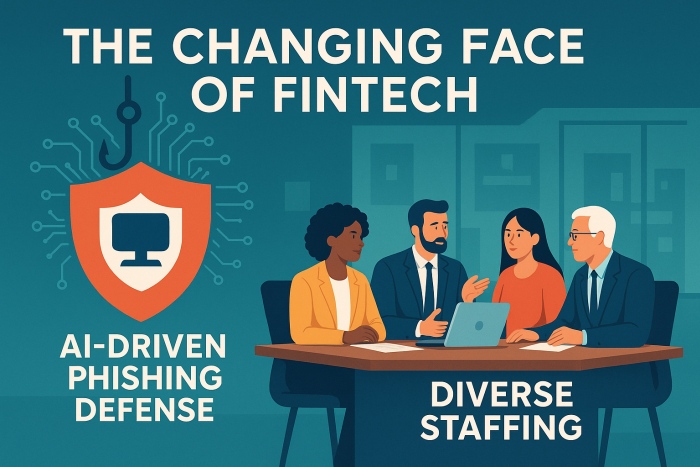
The world of fintech moves faster than most industries.
Every week brings a new regulation, an emerging technology, or a cyber threat that can change the way startups operate.
Among all these moving parts, two factors stand out as game-changers: AI-driven phishing defense and diverse staffing.
At first glance, they may seem unrelated—one is a tech safeguard, the other a people strategy—but in reality, they’re deeply connected.
Diverse staffing means building teams that represent different backgrounds, cultures, genders, and perspectives.
It’s not just about filling quotas; it’s about creating a mix of thinkers who can see problems and opportunities from multiple angles.
In fintech, where innovation and security are crucial, having diverse minds at the table helps companies anticipate risks others might overlook.
I once worked with a startup that struggled to understand why their mobile banking app wasn’t resonating with certain communities.
After bringing in a multicultural design team, they realized that small UI details—like language tone and icon choices—were alienating non-native English speakers.
Once those adjustments were made, engagement skyrocketed.
Diverse staffing isn’t a buzzword—it’s a direct path to resilience and creativity.
Startups that prioritize inclusivity create stronger internal networks and make better, faster decisions.
Phishing attacks have become one of the biggest threats to fintech.
Hackers no longer rely on sloppy scams; they use advanced AI tools to mimic authentic company communications.
In one incident I witnessed, a financial startup received what appeared to be a vendor invoice email.
The tone, logo, and even the metadata looked legitimate—but it was a targeted phishing attempt powered by AI-generated content.
Because one employee noticed subtle inconsistencies, the company avoided a potential breach worth millions.
That awareness came from training sessions led by a culturally diverse security team that understood how different communication styles could be exploited in phishing attacks.
Their unique insights into language nuances helped them spot what others missed.
AI phishing defense systems rely on machine learning to detect abnormal patterns—strange email origins, inconsistent phrasing, or odd click behavior.
But machines alone can’t interpret every context correctly.
That’s where diverse staffing bridges the gap.
People from different linguistic and cultural backgrounds can identify red flags that AI may misinterpret.
For instance, an employee fluent in multiple languages might recognize that an email claiming to be from a French client used incorrect business etiquette or spelling conventions.
A cybersecurity engineer from another region might catch phishing attempts that play on local banking jargon.
This mix of perspectives strengthens the AI’s learning loop—feeding it richer, more nuanced data to detect future threats.
Customers in fintech trust brands that understand their specific needs and communication styles.
When users see themselves represented in a company’s workforce, that trust deepens.
A diverse team doesn’t just improve cybersecurity—it enhances customer relationships and global reach.
Take digital payment startups expanding into international markets.
Having employees who understand local financial systems, traditions, and risk perceptions can make product launches smoother.
This firsthand knowledge ensures compliance with cultural expectations and helps prevent unintentional errors that could trigger regulatory scrutiny.
When I consulted for a mid-sized fintech company, their hiring process focused almost entirely on technical skills.
They had brilliant engineers, but their cybersecurity incidents kept rising.
Once they diversified their recruitment—bringing in specialists from different regions, languages, and genders—everything changed.
The team’s brainstorming sessions became more dynamic, and phishing simulations revealed a 40% improvement in detection rates.
Their success wasn’t accidental.
Diverse staffing created an environment where people felt empowered to question assumptions and propose unconventional ideas.
That mindset proved invaluable for strengthening AI defense systems and developing smarter internal training modules.
AI can process massive amounts of data faster than any person, but it lacks intuition.
Humans—especially those with varied experiences—excel at reading emotional cues, tone, and intent.
For example, a phishing email designed to mimic urgency might trick a machine’s keyword filter but feel “off” to a human reader.
A multicultural security team understands that emotional manipulation looks different across cultures.
In some regions, scammers use politeness and flattery; in others, they exploit authority and hierarchy.
Combining AI’s analytical power with these human instincts creates a more holistic defense system.
Startups thrive when teams move quickly, communicate openly, and challenge each other’s thinking.
Diversity encourages all three.
When employees come from different walks of life, discussions become richer, and blind spots get smaller.
It’s no surprise that companies with inclusive leadership outperform competitors in innovation and market growth.
In one fintech accelerator program, a group of startups was asked to pitch AI-based security solutions.
The winning team wasn’t the one with the most funding or tech power—it was the one with members from six countries and a balanced gender ratio.
Their final product succeeded because it accounted for human error, cultural behavior, and ethical considerations that others ignored.
To integrate diversity and AI defense effectively, fintech startups should:
Tomorrow’s fintech ecosystem won’t rely solely on firewalls and encryption—it will depend on the collective intelligence of humans and machines.
Diverse staffing ensures that AI systems are trained with better context and that decision-making remains human-centered.
This hybrid model of defense and inclusion isn’t just ethical; it’s strategic.
The startups that blend AI technology with human diversity won’t just survive—they’ll lead.
They’ll build systems that can outsmart cybercriminals, earn global trust, and adapt faster than ever before.
Innovation in fintech is no longer just about coding speed or funding size.
It’s about who’s sitting at the table, what experiences they bring, and how they collaborate with technology.
AI phishing defense provides the armor, but diverse staffing builds the strength behind it.
When those two forces align, fintech startups transform from vulnerable targets into resilient, future-ready organizations.
The National Crowdfunding & Fintech Association (NCFA Canada) is a financial innovation ecosystem that provides education, market intelligence, industry stewardship, networking and funding opportunities and services to thousands of community members and works closely with industry, government, partners and affiliates to create aa vibrant and innovative fintech and funding industry in Canada. Decentralized and distributed, NCFA is engaged with global stakeholders and helps incubate projects and investment in fintech, alternative finance, crowdfunding, peer-to-peer finance, payments, digital assets and tokens, artificial intelligence, blockchain, cryptocurrency, regtech, and insurtech sectors. Join Canada's Fintech & Funding Community today FREE! Or become a contributing member and get perks. For more information, please visit: www.ncfacanada.org
| | |
|---|---|---|
| | |
AI Ethics | Oct 10, 2025

Image: Freepik
On October 7, 2025, AP news reported that Deloitte Australia has agreed to refund part of a $440,000 AUD government contract for not disclosing the use of AI and delivering a 237 page welfare report to the Department of Employment and Workplace Relations (DEWR) that was riddled with AI generated errors, fabricated quote, non-existing sources and incorrect legal references.
Deloitte Australia subsequently returned part of its fee and reissued a corrected report with full disclosure that AI had been used while correcting the identified errors, raising questions around how oversight can keep pace with growing enterprise AI adoption.
According to the Guardian's analysis of Deloitte's AI mistake, the DEWR report was first published in July 2025, and not until several months later did University of Sydney researcher Chris Rudge first detect the fake academic references embedded throughout Deloitte’s report. He described the contents as clearly AI generated, such as strange book titles and misattributed legal quotes.
Senator Barbara Pocock later criticized the firm’s use of AI saying, "[Deloitte] misused AI and used it very inappropriately: misquoted a judge, used references that are non-existent”.
Shame on Deloitte. Bigger shame on Govt: $440k contract for rubbish work: “Deloitte has admitted to using generative AI for a core analytical task; but it failed to disclose this in the first place.” pic.twitter.com/QLM1Y4kp3u
— Barbara Pocock (@BarbaraPocock) October 5, 2025
The Deloitte case shows how unchecked automation can weaken confidence in institutions that depend on verified data and transparent reporting. For fintechs and financial institutions, it reinforces that every AI-assisted process from compliance to portfolio analysis needs accountable oversight and clear audit trails.
"Oversight can be human, automated, or hybrid, but it must always be explainable and verifiable."
Canadian regulators are also under pressure to ensure that AI tools used in finance meet standards of traceability and accountability. Embedding disclosure requirements, validation checkpoints, and auditable review logs can prevent governance breakdowns before they escalate.
Consulting and financial firms that apply AI ethically and responsibly will maintain (and grow) their credibility, while those that don’t risk lasting damage to their reputation. According to news reports, at least the report recommendations were in tact. Accountability is the real audit.
The National Crowdfunding & Fintech Association (NCFA Canada) is a financial innovation ecosystem that provides education, market intelligence, industry stewardship, networking and funding opportunities and services to thousands of community members and works closely with industry, government, partners and affiliates to create aa vibrant and innovative fintech and funding industry in Canada. Decentralized and distributed, NCFA is engaged with global stakeholders and helps incubate projects and investment in fintech, alternative finance, crowdfunding, peer-to-peer finance, payments, digital assets and tokens, artificial intelligence, blockchain, cryptocurrency, regtech, and insurtech sectors. Join Canada's Fintech & Funding Community today FREE! Or become a contributing member and get perks. For more information, please visit: www.ncfacanada.org
| | |
|---|---|---|
| | |
Oct 9, 2025

Image: Freepik
When most people think about investing, they picture stock tickers, market swings, and the rush of watching their portfolio rise and fall. What rarely gets the spotlight is the quiet factor that can make or break a lifetime of financial growth: taxes. In Canada, where the tax landscape is as complex as the investments themselves, learning to think tax smart is not just an advanced strategy. It is the difference between chasing returns and actually building real, lasting wealth.
According to the Canada Revenue Agency’s Overall Federal Tax Gap Report, billions of dollars in tax revenue go uncollected every year due to underreporting or noncompliance. For individual investors, this underscores a broader reality: missed opportunities and poor tax planning can quietly erode wealth over time.
At the same time, emerging wealth technology platforms and independent advisory models are pushing tax efficiency into mainstream conversation. Together, these trends show why tax smart investing is no longer niche. It is becoming the foundation for building wealth in Canada’s evolving financial system.
It is tempting to believe that a few big wins on the stock market will set you up for life. But the truth is, gross returns do not equal net gains. Without careful tax planning, a healthy looking portfolio can lose value year after year.
Capital gains, dividends, and interest income are all taxed differently. The problem is, most investors do not think about this until tax season, when it is too late to adjust. A dollar earned in one type of investment may be worth far less than a dollar earned somewhere else once taxes are factored in. Wealthy Canadians and institutions have known this for decades. The rest of us are just starting to catch up.
Think of taxes as a silent partner. They take a cut whether you like it or not. The real skill is learning how to minimize their share while still growing your wealth responsibly. That means more than stuffing money into RRSPs or TFSAs, although those matter. It is about positioning investments where they make the most sense from a tax perspective.
For example, interest income is heavily taxed, while capital gains and Canadian dividends are more efficient. Holding bonds inside registered accounts, while keeping eligible dividends outside, can help maximize what you keep. The best investors do not just diversify across asset classes. They diversify across tax treatments.
Investors who want a clear explanation of registered versus non-registered accounts can turn to the Financial Consumer Agency of Canada’s savings and investment products guide.
Two investors could earn the exact same return, but the one with the smarter tax strategy will always come out ahead. Over decades, those differences compound dramatically.
Take a simple case: an investor who earns an annual return of 6 percent but loses 1.5 percent to taxes every year is not really earning 6 percent at all. Compare that to someone earning the same 6 percent but only losing 0.5 percent to taxes. Over 25 years, the second investor ends up with significantly more wealth, not because of higher risk taking, but because of lower tax drag. That is the quiet power of tax smart investing.
The Ontario Securities Commission’s GetSmarterAboutMoney resource includes calculators and tools that illustrate how taxes impact long term investing.
More Canadians are realizing that off the shelf investment products do not cut it anymore. They are looking for advisors who can manage not just portfolios, but the bigger picture: how wealth is preserved, passed on, and optimized for the next generation.
Firms such as Tacita Capital represent this shift. As a Canadian family office, they are fully independent and privately owned, offering authentic multi-family office experience supported by an active founding family. With open architecture, they are not tied to proprietary products or restricted fund menus, which allows for greater flexibility and alignment with client needs. Most importantly, they prioritize after tax returns, focusing on tax conscious investing as the foundation for lasting wealth. For families who want to keep more of their wealth in their own hands rather than handing it over to taxes, this approach is becoming essential.
The rise of WealthTech platforms in Canada is making tax smart strategies more accessible. Digital platforms now offer automated tax loss harvesting, personalized portfolio allocation, and even AI driven insights that can optimize for after tax returns in real time.
This is not just about convenience. It is about democratization. What was once the exclusive domain of high net worth families is slowly becoming available to everyday investors. With the right platforms, even small portfolios can be managed with the kind of tax efficiency once reserved for those with entire teams of advisors.
For further reading, see the Bank of Canada’s PIVOT Program initiative, which collaborates with innovators in fintech and AI to explore new tools and technology in Canada’s financial system.
Tax smart investing does not end with stocks and bonds. Alternative assets, such as real estate, private equity, infrastructure, and even impact investments, are playing a growing role in Canadian portfolios. Many of these vehicles come with unique tax considerations, some favorable, others complex.
What makes them powerful is how they can diversify both returns and tax exposure. For example, real estate investment structures can offer depreciation benefits, while private equity gains may be deferred or taxed differently than public market income. The challenge is access and expertise, knowing when these investments make sense, and how to structure them correctly.
The ultimate goal of tax smart investing is not simply to boost returns. It is about building a financial legacy that outlasts the investor. For Canadian families, this often means thinking about succession, estate taxes, charitable giving, and how wealth aligns with values.
Wealth without strategy can create as many problems as it solves. By contrast, wealth that is carefully structured for taxes, inheritance, and long term planning does not just preserve money. It preserves freedom. It gives families the ability to support causes they care about, invest in new ventures, or provide security across generations.
Canada’s tax system can feel punishing at times, but it also offers unique opportunities. Tools like TFSAs and RRSPs, along with carefully designed trust structures, give Canadians more flexibility than many investors abroad enjoy. The challenge is that navigating these opportunities requires knowledge and discipline.
The good news is that more Canadian investors are waking up to the fact that building wealth is not just about buying the right stock at the right time. It is about structuring every decision in a way that minimizes tax erosion. And in today’s world, with both digital platforms and specialized advisors available, this approach is more achievable than ever.
The path to real wealth in Canada is not about flashy trades or beating the market. It is about keeping more of what you already earn. Taxes will always take their share, but how much they take is something you can control with smart strategies, careful planning, and the right guidance.
The National Crowdfunding & Fintech Association (NCFA Canada) is a financial innovation ecosystem that provides education, market intelligence, industry stewardship, networking and funding opportunities and services to thousands of community members and works closely with industry, government, partners and affiliates to create aa vibrant and innovative fintech and funding industry in Canada. Decentralized and distributed, NCFA is engaged with global stakeholders and helps incubate projects and investment in fintech, alternative finance, crowdfunding, peer-to-peer finance, payments, digital assets and tokens, artificial intelligence, blockchain, cryptocurrency, regtech, and insurtech sectors. Join Canada's Fintech & Funding Community today FREE! Or become a contributing member and get perks. For more information, please visit: www.ncfacanada.org
| | |
|---|---|---|
| | |
Digital Banking | Oct 7, 2025

Image: Freepik/rawpixel.com
On October 2, 2025, Netherland-based digital banking experience platform Plumery announced Canada ready features for credit unions and is working with Vancouver-based Aequilibrium on the implementation for Canadian institutions. The release covers payments and transfers including Interac e-Transfer, support for Canadian savings and lending products, business banking tools, and bilingual English and French, privacy, data residency, and accessibility features.
In Jan 2025, Toronto-based credit union Central 1 said that Intellect Design Arena would take over its digital banking after its 2024 review. On March 3, 2025, the transfer took effect, and Intellect took over Forge, MemberDirect, and related web and mobile products while Central 1 continued to provide underlying infrastructure services. As a result, credit unions that previously used Forge now need to choose their next digital banking platform.
Plumery and Aequilibrium have built a localized version tailored to Canadian banking norms. The platform supports bill payments, cheque deposits, Interac e-Transfer, savings and lending products such as GICs and mortgages, business banking tools like bulk payments and payroll, and compliance capabilities including bilingual English and French support, data residency, privacy adherence, and accessibility features. These Canada specific digital banking capabilities are available out of the box.
Plumery's digital banking platform can be branded by the financial institution, allowing credit unions to use their own design and member experiences while using Plumery’s building blocks. They say its approach can reduce switching costs/risks by offering Canada specific features from day one while avoiding unnecessary disruption.
The partnership with Aequilibrium helps with compliance, user experience, and integration while keeping institutions in control of their brand and roadmap. For members, this can mean faster everyday banking, smoother transfers, and interfaces designed for how Canadians bank.
Ben Goldin, CEO and Founder of Plumery:
"With Forge winding down, Canadian institutions have a rare opportunity to modernise on their own terms, rather than being tied to outdated systems. Our platform provides an immediate, future ready option that puts control back in the hands of credit unions. By working with Aequilibrium, we are combining global banking innovation with local expertise to deliver experiences that meet the unique needs of Canadian credit unions’ members."
Plumery says its Canada edition is available now and that it is in conversations with several credit unions evaluating alternatives to Forge.
The National Crowdfunding & Fintech Association (NCFA Canada) is a financial innovation ecosystem that provides education, market intelligence, industry stewardship, networking and funding opportunities and services to thousands of community members and works closely with industry, government, partners and affiliates to create aa vibrant and innovative fintech and funding industry in Canada. Decentralized and distributed, NCFA is engaged with global stakeholders and helps incubate projects and investment in fintech, alternative finance, crowdfunding, peer-to-peer finance, payments, digital assets and tokens, artificial intelligence, blockchain, cryptocurrency, regtech, and insurtech sectors. Join Canada's Fintech & Funding Community today FREE! Or become a contributing member and get perks. For more information, please visit: www.ncfacanada.org
| | |
|---|---|---|
| | |
Agentic AI Framework | Oct 6, 2025
iMAGE: Unlocking the right Agentic AI use cases (Deloitte, Sep 2025)
In September 2025, Deloitte released a research report titled, "Unlocking the Right Agentic AI Use Cases", outlining a structured way for evaluating where autonomous AI systems can deliver the most value. The report emphasizes that agentic AI is less about replacing jobs and more about transforming how organizations reason, decide, and learn at scale.
In this article, NCFA applies the framework to several common fintech processes from transaction monitoring to smart contract audits, and ranks how suitable they are for agentic AI adoption today and in the future as governance, transparency, and learning systems evolve.
Deloitte’s research includes 7 criteria to help developers determine how suitable agentic ai is for automating a particular process - see the table below.
| Criterion | Definition | Low End (Less Ideal) | High End (More Ideal) |
| 1. Reasoning and context | How much the process requires understanding across variables | Follows strict rules or thresholds | Requires judgment and context (e.g., fraud review) |
| 2. Autonomy and escalation | Degree of independent decision-making | Executes instructions only | Decides next actions, knows when to involve humans |
| 3. Goal orientation | Clarity of outcome or success metric | No clear endpoint | Defined goal (e.g., complete onboarding) |
| 4. Multistep nature | Whether multiple systems or tasks must be performed | Single-step task | Coordinates multiple systems sequentially |
| 5. Cyclic repetition | Frequency and feedback loops | One-time task | Repeats with measurable feedback loops |
| 6. Explainability | Transparency of reasoning | Opaque or black-box logic | Traceable reasoning with audit trails |
| 7. Continuous learning | Ability to learn and adapt | Static model | Improves through ongoing data input and correction |
Each process is scored out of ten points using Deloitte’s agentic AI use case suitability framework. The first score reflects current use case suitability in today’s environment. A second estimate indicates how use case suitability could rise in the future as digital governance, explainable systems, and automation standards mature over time.
Identity checks, risk screening, and document verification already rely on structured rules and data. Agentic AI fits naturally here, automating repetitive verification while escalating edge cases. As more jurisdictions adopt digital ID systems, this process could / will reach full autonomy with minimal human input.
Fraud detection already uses machine learning but agentic AI adds reasoning and adaptive responses. It can correlate patterns across payments, wallets, and behavioural data in real time.
With digital audit trails and explainable decision logs this process could operate fully autonomously under continuous supervision frameworks.
Matching incoming and outgoing payments is structured but still requires manual exception handling. Agentic systems can monitor ledgers, spot mismatches, and self-correct using feedback loops. As accounting platforms integrate autonomous verification standards, reconciliation could become a closed-loop agentic process with automated approvals.
Preparing reports for regulators involves collecting, validating, and submitting structured data. Agentic AI can manage workflows and track compliance deadlines. As regulators adopt machine-readable filing systems and trust frameworks, the need for human review will decline, allowing safe automation of most submissions.
Auditing blockchain contracts involves reasoning through logic and risk. Agentic AI can already identify anomalies and test execution scenarios. When standards for autonomous assurance and self-certifying code mature, agents could perform initial audits before human validation.
Today, human advisors must ensure advice suitability and fairness. Agentic AI can model goals and risk preferences, but oversight rules limit autonomy.
As explainability improves and regulators enable digital fiduciary models, these systems could autonomously generate and monitor recommendations.
Managing liquidity involves reasoning across cash flows, forecasts, and risk exposure. Agents can simulate scenarios and suggest rebalancing actions. Once real-time regulatory supervision and audit logs are common, agentic systems could adjust positions within safe parameters.
Tracking, transferring, and redeeming digital tokens are structured, rules-driven tasks. Agentic AI can monitor compliance and manage lifecycle events. As token standards and programmable compliance mature, these agents could manage portfolios with built-in governance.
Support interactions often follow clear procedures with measurable outcomes. Agentic AI can handle queries, resolve issues, and escalate complex cases. As conversational transparency and emotion modeling improve, these agents could manage most client interactions autonomously.
Scenario modelling tests business resilience under stress or uncertainty. Agentic AI can run continuous simulations, adjusting parameters as markets shift. In the future, these systems could interface with policy dashboards to flag emerging risks automatically.
This use case suitability assessment highlights how agentic AI can strengthen the efficiency, accuracy, and competitiveness of financial operations. Processes with structured data and repeatable outcomes like KYC, transaction monitoring, and reconciliation show the highest use case suitability today. These are areas where autonomous systems can already perform safely under human oversight.
For policymakers and regulators, the above examples demonstrate the importance of establishing auditable, explainable AI frameworks that allow more automation without compromising accountability.
For startups and financial institutions, the opportunity lies in targeting 'low lying fruit' (high-use case suitability functions) first to achieve measurable productivity and risk-management gains.
As data ecosystems become more interoperable and governance standards mature, the next stage of AI adoption will evolve from task-level automation to agentic collaboration. In this model, autonomous agents interact with systems, policies, and humans to drive continuous decision-making improvements.
This evolution could redefine the boundaries between financial service providers, regulators, and technology developers. Canada’s leadership potential lies in balancing innovation with responsible oversight, establishing itself as a trusted hub for explainable and accountable AI-driven finance.
The National Crowdfunding & Fintech Association (NCFA Canada) is a financial innovation ecosystem that provides education, market intelligence, industry stewardship, networking and funding opportunities and services to thousands of community members and works closely with industry, government, partners and affiliates to create aa vibrant and innovative fintech and funding industry in Canada. Decentralized and distributed, NCFA is engaged with global stakeholders and helps incubate projects and investment in fintech, alternative finance, crowdfunding, peer-to-peer finance, payments, digital assets and tokens, artificial intelligence, blockchain, cryptocurrency, regtech, and insurtech sectors. Join Canada's Fintech & Funding Community today FREE! Or become a contributing member and get perks. For more information, please visit: www.ncfacanada.org
| | |
|---|---|---|
| | |
AI Regulation | Oct 6, 2025

The European Union’s transparency and copyright rules for general purpose AI models formally took effect on August 2, 2025. Enforcement faced resistance from industry and calls for delay but regulators seem intent on sticking with the original timelines.
Global tech leaders such as, OpenAI, Microsoft, Google, Anthropic, and Amazon have signed the EU Code of Practice for General Purpose AI Models, a framework quickly emerging as the new benchmark for responsible AI and a blueprint for innovators in Canada’s fintech and technology ecosystem.
The EU AI Act, published as Regulation (EU) 2024/1689 in the Official Journal of the European Union, moved into its second phase of implementation this summer. The new rules apply to general purpose AI models (GPAI) trained on large-scale data that can generate text, images, and audio. These models must now meet defined transparency and documentation requirements to operate in the European market.
In July 2025, the European Commission released the Code of Practice for General Purpose AI Models, available on its AI transparency portal. Although its voluntary, the Code itself translates the Act’s broad principles into operational commitments that technology providers can follow, and is becoming a global reference for responsible AI development.
The Code asks developers to be clear about how their AI systems are built. They must publish short summaries of training data and explain the steps taken to reduce bias and misinformation. It marks the first time transparency in AI has been defined as a regulated standard rather than a voluntary goal.
It also sets new expectations for how copyrighted material is handled. Companies must confirm that training data was obtained legally and that rights holders who chose to opt out were respected. They are encouraged to build safeguards that stop AI models from reproducing protected content and to keep a public channel open for complaints.
Finally, the Code highlights safety and security as core responsibilities. Models that use very large amounts of computing power must undergo risk assessments, maintain strong cybersecurity protections, and keep records of any misuse or technical incidents. This brings AI oversight closer to the risk management standards already used in finance.
The European Commission’s list of signatories includes OpenAI, Microsoft, Google, Anthropic, Amazon, IBM, and Mistral AI. Their participation gives the voluntary Code practical weight and sends a message that transparency and accountability are compatible with innovation.
Meta has not signed, citing uncertainty about enforcement and consistency across European member states. It shows the divide between companies moving early to align with transparency and those waiting for further legal clarification. Early signatories are setting examples that others may have to follow once regulation tightens.
Companies that publish their data summaries and risk documentation not only comply with regulation but also strengthen their position with investors and partners. For companies that can responsibly demonstrate how they legally sourced their data to train their models, it can influence purchasing decisions in regulated sectors like finance, health, and insurance.
For AI developers, transparent practices can also lead to improved internal knowledge. Knowing exactly what data was used to train a system and where risks exist improves quality and helps teams innovate with confidence. Transparency is evolving from a compliance task into a type of competitive strategy.
Canada’s Artificial Intelligence and Data Act (AIDA) was part of Bill C-27, which died on the Order Paper when Parliament was prorogued in January 2025. For now, Canada's Voluntary Code of Conduct on the Responsible Development and Management of Advanced Generative AI Systems is still Canada's main AI policy reference. The Code is endorsed by companies such as Cohere, OpenText, BlackBerry, and Telus, and encourages transparency and human oversight in the use of generative AI. While not legally binding, it mirrors much of the EU’s direction and provides a practical foundation for organizations preparing for future legislation.
Canadian firms that sell or integrate AI systems in the European market must already comply with the EU AI Act transparency and copyright rules. The regulation applies outside the EU as well, meaning any company offering AI services or products in Europe must meet the same standards as European providers. This includes publishing training data summaries, documenting data sources, and ensuring lawful use of copyrighted material. For fintechs and technology companies, aligning early with EU standards is not just about compliance. It can help position them as credible and trusted partners in markets that increasingly link transparency with competitiveness.
AI transparency and innovation are now hand in hand in the EU. While enforcement of the new framework will happen gradually, the market impact is immediate with companies now competing not only on performance but on integrity. Companies building transparency into product design, investor communications, and risk management will benefit by transforming responsible AI from an obligation to a strength.
The National Crowdfunding & Fintech Association (NCFA Canada) is a financial innovation ecosystem that provides education, market intelligence, industry stewardship, networking and funding opportunities and services to thousands of community members and works closely with industry, government, partners and affiliates to create aa vibrant and innovative fintech and funding industry in Canada. Decentralized and distributed, NCFA is engaged with global stakeholders and helps incubate projects and investment in fintech, alternative finance, crowdfunding, peer-to-peer finance, payments, digital assets and tokens, artificial intelligence, blockchain, cryptocurrency, regtech, and insurtech sectors. Join Canada's Fintech & Funding Community today FREE! Or become a contributing member and get perks. For more information, please visit: www.ncfacanada.org
| | |
|---|---|---|
| | |


August 26th, 2025

January 4th, 2024

June 1st, 2021

September 9th, 2020

July 9th, 2018

January 3rd, 2018

September 25th, 2017

June 20th, 2017

May 10th, 2017

December 14th, 2016