




Karsten Wenzlaff, Advisor
August 26th, 2025
Karsten Wenzlaff is a Crowdfunding and Fintech Expert from Germany. He is Secretary-General of Digit[...]


AI Research Report | Sep 15, 2025

Image: Banking Use of Agentic AI (Figue 1, MIT Insights Survey 2025)
A recent MIT Technology Review Insights survey of 250 global banking executives found that 70% of banks already use agentic AI, with 16% running live deployments and 52% in pilots. For Canadian financial institutions and fintechs, the race is on with global competitors embedding AI solutions into compliance, fraud prevention, and customer service at scale.
Fraud detection and IT security are setting the pace. More than half of executives report that agentic AI is already highly capable in fraud detection (56%) and security (51%), with efficiency gains and customer experience improvements each cited by 41%. These use cases are significant because fraud losses are rising and regulators are upping their game on cyber resilience.
Practical applications include mortgage underwriting, small business lending, collections, dispute resolution, and know-your-customer KYC compliance. By using agentic agents together with expert human oversight, banks are compressing decision times from weeks to days and freeing time for employees to focus on higher value work.
As HSBC’s Ian Glasner puts it, “Think of agentic AI as like an intern helping you get all of the more simplistic tasks done, but the human is still there to oversee and take the final decision.”

Image: MIT Insights Banking Survey 2025 (Figure 6 Challenges, Agentic AI)
The survey also suggests that adoption challenges are growing, top three barriers include: 1. Governance, risk, and compliance (63%), 2. Shortage of technology skills (58%), and 3. Poor data quality and integration (54%).
To overcome, Canadian banks and fintechs should focus on resolving weak data linkages across silos and the shortage of AI ready talent needed to scale responsibly.
Trust compounds the issue. An EY study found that only 42% of consumers trust financial institutions to manage AI in their best interest, while 30% say they do not trust them at all. That leaves a net trust level of just 12%. In Canada, regulators are focused on consumer protection, and fintechs that build trust into their AI systems could gain an edge.
Leading institutions are building playbooks worth watching. DBS Bank in Singapore applies its PURE framework (Purposeful, unsurprising, respectful, and easy) to explain all customer facing AI systems. If performance metrics breach preset limits, a kill switch halts the system in real time. As DBS’s Nimish Panchmatia warns, “Agentic AI is a continuous journey. If done properly, there’s significant value at the end of it. But you have to persevere.”
HSBC maintains a detailed inventory of AI systems tied to business owners, risk classifications, and model documentation to create a governance baseline across 200,000 employees in more than 50 markets.
For Canadian banks and fintechs, these approaches show the value of aligning governance and technical innovation before scaling widely.
Banks in Asia, Europe, and the U.S. are experimenting with AI at pace, and many are moving from pilots to enterprise adoption. For Canada, efficiency and risk controls are only part of the story. The real differentiator will be who earns the confidence of consumers while scaling responsibly. Agile fintechs can seize this opening. Unlike large banks weighed down by legacy systems and regulatory complexity, fintechs can design AI solutions that are transparent, accountable, and 'trust first' from the start.
 The National Crowdfunding & Fintech Association (NCFA Canada) is a financial innovation ecosystem that provides education, market intelligence, industry stewardship, networking and funding opportunities and services to thousands of community members and works closely with industry, government, partners and affiliates to create aa vibrant and innovative fintech and funding industry in Canada. Decentralized and distributed, NCFA is engaged with global stakeholders and helps incubate projects and investment in fintech, alternative finance, crowdfunding, peer-to-peer finance, payments, digital assets and tokens, artificial intelligence, blockchain, cryptocurrency, regtech, and insurtech sectors. Join Canada's Fintech & Funding Community today FREE! Or become a contributing member and get perks. For more information, please visit: www.ncfacanada.org
 |  |  |
|---|---|---|
 |  |  |
Regulation | Sep 15, 2025

Image: Paul Atkins, SEC Chair
On September 10, 2025, SEC Chair Paul S. Atkins delivered a keynote address in Paris at the OECD Roundtable on Global Financial Markets, resetting the tone for U.S. capital markets. His speech positioned the SEC not as an adversary to entrepreneurs but as an enabler of growth, advancing Project Crypto, a broad modernization initiative aimed at bringing securities regulation into the blockchain era.
Paul S. Atkins, SEC Chair:
“It is a new day at the SEC. Policy will no longer be set by ad hoc enforcement actions. We will provide clear, predictable rules of the road so that innovators can thrive in the United States.”
One of the most significant parts of Atkins' remarks was his (the SEC's) endorsement of “super-app” platforms. This vision is a welcomed 180 after years of a type of regulate by enforcement approach that drove many U.S. crypto companies overseas.
For fintechs, it means a future where integrated platforms can grow under clear oversight, with investors able to choose from multiple custody models.
For Canadian innovators and regulators, it further raises urgent questions about how Canada will remain competitive if the U.S. creates a friendlier landscape for capital formation and digital asset services.
“We must allow for ‘super-app’ trading platform innovation that increases choice for market participants. Platforms should be able to offer trading, lending, and staking under a single regulatory umbrella.”
Atkins acknowledged that Europe has already moved ahead with the Markets in Crypto Assets regulation, praising the framework as a first attempt at comprehensive digital asset oversight while stressing that the U.S. will not fall behind. By declaring that America must be “second to none” in fostering innovation, he more or less confirmed that the competitive race was on.
For Canadian fintechs, this accelerates the competition challenge with Europe and the U.S. both moving towards clarity, while Canada’s rules remain relatively limited. This moment calls for proportionate approaches to policy that reduce friction for innovators while protecting investors, as highlighted in NCFA’s Canadian Banks and Fintechs Back Regulated Stablecoin post.
Beyond crypto, Atkins described the changes coming in the era of “agentic finance” where autonomous AI agents execute trades, allocate capital, and manage risk with compliance built directly into their code.
Coupled with blockchain, he argued, AI could democratize access to advanced strategies and lower costs for individuals.
The challenge for regulators is to install commonsense guardrails without overreacting.
Fintech builders heard that AI in finance is not only here to stay but will be supported if developed responsibly.
Atkins’ Paris keynote can be taken as a statement of intent. He placed crypto super apps, AI finance, and tokenized markets front and center of U.S. strategy. Fintechs and investors have immediate takeaways. That is regulatory clarity is coming, and the players and markets that adapt quickly will benefit most.
As U.S. and Europe continue to advance crypto regulatory frameworks, it's more critical than ever that Canada expeditiously create proportionate regulation, double down on enabling frameworks, and collaborate with global peers. Canada would benefit from positioning itself as a jurisdiction that rewards responsible experimentation. As Atkins put it, “crypto’s time has come.”
The National Crowdfunding & Fintech Association (NCFA Canada) is a financial innovation ecosystem that provides education, market intelligence, industry stewardship, networking and funding opportunities and services to thousands of community members and works closely with industry, government, partners and affiliates to create aa vibrant and innovative fintech and funding industry in Canada. Decentralized and distributed, NCFA is engaged with global stakeholders and helps incubate projects and investment in fintech, alternative finance, crowdfunding, peer-to-peer finance, payments, digital assets and tokens, artificial intelligence, blockchain, cryptocurrency, regtech, and insurtech sectors. Join Canada's Fintech & Funding Community today FREE! Or become a contributing member and get perks. For more information, please visit: www.ncfacanada.org
| | |
|---|---|---|
| | |
Governance | Sep 15, 2025

Image: Freepik/Atlascompany
President Donald Trump has called for a sweeping change in how publicly listed U.S. companies report their financial results, advocating a move from quarterly disclosures to filings every six months. He argues this measure would save money and enable corporate leaders to concentrate on long term strategies rather than quarterly earnings pressure.
The requirement for quarterly reporting has been in place since 1970 under U.S. securities law, as outlined in SEC disclosure mandates introduced in the 1970s. The proposal requires approval by the U.S. Securities and Exchange Commission (SEC) and would align the U.S. with the UK and some European countries according to Reuters.
Under SEC rules now, U.S. issuers file annual 10-K reports and quarterly 10-Q updates. The 10-Q includes unaudited interim statements and disclosure about events and risks for the period. The SEC last examined reporting frequency in its 2018 request for comment, inviting views on whether the system encourages short term focus and how to reduce duplication while protecting investors.
Europe removed the quarterly mandate in 2013 through the Transparency Directive reform, and toward annual and half-year reports while preserving continuous disclosure duties. Singapore adopted a risk-based approach in 2020, ending blanket quarterly requirements for most issuers, as outlined in SGX’s 2020 change. In Canada, the CSA’s 2021 proposed amendments to NI 51-102 sought to streamline and reduce reporting obligations, including combining interim reports and MD&A, and offering electronic delivery models, but those reforms have been delayed and are not yet implemented.
Quarterly updates are great regular checkpoints when companies must reveal material issues and take questions on earnings calls. Moving to semiannual reports would reduce the frequency of these windows.
Supporters say fewer filings could lower compliance costs and ease short term pressure. Critics warn about weaker transparency and delayed red flags which could harm investors.
Any change would run through SEC rulemaking, including proposal, public comment, and cost benefit review. Smaller issuers or specific industries may require exemptions, and resistance from analysts and investors who rely on quarterly earnings can be expected. During Trump’s first term the idea didn't advance, but interest has resurfaced. Until a formal proposal appears, quarterly 10-Q filings remain in force.
Frequent disclosure reporting is at the core of how capital markets assign value and monitor risk. A move to semiannual reporting could help executives plan on a longer timeline, potentially supporting innovation and productivity. However, delayed release of material information could weaken investor confidence. Whether Trump's request stays as campaign talk or becomes an actual rule will depend on how the SEC responds and what institutional investors and company boards say.
The National Crowdfunding & Fintech Association (NCFA Canada) is a financial innovation ecosystem that provides education, market intelligence, industry stewardship, networking and funding opportunities and services to thousands of community members and works closely with industry, government, partners and affiliates to create aa vibrant and innovative fintech and funding industry in Canada. Decentralized and distributed, NCFA is engaged with global stakeholders and helps incubate projects and investment in fintech, alternative finance, crowdfunding, peer-to-peer finance, payments, digital assets and tokens, artificial intelligence, blockchain, cryptocurrency, regtech, and insurtech sectors. Join Canada's Fintech & Funding Community today FREE! Or become a contributing member and get perks. For more information, please visit: www.ncfacanada.org
| | |
|---|---|---|
| | |
Sep 15, 2025

Image: Pexels/Alesia Kozik
Fintech keeps nudging online gambling into a different shape. Not in one big leap, more like a series of quick steps. Blockchain, AI, digital wallets, and mobile-first rails are taking the lead, or at least that’s how it looks from recent rollouts. People want speed, privacy, and fewer hoops to jump through. One stat often cited: around 35% of global online casino operators supported crypto in early 2024, per the European Business Review.
Platforms have answered with provably fair mechanics, faster withdrawals, and fees that drift toward zero. AI is seeping into everything from gameplay suggestions to risk checks. New payment links try to satisfy regulators as much as players, which is harder than it sounds. This isn’t just a tech upgrade. It is slowly changing how players pay, play, and decide whom to trust. Both sides of the table feel it, and the ripple seems set to carry into 2025 and, probably, a bit beyond.
Crypto-friendly online casino now list Bitcoin, Ethereum, and a handful of stablecoins as routine options. Some sites go further, running almost entirely on-chain, which can mean near-instant deposits and withdrawals for local and cross-border users. Compared with bank transfers, wait times have dropped from days to minutes in many cases. A few platforms even enable peer-to-peer movement of funds, trimming out processors and, usually, costs. The old banking rails aren’t always required. Privacy tends to improve, too, because identities can be minimal or encrypted on decentralised ledgers.
The bigger shift may be transparency. Immutable records log bets, outcomes, and payouts so players can check results themselves. That “provably fair” idea, noted by Morningstar, appears to build confidence and draw in younger, more crypto-native audiences. Access expands as well. Where banking controls are tight, crypto can offer a route in. Trends flagged by RadCred suggest that more than 60% of new crypto casino sign-ups in 2025 could come from outside North America and Western Europe. If anything, crypto and blockchain still look like the sector’s loudest fintech swing.
Contactless options and e-wallets now feel standard on major platforms. Integrations with tools like GCash make deposits and payouts feel almost casual, which, admittedly, is the point. Speed leads. Instead of the old waiting windows, balances appear quickly, sometimes immediately. Security gets a boost as well through two-factor checks and encrypted channels. For the online casino market, where trust and immediacy matter, these payment features have become non-negotiable.
Mobile-first design tracks the broader iGaming pivot to phones. Most players, it seems, have left desktops behind, and their payment habits followed. Apps are being tuned for one-tap flows, biometrics, and live balances that update without fuss. TechSpective reports that e-wallet adoption can cut payment drop-off by about 27%. Operators benefit on the back end, too, with automated compliance screens and lower fraud exposure. It’s not only a UX story. Payment innovation tends to raise operational efficiency and make audits easier, which keeps both customers and regulators relatively satisfied.
AI now threads through much of the customer journey. Recommendation engines learn from play patterns to surface games a player might actually enjoy. Bonuses adjust on the fly. European Business Review points to retention improving by as much as 32% in year one for some adopters, though results vary.
There’s a safety angle, too. Models scan for risk signals and can flag patterns that resemble harmful play, then nudge for a pause or trigger a cool-off. Support has shifted as well. Chatbots handle quick questions instantly, so human agents focus on tougher issues. Net result: platforms feel more responsive while still ticking the social responsibility box. AI’s weight in both satisfaction and compliance strategies seems to be growing, even if the playbooks are still being refined.
Security has not been an afterthought. Biometric logins, end-to-end encryption, and in some cases blockchain-backed ledgers protect accounts and transactions. For plenty of players, confidence that outcomes and funds cannot be quietly altered matters as much as speed. The Maui News reported a 19% drop in cyber-fraud across major online gambling markets after multi-factor authentication and newer encryption standards rolled out in late 2024, which is encouraging if not a cure-all.
Meanwhile, social layers are getting thicker. Multiplayer modes, chat features, and live events turn solitary spins into shared moments. With 5G helping out, live gaming holds up on the go. Under the hood, fintech automation tightens payment flows, reduces fraud risk, and sharpens compliance accuracy. Put together, stronger security, richer community tools, and smoother operations have pushed usage and revenue higher, with sector reports putting 2023 global revenues above $95 billion. It could climb further, though cycles have a way of surprising us.
As payments accelerate, responsible gambling has to keep pace. Operators are leaning on AI to spot risk earlier and step in sooner. Self-exclusion and spend caps are, by now, standard kit. Payment blocks and faster ID checks add another layer, slowing unauthorized access and helping prevent harm.
Regulators increasingly expect these protections to ship alongside convenience, not after it. For the ecosystem to stay healthy, technology and accountability need to move together. Sustainable progress, ideally, gives players more control and clearer support. The exact balance is still being worked out, and maybe that’s healthy progress rather than a finished product.
The National Crowdfunding & Fintech Association (NCFA Canada) is a financial innovation ecosystem that provides education, market intelligence, industry stewardship, networking and funding opportunities and services to thousands of community members and works closely with industry, government, partners and affiliates to create aa vibrant and innovative fintech and funding industry in Canada. Decentralized and distributed, NCFA is engaged with global stakeholders and helps incubate projects and investment in fintech, alternative finance, crowdfunding, peer-to-peer finance, payments, digital assets and tokens, artificial intelligence, blockchain, cryptocurrency, regtech, and insurtech sectors. Join Canada's Fintech & Funding Community today FREE! Or become a contributing member and get perks. For more information, please visit: www.ncfacanada.org
| | |
|---|---|---|
| | |
Regulation | Sep 10, 2025

Image: Freepik/Rawpixel.com
On August 25 2025, Gráinne Moss Chief Executive of New Zealand’s Ministry for Regulation shared a note on the agency’s progress in making regulation work better for everyone. The Ministry has a clear mandate to improve regulation across the system, reduce duplication, and build public trust. Its initiatives provide practical lessons that could benefit Canadian regulators as they work to modernize their own frameworks.
Moss emphasized the Ministry’s role as a central agency taking a system wide view of regulation. The goal is to identify duplication, spot ineffective rules, and develop solutions with other agencies, businesses, and communities. Canada could explore a similar coordinating function to align efforts across federal and provincial regulators, particularly in complex areas such as housing, infrastructure, and environmental policy.
One of the Ministry’s flagship achievements is RegRoom, an online learning and collaboration hub. It includes easy to use guides and training on how regulators do their work, how to use evidence in decisions, how investigations are carried out, and how the courts are involved. By building a common foundation across agencies, RegRoom reduces duplication and strengthens everyday regulatory practice.
A Canadian version could help standardize professional training for regulators and encourage stronger collaboration across jurisdictions.
The Ministry also developed a Regulatory Review Framework and the Regulatory Quality Assessment Tool. These solutions are used to assess whether rules are clear, fair, proportionate, and future proof. The framework helps distinguish between systemic flaws and operational issues, ensuring reviews lead to meaningful improvements. Canada could integrate a similar tool into its regulatory impact assessment process to strengthen consistency and accountability.
A major innovation is the Red Tape Tipline, a portal which allows people to report regulatory issues that cause unnecessary cost or confusion. In April to June 2025, 130 tips were submitted. Every submission is reviewed, and some have already led to changes like making building permits easier for small projects and bringing scaffolding rules up to date. This shows how citizen input can lead directly to real world change. Canada could adopt a national feedback hub to capture and respond to similar issues in its own system.
To maintain trust, the Ministry publishes quarterly reports on the issues raised, actions taken, and outcomes. Regular, transparent reporting like this, especially on the outcomes, would help Canadian regulators show accountability and demonstrate how feedback drives real improvements.
Canada’s economy is weighed down by complex rules and barriers between provinces that make it harder for businesses to grow. Reducing these burdens is key to improving productivity and competitiveness. New Zealand’s approach shows how innovative tools, public feedback portals, and stronger review frameworks can cut duplication and make regulation more efficient.
For sectors like fintech and financial services, modernizing regulation is essential.
"Clearer rules and less red tape would support access to capital, cross border growth, and faster adoption of new technologies. By modernizing its regulatory approach, Canada can lower costs for businesses, improve trade across provinces, and create a system that supports both innovation and trust."
The National Crowdfunding & Fintech Association (NCFA Canada) is a financial innovation ecosystem that provides education, market intelligence, industry stewardship, networking and funding opportunities and services to thousands of community members and works closely with industry, government, partners and affiliates to create aa vibrant and innovative fintech and funding industry in Canada. Decentralized and distributed, NCFA is engaged with global stakeholders and helps incubate projects and investment in fintech, alternative finance, crowdfunding, peer-to-peer finance, payments, digital assets and tokens, artificial intelligence, blockchain, cryptocurrency, regtech, and insurtech sectors. Join Canada's Fintech & Funding Community today FREE! Or become a contributing member and get perks. For more information, please visit: www.ncfacanada.org
| | |
|---|---|---|
| | |
Crypto | Sep 9, 2025
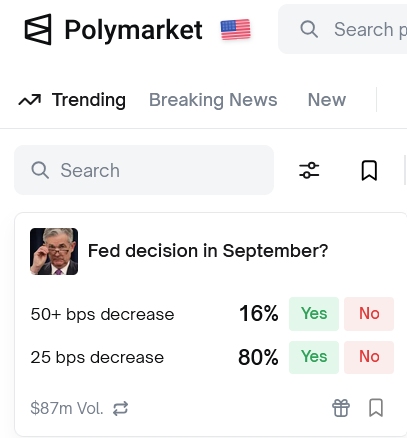
Image from Polymarket website
Polymarket has regained the ability to operate in the United States after acquiring a CFTC regulated and licensed derivatives exchange QCEX for $112 million in July 2025. Soon after the acquisition the Commodity Futures Trading Commission issued a no action letter that relaxed certain reporting and recordkeeping rules tied to event contracts, clearing the way for Polymarket to relaunch in the U.S. after being blocked since 2022 and paying a $1.4 million fine for operating without registration as part of a settlement with the CFTC.
Chief Executive Shayne Coplan highlighted the speed of the approval, writing on X that the green light from the CFTC had been 'accomplished in record timing.'
Polymarket has been given the green light to go live in the USA by the @CFTC.
Credit to the Commission and Staff for their impressive work. This process has been accomplished in record timing.
Stay tuned https://t.co/NVziTixpqO
— Shayne Coplan 🦅 (@shayne_coplan) September 3, 2025
The relaunch it seems was in a politically charged setting. Days before the approval, Donald Trump Jr. disclosed that he had invested through 1789 Capital and accepted an advisory role. The timing of Trump Jr.’s advisory role at Polymarket has raised questions about the influence of politics in a market that depends on regulatory relief.
Not all regulators support the path taken. Outgoing Commissioner Kristin Johnson argued that retail traders face significant risks and that the agency should move beyond case by case exemptions. In her view, the CFTC should create formal rules on which event contracts are permissible instead of leaving gaps in oversight.
Polymarket’s value comes from what people trade. Its most recent markets show how diverse those bets can be.
Traders currently assign about a 7% chance that Donald Trump will leave office before the end of 2025.
At the start of 2025, Polymarket listed more than 65% odds of a U.S. recession. By mid summer, that figure had fallen to 20% after a pause in new tariffs lowered fears. Economists note that these contracts reflect sentiment rather than guaranteed outcomes.
Social and sports betting examples are also trendy, such as the Taylor Swift and Travis Kelce engagement market. A trader turned $12,000 into $50,000 after betting on the couple’s announcement. Another user invested just over $2,000 the day before and made about $3,100 in profit. The odds jumped from 24% to 41% within a single day. No different in how the odds shift around in an in play betting app.
Unexpected outcomes can produce even larger returns or losses. During the papal conclave in May, Cardinal Robert Prevost was trading at only 1%. A bettor who backed him turned $1,059 into more than $63,000 after he became Pope Leo XIV. Total volume on papal betting markets reached about $40 million across Polymarket and Kalshi, another prediction marketplace.
Polymarket’s journey from fine to license shows how quickly a fintech can move from penalty to legitimacy once regulators are engaged, and the importance of building on licensed infrastructure. The markets themselves are worth monitoring, as they mirror real time sentiment. While not perfect market predictors, they are increasingly visible and sometimes a useful barometer for policymakers, investors, and punters alike.
The National Crowdfunding & Fintech Association (NCFA Canada) is a financial innovation ecosystem that provides education, market intelligence, industry stewardship, networking and funding opportunities and services to thousands of community members and works closely with industry, government, partners and affiliates to create aa vibrant and innovative fintech and funding industry in Canada. Decentralized and distributed, NCFA is engaged with global stakeholders and helps incubate projects and investment in fintech, alternative finance, crowdfunding, peer-to-peer finance, payments, digital assets and tokens, artificial intelligence, blockchain, cryptocurrency, regtech, and insurtech sectors. Join Canada's Fintech & Funding Community today FREE! Or become a contributing member and get perks. For more information, please visit: www.ncfacanada.org
| | |
|---|---|---|
| | |
Data Breach | Sep 9, 2025

Image: Freepik/Rawpixel.com
On September 5 2025, Wealthsimple (WS) confirmed that a data security breach occurred on August 30. The company emphasized that it “acted quickly and in a few hours the issue was contained. Our security team, with the help of external experts, immediately began a thorough investigation.”
The breach exposed sensitive personal data including contact details, government IDs submitted at signup, financial account numbers, IP addresses, Social Insurance Numbers, and dates of birth.
All accounts remain secure, and “no funds were accessed or stolen. No passwords were compromised… All accounts remain fully secure.” Less than 1% of clients were impacted out of WS's client base of about three million.
The breach resulted from a compromised component in a third party software package described by the company as “written by a trusted third party”. Wealthsimple confirmed the incident was not linked to any Salesforce breaches circulating in the media.
They said, “We learned that a specific software package had been compromised.” No attackers have been publicly identified, and the specific vendor has not been disclosed.
Wealthsimple detected the compromise on August 30 and contained it within hours. By 10:30 AM EST on September 5 the company had emailed all affected clients and published its public update in the Help Centre at 14:43 ET. The statement included: “If you did not receive an email from us about this, your data was not impacted.”
Wealthsimple is offering every impacted client two years of free credit monitoring, dark web monitoring, identity theft protection, and insurance. Regulators and law enforcement were notified in alignment with standard protocols.
According to the PR statement that Wealthsimple provided NCFA Canada with:
"We apologize for this incident, which happened as a result of a third-party vulnerability. We informed impacted clients as quickly as possible and set up complimentary credit and dark web monitoring, as well as identity theft protections. Significantly less than 1% of our clients were affected. We’re continually strengthening our security infrastructure and have already made improvements to prevent this type of issue from happening again."
Wealthsimple confirmed that improved protections have been implemented to better protect against similar threats.
While technical details weren't disclosed, the breach confirms that even the most advanced fintech platforms are only as resilient as their weakest external link (AKA supply chain risk).
Fintech firms must treat vendor risk management with the same rigor applied to their in house systems, including rigorous assessments of third party dependencies, continuous monitoring of software integrity, well rehearsed incident response plans, and transparent communication with clients and regulators.
For policymakers and regulators, the incident raises important questions about oversight. How can industry standards for supply chain risk be established and enforced before breaches occur?
Trust is the most vital currency. Companies of all sizes must ensure that every link from internal databases to external software is secure to protect clients and preserve consumer and business confidence.
The National Crowdfunding & Fintech Association (NCFA Canada) is a financial innovation ecosystem that provides education, market intelligence, industry stewardship, networking and funding opportunities and services to thousands of community members and works closely with industry, government, partners and affiliates to create aa vibrant and innovative fintech and funding industry in Canada. Decentralized and distributed, NCFA is engaged with global stakeholders and helps incubate projects and investment in fintech, alternative finance, crowdfunding, peer-to-peer finance, payments, digital assets and tokens, artificial intelligence, blockchain, cryptocurrency, regtech, and insurtech sectors. Join Canada's Fintech & Funding Community today FREE! Or become a contributing member and get perks. For more information, please visit: www.ncfacanada.org
| | |
|---|---|---|
| | |


August 26th, 2025

January 4th, 2024

June 1st, 2021

September 9th, 2020

July 9th, 2018

January 3rd, 2018

September 25th, 2017

June 20th, 2017

May 10th, 2017

December 14th, 2016