




Karsten Wenzlaff, Advisor
August 26th, 2025
Karsten Wenzlaff is a Crowdfunding and Fintech Expert from Germany. He is Secretary-General of Digit[...]


Aug 18, 2026

Markets have a few gauges that traders keep open even when they are not planning to trade them. The Nasdaq 100 is one of those gauges. It tends to get attention before the US session, during earnings weeks, and on days when rates or technology shares move hard.
Part of that comes from the companies inside the index. The Nasdaq 100 includes many of the names people already know from software, chips, cloud services, online retail, and consumer devices. When traders change their view on those companies, the index often shows it quickly. That is why the index can be useful even for people who are not trading it that day.
The Nasdaq 100 tracks 100 large non-financial companies listed on the Nasdaq exchange. Because the index leans toward technology and other growth businesses, it can move differently from broader benchmarks that include more banks, utilities, and industrial stocks. A broad index may look calm while the Nasdaq 100 is already showing stress in growth shares.
That mix gives the index a sharper edge. It may rally when traders feel more confident about growth and future earnings. It may also sell off quickly when rate expectations rise or when a large company warns that demand is slowing. The same feature that makes the index interesting can also make it uncomfortable to hold through rough sessions.
For active traders, those swings can create setups. For people watching the wider market, they can also show how much risk investors are willing to take. A strong Nasdaq 100 session can point to renewed appetite for growth stocks. A sudden drop can signal a more cautious mood, especially around inflation data, central bank comments, or major earnings results.
Price movement in the Nasdaq 100 rarely comes from one headline. Traders usually look at company news, macro data, and the general tone of US equities before deciding whether a move has staying power. A rally based only on one strong stock may fade faster than a move supported by several sectors inside the index.
Those drivers can overlap. A company may report strong revenue but still fall if margins disappoint or if traders think interest rates will stay high. Another stock may rise on weaker numbers because expectations were already low. That is why Nasdaq 100 moves often need context rather than a quick headline reading.
For many traders, the index is a shorthand for how the market is treating large growth companies against the current economic backdrop. It is not a perfect economic signal, but it can show whether investors are leaning toward risk or stepping back from it.
Trading platforms make that monitoring easier than it used to be. A trader can keep charts, watchlists, alerts, price data, and instrument details in one place instead of jumping between separate screens. That convenience matters when the market is moving and a slow check can lead to a late decision.
This is useful when the market starts moving quickly. One earnings report, one change in rate expectations, or one sharp move in US equity futures can change the tone of the session. Traders following the Nasdaq 100 usually want to see price levels, spreads, recent volatility, and related news before they place an order.
Someone comparing index products can use Vantage's nas100 page to check instrument details, pricing context, and platform access before deciding whether the market fits their plan. That page is not a trading signal. It is a reference point for understanding the product before putting money at risk.
Good platform habits are usually boring, but they matter. Traders may set alerts near levels they care about, check the daily range before deciding position size, and compare current spreads with what they normally see. None of that predicts the next move. It simply reduces the chance of entering a trade without knowing the basic conditions.
A chart helps, but it is only part of the job. Traders also need to know how the instrument behaves on the platform they use. That includes the typical spread, order types, margin requirements, and how quickly prices can change during busy sessions.
Risk controls deserve the same attention as the setup. Stop-loss orders, position sizing, alerts, and account limits can keep a market view from turning into oversized exposure. That matters even more with index-based products, where leverage can magnify losses as well as gains.
Execution is another practical issue. In quieter sessions, prices may move in a fairly orderly way. During data releases or earnings headlines, the same market can become much harder to read. Watching how a platform handles those moments can be as useful as watching the chart.
A simple pre-trade routine can help. Check why the index is moving, decide where the idea is wrong, and know the maximum loss before entering. Traders do not need a complicated checklist, but they do need a repeatable one. Without that, a fast market can turn a reasonable idea into a rushed reaction.
The Nasdaq 100 is easy to follow because many of its companies are familiar. That familiarity can be misleading. Knowing the names in the index does not protect a trader from sudden gaps, sharp reversals, or bad timing. A familiar company can still move in a way that surprises even experienced traders.
Past moves do not guarantee the next one. A pattern that worked during one earnings season can fail in the next. A level that held last month can break when macro conditions change. The index is liquid and closely watched, but that does not make it predictable.
Used carefully, Nasdaq 100 price action can help traders understand the mood around growth stocks and wider equity risk. It works best alongside product research and a clear risk plan. Preparation matters more than prediction, especially in a market where speed can make confidence look better than it really is.
 The National Crowdfunding & Fintech Association (NCFA Canada) is a financial innovation ecosystem that provides education, market intelligence, industry stewardship, networking and funding opportunities and services to thousands of community members and works closely with industry, government, partners and affiliates to create a vibrant and innovative fintech and funding industry in Canada. Decentralized and distributed, NCFA is engaged with global stakeholders and helps incubate projects and investment in fintech, alternative finance, crowdfunding, peer-to-peer finance, payments, digital assets and tokens, artificial intelligence, blockchain, cryptocurrency, regtech, and insurtech sectors. Join Canada's Fintech & Funding Community today FREE! Or become a contributing member and get perks. For more information, please visit: www.ncfacanada.org
 |  |  |
|---|---|---|
 |  |  |
August 17, 2026 | NCFA Market Activity | Banking And Credit, Artificial Intelligence And Data

On August 17, 2026, Montréal-based Brdg confirmed a C$850,000 pre-seed round to expand its construction finance platform. One week earlier, Toronto-based Mortgage Automator launched Construction Draw Management, bringing construction budgets, draw schedules and approvals into the active loan file.
Brdg organizes project information across developers, cost consultants and lenders. Mortgage Automator brings draw control into the lender's loan system.
Brdg isn't a lender. Its software organizes the documents, budgets and project information used to prepare and review construction financing.
The platform accepts documents through email or upload, classifies them and organizes them into a project record. It tracks budgets, project progress and funding information, checks draw readiness across legal, contract, construction and financial categories, and produces lender-ready reports. Brdg provides separate workflows for developers, lenders and cost consultants. Its construction finance platform also shows document ingestion, project dashboards, cash-flow tracking and draw-disbursement readiness.
Brdg reports 30,000+ construction-related documents processed, more than C$300 million in development and active construction, and an average 5.5-day reduction in draw cycle time.
The document volume and reported time savings indicate that Brdg is being used in live construction finance workflows. The C$300 million figure describes development and active construction associated with Brdg's work. It is not revenue, loans originated, financing arranged or assets under management.
Brdg also describes the product as AI-powered and uses labels including Intelligence Agent and Submission Agent. Public evidence supports AI-assisted document and workflow processing. It does not establish autonomous underwriting or credit decisions.
Forum Ventures invested in Brdg, and the company joined its Summer 2026 cohort. Co-founder Ness Cabessa describes Brdg as replacing spreadsheets, email and manual draw processes with a structured construction finance platform.
Mortgage Automator starts from the lender side.
Its Draw Management feature keeps the construction budget inside the same system as the loan. Lenders build budget categories, line items and amounts in Mortgage Automator, then manage planned or ad hoc draw requests against that budget.
The system flags variances and can enforce configurable loan-to-cost limits. Project Health compares work completed with funds already disbursed, giving lenders another way to identify budget drift across active construction loans.
Mortgage Automator says the feature responds to private mortgage lenders, including construction and fix-and-flip lenders that were managing loans in one system while tracking construction budgets in spreadsheets or separate software.
A developer may prepare budgets, invoices and supporting documents. Cost consultants review project costs and progress. Lenders determine whether conditions have been met before additional funds are released.
Construction loans release financing in stages because lenders need evidence that work and project costs are progressing before advancing more capital.
That process is visible in Canada's public construction financing system. CMHC's Apartment Construction Loan Program provides loans starting at C$1 million and can finance up to 100% of the residential component's cost for qualifying projects.
The federal program has been expanded to more than C$55 billion in loan funding. Some program streams use monthly construction draws once the loan agreement is in place.
Every draw can bring another set of budgets, invoices, progress information, contracts, approvals and supporting reports into the financing process.
Cost consultants are also part of that control chain. They can review construction progress, costs and supporting documentation before lenders release additional financing.
Brdg structures project information before and during lender review. Mortgage Automator keeps budgets and draw controls attached to the active loan.
The next evolution is to carry the same structured project data from developers and cost consultants into lender systems without rebuilding it at each stage.
That would reduce duplicate data entry, make budget changes easier to trace and give lenders a clearer record of what changed between draw requests.
The open question is how the market develops from here. Lenders may prefer draw tools built into their loan systems. Developers and cost consultants may need platforms that work across several lenders. Integrations could eventually connect the two.
Will construction finance software remain split between developer, consultant and lender workflows, or will shared project data eventually connect the full draw process?
The National Crowdfunding & Fintech Association (NCFA Canada) is a financial innovation ecosystem that provides education, market intelligence, industry stewardship, networking and funding opportunities and services to thousands of community members and works closely with industry, government, partners and affiliates to create a vibrant and innovative fintech and funding industry in Canada. Decentralized and distributed, NCFA is engaged with global stakeholders and helps incubate projects and investment in fintech, alternative finance, crowdfunding, peer-to-peer finance, payments, digital assets and tokens, artificial intelligence, blockchain, cryptocurrency, regtech, and insurtech sectors. Join Canada's Fintech & Funding Community today FREE! Or become a contributing member and get perks. For more information, please visit: www.ncfacanada.org
| | |
|---|---|---|
| | |
Aug 17, 2026

When the first DORA Register of Information submissions arrived in April 2025, European supervisors kept hitting the same wall. Financial entities could not produce an accurate, current list of their own ICT assets. The data sat in spreadsheets, in a departed engineer's notes, and across two or three tools that disagreed with each other. The EBA flagged widespread gaps and sent institutions back to resubmit, in several cases more than once.
None of that was a security failure in the usual sense. The controls were often in place. What was missing sat one level lower: a reliable inventory of what the firm actually runs. For a fintech, that absence is not a documentation nuisance. Operational resilience – keeping payments, ledgers, and customer access working through a disruption – rests on knowing what you run, where it runs, and what stops when a component fails. You cannot map a dependency you never recorded, and you cannot restore a service whose parts you cannot name.
DORA (Regulation (EU) 2022/2554), in force since 17 January 2025, states the requirement plainly. Article 8 obliges financial entities to identify and classify all ICT assets and information assets, document the links and interdependencies between them, and keep those inventories current – refreshed after every major change, with a dedicated risk assessment of legacy systems at least once a year. DORA requires EU member states to lay down effective, proportionate and dissuasive penalties for financial entities. The sanctions that apply depend on national law and on the circumstances of the breach.
The UK sets a parallel bar. Under FCA policy statement PS21/3 and PRA supervisory statement SS1/21, the transitional implementation period ended on 31 March 2025. Firms must identify their important business services, set impact tolerances, and map the resources each service depends on, including technology, data, facilities, and people. That mapping collapses without an accurate asset layer beneath it. In the US, the 2020 interagency paper on operational resilience points the same way, tying resilience to a clear view of critical systems and their dependencies.
Enforcement is tightening rather than loosening. Germany's BaFin declared the DORA “transformation year” over at the end of 2025, a signal that supervisors now expect working inventories, not remediation plans. Three regulators, one shared premise: transparency of IT assets is the precondition for everything built on top of it.

Figure 1
Figure 1. IT asset transparency is the base layer every resilience process depends on.
Transparency is not a spreadsheet exported once a quarter. It is three capabilities working together, and the weakest one sets the ceiling.
Automated hardware and software auditing finds devices, virtual machines, cloud instances, and installed packages without waiting for anyone to complete a form. Fintechs churn infrastructure quickly, so a hand-maintained list is stale within weeks. Agent-based and agent-less scanning each catch what the other misses – agents report from laptops that leave the network, while agent-less scans reach devices where you cannot install software.
A configuration management database (CMDB) records that a specific payment API runs on these servers, reads from that database cluster, and backs a named customer-facing service. During an incident, that relationship graph gives you blast radius in seconds instead of a war-room reconstruction. A flat asset list cannot answer the question that matters: if this fails, what else goes with it?
Every asset needs a criticality rating, a named owner, a lifecycle state, and a link to the business function it supports. That is close to a word-for-word restatement of what DORA Article 8 asks a financial entity to hold, which is why an inventory missing those fields tends to fail at submission time rather than during an outage.
Table 1. What each resilience obligation actually needs from the asset layer.
| Resilience obligation | Asset data it requires | Consequence of a gap |
| DORA Article 8 inventory and classification | Full list of hardware, software, and cloud services with a criticality rating and named owner | Incomplete Register of Information; repeated resubmission cycles |
| Dependency mapping (DORA Art. 8; UK important-business-service mapping) | CMDB relationships tying assets to services, users, and third parties | Cannot scope incident impact or evidence a recovery path |
| Incident response and recovery | Live location, configuration, and ownership for every asset | Longer time-to-restore; recovery steps improvised during the outage |
| Yearly legacy-system risk review | Lifecycle state, end-of-life flags, and patch status | End-of-life systems stay live and unassessed |
| Third-party and concentration risk | Register of vendor-linked assets and their interconnections | Blind to a supplier dependency during a supplier outage |
The failure modes are predictable. Cloud and SaaS growth push assets outside the corporate network, where an on-network scanner never sees them. Shadow IT – a product team standing up a service on a corporate card – never reaches the register at all. Remote and field laptops drop off the VPN and stop reporting, so their patch state quietly goes unknown. And the most common failure is the humblest one: the inventory lives in spreadsheets and email threads that no discovery tool feeds, so it drifts out of date the moment it is saved.
The dataset behind Alloy Software's recent deals shows how entrenched that last pattern is. Across more than 40 closed-won accounts between 2024 and 2026, spreadsheets, email, and homegrown databases were the single most common system teams were replacing – ahead of any named commercial tool.

Figure 2
Figure 2. Prior systems replaced across 40+ Alloy Software closed-won deals (2024–2026).
A workable sequence follows the order of dependency, not the order of visible output:
The order matters. Teams that start with dashboards before discovery end up with attractive reports built on data nobody trusts. Discovery first, relationships second, reporting last.
For a regulated fintech, three questions filter the market quickly. Does discovery reach cloud and off-network devices? Does the CMDB model relationships rather than store a flat list? Can the data stay on-premises where a security policy or air-gapped requirement demands it? Cost matters, but it rarely decides the outcome on its own.
Table 2. Decision view across five ICT asset and service-management platforms.
| Platform | Discovery reach | CMDB and relationships | Hosting | Indicative cost / fit |
| Alloy Navigator | Agent and agent-less network inventory; off-network audit for field laptops | Integrated CMDB; tickets linked to assets, users, and contracts | On-prem or cloud | ~$1k–$25k/yr; 2–35 IT staff |
| ServiceNow | Agent-less discovery via MID server; broad cloud coverage | Deep, highly configurable CMDB | Cloud-first; limited on-prem | Six-figure programmes; 100+ IT staff |
| Lansweeper | Agent and agent-less scanning; strong network coverage | Asset-centric; lighter service relationships | Cloud or on-prem | Per-asset pricing that has risen sharply; small–mid teams |
| ManageEngine ServiceDesk Plus | Agent and agent-less; discovery add-on | CMDB in higher tiers | On-prem or cloud | Low–mid, per-technician/node; small–mid teams |
| Freshservice | Discovery agent plus probe | Cloud-native CMDB | Cloud only | Per-agent SaaS; no on-prem option |
Costs reflect market positioning, not quotes; verify against current vendor pricing before shortlisting.
Where a firm has outgrown spreadsheets but cannot absorb a six-figure ServiceNow programme, mid-market platforms cover the ground. Alloy Navigator sits in that band: agent and agent-less network inventory, an integrated CMDB that links tickets to assets, users, and contracts, and a choice of on-premises or cloud hosting for healthcare, public-sector, and finance environments with strict data-residency rules. Deal data puts its annual cost between roughly $1,000 for small teams and $25,000 for larger estates, which is why it usually appears against Lansweeper and ManageEngine rather than enterprise suites.
An accurate asset register earns its keep only when it feeds the processes around it. Change management is the clearest example: when every change references the assets and services it touches, the CMDB stays current as a by-product of daily work instead of decaying between audits. Incident response reads the same relationship graph to scope impact, and third-party risk mapping – a specific DORA obligation – draws on the register of vendor-linked assets. Teams that want to go deeper on tying assets to change and incident workflows tend to find that the relationship model, not the raw asset count, is where the resilience value sits.
If a fintech can answer three questions on demand – what do we run, what depends on it, and who owns it – most of DORA Article 8 and the UK mapping requirement is already within reach. If it cannot, no volume of policy documentation closes the gap, because the gap is data, not paperwork. Point automated discovery at the whole estate, including cloud and remote endpoints, and measure how far the result differs from the current spreadsheet. That delta is the honest size of the resilience problem.
The National Crowdfunding & Fintech Association (NCFA Canada) is a financial innovation ecosystem that provides education, market intelligence, industry stewardship, networking and funding opportunities and services to thousands of community members and works closely with industry, government, partners and affiliates to create a vibrant and innovative fintech and funding industry in Canada. Decentralized and distributed, NCFA is engaged with global stakeholders and helps incubate projects and investment in fintech, alternative finance, crowdfunding, peer-to-peer finance, payments, digital assets and tokens, artificial intelligence, blockchain, cryptocurrency, regtech, and insurtech sectors. Join Canada's Fintech & Funding Community today FREE! Or become a contributing member and get perks. For more information, please visit: www.ncfacanada.org
| | |
|---|---|---|
| | |
August 17, 2026 | NCFA Market Activity | Capital Markets And Market Infrastructure, Wealth Investing And Trading, Competition And Market Structure

National Bank is modernizing its fund and ETF accounting infrastructure with Multifonds, bringing work handled across separate systems onto one platform.
On August 11, 2026, Multifonds announced that National Bank of Canada had selected Multifonds for fund and ETF accounting after an evaluation and proof of concept.
The project gives National Bank one accounting environment for more of the valuation, NAV and ETF administration work it performs for firms that offer investment funds and ETFs.
National Bank provides fund and ETF administration services that include fund accounting, transfer agency, ETF basket creation, financial statements and tax support.
Multifonds Global Accounting brings fund and ETF accounting into one environment. It processes data in real time and uses exception based workflows so operations teams can focus on records that need review.
The platform includes more than 350 configurable controls across NAV, valuation and distribution work. Multifonds says it supports more than 40,000 funds across 35+ jurisdictions.
National Bank plans to replace siloed systems with the platform. Multifonds expects the change to reduce manual steps, improve oversight and support faster product onboarding.
While those are the expected benefits, the results will depend on how the platform performs once National Bank moves more accounting work into production.
ETF administration involves more than calculating a fund's value. National Bank also supports transfer agency, market makers and the creation of ETF baskets.
Those processes depend on accounting records and outside data staying aligned. Multifonds connects ETF accounting with more automated data exchange, giving National Bank a common system for more of that work.
Canada's ETF market has grown sharply. Canadian ETFs attracted a record C$122 billion in net inflows in 2025, up 62% from the previous record, and Canadian ETF assets reached about C$790.5 billion by the end of March 2026.
Canada's ETF market has grown sharply. Canadian ETFs attracted a record C$122 billion in net inflows in 2025, while industry assets approached C$800 billion in early 2026.
The market is also under closer regulatory review. The CSA consultation on Canadian ETF rules examines areas including unit creation and redemption, ETF trading, NAV alignment and basket practices.
That growth means more products, valuations, baskets, records and exceptions for administrators to process. Automation can reduce repetitive work, but controls still have to catch problems before incorrect data reaches fund managers, trading partners or investors.
The same operating challenge appears in tokenized fund operations. New ways to issue or transfer fund interests still depend on reliable pricing, accounting, investor records and administration.
National Bank is investing in a part of the market where other large Canadian asset servicers are also spending on technology.
In April, CIBC Mellon expanded its Appian automation program. Planned improvements include a more digital ETF service and fund administration workflows designed to reduce manual work and improve data visibility. CIBC Mellon reported more than C$3.4 trillion in assets under administration as of March 31, 2026.
RBC Investor Services reported C$3.1 trillion in assets under administration in the second quarter. Its asset servicing technology investments include ETF modernization, automated reconciliations and predictive reporting.
These investments highlight competitive pressure. Fund administrators need to support more products and data without adding manual work at the same rate.
Technology can influence how quickly an administrator launches products, handles exceptions and gives clients access to accurate information.
National Bank is also using specialist technology in other operating areas. Its Sardine fraud controls deployment focuses on fraud and financial crime rather than fund administration, but both projects use specialist technology for high-volume financial operations.
Moving more fund and ETF accounting onto one platform can simplify operations, but it also increases dependence on that platform.
National Bank will need strong data quality, integrations, controls and recovery processes as the implementation expands. If a shared accounting system fails, the adverse impacts can amplify and reach more funds and ETF workflows at once.
As Canadian asset servicers automate more fund and ETF administration, will technology become a bigger factor in which providers win new business?
The National Crowdfunding & Fintech Association (NCFA Canada) is a financial innovation ecosystem that provides education, market intelligence, industry stewardship, networking and funding opportunities and services to thousands of community members and works closely with industry, government, partners and affiliates to create a vibrant and innovative fintech and funding industry in Canada. Decentralized and distributed, NCFA is engaged with global stakeholders and helps incubate projects and investment in fintech, alternative finance, crowdfunding, peer-to-peer finance, payments, digital assets and tokens, artificial intelligence, blockchain, cryptocurrency, regtech, and insurtech sectors. Join Canada's Fintech & Funding Community today FREE! Or become a contributing member and get perks. For more information, please visit: www.ncfacanada.org
| | |
|---|---|---|
| | |
Aug 17, 2026

A mid-size alternative lender in Vilnius pulls company registry filings, marketplace pricing and sanctions lists into its underwriting model every night. None of it is illegal to read. Most of it becomes a liability the moment it is copied, stored and combined with something else. That gap between "publicly visible" and "lawfully processed" is where fintech compliance teams keep losing arguments with their own data science departments.
Public web data – company filings, marketplace listings, court dockets, sanctions databases, social media bios – has become a standard input for credit scoring, fraud detection, KYB and competitive pricing in financial services. In Meta Platforms v. Bright Data, a federal district court held that Bright Data had not breached Meta's terms of service by collecting data from logged-out pages, which was the specific conduct at issue. The ruling turned on Bright Data's particular conduct and its contractual relationship with Meta rather than establishing a general rule for scraping public websites. For a regulated entity, that distinction is not academic. A bank's third-party risk team, an EU DORA auditor or a state attorney general does not care whether the data was "technically public" if the collection method itself created exposure.
hiQ Labs v. LinkedIn is still the reference case for US practitioners, and it is more nuanced than the headlines from 2019 suggest. The Ninth Circuit held twice, first in 2019 and again on remand in 2022, that scraping data from pages open to any visitor does not amount to accessing a computer "without authorization" under the Computer Fraud and Abuse Act. That took the CFAA off the table as a criminal exposure for reading public pages. It did not end the case. hiQ and LinkedIn settled the remaining contract claims in 2022, and hiQ agreed to destroy the data it had already collected and pay damages, because its scraping still violated LinkedIn's user agreement. The lesson for a fintech legal team is specific: CFAA risk and contract risk are two separate questions, and winning on one does not close the other.
On the EU side, the CFAA question barely matters, because GDPR does not distinguish between public and private personal data. Article 4 defines personal data by whether it relates to an identifiable natural person, not by where it was found. A LinkedIn bio, a court filing with a defendant's name, or a marketplace seller profile with a real name attached all fall inside GDPR's scope the moment they are collected, and Article 6 still requires a lawful basis – legitimate interest is workable for adverse-media or fraud screening, but it requires a documented balancing test, not just a note in a Confluence page.
Four use cases account for most of the public-data traffic coming out of fintech data engineering teams. Alternative underwriting pulls e-commerce store metrics, invoice marketplaces and gig-platform ratings to score borrowers who lack conventional credit files – Kabbage and, later, Amex built entire product lines on this. AML and sanctions screening cross-references OFAC, EU and UN lists against onboarding data, refreshed daily because list updates are unscheduled. Competitive pricing intelligence in embedded finance and BNPL tracks merchant-facing rates across marketplaces to benchmark interchange and fee structures. Fraud and adverse-media screening checks court records, press mentions and social profiles as a secondary signal alongside device fingerprinting.
Not all four carry the same regulatory weight. The table below is the one compliance teams actually need before greenlighting a collection project, not a generic "data source" taxonomy.
| Data source | Typical fintech use | Regulatory sensitivity | Main legal basis to check |
| Company registries (Companies House, EDGAR, EU BRIS) | KYB, beneficial ownership checks | Low to medium | Public register rules and applicable data protection law; filings may contain personal data of directors, officers, beneficial owners and other natural persons |
| Sanctions and PEP lists (OFAC, EU, UN) | AML/KYC screening | Low | Government-published, but update frequency and source authenticity matter |
| E-commerce and marketplace pricing | Competitive intelligence, embedded-finance pricing models | Low to medium | Terms of service and contract law; CFAA exposure may be lower for pages accessible without login (per hiQ v. LinkedIn) |
| Public social media profiles | Alternative credit signals, fraud indicators | Medium to high | GDPR/CCPA personal-data rules apply even if the profile is public |
| Court records and litigation databases | Adverse media, fraud investigation | High | Jurisdiction-specific rules on re-use of judicial data (varies widely, e.g. France's Article 33) |
The engineering choices matter as much as the legal analysis, because a regulator or a bank's third-party risk assessor will ask for logs, not intentions. A defensible pipeline has five properties, and they map to concrete infrastructure decisions rather than policy statements.

Figure 1
Figure 1. Each control maps to an artifact a third-party risk assessor can actually inspect. The first four are described below; request logging is the fifth, and the one the practical takeaway returns to.
Reading a site's robots.txt crawl-delay directive and setting concurrency accordingly is a five-minute engineering task that changes the legal character of the whole program. A crawler hitting a company registry at 200 requests per second looks like a denial-of-service test to the target's security team, regardless of what the data is used for afterward. Most production fintech scrapers we've reviewed cap at 1 request per 2-4 seconds per domain, which keeps CPU load on the target negligible and avoids the WAF triggers that generate abuse complaints in the first place.
This is the point where proxy infrastructure choice stops being a procurement decision and starts being a compliance decision. Rotating through residential or datacenter IPs to maintain a stable success rate against rate limits is standard engineering practice. Rotating IPs specifically to re-access a source after being blocked for a terms-of-service violation is the fact pattern that turned hiQ's win on CFAA into a loss on contract claims. The distinction sounds semantic until an opposing counsel reconstructs your request logs during discovery.
Filtering personal identifiers (names, emails, phone numbers, biometric-adjacent fields) before the data lands in a warehouse is materially cheaper than filtering it after ten analysts have already queried the raw table. A regex-and-NER pass at the collection layer, logged with a timestamp and a rule version, is the artifact a DPO can actually show an auditor.
GDPR's storage limitation principle (Article 5(1)(e)) and most US state privacy laws expect a defined retention period. "We keep everything indefinitely for model retraining" is the single most common finding in the DPIAs we've read for alt-data underwriting programs, and it is usually fixable with a 90-180 day rolling window plus a documented exception process for flagged accounts.
Proxy and scraping infrastructure choice affects three things a compliance file will ask about: whether the vendor itself runs KYC on IP sourcing, whether the billing model matches your actual usage pattern (per-IP monthly vs. per-GB bandwidth), and whether the vendor's own terms indicate the network is ethically sourced rather than built from compromised devices.
| Provider | Billing model | Entry price | Where it fits a fintech workload |
| Proxys.io | Per dedicated IP / month | From $1.40/mo (individual IPv4), $0.13/mo (IPv6) | Steady, low-volume monitoring jobs (registry checks, sanctions list refresh) where a fixed, auditable IP per data feed is easier to log than rotating bandwidth pools |
| Decodo (formerly Smartproxy) | Per GB, tiered | $2.00-$3.75/GB depending on volume | Mid-volume scraping across many source domains where bandwidth, not IP count, is the cost driver |
| Oxylabs | Per GB, sales-assisted | Roughly $8/GB at entry tier, KYC required before provisioning | Enterprises that want a vendor-side KYC record as part of their own third-party risk file |
| Bright Data | Per GB (PAYG or committed) | $8.40/GB PAYG residential, down to ~$3/GB committed; datacenter from ~$0.90/GB | Large, multi-region collection programs where volume discounts offset the higher entry rate |
The billing model split matters more than the headline price. A sanctions-list refresh job that hits the same twelve government sources every night at a predictable, low volume is a poor fit for per-GB bandwidth pricing – you're paying for a metric (data transferred) that has almost nothing to do with your actual constraint, which is IP reputation and consistency of access over time. Vendors like Proxys.io bill per dedicated IP per month, which lines up better with that access pattern and makes cost forecasting for a fixed set of monitored sources straightforward. A marketplace-pricing crawl that touches thousands of product pages across dozens of domains is the opposite case: bandwidth is the real cost driver, and a per-GB model from Decodo, Oxylabs or Bright Data scales more predictably with that workload. Enterprises already running Oxylabs' or Bright Data's own KYC process may lean on that as one input to their own vendor risk assessment, though it doesn't substitute for one.
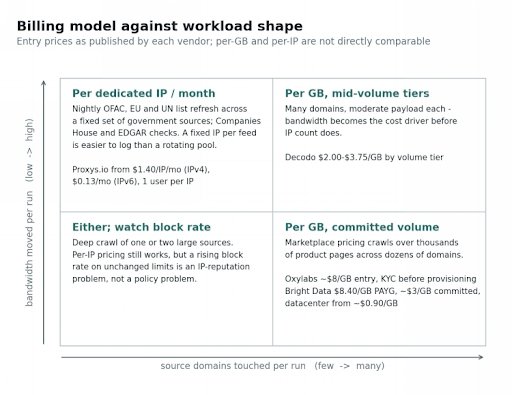
Figure 2
Figure 2. The two variables that move cost are how many domains a run touches and how much data it moves, not the headline price per unit. Per-IP and per-GB rates are quoted in different units and cannot be compared directly.
None of these vendors, including the ones with published ethics or KYC pages, remove the fintech's own obligation to define a lawful basis, log what was collected, and honor retention limits. The proxy layer solves an availability and reliability problem – consistent access to public pages without disproportionate load on the source – not a data protection problem.
Three signals usually mean a proxy or scraping setup needs to change, independent of price. First, a rising block rate on sources with unchanged rate limits – that's an IP-reputation problem the vendor's pool has accumulated, not something a compliance policy fixes. Second, the compliance team asking for source-level access logs the engineering stack can't currently produce – that's a signal the collection layer needs structured logging before it needs a new vendor. Third, a shift in workload shape, for example moving from a handful of steady, low-volume registry checks to broad multi-domain marketplace crawling, which usually means the per-IP pricing that worked for the first case stops making sense for the second.
A fintech data program built on public web sources holds up under regulatory review when three things are documented before the first request is ever sent: the lawful basis for each data category (not a blanket justification), the technical controls that keep collection proportionate to the source (rate limits, minimization, retention), and a request log detailed enough to reconstruct what was collected and why if a regulator or a counterparty's third-party risk team asks. The infrastructure vendor is a smaller decision than most procurement processes treat it as – it changes reliability and cost, not the underlying legal analysis.
The National Crowdfunding & Fintech Association (NCFA Canada) is a financial innovation ecosystem that provides education, market intelligence, industry stewardship, networking and funding opportunities and services to thousands of community members and works closely with industry, government, partners and affiliates to create a vibrant and innovative fintech and funding industry in Canada. Decentralized and distributed, NCFA is engaged with global stakeholders and helps incubate projects and investment in fintech, alternative finance, crowdfunding, peer-to-peer finance, payments, digital assets and tokens, artificial intelligence, blockchain, cryptocurrency, regtech, and insurtech sectors. Join Canada's Fintech & Funding Community today FREE! Or become a contributing member and get perks. For more information, please visit: www.ncfacanada.org
| | |
|---|---|---|
| | |
August 17, 2026 | NCFA Market Activity | Lending Consumer Credit And BNPL, Digital Assets, Competition And Market Structure

On August 13, 2026, Montreal-based Shakepay launched its Shakepay bitcoin-backed line of credit, BLOC, for eligible Canadian customers. Borrowers can access up to C$50,000, with rates starting at 9.5% APR, using eligible bitcoin held with Shakepay as collateral.
BLOC is offered by Shakepay Credit Inc., an affiliated entity that received securities law exemptive relief to offer bitcoin-backed credit to eligible customers.
Shakepay retains more of the lending operation inside affiliated entities rather than relying on an outside lender to run the credit product.
That sets up a useful comparison with the APX and Netcoins embedded lending model.
BLOC is a revolving line of credit available within Shakepay. Eligible customers can draw against available credit, monitor balances and loan-to-value, make payments and adjust eligible collateral subject to their agreement.
Bitcoin volatility is still paramount. If collateral values fall, borrowers may have to add bitcoin or repay part of the balance. Some or all of the collateral can ultimately be liquidated.
The CSA list of authorized crypto platforms includes Shakepay Inc. as a crypto asset trading platform and Shakepay Credit Inc. separately as a crypto-backed lending platform.
Customers use BLOC through Shakepay, but the loan itself is provided by a separate Shakepay company, Shakepay Credit Inc.
BLOC follows several additions around the same customer relationship.
In July, Shakepay became a direct Interac e-Transfer participant. Customers already had access to e-Transfers, but direct participation gives Shakepay more control over how the service connects to its platform. NCFA's Shakepay Company Intelligence Snapshot tracks its expansion from bitcoin trading into payments, cards and business accounts.
On August 11, Shakepay launched Shakepay savings for cash and bitcoin. Two days later, BLOC added secured credit.
The legal entities and protections differ. Shakepay Inc. operates the regulated crypto platform. Cash savings are offered by Shakepay Financial Inc. Bitcoin savings remain with Shakepay Inc. BLOC is offered by Shakepay Credit Inc.
For customers, those expanding services are part of a common Shakepay experience.
Shakepay says more than 1.5 million Canadians have used the platform. Adding payments, savings and credit gives those customers more reasons to use Shakepay between crypto trades.
Competition therefore extends beyond trading fees and asset listings. Crypto platforms can also compete for payments, balances and borrowing.
Shakepay Credit and APX show two ways Canadian crypto platforms can add secured lending.
Shakepay and Netcoins take different approaches. Shakepay uses a separate company within its own group to provide the loan. Netcoins keeps the customer relationship, while APX handles the lending behind the scenes.
For customers, the practical questions are simpler. Who is actually lending the money? Where is the bitcoin held? What happens if its value falls? How much does the loan cost?
For the platforms, the choice comes down to control. Shakepay keeps more of the lending business inside its own group. Netcoins relies on a specialist provider.
Will Canada's larger crypto platforms keep more regulated financial functions inside affiliated entities, or will specialist providers become the infrastructure behind multiple consumer brands?
The National Crowdfunding & Fintech Association (NCFA Canada) is a financial innovation ecosystem that provides education, market intelligence, industry stewardship, networking and funding opportunities and services to thousands of community members and works closely with industry, government, partners and affiliates to create a vibrant and innovative fintech and funding industry in Canada. Decentralized and distributed, NCFA is engaged with global stakeholders and helps incubate projects and investment in fintech, alternative finance, crowdfunding, peer-to-peer finance, payments, digital assets and tokens, artificial intelligence, blockchain, cryptocurrency, regtech, and insurtech sectors. Join Canada's Fintech & Funding Community today FREE! Or become a contributing member and get perks. For more information, please visit: www.ncfacanada.org
| | |
|---|---|---|
| | |
Aug 17, 2026

Finding the right home improvement specialist is often the defining factor between a stressful renovation and a seamless home upgrade. When it comes to residential remodeling in the National Capital Region, selecting top-tier bathroom contractors Ottawa is essential for ensuring high-quality craftsmanship, compliance with Ontario safety codes, and long-term durability. A bathroom is a complex ecosystem of plumbing, electrical wiring, ventilation, and moisture-proofing—requiring skilled expertise from start to finish.
Among Ottawa's premier residential remodeling specialists, Bath Bloom has established itself as a trusted leader in full-service bathroom transformations. Backed by over two decades of industry experience, Bath Bloom offers homeowners a modern, hassle-free approach to custom remodeling, combining designer aesthetics with licensed trade precision.
Ottawa homes face extreme weather variations throughout the year, ranging from freezing winter conditions to humid summer heat. These environmental shifts cause natural structural expansion and contraction, making proper moisture management and structural integrity critical during a bathroom remodel. Partnering with experienced, local Ottawa bathroom contractors ensures that every layer of your renovation—from subfloor prep and waterproof membranes to final tiling—is built to withstand local climate demands.
Beyond structural durability, working with qualified contractors provides key advantages:
Whether you are updating a compact powder room or designing an expansive master ensuite, Bath Bloom delivers a full spectrum of tailored renovation services across Ottawa, Kanata, Nepean, Barrhaven, and Orléans:
Bath Bloom specializes in converting outdated bathtub-shower combinations into open, luxurious walk-in showers. These custom installations often feature frameless glass enclosures, linear drainage systems, built-in storage niches, and thermostatic multi-jet shower towers.
For homeowners seeking greater accessibility or a sleeker modern look, tub-to-shower conversions offer an immediate upgrade. Bath Bloom utilizes advanced Stone Plastic Composite (SPC) wall panels alongside custom tile work to deliver seamless, grout-free wall surfaces that are effortlessly easy to clean.
For full-scale remodeling projects, Bath Bloom manages complete tear-outs and layout redesigns. This includes relocating plumbing lines, installing custom vanities with quartz or granite countertops, integrating smart LED lighting, and laying premium porcelain tile flooring.
Bath Bloom designs functional, barrier-free spaces for clients looking to age in place safely. Features include low-threshold or curbless shower entries, slip-resistant flooring options, built-in bench seating, and stylishly integrated support hardware.
Selecting a contractor involves comparing craftsmanship, transparency, and client service. Bath Bloom distinguishes itself in the Ottawa market through several core commitments:
To ensure a smooth journey from initial concept to completed space, Bath Bloom follows a proven 5-step project framework:
Investing in a bathroom renovation is one of the most effective ways to elevate your daily living standard while increasing your home’s market value. By hiring experienced, licensed bathroom contractors in Ottawa, you ensure that your project is completed safely, efficiently, and to the highest aesthetic standards.
With over 20 years of experience, transparent fixed pricing, complete 3D design planning, and turnkey project management, Bath Bloom stands out as a premier choice for Ottawa homeowners. To view their project portfolio, explore modern finish options, or request a free consultation, visit bathbloom.ca today.
The National Crowdfunding & Fintech Association (NCFA Canada) is a financial innovation ecosystem that provides education, market intelligence, industry stewardship, networking and funding opportunities and services to thousands of community members and works closely with industry, government, partners and affiliates to create a vibrant and innovative fintech and funding industry in Canada. Decentralized and distributed, NCFA is engaged with global stakeholders and helps incubate projects and investment in fintech, alternative finance, crowdfunding, peer-to-peer finance, payments, digital assets and tokens, artificial intelligence, blockchain, cryptocurrency, regtech, and insurtech sectors. Join Canada's Fintech & Funding Community today FREE! Or become a contributing member and get perks. For more information, please visit: www.ncfacanada.org
| | |
|---|---|---|
| | |


August 26th, 2025

January 4th, 2024

June 1st, 2021

September 9th, 2020

July 9th, 2018

January 3rd, 2018

September 25th, 2017

June 20th, 2017

May 10th, 2017

December 14th, 2016