




Karsten Wenzlaff, Advisor
August 26th, 2025
Karsten Wenzlaff is a Crowdfunding and Fintech Expert from Germany. He is Secretary-General of Digit[...]


July 9, 2026

Source: Bazoom
The Canadian online gambling sector is largely dominated by foreign brands - but domestic operators, and local companies supplying back-end tech or other services to the big names, are also booming. With the market now worth $9.5 billion a year in revenues, picks and shovels are proving a profitable investment.
This piece will look two key domestic brands in Canada's online gambling space, as well as why they're currently not on the level of international competition. And then analyze the potential state of the market going forward, including a new launch in Alberta.
Canada's online gambling system is currently fragmented. The most populous province of Ontario has it's own regulated and licensed market, with Alberta soon set to follow that model. The other states are served by a mix of provincial-backed operators and offshore operators across the globe.
One of the biggest international operators serving markets across North America is Stake. A look at something like the Stake promo code page at Sportsbook Review tells you there's a lot of interest in this one operator's offers and the comparison sites that break them down for players. If you want to compare the offers, you can find more information here, which also shows how competitive the market is, with customers expecting detailed analysis before making a choice.
Despite being a popular market, the prior state of regulations has limited the capacity for Canadian gambling brands directly serving Canadian players. Before Ontario opened its market in 2022 such an operation would have been illegal in many provinces. But in 2026, this has changed. There are now several large Canadian-based gambling companies that directly supply Canadians and keep revenues and taxes in the local economy.
Examples include theScore Bet, Betty and Bet99 among others. Although these brands can't compete with international giants that dominate the market, they are nevertheless making respectable revenues. TheScore Bet is probably the biggest and most established operator. However, although still based in Toronto it is now a subsidiary of American giant Penn Entertainment.
As well as B2C online gambling, Canadian companies are also big in the B2B gambling space. Bragg Group, based in Toronto, provides back-end gaming services for many international gambling brands including those now licensed in Ontario, while Geocomply, based in Vancouver, is a global provider of geolocation technology used to ringfence online gambling in certain jurisdictions worldwide.
Canada's homegrown gambling operations have done well from the Ontario market. However, with big competition from established US brands and offshore operators elsewhere, expanding the locally-licensed market to Alberta will be seen as a massive opportunity.
All three of the Canadian-based betting platforms mentioned above have applied for a license in Alberta, to launch when the market opens.
With the total custom expected to hit an estimated $400 million operators (before the 22% revenue sharing agreement with province) in just the opening half year. That means even if local operators take a smaller slice of the pie than giants like DraftKings and FanDuel, the revenue potential is still significant.
Provincially owned betting platform PlayAlberta may also remain a significant player. Although it failed to attract enough attention away from the offshore market for the government to be entirely happy with it, the site still has its players. However, rumours are now the government is going to get tax money from private operators it no longer sees the expense of running it as worthwhile and so rumors are it could be for sale to private operators.
Then there are the back-end tech suppliers poised to profit, whoever wins the market share race in Alberta. Among Bragg Gaming's clients are many local and international operators - including both DraftKings and FanDuel.
While the Canadian gambling market is booming, and possibly set to see even further growth when Alberta's market opens, things have not always been straightforward for operators or public opinion.
Politicians and the public are more aware than ever of responsible gambling, and compliance costs for Canadian-based gambling operators are high. They also face advertising restrictions that international offshore operators do not nationally, although regulators in Ontario have been looking to curb both kinds of gambling advertising.
Customer acquisition costs are also high, especially when operators compete on a new market. Alberta will offer another chance for smaller Canadian gambling brands to start on a new playing field against the big operators. However the financial clout of FanDuel, for example, often allows them to offer bigger bonuses. Because they can more easily swallow the cost of a player getting lucky of the bonus and winning big.
Nevertheless, in a competitive market that is new for Albertan customers, a locally-based option may prove well placed. Only time will tell. Certainly many companies are betting on Alberta, with more than 45 operators registered for launch ahead of the July 13 opening day. With Ontario's market posting huge revenues and tax dollars since 2022, few would bet against a similarly successful launch.
 The National Crowdfunding & Fintech Association (NCFA Canada) is a financial innovation ecosystem that provides education, market intelligence, industry stewardship, networking and funding opportunities and services to thousands of community members and works closely with industry, government, partners and affiliates to create a vibrant and innovative fintech and funding industry in Canada. Decentralized and distributed, NCFA is engaged with global stakeholders and helps incubate projects and investment in fintech, alternative finance, crowdfunding, peer-to-peer finance, payments, digital assets and tokens, artificial intelligence, blockchain, cryptocurrency, regtech, and insurtech sectors. Join Canada's Fintech & Funding Community today FREE! Or become a contributing member and get perks. For more information, please visit: www.ncfacanada.org
 |  |  |
|---|---|---|
 |  |  |
July 8, 2026 | NCFA Market Activity | SME Finance And Business Banking, Artificial Intelligence And Data, Digital Identity And Trust, Cybersecurity And Fraud, Fintech And Innovation

On July 7, 2026, Equifax announced a definitive agreement to acquire Círculo de Crédito, a Mexican credit information services company, for a $750 million enterprise value. The companies expect the transaction to close in the fourth quarter of 2026, subject to closing conditions and regulatory review.
Círculo de Crédito operates consumer and commercial credit bureau services in Mexico. Equifax says the company serves more than 1,700 bank, retail, fintech, small business lending, microfinance and telecommunications customers, with 2 billion tradelines covering 80 million validated identities.
The deal expands Equifax’s international credit data footprint in Mexico, which Equifax describes as one of the fastest growing credit markets globally. Círculo de Crédito generated an estimated $134 million in revenue for the 12 months ended June 30, 2026, up 31%, with $62 million of adjusted EBITDA.
Equifax says Círculo de Crédito uses alternative data, including gig economy transactions, utility payment history and telecommunications payment history. Mexico has a large underbanked population. Mexico is a market where more than 25% of the population lacks access to formal financial products and nearly 44% does not have a bank account.
Alternative data can help lenders assess thin file borrowers, informal workers, microbusinesses and consumers without deep traditional credit histories. It can also help challenge questions about consent, data quality, explainability, model governance and consumer protection when credit access depends on broader data signals.
More data can widen access, but only if lenders can show how the data is collected, governed, explained and challenged.
Equifax says the acquisition gives Círculo de Crédito customers access to Equifax cloud native capabilities, EFX.AI technology, identity protection and fraud prevention offerings.
Following closing, Círculo de Crédito will join the Equifax International business. Juan Manuel Ruiz Palmieri and the existing Círculo de Crédito team are expected to continue leading the company.
The acquisition also continues Equifax’s expansion strategy. CEO Mark W. Begor said Círculo de Crédito would be Equifax’s 17th bolt on acquisition in the past six years, bringing the total for that period to nearly $5 billion.
Lenders increasingly rely on identity coverage, alternative data, fraud controls and AI assisted underwriting to expand credit access. That same data quality issue appears in AI Won't Solve SME Finance Without Better Data, where the core problem is not model ambition, but whether business data is trusted, verified and usable.
That connects directly to Canada’s own SME finance debate. NCFA recently examined why SME loan competition in Canada is under review, including lender concentration, switching friction and access barriers for smaller firms.
It also fits the Open Finance SME Capital Access opportunity area, where SME data, credit access and open finance are already linked.
More data can support credit access. The hard part is proving that expanded data use remains accurate, explainable and fair.
Can alternative data expand credit access without creating new blind spots in consent, model governance and borrower recourse?
The National Crowdfunding & Fintech Association (NCFA Canada) is a financial innovation ecosystem that provides education, market intelligence, industry stewardship, networking and funding opportunities and services to thousands of community members and works closely with industry, government, partners and affiliates to create a vibrant and innovative fintech and funding industry in Canada. Decentralized and distributed, NCFA is engaged with global stakeholders and helps incubate projects and investment in fintech, alternative finance, crowdfunding, peer to peer finance, payments, digital assets and tokens, artificial intelligence, blockchain, cryptocurrency, regtech, and insurtech sectors. Join Canada's Fintech & Funding Community today FREE! Or become a contributing member and get perks. For more information, please visit: [www.ncfacanada.org](http://www.ncfacanada.org)
| | |
|---|---|---|
| | |
July 8, 2026 | NCFA Market Activity | SME Finance And Business Banking, Artificial Intelligence And Data, Payments And Money Movement, Digital Identity And Trust, Risk Compliance And Regtech

On July 7, 2026, Vancouver-based Canadian fintech company FintechWerx International Software Services Inc. announced that it entered an intellectual property and technology asset purchase agreement to acquire Ruby Loans, a small and medium sized Canadian business lending platform.
FintechWerx agrees to acquire the technology from 1431575 B.C. Ltd., an arm’s length vendor. Closing is still subject to the usual conditions, including corporate, regulatory and Canadian Securities Exchange approvals.
FintechWerx is paying up to $825,000. The package includes $100,000 in cash on closing, 728,862 common shares at a deemed price of $0.6174 per share, and up to $275,000 in milestone payments through additional shares.
Ruby Loans is positioned as an AI native loan origination infrastructure for credit unions and other financial institutions, helping prepare decision ready SME loan files before human underwriting review.
While the purchase price is modest, the operating problem is not.
The OECD’s 2026 Canada SME financing profile says small business lending in Canada reached $160.1 billion in 2024, up from $134.8 billion in 2023. Small businesses represented 11.7% of total outstanding business loans.
Statistics Canada reported that 25.7% of Canadian SMEs requested debt financing in 2023. The most common products were business credit cards, lines of credit and term loans.
SME finance is often judged by capital availability, while the borrower experience depends on workflow. A lender can have capital and still lose time to incomplete files. A business can need liquidity and still get stuck in repeated document requests. Also worth noting that SME loan competition in Canada is currently under review.
That kind of friction is costly in the current climate. Tariffs, input costs and uncertain demand are putting pressure on many Canadian SMEs. CFIB reported in March 2026 that 68% of Canadian small business owners continued to say they were negatively affected by U.S. tariffs.
FintechWerx already provides merchant onboarding, payment processing, identity verification, fraud mitigation and data services. Ruby Loans adds AI native SME loan origination technology to that platform.
Ruby Loans automates borrower intake, document collection and policy based pre screening before a lending officer reviews an application. The platform includes a configurable policy rules engine, automated applicant interview and Accept, Review or Decline dashboard.
George Hofsink, CEO of FintechWerx, said about the acquisition:
"Represents a strategic expansion of our financial infrastructure capabilities" and "creates significant opportunities to enhance the Ruby Loans platform through our data, analytics and AI initiatives."
Credit unions have local relationships and member trust. They also face capacity limits. Small business lending can take time because the files are messy, the borrower story is specific and the final human oversight credit judgment takes time.
Ruby Loans targets the file preparation burden at the credit union level. The borrower starts the inquiry. The platform collects information, applies the institution’s policy rules and prepares a more complete file before the lending officer reviews it.
NCFA recently covered a similar partnership with Conexus backing JUDI.AI for credit union SME lending. JUDI.AI is a separate company, but the signal is aligned. Canadian credit union channels are looking for SME lending tools that improve speed without weakening underwriting discipline.
Fred Zdan, founder of Ruby Loans, said he built the platform to simplify a lending process that has been complex and time consuming for borrowers and lenders. FintechWerx also plans discussions to appoint Zdan as executive chair and CEO of FinanceWerx Solutions Inc., a wholly owned subsidiary.
The agentic AI claim only is only as good as the data and evidence given to lenders. The opportunity is decision support, not autonomous credit approval (yet).
AI won't fix a poor intake workflow either. Missing documents, weak identity checks and scattered borrower data make analytics less reliable. Structured borrower files give lenders a better base to work from.
For regulated lenders, AI can help flag gaps, apply policy rules and route files. Human review still has to carry the credit judgment.
FintechWerx’s existing fraud and identity capabilities could become relevant here. Online SME lending needs speed, but it also needs trust. NCFA unveiled this in How Fraud Broke The Old Rules Of Trust And Verification, which looks at how digital fraud is forcing financial firms to strengthen identity checks, transaction monitoring and verification controls. SME lending faces the same challenge as more borrower activity shifts online.
Can Canadian credit unions use AI native loan origination to speed up SME credit while keeping human judgment at the centre of underwriting?
The National Crowdfunding & Fintech Association (NCFA Canada) is a financial innovation ecosystem that provides education, market intelligence, industry stewardship, networking and funding opportunities and services to thousands of community members and works closely with industry, government, partners and affiliates to create a vibrant and innovative fintech and funding industry in Canada. Decentralized and distributed, NCFA is engaged with global stakeholders and helps incubate projects and investment in fintech, alternative finance, crowdfunding, peer to peer finance, payments, digital assets and tokens, artificial intelligence, blockchain, cryptocurrency, regtech, and insurtech sectors. Join Canada's Fintech & Funding Community today FREE! Or become a contributing member and get perks. For more information, please visit: [www.ncfacanada.org](http://www.ncfacanada.org)
| | |
|---|---|---|
| | |
July 8, 2026 | NCFA Insight | Artificial Intelligence And Data, Risk Compliance And Regtech, Digital Identity And Trust, Cybersecurity And Fraud, Fintech And Innovation

On July 7, 2026, Lightworks, Scotiabank, Sun Life and TELUS launched The AI Consortium to jointly build critical AI control infrastructure in Canada. Lightworks will operate the consortium’s infrastructure and coordinate deployment across members.
The first project is an Agentic Control Plane, described as a system for enterprise visibility and control across models, agents, users and inference pipelines (think regulated enterprises). Future projects named in the release include an AI Operations Center and AI Token Exchange.
The announcement points to the reality that Canadian regulated enterprises are beginning to pool the control systems they’ll need before agentic AI reaches banking, insurance, telecom, compliance, fraud, advice and operations at scale.
The consortium model solves a practical problem. AI control infrastructure is expensive to build alone. Banks, insurers and telecom firms have similar needs around agent visibility, permissioning, audit trails, inference monitoring, incident response, cyber controls, governance evidence and internal authority.
Building those controls separately inside every firm creates duplicated cost and slower learning.
Pooling engineering, research and governance resources can lower build costs, spread deployment lessons across members and create shared IP that Canadian firms can improve together.
There is also a competitive angle. Large U.S. AI firms are already building control points around cloud platforms, chips, data centres, model access, enterprise tools and distribution. The AI Infrastructure Partnership from BlackRock, Global Infrastructure Partners, Microsoft and MGX was designed to invest in data centres and supporting power infrastructure, with a stated goal of mobilizing up to $100 billion including debt financing.
Canadian firms can buy AI tools from global providers, but the risk is eroding domestic sovereignty as buying isn't the same as control.
If banks, insurers and telecom firms rely entirely on outside platforms for agent permissions, runtime monitoring, audit evidence and governance records, they risk becoming downstream users of systems they can't shape and certainly not control. Shared Canadian infrastructure gives them a way to build capability, retain control knowledge and compete before foreign platforms define how enterprise AI is governed.
Collaboration also creates governance questions. If member firms rely on common systems for agent permissions, policy enforcement, monitoring, logging and deployment standards, that shared system becomes important infrastructure. Governance, failure handling, evidence retention, security incidents, membership, commercialization and Canadian IP will all shape whether the model becomes durable.
Those questions come with any shared system that becomes strategically important.
Traditional AI tools may summarize documents, classify records or support customer service. Agentic systems can act across tools, workflows and data environments, which alters the risk profile.
Companies need to know which agents are active, which models they use, which users can deploy them, what systems they can touch, what actions need human approval, how outputs are logged and how failures are detected.
The consortium’s Agentic Control Plane directly targets that problem by focusing on visibility and control across models, agents, users and inference pipelines.
The UK FCA’s Mills Review examines how AI may affect retail financial services, consumers, firms, markets and regulation. Reuters reported that the review raised concerns around AI driven financial advice, customer harm, fraud, cyber risk and reliance on a small number of technology providers.
Singapore is already more specific on agentic finance. The Monetary Authority of Singapore’s Safeguards for Agentic Finance at Runtime work focuses on how AI agents in financial services can operate safely, securely and reliably.
Regulated firms need more than AI principles. They need controls that define what agents can do, how human oversight is triggered, what gets recorded and how firms respond when something goes wrong.
Scotiabank and Sun Life's participation make this financially relevant.
Agentic AI could eventually support customer service, claims handling, fraud monitoring, compliance workflows, credit support, treasury operations, internal software development and employee productivity. Those are implications, not confirmed consortium use cases.
AI agents in financial services may touch sensitive data, regulated advice boundaries, customer records, third party tools, payment workflows, fraud controls and internal decision processes. The more useful agents become, the more important it becomes to know who approved them, what they accessed, what they did and how exceptions are handled.
Control infrastructure needs to come before wider spread deployment.
The consortium also fits a wider Canadian AI infrastructure theme.
In May 2026, the Government of Canada and TELUS advanced work on sovereign AI infrastructure. That project is separate from the consortium and should not be conflated with it.
Still, the direction is consistent. Canada is trying to build more domestic AI capability rather than rely only on external platforms.
Sovereign AI is not only compute. For regulated sectors, it also means governance systems, audit evidence, agent controls, security practices and operational knowledge that Canadian firms can shape directly.
Industry consortiums usually appear when a problem is too expensive, risky or systemically important for firms to solve alone. Financial services has seen this pattern before in shared utilities, payment systems, identity programs, fraud controls, standards bodies and market infrastructure. AI is entering similar territory because the costs and risks are common across regulated firms.
The consortium structure could create practical benefits, such as common controls, faster security learning, better incident response patterns, shared governance evidence and stronger procurement leverage with external AI providers.
This trend aligns with agentic AI risk and governance, where the core issue isn't only what agents can do, but who controls them. It also connects to regulated AI control gaps around data, vendors, fraud and operational risk.
The financial crime angle is important too. AI, programmable finance and financial crime are converging as bad actors use automation while regulated firms try to strengthen controls.
For NCFA's Financial Innovation Map, the relevant nodes include Agentic Finance, AI Governance, Digital Identity And Trust, Regtech, Cybersecurity And Fraud, Operational Risk, permissioned agents, auditability and sovereign AI infrastructure.
Follow-up questions are whether additional regulated firms join, whether regulators reference the model, whether the AI Operations Center is launched, and how the AI Token Exchange is defined in practical terms.
Will the consortium publish standards, audit methods or governance patterns? Does it commercialize infrastructure beyond founding members? Does it create shared security practices? Does it become a Canadian regulated sector AI utility?
If Canadian firms build shared AI control infrastructure to reduce cost, learn faster and compete with global platforms, who governs the control system once agentic AI becomes critical to banking, insurance and telecom operations?
The National Crowdfunding & Fintech Association (NCFA Canada) is a financial innovation ecosystem that provides education, market intelligence, industry stewardship, networking and funding opportunities and services to thousands of community members and works closely with industry, government, partners and affiliates to create a vibrant and innovative fintech and funding industry in Canada. Decentralized and distributed, NCFA is engaged with global stakeholders and helps incubate projects and investment in fintech, alternative finance, crowdfunding, peer to peer finance, payments, digital assets and tokens, artificial intelligence, blockchain, cryptocurrency, regtech, and insurtech sectors. Join Canada's Fintech & Funding Community today FREE! Or become a contributing member and get perks. For more information, please visit: [www.ncfacanada.org](http://www.ncfacanada.org)
| | |
|---|---|---|
| | |
July 8, 2026

PHBingo has earned a lasting place in Filipino entertainment because it succeeds at something many games struggle to achieve: it is easy to understand from the moment a player sees it.
Long before online gaming platforms existed, bingo cards were already appearing at community gatherings, fundraising events, town celebrations, and local peryas.
The format was simple enough for newcomers to follow while remaining engaging enough to keep participants invested until the final number was called.
What has changed over the years is not the game itself but the environment surrounding it.
Number generation, card monitoring, and winner verification happen through automated processes, creating a more streamlined experience without altering the mechanics that define bingo.
This shift has made the game more accessible than ever. Players no longer need to wait for a scheduled community event or gather enough people to fill a venue.
Sessions can take place online, allowing participation from virtually anywhere with an internet connection.
GameZone embraces this accessibility while introducing players to a much broader entertainment ecosystem. While many users arrive looking specifically for PHBingo, they often discover a collection of games inspired by familiar Filipino experiences.
The platform serves as a bridge between traditional recreational activities and modern digital systems, preserving recognizable concepts while making them easier to access.
In that sense, bingo functions as more than a standalone game. It acts as an entry point into a wider world of Filipino-inspired entertainment that continues to evolve alongside technology.
The connection between bingo and peryagames is easy to understand once their shared qualities become apparent. Both rely on straightforward participation, visible outcomes, and rules that can be learned quickly through observation.
These characteristics helped make them popular in traditional carnival settings and continue to support their relevance in digital environments today.
GameZone extends this spirit through several peryagame-inspired titles that retain the accessibility associated with local fairs and fiestas.
Among the most recognizable is Color Game, a digital adaptation of a classic carnival attraction.
Players select colors before the outcome is determined through a dice-based process. The concept requires little explanation, making it approachable even for first-time participants.
Another example is Pinoy Drop Ball, which revolves around a visible ball-drop mechanic. Players watch the ball move through a structured course before arriving at a final position that determines the result.
Because every stage of the process can be followed visually, the game remains easy to understand while maintaining anticipation throughout each round.
What makes these titles noteworthy is their ability to preserve familiar entertainment concepts while benefiting from the convenience of digital infrastructure.
The games remain approachable, but the surrounding systems offer improved organization and efficiency compared to traditional physical setups.
For players who begin with PHBingo, these games often feel like a natural next step. They maintain the straightforward participation that many users appreciate while introducing different formats and presentations.
By bringing these experiences together under one platform, GameZone creates an environment where traditional Filipino gaming culture can continue thriving in a format suited for modern audiences.
One of the more interesting aspects of GameZone's catalog is its willingness to experiment with presentation styles while maintaining consistent operational standards.
Beyond traditional bingo and carnival-inspired titles, the platform includes several branded experiences that introduce recognizable personalities and alternative gameplay formats.
A notable example can be found in PacMan's Bingo Boom and PacMan's Color Game.
Unlike conventional game sessions, these titles feature livestream-style presentations with real hosts guiding players throughout the experience. The hosts contribute energy and interaction, creating a format that feels more dynamic and communal.
Despite the live presentation, the platform maintains a clear separation between entertainment and outcome determination.
Results continue to depend on certified randomization systems and established verification procedures rather than host involvement.
GameZone also highlights one of the country's most celebrated sports figures through Manny Punch and Pacquiao Fortune. Manny Punch introduces gameplay conditions that allow users to navigate different levels of risk and reward.
Pacquiao Fortune, meanwhile, adopts reel-based mechanics that provide an alternative style of play compared to traditional bingo formats.
Together, these games demonstrate how online gaming libraries can expand without losing structure. Each title offers something distinct, yet all remain connected through the same operational framework.
For players exploring beyond PHBingo, these additions reveal how diverse the platform has become.
The variety is not simply about offering more games but about presenting different experiences while maintaining consistency, oversight, and verified gameplay systems.
The value of a gaming platform extends beyond the games themselves. While engaging titles attract players initially, long-term participation often depends on the systems that support the overall experience.
GameZone places significant emphasis on organization and operational reliability. Before participating, users complete registration and verification procedures designed to help maintain account security and platform integrity. These requirements create a more structured environment while supporting responsible platform management.
Financial transactions are also supported through widely recognized payment channels. Players can make deposits and withdrawals using services such as GCash, Maya, and QRPH-supported options, allowing convenient access to account funding and payouts.
Equally important are the systems responsible for gameplay administration. Automated card tracking, verified results, and certified randomization processes help maintain consistency across the platform's various titles.
Whether a player joins PHBingo, Color Game, Pinoy Drop Ball, Manny Punch, or Pacquiao Fortune, the same commitment to operational standards remains in place.
New players can easily learn the games, while returning users benefit from structured systems designed to support a reliable experience.
PHBingo may be what introduces many players to the platform, but it rarely tells the whole story.
Once users begin exploring, they encounter a collection of games inspired by Filipino traditions, modern presentation styles, and regulated digital operations.
Together, these elements create an environment where familiar entertainment concepts continue finding new audiences online.
Q: What is a peryagame?
A: A peryagame is a carnival-style game commonly associated with Filipino fiestas, fairs, and community celebrations.
Q: How does GameZone operate Bingo?
A: GameZone presents bingo through livestream sessions with real hosts while maintaining automated verification systems.
Q: Who is Manny Pacquiao?
A: Manny Pacquiao is a world-renowned Filipino boxing champion and former welterweight titleholder.
Q: How do I make a GameZone account?
A: You need a valid government-issued ID and an active mobile phone number.
Q: How do I deposit and withdraw earnings from my wins?
A: Through trusted online payment services such as GCash, Maya, GrabPay, and QRPH-supported channels.
The National Crowdfunding & Fintech Association (NCFA Canada) is a financial innovation ecosystem that provides education, market intelligence, industry stewardship, networking and funding opportunities and services to thousands of community members and works closely with industry, government, partners and affiliates to create a vibrant and innovative fintech and funding industry in Canada. Decentralized and distributed, NCFA is engaged with global stakeholders and helps incubate projects and investment in fintech, alternative finance, crowdfunding, peer-to-peer finance, payments, digital assets and tokens, artificial intelligence, blockchain, cryptocurrency, regtech, and insurtech sectors. Join Canada's Fintech & Funding Community today FREE! Or become a contributing member and get perks. For more information, please visit: www.ncfacanada.org
| | |
|---|---|---|
| | |
July 7, 2026 | NCFA Fintech Market Activity | Consumer Finance And Lending, Payments And Money Movement, Artificial Intelligence And Data, Fintech And Innovation

On July 7, 2026, Haventree Bank launched its Everyday Growth Account, adding direct digital deposits to a Schedule I bank known for alternative mortgages and insured GICs. The account pays 2.50% interest, has no monthly fee, no minimum balance, CDIC coverage, bill payments, Interac e-Transfers, EFTs, direct deposit, joint accounts, and up to eight accounts per user. Haventree is offering it through a new digital banking app.
This is not only a savings account launch. It is a competition test for Canadian banking. Haventree is using its bank charter, deposit protection, and digital distribution to compete for everyday balances at a time when consumers are switching more, open banking is advancing, and mortgage competition is becoming more data driven.
Haventree is a Canadian owned Schedule I bank, federally regulated by OSFI under the Bank Act. The bank says its current products include mortgage solutions and GICs, offered through brokers and financial partners. Its accessibility plan describes the bank as having about 290 employees and specializing in alternative mortgage solutions and insured GIC deposits.
Haventree already has regulated bank status, a mortgage business, broker relationships, GIC deposits, CDIC membership, and OSFI supervision. The new account now adds a direct daily relationship with consumers. Broker and partner channels can bring mortgages and GICs. A digital account can bring deposits, cash behaviour, app engagement, and future product paths.
For a smaller bank, direct deposits bring not only funding, but also customer data, trust, and a starting point for deeper relationships.
The timing is better than it would have been a few years ago.
Environics and Hay Research found that 24% of Canadians switched to a new financial institution in 2025 when opening a new account, the highest level in the study’s 20 year history. The study is based on more than 45,000 Canadians.
A related switching study report noted that online account opening accounted for 55% of switchers in 2025, up from 22% in 2013.
The research doesn't mean consumers will move primary accounts quickly, but it shows the market is less fixed than the old banking loyalty story suggests. A 2.50% rate can attract attention.
The harder challenge is whether customers will move direct deposits, bill payments, savings buckets, and idle cash into a new account. A strong interest rate starts the conversation, but habit decides whether balances stay.
Haventree enters a crowded field. Consumers can already compare EQ Bank, Oaken, Tangerine, Simplii, Wealthsimple Cash, KOHO, Neo, PC Financial, and other digital money products. The competitive paths however are different.
KOHO’s bank licence push shows a fintech trying to gain more control over banking operations. Wealthsimple’s banking feature expansion shows a financial platform adding spending, credit, and loan tools around an existing customer base. EQ Bank’s account expansion shows a digital bank adding more daily account use cases.
Haventree comes from the regulated bank side. It doesn't need to become a bank. It needs to make consumers care that it already is one.
Fintechs often compete on product design and speed while working around banking dependencies. Smaller banks can compete from inside the regulatory perimeter, but they still need a modern product experience and a clear reason for customers to switch.
Canada’s banking market is opening from both directions. OSFI’s streamlined approvals framework gives targeted new entrants a clearer route into the federal banking system. At the same time, existing federally regulated banks such as Haventree are adding digital distribution.
Open banking adds the next pressure point. Consumer driven banking is progressing through implementation, with read access and data mobility as the first phase. Canada’s proposed Consumer Driven Banking rules cover accreditation, consent, liability, security, service levels, fees, and violations.
If consumers can compare accounts, share data, verify income, connect budgeting tools, and switch products with less friction, smaller banks will need stronger digital channels before portability improves. And it's pretty clear that Haventree isn't waiting for open banking to mature before building that channel.
Haventree’s mortgage base also matters because lending competition is changing. Mortgage and credit competition are no longer only about branch reach, rate sheets, and broker relationships. Digital onboarding, document automation, income verification, alternative data, cash flow analysis, and AI assisted underwriting are changing how lenders assess borrowers and manage files.
EQ Bank and FundMore’s mortgage lending work highlights how AI tools can help optimize mortgage processing. FundMore and Senso AI also point to a broader lending trend where better data can shorten manual review, improve risk assessment, and support more responsive credit decisions.
For Haventree, direct deposits could become more than funding if the account gains adoption. Daily banking relationships can create useful customer context across savings, GICs, mortgages, and future credit products. That does not mean deposits automatically feed underwriting. It does mean the strategic value of account relationships rises as lending becomes more data driven.
With the launch now in market, the model needs operating proof. Useful evidence will include account openings, average balances, direct deposit uptake, e-Transfer activity, bill payment use, app engagement, GIC conversion, mortgage cross sell, customer acquisition cost, and whether Haventree adds cards, budgeting, credit, or open banking powered tools.
If those indicators grow, this becomes more than a product launch. It becomes evidence that smaller Schedule I banks can use digital accounts to compete directly for deposits while fintechs try to gain more control inside banking.
If they can't , it becomes a reminder that bank status and a competitive rate are not enough. Digital banking competition is won through trust, product depth, switching convenience, and repeated use.
If smaller Schedule I banks can win deposits through digital accounts, will Canada’s next banking competition come from fintechs becoming banks, or banks adopting fintech distribution before open banking makes switching easier?
The National Crowdfunding & Fintech Association (NCFA Canada) is a financial innovation ecosystem that provides education, market intelligence, industry stewardship, networking and funding opportunities and services to thousands of community members and works closely with industry, government, partners and affiliates to create a vibrant and innovative fintech and funding industry in Canada. Decentralized and distributed, NCFA is engaged with global stakeholders and helps incubate projects and investment in fintech, alternative finance, crowdfunding, peer to peer finance, payments, digital assets and tokens, artificial intelligence, blockchain, cryptocurrency, regtech, and insurtech sectors. Join Canada's Fintech & Funding Community today FREE! Or become a contributing member and get perks. For more information, please visit: www.ncfacanada.org
| | |
|---|---|---|
| | |
Jul 3, 2026 | NCFA Resource | Regulation And Policy, Banking And Credit, Risk Compliance And Regtech
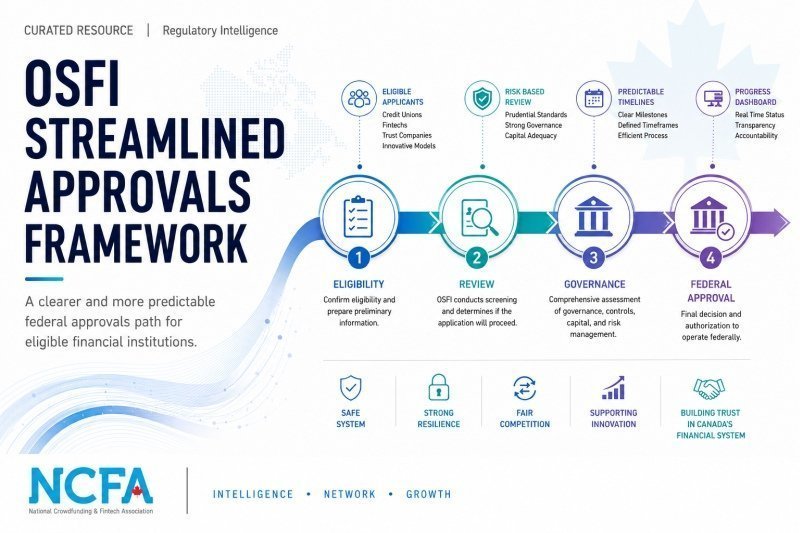
NCFA has published a new Regulatory Intelligence guide to OSFI fast track approvals. The guide explains the official Streamlined Approvals Framework for Targeted New Entrants and how eligible organizations can prepare for federal entry as a bank, trust company, loan company or federal credit union.
It brings OSFI’s framework overview, screening criteria, application requirements, three process phases, indicative timelines, toolkit documents and applicant dashboard into one practical reference.
The guide helps readers understand how OSFI’s Streamlined Approvals Framework is designed to make approvals clearer and more predictable while maintaining prudential standards.
It follows the process from eligibility screening and the initial readiness assessment through formal application review, ministerial approval and operational readiness where an Order to Commence and Carry on Business is required.
The framework currently targets two groups: provincial credit unions seeking federal continuance and entities with technologically innovative or emerging banking models, including fintechs and crypto asset custodians, seeking to incorporate as a bank or federally regulated trust and loan company.
This resource is useful for fintech founders, provincial credit unions, prospective banks, trust and loan companies, crypto asset custodians, compliance teams, investors, legal advisors and organizations assessing federal financial institution status.
It is especially useful for teams evaluating licensing strategy, ownership, governance, capital and liquidity, operational controls, risk management, supervisory readiness and whether federal institution status is commercially justified.
The guide consolidates a detailed approvals process into one applicant workflow. Readers can compare the two eligible routes, review evidence expectations, identify common delay risks and understand where OSFI’s published timelines apply.
The framework is targeted. It is not a general fast track for every fintech, payments company, lender or financial platform. Organizations outside its scope may need other routes, including Retail Payment Activities Act registration, securities registration, provincial licensing or partnerships with regulated institutions.
OSFI may refine the framework as it gains experience and may limit the number of applications processed through it. Readers should use the guide for ecosystem intelligence and planning, not as legal, financial, investment, compliance or professional advice.
OSFI Fast Track And Streamlined Approvals Framework (primary NCFA guide)
OSFI Fast Track Approval Announcement (original NCFA analysis)
Canada Open Banking Rules And Regulations (related Regulatory Intelligence)
Canada’s Stablecoin Regulatory Framework (related Regulatory Intelligence)
OSFI Streamlined Approvals Framework (official framework)
OSFI Launch Announcement (official news release)
The National Crowdfunding & Fintech Association (NCFA Canada) is a financial innovation ecosystem that provides education, market intelligence, industry stewardship, networking and funding opportunities and services to thousands of community members and works closely with industry, government, partners and affiliates to create a vibrant and innovative fintech and funding industry in Canada. Decentralized and distributed, NCFA is engaged with global stakeholders and helps incubate projects and investment in fintech, alternative finance, crowdfunding, peer-to-peer finance, payments, digital assets and tokens, artificial intelligence, blockchain, cryptocurrency, regtech, and insurtech sectors. Join Canada's Fintech & Funding Community today FREE! Or become a contributing member and get perks. For more information, please visit: www.ncfacanada.org
| | |
|---|---|---|
| | |


August 26th, 2025

January 4th, 2024

June 1st, 2021

September 9th, 2020

July 9th, 2018

January 3rd, 2018

September 25th, 2017

June 20th, 2017

May 10th, 2017

December 14th, 2016