




Karsten Wenzlaff, Advisor
August 26th, 2025
Karsten Wenzlaff is a Crowdfunding and Fintech Expert from Germany. He is Secretary-General of Digit[...]


Launch | May 9, 2024

Image: X10 release
Three former Revolut employees have launched X10, a new hybrid crypto exchange, that merges the benefits of centralized and decentralized platforms. Backed by $6.5 million in venture capital from Tioga Capital, Semantic Ventures, Cherry Ventures, Starkware and Cyber Fund, X10 is combining the performance of a centralized exchange with decentralized security so users can experience a fast, secure trading environment with self-custody of assets.
The company's founder and CEO, Ruslan Fakhrutdinov, was the former head of crypto ops at Neobank Revolut, together with Dmitrii Krasovskikh (former-tech lead), and Stefano Franz (former lead crypto engineer)
"With X10, we want to give our users and traders the best of both worlds. Imagine the features and the speed of Coinbase or Binance but with full self-custody. The FTX situation, where users only got back a third of their funds, serves as a wake-up call for the industry. It urges us to reinforce trust and efficiency in crypto trading through on-chain trade settlement, validation, and self-custody”.
The x10 exchange platform uses the StarkEx Layer 2 engine for on-chain trade settlement, which not only ensures self-custody and transparency but also significantly enhances liquidity and user experience through superior latency and throughput. Key features include on-chain trade settlement and validations, superior performance through off-chain processing, and safeguards like independent Oracle price validation, making it a comprehensive solution in today's crypto trading space.
X10 is headquartered in the United Kingdom and operates under UK regulatory guidelines. Although the specific type of regulatory license isn't mentioned in the release or on it's site but engaging with progressive financial regulatory authorities like the UK's Financial Conduct Authority (FCA) to ensure compliance with evolving crypto regulations will be key in maintaining trust and safety in financial transactions on their platform. Perhaps a great candidate for the FCAs new digital securities sandbox initiative - notably, the FCA and BoE are consulting on the final rules of the digital securities sandbox now.
As the crypto market continues to evolve in the wake of high-profile collapses like FTX, X10 stands out as a forward-thinking response. This strategic blend being touted as the 'best of cefi and defi' could potentially influence future regulatory frameworks and market structures, making X10 an important project in shaping the future of cryptocurrency exchanges.
 The National Crowdfunding & Fintech Association (NCFA Canada) is a financial innovation ecosystem that provides education, market intelligence, industry stewardship, networking and funding opportunities and services to thousands of community members and works closely with industry, government, partners and affiliates to create a vibrant and innovative fintech and funding industry in Canada. Decentralized and distributed, NCFA is engaged with global stakeholders and helps incubate projects and investment in fintech, alternative finance, crowdfunding, peer-to-peer finance, payments, digital assets and tokens, artificial intelligence, blockchain, cryptocurrency, regtech, and insurtech sectors. Join Canada's Fintech & Funding Community today FREE! Or become a contributing member and get perks. For more information, please visit: www.ncfacanada.org
 |  |  |
|---|---|---|
 |  |  |
Economics and Finance | May 2, 2024

Image: Freepik/teravector
Recent studies reveal a stark divergence between the growth of dividends and wages worldwide. An Oxfam study highlights that over the past three years, dividends grew 14 times faster than wages across 31 major economies. This widening gap underscores a deepening economic disparity, with shareholders benefiting significantly more than employees from corporate profits. This trend is not only indicative of the economic landscape but also serves as a critical entry point into discussing why companies issue dividends and what this means for investors and fintechs.
The long-term economic implications of dividends outpacing wage growth could be significant for countries in this situation:
The recent changes to the capital gains tax in the 2024 federal budget could potentially influence long-term economic impacts, especially in contexts where dividends continue to outpace wage growth. The new rules will increase the capital gains inclusion rate from 50% to 66.67%, starting from June 25, 2024. This adjustment means that a larger portion of capital gains will be subject to taxation, potentially reducing the attractiveness of investments that are prone to generating significant capital gains.
A Decentralized Autonomous Organization (DAO) might offer several advantages for a company looking to consistently increase or manage dividends over time, especially in terms of governance, stakeholder engagement, and financial management.
As dividends continue to outpace wage growth, understanding the implications for economic stability and equity is crucial. By leveraging a DAO structure, a company might find it more feasible to implement and maintain a progressive dividend policy that aligns with the interests of a diverse group of stakeholders, ensuring the company's long-term financial health and attractiveness to investors.
This structure could be particularly advantageous for companies in rapidly evolving industries or those seeking to engage a broad base of international investors.
The National Crowdfunding & Fintech Association (NCFA Canada) is a financial innovation ecosystem that provides education, market intelligence, industry stewardship, networking and funding opportunities and services to thousands of community members and works closely with industry, government, partners and affiliates to create a vibrant and innovative fintech and funding industry in Canada. Decentralized and distributed, NCFA is engaged with global stakeholders and helps incubate projects and investment in fintech, alternative finance, crowdfunding, peer-to-peer finance, payments, digital assets and tokens, artificial intelligence, blockchain, cryptocurrency, regtech, and insurtech sectors. Join Canada's Fintech & Funding Community today FREE! Or become a contributing member and get perks. For more information, please visit: www.ncfacanada.org
| | |
|---|---|---|
| | |
Insurance for DAOs | April 23, 2024

Image: Freepik
Decentralized Autonomous Organizations (DAOs) represent a novel form of organizational structure built on blockchain technology, characterized by decentralized governance and operation without traditional management hierarchies. While DAOs offer numerous advantages such as transparency and global collaboration, their unique nature also presents significant risk management challenges. Traditional insurance products often fall short of addressing the specific needs of DAOs, which include smart contract vulnerabilities, regulatory uncertainties, and operational risks to name but a few.
As the blockchain and cryptocurrency domains continue to evolve, so too does the insurtech industry, which has begun tailoring solutions to meet the needs of these digital-first entities. This segment of the insurance industry focuses on leveraging technology to solve the challenges faced by crypto-native organizations, including DAOs, which have been largely underserved by conventional insurance markets.
Now let's look at a couple of DAO tailored offerings:
Fenwick's REBA Solution offers pioneering insurance products designed explicitly for DAOs and similar organizations. It incorporates a corporate structure that protects the DAO's key figures such as founders, directors, and officers, and also covers the token holders involved in DAO governance. This comprehensive coverage is critical as it ensures that all parties involved in the DAO are protected from potential liabilities and risks associated with their governance roles.
The REBA Solution offers several key benefits to DAOs, significantly enhancing their risk management framework:
UnoRe is a pioneering force in the decentralized insurance market, specifically tailored to meet the unique needs of Decentralized Autonomous Organizations (DAOs) and other crypto-native entities. In their insightful article, "Changing The Paradigm In DAO Asset Management: The Role of Insurance," UnoRe discusses how their innovative insurance solutions are empowering DAOs to manage assets with greater confidence and security.
They highlight the critical role of decentralized insurance in enabling DAOs to transition from just storing assets to actively investing them, thereby generating substantial returns while minimizing risks. This approach not only enhances asset management strategies for DAOs but also improves investor confidence in DeFi markets.
According to UnoRe, their insurance platform has distributed over $10 million in coverage across a diverse range of crypto protocols and maintains an active capacity exceeding $4.4 million. They have underwritten risk for more than 85 different protocols and six stablecoins through our B2C Insurance Sales dApp, known as The Cover Portal.
The insurance framework for DAOs like REBA or UnoRe must navigate complex legal and regulatory environments. These products are often established in jurisdictions favorable to cryptocurrency enterprises, such as Bermuda, which offers a regulatory framework supportive of innovative insurance solutions.
Having said that, Wyoming recently passed the DUNA Act, a comprehensive legal framework formalizing DAOs within its legal structure. The DUNA Act aims to provide clarity and security for DAOs, addressing various legal aspects to foster their integration into mainstream business environments. This legislation not only enhances the operational legitimacy of DAOs but also positions Wyoming as a hub for blockchain innovation and a model for other jurisdictions considering similar regulatory approaches.
Understanding these legal contexts is crucial if setting up and operating a DAO, and when selecting an insurance provider. Learn more
The future of DAO insurance is looking more promising as more insurtech companies recognize the need for tailored solutions. The growth of such insurance models is likely to grow alongside the expansion of the DAO ecosystem itself, reflecting broader acceptance and integration of blockchain technologies across different sectors. As these solutions become more refined and widespread, they will help legitimize and stabilize DAOs as a viable alternative to traditional organizational structures.
The National Crowdfunding & Fintech Association (NCFA Canada) is a financial innovation ecosystem that provides education, market intelligence, industry stewardship, networking and funding opportunities and services to thousands of community members and works closely with industry, government, partners and affiliates to create a vibrant and innovative fintech and funding industry in Canada. Decentralized and distributed, NCFA is engaged with global stakeholders and helps incubate projects and investment in fintech, alternative finance, crowdfunding, peer-to-peer finance, payments, digital assets and tokens, artificial intelligence, blockchain, cryptocurrency, regtech, and insurtech sectors. Join Canada's Fintech & Funding Community today FREE! Or become a contributing member and get perks. For more information, please visit: www.ncfacanada.org
| | |
|---|---|---|
| | |
Crypto Innovation | April 23, 2024

Image: Freepik
The Bitcoin halving completed last Friday evening, a pre-scheduled technical event designed to reduce the Bitcoin block reward by half, coincided with the launch of a new fungible token protocol, Bitcoin Runes, by Casey Rodarmor, expanding Bitcoin's utility and setting the stage for new applications and efficiencies.
Since their inception at the latest Bitcoin halving, over 8,161 Runes have been etched into Bitcoin’s blockchain, leading to 1.57 million Rune-related transactions by 101,728 holders. This explosive adoption demonstrates the market's readiness to explore and integrate these new capabilities within the existing Bitcoin infrastructure.
One of the immediate effects of the Runes launch was the huge increase in Bitcoin transaction fees. The average transaction fee soared to an all-time high of $128.45, a spike attributed to the rush in creating and trading these new tokens which was a 'gold mine' for miners enjoying increased fee revenues but a challenge for regular users dealing with higher costs. The Bitcoin average transaction fee has since returned to normal and is currently at $24.99 on April 22 according to Ychart data.
Casey Rodarmor, known for his creation of the Bitcoin Ordinals protocol, is the driving force behind Bitcoin Runes. His background in developing protocols that enhance Bitcoin’s functionality makes him a pivotal figure in this new venture.
Bitcoin Runes is designed to efficiently create fungible tokens directly on Bitcoin’s blockchain using the UTXO model, which is considered more robust and secure compared to the account models used by other blockchains.
Unlike BRC-20, which relies on the Ordinals protocol and faces challenges such as network clogging, Runes aims to streamline the process, reducing transfer fees and improving transaction efficiency on the blockchain.
Ahead of its official launch, the Runes protocol has stirred significant interest, with numerous projects gearing up to integrate or transition to this new standard, indicating robust pre-launch traction.
Projects like RSIC and Node Apes have announced plans to utilize Runes for token creation, showcasing early adoption and potential growth within the ecosystem.
The anticipation of Runes has led to a surge in activities related to Bitcoin Ordinals, with increasing transaction volumes and discussions within the community, highlighting a positive market reception.
Ongoing enhancements are anticipated to focus on scalability and integration with other blockchain functionalities, aiming to broaden the utility and efficiency of Runes.
By simplifying the creation of fungible tokens on Bitcoin, Runes could pave the way for more complex financial products and services to operate on the Bitcoin network, potentially leading to broader innovations in decentralized finance (DeFi).
Runes may encounter scalability and regulatory challenges as it grows. Addressing these will require continuous technical upgrades and proactive engagement with regulatory bodies to ensure compliance and sustainable growth.
The launch of Bitcoin Runes at the latest Bitcoin halving is a strategic expansion of Bitcoin's role in the digital economy - from digital gold to a more innovative platform capable of supporting diverse financial instruments. This could potentially attract new users and developers to the Bitcoin ecosystem, fostering further innovation and possibly redefining the future outlook of decentralized finance.
The National Crowdfunding & Fintech Association (NCFA Canada) is a financial innovation ecosystem that provides education, market intelligence, industry stewardship, networking and funding opportunities and services to thousands of community members and works closely with industry, government, partners and affiliates to create a vibrant and innovative fintech and funding industry in Canada. Decentralized and distributed, NCFA is engaged with global stakeholders and helps incubate projects and investment in fintech, alternative finance, crowdfunding, peer-to-peer finance, payments, digital assets and tokens, artificial intelligence, blockchain, cryptocurrency, regtech, and insurtech sectors. Join Canada's Fintech & Funding Community today FREE! Or become a contributing member and get perks. For more information, please visit: www.ncfacanada.org
| | |
|---|---|---|
| | |
Crypto | April 22, 2024

Image: World Chain users can optionally and anonymously verify their addresses as real humans using World ID to get priority blockspace and a gas allowance.
The latest update on Sam Altman's Worldcoin is that the Worldcoin Foundation has announced the launch of World Chain, a permissionless, open-source Ethereum layer 2 blockchain expected to debut in mid-2024. This new blockchain is deeply integrated with the Worldcoin protocol and aims to accelerate the adoption of "World ID."
Worldcoin's system uses an "Orb" device to scan users' eyes and convert the biometric image into a secure number string. This process verifies an individual as a unique human and grants a World ID, which functions similarly to a digital passport, allowing users to authenticate various applications while confirming their personhood.
To date, 10 million people across 167 countries have registered their biometrics with Worldcoin, with their verified wallets conducting 75 million transactions. The technology is primarily aimed at distinguishing real human users from bots and AI, which are prevalent in other blockchain systems and often lead to network congestion and high transaction fees.
Despite this growth, the market response has been mixed. Since late March 2024, the market cap of Worldcoin tokens (WLD) has declined by over a third, and the price has halved. Of course, regulatory challenges have emerged, with Worldcoin's Orbs being banned in several European countries over data privacy concerns. World ID and the World App remain widely accessible, including in the United States.
World Chain is being touted as a blockchain that is specifically designed for human interactions which helps differentiate it from other blockchains that are ripe with bot activity and manipulation. The Worldcoin Foundation is actively encouraging developers to build on World Chain and is facilitating community engagement through grants and partnerships with the full launch of World Chain expected later this summer, with a developer preview expected shortly.
Users can verify their addresses on World Chain anonymously through zero-knowledge proofs which ensures privacy while benefiting from verified status giving them priority in block space and also a gas allowance for transactions.
World Chain will be open source and permissionless (with plans for eventual community governance) and will function as a Layer 2 blockchain under Ethereum, ensuring enhanced scalability and security through alignment with the Superchain ecosystem. Developers will be able to create real-world applications that are beneficial for every day life by connecting millions of verified users globally.
By focusing on real users and keeping the bots at bay, World Chain aims to create a more trustworthy and inclusive blockchain environment, however its success relies on the future of digital innovation, user privacy, and regulatory compliance. Solving for this balance will potentially set a new standard for blockchain solutions globally.
The National Crowdfunding & Fintech Association (NCFA Canada) is a financial innovation ecosystem that provides education, market intelligence, industry stewardship, networking and funding opportunities and services to thousands of community members and works closely with industry, government, partners and affiliates to create a vibrant and innovative fintech and funding industry in Canada. Decentralized and distributed, NCFA is engaged with global stakeholders and helps incubate projects and investment in fintech, alternative finance, crowdfunding, peer-to-peer finance, payments, digital assets and tokens, artificial intelligence, blockchain, cryptocurrency, regtech, and insurtech sectors. Join Canada's Fintech & Funding Community today FREE! Or become a contributing member and get perks. For more information, please visit: www.ncfacanada.org
| | |
|---|---|---|
| | |
Chainlink | Release | April 22, 2024

Transporter is built to give users complete peace of mind by offering an intuitive UI, 24/7 global support, and a visual tracker that provides real-time visibility into the state of their cross-chain transactions.
Chainlink has officially released Transporter, a new application designed to facilitate secure and efficient cross-chain cryptocurrency transactions. Transporter is built on the Chainlink Cross-Chain Interoperability Protocol (CCIP), renowned for its security. The application features an intuitive user interface (UI) that simplifies the process for users, allowing them to perform transactions easily across multiple blockchains including Ethereum, BNB Chain, and Polygon among others.
Sergey Nazarov, Co-Founder of Chainlink:
"Transporter makes it easier to utilize the security benefits of Chainlink CCIP for the transfer of large token value and critical messages across chains. Having a secure way to move both value and data across chains is something the blockchain industry has needed for years and I'm excited that Transporter is making that more accessible."
By facilitating secure, fast, and reliable cross-chain transactions, Chainlink's Transporter opens up a myriad of possibilities for users and developers looking to operate across multiple blockchain environments. This not only broadens the scope of blockchain applications but also enhances the overall efficiency and utility of the digital asset ecosystem.
Here are several practical examples of how Chainlink's Transporter might be used:
A DeFi user wants to leverage higher yields available on another blockchain. Using Chainlink's Transporter, the user can securely transfer their digital assets from Ethereum to a blockchain like Binance Smart Chain (BSC) where they intend to participate in a high-yield farming protocol. This transfer is done without the need to rely on centralized exchanges, thus maintaining security and reducing transaction fees.
An NFT artist wants to list and sell their digital artwork on multiple blockchains to access a broader market. Through Chainlink Transporter, the artist can easily bridge their NFTs from Ethereum to other chains like Polygon or Flow, enhancing visibility and accessibility without compromising on security.
A blockchain-based gaming platform allows users to earn tokens and in-game assets.
With Chainlink's Transporter, players can transfer their game assets and tokens from the native gaming blockchain to Ethereum to trade on larger, more liquid markets or even transfer them into other gaming platforms that offer different experiences or rewards.
A supply chain management company uses a private blockchain for tracking goods but wants to leverage decentralized finance (DeFi) mechanisms on public blockchains for better financing options. Chainlink Transporter facilitates the secure, verifiable transfer of data and value between the private supply chain blockchain and public financial blockchains, enabling innovative financing solutions like tokenized invoices.
Developers are building decentralized applications that need to interact with multiple blockchains to function optimally. For instance, a decentralized insurance app could use data from different blockchains to process claims or assess risks.
Chainlink Transporter can securely manage the data and value exchanges across these various networks, enabling robust multi-chain DApps.
Traders identify price discrepancies for the same asset across different decentralized exchanges (DEXes) on different blockchains. Chainlink Transporter enables these traders to quickly and securely move assets between these chains, capitalizing on arbitrage opportunities in real-time.
By providing a secure, efficient, and user-friendly platform for cross-chain transactions, Transporter improves the utility and broader adoption of digital assets across various sectors. This development could potentially lead to new standards in the security and interoperability of blockchain transactions, influencing future innovations in the crypto space.
The National Crowdfunding & Fintech Association (NCFA Canada) is a financial innovation ecosystem that provides education, market intelligence, industry stewardship, networking and funding opportunities and services to thousands of community members and works closely with industry, government, partners and affiliates to create a vibrant and innovative fintech and funding industry in Canada. Decentralized and distributed, NCFA is engaged with global stakeholders and helps incubate projects and investment in fintech, alternative finance, crowdfunding, peer-to-peer finance, payments, digital assets and tokens, artificial intelligence, blockchain, cryptocurrency, regtech, and insurtech sectors. Join Canada's Fintech & Funding Community today FREE! Or become a contributing member and get perks. For more information, please visit: www.ncfacanada.org
| | |
|---|---|---|
| | |
Bitcoin | April 15, 2024

Image: Freepik
The upcoming Bitcoin halving in 2024 is poised to significantly impact the cryptocurrency market. Historically, these events have precipitated major price fluctuations and heightened investor interest due to the reduced rate at which new bitcoins are created, effectively diminishing the block reward from 6.25 to 3.125 bitcoins.
Bitcoin halvings are scheduled to occur approximately every four years, or every 210,000 blocks, until the maximum supply of 21 million Bitcoins has been mined. This is expected to continue until around the year 2140. After the 2024 halving, there will be several more halvings until the maximum supply limit is reached. Each halving reduces the rate at which new Bitcoins are created and released into circulation, thus prolonging the period of mining reward distributions. Here's what you need to know.
Below is a chart and table displaying the Bitcoin prices approximately one year before and one year after each of the halving events:
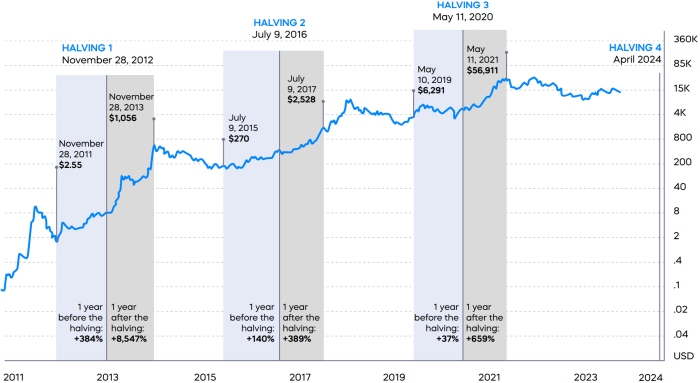
Image: Bloomberg, Bitcoin Halvings as of Dec 31, 2023
While the halving day itself is expected to be a non-event in terms of immediate market impact—likely priced in due to the efficient market hypothesis—the broader implications for Bitcoin's scarcity and investor perception could drive much anticipated post-halving market activity for the next up cycle.
The National Crowdfunding & Fintech Association (NCFA Canada) is a financial innovation ecosystem that provides education, market intelligence, industry stewardship, networking and funding opportunities and services to thousands of community members and works closely with industry, government, partners and affiliates to create a vibrant and innovative fintech and funding industry in Canada. Decentralized and distributed, NCFA is engaged with global stakeholders and helps incubate projects and investment in fintech, alternative finance, crowdfunding, peer-to-peer finance, payments, digital assets and tokens, artificial intelligence, blockchain, cryptocurrency, regtech, and insurtech sectors. Join Canada's Fintech & Funding Community today FREE! Or become a contributing member and get perks. For more information, please visit: www.ncfacanada.org
| | |
|---|---|---|
| | |


August 26th, 2025

January 4th, 2024

June 1st, 2021

September 9th, 2020

July 9th, 2018

January 3rd, 2018

September 25th, 2017

June 20th, 2017

May 10th, 2017

December 14th, 2016