




Karsten Wenzlaff, Advisor
August 26th, 2025
Karsten Wenzlaff is a Crowdfunding and Fintech Expert from Germany. He is Secretary-General of Digit[...]


Stablecoins | Nov 25, 2025

Image generated by AI
On November 25 2025, Klarna Group plc announced the launch of KlarnaUSD, and enters a global stablecoin market that McKinsey estimates now processes more than US$27 trillion in annual transactions and sits inside a cross border payments system that produces about US$120 billion in yearly fees.
Klarna brings 114 million customers and US$118 billion in annual gross merchandise value to its launch. The company already operates as a licensed bank in Sweden through Klarna Bank AB, and the company continues to expand its banking services beyond that market as it builds new digital payment and settlement tools. Klarna now moves beyond buy now pay later in the US and steps into the stablecoin market with an infrastructure level product designed for scale.
KlarnaUSD runs on the Tempo blockchain that Stripe and Paradigm created that's designed for payments. Tempo supports fast and low cost transfers which gives the company a quicker way to move money than traditional bank systems.
The stablecoin is issued through Open Issuance by Bridge explained by Stripe. Bridge connects Tempo to apps, wallets and bank accounts so KlarnaUSD can move across the app, the merchant portal and settlement tools.
Klarna's stablecoin keeps a one-to-one value with the US dollar, and its reserves sit off chain so the service can follow local rules.
KlarnaUSD runs on Tempo’s testnet today and moves to mainnet in 2026 which gives the company time to test and build before public availability.
Sebastian Siemiatkowski, co-founder and CEO of Klarna:
"Klarna has the scale to change payments globally: with Klarna’s scale and Tempo’s infrastructure, we can challenge old networks and make payments faster and cheaper for everyone,”
Klarna presents KlarnaUSD as a faster and cheaper settlement tool but the likely impact will reach further and impact how payments and value move inside Klarna’s ecosystem.
Klarna can settle payouts through KlarnaUSD which avoids long clearing cycles and reduces FX friction. Merchants that receive faster settlement at lower cost usually send more business volume to the service that provides those results because it improves cash flow and reduces operational friction. So Klarna can also expect more volume.
Shoppers can complete international purchases with KlarnaUSD and avoid the delays and FX fees that occur on card and bank networks. Merchants that convert international shoppers at lower cost often strengthen their margin and rely more on the service that supports those outcomes.
Refunds, reversals and buy now pay later corrections can move across KlarnaUSD flows with fewer delays.
Consumers that receive faster refunds tend to return to the service that resolves issues quickly which supports higher repeat use.
KlarnaUSD can support balances, rewards and saving style tools inside the app without the company building full banking infrastructure in each region. Users that keep balances inside a single platform often deepen their engagement because their financial activity stays in one place.
Fintech companies can use KlarnaUSD for their own settlement flows which reduces cost and increases speed. Platforms that provide reliable settlement rails often become part of a partner’s operational stack which expands the platform’s role in the broader ecosystem.
Stablecoin issuance introduces new responsibilities for Klarna. Regulatory risk matters because stablecoins sit under active review and issuers must meet rules on reserves, redemption and consumer protection.
Reserve management brings risk because Klarna must maintain high quality USD backing and manage liquidity for redemptions.
Technology risk also exists because KlarnaUSD depends on the Tempo blockchain and Stripe’s Bridge framework which must perform under load and remain secure.
Reputation risk matters because any issue with redemption, reserves or outages can affect trust across Klarna’s full product suite.
Klarna operates in Canada today through its app and merchant partners. According to NCFA’s Canadian market overview in “Klarna’s Meteoric Rise in the Canadian Financial Ecosystem” (Aug 2023), Klarna gained 640,000 active Canadian consumers within 18 months of its Canadian launch.
Klarna notably also went public this past September 2025 on the New York Stock Exchange, IPO priced at US$40 per share and opened with a 16% jump, as outlined in the NCFA analysis of Klarna’s IPO pop. This debut placed Klarna’s valuation near US$17.5 billion and signalled strong early investor interest. The stock now trades near US$29.92 (KLAR), according to the latest public market price. Maturing crypto markets, Klarna's digital bank growth plans, and recent IPO all help explain why Klarna is investing in new digital settlement tools, and let's not forget investor expectations.
While Klarna hasn't announced a Canadian launch timeline for KlarnaUSD. The confirms that KlarnaUSD is in testnet and planned for mainnet in 2026. Plus, a Canadian rollout depends on the completion of Canada’s new stablecoin rules of which the first draft of the national stablecoin act has just been released. Also worth reviewing is the FCAC's national survey on Canadian stablecoin use and views.
KlarnaUSD highlights how fintech companies can advance when they control both the customer network and the settlement rail. Klarna improves speed, lowers cost and gains room to build new financial services without relying on legacy systems. For Canada the timing is important. Stablecoin settlement is now moving into commercial use and companies that adopt token based rails can gain real cost and speed advantages. Canada’s stablecoin work gives local innovators a chance to compete as global fintechs introduce faster settlement tools.
 The National Crowdfunding & Fintech Association (NCFA Canada) is a financial innovation ecosystem that provides education, market intelligence, industry stewardship, networking and funding opportunities and services to thousands of community members and works closely with industry, government, partners and affiliates to create a vibrant and innovative fintech and funding industry in Canada. Decentralized and distributed, NCFA is engaged with global stakeholders and helps incubate projects and investment in fintech, alternative finance, crowdfunding, peer-to-peer finance, payments, digital assets and tokens, artificial intelligence, blockchain, cryptocurrency, regtech, and insurtech sectors. Join Canada's Fintech & Funding Community today FREE! Or become a contributing member and get perks. For more information, please visit: www.ncfacanada.org
 |  |  |
|---|---|---|
 |  |  |
Crypto Regulation | Nov 25, 2025

AI generated image
On November 24 2025, the US Securities and Exchange Commission (SEC) Corporate Finance Division issued a no action letter to Fuse Crypto Limited that sets the conditions under which the company can offer its ENERGY token without triggering US securities registration under Section 5 or reporting requirements under Section 12(g). This action gives the market a detailed example of how a behaviour based reward token can satisfy regulators when the program avoids speculation and ties all earning activity to user actions.
The SEC based its position on the facts described in the request for relief letter that Fuse’s counsel submitted on November 19 2025 (13 page PDF). The filing outlines how the program works how users earn tokens and how redemption value is controlled. The SEC makes clear that any different facts or conditions could lead to a different conclusion.
Fuse’s submission describes a program that rewards users for energy related behaviour that supports distributed energy resources. Users earn tokens when they install and connect rooftop solar systems, batteries, electric vehicle chargers or similar equipment. They also earn tokens when they make this equipment available for grid supportive functions or adjust consumption to help reduce stress on local systems. These actions are measurable and tied directly to the program.
The submission explains the formula Fuse uses to allocate token rewards. The formula measures user generated energy behaviour and applies a fixed structure that determines the number of tokens a user receives. This formula must remain constant. The SEC notes that it depends on this structure when evaluating whether the program’s value creation resembles investment activity.
The filing also states that redemption value is capped. Users may redeem tokens only for goods or services the program makes available at the time of redemption. The value cannot exceed Fuse’s profit margin and redemption depends on average market pricing. This removes speculative upside and keeps the token tied to consumption.
The submission also details that Fuse will present the program as a rewards system and not as an investment, and that all earning activity must flow from how users participate in the program. Users configure their preferences inside the app to enable token earning and select the settings that determine how their connected energy resources take part in the program. The filing states that token rewards come only from this participation and from measurable energy related behaviour, and that all value remains tied to capped redemption and consumptive use rather than to any form of investment activity.
The program does not give token holders any right to profit sharing future income ownership or governance. All value comes from user behaviour and redemption inside the program.
These conditions help regulators understand that the token does not function like a security. The SEC confirms that its relief applies only to these facts and does not classify the token.
The Fuse program connects token creation to real actions that support distributed energy systems. Users earn tokens directly from participation and do not buy them with investment expectation. The structure ties value to measurable behaviour and redemption uses a strict cap based on profit margin and market pricing. This design prevents investor style appreciation and aligns the token with its use as a reward.
This event gives issuers a detailed reference for designing behaviour based programs. Many token projects claim utility status but still allow value growth that resembles investment behaviour. Fuse provides an example of how limits on value, transparent formulas, and consumption use can support compliance.
The program also shows that clear documentation matters. Fuse’s submission provides detailed explanations of user actions, redemption rules, promotional commitments, and technical configuration.
Regulators rely on this specificity when evaluating whether a token program functions as a financial product. Fintech teams building similar programs can use this model to see how clear rules and measurable user actions help regulators understand how the system works.
The SEC decision gives Canadian fintechs a good example of how American regulators analyze behaviour-based token programs. Canadian regulators continue to rely on the economic reality approach as set out in the CSA staff notice 46-308 on token classification published June 11 2018. While no formal newer guidance appears to have been issued publicly, issuers should monitor for any updates.
This guidance explains that labels do not determine the legal outcome. Regulators examine the purpose of a token how it enters circulation how users receive value and whether promotional language creates investment expectation.
The Fuse no action letter and submission model aligns with these principles. It shows how programs that tie value to specific actions and use measurable formulas can reduce regulatory risk. Canadian issuers designing clean energy mobility or infrastructure incentives can benefit from reviewing the program and understanding how to document participation value mechanics and redemption paths in a compliant manner.
Many Canadian fintechs build products that operate in both markets. The SEC decision provides a reference for how US regulators evaluate tokenized reward-based systems. Canadian teams could use the US-based Fuse decision to prepare materials that align with principles used in both countries.
The No Action Letter applies only to the facts Fuse described in its incoming letter. If Fuse changes earning mechanics, redemption formulas, user eligibility, promotional language, or transferability rules the SEC may reach a different conclusion. The relief applies only to Section 5 and Section 12(g) and does not bind other regulators. The No Action Letter also doesn't prevent actions by other divisions inside the SEC or by other agencies such as the CFTC, FinCEN, IRS or state regulators.
Canadian regulators may also reach a different outcome if facts differ from the submission or if market behaviour creates investor style expectations. The SEC’s letter does not classify the token. It only describes the enforcement position for the facts presented.
The SEC's corporate finance decision on the Fuse reward program gives fintechs a detailed look at how behaviour based tokens can meet regulatory expectations when value comes from measurable user actions and redemption is tightly controlled.
Canadian fintechs designing cross-border token programs can use the Fuse no action event to help design programs and prepare materials that address the economic reality tests used in Canada. As more companies explore real world token models this type of clarity supports innovation and helps developers understand how to design programs that balance consumer incentives with regulatory confidence.
The National Crowdfunding & Fintech Association (NCFA Canada) is a financial innovation ecosystem that provides education, market intelligence, industry stewardship, networking and funding opportunities and services to thousands of community members and works closely with industry, government, partners and affiliates to create a vibrant and innovative fintech and funding industry in Canada. Decentralized and distributed, NCFA is engaged with global stakeholders and helps incubate projects and investment in fintech, alternative finance, crowdfunding, peer-to-peer finance, payments, digital assets and tokens, artificial intelligence, blockchain, cryptocurrency, regtech, and insurtech sectors. Join Canada's Fintech & Funding Community today FREE! Or become a contributing member and get perks. For more information, please visit: www.ncfacanada.org
| | |
|---|---|---|
| | |
Stablecoin Regulation | Nov 21, 2025

Image generated by AI
On November 18 2025, the federal government of Canada released its first draft of the Stablecoin Act when introducing the Budget 2025 Implementation Act through Bill C 15. The legislation appears in Division 45 of Part 5 and establishes Canada’s first national framework for stablecoins. The official text published in the Bill C 15 First Reading record explains that the Act sets duties for stablecoin issuers, outlines the role of the Bank of Canada and introduces rules for reserves, redemption and governance. The full clause-by-clause level rules appear in the Draft Stablecoin Act document, now moved to a dedicated page on the Department of Finance's website under Canada's Stablecoin Framework.
The Act explains that if a company issues a stablecoin and follows this new federal law, the company is not treated like a bank for certain parts of the Bank Act, the Insurance Companies Act or the Trust and Loan Companies Act. In simple terms, if a company issues a stablecoin under this law, it is not treated as if it is taking deposits like a bank. This helps make sure that stablecoin issuers are regulated, but not in a way that turns them into banks.
The draft Act also says that if a company issues a stablecoin and follows this law, it is not treated as if it is dealing in securities for the specific federal rules listed in the Act.
The Act gives the Bank of Canada the job of keeping a public list of approved stablecoin issuers. An issuer must not give false or misleading information to the public.
The Act also places limits on what issuers are allowed to do. An issuer cannot use regulated words or symbols in a way that breaks future rules. An issuer cannot pay interest or any form of yield to stablecoin holders. This means stablecoins covered by this Act cannot look or act like investment products.
The Act also says an issuer cannot offer a stablecoin if it is treated as official money anywhere in the world. The issuer cannot offer a stablecoin if it is viewed as a bank deposit, if it is insured by a government deposit insurance program or if it is guaranteed by a government.
The Act has strong rules for how issuers must hold reserves. An issuer must hold enough assets to match the full value of all stablecoins in circulation. These assets can only be used to redeem stablecoins. They cannot be used for anything else.
The reserve must consist of the same currency the stablecoin is tied to or high quality liquid assets in that currency. Only the Bank of Canada or future regulations can approve other reserve assets.
The Act protects these reserves from being pledged, used as collateral, or borrowed against. The issuer cannot let anyone else have a claim on them.
The issuer must keep reserve assets with qualified custodians. The custodian must hold these assets separately from their own. The assets must not be available to satisfy the debts of the custodian or the issuer. They exist only to support redemptions. This helps keep customer value safe even if something goes wrong with the issuer or the custodian.
The Act makes clear that stablecoins must be redeemable at face value in the official currency they track. The issuer must follow this rule in line with future regulations. This protects users who want to convert stablecoins back into regular money.
Issuers must have a governance policy that sets out who is responsible for what. This includes the responsibilities of the governing body and senior management, how accountability works, how third party service providers are managed and how conflicts of interest are handled. This pushes issuers to run stablecoin operations with clear oversight and internal controls.
The Act explains where stablecoins fit into the wider regulatory world. A compliant stablecoin issuer is not considered to be dealing in securities or taking deposits for certain sections of federal prudential laws.
The Act also says that a stablecoin issuer counts as a business dealing in virtual currency under Canada’s anti-money laundering and anti-terrorist financing laws. This means the issuer must follow all federal AML and ATF rules, just like any other virtual currency business.
The draft Act must still move through Parliament. Many details will depend on future regulations written by the Minister and guidance from the Bank of Canada. Provinces will continue to have their own rules, including securities and consumer protection laws. The restriction on interest and yield pushes stablecoins towards payment and settlement functionality rather than investment use. The reserve and custody rules help protect customers. The governance requirements ensure that issuers treat stablecoins as serious financial products with clear oversight.
This draft law provides clear rules on reserves, custody, redemption and governance. It also clarifies how stablecoins fit within Canadian financial law, which helps fintechs design products, build payment systems and plan compliance with confidence. Earlier this year in July 2025, EY published a report on various approaches to global stablecoin regulation
The National Crowdfunding & Fintech Association (NCFA Canada) is a financial innovation ecosystem that provides education, market intelligence, industry stewardship, networking and funding opportunities and services to thousands of community members and works closely with industry, government, partners and affiliates to create a vibrant and innovative fintech and funding industry in Canada. Decentralized and distributed, NCFA is engaged with global stakeholders and helps incubate projects and investment in fintech, alternative finance, crowdfunding, peer-to-peer finance, payments, digital assets and tokens, artificial intelligence, blockchain, cryptocurrency, regtech, and insurtech sectors. Join Canada's Fintech & Funding Community today FREE! Or become a contributing member and get perks. For more information, please visit: www.ncfacanada.org
| | |
|---|---|---|
| | |
Stablecoins | Nov 19, 2025
Image generated by AI
On September 11 2025 the Financial Consumer Agency of Canada (FCAF) released national survey findings on how Canadians understand, use and experience stablecoins. The data arrives at a moment when digital money education is becoming essential and also November is Financial Literacy Month. The survey highlights where Canadians feel confident, where they lack clarity and where they face real harm when interacting with stablecoin products.
The findings come from a national sample of 2,410 Canadian adults, including 386 stablecoin owners, surveyed between December 2023 and January 2024. Results reflect a cross-section of Canadians aged 18 and up.
Only 4% of Canadian adults currently hold stablecoins and 5% have held them in the past, while 91% report no ownership at all.
Adoption is higher among adults aged 18 to 34, higher-income households and respondents identifying as Indigenous or Black.
These early patterns show that stablecoin use is limited today, but it is already interacting with diverse communities and younger Canadians who often engage with digital financial tools first. This confirms the need for accessible, plain language education resources that help people understand how stablecoins work and how to evaluate them responsibly.
According to the survey, 21% of Canadians could correctly define a stablecoin.
The average score on a short knowledge test was 18%, even though respondents estimated their score at around 50%. This confidence gap reveals why more stablecoin education is a must.
When people believe they understand a financial tool but lack the basics, they are more likely to overlook risks related to stability, issuer credibility, redemption processes or platform security.
Among Canadians who currently or previously owned stablecoins, 49% reported at least one negative experience.
About 10% said they lost funds due to fraud, hacking or platform failure. Among those affected, reported losses ranged from under CA$10,000 to as high as CA$60,000.
The number of users may still be small, but the concentration of harm is significant. These findings show why stablecoin topics must be included in consumer education, and why fintech firms developing digital money products need strong transparency, redemption clarity and operational safeguards to build and maintain trust.
The survey identifies protection and clarity as key drivers of trust. 41% of respondents support a distinct regulatory framework for stablecoins.
Among current owners, 63% want stablecoins regulated the same way as payment or money-transfer products.
Among people who avoid stablecoins, 44% say missing protections as their main reason.
These results show that Canadians are open to digital forms of money, but they want stablecoin issuers and platforms to offer clear information and credible safeguards before wider participation feels safe.
For NCFA’s community of fintech leaders, innovators, investors and policymakers, this research helps strengthen the case for improving stablecoin literacy for both businesses and consumers who need to get ready for Canada’s evolving digital finance landscape. Strong literacy reduces confusion, builds confidence and supports responsible adoption.
A sampling of NCFA stablecoin coverage and how they fit into Canada’s wider fintech landscape.
The National Crowdfunding & Fintech Association (NCFA Canada) is a financial innovation ecosystem that provides education, market intelligence, industry stewardship, networking and funding opportunities and services to thousands of community members and works closely with industry, government, partners and affiliates to create a vibrant and innovative fintech and funding industry in Canada. Decentralized and distributed, NCFA is engaged with global stakeholders and helps incubate projects and investment in fintech, alternative finance, crowdfunding, peer-to-peer finance, payments, digital assets and tokens, artificial intelligence, blockchain, cryptocurrency, regtech, and insurtech sectors. Join Canada's Fintech & Funding Community today FREE! Or become a contributing member and get perks. For more information, please visit: www.ncfacanada.org
| | |
|---|---|---|
| | |
Stablecoin Regulations | Nov 17, 2025

AI generated image
On November 10 2025, the Bank of England released a proposed regulatory regime for sterling denominated systemic stablecoins for consultation. The paper explains how large scale issuers designated as systemic would be required to back customer balances, manage reserves and operate safely within the United Kingdom financial system. These rules apply only when HM Treasury designates an issuer as systemic.
Smaller issuers remain active in the market under the Financial Conduct Authority rules and may transition into the systemic framework if they grow to a scale that could influence the wider financial system.
The consultation is the most detailed update to United Kingdom stablecoin policy since HM Treasury released draft cryptoasset legislation in April 2025, and establishes a clear structure for how systemic digital money could function safely in day to day payments.
The consultation explains how systemic stablecoins must be backed and why this structure matters for safety in everyday payments. Issuers must hold at least 40% of reserves as deposits at the Bank of England. The remaining portion, up to 60%, can be invested in short term United Kingdom government securities. This mix offers strong protection and keeps the reserve simple and transparent.
The Bank of England also outlines a transition period for new issuers. In the early stages, they may place up to 95% of backing assets in government debt before moving toward the long term structure. This step is meant to support early growth while maintaining a high level of safety.
All backing assets must sit in a statutory trust that always matches the value of coins in circulation. This requirement protects customer funds and reduces the risk of shortfalls during periods of stress. It also creates a clear line between the issuer’s own balance sheet and the assets that support the stablecoin.
The proposed regime introduces requirements for how backing assets are held and protected. The consultation sets out the expectation that backing assets sit in a segregated trust structure with protections similar to client asset rules. This mix of central bank deposits and short term government securities is intended to provide strong protection for customer funds while allowing issuers to generate modest returns needed to support operations.
Institutions holding backing assets would also need to meet operational resilience standards and demonstrate they can respond to stress conditions without interruption to customer redemptions.
Systemic stablecoin issuers would operate under prudential requirements similar to other payment system operators. The consultation notes that the Bank of England would supervise major issuers to ensure continuing safety, strong risk controls and effective recovery planning.
The focus is on preventing operational failure in a systemically important payment instrument. The combination of required reserve composition and Bank of England supervision is designed to manage the risks associated with large scale issuance of digital money in everyday payments.
Issuers that reach systemic scale would be supervised in the same framework applied to other major payment firms. The regime outlines how stablecoins can connect to payment rails in the United Kingdom while meeting resilience expectations. The Bank of England highlights the importance of maintaining continuity of payments even during stress events, which is a central consideration in the proposed framework.
The Bank of England is accepting written submissions on the consultation. Responses can be provided directly through the consultation portal hosted by the Bank of England.
The consultation is a major advancement toward integrating large scale stablecoins into the formal financial system. It provides clear expectations for how issuers can operate safely with trusted backing, operational resilience and strong central bank supervision while supporting innovation in payments.
Canada continues to develop its own approach to digital assets and stablecoin oversight. The Retail Payment Activities Act is already in effect and sets expectations for payment service providers. Budget 2025 confirmed that federal authorities are developing a national framework for stablecoins and the Bank of Canada will administer it with publication expected in 2026. As other jurisdictions advance their own frameworks, coordinated and transparent regulation will remain important for financial stability and consumer protection.
The National Crowdfunding & Fintech Association (NCFA Canada) is a financial innovation ecosystem that provides education, market intelligence, industry stewardship, networking and funding opportunities and services to thousands of community members and works closely with industry, government, partners and affiliates to create a vibrant and innovative fintech and funding industry in Canada. Decentralized and distributed, NCFA is engaged with global stakeholders and helps incubate projects and investment in fintech, alternative finance, crowdfunding, peer-to-peer finance, payments, digital assets and tokens, artificial intelligence, blockchain, cryptocurrency, regtech, and insurtech sectors. Join Canada's Fintech & Funding Community today FREE! Or become a contributing member and get perks. For more information, please visit: www.ncfacanada.org
| | |
|---|---|---|
| | |
Token Sales | Nov 13, 2025

Image: Freepik/diana.grytsku
On November 10, 2025 Coinbase announced the launch of its new 2025 end-to-end token sales platform, with the goal is to make token launches more open, fair, and easy to understand, while helping projects build real communities and stable markets. The news is the return of U.S. retail access to public token sales for the first time since 2018, triggered by both market demand and a pro-crypto U.S. Securities and Exchange Commission (SEC) who now says that most crypto tokens are not securities, a complete pivot from the Gensler years when regulators focused mainly on enforcement.
Coinbase’s new model aims to redefine how tokens are launched and distributed by emphasizing fairness, compliance, and long-term project stability. Instead of fast paced selling campaigns that reward a small group of insiders and large buyers, Coinbase is implementing an algorithm that fills smaller requests first, giving retail users increased access to participate. Similarly, here you can find Coinbase black friday deals. This sale window remains open for a set period, usually about a week, and then once closed, allocations are finalized. This ensures a balanced distribution and greater transparency in how tokens reach users.
Every issuer must share verified information about its team, tokenomics, and goals before the sale begins. Coinbase requires a 6 month lock-up period for issuers and their affiliates, which prevents early sell-offs and maintains market trust. These requirements strengthen accountability and align with the platform’s focus on transparent and compliant token issuance.
Coinbase’s design also rewards true community participation. Users who hold tokens beyond the first 30 days receive higher priority in future sales, discouraging short-term speculation (a type of loyalty benefit). For issuers, the model offers exposure to Coinbase’s global retail base and a transparent way to build exchange liquidity over time.
Coinbase has confirmed that Monad (MON) will be the first project to use the new platform, with its token sale scheduled for November 17–22, 2025. A key test of how a compliant, exchange led distribution can work in practice.
The design directly addresses problems seen during the 2017–2018 ICO boom, when many projects raised funds without meeting disclosure or compliance standards. Coinbase’s structured, transparent model supports fair access for users while maintaining clear accountability for issuers.
| Component | ICO Era (2017–2018) | Coinbase Model (2025) |
| Regulatory Clarity | Operated in uncertain areas with little oversight. Many projects later faced SEC actions | Built under SEC guidance that most tokens are not securities, supported by clear disclosures and verified governance |
| Access and Distribution | First-come systems rewarded speed and capital. Retail participation declined as regulators tightened oversight after widespread enforcement against unregistered ICOs, leading most platforms to limit token sales to accredited investors | Algorithm fills smaller requests first, expanding access and allowing U.S. retail buyers to join under defined limits |
| Issuer Accountability | Founders could sell immediately after launch and there were few restrictions or audits | 6 month issuer lock-up and Coinbase approval for any resale, keeping incentives aligned with buyers |
| Market Integrity | Tokens often listed quickly and traded on hype, leading to volatile price swings | Sales connect directly to Coinbase’s exchange roadmap, adding structure and steady liquidity over time |
| User Protection | Few safeguards or verified disclosures; frequent fraud cases | Verified project details, transparent sale process, and checks that reward real users over short-term traders |
Coinbase’s token sale model operates under the U.S. Securities and Exchange Commission’s current interpretation that most tokens are not securities when issued transparently and tied to legitimate network utility. This approach aligns with the SEC’s Project Crypto initiative, which promotes responsible innovation, fair access, and clear disclosure standards for digital assets.
In contrast, Canada maintains a more restrictive policy framework. Under current Canadian rules, most token sales are considered securities offerings unless they clearly fall outside investment contract criteria. The foundational guidance remains the CSA Staff Notice 46-308 – Securities Law Implications for Offerings of Tokens, which sets out how tokens may qualify as securities depending on their structure, purpose, and how they are marketed to participants.
Also, the Canadian Securities Administrators hosts an investor advisory titled Buying and Selling Crypto Assets, which cautions that token sales and trading platforms must comply with registration and disclosure requirements. Unlike the U.S., where retail investors are now permitted to participate in regulated public token sales, Canadian participation remains limited to accredited or exempt investors.
It's clear that the two markets are taking different paths. The United States is moving toward a system that rewards transparency and practical utility, while Canada’s framework continues to prioritize investor protection via restriction. Over time, Canada may need to modernize its regulatory approach to encourage innovation and maintain competitiveness in the global digital asset economy.
It was also recently discovered that Coinbase is moving it's legal incorporation from Delaware to Texas, as detailed in a report on the company’s shift to Texas corporate law. Texas offers a more innovation-friendly business environment and growing digital asset economy. Overall, Coinbase's new token sale model could help define how token distribution evolves worldwide, offering a practical roadmap for compliance with retail access.
The National Crowdfunding & Fintech Association (NCFA Canada) is a financial innovation ecosystem that provides education, market intelligence, industry stewardship, networking and funding opportunities and services to thousands of community members and works closely with industry, government, partners and affiliates to create a vibrant and innovative fintech and funding industry in Canada. Decentralized and distributed, NCFA is engaged with global stakeholders and helps incubate projects and investment in fintech, alternative finance, crowdfunding, peer-to-peer finance, payments, digital assets and tokens, artificial intelligence, blockchain, cryptocurrency, regtech, and insurtech sectors. Join Canada's Fintech & Funding Community today FREE! Or become a contributing member and get perks. For more information, please visit: www.ncfacanada.org
| | |
|---|---|---|
| | |
Alternative Assets | Nov 12, 2025
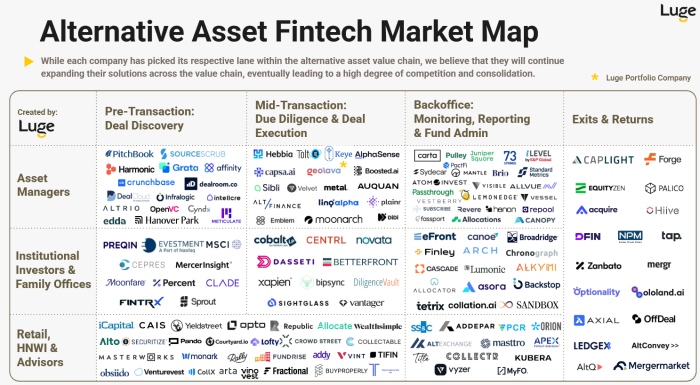
Image: State of Alternative Assets: A Fintech Perspective (Luge Capital, Nov 2025)
On November 11, 2025 Luge Capital published an informative report titled "2025 State of Alternative Assets: A Fintech Perspective'. Global Alternative Assets (Alts or AltAssets) reached $19 trillion in 2023 and could grow to $33 trillion by 2030, per the report's analysis of verified data from Preqin, BCG, and Deloitte.
Private equity and private credit stand out as the biggest categories but behind this growth, fintech companies are quietly rebuilding how money is raised, managed, and circulated across private investments.
Laviva Mazhar, a Principal at Luge Capital and Author of the report, compares what's happening today to the early computerization of trading desks. Manual processes are being replaced by connected systems that make private markets work more smoothly.
New companies are designing tools that handle every step of the process, from AI-supported deal sourcing and due diligence to data collection and performance reporting. The report names Canoe Intelligence (U.S.), 73 Strings (India), and Mantle (Canada) among the firms setting new benchmarks for automation.
Large players such as BlackRock, iCapital, and Hamilton Lane are also expanding through partnerships and acquisitions, bringing these innovations into the mainstream.
Private equity assets under management reached $5.8 trillion in 2023, while private credit is expected to reach $2.6 trillion by 2029. The number of U.S. companies backed by private equity has climbed 490% since 2000, validating how deep private capital is supporting business growth.
Company buyouts or public companies being taken private off the stock market increased 32% year over year, pointing to strong investor appetite for longer-term ownership. Across North America $297 billion has flowed into 7,300 private Canadian companies since 2013, backed by the shared strength of regional investment ecosystems.
Luge reports that 86% of institutional investors already allocate to alternatives, but individual investors are beginning to play a larger role. Assets from the wealth channel in the U.S. are projected to more than double to $3 trillion by 2029.
Fintech platforms like iCapital (U.S.), Yieldstreet (U.S.), and Opto Investments (U.S.) are developing digital pathways that make it easier for people to participate in funds once reserved for large institutions. This growing inclusion is one of the strongest patterns Luge identifies across the market.
According to Luge, the biggest opportunities now lie in the systems that connect private markets together. These include data sharing networks, portable investor identity tools, and liquidity platforms for secondary trading. The report also highlights a new class of software that helps fund managers handle onboarding, compliance, and reporting in one place. These initiatives are setting the stage for a more open and efficient investment environment.
Fintech companies that make it easier to access capital, reduce paperwork, and build trust are helping the global economy work better. This focus mirrors NCFA Canada’s commitment to supporting innovation, inclusion, and competitiveness through responsible market design that benefits investors, businesses, and communities alike. Download Luge Capital's latest report on the State of Alternative Assets in 2025 and/or subscribe to NCFA's weekly newsletter.
The National Crowdfunding & Fintech Association (NCFA Canada) is a financial innovation ecosystem that provides education, market intelligence, industry stewardship, networking and funding opportunities and services to thousands of community members and works closely with industry, government, partners and affiliates to create a vibrant and innovative fintech and funding industry in Canada. Decentralized and distributed, NCFA is engaged with global stakeholders and helps incubate projects and investment in fintech, alternative finance, crowdfunding, peer-to-peer finance, payments, digital assets and tokens, artificial intelligence, blockchain, cryptocurrency, regtech, and insurtech sectors. Join Canada's Fintech & Funding Community today FREE! Or become a contributing member and get perks. For more information, please visit: www.ncfacanada.org
| | |
|---|---|---|
| | |


August 26th, 2025

January 4th, 2024

June 1st, 2021

September 9th, 2020

July 9th, 2018

January 3rd, 2018

September 25th, 2017

June 20th, 2017

May 10th, 2017

December 14th, 2016