




Karsten Wenzlaff, Advisor
August 26th, 2025
Karsten Wenzlaff is a Crowdfunding and Fintech Expert from Germany. He is Secretary-General of Digit[...]


Digital Money | Nov 12, 2025

Image: Freepik/Pikisuperstar
On November 12, 2025, J.P. Morgan announced that it had become the first major bank to issue a USD deposit token on a public blockchain. The new JPM Coin (ticker JPMD) allows institutional clients to send and receive funds instantly using Base, the Ethereum Layer 2 network developed by Coinbase.
The project follows successful testing in June of this year with B2C2, Coinbase, and Mastercard, which achieved real-time issuance and redemption of the token. The initiative is led by Kinexys by J.P. Morgan, the bank’s blockchain division that has built digital financial infrastructure since 2015.
J.P. Morgan’s motivation goes beyond efficiency. By placing regulated deposits directly on a public chain, the bank is positioning itself for the next era of interoperable digital finance. Its clients can now settle cross-border trades, treasury flows, and digital asset transactions onchain, with the reliability and security of a regulated deposit. This model combines bank-grade security with blockchain’s speed and transparency.
Rather than competing with stablecoins, J.P. Morgan is building a framework where traditional deposits become programmable financial instruments, integrated with smart contracts.
The launch shows how large banks are implementing strategies for digital money. For global institutions, it reduces the friction of moving funds across time zones and platforms, offering constant access to liquidity and settlement.
By offering instant, always-on settlement and programmable deposits backed by a regulated bank, J.P. Morgan is setting a new standardfor how traditional finance can participate safely in the digital asset economy while maintaining oversight and trust.
For Canada, J.P. Morgan’s approach provides a clear case study as the Office of the Superintendent of Financial Institutions (OSFI) and the Bank of Canada (BoC) advance their own stablecoin policy framework. If Canada adopts similar standards for CAD-denominated deposit tokens, it could enable cheaper, faster settlements while maintaining full regulatory oversight.
There's also an opportunity for Canadian fintechs to collaborate with banks on compliant blockchain payment rails. Domestic players like Interac and major banks may soon face competitive pressure if global stablecoin transactions become a new standard. This type of regulatory model would allow Canadian financial institutions to issue tokenized deposits that preserve trust while keeping innovation local.
Once Canadian regulators establish clarity around digital deposits, the cost of settlement could fall dramatically. Current payment systems such as e-Interac and card networks, rely on intermediaries that add delay and cost. Regulated tokens could settle value directly between wallets within seconds, removing several layers of friction.
While this could reduce traditional fee income, it also supports innovation and opens new business models.
Banks could earn from providing liquidity, token custody, or smart contract services. Fintechs could integrate programmable money into real-time lending, payroll, or cross-border commerce.
If Canada aligns with international standards, the combination of stable onchain settlement and regulatory assurance could strengthen national competitiveness and attract global capital.
J.P. Morgan’s entry into public blockchain payments proves that regulated institutions can safely participate in decentralized finance while meeting compliance standards. The ability to move regulated value instantly across borders could help Canadian firms compete globally, expand access to capital, and reinforce confidence in digital finance.
 The National Crowdfunding & Fintech Association (NCFA Canada) is a financial innovation ecosystem that provides education, market intelligence, industry stewardship, networking and funding opportunities and services to thousands of community members and works closely with industry, government, partners and affiliates to create a vibrant and innovative fintech and funding industry in Canada. Decentralized and distributed, NCFA is engaged with global stakeholders and helps incubate projects and investment in fintech, alternative finance, crowdfunding, peer-to-peer finance, payments, digital assets and tokens, artificial intelligence, blockchain, cryptocurrency, regtech, and insurtech sectors. Join Canada's Fintech & Funding Community today FREE! Or become a contributing member and get perks. For more information, please visit: www.ncfacanada.org
 |  |  |
|---|---|---|
 |  |  |
Digital Assets | Nov 12, 2025
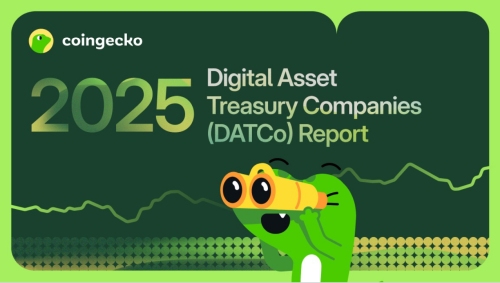
On November 5, 2025 CoinGecko published a comprehensive 2025 Digital Asset Treasury Companies Report unveiling the trends, rankings and strategies of mainly public companies that are increasingly adding digital assets to their balance sheets.
The report outlines three types of public DATCos including (1) Crypto mining firms (i.e., MARA Holdings), (2) Pure play firms whose sole purpose is to accumulate crypto assets (i.e., Strategy or Bitcoin Treasury Corp), and (3) Companies with crypto reserves (i.e., Bitfarms Ltd), with the full source data being available in the report along with CoinGecko's Treasuries Tracker (NB: includes government holdings in rankings).
CoinGecko’s data shows the number of Digital Asset Treasury Companies expanding from just 4 in early 2020 to 142 by October 2025. Total holdings rose from about $30 million to $137.3 billion USD, more than doubling in 2025 alone.
Bitcoin represents about 82.6 % of total holdings, Ethereum 13.2 %, and Solana 2.1 %, with the rest spread among smaller tokens. The United States leads with 60 companies; Canada ranks second with 19, reflecting its strong base of listed miners and crypto firms.
The takeaway is that public companies are increasingly adding digital assets to their balance sheet. Below are highlights of the ins and outs of how they do it, and some lessons learned.
CoinGecko traces Strategy’s transformation from a software company into the world’s largest corporate Bitcoin holder. Since pivoting in August 2020, Strategy has acquired about 640,800 BTC, roughly 3 % of total Bitcoin supply, and now manages holdings exceeding $70 billion USD.
The company funded these purchases through a mix of equity offerings, bond issuances, and preferred shares. Its stock has traded at premiums to its Bitcoin net asset value during parts of 2024, underlining investor appetite for exposure to corporate crypto reserves.
CoinGecko tracks at least $42.7 billion USD in new crypto purchases by DATCos between January and October 2025, with more than half occurring in the third quarter. Bitcoin accounted for roughly 70 % of total spend, Ethereum for 18 %, and Solana led among smaller allocations.
This acceleration reflects growing comfort with digital assets as long-term treasury instruments rather than short-term speculative holdings.
As of November 2025, Strategy leads with $70.7 billion USD in Bitcoin. BitMine Immersion ranks second with combined Ethereum and Bitcoin holdings of $12.9 billion USD, followed by Sharplink, a major Ethereum holder.
The top group also includes Marathon Digital, Riot Platforms, Coinbase, Galaxy Digital, and Tesla. Together, the top 15 account for most corporate-owned digital assets.
Three Canadian-listed firms, Galaxy Digital, Hut 8 Mining, and Bitfarms Ltd., remain among the most significant international participants, confirming Canada’s status as a leader in Bitcoin and Ethereum treasury adoption. Both Galaxy Digital and Hut 8 are listed as U.S. firms on the tracker but they are registered and originated in Canada.
Bitcoin treasuries held by DATCos now total about 1.03 million BTC, equal to 4.9 % of total Bitcoin supply. Strategy alone holds roughly 61.5 % of that amount.
Ethereum holdings across DATCos reached 4.7 million ETH, or 3.9 % of supply, with BitMine Immersion responsible for about 69 % of the total.
Solana treasuries rose to 15.9 million SOL, about 2.9 % of supply. Forward Industries’ $1.65 billion purchase of 6.8 million SOL in September 2025 represents nearly half of all corporate Solana reserves.
CoinGecko documents four key financing methods that DATCos have been using to acquire crypto assets:
Together, these options spotlight structured financing strategies that balance investor access with risk control.
mNAV compares a company’s market capitalization to the value of its crypto holdings, which acts as a sustainability barometer. When mNAV falls below 1.0, raising new equity dilutes shareholders rather than adding value.
CoinGecko found several DATCos near or below that threshold in late 2025. As a result some companies paused new acquisitions, while others turned to preferred shares or buybacks to stabilize their valuations.
CoinGecko’s report offers several clear lessons from 2025’s wave of funding stress and consolidation among crypto treasury companies.
When a company’s share price falls and its mNAV drops near or below 1.0, equity financing becomes uneconomical. Semler Scientific (SMLR) faced this in mid-2025, as weak stock performance made new issuance impossible and a shareholder vote to authorize preferred shares failed.
With no viable financing options left, Semler merged with Strive in September 2025. Consolidation often becomes the only path forward when market access closes.
After the merger Semler relied on preferred equity but its combined valuation still dropped by about 80 %, showing that preference structures help liquidity but not long-term confidence.
Across all DATCos, outstanding debt stood near $12.7 billion USD, which is modest compared with roughly $200 billion USD in crypto assets, leaving space for responsible borrowing to reduce reliance on stock issuance.
Companies use buybacks or issue preference shares to support valuations when mNAV weakens. ETHZilla even sold Ethereum in October 2025 to fund a buyback (a rare reversal of the usual accumulation pattern).
Several DATCos saw share prices surge briefly after announcing digital asset strategies, then retreat as fundamentals reasserted themselves. Some cases drew regulator scrutiny for pre-announcement trading. Companies should not base treasury policy on short-lived market premiums.
Strategy’s perpetual preferred shares attract investors through structured yields, but questions remain when dividends are financed by new share issuance. Transparent funding disclosure maintains credibility.
At a time when Canada's policymakers are creating stablecoin rules, it can learn from these global cases by allowing fair-value accounting for digital assets, enabling multiple funding tools, and setting clear disclosure standards. Canada’s listed mining and fintech firms already play a leading role in corporate crypto adoption. Yet few non-mining public companies have introduced digital reserves.
By updating accounting rules, modernizing treasury disclosure, and piloting a Digital Treasury Sandbox, regulators could enable more smaller scale companies with well-governed asset allocations to improve competitiveness and financial resilience. Digital assets are now a recognized part of global corporate finance. Bitcoin remains the anchor, while Ethereum and Solana continue to gain traction.
The National Crowdfunding & Fintech Association (NCFA Canada) is a financial innovation ecosystem that provides education, market intelligence, industry stewardship, networking and funding opportunities and services to thousands of community members and works closely with industry, government, partners and affiliates to create a vibrant and innovative fintech and funding industry in Canada. Decentralized and distributed, NCFA is engaged with global stakeholders and helps incubate projects and investment in fintech, alternative finance, crowdfunding, peer-to-peer finance, payments, digital assets and tokens, artificial intelligence, blockchain, cryptocurrency, regtech, and insurtech sectors. Join Canada's Fintech & Funding Community today FREE! Or become a contributing member and get perks. For more information, please visit: www.ncfacanada.org
| | |
|---|---|---|
| | |
Crypto | Nov 7, 2025

Image courtesy of AI
On November 5 2025, Ripple announced a $500 million strategic raise led by Fortress and Citadel Securities at a $40 billion valuation. The company positioned the funding round as confirmation of its recent trajectory and a way to deepen ties with financial partners after its strongest year on record.
Brad Garlinghouse, CEO Ripple:
“This investment reflects both Ripple’s incredible momentum, and further validation of the market opportunity we’re aggressively pursuing by some of the most trusted financial institutions in the world. We started in 2012 with one use case payments and have expanded that success into custody, stablecoins, prime brokerage and corporate treasury, leveraging digital assets like XRP. Today, Ripple stands as the partner for institutions looking to access crypto and blockchain.”
Ripple points to six acquisitions completed in just over two years that expand Ripple's ecosystem from a payments specialist to a broader institutional platform spanning custody, prime brokerage and corporate treasury.
On May 17, 2023 Ripple acquired Metaco for approx $250 million, adding an institutional custody stack and tokenization tooling that supports enterprise use cases.
On June 11, 2024 Ripple officially acquired Standard Custody and Trust Company (M&A price undisclosed), following regulatory approvals, expanding Ripple’s portfolio of licences and custody capabilities.
On April 8, 2025 Ripple acquired Hidden Road for $1.25 billion (now operating as Ripple Prime). The deal gives Ripple a global multi asset prime broker serving hundreds of institutional clients and positions RLUSD for collateral and cross margin uses.
Then on August 7, 2025 Ripple acquired Rail for $200 million, a Toronto based stablecoin payments platform, strengthening Ripple Payments with virtual accounts, cross border flows and back office automation.
On October 16, 2025 Ripple acquired GTreasury for $1 billion, opening up the corporate treasury market to Ripple’s infrastructure and customers that want to use stablecoins and tokenized deposits at scale.
And on November 3, 2025 Ripple acquired Palisade for an undisclosed amount, adding wallet and custody technology designed for real time institutional payments and treasury use cases.
The Rail acquisition anchors part of Ripple’s stablecoin payments build in Toronto, tipping the hat that Canada can be a node for institutional stablecoin flows. For Canadian banks, credit unions and large corporates, the combination of Rail for payments, GTreasury for treasury systems and Ripple Prime for brokerage creates an end to end platform that could change how liquidity, collateral and settlements move across borders and time zones.
For regulators, Ripple’s accumulation of more than seventy licences via Standard Custody's acquisition suggest a regulatory path where custody, treasury and brokerage converge. This raises familiar questions about prudential oversight and new ones about stablecoin collateral, cross margining and non bank market infrastructure that interfaces with core payment systems.
Ripple continues to prioritize licensing and compliance as part of its core strategy. When announcing the Standard Custody deal in February 2024, CEO Brad Garlinghouse said the acquisition “underscores Ripple’s ongoing commitment to working closely with regulators and maintaining the highest standards of compliance.” That focus on regulatory engagement gives institutions and policymakers a clearer sense of how Ripple plans to connect custody, brokerage, and treasury activities within today’s legal frameworks.
Ripple’s institutional expansion now focuses on integrating custody, payments, and treasury capabilities gained through its recent acquisitions. The company said these additions strengthen its position as a full-service provider for financial institutions, combining secure custody infrastructure, stablecoin payment tools, and prime brokerage access within one platform.
Brad Garlinghouse, CEO Ripple when announcin the GTreasury deal:
“For too long, money has been stuck in slow, outdated payments systems and infrastructure, causing unnecessary delays, high costs, and roadblocks to entering new markets problems that blockchain technologies are ideally suited to solve,”
The National Crowdfunding & Fintech Association (NCFA Canada) is a financial innovation ecosystem that provides education, market intelligence, industry stewardship, networking and funding opportunities and services to thousands of community members and works closely with industry, government, partners and affiliates to create a vibrant and innovative fintech and funding industry in Canada. Decentralized and distributed, NCFA is engaged with global stakeholders and helps incubate projects and investment in fintech, alternative finance, crowdfunding, peer-to-peer finance, payments, digital assets and tokens, artificial intelligence, blockchain, cryptocurrency, regtech, and insurtech sectors. Join Canada's Fintech & Funding Community today FREE! Or become a contributing member and get perks. For more information, please visit: www.ncfacanada.org
| | |
|---|---|---|
| | |
Federal Budget 2025 | Nov 5, 2025

Image courtesy of AI
On November 4, 2025, the Government of Canada tabled Budget 2025, announcing targeted investments in several fintech and related sectors of interest including open banking, digital assets, artificial intelligence, and venture capital to strengthen national competitiveness and expand innovation.
NCFA welcomes these measures that taken together, form a coordinated strategy to modernize Canada’s financial system and accelerate technology adoption across sectors. While there are many parts to the 493 page PDF document designed to modernize government, stimulate investment and support key sectors of the economy (especially those being adversely impacted by the weight of Washington's tariff policy), this article focuses on 6 select areas of the budget.
Budget 2025 confirms that Canada will move forward with the Consumer-Driven Banking Act to establish a national open banking framework. Oversight will rest with the Bank of Canada, which receives $19.3 million over two years to build and supervise the system. The $36.9 million previously allocated to the Financial Consumer Agency of Canada (FCAC) will be reprofiled to align with this transition. To support cybersecurity and national security functions, $25.7 million over five years and $5 million ongoing are provided to CSIS and the RCMP.
The government also commits that Canadians will not be subject to fees when accessing and sharing their financial data under the new regime. This right will be included in federal privacy legislation to protect consumers from banks charging for data portability.
Timeline:
The data access fee ban effectively aligns Canada with the UK and Australia, where accredited fintechs can access user-permitted financial data without paying incumbent banks, creating a more level playing field for startups.
Firms should focus on accreditation, API readiness, and user consent ecosystems now, while anticipating the full rollout with data portability and write-access functionality expected in 2027. The Bank of Canada’s new role brings institutional authority to open banking, aligning Canada’s model with prudential oversight practices seen in advanced financial systems.
Budget 2025 introduces a federal framework for fiat-backed stablecoins to protect consumers and ensure financial stability. Issuers must maintain adequate reserves, provide redemption rights, and follow strict disclosure and audit rules. The Bank of Canada will oversee compliance and receive $10 million over two years starting in 2026–27, with ongoing costs of about $5 million annually recovered from issuers. The Retail Payment Activities Act will be amended to extend oversight to payment service providers dealing in prescribed stablecoins.
This is Canada's first major step towards integrating digital assets within regulated finance. Fintechs and payment firms can soon align product design with national standards for reserve management and risk controls. The framework signals Canada’s preference for stablecoins backed by traditional assets and issued under domestic supervision, distinguishing it from more permissive global approaches.
Budget 2025 strengthens financial system integrity by modernizing the Proceeds of Crime (Money Laundering) and Terrorist Financing Act and the Personal Information Protection and Electronic Documents Act. The updates ban cash transactions over $10,000, prohibit third-party cash deposits, and authorize real-time information sharing through the new Integrated Money Laundering Intelligence Partnership. FINTRAC is added to the Financial Institutions Supervisory Committee, expanding coordination with the Bank of Canada, OSFI, and the Department of Finance.
This overhaul moves compliance toward continuous data exchange rather than static reporting. For regtech and fintech firms, it expands the market for monitoring, analytics, and automation tools. By embedding FINTRAC directly within the supervisory structure, the government is creating a multi-agency model similar to the UK’s Joint Money Laundering Intelligence Taskforce. These measures are foundational to supporting open banking and payments modernization safely.
Budget 2025 commits $925.6 million over five years starting in 2025–26 to build sovereign public AI infrastructure, including a Canadian sovereign cloud for compute capacity. Of this, $800 million comes from reallocated funds. The new Minister of Artificial Intelligence and Digital Innovation will coordinate partnerships with industry and direct investments through the Canada Infrastructure Bank. Statistics Canada receives $25 million over six years and $4.5 million ongoing for AI and digital measurement programs.
The budget also reforms the Scientific Research and Experimental Development (SR&ED) tax incentive. The annual enhanced credit limit rises from $4.5 million to $6 million, and companies can elect pre-claim approval for faster reimbursements, reducing average processing from 180 days to 90 days by April 2026.
This is the largest coordinated investment in Canada’s digital productivity to date. Sovereign compute and AI infrastructure will help domestic firms train and deploy large models while maintaining data residency. The SR&ED reform improves liquidity during tight capital cycles for startups, software developers, and AI ventures by accelerating access to refundable credits. These changes directly respond to longstanding calls from the innovation community for faster turnaround and broader eligibility for digital R&D.
To expand the growth capital ecosystem, Budget 2025 allocates $1 billion over three years starting in 2026–27 to the Business Development Bank of Canada (BDC) for the Venture and Growth Capital Catalyst Initiative. This fund will leverage pension and institutional investment to scale up Canadian venture capital and support new, diverse fund managers. Additional measures include:
These measures help close gaps between early-stage funding and commercialization. The Catalyst Initiative could attract more private capital into growth-stage companies, while IP and R&D supports strengthen Canada’s intangible economy. For fintechs, this capital mobilization aligns with efforts to improve scaling conditions, enabling firms to move beyond domestic pilots into global markets. By expanding the Canada Growth Fund Venture Program and the Venture Capital Catalyst Initiative, Ottawa is trying to fill the scale-up gap where private funding has been slow to follow through.
Budget 2025 targets long-standing consumer frustrations with high fees, slow transfers, and limited access to funds. The government will review ATM and Interac e-Transfer fees charged by federally regulated institutions and will report on corrective actions in 2026.
By spring 2026, the government will also ban investment and registered account transfer fees, which average $150 per account, and mandate faster, transparent transfers. Fintechs such as Wealthsimple and Questrade have supported these measures for years, arguing they will remove switching barriers and increase competition.
Consumer access to deposited funds will also improve. The Bank Act will be amended to raise immediate access for cheque deposits from $100 to $150, close the gap between in-person and digital deposits, and shorten cheque-hold times by raising the threshold for early release from $1,500 upward.
To strengthen competition, the public-holding threshold for smaller banks and credit unions will double from $2 billion to $4 billion, supported by a new voluntary code of conduct on brokered deposit access and fair distribution.
These reforms respond directly to public frustration with high account transfer costs, after firms like Wealthsimple and Questrade called for faster, cheaper asset portability. Lower fees, faster access to money, and easier account switching will force incumbents to compete on value. Fintech companies gain room to build better portability and payments solutions within a simpler and more open regulatory landscape.
Budget 2025 delivers the clearest roadmap for a more competitive financial services sector and digital economy. Open banking, AI, and venture capital measures finally intersect within a national policy framework designed to increase innovation and resilience. The obvious challenge now is delivery and execution. Timelines must hold, interoperability standards must stay open, and public-private coordination must translate funding into outcomes. Canada has a window to jump-start competitiveness by executing on what has already been announced rather than starting new consultations. The need is there. The foundation is set. It's now time to build and execute Canada.
Subscribe to NCFA Canada’s weekly newsletter for news, analysis and updates on fintech innovation, policy, and funding.
The National Crowdfunding & Fintech Association (NCFA Canada) is a financial innovation ecosystem that provides education, market intelligence, industry stewardship, networking and funding opportunities and services to thousands of community members and works closely with industry, government, partners and affiliates to create a vibrant and innovative fintech and funding industry in Canada. Decentralized and distributed, NCFA is engaged with global stakeholders and helps incubate projects and investment in fintech, alternative finance, crowdfunding, peer-to-peer finance, payments, digital assets and tokens, artificial intelligence, blockchain, cryptocurrency, regtech, and insurtech sectors. Join Canada's Fintech & Funding Community today FREE! Or become a contributing member and get perks. For more information, please visit: www.ncfacanada.org
| | |
|---|---|---|
| | |
Blockchain | Nov 5, 2025

Image: Freepik/tonodiaz
On November 4, 2025 Canadian DMG Blockchain Solutions Inc. (TSX V: DMGI; OTCQB: DMGGF; Frankfurt: 6AX) announced a letter agreement and deposit to acquire a 27,600 square foot building in Boardman, Oregon. The property sits on eight acres with an option for ten more and is connected to 3.75 megawatts of power. DMG expects to close the transaction in the coming weeks, according to the official news release.
The Boardman area hosts multiple large data facilities, offering strong connectivity and access to utility power. DMG plans to retrofit the existing building or add new capacity on the full site to support high performance computing, such as training AI models and data processing, expanding beyond just Bitcoin mining.
DMG reported 23 Bitcoin mined in October 2025, which was unchanged from September. Hashrate rose from 1.65 to 1.75 exahashes per second. The company ended October holding 359 Bitcoin, up from 342 in September. The company noted cooler seasonal temperatures and continued optimization.
The Oregon expansion complements DMG’s Canadian plan to build sovereign AI capacity. On October 28, 2025 DMG announced a partnership with the Malahat Nation to form a regulated utility that would power a fifteen megawatt site on Vancouver Island.
DMG Blockchain's U.S. expansion is an example of how Canadian firms in blockchain and data infrastructure are scaling across borders while keeping a focus on domestic capacity. How quickly the retrofit in Oregon will take will determine how quickly DMG can deliver to market high performance compute services for AI and digital asset clients. More information is available at the DMG Blockchain website.
The National Crowdfunding & Fintech Association (NCFA Canada) is a financial innovation ecosystem that provides education, market intelligence, industry stewardship, networking and funding opportunities and services to thousands of community members and works closely with industry, government, partners and affiliates to create a vibrant and innovative fintech and funding industry in Canada. Decentralized and distributed, NCFA is engaged with global stakeholders and helps incubate projects and investment in fintech, alternative finance, crowdfunding, peer-to-peer finance, payments, digital assets and tokens, artificial intelligence, blockchain, cryptocurrency, regtech, and insurtech sectors. Join Canada's Fintech & Funding Community today FREE! Or become a contributing member and get perks. For more information, please visit: www.ncfacanada.org
| | |
|---|---|---|
| | |
Stablecoins | Nov 4, 2025

On October 28, 2025, Visa CEO Ryan McInerney told investors in a Visa Q4 earnings call (22 page PDF) that the company is adding support for four stablecoins operating on four distinct blockchains across two currencies, with conversion to more than 25 fiat currencies. He said Visa’s stablecoin-linked card spend has quadrupled over the past year, with monthly settlement volumes reaching an annualized $2.5 billion. So now we can all expect to have access to embedded digital currency settlement directly into its global treasury and FX systems.
Visa’s public Onchain Analytics Dashboard reports more than US $9.6 trillion in adjusted transaction volume, over 10 billion transactions, and an average stablecoin supply above US $221 billion across Ethereum, Solana, Polygon, and Avalanche. The numbers confirm that fiat-backed stablecoins are already a growing part of daily global payments.
Based on Visa’s earlier pilot programs using USDC on Ethereum and Solana, it is reasonable to expect these networks to be among the four blockchains involved, though earnings call transcript doesn't name specific stablecoins or chains.
Visa’s expansion is a transition from testing digital currency settlement to making it part of its core infrastructure. The company is linking stablecoins to its global treasury and FX networks, allowing conversion between digital assets and traditional currencies without adding new intermediaries. So stablecoins will become programmable tools for cross-border settlement and liquidity management.
Ryan McInerney, Visa CEO:
“We are adding support for four stablecoins, running on four unique blockchains, representing two currencies, that we can accept and convert to over 25 traditional fiat currencies. Our digital currency work builds on our core competencies — connecting buyers and sellers, securing payments, and enabling interoperability across currencies and networks.”
Fintechs and financial institutions should take notice because Visa is not just planning to accept stablecoins as a form of payment, it's building a bridge between regulated banking infrastructure and onchain finance. Visa’s integration also provides a compliance template that shows how large-scale financial networks can handle digital assets safely within existing frameworks.
Visa’s financial results strengthen the case why stablecoin settlement is strategically important. According to Visa’s investor materials, cross-border payment volume grew 10% year over year in Q4 2025, driven by travel and international eCommerce. Total revenue reached US $9.2 billion, up 9%, with payment volume increasing 8% on a constant-dollar basis.
Stablecoins fit naturally into this picture. They can move value instantly across borders, reducing settlement friction and costs for businesses that operate in multiple currencies. For enterprises, corporates, and fintechs, Visa’s model offers a regulated approach to use stablecoins for treasury, payroll, and remittances at scale.
Visa’s partnerships with digital wallets, neobanks, and blockchain platforms extend its reach into Web3 commerce while maintaining the dispute resolution and identity safeguards that make card networks trusted globally.
McInerney emphasized continued collaboration with policymakers and central banks to ensure that new payment models meet regulatory expectations while delivering tangible economic benefits.
For Canada, Visa's approach of blending real world payments with programmable finance is a framework offering lessons on how to connect open banking, digital money regulation, and cross-border innovation at scale and under clear governance.
The National Crowdfunding & Fintech Association (NCFA Canada) is a financial innovation ecosystem that provides education, market intelligence, industry stewardship, networking and funding opportunities and services to thousands of community members and works closely with industry, government, partners and affiliates to create a vibrant and innovative fintech and funding industry in Canada. Decentralized and distributed, NCFA is engaged with global stakeholders and helps incubate projects and investment in fintech, alternative finance, crowdfunding, peer-to-peer finance, payments, digital assets and tokens, artificial intelligence, blockchain, cryptocurrency, regtech, and insurtech sectors. Join Canada's Fintech & Funding Community today FREE! Or become a contributing member and get perks. For more information, please visit: www.ncfacanada.org
| | |
|---|---|---|
| | |
Nov 4, 2025

In Canada, a growing number of retirees are seeking a safe and worry-free way to realize long-term growth in their digital assets. Faced with persistently low bank interest rates, limited returns from traditional investment products, and volatile crypto markets, striking a balance between stability and growth has become a crucial issue for retired families.
Many Canadian retirees are legally participating in XRP (Ripple) cloud mining through ETCMining platform, Earn passive income every day. This new model requires no trading and does not rely on short-term price fluctuations, providing a completely new solution for long-term retirement income.
In the past, retirees holding XRP or BTC had to wait for price increases to profit. With ETCMining, these assets are directly converted into cloud mining income. For retirees, this means they can receive a daily digital "retirement supplement" without having to operate or monitor the market.
Register an ETCMining account → Select a hash rate contract → Start mining automatically, no equipment or maintenance required.
The platform boasts mature technology and stable hash rate, providing users with stable long-term returns and suitable for conservative investment needs.
Supporting major cryptocurrencies such as BTC, XRP, ETH, and DOGE, users can freely choose the mining asset of their choice.
We provide 24/7 customer service and online training to help retirees quickly get started and build confidence.
The following are some of the most popular contracts recently launched:
| mining pools | price | day | Daily income | Principal + Return |
| New User Experience Contract | $100 | 2 | $4 | $100+$8 |
| MICROBT WhatsMiner M50 | $500 | 5 | $6 | $500+$30 |
| MICROBT WhatsMiner M50S | $1,200 | 10 | $14.76 | $1,200+$147.6 |
| ETC Miner E9 Pro | $3,300 | 16 | $42.9 | $3,000+$686.4 |
| Bitcoin Miner S21+ Hyd | $5,000 | 25 | $70 | $8,000+$1,750 |
| ETC Miner E11 | $8,300 | 30 | $124.5 | $10,000+$3,735 |
ETCMining is more like a "digital pension value-added channel," allowing retirement assets to continue to grow over the long term.
Register for an ETCMining account and receive a $20 new user bonus, allowing you to experience the platform's profitability with zero entry requirements.
Choose based on your budget and schedule, and participate directly with major assets like XRP, BTC, and ETH.
Income will be distributed daily to your account and can be withdrawn or reinvested at any time, achieving compound growth.
"From the Era of Trading to the Era of Holding for Interest"
ETCMining represents a more mature asset management approach, not high-risk speculation
As more and more Canadian retired families begin to consider crypto assets as a source of long-term cash flow, cloud mining is becoming a new generation of reliable financial management tools.
ETCMining is a global clean energy cloud mining platform founded in the UK in 2019, dedicated to providing users with stable, secure, and sustainable computing power services. Leveraging over 100 large-scale mining farms and data centers across Eastern Europe, North America, Central Asia, and Australia, the platform implements a highly efficient, low-energy, green mining strategy.
Currently, ETCMining's services are available in over 190 countries and regions worldwide, with over 7 million registered users. With its leading technology and stable returns, it continues to be widely trusted by investors worldwide.
If you already have XRP/BTC/ETH, you desire a stable cash flow from your assets, you are averse to speculative risk, and you prefer a sustainable and secure growth model, then ETCMining could be your second pension for your digital assets.
For more information, please visit https://etcmining.com/ or contact us via email: info@etcmining.com
Application download: https://etcmining.com/xml/index.html#/app
The National Crowdfunding & Fintech Association (NCFA Canada) is a financial innovation ecosystem that provides education, market intelligence, industry stewardship, networking and funding opportunities and services to thousands of community members and works closely with industry, government, partners and affiliates to create a vibrant and innovative fintech and funding industry in Canada. Decentralized and distributed, NCFA is engaged with global stakeholders and helps incubate projects and investment in fintech, alternative finance, crowdfunding, peer-to-peer finance, payments, digital assets and tokens, artificial intelligence, blockchain, cryptocurrency, regtech, and insurtech sectors. Join Canada's Fintech & Funding Community today FREE! Or become a contributing member and get perks. For more information, please visit: www.ncfacanada.org
| | |
|---|---|---|
| | |


August 26th, 2025

January 4th, 2024

June 1st, 2021

September 9th, 2020

July 9th, 2018

January 3rd, 2018

September 25th, 2017

June 20th, 2017

May 10th, 2017

December 14th, 2016