




Karsten Wenzlaff, Advisor
August 26th, 2025
Karsten Wenzlaff is a Crowdfunding and Fintech Expert from Germany. He is Secretary-General of Digit[...]


Enforcement | May 12, 2025

Image: AI Freepik
On May 9, 2025, U.S. President Trump signed an executive order called 'Fighting overcriminalization in federal regulations' that changes how federal agencies can or cannot pursue criminal enforcement for regulatory violations, redefining risk for fintech and crypo leaders. The policy order says prosecutors must now show clear evidence that a person or company intended to break the law before charging them criminally.
This move targets the issue of overcriminalization and aims to reduce legal risk for businesses that unknowingly violate complex or technical rules. It could reshape how enforcement decisions are made in fintech, crypto, and other innovation-driven sectors.
Here's a link the fact sheet published by the White House. Essentially the order mandates all federal agencies to:
1. A good example may be former Binance CEO, Changpeng Zhao (CZ) who was sentenced to four months in prison in 2023 for violating the Bank Secrecy Act. The case focused on compliance gaps, not fraud. Similar enforcement actions in the future might be handled differently if there was no evidence of intent.
2. These two former Coinbase employees, Ishan and Nikhil Wahi, were convicted of insider trading using confidential listing information. Since their actions were deliberate, the order may not directly apply to them but it might influence how prosecutors approach future cases involving gray areas in trading conduct.
3. Fintech and crypto companies operating in complex and evolving regulatory environments may benefit the most. The new policy could limit criminal risk for teams that unintentionally violate reporting, registration, or compliance rules.
4. Sam Bankman-Fried was convicted in 2023 and sentenced to 25 years in prison. The FTX founder was found guilty of fraud, conspiracy, and misuse of customer funds. Courts found that his actions were intentional and deceptive, so the order likely does not apply in his case.
5. Alex Mashinsky former Celsius CEO pleaded guilty to fraud and market manipulation and recently received a 12 year prison sentence for crypto fraud and knowingly misleading customers. As a result, his case also likely falls outside the scope of the new enforcement policy.
The new policy directive places the burden on agencies to prove intent before pursuing criminal charges. The change may protect founders, operators, and teams from facing prison time over technical mistakes or unclear compliance rules in an ever evolving regulatory environment.
While the order does not affect past convictions, it may influence how courts and prosecutors handle ongoing investigations. It also gives legal teams a new foundation to challenge charges that lack clear evidence of intentional wrongdoing.
 The National Crowdfunding & Fintech Association (NCFA Canada) is a financial innovation ecosystem that provides education, market intelligence, industry stewardship, networking and funding opportunities and services to thousands of community members and works closely with industry, government, partners and affiliates to create a vibrant and innovative fintech and funding industry in Canada. Decentralized and distributed, NCFA is engaged with global stakeholders and helps incubate projects and investment in fintech, alternative finance, crowdfunding, peer-to-peer finance, payments, digital assets and tokens, artificial intelligence, blockchain, cryptocurrency, regtech, and insurtech sectors. Join Canada's Fintech & Funding Community today FREE! Or become a contributing member and get perks. For more information, please visit: www.ncfacanada.org
 |  |  |
|---|---|---|
 |  |  |
AI | May 9, 2025

Image: Freepik/iconicbestiary
On May 8, 2025 during a U.S. Senate testimony on 'Winning the AI Race', Microsoft Vice Chair Brad Smith said the company blocked employees from using the DeepSeek AI app because of the app’s data collection practices, risks of propaganda, and Chinese state censorship. Smith confirmed that DeepSeek “is not available on the Microsoft store” and cannot be used by staff. The full hearing coverage can be found at TechCrunch.
But at the same time Microsoft continues to offer DeepSeek’s open source AI models through its Azure cloud platform, raising questions for both the public and business users alike. According to Dataconomy, Microsoft claims that it has audited, changed, and sandboxed the models before release to remove parts they deem are risky or unsafe.
This mixed approach has raised some concerns since the AI model can be used by others without Microsoft's internal protections. Some smaller companies may also not have the tools or awareness to even evaluate these risks, whether they be related to security or reputation.
It's the same underlying tech. Even if Microsoft tweaks the model, the core code base still comes from DeepSeek, so any unknown, unspottable, or embedded risk could still be present.
The open source models that Microsoft offers via its Azure cloud platform, could have been adversely modified by bad actors for risks like surveillance, disinformation or phishing campaigns.
It's a double standard for Microsoft to say it's unsafe for employees but okay for customers to use it. It sends a mixed message and in certain cases a reputational or regulatory risk could grow for companies that adopt it.
If governments and regulator tighten controls around AI supply chains, especially foreign ones from China, then companies could face compliance, or import/export restrictions in the the future. The State of New York has already banned DeepSeek on official devices earlier this year due to data privacy and censorship concerns.
Fintechs and financial institutions need to verify AI model origins and audit what is under the hood, and understand how its being deployed while staying aware of compliance risks. Microsoft’s internal controls may reduce risk for its own teams, but the public and smaller firms are left more exposed.
The National Crowdfunding & Fintech Association (NCFA Canada) is a financial innovation ecosystem that provides education, market intelligence, industry stewardship, networking and funding opportunities and services to thousands of community members and works closely with industry, government, partners and affiliates to create a vibrant and innovative fintech and funding industry in Canada. Decentralized and distributed, NCFA is engaged with global stakeholders and helps incubate projects and investment in fintech, alternative finance, crowdfunding, peer-to-peer finance, payments, digital assets and tokens, artificial intelligence, blockchain, cryptocurrency, regtech, and insurtech sectors. Join Canada's Fintech & Funding Community today FREE! Or become a contributing member and get perks. For more information, please visit: www.ncfacanada.org
| | |
|---|---|---|
| | |
Enforcement | May 9, 2025

Image: Freepik
Alex Mashinsky, Founder of the crypto lending platform Celsius, has been sentenced to 12 years in prison for defrauding customers and manipulating the price of his company’s digital token.
According to a press release issued May 8, 2025 from the U.S. Department of Justice, Mashinsky promised people their money would be safe and earn high rewards on Celsius. However, courts found that instead he used customer deposits to make risky bets and secretly boost the price CEL, Celsius’s own token. At the company’s peak, Celsius held about $25 billion in customer assets. When Celsius collapsed in July 2022, around 600,000 customers lost access to $4.7 billion worth of crypto. The sentence came from a U.S. court after Mashinsky admitted in December 2024 that he committed fraud and misled investors.
Jay Clatyon, U.S. Attorney said:
“Mashinsky made tens of millions of dollars while his customers lost billions... The rules against fraud still apply.”
As reported by Reuters, Mashinsky also said publicly that he wasn’t selling CEL tokens, but in fact he was and made about $48 million in profit from doing so. Further, he took out $8 million of his own money just before the company blocked customer withdrawals. He told customers that Celsius was financially strong even that he knew it was failing.
In addition to 12 years prison time, Mashinsky must pay a fine and give up his profits from the token sales.
Crypto companies must follow the same rules as everyone else. Misleading customers and manipulating markets has serious consequences. As more and more people engage with digital assets, trust and transparency is critical for the future of finance.
The National Crowdfunding & Fintech Association (NCFA Canada) is a financial innovation ecosystem that provides education, market intelligence, industry stewardship, networking and funding opportunities and services to thousands of community members and works closely with industry, government, partners and affiliates to create a vibrant and innovative fintech and funding industry in Canada. Decentralized and distributed, NCFA is engaged with global stakeholders and helps incubate projects and investment in fintech, alternative finance, crowdfunding, peer-to-peer finance, payments, digital assets and tokens, artificial intelligence, blockchain, cryptocurrency, regtech, and insurtech sectors. Join Canada's Fintech & Funding Community today FREE! Or become a contributing member and get perks. For more information, please visit: www.ncfacanada.org
| | |
|---|---|---|
| | |
Investor Research | April 23, 2025
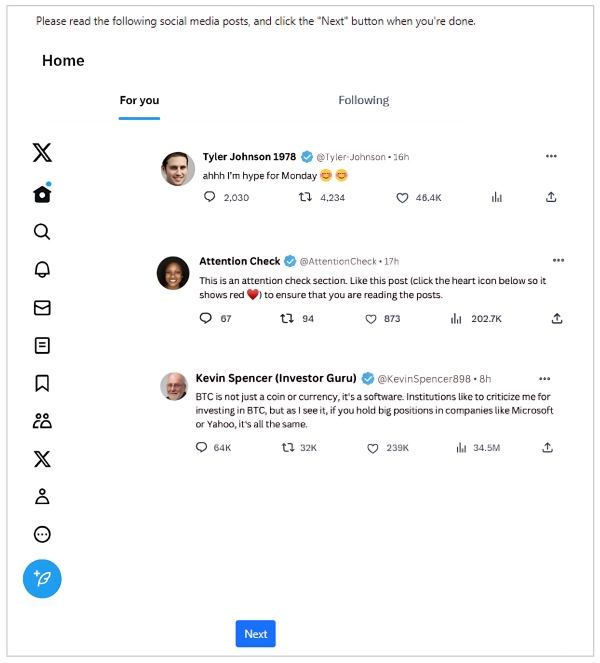
Image from OSC Retail Investor and Social Media Study Interface
The story goes something like this... Maya wasn't looking for investment advice when she jumped on her phone and started scrolling through short videos when one caught her attention. A young finfluencer explained how he built a portfolio by investing a small amount each week. He showed screenshots, made it sound simple, and wrapped the message in personal success. It felt real and by the end of the clip Maya was thinking about following his exact steps. What she didn't realize was how many others were doing the same, by trusting only a short video.
Social media platforms have become a significant source of financial information for Canadians. According to the 2024 Canadian Securities Administrators (CSA) Investor Index, 53% of investors use social media for investment information (up 18% since 2020). Not surprisingly, among young investors aged 18 to 24, the figure rises to 82%. And to zoom in even further, 46% of investors report encountering investment opportunities on social media (up 17% from 2020).
On April 22, 2025, the Ontario Securities Commission (OSC) revealed their latest retail investor research, 'Social Media and Retail Investing: The Rise of Finfluencers' in collaboration with The Decision Lab. This post is data-driven look at how trust can turn into risk, and what the OSC likely plans to do about it.
The OSC surveyed 655 Canadian retail investors and found:
And those who acted on finfluencer advice, the following behaviours increased significantly:
The survey results suggest that a growing number of retail investors are relying on social media for online financial advisor, and based on their trust of finfluencers, investment advice found on social media often replaces traditional financial guidance which can lead to increased exposure to risk, especially among younger investors who are online frequently.
To better understand how social media and finfluencer content affects financial decisions, the Ontario Securities Commission ran an online study with 1,465 Canadians who use social media. Each person was randomly placed into different groups to see how different types of posts might influence what they would choose to buy in a simulated investment setting. Participants managed a simulated $10,000 portfolio and were exposed to promotional finance content modelled after real social media posts. Here's the rub:
These above results confirmed that exposure to financial content on social media can significantly impact investment decisions, especially among those with less experience.
The OSC ran tests to look at which behavioural interventions could be used to reduce the influence of influencer content including:
The results found that all of the above methods helped reduce the number of participants who purchased the promoted assets but none completely eliminated the influence of the original content.
The OSC's report suggests that the regulator supports continuation of regulatory oversight and targeted interventions to protect retail investors from finfluencer content, especially since social media is now integral to the distribution and/or access of financial advisor. In addition to the various Canadian regulatory guidelines below, the report confirms that authorities should consider additional measures to address these concerns that are now backed by evidence.
While some finfluencers provide valuable insights for investors, others can provide misleading or harmful advice. The OSC's findings are a cause for concern for regulators who are evaluating further oversight measures to protect retail investors from the potential risks associated with unregulated financial advice on social media platforms (or by finfluencers). Learn more about the OSC's study about the Rise of Finfluencers and Social Media and Retail investing.
The National Crowdfunding & Fintech Association (NCFA Canada) is a financial innovation ecosystem that provides education, market intelligence, industry stewardship, networking and funding opportunities and services to thousands of community members and works closely with industry, government, partners and affiliates to create a vibrant and innovative fintech and funding industry in Canada. Decentralized and distributed, NCFA is engaged with global stakeholders and helps incubate projects and investment in fintech, alternative finance, crowdfunding, peer-to-peer finance, payments, digital assets and tokens, artificial intelligence, blockchain, cryptocurrency, regtech, and insurtech sectors. Join Canada's Fintech & Funding Community today FREE! Or become a contributing member and get perks. For more information, please visit: www.ncfacanada.org
| | |
|---|---|---|
| | |
AI Security | April 22, 2025

Image: Freepik/atlascompany
Perplexity AI is growing fast with over 10 million Android downloads and is backed by tech royalty like Jeff Bezos but a new security report by a Singapore security firm AppKnox found major vulnerabilities that could be exploited by attackers. We're not talking small potatoes here. We're talking about huge issues like hardcoded API keys and significant weaknesses against any sort of malicious hacking.
While Perplexity's android app isn't what most fintechs run their AI service on, it's a red flag about the state of security in the quickly evolving world of artificial intelligence tools that banks, wealthtech platforms, and credit unions are exploring, embedding, investing and integrating in..
Perplexity’s Android app includes private access keys that should not be exposed. These keys work like internal passwords and were stored inside the app itself. This makes it easy for anyone with technical skills to find and misuse them. These hardcoded credentials could be downloaded and used to access Perplexity's AI full system completely for free.
Another serious problem is that the app does not check if it is connecting to a real or fake server. Cybernews reports that someone on public WiFi could take advantage of this to spy on what users are doing. This might include watching what they search, type, or log in to.
The app has not fixed several known security flaws that have existed in Android for years, such as StrandHogg and Janus are still present. These are weaknesses that hackers already understand and can use to gain control or access private information.
Perplexity's app doesn't check if a phone is rooted or not, and it's less secure if it is.
The app’s code is also not protected. This means someone could open it up, look inside, and understand exactly how it works. They could then use this to find more vulnerabilities to attack or copy its features.
The app can be tricked into letting attackers control parts of the screen without the user knowing. So, you could be typing into a pop-up form or something that looks familiar but it's actually a trap that can steal your information.
How is it possible that a high profile AI unicorn like Perplexity ships a mobile app that fails basic security checks? If they are missing the basics, how many others are? This raises a critical question for fintechs and financial institutions looking to integrate AI whether it's a chatbot, SDK, API, or embedded assistants.
Are you checking how secure your vendors really are?
It's a reality check that a soaring valuation doesn’t guarantee strong engineering discipline.
Where are the API keys stored? If they live in the mobile app code, that’s a no-go.
Does the vendor use SSL validation and pinning? If not, data can be intercepted over public WiFi.
Are known vulnerabilities patched? Run a third party scan or ask for one.
Is the code protected? If it’s not, attackers can easily reverse-engineer how it works.
Does the app detect rooted or jailbroken devices? If not, it might be operating in a compromised environment.
What’s the vendor’s breach response plan? Ask how they handle disclosures, patches, and updates.
How much access are you really giving? Use API scopes, rate limits, and narrow permissions by default.
Perplexity's Android app glaring security risks is a textbook example of what happens when security gets left behind in a rush to launch/scale products out the door. Don't ever forget that financial data isn't forgiving when it leaks. Whether you're exploring AI for customer support, product recommendations, or internal workflows, you need to prioritize the app and API security for your use case. Trust is earned but it can be lost in a heart beat.
The National Crowdfunding & Fintech Association (NCFA Canada) is a financial innovation ecosystem that provides education, market intelligence, industry stewardship, networking and funding opportunities and services to thousands of community members and works closely with industry, government, partners and affiliates to create a vibrant and innovative fintech and funding industry in Canada. Decentralized and distributed, NCFA is engaged with global stakeholders and helps incubate projects and investment in fintech, alternative finance, crowdfunding, peer-to-peer finance, payments, digital assets and tokens, artificial intelligence, blockchain, cryptocurrency, regtech, and insurtech sectors. Join Canada's Fintech & Funding Community today FREE! Or become a contributing member and get perks. For more information, please visit: www.ncfacanada.org
| | |
|---|---|---|
| | |
Antitrust | April 21, 2025

Image: Freepik/upklyak
The U.S. Federal Trade Commission (FTC) first sued Facebook (now called Meta Platforms Inc.) in December 2020, claiming it broke competition laws by buying Instagram and WhatsApp to suppress competition and maintain a monopoly in personal social media markets. The case was renewed in 2021 with more evidence and the trial started on April 14, 2025, with Mark Zuckerberg already on the stand in the U.S. District Court for the District of Columbia.
The FTC argues Meta bought Instagram for $1 billion in 2012 and WhatsApp for $19 billion in 2014 in what they call a 'buy or bury' strategy to dominate the market, which it now controls -see FTC opening statement slides:
During the trial, FTC presented internal messages/texts in 2012 from CEO Mark Zuckerberg, saying:
“It is better to buy than compete.”
The FTC now seeks a court order that could force Meta to breaking-up or divesting Instagram and WhatsApp entirely.
On April 13, 2025 in an official Meta blog post, Meta’s Chief Legal Officer Jennifer Newstead says that the FTCs case is 'weak' and that the lawsuit is wrong, saying it ignores how competitive the tech space has become. She argues that platforms like TikTok, YouTube, Snapchat and others fiercely compete for users' time and attention and that the FTC is using a narrow definition for personal social networking. She continues to say that Instagram and WhatsApp grew under Facebook/Meta's ownership because of the investments in safety, encryption, and performance.
While Canada has not filed a federal antitrust lawsuit like the FTC, there are a number of legal and regulatory actions against Meta including:
1. Canada passed the Online News Act (Bill C-18) in June 2023 to help struggling news publishers that required big tech platforms like Meta to pay Canadian outlets when they share or link to their news. The expectation is that platforms like Meta and Google are to contribute at least $100 million CAD annually to support the sustainability of the Canadian news industry. Meta responded by blocking all Canadian news content from Facebook (now Meta) and Instagram feeds. So in response, News Media Canada and CBC filed a complaint with the Competition Bureau, arguing that Meta’s move was anti-competitive and harmful to the public, which the Bureau is currently investigating.
2. In 2024, four Ontario school boards sued Meta, TikTok’s parent ByteDance, and Snapchat’s owner Snap Inc., asking for over $4 billion CAD in damages. They claim the platforms were designed to be addictive, harming students mental health and learning. The companies tried to get the case thrown out but an Ontario judge ruled that the case proceed which now has expanded to 14 school boards. The boards say they've had to spend more funding on mental health and classroom supports because of social media's impact, and want the platforms redesigned to reduce harm to students.
3. In 2024, Canada passed the Digital Services Tax Act, introducing a 3% tax on revenue earned in Canada by large global tech companies like Meta. It applies to companies with more than €750 million in global revenue and at least C$20 million in Canadian digital revenue. The first payments are due by June 30, 2025. The tax was delayed for years during global talks but Canada moved ahead after little progress. Meta opposes the digital services tax, and it's not a secret that President Trump dislikes the tax too, and we can expect it to be raised when renegotiating the Canada-United-States-Mexico-Agreement (CUSMA) trade agreement. Revenue collection is proceeding with its first collection in 2025.
We're at a regulatory turning point against big tech. From Washington to Ottawa, digital platform dominance is in the spotlight. The outcome of Meta's trial, as well as Canada's legal pressures could lead to new enforcement models, investment opportunities, and an increase in competition in areas that have been long dominated by Big Tech.
Also, smaller firms operating in AI, digital media, and user engagement platforms may find that regulators are more willing to intervene or step in/up if complaints are made.
The National Crowdfunding & Fintech Association (NCFA Canada) is a financial innovation ecosystem that provides education, market intelligence, industry stewardship, networking and funding opportunities and services to thousands of community members and works closely with industry, government, partners and affiliates to create a vibrant and innovative fintech and funding industry in Canada. Decentralized and distributed, NCFA is engaged with global stakeholders and helps incubate projects and investment in fintech, alternative finance, crowdfunding, peer-to-peer finance, payments, digital assets and tokens, artificial intelligence, blockchain, cryptocurrency, regtech, and insurtech sectors. Join Canada's Fintech & Funding Community today FREE! Or become a contributing member and get perks. For more information, please visit: www.ncfacanada.org
| | |
|---|---|---|
| | |
Financing | April 18, 2025

Image: Freepik
On April 16, 2025, Toronto-based digital insurance provider PolicyMe confirmed that they raised $30 million CAD through a mix of equity and debt financing between 2023 and 2025, bringing a total of $51 million CAD funding to date. The new funding round was led by Blue Cross Life Insurance Company of Canada and Securian Canada, and included support from existing investors RGAX, HCS Capital, Westdale Properties, and others.
Andrew Ostro, CEO & Co-Founder of PolicyMe:
“We’ve seen tremendous success over the past three years. At PolicyMe, we’re not just growing—we’re revolutionizing the insurance journey and setting a new standard for a customer-centric experience. By balancing digital speed with human support, we give customers the choice between a fully online process or advisor guidance, making coverage truly seamless.”
In just the past few years since closing an $18 million Series A round in 2022, PolicyMe has sold more than $10 billion in life insurance coverage, has grown its annual premium sales by more than 5.5x, and team to 100 employees.
The insurtech provides a end-to-end digital platform for policy quoting, underwriting, and issuance all in one place, enabling partners to launch insurance products in as little as 3 to 6 months with a B2B2C distribution model.
The funding will help PolicyMe to expand its product suite and technology, as they grow beyond term life insurance to add new digital health and dental insurance products, especially for self-employed and gig economy workers (more than 7.3 million Canadians, many without access to health or protection plans). PolicyMe aims to close this gap with affordable and accessible insurance, and also plans to invest in artificial intelligence to improve the efficiency and personalization of its platform.
Tim Mawhinney, President & CEO of Blue Cross Life:
“At Blue Cross Life, our purpose is to improve the well-being and financial security of Canadians through innovative insurance solutions. By leveraging PolicyMe’s end-to-end digital platform, we’ve simplified what can be a complex process into something Canadians can complete in just minutes.”
Insurtech's are finally winning over traditional insurance companies who are often said to be the most conservative sector in financial services. With $30M in new funding, AI-driven tools, and broader distribution, Canadians can finally look forward, flexible, affordable and inclusive financial protection standards and digital insurance products that work for all sectors in real life.
The National Crowdfunding & Fintech Association (NCFA Canada) is a financial innovation ecosystem that provides education, market intelligence, industry stewardship, networking and funding opportunities and services to thousands of community members and works closely with industry, government, partners and affiliates to create a vibrant and innovative fintech and funding industry in Canada. Decentralized and distributed, NCFA is engaged with global stakeholders and helps incubate projects and investment in fintech, alternative finance, crowdfunding, peer-to-peer finance, payments, digital assets and tokens, artificial intelligence, blockchain, cryptocurrency, regtech, and insurtech sectors. Join Canada's Fintech & Funding Community today FREE! Or become a contributing member and get perks. For more information, please visit: www.ncfacanada.org
| | |
|---|---|---|
| | |


August 26th, 2025

January 4th, 2024

June 1st, 2021

September 9th, 2020

July 9th, 2018

January 3rd, 2018

September 25th, 2017

June 20th, 2017

May 10th, 2017

December 14th, 2016