




Karsten Wenzlaff, Advisor
August 26th, 2025
Karsten Wenzlaff is a Crowdfunding and Fintech Expert from Germany. He is Secretary-General of Digit[...]


M&A | June 16, 2025

Image: Freepik
Another high growth Canadian founded tech startup exits on foreign soil. U.S. giant Qualcomm has agreed to acquire Toronto-founded semiconductor designer Alphawave Semi (Alphawave) for US$2.4 billion. The acquisition strengthens Qualcomm's data center and AI capabilities but also raises recurring questions about Canada's ability to retain and scale its homegrown innovators.
Alphawave was founded in Toronto in 2017 by Canadian engineer Tony Pialis. The company builds technology that helps computers move large amounts of data quickly and efficiently. Qualcomm plans to use Alphawave's technology alongside its own processors to support the growing demand for AI and energy efficient data centers.
In 2021, Alphawave chose to go public on the London Stock Exchange instead of listing on a Canadian stock exchange like the TSX. The decision was widely viewed as a sign that Canada's capital markets were not deep enough to support large scale semiconductor or hardware IPOs. At the time, Alphawave raised roughly US$500 million in its debut, validating London as a preferred launchpad for global visibility.
Alphawave is legally incorporated in the United Kingdom as Alphawave IP Group plc (AWE.L), with its official registered office in Leeds, England. The company is listed on the London Stock Exchange and governed by UK corporate law.
However, since the firm was founded in 2017 in Toronto, it maintains significant operations in Canada. Its main office still remains in Toronto, and it continues to operate major engineering and R&D facilities in Kanata, Ottawa, employing over 250 staff in the country. Alphawave recently opened a 20,000 square foot R&D lab in Kanata and actively recruits from Canadian universities.
So, while the public listing and legal structure are based in the UK, Alphawave's tech development and leadership talent are deeply rooted in Canada. The decision to list in London was based on the availability of semiconductor capital and deeper markets for advanced technology, according the company's leadership.
Alphawave is one of the most prominent Canadian-founded technology firms to exit internationally in recent years. The company's core IP and chiplet designs power data centers, AI infrastructure, and cloud platforms, foundations for fintech, e-commerce, and cybersecurity services, which are increasingly built with low latency, high performance hardware.
For policymakers and Canadian fintech leaders, it's clear that without stronger later stage funding mechanisms, global scale listings, and/or targeted supports, more Canadian firms are at risk of scaling elsewhere and being acquired prematurely.
Alphawave's story is another wake up call that Canada needs to continue to invest in Canadian tech companies to be globally competitive, from capital to commercialization, or risk a further drain of companies that need to look elsewhere to support their growth and success.
 The National Crowdfunding & Fintech Association (NCFA Canada) is a financial innovation ecosystem that provides education, market intelligence, industry stewardship, networking and funding opportunities and services to thousands of community members and works closely with industry, government, partners and affiliates to create a vibrant and innovative fintech and funding industry in Canada. Decentralized and distributed, NCFA is engaged with global stakeholders and helps incubate projects and investment in fintech, alternative finance, crowdfunding, peer-to-peer finance, payments, digital assets and tokens, artificial intelligence, blockchain, cryptocurrency, regtech, and insurtech sectors. Join Canada's Fintech & Funding Community today FREE! Or become a contributing member and get perks. For more information, please visit: www.ncfacanada.org
 |  |  |
|---|---|---|
 |  |  |
Stablecoins | June 13, 2025
On June 12, 2025, Shopify announced that USDC stablecoin payments will be made available to its global merchant base via a new partnership with Coinbase and Stripe. So merchants can now accept USD Coin via Coinbase' Base Blockchain. This new payment feature is available in early access and will expand over time to offer fast, borderless payments without foreign exchange fees and integrated support for crypto wallets through Stripe.
Merchants using Shopify Payments can now accept USDC from supported crypto wallets through guest checkout and Shop Pay. By default, they receive payouts in their local currency, with no foreign exchange fees. Alternatively, they can choose to retain USDC in their own wallets. Transactions are processed using a bespoke smart contract system on the Base network, jointly developed by Shopify and Coinbase. This new payment layer is purposely built to offer similar functions as traditional card networks, allowing features such as delayed capture, tax finalization, and inventory reservation to work natively with stablecoin payments. So stablecoin checkout process will act just like normal e-comm payments but with the benefits of being faster and global.
Shopify recently acquired Privy which gives Shopify access to a wallet layer that integrates smoothly with both new and existing platforms. Stripe acquired Bridge, which provides the stablecoin rails needed to connect wallet payments to practical merchant settlements. So thanks to Stripe's backend capabilities, merchants won't have to manage blackchain infrastructure but payments will appear on their dashboard as any other transaction would.
Stablecoins offer three major benefits which allow small businesses to access global markets, receive payments quickly, and reduce reliance on expensive or delayed banking infrastructure:
Stablecoins have been all the rage recently, but there should be no doubt now that they've moved beyond hype and being adopted in real world scenarios at scale. The confluence of proven technology, incentives, and aligning regulations make stablecoin payments ready for prime time, and everyday merchants.
Shopify has widespread reach, serving millions of businesses globally every day from startups to large brands. It's somewhat clever to mimick existing card payment flows because it reduces learning curves and some friction points for retails.
Stripe's wallet to fiat infrastructure removes the complexity of crypto for every day merchants.
Stablecoin policies in the U.S. are moving forward, creating a legal pathway for this type of integration to work. The landscape was vastly different only a year ago. The GENIUS Act aims to provide clear rules for dollar-backed stablecoins like USDC.
This move will add significant competitive pressure to competing payment processors, and e-commerce merchant ecosystems. Expect Meta, Apple Pay, PayPal, Walmart, and Amazon to follow soon. Oh look, they already have started to move.
This is no longer a pilot. I repeat, this is no longer a pilot. Stablecoin infrastructure is being released into production at scale.
The National Crowdfunding & Fintech Association (NCFA Canada) is a financial innovation ecosystem that provides education, market intelligence, industry stewardship, networking and funding opportunities and services to thousands of community members and works closely with industry, government, partners and affiliates to create a vibrant and innovative fintech and funding industry in Canada. Decentralized and distributed, NCFA is engaged with global stakeholders and helps incubate projects and investment in fintech, alternative finance, crowdfunding, peer-to-peer finance, payments, digital assets and tokens, artificial intelligence, blockchain, cryptocurrency, regtech, and insurtech sectors. Join Canada's Fintech & Funding Community today FREE! Or become a contributing member and get perks. For more information, please visit: www.ncfacanada.org
| | |
|---|---|---|
| | |
Financing | June 12, 2025

Image: Freepik/rawpixel.com
On June 6, 2025, Gemini announced that it confidentially submitted a draft registration statement to the U.S. Securities and Exchange Commission (SEC) for a proposed IPO of its Class A common stock. The SEC will now review the statement subject to market conditions.
According to Coingecko, the total global crypto market cap has reached $3.5 trillion with Bitcoin holding above $107,000. Stablecoin issuer Circle's IPO debuted on the NYSE in early June with a over 170% on the first day. Coinbase joined the S&P 500 in May.
Gemini’s IPO intent follows the resolution of enforcement matters with both the SEC and CFTC, positioning itself as one of the first fully compliant crypto exchanges to go public since the FTX collapse in 2022.
If Gemini clears the IPO gate in the U.S., the flood gates will be open for a reset of crypto's place in public markets but only for compliant and credible digital asset firms that prove they are ready for institutional trust (and capital) - not just the hype.
The National Crowdfunding & Fintech Association (NCFA Canada) is a financial innovation ecosystem that provides education, market intelligence, industry stewardship, networking and funding opportunities and services to thousands of community members and works closely with industry, government, partners and affiliates to create a vibrant and innovative fintech and funding industry in Canada. Decentralized and distributed, NCFA is engaged with global stakeholders and helps incubate projects and investment in fintech, alternative finance, crowdfunding, peer-to-peer finance, payments, digital assets and tokens, artificial intelligence, blockchain, cryptocurrency, regtech, and insurtech sectors. Join Canada's Fintech & Funding Community today FREE! Or become a contributing member and get perks. For more information, please visit: www.ncfacanada.org
| | |
|---|---|---|
| | |
Fintech Product Launch | June 12, 2025
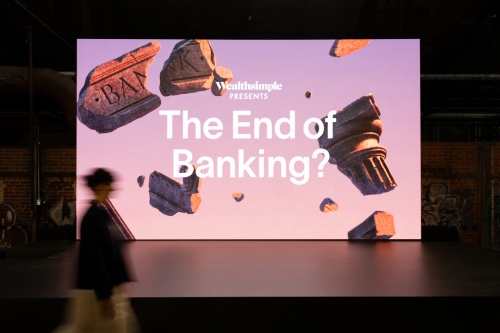
Image: Wealthsimple Presents: The End of Banking (WS Newsroom)
On June 11, 2025, Wealthsimple hosted their first 'Wealthsimple Presents: The End of Banking?" public event in Toronto where they announced the launch of two new financial products that will compete head-on with Canada's largest banks and financial institutions. (1) No fee 2% cashback credit card; and (2) Instant access low rate line of credit starting as low as 4.45%.
These offerings are for anyone who is currently paying banks and credit card companies higher interest rates and fees for the same services, and everything is online and available without having to visit a physical branch. This is healthy competition that will only benefit consumers, and the Canadian government and regulators should take notice.
The company also highlighted a series of upgrades to its hybrid chequing/spending account and teased new cash delivery pilots that could soon offer same day cash drop-offs to users' doorsteps.
Michael Katchen, Co-founder and CEO of Wealthsimple:
“Canadians don’t need another bank. They need something better. We’re removing friction, fees, and outdated experiences.”
The new Wealthsimple credit card is the most requested product in the company’s history. It offers:
Sam Newman-Bremang, Senior Product Director at Wealthsimple:
“This isn’t just another credit card, it’s the one Canadians have been asking for. As the most requested product in our history, it’s clear people want a smarter and more rewarding way to use credit. So that’s what we built: a card that puts humans first, with unlimited cashback, no foreign transaction fees, and no hidden charges.”
Wealthsimple will also roll out a line of credit product by the end of 2025 with rates starting at 4.45%, depending on collateral and client profile. The current Bank of Canada prime rate is 4.95% source, which means Wealthsimple’s offering could undercut many traditional unsecured personal loan products, such as unsecured credit card APRs (20-24%+) or home equity LOC rates (typically 5.5-5.7%).
Unlike typical credit lines, Wealthsimple clients will be able to use their investment or chequing balances at Wealthsimple as collateral, enabling lower risk and faster approval.
Plus, because Wealthsimple is not a federally regulated bank, it partners with 10 Canadian banks to hold deposits and qualify customers for up to $1 million in CDIC protection, which is much more than the standard $100,000 protection one would get by banking at a single institution.
Wealthsimple now offers a type of chequing account that pays 2.75% interest, 1% cashback on debit purchases, no monthly fees, and no ATM or FX fees. Over one million clients or approx 33% of Wealthsimple’s user base has already adopted the spending account.
The company estimates that in 2024, its users saved more than $100 million in fees they would have paid to traditional banks source.
Recent additions include:
Wealthsimple’s growth strategy is grounded in public dissatisfaction with incumbent financial institutions. In a 2025 Angus Reid survey commissioned by Wealthsimple:
Despite this, the Big Six banks still dominate with over 90% of banking assets under management in Canada. But no doubt that Wealthsimple is on a growth pathway that will chip away at the bank's dominant share by competing with seamless design, lower fees, higher yielding accounts and integrated financial tools built for mobile first customers.
Canada's fintech sector continues to face significant barriers to scale, including regulatory delays around open banking and digital ID. Despite that, leading scale-up fintechs like Wealthsimple are demonstrating how digital platforms can expand their value propositions without becoming a formal bank or acquiring a banking license.
Its model has scaled without a banking licence by partnering with regulated banks and embedding services within a single mobile platform. Wealthsimple now has over 3 million clients and manages over $70 billion in assets, up from $18 billion in 2021. If/when opening banking arrives in Canada, platforms that blend investments, borrowing, payments on a single interface will be game-changing for Canada's financial economy.
The National Crowdfunding & Fintech Association (NCFA Canada) is a financial innovation ecosystem that provides education, market intelligence, industry stewardship, networking and funding opportunities and services to thousands of community members and works closely with industry, government, partners and affiliates to create a vibrant and innovative fintech and funding industry in Canada. Decentralized and distributed, NCFA is engaged with global stakeholders and helps incubate projects and investment in fintech, alternative finance, crowdfunding, peer-to-peer finance, payments, digital assets and tokens, artificial intelligence, blockchain, cryptocurrency, regtech, and insurtech sectors. Join Canada's Fintech & Funding Community today FREE! Or become a contributing member and get perks. For more information, please visit: www.ncfacanada.org
| | |
|---|---|---|
| | |
AI Policy | June 11, 2025
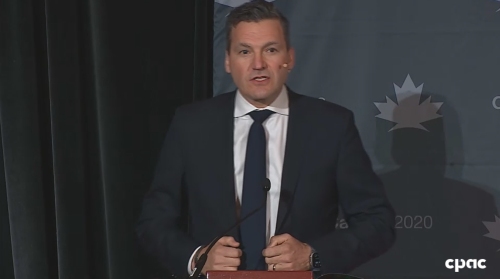
Image: Canada's Minister of AI and Digital Innovation, Solomon Evans Keynote at Canada 2020 event Ottawa (CPAC)
Prime Minister Mark Carney recently appointed Solomon Evans as Canada's first ever Minister of artificial intelligence and digital innovation to lead AI policy development and scale industry, trust and adoption. Solomon just delivered his first public remarks saying that the federal government will prioritize economic growth from artificial intelligence over advancing strict new rules. This new approach follows the collapse of Bill C-27’s AI framework, which failed to pass before the election and left Canada without a federal AI law.
Delivering a key note at a Canada 2020 event in Ottawa on June 10, 2025, Solomon said regulation must protect privacy and personal data but should not constrain innovation. Solomon confirmed that the previous governments AI regulation bill is currently under review.
“We’re not here to throw a saddle on the bucking bronco of AI but we do need to make sure it doesn’t kick anyone in the face.”
Feeling the heat of competition, even governments feel FOMO, and the global trend currently is moving from AI safety messaging towards AI adoption strategies. At the AI Action Summit in Paris, U.S. Vice President JD Vance pushed back on Europe’s regulatory overreach, while President Trump’s draft 'One Big Beautiful Bill' includes a proposed ten-year ban on state-level AI rules. Solomon seems aligned with this shift suggesting that global coordination is difficult, and Canada “won’t go it alone”.
NCFA Canada supports a speedy, focused rollout of AI investments that prioritize open access and trust, especially for smaller firms. Without clear guidance, shared tools and integrate support, SMEs will fall behind. Most do not have the internal capacity to evaluate or safely integrate AI, and that puts Canada’s productivity and innovation milestones in jeopardy. Canada's new AI czar, Solomon, acknowledged this gap, saying big companies are adopting AI, but “small and medium enterprises are not.”
Solomon also emphasized government support for Canadian champions like Cohere. In cases where specialized technical leadership is required to build national AI infrastructure, such as secure compute environments, working with proven domestic firms can make strategic sense. But NCFA cautions that these partnerships must be transparent, based on merit, and designed to benefit the broader ecosystem. The priority must remain funding open infrastructure and access, not enabling a sustainable advantage to a select few. Without transparency on this front, Canada risks loss of investment, talent, and IP.
The reality is that Canada’s innovation economy simply can't afford red tape bottlenecks or further restrictions that slow AI growth, especially since its hoping that broad adoption of the technology will turn the countries productivity woes around.
Canada also can't afford regulatory ambiguity that raises red flags for domestic and global firms alike. Solomon says he wants to “crank up commercialization” and support IP protection. That will only work if firms trust the environment they’re entering. For that, Canada needs smart policy, not just encouragement.
Canada is in a global race to lead in responsible AI and having a dedicated AI minister is a positive step, but evolving Canada into a trusted AI economy depends on speed, clarity and inclusion among other things. NCFA calls for the government to boost support for SME adoption, ensure rules are clear and fair, and build national infrastructure that attracts global innovators without sidelining local ones.
The National Crowdfunding & Fintech Association (NCFA Canada) is a financial innovation ecosystem that provides education, market intelligence, industry stewardship, networking and funding opportunities and services to thousands of community members and works closely with industry, government, partners and affiliates to create a vibrant and innovative fintech and funding industry in Canada. Decentralized and distributed, NCFA is engaged with global stakeholders and helps incubate projects and investment in fintech, alternative finance, crowdfunding, peer-to-peer finance, payments, digital assets and tokens, artificial intelligence, blockchain, cryptocurrency, regtech, and insurtech sectors. Join Canada's Fintech & Funding Community today FREE! Or become a contributing member and get perks. For more information, please visit: www.ncfacanada.org
| | |
|---|---|---|
| | |
AI | June 9, 2025

Image: Freepik
On June 4, 2025, Reddit filed a lawsuit against Anthropic, alleging that the AI tech system conducted more than than 100,000 unauthorized data scraping events since last July, violating Reddit's user terms. It comes at a time when Anthropic is expanding the reach of Claude, its AI model family, across enterprise and government sectors. The legal, ethical, and commercial stakes are high.
Reddit's lawsuit is a critical test of Anthropic’s values and the public credibility of responsible AI branding. As Claude advances deeper into sensitive sectors like national security, it'll be more important than ever to define what real accountability with regards to data use looks like, and for Claude/Amodei to deliver on his ethical promise.
The National Crowdfunding & Fintech Association (NCFA Canada) is a financial innovation ecosystem that provides education, market intelligence, industry stewardship, networking and funding opportunities and services to thousands of community members and works closely with industry, government, partners and affiliates to create a vibrant and innovative fintech and funding industry in Canada. Decentralized and distributed, NCFA is engaged with global stakeholders and helps incubate projects and investment in fintech, alternative finance, crowdfunding, peer-to-peer finance, payments, digital assets and tokens, artificial intelligence, blockchain, cryptocurrency, regtech, and insurtech sectors. Join Canada's Fintech & Funding Community today FREE! Or become a contributing member and get perks. For more information, please visit: www.ncfacanada.org
| | |
|---|---|---|
| | |
AI | June 9, 2025

Image: Ilya Sutskever at University of Toronto convocation June 6, 2025 via Youtube
On June 6, 2025 at the University of Toronto’s convocation, Ilya Sutskever, cofounder of OpenAI and lead innovator of ChatGPT, delivered a powerful message while accepting an honorary degree in Doctor of Science (actually his fourth UoT degree). He warned that artificial intelligence (AI) is quickly advancing to a point where it will do everything humans can do, and we're not ready for what comes next.
Once a machine can learn anything a person can learn, no task is out of reach. This idea is central to Sutskever’s argument that AI will eventually match all human abilities. “We have a brain, and the brain is a biological computer… So why can't a digital brain do the same things?”
“The day will come when AI will do all of the things that we can do, not just some of them, but all of them.”
The timeline is uncertain but the direction is clear. Whether it takes 3, 5 or 10 years, general purpose AI will change how the economy functions and how people define and measure productivity.
Sutskever warns that even efforts to retrain workers may fall short because as technology marches forward, the very jobs people train for could vanish before they are ready to take them on.
“Many will find that the new job they were training for no longer exists by the time they finish retraining.”
He also said that while some will turn to universal basic income but it may not hold up because people may be seen as no longer economically productive.
Sutskever predicts two long-term outcomes. If humans find a way to offer lasting value, we may be treated as companions to AI systems. If not, we risk becoming irrelevant or extinct.
“In the best-case scenario, humanity will become like pets or the microbiome of artificial intelligence. In the worst-case scenario, humanity will become obsolete or even extinct.”
“The challenge that AI poses is the greatest challenge of humanity ever. And overcoming it will bring the greatest reward.”
He stresses that the response cannot be passive. Every person and institution will need to participate in what this technology becomes.
“Accept reality as it is, try not to regret the past, and try to improve the situation.”
Meeting this moment requires emotional resilience. He says people should remain focused on the present instead of looking backward and encouraged others to adopt the same mindset.
Sutskever’s speech is measured insight into the future, and governments, industry, innovators globally need to take his message as a direct challenge to act now (if you're not already sweating the pace of change in 2025). At NCFA Canada, we believe his message carries the kind of disruption that financial leaders must (anticipate and) respond to with urgency.
Canada cannot afford to be unprepared. While the changes can be guided with responsible AI efforts, they seemingly cannot be stopped, and so we must act with urgency to be prepared as new AI powered systems will influence financial markets, education, investment models, employment pathways, human mobility and more. the fintech sector needs to become more agile, more connected, and more willing to build for what's coming next.
"Innovating and adapting at the speed of AI development means building solutions and platforms that help people create value alongside AI, not behind or beneath it. It also means designing incentives and safeguards that match the reality of a hybrid workforce where humans and machines co-exist, and to embolden the leadership and collaboration needed to work together to solve problems." Craig Asano, NCFA
Canada cannot rely on other jurisdictions to define what safe and responsible AI looks like, and Canadian fintechs and institutions should play a direct role in developing policies, models, and frameworks that ensure AI serves the public interest.
This is not just a technology issue. It is a national competitiveness issue. It is also a question of whether we will help define the rules of the future or simply be beholden to them.
The National Crowdfunding & Fintech Association (NCFA Canada) is a financial innovation ecosystem that provides education, market intelligence, industry stewardship, networking and funding opportunities and services to thousands of community members and works closely with industry, government, partners and affiliates to create a vibrant and innovative fintech and funding industry in Canada. Decentralized and distributed, NCFA is engaged with global stakeholders and helps incubate projects and investment in fintech, alternative finance, crowdfunding, peer-to-peer finance, payments, digital assets and tokens, artificial intelligence, blockchain, cryptocurrency, regtech, and insurtech sectors. Join Canada's Fintech & Funding Community today FREE! Or become a contributing member and get perks. For more information, please visit: www.ncfacanada.org
| | |
|---|---|---|
| | |


August 26th, 2025

January 4th, 2024

June 1st, 2021

September 9th, 2020

July 9th, 2018

January 3rd, 2018

September 25th, 2017

June 20th, 2017

May 10th, 2017

December 14th, 2016