




Karsten Wenzlaff, Advisor
August 26th, 2025
Karsten Wenzlaff is a Crowdfunding and Fintech Expert from Germany. He is Secretary-General of Digit[...]


Payments Regulation | May 1, 2025
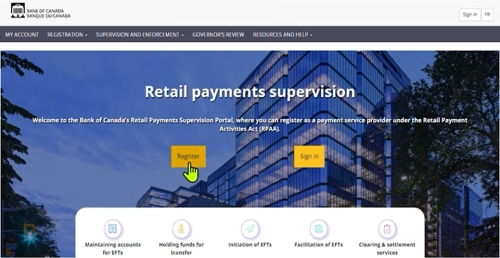
Image: PSP Connect, Retail Payments Supervision (Bank of Canada)
On April 30, 2025, the Bank of Canada (BoC) shared a new update on how it will enforce the Retail Payment Activities Act (RPAA). Payment service providers, known as PSPs, had until November 15, 2024 to register. Those who failed to do so are now being urged to act immediately or face enforcement.
BoC message:
“If you missed this deadline, you must apply immediately and at least 60 days before starting any retail payment activities. Failure to register may result in enforcement action,” the Bank stated in its April 30 message.
The Bank has updated its enforcement process outlining they may contact a PSP that is under investigation. Communication methods may include phone calls, encrypted email, courier delivery, and other secure channels. The approach is inline with the enforcement tools at their disposal published in June 2024, which include monetary penalties and compliance orders.
The BoC is also sending a reminder of how to submit a registration application through PSP Connect, the Bank's secure online portal.
1. Create a PSP Connect account
Here's a handy step by step tutorial and video available on the Bank of Canada's website to help you with the process.
2. Enter the required information and upload all documents
You can save your progress and return later if needed.
3. Submit your completed application and pay the fee
There's a $2500 application fee that must be paid in full by either credit card or debit. Alternative payment arrangements such as direct deposit or wire transfer may be arranged if several card payment attempts fail.
If you are new to the process or need further help, and have missed the workshops/tutorials, the Bank encourages PSPs to use its general inquiries form.
This update signals that the BoC is shifting from education to enforcement, as they are making it clear they are ready to take action against unregistered PSPs. Regulatory oversight of retail payments will only become more structured from here, and payment providers must meet their legal obligations or face financial and operational consequences.
 The National Crowdfunding & Fintech Association (NCFA Canada) is a financial innovation ecosystem that provides education, market intelligence, industry stewardship, networking and funding opportunities and services to thousands of community members and works closely with industry, government, partners and affiliates to create a vibrant and innovative fintech and funding industry in Canada. Decentralized and distributed, NCFA is engaged with global stakeholders and helps incubate projects and investment in fintech, alternative finance, crowdfunding, peer-to-peer finance, payments, digital assets and tokens, artificial intelligence, blockchain, cryptocurrency, regtech, and insurtech sectors. Join Canada's Fintech & Funding Community today FREE! Or become a contributing member and get perks. For more information, please visit: www.ncfacanada.org
 |  |  |
|---|---|---|
 |  |  |
ESG | April 30, 2025

Image: Freepik
Retuers reports that Royal Bank of Canada has stepped back from its $500 billion sustainable finance target, which was originally pledged in early 2021.
In its 2024 sustainability report (152 page PDF), RBC wrote that it would no longer publish several climate-related metrics because of the recent changes to Canada’s Competition Act that now require firms to fully support environmental claims with evidence. The Competition Bureau of Canada also published a companion link outlining their perspective on deceptive marketing and views on environmental claims and greenwashing in Canada.
An example of one of the metrics that RBC is no longer reporting is the energy supply ratio, which compares financing of low carbon projects to fossil fuel ones. RBC used to report the metric in past disclosures under shareholder pressure, such as from the New York City Comptroller. However, RBC now says it cannot share it publicly due to the updated laws. It's worth noting that RBC still tracks these metrics internally but it simply stopped reporting them to avoid legal risk.
RBC is part of a larger trend with several major Canadian banks recently exciting the Net Zero Banking Alliance and walking back similar commitments. In addition to the legal risk of 'greenwashing', these decisions are being made following increased scrutiny from regulators, investors, and advocacy groups.
All environmental or climate claims need to be backed by clear evidence, including proof of how the data was calculated (not just the result). Companies must also use internationally recognized standards or methods of calculation like ISO or the Task Force on Climate-Related Financial Disclosures (TCFD). So when a company says it's funding green projects or working towards net zero, it MUST be able to show exactly how with verifiable evidence. The Competition Bureau explains the changes here.
This is surely a turning point in Environmental, Social, and Governance (ESG) and climate reporting in Canada. Institutions must now take climate statements, especially financial ones, more seriously as they have to be accurate, verified, and legally on the right side.
For fintechs and banks that rely on reporting ESG data as either a competitive advantage or primary part of their model, they must strengthen internal tracking and reporting systems if disclosing. Any vague promises about green initiatives is no longer enough, and the cost of getting it wrong is now legal exposure.
The National Crowdfunding & Fintech Association (NCFA Canada) is a financial innovation ecosystem that provides education, market intelligence, industry stewardship, networking and funding opportunities and services to thousands of community members and works closely with industry, government, partners and affiliates to create a vibrant and innovative fintech and funding industry in Canada. Decentralized and distributed, NCFA is engaged with global stakeholders and helps incubate projects and investment in fintech, alternative finance, crowdfunding, peer-to-peer finance, payments, digital assets and tokens, artificial intelligence, blockchain, cryptocurrency, regtech, and insurtech sectors. Join Canada's Fintech & Funding Community today FREE! Or become a contributing member and get perks. For more information, please visit: www.ncfacanada.org
| | |
|---|---|---|
| | |
Innovation Economy | April 29, 2025

Image: Freepik
Mark Carney has been elected as Canada's 24th Prime Minister after leading the Liberal Party to win the 2025 federal election. The Liberals secured 168 seats (just shy of a majority), and are expected to form a minority government. Prime Minister Mark Carney has already spoken with President Trump about the pressing issues of tariffs, trade war and 51st state rhetoric, and the two leaders have agreed to meet in person.
While those issues are of critical importance to Canada's sovereignty, this article looks at Carney's past public comments and Liberals 2025 platform to get a sense for the implications for Canada's fintech sector under his expected leadership.
In 2019, Carney was the Governor of the Bank of England (BoE) and said the following at the Innovate Finance Global Summit:
“A new economy requires a new finance... to serve the digital economy, to support the major transitions underway across the globe and to increase the sector’s resilience”.
The newly elected Prime Minister of Canada has a deep background in finance, global networks, and a steady hand at innovation. He's expected to speed up payments modernization, support the responsible AI development, foster fintech investment, tighten crypto rules, and open more global markets to Canadian companies. The Liberal Party commitments that support innovation include financial technologies and sustainable finance, infrastructure investment, internal trade reform, red tape reduction, and a patent box regime, all told would help strengthen the economy and fintech growth.
When Carney was leading the BoE, he signalled strong support for opening payments infrastructure to non-bank providers, helping to boost innovation and competition. In Canada, the implementation of open banking and payment modernization initiatives (i.e. Real Time Rail System) have sadly faced prolonged delays. Carney is expected to speed up these rollouts to benefit consumers and competition. Open banking will give consumers control over their financial data and allow fintech companies to create new services, while the operating firms must meet high security and operational standards.
As part of its 2025 platform, the Liberal government committed to eliminating federal barriers to interprovincial trade and labour mobility by Canada Day. Reducing costs and aligning standards could benefit fintech companies that must constantly track and adjust to changing and inconsistent provincial compliance requirements, in sectors like payments, insurtech, wealthtech, and others. Streamlining trade and regulatory barriers would help fintechs expand nationally more effectively, reduce legal and operational costs, and also contribute to offering consistent services to customers and businesses from coast to coast.
Carney spoke about how emerging technologies are game-changing finance in a 2018 Mansion House speech “New Economy, New Finance, New Bank”, where he acknowledged AI's growing impact on credit and risk systems.
Under his government, Canada is expected to advance the Artificial Intelligence and Data Act to regulate high impact AI systems including financial firms using AI for credit scoring, fraud detection, or robo advising to ensure responsible AI standards are met for fairness, explainability, and consumer protection.
Immediately after securing Liberal leadership, Carney axed the controversial capital gains tax hike, directly supporting Canada's innovation economy. Under his leadership, Carney could expand access to venture capital, innovation incentives, and encourage national regulatory alignment for startups operating across multiple provinces. The Liberal platform also supports a patent box regime, focused on scaling high growth firms, retaining intellectual property in Canada, and improving commercialization outcomes from public and private R&D. The Liberal 2025 Platform outlines efforts to increase business investment and create a more competitive innovation environment, especially for sectors like fintech and AI.
Although Carney previously showed openness towards regulated forms of crypto innovation, in 2018, he spoke critically of unbacked crypto assets and called Bitcoin “neither a store of value nor a useful means of exchange”. It's expected that he'll tighten oversight of crypto exchanges, stablecoin issuance, and asset custody. Lastly, while Carney hasn't explicitly endorsed a Canadian CBDC, he has called for central banks to explore sovereign digital currencies as tools to support monetary policy and financial stability. During a 2019 speech at the Jackson Hole Economic Symposium, for example, Carney proposed the idea of a "synthetic hegemonic currency" (SHC) as a potential solution to the destabilizing dominance of the U.S. dollar in the global financial system.
Mark Carney is one of the most prominent global figures in sustainable finance. He co-founded the Glasgow Financial Alliance for Net Zero (GFANZ) and served as the UN Special Envoy on Climate Action and Finance. His leadership brings a strong focus on aligning financial systems with climate goals. The 2025 Liberal platform commits to supporting green innovation and transitioning Canada toward a low-carbon economy. This creates opportunities for fintechs in areas like ESG data services, green lending, climate risk modeling, and carbon trading infrastructure.
Carney is expected to support broader digital financial access across Canada. In his 2018 “Future of Money” speech, he emphasized the role of digital identity, financial modernization, and infrastructure in improving inclusion. While he has't directly addressed digital ID for Canada, the Liberal platform’s national digital readiness strategy includes high speed rail and northern connectivity projects that could help bring digital banking and fintech services to underserved and remote communities.
| Opportunities | Challenges |
| Launch of real time payments and open banking | Meeting tougher compliance and risk standards |
| New funding for AI, fintech innovation, and green finance | Higher expectations for responsible AI and cybersecurity |
| Stronger startup investment environment and patent box incentives | Adapting to stricter crypto and stablecoin rules |
| Global trade partnerships and reduced internal trade barriers | Competition from international fintech firms |
| Possible leadership in digital identity and CBDC projects | Regulatory complexity for multi jurisdictional firms |
| Growth in sustainable finance and ESG fintech | Evolving global standards for ESG data and disclosures |
| Growth in digital access through national infrastructure | Uneven fintech access in rural and remote communities |
Mark Carney's credentials offer an elite tier of credibility in global finance, climate leadership, and modernization of financial systems. Together with the Liberal 2025 Platform's strategic commitments to innovation, interprovincial trade liberalization, red tape reduction, and IP commercialization, his leadership is desperately needed to improve Canada's flailing productivity, upgrade its financial ecosystem, build public trust and international competitiveness.
His background also positions Canada to lead in sustainable finance, aligning innovation with global climate goals. For fintech entrepreneurs, investors, and policymakers, the Carney era is underpinned by stable governance and a clear vision, offering a mix of opportunity and responsibility.
The National Crowdfunding & Fintech Association (NCFA Canada) is a financial innovation ecosystem that provides education, market intelligence, industry stewardship, networking and funding opportunities and services to thousands of community members and works closely with industry, government, partners and affiliates to create a vibrant and innovative fintech and funding industry in Canada. Decentralized and distributed, NCFA is engaged with global stakeholders and helps incubate projects and investment in fintech, alternative finance, crowdfunding, peer-to-peer finance, payments, digital assets and tokens, artificial intelligence, blockchain, cryptocurrency, regtech, and insurtech sectors. Join Canada's Fintech & Funding Community today FREE! Or become a contributing member and get perks. For more information, please visit: www.ncfacanada.org
| | |
|---|---|---|
| | |
DEI Regulation | April 25, 2025

Image: Freepik
On April 23, 2025, the Canadian Securities Administrators (CSA) announced that it is pausing plans to create mandatory rules for climate and diversity reporting, since the U.S. Securities Exchange Commission (SEC) has cancelled their DEI initiatives and the need to focus on making Canadian markets more robust, efficient and competitive.
Stan Magidson, CSA Chair and Chair/CEO of the ASC:
“In recent months, the global economic and geopolitical landscape has rapidly and significantly changed, resulting in increased uncertainty and rising competitiveness concerns for Canadian issuers,”
Although proposed rules requiring companies to disclose more detailed information about climate risks and board diversity is not moving forward, companies must still adhere to the current rules under Canadian securities law that require disclosure of any material risk that would significantly impact the business or its investors, including climate-related risks.
For companies wondering about the Canadian Sustainability Standards Board (CSSB) standards (CSDS 1 and CSDS 2) that were introduced last December 2024, they are 'voluntary but encouraged'. These standards offer a framework for sustainability disclosures that are aligned with international norms but they will not be enforced unless circumstances change.
While there are no new diversity requirements being added, non-venture issuers (companies listed on senior public stock exchanges, such as the TSX or NEO), are still required to report on representation of women on boards and in executive positions, covered under the existing rules in National Instrument 58-101.
The CSA says it will continue to monitor public company disclosures for misleading or incomplete climate claims (i.e. greenwashing) and may provide future guidance if needed.
Some investors and advocates for diversity and inclusion may be disappointed by the pause on mandatory disclosure rules. At the same time, many companies are likely to appreciate the flexibility to use voluntary standards, especially given the current economic and regulatory landscape.
The National Crowdfunding & Fintech Association (NCFA Canada) is a financial innovation ecosystem that provides education, market intelligence, industry stewardship, networking and funding opportunities and services to thousands of community members and works closely with industry, government, partners and affiliates to create a vibrant and innovative fintech and funding industry in Canada. Decentralized and distributed, NCFA is engaged with global stakeholders and helps incubate projects and investment in fintech, alternative finance, crowdfunding, peer-to-peer finance, payments, digital assets and tokens, artificial intelligence, blockchain, cryptocurrency, regtech, and insurtech sectors. Join Canada's Fintech & Funding Community today FREE! Or become a contributing member and get perks. For more information, please visit: www.ncfacanada.org
| | |
|---|---|---|
| | |
AI Security | April 22, 2025

Image: Freepik/atlascompany
Perplexity AI is growing fast with over 10 million Android downloads and is backed by tech royalty like Jeff Bezos but a new security report by a Singapore security firm AppKnox found major vulnerabilities that could be exploited by attackers. We're not talking small potatoes here. We're talking about huge issues like hardcoded API keys and significant weaknesses against any sort of malicious hacking.
While Perplexity's android app isn't what most fintechs run their AI service on, it's a red flag about the state of security in the quickly evolving world of artificial intelligence tools that banks, wealthtech platforms, and credit unions are exploring, embedding, investing and integrating in..
Perplexity’s Android app includes private access keys that should not be exposed. These keys work like internal passwords and were stored inside the app itself. This makes it easy for anyone with technical skills to find and misuse them. These hardcoded credentials could be downloaded and used to access Perplexity's AI full system completely for free.
Another serious problem is that the app does not check if it is connecting to a real or fake server. Cybernews reports that someone on public WiFi could take advantage of this to spy on what users are doing. This might include watching what they search, type, or log in to.
The app has not fixed several known security flaws that have existed in Android for years, such as StrandHogg and Janus are still present. These are weaknesses that hackers already understand and can use to gain control or access private information.
Perplexity's app doesn't check if a phone is rooted or not, and it's less secure if it is.
The app’s code is also not protected. This means someone could open it up, look inside, and understand exactly how it works. They could then use this to find more vulnerabilities to attack or copy its features.
The app can be tricked into letting attackers control parts of the screen without the user knowing. So, you could be typing into a pop-up form or something that looks familiar but it's actually a trap that can steal your information.
How is it possible that a high profile AI unicorn like Perplexity ships a mobile app that fails basic security checks? If they are missing the basics, how many others are? This raises a critical question for fintechs and financial institutions looking to integrate AI whether it's a chatbot, SDK, API, or embedded assistants.
Are you checking how secure your vendors really are?
It's a reality check that a soaring valuation doesn’t guarantee strong engineering discipline.
Where are the API keys stored? If they live in the mobile app code, that’s a no-go.
Does the vendor use SSL validation and pinning? If not, data can be intercepted over public WiFi.
Are known vulnerabilities patched? Run a third party scan or ask for one.
Is the code protected? If it’s not, attackers can easily reverse-engineer how it works.
Does the app detect rooted or jailbroken devices? If not, it might be operating in a compromised environment.
What’s the vendor’s breach response plan? Ask how they handle disclosures, patches, and updates.
How much access are you really giving? Use API scopes, rate limits, and narrow permissions by default.
Perplexity's Android app glaring security risks is a textbook example of what happens when security gets left behind in a rush to launch/scale products out the door. Don't ever forget that financial data isn't forgiving when it leaks. Whether you're exploring AI for customer support, product recommendations, or internal workflows, you need to prioritize the app and API security for your use case. Trust is earned but it can be lost in a heart beat.
The National Crowdfunding & Fintech Association (NCFA Canada) is a financial innovation ecosystem that provides education, market intelligence, industry stewardship, networking and funding opportunities and services to thousands of community members and works closely with industry, government, partners and affiliates to create a vibrant and innovative fintech and funding industry in Canada. Decentralized and distributed, NCFA is engaged with global stakeholders and helps incubate projects and investment in fintech, alternative finance, crowdfunding, peer-to-peer finance, payments, digital assets and tokens, artificial intelligence, blockchain, cryptocurrency, regtech, and insurtech sectors. Join Canada's Fintech & Funding Community today FREE! Or become a contributing member and get perks. For more information, please visit: www.ncfacanada.org
| | |
|---|---|---|
| | |
M&A and Financing | April 22, 2025

FundThrough acquires Ampla and cecures a $25M Series B equity investment, led by Klister Credit Corp.
Toronto-based financial invoicing technology firm FundThrough announced on April 22, 2025, the strategic acquisition of U.S.-based Ampla Technologies along with $25 million in new equity funding to grow its platform. This achievement builds on prior milestones including the acquisition of BlueVine's invoice factoring business in 2021, and a $10 million commitment in 2020 to help Canadian businesses during the early days of the pandemic.
From day one, FundThrough's mission to help small and medium sized businesses get access to money they've already earned quicker, has been a great success. They advance cash based on unpaid invoices, giving businesses the working capital they need to pay suppliers, make payroll, and process new orders without having to wait weeks or months for larger customers to pay.
A key strength of their model is how easily it integrates into how businesses already work. FundThrough's platform uses a permission-based, secure connection into various accounting software applications like QuickBooks or Xero, and analyzes invoice data to identify outstanding customer payments, triggering automated funding offers designed to reduce the strain of long payment cycles. Since launching, the company has funded over $2.7 billion in invoices of which 85% supports U.S customers.
Ampla Technologies is a U.S. fintech providing consumer brands with working capital, banking, corporate cards, and analytics. They've managed over $5 trillion in transaction volume and originated over $2 billion in credit. By incorporating Ampla's tech into FundThrough's stack, the combined platform will offer more AI powered tools to help small businesses assess risk, improve cash flow forecasting, and access credit faster.
Steven Uster, CEO of FundThrough:
“Now, Ampla’s technology significantly enhances FundThrough’s AI-powered model, enabling us to level the playing field further. With Ampla, we can scale faster, enhance our credit underwriting and monitoring processes, and help even more businesses solve their number one pain point, cash flow."
Alongside Ampla's acquisition, FundThrough announced closure of a $25 million Series B equity round, led by Canadian Klister Credit Corp with other investors including Canadian Business Growth Fund and Urbana Corporation. New funds will support future acquisitions and the ongoing expansion into U.S. and Canadian markets and improve the platforms AI capabilities.
John Phillips, President of Klister:
“FundThrough’s track record over the past years of uncertainty is impressive. My increased investment reflects my confidence in the FundThrough team’s continuing focus on serving this important market.”
This acquisition shows how fintech is changing the way small businesses manage cash flow. Traditional financing can often takes weeks to process and may require credit checks or collateral. FundThrough uses verified invoice data and AI-driven analytics to give small businesses faster access to the money they’re owed. As more companies deal with long payment terms from large buyers, this kind of invoice funding helps level the playing field.
It gives small and medium-sized businesses more control over their cash flow, without the delays of traditional banking. FundThrough’s growth also highlights how Canadian fintech companies are expanding into the U.S. by offering digital first financial tools and smarter funding solutions to help businesses stay competitive.
The National Crowdfunding & Fintech Association (NCFA Canada) is a financial innovation ecosystem that provides education, market intelligence, industry stewardship, networking and funding opportunities and services to thousands of community members and works closely with industry, government, partners and affiliates to create a vibrant and innovative fintech and funding industry in Canada. Decentralized and distributed, NCFA is engaged with global stakeholders and helps incubate projects and investment in fintech, alternative finance, crowdfunding, peer-to-peer finance, payments, digital assets and tokens, artificial intelligence, blockchain, cryptocurrency, regtech, and insurtech sectors. Join Canada's Fintech & Funding Community today FREE! Or become a contributing member and get perks. For more information, please visit: www.ncfacanada.org
| | |
|---|---|---|
| | |
Antitrust | April 21, 2025

Image: Freepik/upklyak
The U.S. Federal Trade Commission (FTC) first sued Facebook (now called Meta Platforms Inc.) in December 2020, claiming it broke competition laws by buying Instagram and WhatsApp to suppress competition and maintain a monopoly in personal social media markets. The case was renewed in 2021 with more evidence and the trial started on April 14, 2025, with Mark Zuckerberg already on the stand in the U.S. District Court for the District of Columbia.
The FTC argues Meta bought Instagram for $1 billion in 2012 and WhatsApp for $19 billion in 2014 in what they call a 'buy or bury' strategy to dominate the market, which it now controls -see FTC opening statement slides:
During the trial, FTC presented internal messages/texts in 2012 from CEO Mark Zuckerberg, saying:
“It is better to buy than compete.”
The FTC now seeks a court order that could force Meta to breaking-up or divesting Instagram and WhatsApp entirely.
On April 13, 2025 in an official Meta blog post, Meta’s Chief Legal Officer Jennifer Newstead says that the FTCs case is 'weak' and that the lawsuit is wrong, saying it ignores how competitive the tech space has become. She argues that platforms like TikTok, YouTube, Snapchat and others fiercely compete for users' time and attention and that the FTC is using a narrow definition for personal social networking. She continues to say that Instagram and WhatsApp grew under Facebook/Meta's ownership because of the investments in safety, encryption, and performance.
While Canada has not filed a federal antitrust lawsuit like the FTC, there are a number of legal and regulatory actions against Meta including:
1. Canada passed the Online News Act (Bill C-18) in June 2023 to help struggling news publishers that required big tech platforms like Meta to pay Canadian outlets when they share or link to their news. The expectation is that platforms like Meta and Google are to contribute at least $100 million CAD annually to support the sustainability of the Canadian news industry. Meta responded by blocking all Canadian news content from Facebook (now Meta) and Instagram feeds. So in response, News Media Canada and CBC filed a complaint with the Competition Bureau, arguing that Meta’s move was anti-competitive and harmful to the public, which the Bureau is currently investigating.
2. In 2024, four Ontario school boards sued Meta, TikTok’s parent ByteDance, and Snapchat’s owner Snap Inc., asking for over $4 billion CAD in damages. They claim the platforms were designed to be addictive, harming students mental health and learning. The companies tried to get the case thrown out but an Ontario judge ruled that the case proceed which now has expanded to 14 school boards. The boards say they've had to spend more funding on mental health and classroom supports because of social media's impact, and want the platforms redesigned to reduce harm to students.
3. In 2024, Canada passed the Digital Services Tax Act, introducing a 3% tax on revenue earned in Canada by large global tech companies like Meta. It applies to companies with more than €750 million in global revenue and at least C$20 million in Canadian digital revenue. The first payments are due by June 30, 2025. The tax was delayed for years during global talks but Canada moved ahead after little progress. Meta opposes the digital services tax, and it's not a secret that President Trump dislikes the tax too, and we can expect it to be raised when renegotiating the Canada-United-States-Mexico-Agreement (CUSMA) trade agreement. Revenue collection is proceeding with its first collection in 2025.
We're at a regulatory turning point against big tech. From Washington to Ottawa, digital platform dominance is in the spotlight. The outcome of Meta's trial, as well as Canada's legal pressures could lead to new enforcement models, investment opportunities, and an increase in competition in areas that have been long dominated by Big Tech.
Also, smaller firms operating in AI, digital media, and user engagement platforms may find that regulators are more willing to intervene or step in/up if complaints are made.
The National Crowdfunding & Fintech Association (NCFA Canada) is a financial innovation ecosystem that provides education, market intelligence, industry stewardship, networking and funding opportunities and services to thousands of community members and works closely with industry, government, partners and affiliates to create a vibrant and innovative fintech and funding industry in Canada. Decentralized and distributed, NCFA is engaged with global stakeholders and helps incubate projects and investment in fintech, alternative finance, crowdfunding, peer-to-peer finance, payments, digital assets and tokens, artificial intelligence, blockchain, cryptocurrency, regtech, and insurtech sectors. Join Canada's Fintech & Funding Community today FREE! Or become a contributing member and get perks. For more information, please visit: www.ncfacanada.org
| | |
|---|---|---|
| | |


August 26th, 2025

January 4th, 2024

June 1st, 2021

September 9th, 2020

July 9th, 2018

January 3rd, 2018

September 25th, 2017

June 20th, 2017

May 10th, 2017

December 14th, 2016