




Karsten Wenzlaff, Advisor
August 26th, 2025
Karsten Wenzlaff is a Crowdfunding and Fintech Expert from Germany. He is Secretary-General of Digit[...]


Consensus Toronto | May 9, 2025

The financial world is changing fast, and Consensus 2025 Toronto is where proactive, leading advisors will be. On May 15, CoinDesk is hosting Wealth Management Day as part of its flagship conference at the Metro Toronto Convention Centre. It's a dedicated one day program specifically for professional wealth managers and financial advisors who want to understand how digital assets, tokenization, AI, and macro forces are changing investment portfolios now and in the future.
Approved advisors will receive a complimentary Platinum Pass, for full 3-day access to Consensus 2025 from May 14–16, including all general programming, high-level networking, and private meetings with industry leaders.
Wealth Management Day offers a full morning of advisor focused content followed by roundtable networking in the afternoon. Topics include:
Speakers come from leading firms like Coinbase, T. Rowe Price, Evolve ETFs, CMCC Global, and Cambrian Asset Management. Government regulators and fintech founders will also join for candid conversations about what's happening today, what's coming next, and what advisors need to prepare for.
Below are just a few of the speakers presenting on Wealth Management Day at Consensus on May 15:
Globally and in Canada too, investors are looking for advisors who can offer informed, compliant, and proactive strategies and advice. Wealth Management Day is where crypto and the investment ecosystem intersect, from startups to global firms, regulators to entrepreneurs.
For advisors, Wealth Management Day is a low risk, high reward way to plug in, and it’s free for those who qualify.
"With ETFs and tokenized funds on the rise, advisors who ignore digital assets risk being left behind, not by the technology but by their clients who want to drive the future. "
 The National Crowdfunding & Fintech Association (NCFA Canada) is a financial innovation ecosystem that provides education, market intelligence, industry stewardship, networking and funding opportunities and services to thousands of community members and works closely with industry, government, partners and affiliates to create a vibrant and innovative fintech and funding industry in Canada. Decentralized and distributed, NCFA is engaged with global stakeholders and helps incubate projects and investment in fintech, alternative finance, crowdfunding, peer-to-peer finance, payments, digital assets and tokens, artificial intelligence, blockchain, cryptocurrency, regtech, and insurtech sectors. Join Canada's Fintech & Funding Community today FREE! Or become a contributing member and get perks. For more information, please visit: www.ncfacanada.org
 |  |  |
|---|---|---|
 |  |  |
Digital Banking | May 9, 2025
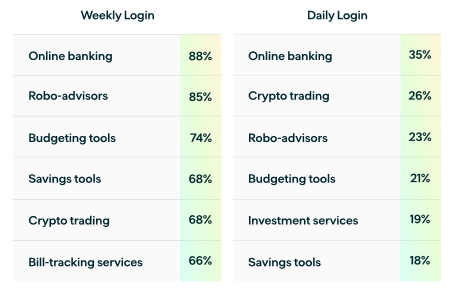
Image: Frequency of Use (Plaid x YouGov Money Talks survey report)
Between August 20-26th 2024, Plaid commissioned a national survey through the YouGov platform to understand how U.S. consumers bank, pay, and invest. The survey reveals insights of consumer preferences in digital finance, including trust in financial providers, app usage, payment methods, credit attitudes, and investment habits, based on weighted responses from 2,077 adults. Fintechs, digital finance platforms, and financial institutions need to stay up to date with the latest retail digital banking trends if they want to compete for consumer loyalty. Read 'Money Talks' (28 page PDF) report explaining these trends. Below we break-down key insights for NCFA's readers. Not yet subscribed? Sign-up for NCFA's weekly newsletter here.
Consumers continue to trust traditional banking institutions more than 100% digital platforms:
Trust and security go hand and hand, and overall, trust comes from perceived care and protection:
Consumers also shared who they rely on for financial well-being. The takeaway is that fintechs and advisory services must do more to be seen as helpful and caring, a useful partner in people’s financial lives.
Online banking is the most widely used financial tool: 99% percent of consumers are familiar with it, and 74% use it weekly.
Other commonly used tools include savings apps (68% weekly or daily), budgeting tools (85%), and peer-to-peer payment apps like Venmo or Zelle (used weekly by 50% of users). Roboadvisors are accessed more than once per week by (80%) of their users but only 1% of all consumers report using them regularly.
When asked what improvements they want most in financial apps:
60% of respondents said it is important to link their bank account with the financial apps they use.
Takeaway: Apps that are integrated, responsive, and secure are the most likely to be used often. Fintechs and banks that overcomplicate services or create friction in setup risk being overlooked, even if their offerings are advanced.
25% currently invest in cryptocurrency. Another 21% say they plan to invest in crypto or NFTs in the next year. These responder levels of engagement are equal to the 25% of people who say they will invest in stocks or trading platforms during the same period.
Crypto investors are not limiting their exposure:
Only 11% of respondents have used AI tools to support their investing decisions -> interestingly, this already exceeds the share of people using roboadvisors, suggesting that AI powered investment tools are gaining traction faster than traditional automated advice products.
Takeaway: Fintechs offering secure, easy to understand crypto access or AI investment tools can appeal to a growing investor base. Banks that avoid crypto are at risk of losing relevance with younger and self-directed investors.
Debit cards are now more commonly used than credit by younger adults. According to EY data cited in the report, 69% of Gen Z use debit cards daily or weekly. Many say they avoid credit cards because they do not want debt or do not qualify.
Buy now pay later (BNPL) services have grown 40% in usage since 2021.
Takeaway: Only 30% of respondents believe their credit score accurately reflects their financial health. 55% said they have been denied a loan due to a low score. These figures support growing interest in alternative data, such as cash flow and account history, for lending decisions.
Older adults are especially cautious. People aged 66 to 70 are 55% more likely to mistrust digital banks than those aged 22 to 25. Younger adults are more flexible. Among respondents aged 18 to 24, 36% said they would switch banks for a better digital payment experience.
Despite these trends, most people are not actively looking to change banks:
Consumers use different payment methods based on transaction size and age group:
To fund digital wallets:
Takeaway: Fintechs that want to increase adoption of pay by bank options must improve the experience. According to the report, 49% of users say they are likely to use pay by bank if the account linking process is easy.
Consumers want financial services that are clear, secure, and helpful, with trust remaining the most important factor in deciding whether to try a new app, share data, or switch banks. Traditional banks still hold an advantage in trust and reach but must modernize quickly. Fintechs have room to grow if they lead with transparency and value. Financial institutions that support financial goals and offer simple, connected experiences will stay relevant in 2025 (and beyond). Learn more about how consumers in the U.S. use, feel, bank, transact and acquire in 'Money Talks'.
The National Crowdfunding & Fintech Association (NCFA Canada) is a financial innovation ecosystem that provides education, market intelligence, industry stewardship, networking and funding opportunities and services to thousands of community members and works closely with industry, government, partners and affiliates to create a vibrant and innovative fintech and funding industry in Canada. Decentralized and distributed, NCFA is engaged with global stakeholders and helps incubate projects and investment in fintech, alternative finance, crowdfunding, peer-to-peer finance, payments, digital assets and tokens, artificial intelligence, blockchain, cryptocurrency, regtech, and insurtech sectors. Join Canada's Fintech & Funding Community today FREE! Or become a contributing member and get perks. For more information, please visit: www.ncfacanada.org
| | |
|---|---|---|
| | |
M&A | May 8, 2025

Image credit: Coinbase Announcement
On May 8, 2025, Coinbase announced that it has agreed to acquire Deribit in a $2.9 billion deal, to become the world’s largest crypto options exchange. The acquisition includes $700 million in cash and 11 million shares of Coinbase Class A common stock, and is the largest strategic M&A deal to date in the Digital Assets space per Financial Technology Partners who served as the exclusive financial advisor to Deribit to facilitate the transaction which is expected to close by the end of 2025.
Deribit provides institutional-grade infrastructure for trading derivatives across Bitcoin, Ethereum, and other major tokens, and currently holds around $30 billion in open interest and processed more than $1 trillion in trading volume last year in 2024, making it the global leader in Bitcoin and Ethereum options trading.
With this deal, Coinbase becomes the most comprehensive provider of crypto derivatives globally for hedge funds, asset managers, and proprietary trading firms, offering access to spot, futures, perpetual futures, and options trading on a single platform.
Luuk Strijers, CEO of Deribit:
“We’re excited to join forces with Coinbase to power a new era in global crypto derivatives. As the leading crypto options platform, we’ve built a strong, profitable business, and this acquisition will accelerate the foundation we laid while providing traders with even more opportunities across spot, futures, perpetuals, and options – all under one trusted brand."
Derivatives represent about 70% of the global crypto trading volume, including futures, perpetuals, and options. Coinbase already offered futures and perpetuals via its U.S. and international exchanges. Now with the acquisition of Deribit's options infrastructure, it completes Coinbase's platform product stack evolving from basic spot trading to provide access to more advanced strategies and instruments.
Greg Tusar, Vice President of Institutional Products at Coinbase:
"With Deribit’s strong presence and professional client base, Coinbase is making its most substantial move yet to accelerate our international growth strategy. Deribit will immediately enhance profitability and add diversity and durability to our trading revenues upon close."
This is not Coinbase’s first major infrastructure acquisition, and at this point it's a pattern of acquiring strategic platforms and integrating them into essential components of its institutional offerings. Each of these deals broadened Coinbase's reach among professional and institutional traders and investors.
Coinbase's acquisition of Deribit is a clear sign of where the industry is heading. The next phase of crypto growth will be built on institutional-grade infrastructure, not hype. Advanced trading tools, capital efficiency, and compliance are becoming the new standards.
The National Crowdfunding & Fintech Association (NCFA Canada) is a financial innovation ecosystem that provides education, market intelligence, industry stewardship, networking and funding opportunities and services to thousands of community members and works closely with industry, government, partners and affiliates to create a vibrant and innovative fintech and funding industry in Canada. Decentralized and distributed, NCFA is engaged with global stakeholders and helps incubate projects and investment in fintech, alternative finance, crowdfunding, peer-to-peer finance, payments, digital assets and tokens, artificial intelligence, blockchain, cryptocurrency, regtech, and insurtech sectors. Join Canada's Fintech & Funding Community today FREE! Or become a contributing member and get perks. For more information, please visit: www.ncfacanada.org
| | |
|---|---|---|
| | |
Payments | May 7 2025
Image from Shakepay joins Payments Canada
Canadian fintech just took a significant step forward. On May 5, 2025, Shakepay Inc, a Montreal-based crypto platform and CIRO-regulated securities dealer announced that they are the first crypto-native company to officially join Payments Canada, an independent public-purpose organization that owns and operates Canada's core payment infrastructure under federal oversight including the systems that clear and settle over $120 trillion annually.
This move could open the door for deeper integration of digital assets into Canada's regulated financial system, which in turn could accelerate innovation, competition, and consumer access to key fintech services including crypto and digital assets more broadly.
Shakepay’s blog announcement:
"Not only are we joining an exclusive group of fintechs, but it marks a significant step towards bridging the gap between the crypto industry and traditional finance in Canada."
Shakepay’s access to the national payment infrastructure is about more than speed. It aligns with their vision to make 'bitcoin more accessible to Canadians', and as member they can work directly with banks, fintechs, and other financial institutions under the same rules and protections as traditional players. This includes faster and more reliable fiat payment options to its customers, and access to the Real-Time Rail system when it's expected to rollout in 2026.
This is the same infrastructure that open banking will rely on, so it gives Shakepay critical access, aligning its services with evolving standards for instant payments, data access, and interoperability.
It also gives them a seat at the 'parents table', allowing them to participate in key discussions, collaborate with key industry leaders, and bridge the gap between digital assets and traditional finance, while setting the stage for future participation in Canada's open banking framework.
It does raise several questions though, such as will this move make it easier for other fintechs to gain access to the same payments infrastructure? Will their ability to educate, advocate, and generate significant banking partnerships accelerate regulatory clarity for expanding crypto services in Canada? Will this lead to a direct crypto to fiat payment service via the national payments infrastructure?
While the answers will no doubt take time to emerge, the line between traditional financial institutions and digital asset platforms continues to blur. And this is the first time that a crypto-native firm is running through the heart of Canada's payment system.
The National Crowdfunding & Fintech Association (NCFA Canada) is a financial innovation ecosystem that provides education, market intelligence, industry stewardship, networking and funding opportunities and services to thousands of community members and works closely with industry, government, partners and affiliates to create a vibrant and innovative fintech and funding industry in Canada. Decentralized and distributed, NCFA is engaged with global stakeholders and helps incubate projects and investment in fintech, alternative finance, crowdfunding, peer-to-peer finance, payments, digital assets and tokens, artificial intelligence, blockchain, cryptocurrency, regtech, and insurtech sectors. Join Canada's Fintech & Funding Community today FREE! Or become a contributing member and get perks. For more information, please visit: www.ncfacanada.org
| | |
|---|---|---|
| | |
Fintech Services | May 6, 2025

Image: Freepik
Two of Europe's leading digital banks, Revolut and N26 are now expanding into the telcom sector for continued growth. First it was Revolut on April 30, 2025 who announced they are launching mobile phone plan offerings in the UK and Germany, directly challenging traditional telecommunications network providers. Offering unlimited calls, texts, domestic, and 20GB of EU and US roaming, all managed inside its app without the need for a contract, all for £12.50 per month (introductory offer; UK waitlist; GER waitlist)
Just days later, Bloomberg reported that German neobank N26 also planned to launch a mobile phone service in Germany in May. These are not side pet projects but new product launches that provide key insight into how digital banks plan to fuel growth. It's easy to envision how digital finance platforms that offer banking, payments, and other services like phone plans or even internet can be rolled into a single platform and customer experience. The question for Canada is not whether consumers want more product choice and better pricing, it's whether the country (read: political will) are ready for it or not?
Revolut first dipped its toes into mobile connectivity by launching its eSIM product last year which has already become its most popular non-banking feature, with millions of data plans being activated in more than 100 countries. And now, backed by user demand and network partnerships, Revolut is launching a full mobile service. And now, N26 is doing the same. Both digital banks are offering a simple, affordable (flat rate) plans through national mobile networks and bundling everything into their apps.
In 2018, the CBC reported that Canadian mobile phone bills were among the highest globally. Even the Canadian Radio-television and Telecommunications Commission (CRTC) regulator has acknowledged concerns about the affordability of telecommunications services in Canada. It's not a new discovery, they've been saying the same thing for years. The Competition Bureau of Canada published a report confirming that Canadians want more competition in the financial sector, especially younger generation who are mobile first and ready for apps that simplify their bills, reduce fees, and improve control.
While the majority of Canadians still rely on a handful of banks and telcoms, Canada's market is still closed to this model. The top five-six banks in Canada control over 90% of all bankable assets, and the top three telcoms serve the majority of mobile customers. Mobile virtual network operator access is limited. Same thing goes for banks. Banking licensing process is long (approx 5 years) and expensive. While these conditions may protect incumbents, it makes it almost impossible for platforms like Revolut or N26 to launch integrated financial or mobile services in Canada.
Now that Mark Carney has been elected as Canada's new prime minister, there's increasing pressure to improve competition to drive affordability and fix Canada's weak and declining productivity. The convergence of banking and telecommunications checks all boxes. Canada just needs to expedite the modernization of it's digital infrastructure to support long term and sustainable growth from a more competitive sector.
Canada's policies must enable innovation for Canada to build a more robust economy and attract investment. The benefits of expanding competition and bundling the fintech-telcom sectors are many including consumer affordability and choice.
Revolut and N26 are showing that mobile and financial services can be bundled into seamless digital service platforms that offer users more control and lower fees. Canadian consumers want this to happen but past-governments have lacked the political will to act. However, with a new prime minister and economic mandate, there's hope and a window of opportunity that Canada may see increased focus on competition and productivity.
The National Crowdfunding & Fintech Association (NCFA Canada) is a financial innovation ecosystem that provides education, market intelligence, industry stewardship, networking and funding opportunities and services to thousands of community members and works closely with industry, government, partners and affiliates to create a vibrant and innovative fintech and funding industry in Canada. Decentralized and distributed, NCFA is engaged with global stakeholders and helps incubate projects and investment in fintech, alternative finance, crowdfunding, peer-to-peer finance, payments, digital assets and tokens, artificial intelligence, blockchain, cryptocurrency, regtech, and insurtech sectors. Join Canada's Fintech & Funding Community today FREE! Or become a contributing member and get perks. For more information, please visit: www.ncfacanada.org
| | |
|---|---|---|
| | |
Agentic AI | May 5, 2025

Image: Freepik
Last month, Amazon launched its AI concierge shopping service. Now Visa is rolling out its 'Intelligent Commerce' (April 30) and Mastercard with its 'Agent Pay' (Apr 29). Without question artificial intelligent smart, buying assistants are becoming active customers in daily transactions. They aren't just answering questions or offering a comparative analysis, they are being enabled to make real purchases, book real services, and handle real payments. While these services are being tested and iterated, the implications are significant for fintech companies. If people rely on smart agents as (one of) the main ways they shop and pay, then financial technology firms that aren't ready could be left behind.
Agentic AI is flipping the script and changing the role of the actual human buyer. More and more decisions and purchases on behalf of customers will be completed by agentic AI buyers, meaning that the front-end UX/UI will also need to be designed for AI agents, and overtime less about human buyers. So traditional fintech interfaces that rely on pleasing human designs, well organized navigation, step-by-step forms and processes, may soon be irrelevant.
Why? Well smart agents don't browse; they query APIs based on a set of rule-based purchasing requirements, and act instantly. Fintechs now need to build tools that interact with agents and not just design interfaces that are pleasing for humans to look at. As the sentence is written, starting to wonder if we're all turning into robots here!
Instead of a human user buying something directly, they authorize their agentic AI buying assistant to buy it for them. These 'buy-for-me' agents follow rules set by the end-user, such as only buy from my trusted list of sellers, or stay within a budget. Important to know that these agents don't use traditional credit cards to make a purchase, they are using safer, digital payment tokens. Visa and Mastercard have already built the infrastructure to enable agents to act on behalf of users (no credit card required).
At the core of so many digital innovations, and perhaps one of the biggest challenges with Agentic AI buyers, is 'TRUST'. People are still unsure whether to let an AI spend their hard earned money, especially for large purchases like a new car, TV or even a house. Even with the right rules and controls in place, users need a way to monitor or check in on what an assistant is doing. If an agent buys something on their behalf, they may for example expect to have the ability to override or undue mistakes quickly, so fintechs must offer tools that make this experience easier and more seamless than today, if they want adoption to grow.
Then there's regulation. If an agent hallucinates after explicitly being instructed to follow a laundry list of rules, then they purchase something that's not wanted or more expensive than allowed then who is actually responsible? Right now the rules are unclear. So financial tech firms will need to show a traceable, non-tamperable, audit trail to prove that the agent had permission to buy (or not). Financial service transactions are highly sensitive and private, rules and the regulations around them must be strictly enforced, or risk backlash.
Another challenge will be interoperability between different systems. Amazon, Visa, Mastercard, and others are each building their own platforms. Without shared standards, fintechs may have to build separate connections for each system. Creating a shared standard that optimizes interoperability is a great opportunity and challenge for facilitating how AI agent-driven commerce could be globally.
Yes, within certain limits. Visa lets users set conditions for how their assistants can spend. Mastercard supports secure payments using special tokens built for AI. These buying systems are live and consumers can already use them today but most buying tools are still restricted to basic purchasing functionality, and can't yet handle more complex decisions like comparing options or negotiating pricing deals and discounts.
AI agents are still an emerging innovation, so we'll likely see niche agents for a while, such as one to help buy groceries, or find discounted prices, book travel, or manage recurring business purchases. General AI buying assistants or ones that can conceivably buy anything from anywhere are still many steps away. They'll need access to more interfaces, more data, and optimized logic to support complex decisions and outcomes.
Now is the time to prepare and build digital wallets that work well with AI buying agents. These smart wallets should show what the assistant is doing and let users set rules or stop transactions if needed. Fintechs should also think about offering services that agents can call on. For example, an assistant might ask for the best foreign exchange rate or check for promotional offers. Fintechs that provide this kind of useful data to agents will be in demand.
Another need is for smarter fraud detection. Agentic spending looks different from human spending, as it's faster and sometimes harder to explain. This means that older fraud detection models won’t work as well. Fintechs that build tools to understand and respond to this new kind of buying activity will have an edge.
Consent and approval tracking is another piece of the puzzle. If an agent buys something, there needs to be a clear record showing what it was allowed to do and when. Building this kind of audit trail will be essential, as regulators and buyers will demand it.
As financial and e-commerce giants like Visa, Amazon, and Mastercard rollout smart buying agents, fintechs need to start preparing to build wallets and systems that work with these agents. To offer services and data in a way that AI agents can easily use. Tools must be safe, compliant, flexible, and transparent. Early companies that build this changing AI agent buying layer will be ready for what agent marketplaces will look like and how they behave in the future. Not to long from now, human users will be choosing which agents, the marketplace, and fintech wallets they want handling their purchases and money.
The National Crowdfunding & Fintech Association (NCFA Canada) is a financial innovation ecosystem that provides education, market intelligence, industry stewardship, networking and funding opportunities and services to thousands of community members and works closely with industry, government, partners and affiliates to create a vibrant and innovative fintech and funding industry in Canada. Decentralized and distributed, NCFA is engaged with global stakeholders and helps incubate projects and investment in fintech, alternative finance, crowdfunding, peer-to-peer finance, payments, digital assets and tokens, artificial intelligence, blockchain, cryptocurrency, regtech, and insurtech sectors. Join Canada's Fintech & Funding Community today FREE! Or become a contributing member and get perks. For more information, please visit: www.ncfacanada.org
| | |
|---|---|---|
| | |
Fintech Signal | May 2, 2025

Image: Larry Fink, Chair of BlackRock (Website, 2025 letter to investors)
Last month, Larry Fink the Chairman of BlackRock delivered his vision for unlocking private markets and the future of capital markets innovation in his 2025 annual letter to investors. His letter essentially outlines a strategy and roadmap that fintech players, especially in Canada can see it as a call to action. In his own words, Fink discusses areas of focus that have the potential to democratize private markets that traditionally have been seen as opaque and harder to value with less liquidity, less regulation and limited participation by institutional and high-net worth individual investors.
Below are five direct quotes that should excite fintech builders and investors and signals a turning point and window of opportunity, especially when they hear it from the head of the world's largest asset manager directly.
1 “Private markets don’t have to be as risky, or opaque, or out of reach. Not if the investment industry is willing to innovate.”
Fink says private markets need to become easier for more people to access. In the past, only large funds and institutions could invest in things like private equity or credit (loans), but that is starting to change. New tools are helping to open the door with automated data platforms, risk analysis engines, and tokenization infrastructure that turn investments into digital tokens that are easier to buy and sell.
In practical terms, this means fintech firms that can bring transparency, indexing, or fractional access to private assets will gain investor and consumer interest. BlackRock itself acquired Preqin, a leading private markets data provider to drive this data led transformation.
According to McKinsey's 2025 private equity (PE) report, global private equity AUM remains well above $13 trillion and 2024 deal values rebounded by 14% to $2 trillion, for the third highest year on record for PE activity.
2. “Every stock, every bond, every fund—every asset—can be tokenized.”
This may sound speculative but it's not. Fink is laying down the gauntlet for a future where asset ownership is digitized and real time. Why? Because the big unlock here is yield. If tokenization allows $100 investment plays of private equity or infrastructure deals, then platforms can create products that serve both retail and institutional climates using much of the same structure.
Boston Conulsting Group's 2024 whitepaper "Tokenized Funds: The Third Revolution in Asset Management Decoded" forecasts that tokenized funds could reach over $600 billion AUM by 2030, especially if the growth pattern is similar to exchange-traded funds (ETFs).
3. “Artificial intelligence will transform how we understand markets and allocate capital.”
This isn't about chatbots. Finks talking about artificial intelligence (AI) as a capital allocation engine. Using AI to assess and predict risks, identify high potential assets, and help funds build and maintain more resilient portfolios. AI is already being used to evaluate startups, monitor compliance, and optimize the underwriting of private credit.
In February, the World Economic Forum wrote that only 2% of private equity firms will realize significant value from AI investments in 2025, however 93% anticipate moderate to significant benefits within a three to five year outlook.
The opportunity is clear at this point, such that Canadian platforms that integrate AI to automate deal flow and optimize investor matching will have a competitive offering and advantage in the near future.
4. “We're great at extending people's lives, yet we hardly spend any effort helping them afford those extra years.”
Fink knows that retirement is a crisis waiting to happen. In Canada by way of an example, the 2023 Canadian Retirement Survey by the Healthcare of Ontario Pension Plan (HOOPP) unveiled that 44% of non-retired Canadians between 55 and 64 had less than $5,000 in savings, and 75% had $100,000 or less saved for retirement.
Fink’s answer is a to help retirees by providing a predictable retirement paycheck model, which BlackRock is launching with their LifePath product in the U.S.
This is an area that fintechs can build on by creating digital retirement wallets with automated income streams. How about a syndicated annuity structure or micro investment portfolio that can mimic a steady paycheck. With a proper structure, these models could scale to serve the self-employed and gig economy workers who need retirement planning options, and the earlier the better.
5. “Capitalism did work—just for too few people.”
Fink is talking about allowing more investors into the tent, more geographic and social inclusion. Capital markets must be both global and local at the same time, and talks about enabling global partnerships like their joint venture Jio-BlackRock India, to help them scale their own capital markets.
For Canadian fintechs, this means working to provide smart and modern solutions for underserved regions, including Indigenous communities, rural investors, and newcomers to Canada. Prosper Canada's learning hub cites approx 15% of over 5 million Canadians are underbanked or without access to traditional financial services. That's why it makes initiatives like Koho's postal banking partnership with Canada Post exciting and important at the same time.
BlackRock led by Larry Fink is investing real money and a long term focus on financial technology innovation in capital markets, including tokenization, AI decisioning tools, and an expansion of private capital markets that is already afoot. Fintechs and investment platforms that align with these opportunities stand to benefit from the next iteration of financial infrastructure that will be more inclusive, more data driven, and more robust to deliver long term value for more people.
The National Crowdfunding & Fintech Association (NCFA Canada) is a financial innovation ecosystem that provides education, market intelligence, industry stewardship, networking and funding opportunities and services to thousands of community members and works closely with industry, government, partners and affiliates to create a vibrant and innovative fintech and funding industry in Canada. Decentralized and distributed, NCFA is engaged with global stakeholders and helps incubate projects and investment in fintech, alternative finance, crowdfunding, peer-to-peer finance, payments, digital assets and tokens, artificial intelligence, blockchain, cryptocurrency, regtech, and insurtech sectors. Join Canada's Fintech & Funding Community today FREE! Or become a contributing member and get perks. For more information, please visit: www.ncfacanada.org
| | |
|---|---|---|
| | |


August 26th, 2025

January 4th, 2024

June 1st, 2021

September 9th, 2020

July 9th, 2018

January 3rd, 2018

September 25th, 2017

June 20th, 2017

May 10th, 2017

December 14th, 2016