




Karsten Wenzlaff, Advisor
August 26th, 2025
Karsten Wenzlaff is a Crowdfunding and Fintech Expert from Germany. He is Secretary-General of Digit[...]


M&A | Oct 1, 2025

Image: Freepik
On September 18, 2025, US-based fundraising solutions provider RaiseRight announced the acquisition of Toronto-based FlipGive, a Certified B Corporation known for cashback shopping combined with community fundraising tools. Terms of the deal were not disclosed.
RaiseRight is based in Grand Rapids, Michigan and best known for scrip and gift card fundraising programs that direct spending power to local groups. The company cites more than $900 million raised with over 750 brand partners across 30 years of operations.
FlipGive first went public in 2013, self-described as a retailer-driven fundraising model for schools, sports teams and communities. When they first launched, the National Crowdfunding & Fintech Association of Canada listed FlipGive on it's original crowdfunding directory (not maintained since Jan 2019, as NCFA hosts a new fintech directory in Canada here. as crowdfunding for non profits through product sales and donations, a model that merged a crowdfunding ethos with shopping rewards and donations.
The focus evolved from one time pledges to everyday shopping that earns cash back for teams and community groups. Retailers and restaurants share a percentage of transactions, which turns routine purchases into a steady funding stream.
FlipGive later scaled embedded rewards and reported strong growth, including a $4 million Series B financing round in 2023 in an funding roundup mentioning FlipGive.
According to FlipGive’s own platform data, teams have raised more than $56.6 million through the service, converting everyday purchases into direct support for youth sports and community groups. This total reflects contributions generated from more than 50,000 teams (including my kids hockey team fundraisers!) via $425 million in sales across 900 brands, serving more than 900,000 FlipGive members.
These numbers clearly confirm the demand and impact of the cashback model and how it's grown into a significant funding source for local teams.
Nick Lee, Co-founder of FlipGive:
"From day one, our goal has been to support families and make team fundraising simple and effective. Joining RaiseRight, who shares our mission and values, ensures a future where even more families can benefit."
FlipGive’s brand and Canadian operations will continue while its technology integrates into RaiseRight’s broader platform. The combination adds white label rewards, scrip gift cards, online shopping, dining, and travel into one stack that organizations can use to fund sports, schools, and community programs.
Lou Agnese, CEO of RaiseRight:
"FlipGive has played a valuable role in shaping how communities approach fundraising through its technology and platform. We are excited to expand into the Canadian market and thrilled to welcome the FlipGive brand and team into the RaiseRight family. We will continue to build on FlipGive's innovations to deliver even greater value to the communities we serve across Canada and the United States."
This deal connects two complementary funding rails. FlipGive’s commerce driven crowdfunding roots evolved into cashback infrastructure with RaiseRight’s long running gift card model built to scale. Together they offer a cross-border platform that monetizes everyday spending for community funding while maintaining a social mission. For Canadian fintech and nonprofit stakeholders, the main questions are how will RaiseRight's acquisition steward FlipGive’s B Corporation identity and how integration will affect service for Canadian teams.
 The National Crowdfunding & Fintech Association (NCFA Canada) is a financial innovation ecosystem that provides education, market intelligence, industry stewardship, networking and funding opportunities and services to thousands of community members and works closely with industry, government, partners and affiliates to create aa vibrant and innovative fintech and funding industry in Canada. Decentralized and distributed, NCFA is engaged with global stakeholders and helps incubate projects and investment in fintech, alternative finance, crowdfunding, peer-to-peer finance, payments, digital assets and tokens, artificial intelligence, blockchain, cryptocurrency, regtech, and insurtech sectors. Join Canada's Fintech & Funding Community today FREE! Or become a contributing member and get perks. For more information, please visit: www.ncfacanada.org
 |  |  |
|---|---|---|
 |  |  |
Sep 29, 2025

Image: Freepik/Rawpixel.com
Commercial insurance is a topic that every small business owner must eventually face. Is it worth the investment?
For many, commercial insurance can seem like just another expense on a list already filled with costs.
But look closer, and it becomes clear that commercial insurance is much more than a routine budget item; it is a vital safeguard that can secure the future of a small business against unexpected setbacks.
Small businesses operate with limited resources, which makes them especially vulnerable to unforeseen events. From lawsuits and accidents to theft and cyberattacks, a single incident can cost more than a business can afford to pay out of pocket. Small business insurance like commercial insurance steps in to absorb these shocks, covering legal fees, property repairs, settlements, and medical costs, so business owners aren’t left stranded during emergencies.
Running a small business without insurance is risky. Many entrepreneurs underestimate how frequently claims happen. A customer slipping on a wet floor, a fire damaging inventory, data theft from a cyberattack, these are real scenarios that occur more often than most people realize. Claims like these can easily spiral into six-figure costs, threatening the survival of any business without insurance protection.
One of the most compelling reasons to carry commercial insurance is financial security. Even a minor accident or lawsuit can drain years of savings or hard-earned profits. But there is more: operating without required coverage may expose a business to legal fines, penalties, or even forced closure, depending on local laws and industry regulations. Insurance helps businesses stay compliant, protect their assets, and avoid personal liability, meaning creditors can’t go after owners’ personal property to settle business debts.
Beyond direct financial protection, commercial insurance offers peace of mind that allows owners to focus on growth, rather than worrying about what could go wrong. The right insurance policy signals professionalism and reliability, reassuring clients, partners, and lenders. Many large clients or landlords won’t enter contracts unless a business can show proof of adequate coverage. This trust factor is essential for winning new deals and maintaining long-term relationships.
Additionally, working with an insurance broker can provide valuable support during claims. These experts help navigate paperwork and negotiations, ensuring fair treatment and speedy resolutions. With their guidance, business owners can get back to work faster after a loss and avoid costly mistakes.
Every small business faces unique risks. A restaurant might be concerned about fire or food safety, while a consultancy might worry about professional errors. Common types of commercial insurance include general liability, property protection, and professional liability. It’s important to map risks and buy policies tailored to actual exposures, rather than relying on generic plans or picking coverage based solely on price.
Regular reviews and updates are critical, as coverage should reflect business growth and changes. What worked when a business started may become inadequate as revenue and staff increase. Annual check-ins with a broker can help keep insurance aligned with current needs.
It’s important to know what commercial insurance does not cover. Most policies exclude routine wear and tear, intentional acts, criminal activities, and government fines. Some disasters, like major floods or earthquakes, require separate endorsements. Understanding exclusions allows business owners to add extra protection as needed and avoid surprises during a claim.
For small businesses, commercial insurance is not just worth it; it’s essential. It protects years of hard work and investment, ensures legal and financial security, enhances credibility, and offers expert support in times of crisis. Investing in the right coverage isn’t just good business sense; it’s the key to long-term stability and peace of mind.
The National Crowdfunding & Fintech Association (NCFA Canada) is a financial innovation ecosystem that provides education, market intelligence, industry stewardship, networking and funding opportunities and services to thousands of community members and works closely with industry, government, partners and affiliates to create aa vibrant and innovative fintech and funding industry in Canada. Decentralized and distributed, NCFA is engaged with global stakeholders and helps incubate projects and investment in fintech, alternative finance, crowdfunding, peer-to-peer finance, payments, digital assets and tokens, artificial intelligence, blockchain, cryptocurrency, regtech, and insurtech sectors. Join Canada's Fintech & Funding Community today FREE! Or become a contributing member and get perks. For more information, please visit: www.ncfacanada.org
| | |
|---|---|---|
| | |
Report | Sep 25, 2025

Image: Top 200 Women Powered UK Businesses (report cover)
On September 16, 2025, J.P. Morgan and Beauhurst published the fifth annual Top 200 Women-Powered U.K. Businesses Report (Download 75 page PDF report), showcasing the scale and growth of female-founded and led enterprises in Britain. Since the inaugural edition, the number of women-powered businesses has more than doubled, rising from 6,085 in 2021 to 15,795 in 2025, representing 30.4% of all high-growth companies compared with just 18.3% four years ago.
The data shows that women-powered companies are growing faster than the broader high-growth ecosystem, which expanded by 56.1% over the same period. Regional analysis highlights London and the South East as hubs, with 4,916 and 2,124 women-powered firms respectively. In Wales, women-powered businesses now account for 32.7% of the high-growth firms, the highest proportion of any U.K. region.
Venture capital hit a record high, making up 21.9% of all deals, while women-powered businesses were slightly higher at 22.3%.
Equity crowdfunding has proven itself as transformational, driving the highest number of deals across the U.K.’s high-growth ecosystem. Since 2015, there have been 3,647 equity crowdfunding deals, of which 802 were women-powered fundraises, making it the leading investment route for female-founded and led businesses.
Entrepreneurs are increasingly attracted to equity crowdfunding because it provides access to early-stage capital often unavailable through traditional VC, combined with strong community backing and investor engagement. Two investment crowdfunding platforms stand out:
Over the last five years, equity investment in women-powered businesses grew nearly 97% from £2.29 billion in 2021 to £4.51 billion in 2025.
Exits also tell a updated story. After dipping in 2023, women-led companies generated £5.23 billion in disclosed exits in 2024, compared with £6.74 billion for male-led firms, creating one of the closest splits on record.
Charlotte Bobroff, Head of U.K. Women & Wealth:
"Women are surpassing milestones like never before, and their rapid rise is having a sizable impact on our overall economic output.”
Melis Kahya Akar, Managing Director at General Atlantic, noted persistent capital gaps. She added that investors have a responsibility to foster networks and mentorship:
“According to the World Bank, [women-led businesses] receive just 3% of global VC funding. When women do attract capital, they tend to raise smaller amounts than their male-led equivalents. The result is that fewer women-led businesses reach the later growth stage, at which we usually look to invest.
Representation matters, but there is currently a lack of visible role models, peers and mentors for women entrepreneurs. Only 11% of Fortune 500 CEOs are women, and while this is an increase on previous years, the relative scarcity can act as a deterrent for other women.”
The report highlights fintech and other digital sectors as among the most active areas for women-powered businesses.
In 2024, Software-as-a-Service, online retail, data provision, AI, and fintech were leading sectors for equity deal activity. Data-driven firms led by women have grown sharply, with deal activity in data provision rising from 233 in 2020 to 302 in 2024.
The doubling of female-led high-growth firms, growing access to capital, record-setting exits, and strong representation in fintech and digital-first sectors point to structural change. Download the full report
The National Crowdfunding & Fintech Association (NCFA Canada) is a financial innovation ecosystem that provides education, market intelligence, industry stewardship, networking and funding opportunities and services to thousands of community members and works closely with industry, government, partners and affiliates to create aa vibrant and innovative fintech and funding industry in Canada. Decentralized and distributed, NCFA is engaged with global stakeholders and helps incubate projects and investment in fintech, alternative finance, crowdfunding, peer-to-peer finance, payments, digital assets and tokens, artificial intelligence, blockchain, cryptocurrency, regtech, and insurtech sectors. Join Canada's Fintech & Funding Community today FREE! Or become a contributing member and get perks. For more information, please visit: www.ncfacanada.org
| | |
|---|---|---|
| | |
Funding | Sep 24, 2025

Image courtesy of PRNewswire, Mycroft
On Sep 22, 2025, Toronto-based AI startup Mycroft announced that their agentic AI Security and Compliance Officer has emerged from stealth with $3.5 million USD in seed funding to accelerate product development and expand its reach. The funding round was led by Luge Capital with participation from Brightspark Ventures and Graphite Ventures, alongside existing investors Ripple Ventures, Developer Capital, Antler, BoxOne Ventures, and strategic angels.
This latest round follows a $1.2 million USD pre-seed round last September 2024, reported by BetaKit. Together, the two rounds bring Mycroft’s total funding to approximately $4.7 million USD.
The new capital will go towards product enhancements, expanded go to market initiatives, and scaling up operations. According to SecurityWeek, the platform currently offers modules for cloud security, device security, application protection, and audit preparation. The strategy is a direct response to increasing demand for automation in enterprise compliance and security, as companies face escalating compliance requirements from regulators around the globe.
Security and compliance functions have traditionally been fragmented across multiple tools, manual processes, and spreadsheets. Mycroft’s core innovation is a single AI-driven platform that acts as a Security and Compliance Officer. Behind the scenes, it is powered by no-code AI agents that handle specialized workflows such as monitoring cloud infrastructure, enforcing security policies, managing incidents, and preparing for audits. This design gives companies one platform to manage security and compliance, while multiple no-code AI agents work in the background on specialized tasks.
Mike Kim, Co-founder and CEO of Mycroft:
“Security shouldn’t be a burden. It should be a superpower. Our goal is to give every company access to enterprise grade security without needing a massive team. Mycroft’s AI agents don’t just automate tasks, they elevate the way teams operate, helping them move faster and stay protected from day one.”
Although Mycroft was in stealth mode, they have already signed more than 50 customers in its first six months. Early adopters include Superwhisper, Evolo, CoVet, Unified, Willful, Wisedocs, and Weave (YC25). The rapid uptake for enterprise grade security and compliance solutions highlight clear market need, especially among fast growing tech companies.
Karim Gillani, General Partner at Luge Capital highlights the importance of placing compliance at the center of trust:
“Security and compliance have evolved from manual back office functions to front line priorities that can shape customer experiences and brand reputation. Mycroft’s AI Security and Compliance Officer is the teammate that every company needs in order to stay safe.”
The AI security sector is increasingly crowded, with startups and established firms racing to deliver solutions in cloud protection, identity management, governance, and audit readiness. Mycroft differentiates itself by focusing on autonomous agentic AI that operates with minimal configuration and delivers end to end compliance outcomes. It offers a cost efficient alternative for startups and mid sized companies that lack large security operations teams.
By integrating modules that span from device security to regulatory audit support, Mycroft aims to give scaling companies confidence to grow while maintaining compliance.
Mycroft is well positioned to pursue sectors with heavy compliance such as fintech, healthcare, and SaaS. As regulations tighten globally, demand for solutions that can act as a virtual compliance officer is expected to grow. For more details, visit Mycroft’s official site.
The National Crowdfunding & Fintech Association (NCFA Canada) is a financial innovation ecosystem that provides education, market intelligence, industry stewardship, networking and funding opportunities and services to thousands of community members and works closely with industry, government, partners and affiliates to create aa vibrant and innovative fintech and funding industry in Canada. Decentralized and distributed, NCFA is engaged with global stakeholders and helps incubate projects and investment in fintech, alternative finance, crowdfunding, peer-to-peer finance, payments, digital assets and tokens, artificial intelligence, blockchain, cryptocurrency, regtech, and insurtech sectors. Join Canada's Fintech & Funding Community today FREE! Or become a contributing member and get perks. For more information, please visit: www.ncfacanada.org
| | |
|---|---|---|
| | |
VoPay | Sep 22, 2025

Image: Freepik
On September 18, 2025, VoPay announced real time PayPal and Venmo payouts for businesses in Canada and the U.S. This innovative development comes as digital wallets are expanding rapidly.
Global wallet transaction value is forecasted to rise from about $8.3 trillion in 2025 to $19.7 trillion by 2030, nearly 19% CAGR. In addition to payout flexibility, users also want speed of course, with 61% of millennials showing preference for real-time payouts. Venmo alone processed $275 billion in 2023, about 18% of PayPal volume.
Hamed Arbabi, CEO of VoPay:
“At VoPay, we’re laser-focused on giving businesses access to every major financial rail and wallet through one embedded platform. Our collaboration with PayPal unlocks real-time PayPal and Venmo access for our clients, enabling them to expand choice, optimize operations, and deliver modern, inclusive customer experiences. This is a transformative step in making financial interactions faster, simpler, and universally accessible.”
VoPay’s update enables platforms to send funds to PayPal in Canada and the U.S. and to Venmo in the U.S. with a single API or portal. Recipients can be identified by email, phone number, or wallet handle, giving users wallet choice alongside bank transfers and virtual accounts. Compliance, reporting, settlement, and reconciliation are handled in one place, reducing manual work and errors.
Embedded finance helps companies run more smoothly by using automation and one set of APIs.
Canadian firms compete on how fast and reliably they move money. Wallet payouts lower failed attempts and shorten user wait times. Together with automation efficiencies and global reach, Canadian financial technology firms can now more easily raise the bar for user experience and operational strength.
According to this case study, a Canadian consumer lender modernized disbursements, repayments, and reconciliation with VoPay's suite of solutions. As a result, the company reported a 25% reduction in manual tasks and about 30% lower labour costs after automating. Weekly reconciliation dropped from 10 hours to near zero, and non sufficient funds processing fell from 20 hours a month to near none. These gains free up staff, reduce errors, and deliver faster funding to borrowers.
Instant payouts and wallet choice are becoming standard. Cross border support will matter more as platforms serve global workers and customers. Companies like VoPay that combine embedded finance, wallet rails, and cross border payouts in a single tech stack will be better positioned to scale, control costs, and meet rising client expectations.
The National Crowdfunding & Fintech Association (NCFA Canada) is a financial innovation ecosystem that provides education, market intelligence, industry stewardship, networking and funding opportunities and services to thousands of community members and works closely with industry, government, partners and affiliates to create aa vibrant and innovative fintech and funding industry in Canada. Decentralized and distributed, NCFA is engaged with global stakeholders and helps incubate projects and investment in fintech, alternative finance, crowdfunding, peer-to-peer finance, payments, digital assets and tokens, artificial intelligence, blockchain, cryptocurrency, regtech, and insurtech sectors. Join Canada's Fintech & Funding Community today FREE! Or become a contributing member and get perks. For more information, please visit: www.ncfacanada.org
| | |
|---|---|---|
| | |
Report | Sep 19, 2025
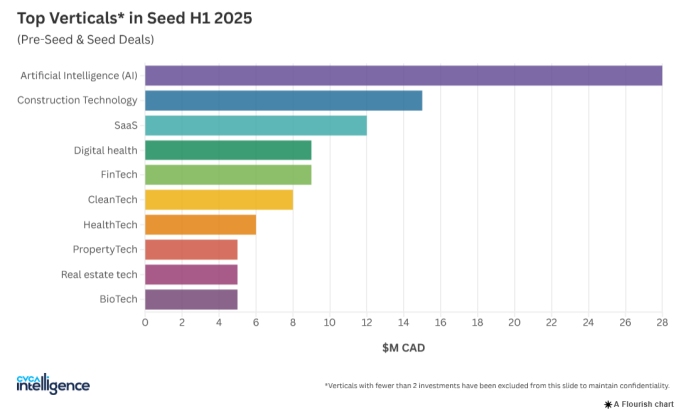
Image: H1 2025 Seed Investing in Canada by Vertical (CVCA Intelligence)
On September 11, 2025, the Canadian Venture Capital and Private Equity Association released its latest report, "The Current State of Seed Investing in Canada", covering tracked investment activity in the first half of 2025. The report recorded $297M invested across 133 seed stage deals in H1 2025.
1. Is seed capital still flowing in Canada, or has the tap run dry?
It's still flowing but selectively. There were 133 rounds worth $297M in H1 2025. The average cheque was $3M, the same as 2024 and down from the $4.09M peak in 2023. But total capital already reached $297M in just six months, equal to all of last year. For entrepreneurs, this means investors are still active but expect clearer proof points before committing. Traction and defensible technology are key.
Ontario pulled in $115.1M across 36 seed deals, nearly 40% of the total. Quebec followed with $66.1M, while Alberta and BC contributed $32.4M and $28.5M. PEI landed a single $6.3M seed round. If you are outside Ontario and Quebec, you may need a lead investor from one of those provinces to close a strong round.
AI is the leader at $24M across 12 seed deals. Construction tech ($15M across 2 deals) and SaaS ($12M across 4 deals) follow. Founders building in other sectors must benchmark carefully. For example, Fintech raised about $9M across pre seed and seed combined, making it harder to get noticed without a compelling angle.
AI again tops the list with $3.9M, followed by digital health at $2.5M. These are modest totals compared to seed, but they set the stage for the next generation of seed deals. Pre seed founders should expect smaller, milestone driven rounds focused on proving product market fit and lining up accelerators, early angels, and alternative finance options like investment crowdfunding.
US investors joined only 27.9% of Canadian seed deals in H1 2025, down from 35.9% in 2023. That is nearly a 30% relative decline. This means Canadian VCs and early stage angels and retail investors are the main gatekeepers at seed. Entrepreneurs should build domestic investor relationships first and then US and global investment pathways.
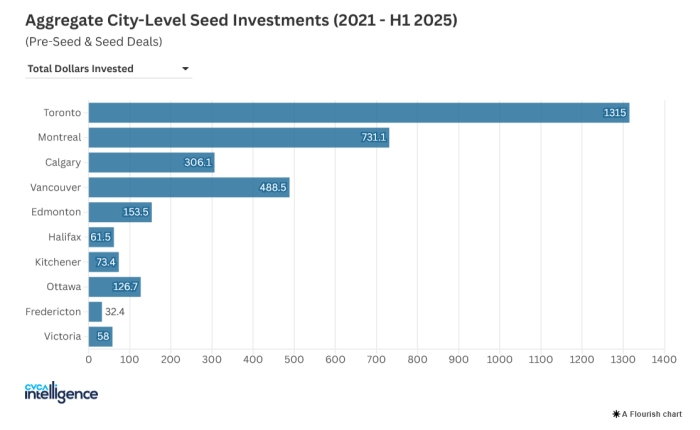
Image: Seed Investments 2021-2025 H1 (CVCA Intelligence)
They have stabilized with the average seed cheque was $3M in H1 2025, unchanged from 2024 but down from $4.09M in 2023. Total deployment hit $297M in H1 2025, already at the full year 2024 level. For investors, that means steady ownership opportunities but faster deal flow.
Ontario ($115.1M across 36 deals) and Quebec ($66.1M across 18 deals) dominate. Alberta ($32.4M) and BC ($28.5M) offer steady but smaller pipelines. For investors, this concentration could means better syndication opportunities in Ontario and Quebec, but higher competition as well.
AI’s $24M across 12 deals makes it the clear leader. SaaS ($12M across 4 deals) provides repeatable playbooks, while construction tech ($15M across 2 deals) indicates appetite for capital intensive bets. Fintech’s about $9M across pre seed and seed shows it remains investable. Portfolios tilted to AI and SaaS, with selective bets in construction and fintech, balance growth with diversification.
Pre seed AI ($3.9M) and digital health ($2.5M) dollars point to pipelines feeding into seed in the next 12 to 18 months. Investors positioning at pre seed should focus on these categories as feeders into later stage strength.
With US participation down to 27.9% from 35.9% last year, a nearly 30% relative decline, Canadian investors are leading more rounds. Other foreign investors ticked up to 10.5%. As a result, early rounds are relying more on domestic syndicates but Series A and B rounds will still require US follow on capital. Investors need to reserve capital and cultivate cross border relationships early.
Seed investment in Canada is concentrating in AI and Ontario while running ahead of last year’s pace. For entrepreneurs, it means tighter pitches and focusing on hubs where money is flowing. For investors, it means disciplined bets on AI and SaaS, while keeping an eye on steady sectors like fintech to diversify portfolios.
The National Crowdfunding & Fintech Association (NCFA Canada) is a financial innovation ecosystem that provides education, market intelligence, industry stewardship, networking and funding opportunities and services to thousands of community members and works closely with industry, government, partners and affiliates to create aa vibrant and innovative fintech and funding industry in Canada. Decentralized and distributed, NCFA is engaged with global stakeholders and helps incubate projects and investment in fintech, alternative finance, crowdfunding, peer-to-peer finance, payments, digital assets and tokens, artificial intelligence, blockchain, cryptocurrency, regtech, and insurtech sectors. Join Canada's Fintech & Funding Community today FREE! Or become a contributing member and get perks. For more information, please visit: www.ncfacanada.org
| | |
|---|---|---|
| | |
Agentic AI Service | Sep 18, 2025

Image: Freepik AI
On September 17, 2025, Amazon announced that it's adding always on agentic AI capabilities to its Seller Assistant tool. It'll first be available to U.S. sellers and then eventually roll out to other countries. Sellers will now have access to an AI partner that can monitor inventory, protect account health, handle compliance, build campaigns, adjust pricing, and generate growth strategies, all at no additional cost.
On the surface, this looks like one of the most significant advancements in how store sellers and entrepreneurs will now operate their Amazon e-commerce stores.
The previous Seller Assistant primarily answered questions but the new agentic AI capable Seller Assistant powered by Amazon Bedrock can reason, plan, and act with seller permission. It analyzes sales patterns, prepares shipment recommendations, and flags slow moving inventory before fees are charged. Sellers can ask when to send products ahead of seasonal demand and receive a full inventory plan within moments, optimized for both cost and delivery speed.
The new Seller Assistant tool continuously scans account metrics for potential issues and proactively protects the health of a seller's account. It can identify listings that might violate new regulations or highlight customer service trends that could impact performance. Sellers receive a clear explanation of risks along with options to fix them, and if approved, Seller Assistant implements the resolution before problems escalate. Verified examples in the announcement include warnings for regulated products such as pesticides where documentation is required, with step by step guidance provided.
Seller Assistant now helps growth. It studies sales data to suggest new product categories, expansion opportunities, and seasonal promotion strategies. During peak events like Prime Day, it can build complete growth plans that coordinate promotions, inventory adjustments, and ad campaigns, leaving sellers free to focus on product innovation and customer relationships.
Expanding into new product categories can come with complicated compliance requirements. Seller Assistant now automatically checks listings for missing certifications such as UL and guides sellers through the documentation process. The tool reduces the time sellers spend on paperwork and helps them enter markets more efficiently, as a result.
Advertising is also being transformed. Through Creative Studio, sellers can generate professional ads using conversational prompts. One seller building a Father’s Day campaign for smart bird feeders saw a 338% increase in click through rate, 89% new to brand purchases, and a 121% return on ad spend when using the AI tool to design Sponsored Video ads.
By analyzing shopping trends alongside product data, the system delivers creative options that are fast, targeted, and backed by transparent reasoning.
Despite the amazing new features and benefits, companies must remain aware of potential risks when adopting agentic AI. Sellers remain legally accountable for compliance, advertising, and customer obligations. Amazon’s tool may act with permission, but ultimate responsibility rests with the business owner.
To reduce risk exposure, sellers should follow some practical steps:
Amazon Sellers have sold over $2.5 trillion or more than 60% of Amazon store sales to date. With new agentic AI capabilities, Amazon is raising the bar once again, providing startups and established brands with a proactive partner that helps them scale more efficiently. As the rollout expand globally, the AI system will only continue to get better and smarter, and more capable at keeping pace with the complexities of modern digital commerce.
The National Crowdfunding & Fintech Association (NCFA Canada) is a financial innovation ecosystem that provides education, market intelligence, industry stewardship, networking and funding opportunities and services to thousands of community members and works closely with industry, government, partners and affiliates to create aa vibrant and innovative fintech and funding industry in Canada. Decentralized and distributed, NCFA is engaged with global stakeholders and helps incubate projects and investment in fintech, alternative finance, crowdfunding, peer-to-peer finance, payments, digital assets and tokens, artificial intelligence, blockchain, cryptocurrency, regtech, and insurtech sectors. Join Canada's Fintech & Funding Community today FREE! Or become a contributing member and get perks. For more information, please visit: www.ncfacanada.org
| | |
|---|---|---|
| | |


August 26th, 2025

January 4th, 2024

June 1st, 2021

September 9th, 2020

July 9th, 2018

January 3rd, 2018

September 25th, 2017

June 20th, 2017

May 10th, 2017

December 14th, 2016