





Karsten Wenzlaff, Advisor
August 26th, 2025
Karsten Wenzlaff is a Crowdfunding and Fintech Expert from Germany. He is Secretary-General of Digit[...]


June 9, 2026 | NCFA Fintech Market Activity | Payments And Market Infrastructure

On June 9, 2026, Lloyds launched Lloyds Accept, a new suite of payment tools powered by Stripe and built into Lloyds' Business Account for UK small businesses.
The launch puts fintech payment infrastructure inside a major bank's SME account relationship. Lloyds says the service gives business customers access to in person payments, online payments, invoicing, payment links, and reporting from one account environment.
Lloyds brings the customer base and banking relationship, while Stripe brings merchant payment infrastructure, onboarding, acceptance, and developer led tools. Lloyds Banking Group says it serves 26 million customers, giving Stripe access to a large UK banking channel without competing for every merchant relationship directly.
Stripe's 2025 annual update confirms that businesses on its platform generated $1.9 trillion in total payment volume, up 34% from 2024. The company also expanded UK products in 2024, including Pay by Bank and business financing, showing expansion into account based payments, working capital, and SME financial operations.
Lloyds is adding specialist payment infrastructure inside its own SME banking relationship instead of building every part itself. Payment acceptance is the visible feature, but onboarding, reconciliation, reporting, fraud controls, financing, and embedded workflows create the larger infrastructure opportunity. Canadian banks are also partnering for merchant payment infrastructure, which shows the same bank fintech execution pattern in another market.
So where is the value accumulating? Banks still control the customer account, balance sheet, trust, and distribution channel. Infrastructure providers increasingly control the operations that powers day to day business activity. That creates practical opportunities around merchant onboarding, payment operations, treasury tools, fraud controls, and business automation, which connect naturally to NCFA’s Financial Innovation Map.
As banks rely more on specialist infrastructure partners, who will own the most valuable parts of the SME relationship? The account, the payment workflow, the operating data, or the tools that help small businesses manage cash flow.
 The National Crowdfunding & Fintech Association (NCFA Canada) is a financial innovation ecosystem that provides education, market intelligence, industry stewardship, networking and funding opportunities and services to thousands of community members and works closely with industry, government, partners and affiliates to create a vibrant and innovative fintech and funding industry in Canada. Decentralized and distributed, NCFA is engaged with global stakeholders and helps incubate projects and investment in fintech, alternative finance, crowdfunding, peer-to-peer finance, payments, digital assets and tokens, artificial intelligence, blockchain, cryptocurrency, regtech, and insurtech sectors. Join Canada's Fintech & Funding Community today FREE! Or become a contributing member and get perks. For more information, please visit: www.ncfacanada.org
 |  |  |
|---|---|---|
 |  |  |
Jun 9, 2026 | NCFA Resource | Capital Formation And Crowdfunding
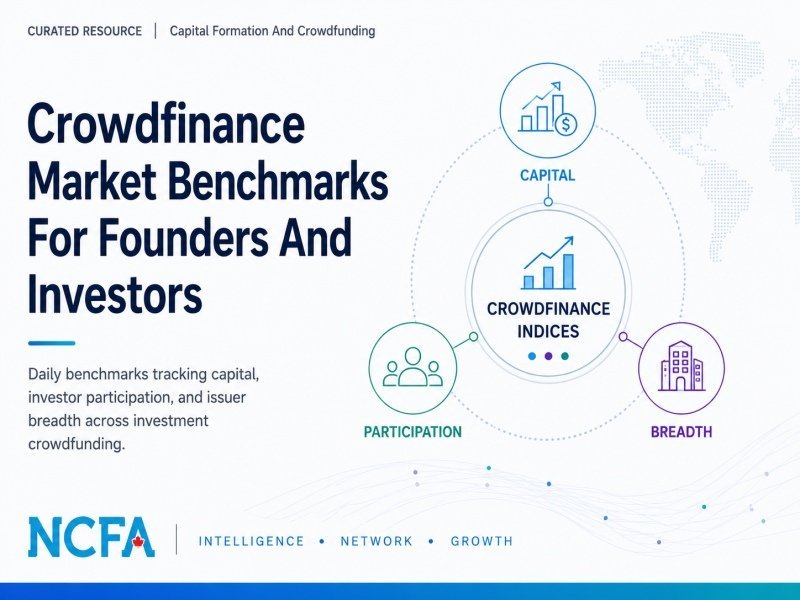
Crowdfund Capital Advisors launched the CCA Crowdfinance Indices, a family of daily benchmarks for the U.S. Regulation Crowdfunding market. The resource tracks more than dollars raised. It measures capital, investor participation, and issuer breadth so founders, investors, platforms, and policymakers can see whether market activity is broadening, concentrating, or cooling.
The data is U.S. specific, but the measurement framework travels. Canada and other jurisdictions can use the same lens to think more clearly about crowdfunding market health, capital access, investor activity, and whether opportunity reaches a wider base of companies.
The indices separate investment crowdfunding activity into three useful indicators.
That breakdown matters because capital raised alone can hide what is really happening. A market can show higher capital while fewer companies receive funding. It can also show more investor activity while average checks get smaller. CCA’s framework helps users see the drivers behind the headline number.
CCA says the indices draw from its CCLEAR data platform and cover activity across leading U.S. intermediaries. The dashboard also includes sector views across technology, healthcare and life sciences, food and beverage, consumer and retail, fintech and financial, energy and cleantech, and real estate and construction.
CCA reports that issuers tracked by the Composite have raised nearly $3.1B across more than 9,000 companies. That makes the index family useful as a market reference, not just a launch announcement.
This resource is useful for crowdfunding platforms, founders, angel investors, policy teams, researchers, ecosystem builders, securities regulators, funding portals, and capital formation advocates.
It is especially useful for anyone trying to understand whether investment crowdfunding is becoming a deeper market, a more concentrated market, or a broader channel for startup and small business finance.
The strength of this resource is its market structure lens. It turns crowdfunding activity into a more useful set of indicators. Capital shows money flow. Participation shows investor engagement. Breadth shows issuer access.
The limit is geography. The indices measure U.S. Reg CF activity. They don't measure Canadian crowdfunding activity or global crowdfunding flows. Canadian readers should use the resource as a benchmark for comparison and market design, not as a proxy for Canada.
That distinction makes the resource more valuable, not less. It shows what better market intelligence could look like in other jurisdictions where crowdfunding data remains fragmented, delayed, or hard to compare.
CCA Crowdfinance Indices Dashboard (primary dashboard)
Reg CF At 10 Shows Equity Crowdfunding Works (cap modernization context)
Fintech Fridays EP57: Equity Crowdfunding 10 Years After Jobs Act (investment crowdfunding history)
UK Crowdfunding Caps Lift As EU Pushes €12M (global cap comparison)
National Instrument 45-110 (Canadian startup crowdfunding rules)
SEC Regulation Crowdfunding (U.S. Reg CF overview)
The National Crowdfunding & Fintech Association (NCFA Canada) is a financial innovation ecosystem that provides education, market intelligence, industry stewardship, networking and funding opportunities and services to thousands of community members and works closely with industry, government, partners and affiliates to create a vibrant and innovative fintech and funding industry in Canada. Decentralized and distributed, NCFA is engaged with global stakeholders and helps incubate projects and investment in fintech, alternative finance, crowdfunding, peer-to-peer finance, payments, digital assets and tokens, artificial intelligence, blockchain, cryptocurrency, regtech, and insurtech sectors. Join Canada's Fintech & Funding Community today FREE! Or become a contributing member and get perks. For more information, please visit: www.ncfacanada.org
| | |
|---|---|---|
| | |
Jun 8, 2026

Building your own standing desk is one of those projects that seems more complicated than it is. The frame does the mechanical work. The desktop is just a surface. Put the right two together and you end up with a custom sit-stand desk that fits your exact dimensions, matches your workspace aesthetic, and costs less than most comparable products bought as a complete unit.
The frame decision is where most of the thinking needs to happen. Get that right and the rest of the project is straightforward.
Commercial standing desks come in a limited range of widths, depths, and surface materials. If your space is non-standard, if you want a specific wood species, a particular thickness, a reclaimed material, or dimensions that don't match what's on the market, building your own is the practical route.
The cost argument is also real. A quality motorised frame without a top is considerably less expensive than the same frame sold as a complete desk with a manufacturer's surface. If you already have a desktop you want to keep, or you're sourcing a slab of solid wood, the frame-only route saves money while improving the result.
Control over the finished product is the third reason. You know what you're getting: a specific frame with specific specifications, paired with a surface you chose rather than what was available in the product line.
Single-leg frames are compact and suited to smaller desktop sizes, typically up to around 120cm wide. The single column limits the maximum stable width but keeps the footprint minimal. For a compact home office setup or a secondary workstation, this configuration works well and costs less than a full two-leg frame.
Two-leg frames are the standard for most desktop sizes. Two columns, one at each end of the desk, provide stability across a wider span. Most two-leg frames accommodate desktops roughly between 100cm and 180cm wide, though the exact range varies by manufacturer. For a main workstation with multiple monitors and full equipment, this is typically the right starting point.
Three-leg and corner configurations support L-shaped or very large surfaces. These are more complex mechanically and more expensive, but they solve the stability problem that arises when a single straight frame is asked to support an unusually wide or non-rectangular top.
Motor configuration is the starting point. A single motor driving both columns through a crossbar is the entry-level approach. It works but introduces some flex between the columns during adjustment on wider desktops. Dual motors, one in each column, driven synchronously by the controller, produce more stability and more even lifting force distribution. For a desktop wider than about 140cm, or for anyone who wants the desk to feel genuinely solid at standing height, dual motors are worth the additional cost.
Height range needs to accommodate both the seated and standing positions of the person using it. The seated position is more constrained by the chair height and the working ergonomics. The standing position needs to allow the keyboard to sit at a height where elbows are roughly at 90 degrees while standing. Most people need a standing height somewhere between 100cm and 120cm. Check the frame's maximum extension against this requirement, and check the minimum against your preferred seated height, before buying.
Weight capacity for the standing desk frame needs to account for the combined weight of the desktop surface and everything on it. A solid wood slab can be heavy. Two monitors, a laptop dock, and accessories add up. Frames rated comfortably above the actual loaded weight will be more stable and last longer than those running near their limit.
Stroke speed affects the experience of using the desk in practice. A frame that adjusts at a reasonable pace, roughly 25 to 40mm per second, feels purposeful without being abrupt. Very slow frames make adjustment feel effortful. Very fast frames can feel slightly aggressive. Most quality frames in the mid-market land in a speed range that works well for daily use.
Controller quality is consistently the underspecified element. A controller with memory presets, the ability to save specific sitting and standing heights and return to them with a single button press, changes whether the desk gets adjusted regularly or sits at one height indefinitely. Manual height finding every time introduces just enough friction that most people stop bothering. Presets remove that friction entirely. This is worth specifying rather than accepting whatever comes with the cheapest frame option.

The frame's desktop compatibility specification typically gives a minimum and maximum width and depth range. The desktop needs to fit within this range for the frame to support it correctly.
Thickness matters for the mounting hardware. Most frame cross-beams use bolts that pass up through the frame into the desktop from below. A desktop that's too thin won't provide enough material for the bolts to grip. A desktop that's too thick may not work with the standard bolt lengths. Around 18 to 25mm is the typical practical range. A solid wood slab can be considerably thicker, which may require longer fasteners.
The stand up desk frame mounting pattern determines how the columns attach to the desktop. Most frames use a crossbar arrangement that spans between the two columns and attaches to the underside of the desktop at multiple points. The crossbar width is adjustable within a range, which is what allows the frame to accommodate different desktop widths.
For solid wood desktops, leave time for the wood to acclimatise to the room's humidity before mounting the frame. Wood moves with seasonal humidity changes, and a slab mounted while it's at one moisture content may develop tension or movement as conditions change.
Most two-leg motorised frames assemble in under an hour with basic tools. The columns attach to the crossbar or base beam, the controller and motor wiring connects through the columns, and the crossbar attaches to the desktop from below.
Cable management is worth planning before assembly rather than after. The desktop will have monitor cables, power, USB, and other runs that need to go somewhere. A cable tray mounted to the underside of the desktop along the back edge, and a cable spine or guide that allows wires to move with the desk during height adjustment without straining, keeps the setup clean and prevents cable damage over time.
Levelling the frame on the floor is the detail that gets skipped and then causes problems. A frame that isn't sitting level will put slightly unequal stress on the columns during adjustment. On hard flooring this is usually managed with the adjustable floor glides that most frames include. On carpet, the glides may need to be extended to compensate for compression. Spend two minutes checking this before loading up the desktop.
Running the anti-collision calibration, where the controller tests the range of travel and sets its limit positions, is a required step on most motorised frames and sometimes gets skipped by people who just want to use the desk. Do it. The calibration is what prevents the motor from running past its travel limits, which over time damages the drive components.
The result of getting all of this right is a desk that fits exactly where it needs to fit, carries the surface you actually wanted, and performs consistently for years. That combination is harder to get from a product catalogue than most people expect, which is what makes the frame-plus-custom-top route worth considering for anyone setting up a serious long-term workspace.
The National Crowdfunding & Fintech Association (NCFA Canada) is a financial innovation ecosystem that provides education, market intelligence, industry stewardship, networking and funding opportunities and services to thousands of community members and works closely with industry, government, partners and affiliates to create a vibrant and innovative fintech and funding industry in Canada. Decentralized and distributed, NCFA is engaged with global stakeholders and helps incubate projects and investment in fintech, alternative finance, crowdfunding, peer-to-peer finance, payments, digital assets and tokens, artificial intelligence, blockchain, cryptocurrency, regtech, and insurtech sectors. Join Canada's Fintech & Funding Community today FREE! Or become a contributing member and get perks. For more information, please visit: www.ncfacanada.org
| | |
|---|---|---|
| | |
June 5, 2026 | NCFA Resource | Financial Innovation
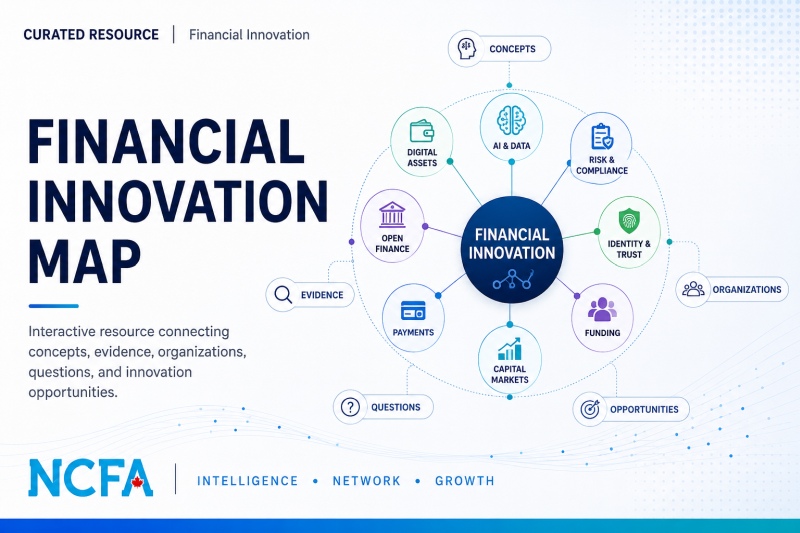
NCFA launched a Financial Innovation Map on June 5, 2026, as a practical resource for founders, investors, financial institutions, policymakers, researchers, and ecosystem builders. The map connects financial innovation concepts, use cases, featured organizations, evidence, questions, and innovation opportunities across fintech, funding, AI, digital assets, open finance, payments, capital markets, compliance, cybersecurity, and trust.
The Financial Innovation Map helps users move from concept awareness to opportunity discovery. Users can select a category, choose a concept, review sample use cases, scan featured organizations, explore innovation questions, and review resources tied to practical financial innovation activity.
The opportunity cards are practical and will continue to evolve. They show where adjacent concepts could combine into practical opportunities, supported by early, growing, or strong evidence. This helps users think beyond definitions and ask where an idea may create real value.
The need for better financial innovation intelligence is global. The BIS Innovation Hub works with central banks on technology trends that affect the global financial system, including digital finance, payments, market infrastructure, regtech, suptech, and financial stability. NCFA’s map gives Canada’s innovation ecosystem a practical way to explore many of the same themes from a founder, investor, policy, and market building lens.
Founders can use the map to test ideas, find adjacent concepts, and sharpen market theses. Investors can scan emerging areas before they become obvious sectors. Financial institutions can explore where new technology may reduce friction, improve workflows, or open new product opportunities.
Regulators, policymakers, researchers, and ecosystem builders can use the map to understand how technologies, rules, organizations, and unanswered questions connect across Canada and global financial innovation markets.
The strength of the Financial Innovation Map is structure. It brings concepts, organizations, resources, questions, and opportunity cards into one place so users can explore financial innovation with more context and less noise.
The first release is intentionally focused. Some concepts have more evidence and opportunity cards than others. That's by design. Opportunities are not added to meet a fixed count. They are added when there is enough evidence, friction, thesis strength, funding interest, or market activity to support inclusion.
The map isn't investment advice, legal advice, or a forecast. It's a curated intelligence resource that will improve as new evidence, resources, organizations, and opportunities are added. Stay tuned for future iterations.
Start with the Financial Innovation Map and explore the categories most relevant to your work.
For related NCFA coverage, see how AI agents, wallets, and financial identity are starting to connect, how agentic AI in banking is moving into practical workflows, and how tokenized infrastructure is changing market operations.
The National Crowdfunding & Fintech Association (NCFA Canada) is a financial innovation ecosystem that provides education, market intelligence, industry stewardship, networking and funding opportunities and services to thousands of community members and works closely with industry, government, partners and affiliates to create a vibrant and innovative fintech and funding industry in Canada. Decentralized and distributed, NCFA is engaged with global stakeholders and helps incubate projects and investment in fintech, alternative finance, crowdfunding, peer-to-peer finance, payments, digital assets and tokens, artificial intelligence, blockchain, cryptocurrency, regtech, and insurtech sectors. Join Canada's Fintech & Funding Community today FREE! Or become a contributing member and get perks. For more information, please visit: www.ncfacanada.org
| | |
|---|---|---|
| | |
June 5, 2026 | NCFA Financial Innovation Map
Financial innovation is creating new language faster than most teams can absorb it.
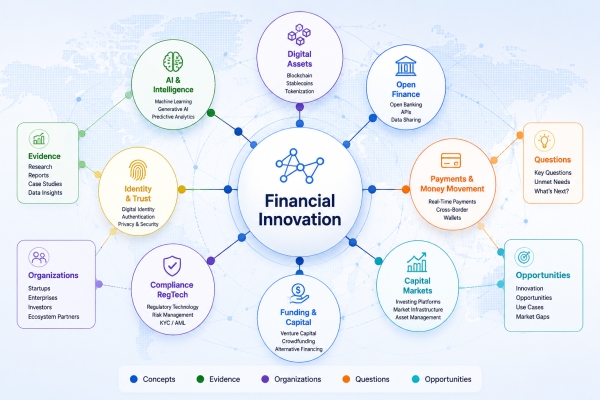
The National Crowdfunding & Fintech Association of Canada's Financial Innovation Map connects concepts, use cases, featured organizations, evidence, questions, and innovation opportunities across fintech, funding, AI, digital assets, open finance, payments, capital markets, compliance, cybersecurity, and trust.
Select a category, choose a concept, and explore how the idea works, who is involved, and where practical opportunities may emerge.
Updated June 2026 | NCFA Financial Innovation Map | MVP v19
Financial innovation is creating new language faster than most teams can absorb it. This living map connects concepts, use cases, market models, featured organizations, innovation opportunities, and questions across fintech, funding, artificial intelligence, digital assets, open finance, payments, capital markets, compliance, cybersecurity, and trust. Select a category, choose a concept, and use the panel to see how the idea works and where it may create practical opportunities.
The National Crowdfunding & Fintech Association (NCFA Canada) is a financial innovation ecosystem that provides education, market intelligence, industry stewardship, networking and funding opportunities and services to thousands of community members and works closely with industry, government, partners and affiliates to create a vibrant and innovative fintech and funding industry in Canada. Decentralized and distributed, NCFA is engaged with global stakeholders and helps incubate projects and investment in fintech, alternative finance, crowdfunding, peer-to-peer finance, payments, digital assets and tokens, artificial intelligence, blockchain, cryptocurrency, regtech, and insurtech sectors. Join Canada's Fintech & Funding Community today FREE! Or become a contributing member and get perks. For more information, please visit: www.ncfacanada.org
| | |
|---|---|---|
| | |
June 4, 2026 | NCFA Market Activity | Capital Markets And Funding

On June 1, 2026, FrontFundr launched the Back The Next Canadian Startup Challenge, a national initiative inviting investors, founders, advisors, partners, supporters, and startup operators to nominate Canadian companies ready to raise capital.
The challenge targets founders building innovative or high growth businesses with early traction, strong market potential, and plans to raise within the next 3 to 6 months. Companies can apply directly or be nominated by someone in the ecosystem. All participating companies must still submit an application.
Applications require a pitch deck, an overview of the business and fundraising goals, and an explanation of why the company fits community investment. Founders can also submit an optional 45 to 60 second video explaining their story, mission, and motivation to raise on FrontFundr.
FrontFundr will review applications based on business innovation, market opportunity, founder strength, execution capability, readiness to raise, and alignment with community investing. Nominations and applications run from June 1 to 30. Shortlisted companies advance to a live pitch competition in early July, where the top 3 to 5 companies will deliver a 5 minute pitch followed by 5 minutes of Q&A.
One selected company receives a free opportunity to launch a FrontFundr campaign and raise from its own supporters and FrontFundr’s investor community. FrontFundr values the package at $13,000. It includes a free campaign listing, due diligence and campaign preparation, and complimentary documentation drafting. Standard closing costs and trade fees still apply.
Finalists and high potential applicants may also continue through an accelerated pathway toward launching a FrontFundr campaign, based on fit, readiness, and alignment with community investing.
Referrers may earn $1,250 when a referred company signs and launches a campaign. Eligible companies must be new to FrontFundr, Canadian, raise at least $250,000, and launch within 6 months of introduction. Rewards can be paid as cash or platform credit upon milestone completion.
FrontFundr says companies on its platform have raised more than $367M across more than 300 campaigns, supported by more than 73,000 investors across Canada.
The winner reduces upfront campaign costs and receives support with preparation, documentation, and platform launch. Finalists may still gain visibility and a faster review process.
The National Crowdfunding & Fintech Association (NCFA Canada) is a financial innovation ecosystem that provides education, market intelligence, industry stewardship, networking and funding opportunities and services to thousands of community members and works closely with industry, government, partners and affiliates to create a vibrant and innovative fintech and funding industry in Canada. Decentralized and distributed, NCFA is engaged with global stakeholders and helps incubate projects and investment in fintech, alternative finance, crowdfunding, peer-to-peer finance, payments, digital assets and tokens, artificial intelligence, blockchain, cryptocurrency, regtech, and insurtech sectors. Join Canada's Fintech & Funding Community today FREE! Or become a contributing member and get perks. For more information, please visit: www.ncfacanada.org
| | |
|---|---|---|
| | |

Last Updated: June 4, 2026
Status: Strengthening
Organizations: OSFI, CIRO, SEC, FSB, CVCA, TSXV, TMX Group, Upstart, goeasy, FrontFundr
The answer is not simply yes or no. Capital is more available in some places and harder to reach in others. Funding channels are multiplying, but capital still flows toward companies that fit the channel, prove the risk, and give investors a clear reason to act.
Public markets are improving from a weak period, but access still depends on timing, disclosure readiness, and investor demand. Recent work on the CSA review of the EMD selling groups exemption and capital markets research through OSC research grants for Ontario capital markets shows that market access remains an active policy issue.
Crowdfunding adds another route. Reg CF’s 10 year record, record Canadian equity crowdfunding activity, and public market challenges and equity crowdfunding capital point to a wider funding stack. These channels still depend on trust, disclosure, visible traction, and investor communication.
Canada’s $750M early growth stage funding envelope reinforces the same point. The policy debate is not only about adding capital. It is about where the financing gap hurts most: pre seed, seed, Series B, growth, or later stage scale up capital.
Capital stack fit is now harder to ignore. Founders and fintechs may combine equity, debt, crowdfunding, private credit, public markets, and lending partnerships, but each channel demands different proof, timing, economics, and risk controls.
Strategic Takeaway
Capital channels are multiplying, but access is not becoming automatic. Founders and fintechs need to know which type of capital they fit and what proof that capital provider needs before money moves.
Click each item to expand
CVCA reported that Q1 2026 saw CAD $936.3M invested across 104 venture capital transactions, compared with 178 transactions and $3.97B in Q4 2025.
Crowdfunding evidence adds an important non bank and non VC funding channel to the capital access question.
TSX Venture Exchange removed its Sponsor requirement, effective immediately.
Upstart announced a $1B forward flow agreement with Eltura Ventures and Aperture Investors.
OSFI reduced capital requirements for certain unrated domestic infrastructure debt held by federally regulated property and casualty insurers.
Click each item to expand
The Financial Stability Board estimated private credit at $1.5T to $2.0T at the end of 2024 and warned that complexity, leverage, and interconnectedness could amplify stress.
goeasy reported a difficult Q4 2025 tied to LendCare credit performance.
CIRO finalized amendments related to fully paid securities lending and financing arrangements.
The SEC Division of Corporation Finance said EDGAR would accept filings during a shutdown, but staff would not be able to declare registration statements effective or qualify Form 1 A offering statements.
The Federal Reserve, FDIC, and OCC requested comment on three proposals to modernize the regulatory capital framework for banks of all sizes.
Do you agree the evidence is strengthening?


Click Agree or Disagree. Your vote is recorded anonymously and aggregate totals tracked.
The National Crowdfunding & Fintech Association (NCFA Canada) is a financial innovation ecosystem that provides education, market intelligence, industry stewardship, networking and funding opportunities and services to thousands of community members and works closely with industry, government, partners and affiliates to create a vibrant and innovative fintech and funding industry in Canada. Decentralized and distributed, NCFA is engaged with global stakeholders and helps incubate projects and investment in fintech, alternative finance, crowdfunding, peer-to-peer finance, payments, digital assets and tokens, artificial intelligence, blockchain, cryptocurrency, regtech, and insurtech sectors. Join Canada's Fintech & Funding Community today FREE! Or become a contributing member and get perks. For more information, please visit: www.ncfacanada.org
| | |
|---|---|---|
| | |



August 26th, 2025

January 4th, 2024

June 1st, 2021

September 9th, 2020

July 9th, 2018

January 3rd, 2018

September 25th, 2017

June 20th, 2017

May 10th, 2017

December 14th, 2016
