





Karsten Wenzlaff, Advisor
August 26th, 2025
Karsten Wenzlaff is a Crowdfunding and Fintech Expert from Germany. He is Secretary-General of Digit[...]


June 2, 2026 | NCFA Fintech Market Activity | Capital Markets And Market Infrastructure, SME Finance And Business Banking

A New York City sports bar has turned a Knicks NBA Finals promotion into a practical prediction market case study. According to NY Sports Day coverage of the promotion, The Jeffrey ('The bar') offered customers free drinks if the Knicks won Game 1 and placed a $5,000 position on a Knicks win through Kalshi, which could pay roughly $13,500 if the Knicks won.
The sports hook is fun. The business logic is better. The bar isn't simply betting on the Knicks with a local sportsbook. It's using a prediction market 'event contract' to run a promotion with a clear downside. If the Knicks win, the contract helps fund the free drinks. If the Knicks lose, customers pay their tabs and the bar loses the $5,000 position. The owner knows the maximum contract cost before the campaign starts.
The promotion creates two linked outcomes.
If the Knicks win, qualifying drink tabs become free and the bar gives up revenue it would otherwise collect. The Kalshi position pays on that same outcome, helping offset the waived tabs.
If the Knicks lose, the Kalshi position expires worthless, but the bar keeps normal drink revenue from customers who came in to watch the game.
It's a different use case from the prediction market stories NCFA has tracked around private market valuation odds and public market sentiment. Here, the contract supports a real world promotion with a known maximum contract cost.
This second outcome is what makes the structure interesting. The bar isn't left with only a $5,000 loss. It may also have a packed room, paid tabs, food orders, longer visits, and new customers. People may spend more because the tab could become free. That excitement is part of the promotion’s value.
The key business question is did the promotion generate enough incremental gross profit to justify the $5,000 contract cost if the Knicks lost? If yes, the losing contract is a campaign expense. If the Knicks won, the payout could help cover the free drinks liability (and possibly more). Either way, the owner puts a known price on the risk.
A traditional hedge normally offsets an existing risk. The bar created the risk by offering free drinks, then used Kalshi to offset part of that exposure.
The hedge quality depends on numbers that haven't been shared publicy like expected crowd size, average tab, food sales, qualifying drink costs, gross margin, and incremental revenue created by the promotion. If free drink liability reached $15,000 and the contract paid $13,500, the bar still carries some cost (of course the owner could choose to cap the number/cost of free drinks). If the room filled up and customers paid their tabs after a Knicks loss, the $5,000 contract loss may still be covered by extra business.
A patio restaurant could run a long weekend rain campaign. Customers get 25% off if rain exceeds a defined threshold during peak patio hours. The restaurant buys a weather contract tied to the same outcome. If it rains, the contract helps fund the discount. If it stays dry, the restaurant keeps full patio revenue and treats the contract cost as part of the campaign budget.
An event organizer could offer partial refunds if a transit strike disrupts attendance. A $3,000 event contract tied to the strike outcome could help cover refunds if the strike happens. If the strike doesn't happen, attendees pay full price and the organizer loses only the known contract cost.
A tourism operator could sell a “city wins, you save” package tied to a major festival or sports bid. If the city wins and the discount triggers, the event contract helps offset the promotion. If the city loses, customers still paid for the trip and the operator knows the campaign cost in advance.
Most prediction market coverage focuses on politics, sports, forecasting, or trading activity. The bar example points to a different use case of outcome based promotions where a business knows the most it can lose before launching the campaign.
It could make a difference for small businesses. Most small operations don't have access to custom insurance, futures contracts, or sophisticated risk tools. Prediction markets are easier to understand. A business can tie a campaign to a public event, cap the contract cost, and create a promotion customers want to talk about.
The risk is that promotion design can slide into speculation if owners do not size the contract properly. As prediction market controls tighten, businesses need clearer guardrails around contract sizing, customer disclosures, and whether the activity manages a real exposure or simply adds another bet. A useful campaign starts with the business exposure, not the excitement of the event. The bar example works as a test case because the contract ($5,000), the customer offer (free drinks), and the revenue opportunity ($13,500 + promo boost) all point to the same outcome.
If prediction markets can help small businesses run outcome based promotions with a known maximum contract cost, where should regulators draw the line between practical risk management and promotional trading?
 The National Crowdfunding & Fintech Association (NCFA Canada) is a financial innovation ecosystem that provides education, market intelligence, industry stewardship, networking and funding opportunities and services to thousands of community members and works closely with industry, government, partners and affiliates to create a vibrant and innovative fintech and funding industry in Canada. Decentralized and distributed, NCFA is engaged with global stakeholders and helps incubate projects and investment in fintech, alternative finance, crowdfunding, peer-to-peer finance, payments, digital assets and tokens, artificial intelligence, blockchain, cryptocurrency, regtech, and insurtech sectors. Join Canada's Fintech & Funding Community today FREE! Or become a contributing member and get perks. For more information, please visit: www.ncfacanada.org
 |  |  |
|---|---|---|
 |  |  |
Jun 3, 2026

Modern businesses exist in an environment where the speed and reliability of transport are primary factors for customer satisfaction and operational success. Both consumers and corporate clients expect that products, documents and necessary supplies are delivered quickly. Same day courier services are a central component of business logistics across many sectors.
Organizations in retail, healthcare, legal and manufacturing sectors increasingly use rapid delivery solutions to meet deadlines and maintain operations - these services are helpful for businesses to respond to customer needs and to lower delays that might impact revenue or public perception.
The expectations of customers are different now than in previous years. Many buyers expect fast delivery options to be a standard part of the purchasing process. Companies that provide same day delivery often have an advantage over others because they are able to fulfill urgent requirements.
Fast delivery is also a factor in customer loyalty - When customers receive products on the promised date, they are more likely to make future purchases. Consistent service is a method to build trust and encourage positive feedback, which helps a business maintain its market position.
Many organizations are dependent on the timely movement of equipment and documents to ensure daily tasks continue without pause. Same day courier services are useful for avoiding disruptions - ensuring that items reach their destination without delays.
Rapid transportation is a tool to prevent expensive interruptions in industries that require time sensitive materials. If a company is in need of replacement parts, legal paperwork or inventory transfers, same day delivery is a way to maintain productivity and lower the time when systems are not functioning.
Businesses that are responsive to customer demands often distinguish themselves from others. Offering same day delivery is a demonstration of a commitment to convenience, which is a factor that influences purchasing decisions.
Strong delivery capabilities are also a way to create new growth opportunities. Companies that fulfill urgent requests are in a better position to attract customers who prioritize speed - this flexibility is what allows businesses to adapt to changing market conditions.
Efficient logistics are the reason for a more adaptable supply chain. Same day courier services are a means to move goods quickly between suppliers, warehouses and customers - this reduces delays that might affect the performance of the entire chain.
Faster transportation is also a support for inventory management. Instead of keeping a high volume of stock, businesses are able to rely on rapid delivery when a need arises - this method is a way to lower storage costs while ensuring products are available when there is demand.
Access to reliable courier solutions is useful for smaller organizations. Many small firms use small business shipping services to compete with larger businesses that possess extensive logistics networks.
Rapid delivery options are a way for smaller firms to provide high levels of service without a large investment in their own vehicles - this creates opportunities for growth and is a method to maintain customer satisfaction and operational efficiency.
Unexpected delays are often the cause of financial losses, missed deadlines and damaged relationships. Same day courier services are a way to lower these risks - providing dependable transportation for urgent shipments.
Businesses are also able to benefit from improved tracking capabilities. Many courier providers offer real time updates so that companies can monitor deliveries and share accurate information with customers - this transparency is a way to build confidence and support better decisions.
Reliable delivery performance is a foundation for stronger relationships with customers, suppliers and partners. When organizations meet their commitments, they establish a reputation for being dependable.
Timely transportation is a support for collaboration between different parts of a business network. Suppliers are able to deliver materials faster and partners can exchange documents more efficiently - these advantages are contributors to long term success.
The growth of digital business models is the reason for the increased importance of fast logistics. Customers often compare delivery options before they make a purchase, which makes speed a factor in the buying process.
Many organizations combine same day courier solutions with other shipping services to create a flexible strategy - this approach is a way for businesses to serve both urgent and standard needs while improving the experience of the customer.
Same day courier services are an essential resource for modern businesses that seek to improve customer satisfaction and streamline operations. By allowing for the rapid delivery of products, these services are a way for organizations to respond to the demands of the current marketplace.
As customer expectations continue to change, businesses that invest in efficient delivery solutions are in a better position for long term growth. Same day courier services provide the speed and flexibility that are necessary for success in a fast paced environment.
The National Crowdfunding & Fintech Association (NCFA Canada) is a financial innovation ecosystem that provides education, market intelligence, industry stewardship, networking and funding opportunities and services to thousands of community members and works closely with industry, government, partners and affiliates to create a vibrant and innovative fintech and funding industry in Canada. Decentralized and distributed, NCFA is engaged with global stakeholders and helps incubate projects and investment in fintech, alternative finance, crowdfunding, peer-to-peer finance, payments, digital assets and tokens, artificial intelligence, blockchain, cryptocurrency, regtech, and insurtech sectors. Join Canada's Fintech & Funding Community today FREE! Or become a contributing member and get perks. For more information, please visit: www.ncfacanada.org
| | |
|---|---|---|
| | |
Jun 3, 2026

Walk through any modern facility and you're surrounded by controlled movement that most people don't examine. A hospital bed adjusting position at the touch of a button. A greenhouse vent opening in response to temperature. A conveyor gate diverting product into a secondary line without anyone pressing anything. The mechanism behind most of this is the same, and it has a name most people outside engineering have never used: an actuator.
That's changing. As automation spreads across Canadian industries, from manufacturing and agriculture to building infrastructure and healthcare, the actuator has moved from a component that engineers specify quietly to something that business decision-makers, procurement teams, and technology investors increasingly need to understand.
An actuator converts energy into mechanical motion. Depending on the energy source, that's either electrical current, compressed air, or pressurised hydraulic fluid. Depending on the application, the motion produced is either linear, a straight push or pull along a single axis, or rotary, rotation around a fixed point.
Electric linear actuators are the most relevant category for the broadest range of modern applications, and understanding how they work explains most of what matters in practice.
A motor drives a lead screw, a precisely threaded rod. A drive nut sits on the screw and meshes with the thread but is prevented from rotating. So when the screw turns, the nut has no option but to travel along it. The rod attached to the nut extends outward as the nut moves in one direction and retracts when the motor reverses.
What this produces is controlled, precise, repeatable straight-line movement from an electrical input. The relationship between motor rotation and rod travel is fixed by the thread pitch, so controlling the motor precisely means controlling the rod's position precisely. Stop the motor and the rod stops. Add position sensing and you know exactly where it is throughout its travel.
This is what makes electric actuation more capable than pneumatic alternatives for most modern applications. A pneumatic cylinder applies pressure in one direction and that's essentially it. An electric actuator can stop at any point in its travel, modulate force, hold a position, and communicate its status to a digital control system. For an era of networked, sensor-driven industrial automation, that's the relevant difference.
One characteristic of lead screw actuators that has real practical consequences is self-locking. With a fine enough thread pitch, the geometry prevents the load from backdriving the mechanism when the motor isn't powered. The rod holds its position without the motor running continuously.
For a patient positioning system that needs to hold position while the patient is settled. For an industrial fixture that needs to maintain clamping force after moving to position. For an adjustable workstation that shouldn't drift during the working day. Self-locking provides this without continuous power draw, which matters both for energy efficiency and for safety in applications where unexpected movement would be a problem.
Not every actuator is self-locking. Coarser thread pitches that prioritise speed over force may allow backdrive. Worth checking explicitly for any application where the load needs to stay put between operations.
The application range is genuinely wider than most people expect once they start looking at it properly.
In manufacturing, actuators drive automated clamping systems, press mechanisms, conveyor divert gates, and positioning equipment. The precision and repeatability they provide is what makes consistent product quality achievable at production scale without continuous human intervention.
Agriculture has become a significant application area. Irrigation control valves that open and close in response to moisture sensors. Greenhouse ventilation systems that regulate temperature automatically. Adjustable equipment on precision farming machinery. These are applications where automation changes operational efficiency in ways that manual operation simply can't match.
Building infrastructure relies on actuators more than most occupants realise. HVAC damper control in commercial buildings adjusts airflow continuously based on occupancy and air quality data. Flood barrier mechanisms operate remotely in response to water level sensors. Automated access control systems handle gate and barrier movement. In a large building, there may be hundreds of these operating simultaneously.
Healthcare is where the performance requirements are most demanding. Surgical tables, patient lift systems, infusion pumps, powered prosthetics. The precision, reliability, and safety standards for actuators in medical applications are substantially higher than in other categories, which is part of why the engineering in that segment has driven development that benefits other application areas.
Consumer applications are broader than most people notice. Electric recliners, adjustable bed bases, sit-stand desks, motorised kitchen cabinet lifts, automated vehicle tailgates. The quality difference between a well-engineered mechanism and a cheap one shows up immediately in how the movement feels.

The actuator selection process looks simple and isn't. Getting one parameter wrong creates problems that are often expensive to fix after installation.
Force rating first. The rated capacity needs to exceed the actual load with meaningful margin, not match it. A unit running at its rated maximum runs hotter and wears faster than one with capacity to spare. One and a half to two times the calculated load is reasonable for most applications. Direction of load matters as much as magnitude. Vertical lifting is the most demanding scenario. Horizontal pushing requires considerably less force for the same load. Angular applications pushing a hinged element through an arc have a force requirement that varies throughout the travel and needs to be assessed at the worst position, usually one of the end points.
Stroke length should match the required travel with some buffer. An actuator that runs out of stroke before the mechanism reaches its end position is a specification error that typically means replacing the unit.

Duty cycle is the parameter that catches people out most often. A unit rated for 20% duty cycle needs four minutes of rest for every minute of running. For a greenhouse vent that cycles twice a day this is irrelevant. For a production gate cycling every few minutes through an eight-hour shift it's the critical specification. Heat is what degrades over-cycled actuators, and the failure tends to arrive weeks after installation rather than immediately, making it easy to misattribute.
Environmental rating needs to match actual installation conditions. IP65 handles outdoor use in typical conditions. Agricultural environments with chemical exposure, food production settings requiring washdown, and coastal locations with salt corrosion all need higher ratings. The cost difference at purchase is small. The cost of premature failure in a difficult-to-access location is not.
Voltage is largely a practical question. 12V DC suits residential, mobile, and off-grid applications. 24V DC is standard in commercial and industrial settings where longer cable runs make voltage drop at lower voltage a real problem. Getting this right at the start avoids needing a converter in the installation.
Control requirements should be established before selecting the unit. A basic extend-retract application needs only a switch. An application needing precise intermediate positioning needs position feedback, Hall effect sensors or a potentiometer, built into the actuator. An application integrating with a building management system or industrial PLC needs compatible control inputs. The linear actuator range that covers all of these specifications is wider than most buyers realise when they start looking.
Electric actuation has been displacing pneumatic and hydraulic systems across a widening range of applications for two decades, driven by the advantages in controllability, digital integration, and the elimination of fluid infrastructure. The direction of industrial automation, toward more connected, more instrumented, more precisely controlled systems, continues to favour electric actuation.
For Canadian businesses evaluating automation technology, the actuator is usually not the headline component. It's the mechanism that makes the headline component work. Getting the specification right has consequences across the operational life of the equipment it's installed in, which makes it worth understanding properly rather than treating as a procurement detail.
The National Crowdfunding & Fintech Association (NCFA Canada) is a financial innovation ecosystem that provides education, market intelligence, industry stewardship, networking and funding opportunities and services to thousands of community members and works closely with industry, government, partners and affiliates to create a vibrant and innovative fintech and funding industry in Canada. Decentralized and distributed, NCFA is engaged with global stakeholders and helps incubate projects and investment in fintech, alternative finance, crowdfunding, peer-to-peer finance, payments, digital assets and tokens, artificial intelligence, blockchain, cryptocurrency, regtech, and insurtech sectors. Join Canada's Fintech & Funding Community today FREE! Or become a contributing member and get perks. For more information, please visit: www.ncfacanada.org
| | |
|---|---|---|
| | |
June 1, 2026

Image: Unsplash/Vladimir Solomianyi
For many small and mid-sized businesses, the gap between sending an invoice and receiving payment is one of the biggest threats to daily operations and steady growth.
Even when sales are healthy on paper, waiting 30, 60, or even 90 days for customers to pay can quickly drain working capital and stall planned investments.
Accounts receivable financing has emerged as a popular solution to this familiar problem, offering immediate access to cash that is otherwise locked up in unpaid invoices.
This guide explains how the model works, what types of arrangements exist, what they typically cost, and which businesses stand to benefit the most.
Accounts receivable financing, often abbreviated as AR financing, is a short-term funding method that allows businesses to access cash based on the value of their outstanding invoices.
A finance company advances a percentage of those invoices upfront, allowing the business to cover operational expenses while it waits for customers to pay.
The arrangement essentially converts a slow-moving asset into immediate working capital without the long approval timelines of a traditional bank loan.
This is particularly valuable for businesses that sell on net terms and routinely face cash flow gaps between delivery and payment.
Unlike a standard business loan, AR financing is secured directly against the value of unpaid invoices rather than broader business assets.
Approval focuses heavily on the creditworthiness of the customers who owe the invoices rather than the borrowing business itself.
This distinction means that companies with limited credit history or imperfect balance sheets may still qualify if their customer base is consistently strong and reliable.
Because the funding is tied directly to existing receivables, many providers do not classify it as traditional debt on the balance sheet.

Image: Unsplash/Scott Graham
To apply for AR financing, a business typically shares details about its accounts receivable, including aging reports, customer payment history, and the face value of outstanding invoices.
The lender then evaluates the quality of those receivables, the reliability of the customers, and the applicant's overall financial health.
Approval timelines vary widely depending on the type of provider chosen for the financing arrangement.
Traditional banks often take a week or longer due to extensive underwriting requirements, while specialized online lenders can sometimes approve and fund applications within 24 hours of submission.
Once approved, the business receives an upfront advance that usually falls between 70 and 95 percent of the eligible invoice value, with the remainder held in reserve.
After the customer pays the invoice, the lender releases the held-back balance minus any agreed-upon fees.
If the financing is structured as an asset sale, the lender also takes responsibility for collecting payment directly from the customer.
If it is structured as a loan, the business continues to manage collections and simply repays the advance once the invoice clears.
The market is served by a wide variety of lenders, and businesses comparing account receivable financing companies will encounter several distinct product structures.
Understanding the differences between these structures is essential to choosing the right fit for a given business model and cash flow pattern.
Invoice factoring is the most well-known form, where a business sells its unpaid invoices to a third-party factor at a discount.
The factor then takes over collection duties and assumes the day-to-day relationship with the customer for payment purposes.
This option suits businesses that want to outsource collections entirely and accept slightly higher fees in exchange for that operational convenience.
It works particularly well in industries like transportation, staffing, and manufacturing, where invoicing volume is high, consistent, and often spread across many customers.
Invoice discounting works similarly to factoring but allows the business to retain full control of customer collections and communications.
The unpaid invoices serve as collateral for a cash advance, while the business continues to manage payment reminders confidentially and on its own terms.
This structure appeals to businesses that prefer to keep their financing arrangements private and outside the awareness of their customers.
It is also a good choice for companies with established credit control processes and trusted client relationships that they do not want to disrupt.
Asset-based lending, often called ABL, is a broader financing solution that allows a business to secure a line of credit or loan against multiple types of assets.
Accounts receivable can be combined with inventory, equipment, or other tangible assets to expand the borrowing base.
This structure is particularly useful for larger businesses with diverse asset pools and ongoing working capital needs throughout the year.
It also offers more flexibility than a single-purpose factoring agreement when funding requirements fluctuate significantly with seasonal or project-based demand.
Selective receivables financing lets a business choose which specific invoices to fund rather than committing the entire sales ledger.
This gives owners precise control over how much they borrow, which customer relationships are involved, and when the financing is needed.
It is well-suited to companies that only need occasional cash flow support rather than a continuous funding facility.
Many growing businesses use it to manage seasonal demand spikes, large one-off opportunities, or unexpected expenses without locking themselves into longer commitments.
The primary cost of AR financing is the factoring or financing fee, which typically ranges between 1 and 5 percent of the invoice value.
The exact percentage depends on factors such as invoice age, customer creditworthiness, total volume, and industry risk profile.
Other potential costs can include set-up fees, administrative service charges, and interest on outstanding advances when the arrangement is structured as a loan.
Effective annual rates often fall between 15 and 35 percent, which makes AR financing relatively expensive compared with traditional bank loans but far more accessible.
Businesses that sell to other businesses on net 30 to net 90 terms typically gain the most from this type of arrangement.
Industries with predictable invoicing patterns, such as construction, transportation, staffing, healthcare, manufacturing, and professional services, are especially well represented among AR financing users.
Companies that struggle to qualify for traditional bank loans often find AR financing more accessible because approval rests largely on customer credit rather than the business owner's own credit profile.
Fast-growing firms also use it to bridge the gap between aggressive expansion and slower-paying customers without taking on long-term debt.
Accounts receivable financing offers a practical and increasingly mainstream way for businesses to unlock cash that is otherwise trapped in unpaid invoices.
With several product structures, advanced rates between 70 and 95 percent, and approval criteria centred on customer credit rather than the business itself, it provides a level of flexibility that traditional lending cannot easily match.
Before signing any agreement, business owners should compare providers carefully, read all fee schedules, and confirm whether the arrangement uses recourse or non-recourse terms.
Done well, AR financing can stabilize cash flow, support steady growth, and remove much of the stress that comes with waiting for slow-paying customers.
The National Crowdfunding & Fintech Association (NCFA Canada) is a financial innovation ecosystem that provides education, market intelligence, industry stewardship, networking and funding opportunities and services to thousands of community members and works closely with industry, government, partners and affiliates to create a vibrant and innovative fintech and funding industry in Canada. Decentralized and distributed, NCFA is engaged with global stakeholders and helps incubate projects and investment in fintech, alternative finance, crowdfunding, peer-to-peer finance, payments, digital assets and tokens, artificial intelligence, blockchain, cryptocurrency, regtech, and insurtech sectors. Join Canada's Fintech & Funding Community today FREE! Or become a contributing member and get perks. For more information, please visit: www.ncfacanada.org
| | |
|---|---|---|
| | |

Last Updated: May 29, 2026
Status: Strengthening
Organizations: Bank of Canada, FCA, APRA, UK Parliament Treasury Committee, European Council, Microsoft, Google, Mastercard, Florida Attorney General
The answer is yes, but the burden is not only regulatory paperwork. AI is creating new costs around model governance, board oversight, vendor control, data quality, fraud prevention, customer fairness, audit trails, human review, and incident response. Financial firms can still gain productivity and better customer service, but the cost of using AI responsibly is rising.
This is why the AI finance question is no longer just about productivity. NCFA analyzed this tension in AI spending and workforce cost resets. The same pressure now extends into compliance. If AI lowers cost per decision, firms still need to prove those decisions remain fair, secure, monitored, and accountable.
It is about whether firms can use AI at scale without losing control. The compliance burden grows when AI starts impacting decisions, communications, onboarding, payments, fraud detection, research, advice, and customer journeys.
That control problem becomes even more acute in AI payments and liability, where consent, authorization, and accountability need to work before autonomous transactions can scale.
The firms to watch are the ones that can turn AI controls into operating discipline. That means clear ownership, tested models, clean data, human escalation, vendor oversight, audit evidence, and governance that works before a regulator asks for proof.
Strategic Takeaway
AI can lower costs and improve service, but it also raises the control bar. The strongest financial firms will not be the ones that use AI everywhere. They will be the ones that know where AI belongs, where humans stay accountable, and how to prove the system works.
Click each item to expand
The Bank of Canada says AI may support productivity growth, but financial firms still need to manage model risk, job changes, data quality, cyber exposure, and financial stability concerns.
The FCA selected eight firms for its second AI Live Testing cohort, including Barclays, Experian, Lloyds Banking Group, and UBS. The focus is safe and responsible deployment, not AI experimentation in isolation.
Mastercard’s Agent Pay Acceptance Framework shows why AI creates a new control layer in payments. If an AI agent can help initiate or complete a transaction, firms need controls over identity, authorization, tokenized credentials, consent, limits, and disputes.
Microsoft says financial firms need to embed governance and security into AI transformation. This includes identity based access, audit trails, adaptive risk controls, and monitoring.
Google’s Gemini Deep Research Agent can plan, execute, and synthesize multi step research tasks. That kind of tool is useful in finance, but it raises questions about source quality, review, recordkeeping, and responsibility for output.
Click each item to expand
APRA told industry it is finalizing its forward plan for AI supervision and will continue monitoring AI use for prudential risks. This is a clear sign that AI governance is entering prudential oversight.
The UK Parliament Treasury Committee reported that 75% of UK financial services firms use AI and called for clearer regulatory direction. That makes the compliance burden visible at sector scale.
The Council and European Parliament agreed to simplify and streamline parts of the AI Act timeline. Even with timing relief, firms still need to prepare for high risk AI obligations, synthetic content rules, documentation, and governance requirements.
The FCA’s Mills Review call for input said AI may enable more sophisticated financial crime, fraud, and manipulation. That makes AI a compliance and fraud control issue, not only a technology choice.
Florida’s Attorney General opened a criminal investigation into OpenAI related to ChatGPT and the Florida State University shooting. The facts are outside financial services, but the compliance lesson is relevant for any firm deploying AI into high risk workflows.
Do you agree the evidence is strengthening?
 3
3

The National Crowdfunding & Fintech Association (NCFA Canada) is a financial innovation ecosystem that provides education, market intelligence, industry stewardship, networking and funding opportunities and services to thousands of community members and works closely with industry, government, partners and affiliates to create a vibrant and innovative fintech and funding industry in Canada. Decentralized and distributed, NCFA is engaged with global stakeholders and helps incubate projects and investment in fintech, alternative finance, crowdfunding, peer-to-peer finance, payments, digital assets and tokens, artificial intelligence, blockchain, cryptocurrency, regtech, and insurtech sectors. Join Canada's Fintech & Funding Community today FREE! Or become a contributing member and get perks. For more information, please visit: www.ncfacanada.org
| | |
|---|---|---|
| | |
May 29, 2026

Most businesses don't struggle to find digital marketing agencies. They struggle to find one that actually understands their industry, reports honestly, and ties every dollar spent back to real revenue. After reviewing dozens of Canadian agencies across service depth, client results, and transparency, a clear pattern emerged: the ones worth your budget are the ones that treat return on investment as a must-have, not a nice-to-have. This guide breaks down the top five agencies in Canada worth serious consideration heading into 2026.
The research approach for this ranking
Every agency on this list was assessed using publicly available sources: Clutch profiles, client testimonials, published case studies, award records, and official service pages. The focus stayed on agencies with a verifiable track record in digital marketing, not just strong website copy or a polished pitch deck.
-> See the full research breakdown
Picking the wrong agency doesn't just waste budget. It sets your business back months while competitors pull ahead.
The real challenge isn't finding an agency that offers services. It's finding one that genuinely understands your industry, can trace every lead back to a specific campaign, and gives you reporting you can actually trust.
Specialized agencies tend to produce better outcomes because they already know the ad platform policies, the content angles that convert, and the audience behavior patterns that matter in your space. That kind of focused experience usually shows up directly in your numbers, whether you're tracking Return on Ad Spend (ROAS), Customer Acquisition Cost (CAC), or Cost Per Lead (CPL).
The right fit doesn't just run campaigns. It moves your business forward.
Note: All data in this table is sourced from review platforms and the official websites of the listed companies.
| Company Name | Years Operating | Headquartered In | Rating |
| dNovo Group | Est. 2011 | Toronto, ON, Canada | 5/5 (Clutch) |
| Dialekta | Est. 2010 | Montreal, Toronto, and Paris | Not listed |
| Major Tom | Est. 2018 | Vancouver, British Columbia | Not listed |
| Kinex Media | Est. 2008 | Mississauga, Ontario, Canada | Not listed |
| Marvel Marketing | Est. 2014 | Calgary, AB | Not listed |
What Does dNovo Group Do?
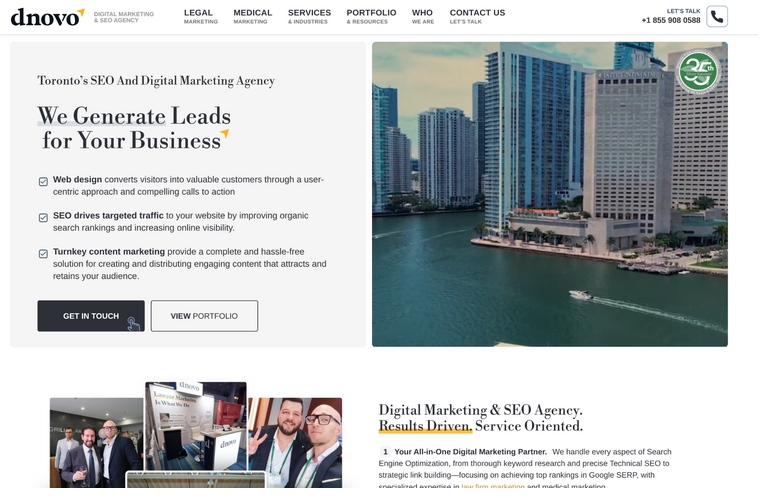
dNovo Group is a Toronto-based boutique agency founded in 2011, built around legal and healthcare marketing. They cover SEO, Local SEO, AI Search Optimization, Google Ads, web design, and content marketing for law firms and medical practices across personal injury, criminal defense, immigration, family law, and more. What sets them apart is the fully in-house team structure. Every campaign is built and managed internally, which means accountability stays in one place and results don't get lost between vendors.
Why dNovo Group Stands Out for Digital Marketing:
The agency fills a specific gap for law firms and healthcare practices that need a marketing partner who already understands their industry's advertising restrictions and client acquisition dynamics. From what the case study data shows, that kind of sector-specific focus tends to produce results that general agencies struggle to replicate at the same pace.
Summary of Real User Reviews:
dNovo Group holds a 5/5 rating across 66 reviews on Clutch, which is honestly rare at that volume. Clients consistently point to measurable outcomes, including 150% increases in qualified leads and website visitors driven by campaigns and 180% gains in client acquisition. The recognition as a Top SEO, Top Advertising, and Top Web Design company on Clutch, plus a Netty Award nomination, backs up what the client feedback is already saying.

What Does Dialekta Do?
Dialekta is a Montreal-based performance marketing agency founded in 2010, and they've grown considerably since then. They cover SEM, SEO, analytics, conversion rate optimization (CRO), media planning, and business intelligence. What makes them interesting compared to others on this list is their move into traditional media in 2020 and their 2024 acquisition of Varibase, which deepened their data and loyalty marketing capabilities. They serve major Canadian brands including Vidéotron, Bell Media, Intact Insurance, and Desjardins Group (not a small client list by any measure).
Why Dialekta Stands Out for Digital Marketing:
Dialekta addresses a real challenge for mid-to-large businesses that need a single partner to connect digital and traditional media without losing performance accountability across channels. Their data activation work, built out further through the Varibase acquisition, gives clients a clearer picture of how campaigns are actually driving discovery call to signed retainer conversion, not just surface-level impressions.
Summary of Real User Reviews:
Dialekta's industry reputation carries weight, especially the Google recognition as one of six most forward-thinking companies worldwide in Search Innovation. Their client retention rates are reported as among the highest in the Canadian agency market, which suggests the results are holding up long after the initial campaign launch. Multiple Infopresse awards round out a track record that's hard to ignore for enterprise-level marketing buyers.
What Does Major Tom Do?
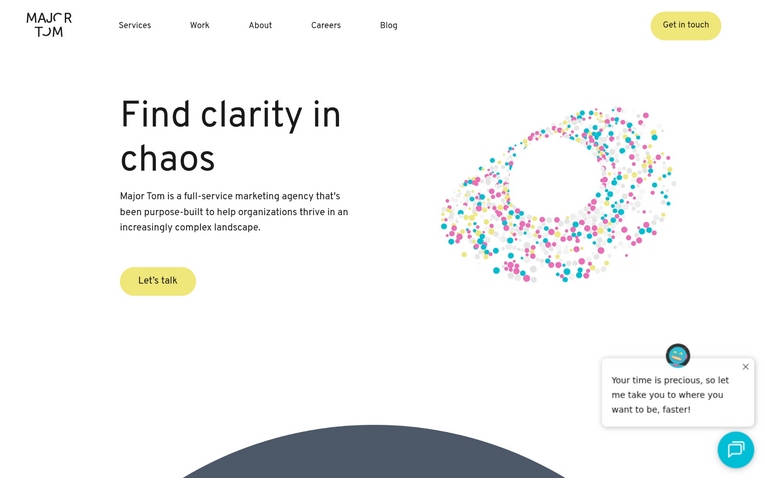
Major Tom is a Vancouver-based full-service agency formed in 2018 through the merger of 6S Marketing and Drive Digital, two respected names in Canadian digital marketing. They cover strategy consulting, web development, creative design, SEO, paid media, ecommerce, social media, content marketing, and marketing automation. Think of them as a shop that can take a brand from broad strategy all the way through to live campaign execution. Their client list includes PepsiCo, SAP, and DoorDash, which shows they can operate at serious scale.
Why Major Tom Stands Out for Digital Marketing:
The agency solves a specific problem for growing businesses that need strategy and execution under one roof, without bouncing between a consulting firm and a production agency. That merger background means their teams are genuinely skilled at both the planning side and the technical delivery, which is a combination that's harder to find than it sounds.
Summary of Real User Reviews:
Major Tom has earned recognition through the Canadian Search Awards for ecommerce work, which points to real performance in a competitive category. The combined heritage of two established agencies gives them a credibility base that newer firms can't replicate overnight. And honestly, the strength of their client portfolio across major global brands says a lot about the trust they've built with marketing buyers at scale.
What Does Kinex Media Do?
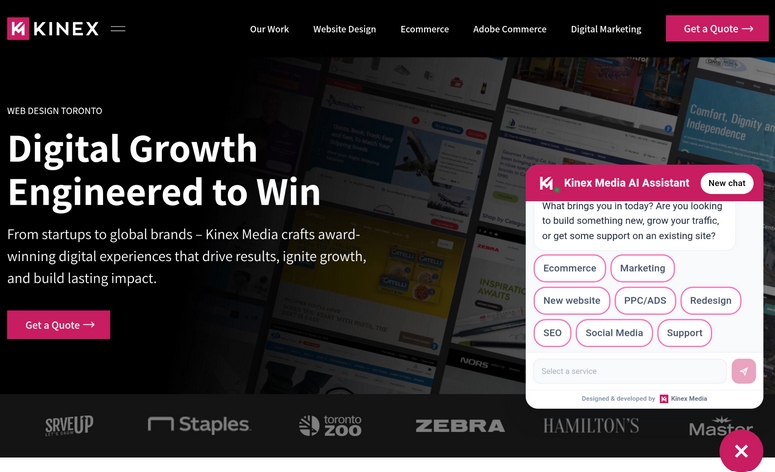
Kinex Media is a Mississauga-based agency founded in 2008, giving them over 15 years of active work in the digital space. They focus on website design and development, Magento ecommerce, SEO, SEM, and print services. What stands out about their approach is the experiment-driven model. Rather than applying a standard playbook, they test strategies on a per-client basis and adjust based on what the data shows. They've worked with more than 2,000 businesses, from early-stage startups to Fortune 500 companies (not a small range by any measure).
Why Kinex Media Stands Out for Digital Marketing:
Kinex Media addresses the frustration businesses face when agencies apply cookie-cutter strategies regardless of industry or business model. Their testing-first mindset means campaigns are shaped by actual performance signals, not assumptions carried over from a previous client in a different vertical.
Summary of Real User Reviews:
The Globe and Mail named Kinex Media one of Canada's top companies for multiple consecutive years, and they ranked #298 on The Americas' Fastest Growing Companies list in 2023. Clutch also places them among Toronto's top web design and development firms. That kind of consistent external recognition across different platforms suggests the client experience is holding up well beyond just the initial project launch.
What Does Marvel Marketing Do?
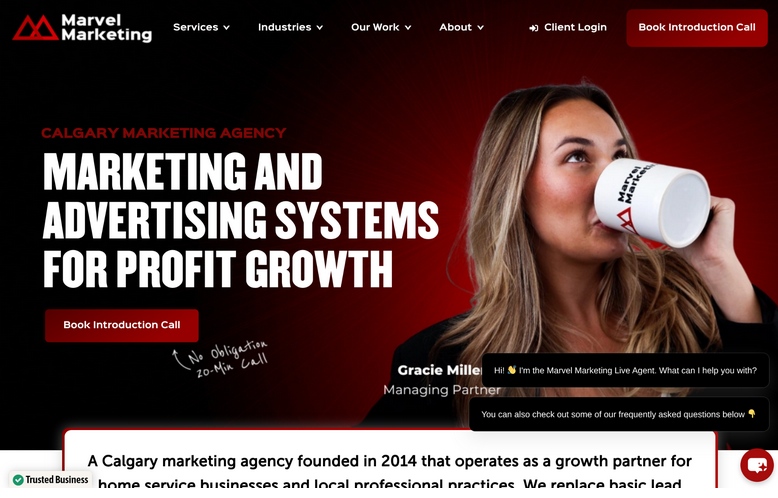
Marvel Marketing is a Calgary-based full-service agency founded in 2014, with offices in Toronto and Vancouver. They cover web design, SEO, social media marketing, PPC, content strategy, brand development, ecommerce, local SEO, and email marketing. They work across B2B, legal, real estate, automotive, franchise, trades, healthcare, and sports sectors. The thing that makes them genuinely different is their "NO RESULTS, NO PAYMENT" guarantee combined with a strict limit of three new clients per month. That kind of intentional capacity cap is rare and signals they're serious about delivering, not just scaling.
Why Marvel Marketing Stands Out for Digital Marketing:
Marvel Marketing directly addresses the anxiety businesses feel when signing long-term agency contracts without knowing if results will follow. Their human-in-the-loop execution model (no reliance on public AI models for strategic decisions) combined with SOC-2 and GDPR data compliance builds trust with clients in regulated industries who can't afford data handling mistakes.
Summary of Real User Reviews:
Detailed third-party review data for Marvel Marketing isn't as widely published as some other agencies on this list, so drawing direct comparisons is harder. That said, their model speaks for itself. The combination of a results-backed guarantee and deliberate client limits suggests a team that would rather do fewer things exceptionally well than take on volume at the expense of quality.
The starting point was a broad sweep of agencies operating across Canada, pulled from directories like Clutch, UpCity, agency-specific review platforms, and Google Business listings. The goal at this stage was building a wide longlist, not filtering yet. Agencies were flagged based on their presence in Canadian markets, the range of digital marketing services listed on their official sites, and whether they had any documented client history.
From that longlist, agencies without verifiable client results or independently published review records were set aside. The shortlisting process focused on identifying patterns across multiple signals: Were the reviews consistent? Did the agency's stated services match what clients actually described receiving? Agencies with thin public footprints or unverified claims were removed before deeper evaluation began.
Each agency's website claims were cross-referenced against third-party sources. If a firm claimed a specific award or recognition, that recognition was confirmed through the awarding organization's published records. Case study numbers (such as percentage increases in client acquisition or campaign performance improvements) were checked against what was publicly available on Clutch profiles and the agencies' own published materials. Claims that couldn't be traced to a source were discounted in the scoring.
Beyond standard service verification, each agency was assessed for its broader standing in the industry. This included award histories, mentions in recognized Canadian business publications, Google Partner or platform certifications, and any original research or published commentary the agency had produced. Recognition from credible external sources (like Google's global Search Innovation ranking for Dialekta or Globe and Mail top-company recognition for Kinex Media) added weight to an agency's overall assessment.
The final layer focused on digital marketing depth. Each agency needed dedicated, clearly defined service pages (not just a general "digital marketing" label), verified client reviews that referenced specific campaign types and measurable outcomes, and case studies that demonstrated performance across relevant channels. Agencies that only operated in one narrow service area without broader digital marketing capabilities were excluded from the final list, keeping the focus on firms that can genuinely support a business's full marketing needs.
Choosing an agency isn't just about who has the best website. The right fit depends on how well their strengths line up with what your business actually needs right now.
Here's what to look at before signing anything:
Canada has no shortage of digital marketing agencies, but the ones worth your budget share a few things in common: real industry experience, honest reporting, and results you can trace back to actual campaigns. Whether you need niche legal marketing like dNovo Group offers, enterprise-level performance work like Dialekta delivers, or a full-service setup like Major Tom provides, the best agency is the one built for your specific business stage and goals.
The National Crowdfunding & Fintech Association (NCFA Canada) is a financial innovation ecosystem that provides education, market intelligence, industry stewardship, networking and funding opportunities and services to thousands of community members and works closely with industry, government, partners and affiliates to create a vibrant and innovative fintech and funding industry in Canada. Decentralized and distributed, NCFA is engaged with global stakeholders and helps incubate projects and investment in fintech, alternative finance, crowdfunding, peer-to-peer finance, payments, digital assets and tokens, artificial intelligence, blockchain, cryptocurrency, regtech, and insurtech sectors. Join Canada's Fintech & Funding Community today FREE! Or become a contributing member and get perks. For more information, please visit: www.ncfacanada.org
| | |
|---|---|---|
| | |
May 27, 2026 | NCFA Market Activity | Funding, Risk Compliance And Regtech, Banking And Credit Infrastructure

On May 20, 2026, Toronto based Quantum Bridge Technologies announced a USD $8M Series A round to expand its quantum safe cybersecurity business for financial institutions, telecom networks, governments, and defence organizations. The University of Toronto spinout says the financing brings its total funding to USD $16M.
Quantum Bridge’s DSKE technology helps organizations create, distribute, and manage symmetric keys across existing networks. The company says customers can add the system across current vendors, security layers, and network environments without replacing core infrastructure.
The timing makes sense given that NIST released its first three post quantum encryption standards in August 2024 and urged system administrators to start moving to the new standards. In Canada, the Cyber Centre’s post quantum migration roadmap gives federal departments a planning model for transitioning non classified IT systems to post quantum cryptography.
Canada has strong, award winning quantum researchers. Buyers need tools they can audit and apply to real networks at scale. Quantum Bridge is actively pitching that to the market directly, and not asking customers to wait for a future quantum event. It's selling a migration solution for institutions that already manage long lived data, critical communications, and regulated infrastructure.
That connects directly to fintech. Payments, digital identity, custody, banking APIs, cloud security, and customer data protection all rely on cryptography. Infrastructure teams are in need of cryptographic agility before regulatory pressure and vendor bottlenecks make upgrades harder.
The Series A gives Quantum Bridge more room to sell into high trust markets where procurement takes time and credibility counts. The investor group also tells a useful story. The round brings together venture capital, telecom exposure, enterprise technology, and cross border capital. That mix fits a company selling security infrastructure into finance, telecom, government, and defence.
Mattia Montagna, Co Founder and CEO, Quantum Bridge Technologies:
“National security can’t wait for perfect conditions. We build quantum-safe systems that work inside real networks today — systems designed to keep protecting sovereign communications as the threat landscape evolves. This funding means we can meet more organizations where they are, and get them protected faster.”
Quantum Bridge’s financing shows where Canadian quantum policy needs to support execution. Canada should help qualified domestic firms prove their systems inside critical sectors before global buyers define the market without us.
The National Crowdfunding & Fintech Association (NCFA Canada) is a financial innovation ecosystem that provides education, market intelligence, industry stewardship, networking and funding opportunities and services to thousands of community members and works closely with industry, government, partners and affiliates to create a vibrant and innovative fintech and funding industry in Canada. Decentralized and distributed, NCFA is engaged with global stakeholders and helps incubate projects and investment in fintech, alternative finance, crowdfunding, peer-to-peer finance, payments, digital assets and tokens, artificial intelligence, blockchain, cryptocurrency, regtech, and insurtech sectors. Join Canada's Fintech & Funding Community today FREE! Or become a contributing member and get perks. For more information, please visit: www.ncfacanada.org
| | |
|---|---|---|
| | |



August 26th, 2025

January 4th, 2024

June 1st, 2021

September 9th, 2020

July 9th, 2018

January 3rd, 2018

September 25th, 2017

June 20th, 2017

May 10th, 2017

December 14th, 2016
