





Karsten Wenzlaff, Advisor
August 26th, 2025
Karsten Wenzlaff is a Crowdfunding and Fintech Expert from Germany. He is Secretary-General of Digit[...]


June 23, 2026 | NCFA Fintech Market Activity | SME Finance And Business Banking, Payments And Money Movement, Fintech And Innovation

On June 18, 2026, EQ Bank launched the EQ Bank Business Card, a reloadable prepaid Mastercard for Canadian small business owners that adds business spending tools to its digital Business Banking suite. For EQ Bank, the card turns the Business Account from a place to hold cash into something owners can use every day.
The product (unavailable in Quebec) offers:
The card extends EQ Bank’s Business Banking platform, which launched in October 2025 with a fully digital Business Account, Business GICs, free everyday transactions, up to 10 sub accounts, and Canada based customer support.
The new card connects to the Business Account and gives owners a real time view of balances and transactions. EQ Bank is trying to turn business banking into a working cash management service, not just a place to hold deposits.
Dan Broten, SVP and Head of EQ Bank:
“Canadian small businesses and entrepreneurs are managing so much in real time, from cash flow and payments to expenses and savings - and their banking needs to keep pace with the demands they're navigating.”
A prepaid business card works differently from a credit card. EQ Bank is targeting owners who want control over spend, access to existing funds, and value on balances without taking on credit checks, paperwork, monthly fees, or annual fees.
The cashback threshold signals the intended user. A business spending at least $10,000 per month is likely focused on cash flow, foreign exchange costs, and financial control rather than rewards alone.
For Canadian SMEs still dealing with high fees, credit friction, cash flow pressure, and fragmented digital workflows, the card is aligned with the push for better banking options for Canadian SMEs.
Loop and EQ Bank launched a multi currency SME credit card to help Canadian businesses manage cross border transactions.
Float’s SME banking research highlighted high fees, credit friction, and outdated financial systems as barriers for Canadian small businesses.
Canadian SME loan competition is under review as debt financing remains concentrated among incumbent financial institutions.
EQB’s PC Financial acquisition shows how the bank continues expanding its consumer banking and payments footprint.
NCFA’s Financial Innovation Map tracks SME finance and business banking opportunities, including cash management, approvals, forecasting, and liquidity gaps.
If EQ Bank can turn deposits, spending, interest, cashback, foreign exchange, and account visibility into one simple workflow, it may strengthen its claim as a challenger option for Canadian small businesses. The advantage wouldn't come from the new card, but from making daily business money management less fragmented.
The tension is that SME financial workflows are messy. Owners still rely on multiple tools for accounting, payroll, lending, payments, and reporting. A better card helps, but the bigger market question is whether digital banks can become the primary financial operating system for Canadian SMEs or whether specialized fintech tools keep owning the workflow around the bank account.
If Canadian SMEs can earn interest, spend, manage cash, and avoid fees from one digital banking stack, what else must a challenger bank add before it becomes the primary operating account?
 The National Crowdfunding & Fintech Association (NCFA Canada) is a financial innovation ecosystem that provides education, market intelligence, industry stewardship, networking and funding opportunities and services to thousands of community members and works closely with industry, government, partners and affiliates to create a vibrant and innovative fintech and funding industry in Canada. Decentralized and distributed, NCFA is engaged with global stakeholders and helps incubate projects and investment in fintech, alternative finance, crowdfunding, peer-to-peer finance, payments, digital assets and tokens, artificial intelligence, blockchain, cryptocurrency, regtech, and insurtech sectors. Join Canada's Fintech & Funding Community today FREE! Or become a contributing member and get perks. For more information, please visit: www.ncfacanada.org
 |  |  |
|---|---|---|
 |  |  |
June 23, 2026 | NCFA Fintech Market Activity | Capital Markets And Funding, SME Finance And Business Banking, Regulation And Policy

On June 22, 2026, Minister Rechie Valdez announced $173.7 million in renewed funding for the Women Entrepreneurship Strategy. The funding supports women entrepreneurs across Canada through the Women Entrepreneurship Loan Fund, the WES Ecosystem Fund, the Women Entrepreneurship Knowledge Hub, and program operations.
Capital gaps only disappear when financing, networks, and support actually reach the founders who face the gaps. The announcement isn't just another program renewal. It shows that Ottawa still sees access to capital, networks, data, and growth support for women entrepreneurs as an active market gap rather than a solved policy file.
The new funding includes $59 million for the Women Entrepreneurship Loan Fund, which supports partner organizations delivering loans of up to $50,000 to women business owners and entrepreneurs. It also includes $100 million for the WES Ecosystem Fund, $7 million for the Women Entrepreneurship Knowledge Hub, and nearly $8 million over five years for program operations.
The Loan Fund has already delivered more than 1,600 loans through partner organizations. Since its 2018 launch, the broader WES initiative has supported more than 500,000 women entrepreneurs. The federal WES program page also notes that only 17.8% of Canadian small and medium sized businesses are owned by women.
Those numbers give the announcement its real weight. The funding isn't meant to be only a social inclusion measure. It's capital infrastructure for a founder segment still underrepresented in business ownership, financing access, and growth networks.
Minister Valdez said women entrepreneurs “create jobs, strengthen communities and contribute to a Canada that is strong for everyone.” That is the public message. The operating issue is more specific: growth requires more than a loan.
Women founders need access to credit, but they also need buyers, mentors, procurement routes, export support, investor relationships, and data that helps programs see what is working. That's why the WES package includes ecosystem funding and the Women Entrepreneurship Knowledge Hub alongside loan capital.
This connects directly to NCFA’s long running focus on women partners, women entrepreneurs, and capital access. When women are missing from capital decision making, financing gaps can persist even when the quality of founders isn't the problem.
BDC launched a $250 million inclusive entrepreneurship initiative to support entrepreneurs facing systemic barriers, including women, Indigenous, and Black led firms.
Canada renewed the $189 million Black Entrepreneurship Program as a separate targeted initiative for Black entrepreneurs and Black owned businesses.
BKR Capital raised a $20 million first close for Black Innovation Fund II, targeting a $50 million final close.
J.P. Morgan’s women powered business report showed rising women led growth companies, equity investment, exits, and crowdfunding activity in the U.K.
Research on female entrepreneurship has long pointed to financial capital, human capital, and network access as connected growth constraints.
If WES funding reaches women entrepreneurs with real growth potential, the payoff may go beyond business starts. It could strengthen regional innovation pipelines, improve founder diversity in high growth sectors, and give more women led companies access to the networks they need to scale.
The challenge is execution. Loan capital can help, but it doesn't automatically solve procurement access, export readiness, investor networks, revenue growth, or later stage financing. The strongest test is whether renewed WES funding helps more women owned businesses move from support programs into durable commercial growth.
If targeted entrepreneurship funding continues, how should Canada measure whether women founders are gaining growth capital, not just program access?
The National Crowdfunding & Fintech Association (NCFA Canada) is a financial innovation ecosystem that provides education, market intelligence, industry stewardship, networking and funding opportunities and services to thousands of community members and works closely with industry, government, partners and affiliates to create a vibrant and innovative fintech and funding industry in Canada. Decentralized and distributed, NCFA is engaged with global stakeholders and helps incubate projects and investment in fintech, alternative finance, crowdfunding, peer-to-peer finance, payments, digital assets and tokens, artificial intelligence, blockchain, cryptocurrency, regtech, and insurtech sectors. Join Canada's Fintech & Funding Community today FREE! Or become a contributing member and get perks. For more information, please visit: www.ncfacanada.org
| | |
|---|---|---|
| | |
Jun 22, 2026

Retail distribution networks use systems for transportation and storage to move products from manufacturers to consumers. Organizations that grow across different regions require the ability to manage large amounts of inventory. Shipping containers are central to this process because they are a standardized and reliable tool for moving goods through the supply chain.
Logistics for retailers are different now because containers are efficient plus require less manual handling - these units are versatile, which allows businesses to transport and store products with consistency across ships, trains and trucks.
Shipping containers are efficient because they create a uniform system for moving goods. Workers can transfer containers between different vehicles without unloading the products - this process is direct, which reduces delays but also limits the chance that items will break.
Moving many goods in one container is a way to manage costs. Retailers combine shipments to fill the available space - this practice reduces total expenses and helps products arrive at distribution centers at the correct time.
Shipping containers are scalable solutions for retailers that are growing. Businesses increase their capacity - adding more containers as demand rises - this allows for growth without the need for large investments in permanent buildings.
Some companies go to buy used shipping container Vancouver to expand their capabilities - this choice is an affordable way to grow while keeping logistics flexible. Owners can place containers in specific locations to meet new inventory needs.
Moving inventory successfully is a requirement for retail operations. Shipping containers allow businesses to move large quantities of merchandise to warehouses and stores in an organized way. Regular schedules are easier to maintain when products are available.
Handling inventory is simpler when using containers - Products stay together in one unit until they reach their destination - this method removes unnecessary steps as well as helps retailers process shipments with speed and accuracy.
Shipping containers are useful for storage within retail networks. They serve as units for inventory that is waiting for distribution for short or long periods - this flexibility allows businesses to manage changes in consumer demand without building larger warehouses.
Organizations often choose to purchase shipping containers to create more storage space near their facilities - these units are a practical way to hold extra inventory while keeping the products easy to access.
Reliable supply chains are possible when the movement of cargo is secure. Shipping containers are made of strong materials that protect products from weather, theft and impact - these units provide a controlled environment for goods that travel long distances.
Predictability is better when distribution networks use standardized containers. Retailers can coordinate with transportation providers or warehouses more easily when everyone uses the same system. Consistency reduces interruptions and helps deliveries arrive on time.
Distribution centers are more productive when they buy shipping container. Receiving is simpler because shipments arrive in organized units. Personnel at the warehouse can unload and sort products quickly when the inventory is structured.
Space is used better within a facility when shipments are in containers. Goods move through the building with fewer steps - this efficiency leads to faster order fulfillment next to higher productivity for the warehouse.
Modern distribution networks use technology to improve how they monitor goods. Shipping containers can have tracking devices and sensors that provide information about their location and status - this data helps retailers make decisions plus fix problems quickly.
Managing inventory is more effective when technology is part of the container system. Retailers see where containers are in the supply chain, which leads to better planning and accurate delivery times. Visibility is helpful for operational performance and customer service.
Shipping containers are important for retail distribution because they support transportation, storage but also inventory movement. Their design helps retailers simplify logistics while reducing costs - these units are a significant tool for businesses that want to improve their operations and meet the needs of their customers.
The National Crowdfunding & Fintech Association (NCFA Canada) is a financial innovation ecosystem that provides education, market intelligence, industry stewardship, networking and funding opportunities and services to thousands of community members and works closely with industry, government, partners and affiliates to create a vibrant and innovative fintech and funding industry in Canada. Decentralized and distributed, NCFA is engaged with global stakeholders and helps incubate projects and investment in fintech, alternative finance, crowdfunding, peer-to-peer finance, payments, digital assets and tokens, artificial intelligence, blockchain, cryptocurrency, regtech, and insurtech sectors. Join Canada's Fintech & Funding Community today FREE! Or become a contributing member and get perks. For more information, please visit: www.ncfacanada.org
| | |
|---|---|---|
| | |
Jun 14, 2026

Family-owned businesses across Canada offer a strong opportunity for entrepreneurs because many are already profitable, trusted locally, and ready for ownership transition. Instead of starting from zero, buyers can acquire an established business with customers, staff, systems, and reputation already in place, especially as more owners consider retirement or succession.
Family-owned businesses play an important role in Canada’s economy. They often operate in local communities for years or even decades, serving loyal customers and building strong reputations through consistent service and personal relationships. Many are owner-operated businesses where trust, reliability, and long-term commitment matter just as much as the products or services they provide.
For buyers, this creates a significant advantage. A family-owned company in Canada may already have an established customer base, experienced employees, dependable supplier relationships, equipment, and stable revenue. It may also benefit from a recognizable local brand and years of goodwill within the community. These are valuable assets that usually take considerable time and investment to develop from scratch.
For entrepreneurs researching acquisition opportunities, Canadian business for sale on Yescapo can be a useful starting point for finding established companies with existing operations, customer relationships, and market history. Instead of buying only physical assets, buyers gain access to business knowledge, working systems, and relationships that have often been built over generations.
This is particularly important in industries where reputation drives success. Local retailers, construction companies, restaurants, service providers, and manufacturing businesses often rely on repeat customers and word-of-mouth referrals. A well-established family business may therefore offer a competitive position that would be difficult and expensive for a new startup to achieve.
One of the biggest opportunities in Canadian family businesses comes from succession. Thousands of owners are approaching retirement after spending decades building successful companies, yet many do not have family members interested in continuing the business. Children may choose different careers, relocate, or simply prefer not to take on the responsibilities of ownership.
As a result, many profitable businesses enter the market despite having healthy financial performance and loyal customers. They are being sold not because they are struggling, but because the owner wants to retire, reduce day-to-day responsibilities, or ensure the company continues under new leadership.
For entrepreneurs, this creates a unique entry point into business ownership in Canada. Buying a family-owned business with established operations can provide immediate access to customers, revenue, trained staff, and existing systems while avoiding many of the challenges involved in launching a company from zero.
Understanding the seller’s motivation is an important part of the process. In succession transactions, owners often care deeply about preserving the company’s reputation, protecting employees, and maintaining relationships with long-standing customers and suppliers. Buyers who respect that legacy and present a clear plan for the future may find it easier to negotiate a successful acquisition and ensure a smoother transition after the sale.
Starting a new company usually means building everything from the ground up. The founder must test demand, find customers, create systems, hire staff, develop supplier relationships, and survive the early stage when cash flow is uncertain.
Buying a family business in Canada offers a different path. The buyer can study real financial records, customer history, contracts, equipment, employee structure, and market position before making a decision. This makes the process more practical and less based on assumptions.
A startup may offer full creative freedom, but it also carries higher uncertainty. A family business may come with older systems or traditional ways of working, but it also provides an existing customer base and proven business model.
For many buyers, the question is simple: why build market trust from zero when an established business for sale in Canada may already have it?
Family businesses are often attractive because they are built around long-term relationships. Many have repeat customers, local recognition, supplier trust, and employees who understand the business well. This can make the transition easier for a new owner.
Another advantage is stability. Many Canadian family businesses operate in practical sectors such as trades, retail, food, manufacturing, distribution, professional services, hospitality, and local services. These businesses often solve everyday needs rather than depend on trends.
A buyer may also find hidden growth potential. Some family businesses are profitable but underdeveloped digitally. They may have weak websites, limited social media, no online booking, outdated branding, or little paid advertising. A new owner can modernize the business without changing its core.
This is why many investors search for profitable businesses for sale Canada listings. They want companies that already work, but still have room to grow.
Family-owned businesses can be found across many industries and provinces. Some operate in large cities such as Toronto, Vancouver, Calgary, Montreal, and Ottawa. Others are based in smaller communities where local trust is especially important.
Common examples include restaurants, cafés, bakeries, convenience stores for sale, construction companies, repair shops, cleaning businesses, accounting firms, dental or wellness clinics, manufacturing companies, logistics businesses, landscaping companies, and specialty retail stores.
Buyers often look for businesses that are simple to understand and have steady demand. A local business for sale Canada opportunity may be attractive if it has repeat customers, reliable employees, clean financial records, and clear room for improvement.
Businesses with recurring revenue can be especially valuable. Examples include maintenance companies, B2B services, subscription-based services, commercial cleaning, bookkeeping, and companies with long-term contracts.
Retiring business owners are one of the main reasons family business transition is becoming important in Canada. Many owners have strong companies but no clear successor. They may be ready to step back, but they do not want the business to disappear.
This can create a more flexible acquisition process. Some sellers may agree to stay involved during a transition period, introduce the buyer to customers and suppliers, and train the new owner. This helps protect business continuity.
For buyers, this is valuable because the seller’s knowledge is often one of the most important assets in a family business. Understanding customer relationships, staff dynamics, supplier terms, and daily operations can reduce risk after the sale.
A good transition plan can make the difference between a smooth acquisition and a difficult one. The best deals usually include clear handover support, communication with employees, and a plan for preserving customer trust.
Before buying a family-owned business, due diligence is essential. The buyer should review financial statements, tax records, revenue trends, profit margins, debts, leases, supplier agreements, employee contracts, equipment, inventory, licences, customer concentration, and legal issues.
It is also important to understand how dependent the business is on the current owner. Some family businesses rely heavily on the founder’s personal relationships. If customers only trust the owner, revenue may fall after the sale unless the transition is handled carefully.
A buyer should also check whether family members work in the business and what will happen after the acquisition. Staff roles, responsibilities, salaries, and expectations should be clear before the deal is completed.
Buying an established business in Canada can be a strong opportunity, but only if the buyer understands the real numbers, the risks, and the operational structure.
Many family businesses have strong foundations but outdated systems. A new owner can often grow the company by improving marketing, technology, pricing, customer service, and operations.
For example, a local service company may have loyal customers but no strong online presence. A buyer could improve the website, SEO, Google Business Profile, paid ads, online reviews, and booking systems. These changes can increase leads without changing the core service.
A retail business might benefit from e-commerce, better inventory management, updated branding, or stronger social media. A B2B company could grow by improving sales processes, customer follow-up, and recurring contracts.
The opportunity is not always about changing the business completely. Often, it is about keeping what works and modernizing what holds the company back.
Many buyers assume they need the full purchase price in cash, but business acquisition Canada deals can be structured in several ways. Buyers may use personal savings, bank financing, investor capital, seller financing, or a combination of these.
Seller financing can be especially relevant in family business succession. This means the seller allows the buyer to pay part of the price over time. It may help the buyer complete the deal and give the seller confidence that the new owner is committed to the business.
Some deals also include an earn-out, where part of the final payment depends on future performance. This can be useful when the seller and buyer need to bridge a valuation gap.
Clean financial records make financing easier. A profitable small business Canada opportunity with strong documentation is usually more attractive to lenders and investors than a business with unclear accounts.
Family businesses can be excellent acquisitions, but they are not risk-free. Some may have outdated systems, informal agreements, weak financial reporting, or operations that depend too much on the founder.
There may also be emotional complexity. A family business is often personal to the seller. Decisions about employees, branding, customers, and legacy may matter deeply. Buyers need to handle the process with respect and clarity.
Another risk is hidden underinvestment. Some owners delay upgrades before selling. Equipment, premises, technology, or staffing may need improvement after acquisition. Buyers should factor these costs into the purchase price.
The best approach is practical: verify the numbers, understand the people, check the contracts, and plan the transition carefully.
Buying a family-owned business in Canada can be a strong strategy for entrepreneurs who want an established company rather than a startup. It offers access to customers, revenue, staff, systems, and local reputation from the beginning.
This strategy is especially attractive for buyers who are good at operations, marketing, modernization, and relationship management. They can take a business that already works and make it stronger.
However, it is not the right path for everyone. Buyers need patience, due diligence, capital, and the ability to manage people and change. A family business may be established, but it still needs leadership.
For the right buyer, Canadian family businesses can offer one of the most practical routes into entrepreneurship through acquisition.
The hidden opportunity in family-owned businesses across Canada lies in the gap between retiring owners and entrepreneurs looking for established companies. Many of these businesses have customers, revenue, employees, reputation, and operational history already in place.
Instead of starting from zero, buyers can acquire a profitable local company and improve it through better marketing, stronger systems, digital tools, and modern management. The opportunity is not only to buy a business, but to continue its legacy and unlock its next stage of growth.
For entrepreneurs searching for Canadian business opportunities, family-owned businesses may be one of the most overlooked paths to ownership.
They often have loyal customers, local reputation, proven operations, trained employees, and steady revenue. This gives buyers a stronger starting point than launching a new company.
Business succession is the process of transferring ownership from the current owner to a new owner. In family businesses, this often happens when the founder retires or no family member wants to take over.
Buying can be better if the buyer wants existing customers, cash flow, and a proven business model. Starting may be better for someone with a unique idea or limited acquisition capital.
You should check financial records, tax documents, debts, leases, supplier agreements, employee contracts, customer concentration, licences, equipment, and how dependent the business is on the current owner.
Yes. Buyers may use personal funds, bank loans, investor capital, seller financing, or earn-out structures. Clean financial records usually make financing easier.
Common examples include restaurants, cafés, retail stores, construction companies, cleaning businesses, clinics, manufacturing companies, repair shops, logistics businesses, and local service companies.
The National Crowdfunding & Fintech Association (NCFA Canada) is a financial innovation ecosystem that provides education, market intelligence, industry stewardship, networking and funding opportunities and services to thousands of community members and works closely with industry, government, partners and affiliates to create a vibrant and innovative fintech and funding industry in Canada. Decentralized and distributed, NCFA is engaged with global stakeholders and helps incubate projects and investment in fintech, alternative finance, crowdfunding, peer-to-peer finance, payments, digital assets and tokens, artificial intelligence, blockchain, cryptocurrency, regtech, and insurtech sectors. Join Canada's Fintech & Funding Community today FREE! Or become a contributing member and get perks. For more information, please visit: www.ncfacanada.org
| | |
|---|---|---|
| | |
June 11, 2026 | NCFA Story Intelligence | Payments And Market Infrastructure

On June 3, 2026, Payments Canada announced that 15 organizations had joined its membership in 2026 following expanded eligibility rules. The latest intake included Beem Credit Union, Ebury Partners Canada, Shaype, Libro Credit Union, and Newton. Earlier additions included Wise Payments Canada, Float, KOHO, Neo Financial, Paramount Commerce, Brim, Meridian Credit Union, Tru Cooperative Bank, DoBusiness.com, and other newly eligible participants.
The membership announcement is the latest chapter, not the whole story. The story is how Canada moves from a tightly controlled payments model toward wider participation in the infrastructure that moves money, shapes competition, influences product design, and affects the choices available to consumers and businesses.
Canada builds its payments foundation around safety and trust.1 The Canadian Payments Association is created in 1980 under what is now the Canadian Payments Act. Payments Canada now owns and operates national payment systems including Lynx and the Automated Clearing Settlement System. The design reflects a clear priority: money movement is critical infrastructure, and critical infrastructure has to be reliable.
For a long time, that model works well enough for most people. Consumers trust their banks. Businesses use established payment tools. Settlement happens in the background. Most Canadians never need to think about who has direct access to the rails because the system mostly shows up as cards, transfers, bill payments, payroll, and cheques.
The market changes faster than the rails. Digital commerce grows. Mobile payments spread. Online transfers become a daily habit. Payments Canada’s 2025 trends report says Canada processed 22.5 billion retail payment transactions worth $12.2 trillion in 2024, with digital payments representing 86% of transaction volume.2
Fintechs start building around systems they can’t fully access. KOHO, Neo Financial, Float, Wise Payments Canada, Paramount Commerce, Brim, and Newton grow because customers want simpler financial products. The problem isn’t demand. The problem is that many new firms still depend on infrastructure controlled by others.
Competition becomes the pressure point. Critics of Canada’s payments model argue that control by a small number of large institutions has contributed to high fees, delay, and limited competition. Reuters reported this criticism when the Bank of Canada began payment service provider registration under the Retail Payment Activities Act.3
The fintech argument becomes practical. If firms outside the largest banks can’t connect on fair terms, they often need intermediaries, workarounds, sponsorship relationships, or slower product paths. That affects costs, margins, speed to market, and the ability to challenge incumbents with better consumer and business experiences.
Ottawa starts changing the legal frame. Finance Canada says amendments to the Canadian Payments Act made on June 20, 2024 expand Payments Canada membership eligibility to Bank of Canada supervised payment service providers, credit union locals that are part of a credit union central, and designated clearing and settlement system operators.4
The Bank of Canada brings PSPs into supervision. Under the Retail Payment Activities Act, the Bank registers and supervises payment service providers and focuses on operational risk, incident response, safeguarding end user funds, and reporting. As of September 8, 2025, PSPs must have risk management and funds safeguarding frameworks in place.5
Real Time Rail becomes the execution test. Payments Canada says the Real Time Rail is planned for launch in Q4 2026 and will support instant, data rich payments through a new exchange, clearing, and settlement system.6 The promise is simple: money should move faster, carry better data, and support new products.
The delays create frustration because the opportunity is real. Payments Canada selected Interac as the exchange solution provider in 2021, when the system was expected to launch in 2022.7 NCFA has tracked the execution question through RTR delay coverage and RTR productivity analysis.
The first wave of PSP members makes the policy visible. Payments Canada welcomes Wise Payments Canada, Float, KOHO, Paramount Commerce, and Brim as new payment service provider members in January 2026.8 NCFA tracks that moment when Payments Canada admits five new PSPs.
Membership is not only about access to rails. Payments Canada’s by law changes update membership requirements and support new eligible members as Canadian Payments Act amendments come into force.11 Membership gives new firms a closer role in the rules, standards, and modernization discussions that shape the system.
That changes the politics of infrastructure. A fintech that has to build around the system is one kind of participant. A fintech that can join, comply, learn the rules, and contribute to modernization discussions is another. The same applies to credit unions, FX firms, and other payment providers that want a role in Canada’s next financial infrastructure chapter.
Consumer driven banking brings the same access debate to financial data. Finance Canada says the framework is meant to let Canadians securely access and share financial data with financial service providers, without fees for accessing and sharing that data, while reducing reliance on risky practices such as screen scraping.12 The Bank of Canada says it will administer the framework so Canadians and businesses can securely share financial data with approved providers of their choice.13
But the friction does not disappear just because the law changes. Tier one banks, fintechs, data aggregators, and policymakers still have to work through scope, liability, accreditation, implementation timelines, commercial terms, and API performance. NCFA’s open banking commercialization roadmap frames the next phase as real API usage, accreditation, liability, and business model design, not just a policy announcement.
Stablecoins pull the payments debate into digital money. Bill C 15 gives Canada a legal framework for stablecoins and consumer driven banking, moving both into the financial policy stack. NCFA framed that moment in Bill C 15 gives Canada a digital finance framework.
The payment infrastructure question is no longer only about bank rails. Stablecoins, payment service providers, RTR, consumer driven banking, and Bank of Canada oversight are starting to occupy the same policy conversation. NCFA’s question post on stablecoins as payment infrastructure shows why digital money now belongs in the same access debate.
Canada’s payments story now connects directly to productivity. The Bank of Canada has warned that weak productivity threatens living standards, and NCFA has linked payments modernization to execution, competitiveness, and growth. Faster settlement, better data, lower friction, and more competition are not abstract infrastructure benefits. They affect how firms operate every day.
Cross border capability becomes part of the same test. Canada’s payment system cannot only work well at home. Canadian businesses, newcomers, exporters, marketplaces, and financial platforms also need better global money movement. That is why NCFA’s cross border payments analysis belongs beside RTR, open banking, and stablecoins.
Canada’s payments infrastructure didn’t turn a corner overnight. The change reflects years of modernization work, policy debate, fintech pressure, consumer demand, and the practical reality that a digital economy needs payment systems that are safe, fast, open enough to compete, and trusted enough to scale. The result is a more diverse payments membership base than Canada had a decade ago, with fintechs, PSPs, credit unions, FX firms, and digital finance companies gaining a larger role in the systems that move money.
Opening access isn’t the finish line. It’s the starting point. Canadian fintechs, banks, credit unions, payment providers, regulators, and infrastructure operators now have to prove broader participation can become better financial services. Now is the time to get to work. Launch Real Time Rail, make consumer driven banking usable, widen the tent responsibly, improve domestic and cross border capability, lower friction for merchants and consumers, and connect these reforms to the Canadian Financial Innovation Map and pipeline Canada needs to compete.
Canada's infrastructure modernization is creating new commercial opportunities in Consumer Driven Banking. See NCFA's Open Banking in Canada Opportunity Brief for the evidence trail, product pathways, competitive benchmark and commercialization outlook.
Which part of Canada’s payments story stood out most to you?
Share this story → Explore related intelligence → Subscribe
The National Crowdfunding & Fintech Association (NCFA Canada) is a financial innovation ecosystem that provides education, market intelligence, industry stewardship, networking and funding opportunities and services to thousands of community members and works closely with industry, government, partners and affiliates to create a vibrant and innovative fintech and funding industry in Canada. Decentralized and distributed, NCFA is engaged with global stakeholders and helps incubate projects and investment in fintech, alternative finance, crowdfunding, peer-to-peer finance, payments, digital assets and tokens, artificial intelligence, blockchain, cryptocurrency, regtech, and insurtech sectors. Join Canada's Fintech & Funding Community today FREE! Or become a contributing member and get perks. For more information, please visit: www.ncfacanada.org
| | |
|---|---|---|
| | |
May 20, 2026

Image: Unsplash/Headway
When did you last notice a sponsor banner on day three of a conference? Exactly. Multi-day events have a visibility half-life, and most brand strategies are not built to last beyond it.
The opening session energy is easy to ride. Sustaining brand presence through meals, breakouts, networking gaps, and general event fatigue is a completely different challenge.
Canada brought together close to 2,555 business events in 2025. The organizers who cracked visibility across all of that were doing something most were not. This article is about what that something looks like in practice.
Most event brands live entirely in the eyes. A logo here, a banner there, a branded tote bag everyone leaves behind on day two. The thing is, human memory does not work that way. People remember how a space made them feel far longer than they remember what it looked like.
This is where sensory marketing comes into play. When you own a scent in your registration lounge or a sound identity in your networking space, you are embedding your brand into the attendee's physical experience. Attendees may not consciously register it, but their nervous system does.
Pick one sense your brand can own consistently across all three or four days. A distinct coffee blend at your branded station. A low ambient sound identity in your lounge. Something tactile in your collateral that feels different from everything else on the table.
Consistency is what makes sensory branding stick. One well-chosen detail repeated across every touchpoint will outlast a dozen visually perfect installations that disappear into the background by midday.
Attendees build a mental map of your event space within the first few hours. Anything sitting in the same spot after that becomes part of the furniture. Your brand needs to travel with the crowd, not wait for the crowd to come back to it.
Think about where people already are. Breakfast queues, session transitions, charging corners, and the slow shuffle between keynote and lunch. Place something worth noticing in those pockets, and you are not interrupting anyone.
It does not have to be extravagant. Even something as simple as custom pens can do real work when placed at the right touchpoints across the event floor. Custom pens come in many forms, so think about your audience.
If you want something functional for a tech-forward crowd, business pens with a stylus are worth considering, notes Pens.com. If the setting is more formal, engraved pens would be a safer option.
Beyond that, rotate your brand presence between days. Move the activation, refresh the messaging, change the location. Give attendees something new to stumble into each morning.
A branded photo corner that was near the entrance on day one can migrate to the lunch area on day two. A product display that lived beside registration can reappear near the closing session. Movement creates the illusion of energy. It is this energy that keeps brands alive in people's peripheral attention.
Nobody wakes up on day two of a conference excited to visit a sponsor booth. But they will absolutely walk across a busy event floor to claim a reward or beat a leaderboard.
If your attendees skew younger, this is even more important. Conference News reported that 64% of Gen Z conference attendees actively seek immersive experiences with Instagrammable moments.
Give them a branded scavenger hunt with photo checkpoints. Build a leaderboard that updates in real time on a screen that everyone passes. Create a stamp card that unlocks something worth having at the end of day three.
The rewards do not need to be expensive. They need to feel earned. An exclusive backstage tour, early access to a session, or a branded item not available anywhere else at the event carries more weight than a generic goodie bag. When attendees are chasing something, your brand is what they are chasing.
Most brands show everything they have on day one. Full messaging, complete product story, every value proposition on the table before lunch. By day two, there is nothing left to discover, and attendees have mentally filed your brand away.
Flip that completely. Give attendees a reason to come back by leaving something unresolved on purpose. Day one, plant a question at your branded touchpoint. Something intriguing enough to linger. Day two, offer a piece of context that deepens it without fully answering it. Day three, deliver the payoff.
This borrows directly from the Zeigarnik Effect. It is a well-documented psychological principle showing that the human brain holds onto incomplete information far more stubbornly than resolved ones. An open loop in someone's mind is essentially a reservation your brand has made in their attention.
Practically, this could look like a teaser installation that changes each morning. A branded countdown with no explanation on day one. A partial reveal on day two. The full picture on day three.
Keep it visual, keep it simple, and make sure every element is unmistakably yours. Attendees will start talking about it, and that conversation is free brand visibility, traveling through every corner of your event.
Canada hosted approximately 2,555 business events in 2025, making it one of the busiest markets for professional gatherings in North America.
According to Conference News, 64% of Gen Z conference attendees prioritize immersive, Instagrammable experiences over traditional formats like panels and keynote presentations.
It is a psychological principle where incomplete information stays top of mind longer. Brands can use this to build multi-day anticipation among attendees.
| Strategy | Key Insight |
| Sensory Marketing | Brand recall builds faster when more than one sense is engaged |
| Moving Brand Touchpoints | Canada hosted ~2,555 business events in 2025, meaning competition for attention has never been tighter |
| Gamification | 64% of Gen Z conference attendees want immersive, Instagrammable experiences |
| Day-by-day Brand Storytelling | The Zeigarnik Effect proves incomplete narratives stay in memory longer than resolved ones |
Multi-day events are chaotic, exhausting, and exciting all at once. In the middle of all that, brand visibility can easily slip down the priority list. Keep it near the top. The strategies we mentioned in this piece are not complicated or expensive.
They just require some deliberate thinking ahead of time. Give your brand a plan that runs the full length of the event, and watch how differently attendees engage with it. The results are bound to speak for themselves.
The National Crowdfunding & Fintech Association (NCFA Canada) is a financial innovation ecosystem that provides education, market intelligence, industry stewardship, networking and funding opportunities and services to thousands of community members and works closely with industry, government, partners and affiliates to create a vibrant and innovative fintech and funding industry in Canada. Decentralized and distributed, NCFA is engaged with global stakeholders and helps incubate projects and investment in fintech, alternative finance, crowdfunding, peer-to-peer finance, payments, digital assets and tokens, artificial intelligence, blockchain, cryptocurrency, regtech, and insurtech sectors. Join Canada's Fintech & Funding Community today FREE! Or become a contributing member and get perks. For more information, please visit: www.ncfacanada.org
| | |
|---|---|---|
| | |
June 10, 2026 | NCFA Story Intelligence | Capital Markets And Funding
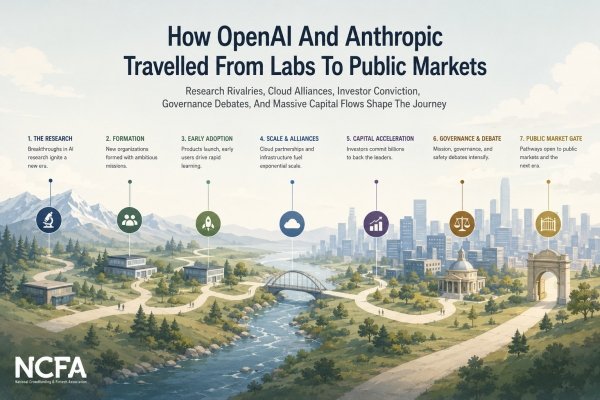
On June 8, 2026, OpenAI confirmed it submitted a confidential S-1 to the U.S. Securities and Exchange Commission. One week earlier, Anthropic disclosed its own confidential draft registration statement for a proposed IPO.
The filings are the trigger, not the story. The story is how frontier AI moves from research labs and safety debates into consumer adoption, cloud alliances, investor conviction, copyright fights, government interest, near trillion dollar private valuations, and the public market gate.
OpenAI starts with a promise that sounds almost incompatible with public markets.1 In 2015, it begins as a nonprofit AI research company with a mission tied to broad public benefit, not shareholder return. That tension does not matter much while the work sits inside research circles. It matters once OpenAI becomes strategically important.
Anthropic comes from inside the same argument.2 Founded in 2021 by former OpenAI researchers, including Dario Amodei, Anthropic builds its identity around reliable, interpretable, and steerable AI systems. It is not just another model company. It is a different answer to a question OpenAI helped make unavoidable.
ChatGPT turns frontier AI into a public habit.3 The late 2022 launch changes the audience almost overnight. Students, founders, developers, workers, executives, and investors start testing advanced AI directly. Reuters later reports ChatGPT reached an estimated 100 million monthly active users in January 2023.4
Claude takes the quieter enterprise path.5 It does not create the same consumer spectacle, but Anthropic leans into reliability, predictable deployment, and safety as commercial positioning. Trust becomes part of the product, especially for organizations that need governance controls before they scale AI usage.
Microsoft turns OpenAI into one of the largest strategic bets in technology.6 The relationship gives OpenAI more than capital. Azure becomes part of its operating foundation, with cloud infrastructure, enterprise distribution, and credibility arriving at a moment when many buyers are still trying to understand what generative AI can become.
Anthropic attracts a different group of believers. Google backs the company. Amazon commits billions and makes Anthropic central to its AI strategy, while AWS becomes Anthropic's primary cloud and training partner.7 Spark Capital and Menlo Ventures remain part of the journey as Anthropic grows from safety focused startup into one of OpenAI's strongest challengers.
OpenAI remains the company everyone else measures against. ChatGPT gives OpenAI distribution, developer attention, and brand recognition. Microsoft's partnership gives it reach into enterprise software. That combination makes OpenAI powerful, but it also makes dependency risk more visible for large buyers.
Anthropic becomes strategically useful because it is different. Claude's role in enterprise productivity and financial workflows shows how a trust first product can become a real alternative. When Microsoft brings Claude into Office productivity, the message is practical: even OpenAI's most important partner wants more than one AI supplier in the stack.
OpenAI's success creates a new constraint. The company is no longer trying to prove that people will use frontier AI. ChatGPT already answered that question. OpenAI now has to fund the compute, deployment, developer usage, and enterprise adoption needed to keep the flywheel turning.
Anthropic faces the same pressure through Claude demand. Its Series H announcement points to global enterprise adoption, expanded compute capacity, Amazon, Google, Broadcom, SpaceX, and chip partners including Micron, Samsung, and SK hynix.8 The company's careful brand does not reduce its need for industrial scale infrastructure.
OpenAI's rise brings copyright and publisher pressure with it. The more useful the models become, the more valuable the training inputs appear. News organizations, authors, artists, and creators increasingly ask how their work contributes to model capability and who captures the value created from it.
Anthropic faces the same ownership question through Reddit. The Reddit lawsuit against Anthropic puts training data claims, platform rights, and AI accountability into the story. The issue is not only whether AI can learn from the web. It is who gets a say when web content becomes commercial fuel.
OpenAI's control questions become public in 2023.9 The board removes Sam Altman, then reverses course after pressure from employees, customers, investors, and partners. The episode is brief, but it changes how people read the company. Governance becomes part of valuation risk.
Anthropic's safety stance faces real world tests. Its product identity is tied to reliability and responsible deployment, but governments, enterprises, and defence buyers want more capability. The tension between safety commitments and state power is already visible in AI ethics, state power, and red lines.
OpenAI's March 2026 financing makes the capital story impossible to ignore.10 The company closes $122B USD in committed capital at an $852B USD post money valuation. The round is anchored by Amazon, NVIDIA, and SoftBank, with continued participation from Microsoft. SoftBank co leads alongside a16z, D. E. Shaw Ventures, MGX, TPG, and accounts advised by T. Rowe Price Associates.
Anthropic's May 2026 Series H shows the same private market scale.11 The company raises $65B USD at a $965B USD post money valuation. Altimeter Capital, Dragoneer, Greenoaks, and Sequoia Capital lead the round, with Capital Group, Coatue, D1 Capital Partners, GIC, ICONIQ, and XN also co leading. Amazon's prior commitment remains part of the picture, along with Google, Broadcom, SpaceX, and chip partners.
OpenAI follows on June 8 and keeps timing open.12 The company confirms it submitted a confidential S-1 but says it has not decided when to go public. Public markets become an option, while OpenAI keeps weighing what may be easier to do as a private company.
Anthropic reaches the IPO gate first on June 1.13 The filing does not set share count or price. It gives the company the option to move after SEC review, market conditions, and other factors.
Different origins. Different philosophies. Different investor groups. Different commercialization paths. Yet both companies arrive at the same gate.
The IPO filings don't end the frontier AI story. They mark the point where a decade of research, product adoption, infrastructure buildout, governance conflict, investor conviction, and public policy pressure begins meeting public markets.
For NCFA, this is where Story Intelligence connects to the Financial Innovation Map. The opportunity set includes private market liquidity, tokenized pre IPO access, AI infrastructure finance, prediction markets around IPO timing and valuation, disclosure standards, and investor protection for companies that may become public only after private markets have already priced much of the upside.
OpenAI and Anthropic followed different paths, attracted different allies, and made different decisions along the way. Yet both arrived at the same gate. That may say as much about the economics of frontier AI as it does about the companies themselves.
What part of the story stood out most to you?
Share this story → Explore related intelligence → Subscribe
The National Crowdfunding & Fintech Association (NCFA Canada) is a financial innovation ecosystem that provides education, market intelligence, industry stewardship, networking and funding opportunities and services to thousands of community members and works closely with industry, government, partners and affiliates to create a vibrant and innovative fintech and funding industry in Canada. Decentralized and distributed, NCFA is engaged with global stakeholders and helps incubate projects and investment in fintech, alternative finance, crowdfunding, peer-to-peer finance, payments, digital assets and tokens, artificial intelligence, blockchain, cryptocurrency, regtech, and insurtech sectors. Join Canada's Fintech & Funding Community today FREE! Or become a contributing member and get perks. For more information, please visit: www.ncfacanada.org
| | |
|---|---|---|
| | |



August 26th, 2025

January 4th, 2024

June 1st, 2021

September 9th, 2020

July 9th, 2018

January 3rd, 2018

September 25th, 2017

June 20th, 2017

May 10th, 2017

December 14th, 2016
