





Karsten Wenzlaff, Advisor
August 26th, 2025
Karsten Wenzlaff is a Crowdfunding and Fintech Expert from Germany. He is Secretary-General of Digit[...]


July 2, 2026

Businesses produce large quantities of data from sales systems, customer interactions, marketing campaigns, websites and operational processes. Organising this information is necessary for identifying opportunities plus making decisions based on facts. Cloud data lakes are flexible environments where organizations store large volumes of structured and unstructured data in one place, which provides a basis for complex analytics but also business intelligence.
Traditional storage systems often require users to organize data before they store it. In contrast, cloud data lakes allow businesses to collect information from many sources and analyze it when necessary - this method helps organizations understand customer behavior, market trends, operational performance as well as potential for future expansion.
A cloud data lake is a central location for storing raw data in its original form. It allows businesses to keep information that does not fit into standard databases. Data is available from websites, mobile applications, social media, sensors, financial systems and tools for managing customer relationships.
Flexibility makes cloud data lakes useful for growth analytics. Organizations are able to combine data from different departments without long preparation periods - this creates a complete view of business activities or helps teams find connections and patterns that are otherwise difficult to see.
Gathering information from many business systems is a primary benefit of cloud data lakes. Marketing data, sales records, customer service interactions, inventory reports next to website analytics are stored together - this broad approach improves the quality and precision of business analysis.
Detailed understanding of performance across the entire organization is possible when businesses collect information from many sources. Analysts are able to study how marketing campaigns affect sales, how support affects customer retention or how inventory management relates to profit - these connections support strategic planning plus initiatives for growth.
Growth analytics require the accurate measurement of performance. Free cloud storage supports constant monitoring - collecting information from operational but also financial systems quickly - this allows organizations to follow key performance indicators and react to changes.
Revenue growth, costs to acquire customers, operational efficiency as well as product performance are measurable through integrated tools. Finding performance issues early allows managers to fix problems before they change the final results significantly.
Cloud data lakes make it simple for authorized teams to find information. Users retrieve data from a central location instead of searching through separate systems - this increases efficiency and reduces the time required for decision making.
Better accessibility also promotes cooperation between departments. Marketing teams, finance departments, operations managers but also executives use the same data. Decisions are consistent and follow the general goals of the business.
Cloud data lakes provide the storage as well as computing power necessary for advanced analytical methods. Businesses use predictive analytics, machine learning models and statistical analysis to find patterns that help future growth - these tools allow organizations to look at future opportunities rather than only looking at past reports.
Complex analytics show trends in customer purchasing, identify segments of the market that produce profit or predict demand. By using these insights, businesses distribute resources effectively and make decisions that support expansion while avoiding unnecessary risks.
Understanding how customers behave is a vital part of business growth. Cloud data lakes allow organizations to join customer information from many channels, like websites, mobile apps next to purchasing platforms - this creates a complete profile of the customer.
Preferences, habits and engagement patterns are visible when businesses have a unified view of customer activity - these insights help organizations create specific marketing campaigns, improve the customer experience plus increase loyalty. Better understanding of customers often results in higher revenue and a better position in the market.
Data volumes often increase quickly as businesses grow - Cloud data lakes scale to meet the needs of the organization, which allows companies to store and analyze large datasets without spending heavily on new infrastructure - this scalability supports long term growth without the need to replace systems constantly.
Many organizations start data projects with affordable solutions, like limited storage for testing. Businesses move to larger environments with more capacity as their needs for analysis grow. Some providers offer plans with unlimited cloud storage but companies should check usage policies or performance needs before choosing one.
Reliable and honest information is necessary for effective growth analytics. Businesses should create data governance rules that define how they collect, store, access next to maintain information. Clear policies improve the quality of data and help the company follow regulations.
Security measures like access controls, encryption plus monitoring tools protect private information. Strong governance ensures that analysis is based on accurate data, which gives decision makers confidence in the insights they use for growth strategies.
Cloud data lakes are a strong foundation for business growth analytics because they centralize information, make data accessible and support complex analysis. They allow organizations to combine data from many sources, understand customers better, monitor performance but also find opportunities for expansion.
Using governance practices and analytical tools helps businesses change large amounts of data into useful insights. A managed cloud data lake helps organizations make decisions based on facts, improve how they operate as well as create growth in a business environment that relies on data.
 The National Crowdfunding & Fintech Association (NCFA Canada) is a financial innovation ecosystem that provides education, market intelligence, industry stewardship, networking and funding opportunities and services to thousands of community members and works closely with industry, government, partners and affiliates to create a vibrant and innovative fintech and funding industry in Canada. Decentralized and distributed, NCFA is engaged with global stakeholders and helps incubate projects and investment in fintech, alternative finance, crowdfunding, peer-to-peer finance, payments, digital assets and tokens, artificial intelligence, blockchain, cryptocurrency, regtech, and insurtech sectors. Join Canada's Fintech & Funding Community today FREE! Or become a contributing member and get perks. For more information, please visit: www.ncfacanada.org
 |  |  |
|---|---|---|
 |  |  |
Jun 29, 2026 | NCFA Resource | Open Banking Open Finance, Regulation And Policy
Last updated: September 11, 2026

NCFA has published a new Regulatory Intelligence guide to Canada Open Banking and Consumer Driven Banking Rules. The interactive resource organizes the proposed regulations, implementation requirements, consultation questions and strategic issues shaping Canada’s regulated open banking framework.
For a broader view of Open Banking and Consumer-Driven Finance, including the Canadian market map, 146 learning modules, company intelligence, global benchmarks and interactive discussions, explore NCFA Open Banking & Consumer-Driven Finance Interactive Intelligence.
The guide tracks accreditation, data scope, consent, authentication, security, technical standards, liability, reporting, complaints, national security review, fees and administrative monetary penalties. It also explains why consumer trust, fraud prevention and clear accountability are central to implementation. For further analysis, see Canada's Open Banking Strategy Starts With Trust.
The resource gives readers a structured way to understand what the proposed Consumer Driven Banking Regulations would require before final rules are published.
Instead of treating the regulations as one long legal document, the guide breaks them into operating topics. Each section separates regulatory requirements, implementation work, consultation considerations and NCFA’s strategic perspective.
Canada’s open banking framework is progressing from policy design into regulatory implementation. Firms need to understand more than API access. They need to prepare evidence for accreditation, consumer consent flows, registry checks, authentication records, security safeguards, breach response, complaint procedures, service standards, reporting obligations and board level accountability.
The 60-day Canada Gazette consultation closed on August 26, 2026. The proposed regulations remain subject to finalization, while firms continue preparing for accreditation, supervision, data-sharing, consent, security and operational requirements.
This resource is useful for fintech founders, open banking platforms, financial institutions, credit unions, payment service providers, data aggregators, regtech providers, compliance teams, investors, policymakers and industry associations.
It is especially useful for organizations assessing accreditation, product design, consent architecture, data sharing duties, technical standards, cybersecurity, consumer protection and implementation costs.
The strength of this resource is its focus on regulatory readiness. It converts the proposed Consumer Driven Banking Regulations into a practical intelligence layer that can support planning, consultation, product design and ecosystem coordination.
The guide connects the proposed regulations to Canada’s policy objectives, including stronger consumer protection, fraud mitigation, secure financial data sharing, competition and confidence in the open banking framework.
It also connects regulation to commercial opportunity. The guide identifies where read access, data portability, identity and income verification, cash flow analysis, embedded workflows, write access and open finance may create future product and infrastructure demand.
The regulations remain proposed and may change following consultation. Readers should use the guide for ecosystem intelligence and planning, not as legal, financial, investment, compliance or professional advice.
Canada Open Banking and Consumer Driven Banking Rules (primary NCFA Regulatory Intelligence guide)
NCFA Open Banking & Consumer-Driven Finance Interactive Intelligence (market map, 146 learning modules, company intelligence, discussions and global benchmarks)
Canada's Open Banking Strategy Starts With Trust (consumer protection and fraud readiness)
Open Banking In Canada Opportunity Brief (commercial opportunity layer)
NCFA Financial Innovation Map (ecosystem context)
Proposed Consumer-Driven Banking Regulations (official Canada Gazette source)
The National Crowdfunding & Fintech Association (NCFA Canada) is a financial innovation ecosystem that provides education, market intelligence, industry stewardship, networking and funding opportunities and services to thousands of community members and works closely with industry, government, partners and affiliates to create a vibrant and innovative fintech and funding industry in Canada. Decentralized and distributed, NCFA is engaged with global stakeholders and helps incubate projects and investment in fintech, alternative finance, crowdfunding, peer-to-peer finance, payments, digital assets and tokens, artificial intelligence, blockchain, cryptocurrency, regtech, and insurtech sectors. Join Canada's Fintech & Funding Community today FREE! Or become a contributing member and get perks. For more information, please visit: www.ncfacanada.org
| | |
|---|---|---|
| | |
June 29, 2026 | NCFA Fintech Market Activity | Capital Markets And Funding, SME Finance And Business Banking, Artificial Intelligence And Data, Fintech And Innovation

On June 29, 2026, Conexus Venture Capital invests in JUDI.AI, a Vancouver fintech whose AI cash flow underwriting platform helps credit unions and community banks make faster small business lending decisions. Existing investor Unitus Community Credit Union also participated.
The round size wasn't disclosed, but its a strong transaction. A credit union backed venture fund is financing AI lending infrastructure that already serves credit unions and community banks across Canada and the U.S.
JUDI.AI says its platform has processed more than $2 billion in small business loan applications, supports more than 50 clients, and can reduce the loan application and decisioning process from more than seven days to under ten minutes without collecting financial statements. The platform uses permissioned bank transaction data, a domain specific credit model, and a real time view of cash flow to assess small business borrowers.
Small business lending has always fit the credit union model in theory. Credit unions know local communities, relationship banking, and member service. The problem is operating cost.
A small business loan can still require bank statements, financial statements, manual review, back and forth questions, policy checks, risk scoring, and approval work. If the process takes too long, borrowers look elsewhere. If the process costs too much, lenders struggle to serve smaller tickets profitably.
JUDI.AI is targeting that gap. The platform combines cash flow analysis, automated underwriting, loan portfolio reporting, and analytics for credit unions and community banks. Instead of relying only on older financial statements or conventional lending metrics, it helps lenders assess live business activity through permissioned transaction data.
That gives credit unions a way to compete on speed without abandoning lending discipline.
Conexus was already familiar with the platform before the venture investment. The announcement says small business members in Saskatchewan previously used JUDI.AI for years to access loans faster, while Conexus reduced the time required to process applications.
That makes the investment more than a financial bet. Conexus is backing a tool it's used inside its own lending workflow, where speed, borrower experience, staff capacity, and credit discipline all matter.
Gord Baizley, CEO of JUDI.AI, framed the business around lending practice:
"At JUDI, we're not just selling a platform. We're championing a methodology. We've learned that success in small business lending is more than just technology, but a holistic approach that blends people, process, technology and intentional growth."
Better SME credit infrastructure is not only about faster models. It also depends on workflow design, risk controls, lender adoption, borrower experience, and portfolio monitoring.
JUDI.AI's model fits a larger fintech pattern. SME finance is increasingly built around current business activity rather than static documents.
That connects directly to Canada's open banking opportunity and NCFA's Open Finance SME Capital Access opportunity work. Read access can support income verification, affordability checks, cash flow insight, fraud signals, onboarding, and SME credit.
For small businesses, the commercial value comes when permissioned financial data helps lenders understand revenue, expense patterns, repayment capacity, seasonality, and account behaviour without weeks of manual collection.
The AI model needs good data, the lender needs clear controls, and the borrower needs a simpler application path. If those pieces work together, small business credit can become faster and more accessible without turning into loose lending.
JUDI.AI's decade of performance data also gives the platform a stronger adoption story than a new AI wrapper. Credit unions are buying a tested underwriting process designed for their borrower base.
Float's $85 million Series C shows Canadian business finance platforms expanding across payments, cash management, credit, and AI finance workflows.
EQ Bank's Business Card launch adds spending, cashback, interest, and cash flow tools to its SME banking stack.
Better banking options for Canadian SMEs remain a live competition issue as business owners seek lower friction, better credit access, and more useful digital financial tools.
NCFA's Financial Innovation Map tracks SME finance, open finance, AI underwriting, business banking, and financial data infrastructure opportunities.
The Conexus investment shows how credit unions can use venture capital as more than a financial return tool. They can back fintech infrastructure that improves member service, strengthens local business lending, and gives community based institutions a better way to compete with digital lenders.
For JUDI.AI, the next step is continued growth. The platform already supports credit unions and community banks across Canada and the U.S., and the new capital supports North American growth and product development. The strongest path is helping lenders approve strong small business borrowers faster, manage risk with better cash flow data, and keep local credit relationships inside the credit union system.
The competitive question is whether credit unions can adopt fast enough? Fintech lenders, banks, embedded finance platforms, and business finance software firms are all trying to own more of the SME finance relationship. Credit unions have trust and local presence. They now need digital credit infrastructure that matches borrower expectations.
If credit unions can combine local member trust with AI cash flow underwriting, can they become the strongest distribution channel for small business lending in Canada?
The National Crowdfunding & Fintech Association (NCFA Canada) is a financial innovation ecosystem that provides education, market intelligence, industry stewardship, networking and funding opportunities and services to thousands of community members and works closely with industry, government, partners and affiliates to create a vibrant and innovative fintech and funding industry in Canada. Decentralized and distributed, NCFA is engaged with global stakeholders and helps incubate projects and investment in fintech, alternative finance, crowdfunding, peer-to-peer finance, payments, digital assets and tokens, artificial intelligence, blockchain, cryptocurrency, regtech, and insurtech sectors. Join Canada's Fintech & Funding Community today FREE! Or become a contributing member and get perks. For more information, please visit: [www.ncfacanada.org](http://www.ncfacanada.org)
| | |
|---|---|---|
| | |
June 26, 2026 | NCFA Insight | SME Finance And Business Banking, Artificial Intelligence And Data, Open Banking And Open Finance, Fintech And Innovation

On June 26, 2026, the OECD published Leveraging AI and Digital Tools for SME Sustainable Finance, arguing that one of the biggest barriers to sustainable finance for small and medium sized businesses is not only capital availability but the cost of collecting, verifying, sharing, and monitoring reliable business information.
SMEs account for around 50% of economic output and business sector environmental impacts, yet remain underrepresented in sustainable finance. Sustainable finance markets have grown, but smaller firms still struggle because sustainability data is costly to generate, difficult to verify, and fragmented across reporting frameworks.
So what does this mean?
AI can help lenders process information faster, automate routine work, and monitor portfolios, but only when SMEs can produce trusted, reusable data. Without that foundation, AI just processes weak information faster.
The OECD identifies four main barriers holding back SME sustainable finance:
The report cites survey evidence that SMEs identify lack of time at 42%, technical difficulties at 41%, and high reporting costs at 41% as top barriers to sustainability measurement and reporting.
Many SMEs may want financing for efficiency upgrades, transition investments, or buyer requirements, but the paperwork and verification burden can make targeted sustainable finance harder to access than standard financing.
The OECD looks at the full financing path, not just the lending decision. The process starts when an SME collects sustainability information and continues through bank onboarding, risk review, monitoring, and reporting.
For SMEs, the first job is basic data capture. Carbon calculators, digital templates, consent based APIs, and automated reporting tools can help owners turn energy use, emissions, invoices, utility data, and operating records into information lenders can review.
For financial institutions, the work then moves through three stages. Front office tools can help with onboarding, document intake, product matching, and early screening. Middle office tools can support risk review, evidence checks, benchmarking, and sustainability claim review. Back office tools can monitor targets, prepare reports, track KPIs, and keep portfolio records current.
The OECD’s warning is direct and impactful. AI cannot compensate for missing, inconsistent, or weakly verified data. AI becomes useful only when the underlying information is trusted enough to compare, reuse, and monitor over time.
Sustainable finance does not scale for SMEs if every small loan requires a custom review. Origination, due diligence, verification, monitoring, and reporting all take time. When the loan is small, those fixed costs can make SME sustainable finance unattractive for lenders even when capital is available.
This is why the OECD's lifecycle approach may help. Digital onboarding, reusable sustainability credentials, API based data sharing, AI assisted verification, and continuous monitoring can reduce the cost of serving smaller borrowers.
The opportunity is not just faster approvals. It is making small ticket sustainable finance workable for lenders and less painful for SMEs.
The OECD highlights several initiatives that show how reusable sustainability data can work in practice.
Denmark's Climate Compass gives SMEs a free digital tool to calculate Scope 1, 2, and 3 emissions in line with recognized standards. The SME Climate Hub offers a free carbon calculator for micro and small businesses. Ireland's Climate Toolkit 4 Business combines an emissions calculator with a climate action plan.
Singapore's Project Greenprint helps SMEs generate emissions reports by pulling data from trusted sources, while the United Kingdom's Project Perseus explores how SMEs can share energy data with banks through reporting solutions. Belgium's Kube ESG, developed with major Belgian banks, gives SMEs a digital platform for sustainability reporting.
SMEs shouldn't have to rebuild the same sustainability file for every bank, buyer, or public program. They need data that can be generated once, verified, and reused with permission.
Canada already has many of the building blocks the OECD describes, but policy and market conversations are often separate.
Open banking and open finance can support permission based business data sharing. Digital identity can improve trust and verification. AI underwriting can reduce manual review. Embedded finance can connect lending to accounting, payments, invoicing, payroll, and commerce data. Sustainability reporting tools can help SMEs generate the evidence lenders and buyers increasingly request.
The opportunity is to connect those pieces. If Canadian SMEs can share trusted business and sustainability data through secure, interoperable systems, lenders can reduce manual work and price risk with better information.
That is where sustainable finance becomes a fintech infrastructure problem. The outcome is trusted business data that SMEs can reuse across banks, buyers, insurers, platforms, and government programs.
Open banking in Canada shows how permission based data sharing can improve financial services and reduce friction for consumers and businesses.
NCFA's Open Banking Opportunity Brief explores the commercial opportunities created by data portability and controlled financial data access.
Float's AI business finance stack points to how Canadian SME finance platforms are moving toward connected finance workflows.
EQ Bank's SME operating account push shows how business banking is expanding from accounts into spending, cash flow, and operating tools.
NCFA's Financial Innovation Map tracks opportunities across SME finance, open finance, AI, digital identity, sustainability, and financial data infrastructure.
If trusted SME data was portable and secure between businesses, lenders, buyers, insurers, platforms, and public programs with permission, which parts of commercial lending would still need manual verification?
The National Crowdfunding & Fintech Association (NCFA Canada) is a financial innovation ecosystem that provides education, market intelligence, industry stewardship, networking and funding opportunities and services to thousands of community members and works closely with industry, government, partners and affiliates to create a vibrant and innovative fintech and funding industry in Canada. Decentralized and distributed, NCFA is engaged with global stakeholders and helps incubate projects and investment in fintech, alternative finance, crowdfunding, peer-to-peer finance, payments, digital assets and tokens, artificial intelligence, blockchain, cryptocurrency, regtech, and insurtech sectors. Join Canada's Fintech & Funding Community today FREE! Or become a contributing member and get perks. For more information, please visit: www.ncfacanada.org
| | |
|---|---|---|
| | |
June 25, 2026 | NCFA Fintech Market Activity | Capital Markets And Funding, SME Finance And Business Banking, Artificial Intelligence And Data, Fintech And Innovation

On June 24, 2026, Float Financial announced a CAD $85 million all equity Series C led by Inovia Capital, with continued participation from Goldman Sachs Alternatives and Garage Capital, and new investment from BDC Capital and Northleaf. Float says the round raises its valuation by 70% and brings total capital raised since inception to CAD $300 million, including debt and equity financing.
The financing gives Float more capital to expand its AI finance workflow layer, grow across Western Canada and Quebec, and hire across product, R&D, sales, and marketing. The company now serves more than 7,500 Canadian businesses and says revenue has grown more than 120% since its Series B.
Float’s own growth data shows how quickly Canadian business finance is moving from point solutions into connected operating platforms. Business account balances are up more than 4.5x, volumes across five products are up more than 100%, and nearly one third of customers now use more than one Float product which suggests Float is expanding inside existing finance teams rather than only adding new accounts.
Float gives Canadian businesses tools for corporate cards, expense management, bill pay, reimbursements, foreign exchange, business accounts, reporting, and working capital credit. The Series C adds more fuel to Float Intelligence, the company’s AI layer for automating finance workflows.
Rob Khazzam, CEO and co-founder of Float, framed the round around infrastructure:
“We are not building a single feature. We are building the infrastructure that powers how Canada does business - and proving that the best financial tools for Canadian businesses don't have to come from somewhere else.”
Canadian businesses want fewer disconnected finance tools. They need better control over spending, faster approvals, clean reporting, cash visibility, cross border payments, and finance workflows that don't depend on manual work.
Float says its platform is trusted by companies including Cohere, Knix, Neo, Jane, and Rebel. The Jane customer quote in the release points to the same theme: Canadian companies want AP, expense, and finance tools built for the Canadian market, not adapted from U.S. systems.
If Float keeps expanding across cards, accounts, payments, credit, and AI finance workflows, Canadian businesses may get a stronger local alternative to the tools many finance teams stitch together today.
Float secured $100 million in debt financing to expand SME finance in Canada before this Series C.
EQ Bank launched a Business Card, adding spending, cashback, interest, and cash flow tools to its SME banking stack.
Relay secured $50 million to grow its SMB finance platform.
Payments Canada admitted new payment service providers, including Float, as access to payment infrastructure opens to more fintech operators.
Canadian SMB banking research highlights high fees, credit friction, and outdated financial systems as ongoing barriers for business owners.
If Canadian businesses adopt one platform for spending, payments, cash, credit, and AI finance workflows, which institution owns the primary operating relationship: the bank, the fintech, or the software layer?
The National Crowdfunding & Fintech Association (NCFA Canada) is a financial innovation ecosystem that provides education, market intelligence, industry stewardship, networking and funding opportunities and services to thousands of community members and works closely with industry, government, partners and affiliates to create a vibrant and innovative fintech and funding industry in Canada. Decentralized and distributed, NCFA is engaged with global stakeholders and helps incubate projects and investment in fintech, alternative finance, crowdfunding, peer-to-peer finance, payments, digital assets and tokens, artificial intelligence, blockchain, cryptocurrency, regtech, and insurtech sectors. Join Canada's Fintech & Funding Community today FREE! Or become a contributing member and get perks. For more information, please visit: www.ncfacanada.org
| | |
|---|---|---|
| | |
June 24, 2026 | NCFA Insight | Capital Markets And Funding, Venture Funding And Building, Fintech And Innovation
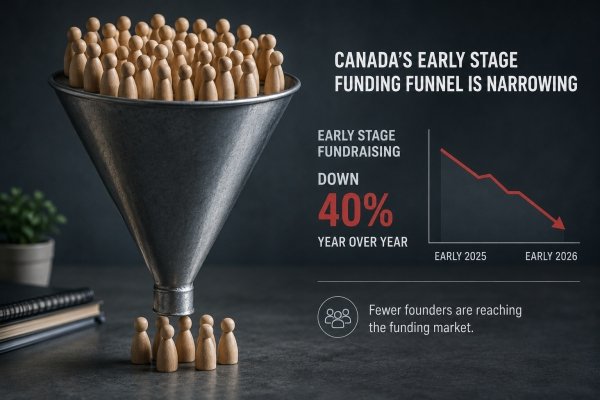
On June 24, 2026, RBCx published its Canadian VC 2026 Mid-Year report, showing that Canada’s early stage funding squeeze at venture funds is now also a startup company reality. RBCx says its Early Stage Banking team works with more than 1,200 pre seed and seed stage companies headquartered in Canada each year, and its current dataset covers more than 2,100 founder conversations.
The figures report that not only less capital is being raised, but fewer founders appear to be reaching the market at all. RBCx tracked 162 companies raising a combined $510.7 million in January 2025. By March 2026, only 61 companies were actively raising, with total capital sought down to about $189.8 million.
Average raise size held near $3 million from September 2024 to March 2026. That makes the data more troubling, not less. The market is not simply producing smaller seed rounds. It appears to be producing fewer founders who can raise them.
RBCx’s data suggests that early stage capital, which is often treated as the entry point into the venture system, is becoming harder to reach.
If fewer pre seed and seed companies are actively raising while average round size holds steady, the impact affects breadth of market.
Stronger or better connected founders may still complete rounds, but the number of companies entering the funding conversation appears to be shrinking.
A smaller early stage funnel means fewer companies get the chance to test markets, build traction, reach Series A, or become future scaleups. The risk is not only lower fundraising volume. It is a thinner innovation pipeline.
The company level data also connects back to the fund level pressure NCFA covered earlier this year in Canadian VC Fundraising Contracts And Concentrates In 2025. RBCx previously found that Canadian venture firms raised just over $2 billion in 2025, while the top five funds captured 83% of total capital raised.
RBCx’s mid year update says the top five funds captured 80% of total capital raised by 2025, while all other funds combined dropped from $4.5 billion at the 2021 peak to $444 million, close to a 90% decline.
When capital concentrates around fewer funds, founders face fewer decision makers, narrower investor funnels, and less room for non consensus ideas. That is especially important at the earliest stages, where conviction often depends on relationships, sector belief, and willingness to take risk before the metrics are obvious.
RBCx estimates that emerging managers raised about $2.8 billion over the past three years, compared with an expected $4.3 billion based on historical averages. That leaves a 36% funding shortfall.
Matt Roberts, Managing Director, Venture Coverage at RBCx, described the issue directly:
“Emerging managers are the engine of early-stage innovation in Canada. They’re willing to take on the riskier bets by backing first-time founders solving problems the market hasn’t fully recognized yet.”
His quote explains why this is a capital formation issue, not only a venture industry issue. Emerging managers often fund the companies that don't yet fit the pattern recognition of larger funds. When those managers cannot raise successor funds, Canada loses part of the market that is most willing to back first time founders, new categories, and early signals.
Canadian VC fundraising contracted and concentrated in 2025, with less new capital available for initial investments.
A built in Canada startup moved to the U.S., showing how capital access, customer depth, and market scale can influence where promising companies choose to grow.
Canada’s productivity challenge increasingly connects to capital formation, innovation scale, and the ability to turn new companies into durable economic output.
Targeted entrepreneurship funding remains an active policy tool as Canada tries to close founder capital gaps across underrepresented groups.
NCFA’s Financial Innovation Map tracks capital formation, alternative funding, venture infrastructure, and founder financing opportunities across Canada’s innovation ecosystem.
If Canada rebuilds early stage breadth, more founders can test markets, attract first capital, and create the next set of Series A candidates. That requires more than headline capital. It requires LP support for emerging managers, stronger growth stage confidence, and funding pathways that let founders raise before they fit the safest investor pattern.
Fewer funded companies may improve selectivity, but it can also remove the messy experimentation that produces outlier companies. If the ecosystem only funds the obvious companies, Canada may reduce failure rates while also reducing the number of breakout opportunities.
If average seed rounds remain stable but far fewer founders are raising, is Canada becoming more selective or simply losing the breadth and risk appetite needed to build the next generation of scaleups?
The National Crowdfunding & Fintech Association (NCFA Canada) is a financial innovation ecosystem that provides education, market intelligence, industry stewardship, networking and funding opportunities and services to thousands of community members and works closely with industry, government, partners and affiliates to create a vibrant and innovative fintech and funding industry in Canada. Decentralized and distributed, NCFA is engaged with global stakeholders and helps incubate projects and investment in fintech, alternative finance, crowdfunding, peer-to-peer finance, payments, digital assets and tokens, artificial intelligence, blockchain, cryptocurrency, regtech, and insurtech sectors. Join Canada's Fintech & Funding Community today FREE! Or become a contributing member and get perks. For more information, please visit: www.ncfacanada.org
| | |
|---|---|---|
| | |

Open finance can move SME capital access beyond static applications and backward looking credit files. The opportunity is to use permissioned business, financial, invoice, payment, accounting and treasury data to support better working capital, credit, invoice finance and treasury decisions.
Market sizing should not rely on one broad fintech TAM figure. The more reliable assessment is that several adjacent markets are converging: SME lending, embedded finance, invoice finance, working capital, open finance infrastructure and AI assisted credit decisioning.
The strongest opening is not simple cash flow underwriting. It is the decision and action layer that turns permissioned SME data into capital access: embedded working capital, real time credit, invoice finance automation and treasury optimization.
UK open finance experiments, CFIT SME prototypes, Canada Consumer Driven Banking implementation, Competition Bureau SME financing findings, embedded finance distribution, AI credit decision controls, invoice data standards, and early evidence that SME treasury optimization becomes a purchasable product rather than only a dashboard feature.
Evidence currently supports four venture scale paths. Connected SME data, cash flow underwriting and AI decisioning are enabling layers. They should not be treated as standalone product paths unless evidence later shows a distinct purchasable product category.
Capital inside SME workflows and platforms
SMEs often need capital at the point of activity: invoices, payroll, inventory, supplier payments, marketplace sales or software workflows. Embedded working capital uses platform context and permissioned financial data to offer capital where the need appears.
The innovation is not embedding a loan button. It is combining workflow data, financial data, repayment capacity and AI assisted decisioning so capital can be offered with better timing, fit and controls.
Platforms may prefer to partner with existing lenders or build lending directly, reducing room for specialist infrastructure providers.
Which embedded workflows create the clearest budget: accounting, PSPs, invoicing, marketplaces, payroll, procurement or vertical software?
Dynamic credit decisions from live business data
Real time SME credit uses fresh cash flow, account, payment, invoice, accounting and business data to support faster approvals, dynamic limits and ongoing reviews. It is different from mature cash flow underwriting when the credit product updates as business conditions change.
Potential buyers include lenders, banks, embedded finance providers, PSPs, accounting platforms and credit infrastructure providers.
If real time credit remains only a faster version of existing underwriting, the innovation window may be too narrow.
Can connected data support dynamic limits, early warnings, covenant style monitoring or instant credit decisions without creating unacceptable bias, privacy or model risk?
Receivables finance using invoice and payment data
Invoice finance automation uses invoice, accounting, buyer, payment and fraud data to decide whether receivables can be financed. The opportunity is stronger when systems verify invoice validity, buyer reliability, payment timing and repayment risk without manual PDF workflows.
This path may be distinct enough to survive as a child opportunity if evidence grows around invoice intelligence, receivables verification and automated funding decisions.
Invoice finance may remain a lender workflow improvement unless automation clearly reduces fraud, friction, cost or access barriers for SMEs.
Are lenders and platforms using live invoice and accounting connections to automate financing decisions, or only digitizing existing manual workflows?
Capital allocation and liquidity decisions
SME treasury optimization goes beyond monitoring. It uses connected financial data and AI assisted decisioning to help SMEs decide when to borrow, repay debt, hold cash, pay suppliers, finance invoices, invest surplus cash or allocate liquidity across accounts and payment rails.
This is currently earlier than embedded working capital, but it may become the most differentiated open finance path if evidence shows SMEs adopting decision products rather than dashboards.
If products remain cash flow dashboards or alerts without trusted action, this should remain an enabling feature rather than a product path.
Will SMEs delegate capital allocation, liquidity and financing actions to AI assisted treasury tools with human oversight?
Filter by signal type to review source records, market signals and thought leadership supporting this opportunity. Evidence is sorted newest to oldest.
Share your perspective, research, case study or video response. You can also express interest in future discussions, collaboration opportunities and innovation activities related to this topic.
Learn how NCFA identifies, validates and tracks innovation opportunities →NCFA Opportunity Intelligence tracks emerging venture opportunities using evidence, market developments and validation signals. Opportunity briefs are updated as new information, evidence and stakeholder perspectives become available. This content is provided for information purposes only and does not constitute legal, investment, financial, tax or professional advice.
The National Crowdfunding & Fintech Association (NCFA Canada) is a financial innovation ecosystem that provides education, market intelligence, industry stewardship, networking and funding opportunities and services to thousands of community members and works closely with industry, government, partners and affiliates to create a vibrant and innovative fintech and funding industry in Canada. Decentralized and distributed, NCFA is engaged with global stakeholders and helps incubate projects and investment in fintech, alternative finance, crowdfunding, peer-to-peer finance, payments, digital assets and tokens, artificial intelligence, blockchain, cryptocurrency, regtech, and insurtech sectors. Join Canada's Fintech & Funding Community today FREE! Or become a contributing member and get perks. For more information, please visit: www.ncfacanada.org
| | |
|---|---|---|
| | |



August 26th, 2025

January 4th, 2024

June 1st, 2021

September 9th, 2020

July 9th, 2018

January 3rd, 2018

September 25th, 2017

June 20th, 2017

May 10th, 2017

December 14th, 2016
