





Karsten Wenzlaff, Advisor
August 26th, 2025
Karsten Wenzlaff is a Crowdfunding and Fintech Expert from Germany. He is Secretary-General of Digit[...]


Stablecoins | July 18, 2025

Image: Freepik/gstudioimagen
The dominoes are definitely starting to fall. Citigroup and Bank of America have confirmed they are developing or preparing to launch their own stablecoins. In back-to-back Q2 earnings calls this week, executives from both banks outlined their intentions to support stablecoin issuance for use cases like digital payments and tokenized deposits.
As reported by Reuters, Citigroup CEO Jane Fraser said on July 15 that the bank is “looking at the issuance of a Citi stablecoin” and that stablecoins would fit within the bank’s current initiatives in tokenized deposits, custody, and digital cash on/off-ramp services.
Then just a day later, Bank of America CEO Brian Moynihan confirmed that Bank of America is actively preparing to issue a stablecoin of its own. He told analysts the bank “expects to launch” a stablecoin and is in conversations with regulators about what a compliant U.S. dollar-backed version would require. Moynihan also pointed to the advancement of the GENIUS Act in Congress as a key milestone for legal clarity.
Note, JPMorgan Chase already has functional stablecoin infrastructure. JPM Coin, a wholesale payments vehicle used by institutional clients, currently moves over $1 billion in transactions daily. The bank is now expanding into tokenized deposit products for digital settlement use.
Tokenized deposits are regular bank deposits that have been turned into digital tokens. They still belong to the customer and are backed by the bank, but because they run on blockchain technology, they can move money faster and incorporate programmable rules.
Worth noting that while Morgan Stanley has not announced its own stablecoin it confirmed during its latest earnings call that it is “actively discussing” potential use cases. CFO Sharon Yeshaya said the firm is monitoring the regulatory landscape and evaluating client needs.
In a Reuters article May 23, 2025, mentioned that JPMorgan Chase, Bank of America, Citigroup, Wells Fargo, and other large commercial banks (including U.S. Bank via consortium channels) are “exploring whether to team up to issue a joint stablecoin,”, but there have been no commitments or formal statements issued yet.
Traditional banks are positioning themselves to be regulated providers of digital dollars that can be used in fast, transparent, and low-cost transactions across modern financial systems.
Stablecoins issued by large banks could compete or potentially replace legacy payment systems for cross-border transfers, securities settlement, reserve management, and cash liquidity optimization. Eventually they may support consumer payments, although bank executives have stressed that the focus is on B2B use cases first.
Bank of England Governor Andrew Bailey recently warned that privately issued stablecoins could destabilize global financial systems if left unregulated, reinforcing the urgency for banks to operate within robust legal and supervisory frameworks.
Traditional finance (TradFi) is gearing up to compete directly with crypto native infrastructure in the issuance and management of digital cash.
The rapid entry of big banks like Citi and Bank of America into stablecoins confirm what fintech leaders have predicted for years. Programmable money will enter the banking mainstream, depending on regulatory approval and market demand.
 The National Crowdfunding & Fintech Association (NCFA Canada) is a financial innovation ecosystem that provides education, market intelligence, industry stewardship, networking and funding opportunities and services to thousands of community members and works closely with industry, government, partners and affiliates to create a vibrant and innovative fintech and funding industry in Canada. Decentralized and distributed, NCFA is engaged with global stakeholders and helps incubate projects and investment in fintech, alternative finance, crowdfunding, peer-to-peer finance, payments, digital assets and tokens, artificial intelligence, blockchain, cryptocurrency, regtech, and insurtech sectors. Join Canada's Fintech & Funding Community today FREE! Or become a contributing member and get perks. For more information, please visit: www.ncfacanada.org
 |  |  |
|---|---|---|
 |  |  |
Crypto Crime | July 16, 2025
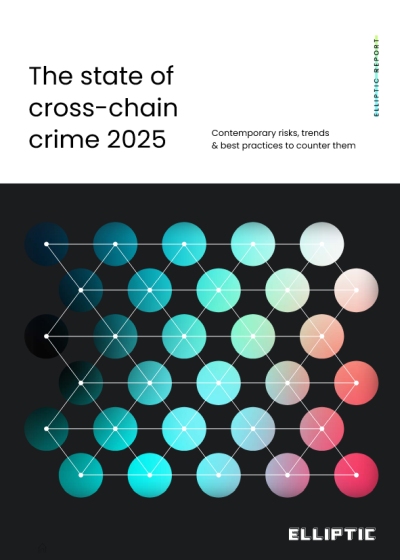
Image: The State of Cross Chain Crime in 2025 (Elliptic Report Cover)
Just in, according to Elliptic’s State of Cross-Chain Crime 2025 report, illegal activity involving decentralized exchanges, bridges, and swap services reached $21.8 billion in 2025 so far, more than 3x the figure in 2023 ($7 billion) and 5x in 2022 ($4 billion). This trend highlights how criminals are exploiting DEXs, cross-chain bridges, and coin swap services to hide money transfers across multiple blockchains.
Elliptic reports that 33% of complex crypto crime investigations use more than 3 blockchains. Another 27% involve over 5 blockchains, while 20% span more than 10. Chain-hopping is a technique that allows criminals, both big and small, to move assets quickly from one chain to another to confuse investigators.
In one confirmed case, a North Korean related wallet moved stolen funds through Bitcoin, Ethereum, Arbitrum, Base, and Tron, all in succession with that single operation using a total of 48 coordinated swaps.
Coin swap platforms have become a preferred laundering tool for ransomware groups, darknet markets, and offshore gambling operations. Unlike DEXs or bridges, these services are centralized, often use privacy-focused Telegram chat service, and allow anonymous swaps between chains with no KYC.
Some operate in regions under sanctions, including Crimea. Elliptic also confirmed that North Korean hackers laundered $200 million of the $1.46 billion Bybit theft through a service called eXch. The platform refused to cooperate with law enforcement and was later shut down by German and Dutch authorities.
Many of the methods used by criminals involve a mix of asset swaps, bridges, gas fee financing, and privacy coins. Elliptic's report confirms that over 300 bridge combinations are being traced automatically using virtual value transfer events (VVTEs), a forensic analytics method developed by Elliptic to automatically trace the source and destination of cross-chain transactions, especially those that pass through bridges.
This automation is a lifeline to investigations and allows regulators, compliance teams, and law enforcement to trace cross-chain fund flows in seconds instead of hours. Elliptic now supports more than 50 blockchains, making it one of the most comprehensive tools available for risk detection.
The scale and speed of illicit activity are outpacing traditional compliance methods. Without updated tools and policies, Canadian fintechs and financial institutions face rising legal, reputational, and regulatory risk. It feels like we've been saying this for a while now, but the use of advanced tracking, wallet screening, and automated compliance solutions are no longer optional, and in fact essential for protecting the integrity of Canada's growing digital finance sector.
The National Crowdfunding & Fintech Association (NCFA Canada) is a financial innovation ecosystem that provides education, market intelligence, industry stewardship, networking and funding opportunities and services to thousands of community members and works closely with industry, government, partners and affiliates to create a vibrant and innovative fintech and funding industry in Canada. Decentralized and distributed, NCFA is engaged with global stakeholders and helps incubate projects and investment in fintech, alternative finance, crowdfunding, peer-to-peer finance, payments, digital assets and tokens, artificial intelligence, blockchain, cryptocurrency, regtech, and insurtech sectors. Join Canada's Fintech & Funding Community today FREE! Or become a contributing member and get perks. For more information, please visit: www.ncfacanada.org
| | |
|---|---|---|
| | |
AI | July 16, 2025
On July 15, 2025, Anthropic announced the release of Claude for Financial Services, a new intelligent platform that helps analysts, underwriters, investors, and fintech teams process complex data, build financial models, and make faster decisions. It can connect to common data platforms like Snowflake, Capital IQ, PitchBook, and Databricks, and provides users with real-time access to the data, including links to the original source data for verification.
Unlike general AI tools, Claude was specifically built for financial use, so it supports high data volume work requests, understands market data, and provides results that can be audited and explained.
Claude's financial service platform is already being used by Bridgewater, NBIM, AIG, and Commonwealth Bank of Australia to name just a few.
Consulting partners such as Deloitte, KPMG, PwC, and Tribe AI are offering onboarding support and custom use cases for Claude. These include regulatory compliance, private credit modeling, deal analysis, and insurance operations.
Claude helps reduce manual work and improves analysis across research, compliance, and investment workflows. It can summarize earnings calls, review investor filings, generate Python or Excel models, compare financial metrics across companies, and produce complete investment memos with source references. Risk teams can run simulations such as Monte Carlo models, while underwriters and portfolio managers can automate routine data reviews and compliance tasks.
At this point, it's almost better to ask what can Claude not do for financial and investment teams! All work is kept private by default, and Claude does not learn/train from it's user's data, which is a critical point.
And did we mention that verification source links are provided with every response, so accuracy can be confirmed and peace of mind had.
In benchmark tests by Vals AI, Claude Opus 4 outperformed other AI models in finance specific tasks. It also scored 83% on advanced Excel modeling exercises modeled after the Financial Modeling World Cup, passing 5 of 7 levels.
NBIM, Norway’s sovereign wealth fund, reported significant gains in productivity after deploying Claude.
Nicolai Tangen, CEO, NBIM:
“Claude has fundamentally transformed the way we work at NBIM. With Claude, we estimate that we have achieved ~20% productivity gains — equivalent to 213,000 hours. Our portfolio managers and risk department can now seamlessly query our Snowflake data warehouse and analyze earnings calls with unprecedented efficiency.”
AIG also reported improved accuracy and faster turnaround in its underwriting process.
Peter Zaffino, CEO, AIG:
“With the incorporation of Claude's advanced capabilities into our underwriting process, we have been able to compress the timeline to review business by more than 5x in our early rollouts while simultaneously improving our data accuracy from 75% to over 90%.”
Aaron Linsky, CTO at Bridgewater’s AIA Labs, Claude powered the first versions of their in-house research assistant.
“Claude powered the first versions of our Investment Analyst Assistant, which streamlined our analysts’ workflow by generating Python code, creating data visualizations, and iterating through complex financial analysis tasks with the precision of a junior analyst.”
Claude for Financial Services is available now through the AWS Marketplace, which streamlines purchase for firms already using Amazon Web Services. It will also be listed on the Google Cloud Marketplace in the coming weeks.
Anthropic hasn't published fixed pricing just yet. Instead, firms must get in touch with sales for tailored proposals likely based on usage, integrations, and number of users. Fintech companies can also access Claude through API to build custom applications for underwriting, onboarding, or data transformation.
Financial companies are under pressure to go faster while staying accurate and compliant. Claude is now offering them a tool that works with their existing platforms while increasing productivity while ensuring auditability and traceability. Now that enterprise organizations have verified performance metrics, Claude is positioning itself to become a key part of how financial professionals manage their data and make decisions.
The National Crowdfunding & Fintech Association (NCFA Canada) is a financial innovation ecosystem that provides education, market intelligence, industry stewardship, networking and funding opportunities and services to thousands of community members and works closely with industry, government, partners and affiliates to create a vibrant and innovative fintech and funding industry in Canada. Decentralized and distributed, NCFA is engaged with global stakeholders and helps incubate projects and investment in fintech, alternative finance, crowdfunding, peer-to-peer finance, payments, digital assets and tokens, artificial intelligence, blockchain, cryptocurrency, regtech, and insurtech sectors. Join Canada's Fintech & Funding Community today FREE! Or become a contributing member and get perks. For more information, please visit: www.ncfacanada.org
| | |
|---|---|---|
| | |
Open Banking | July 15, 2025

Image: Freepik
On July 11, 2025, Reuters reported that JPMorgan Chase is planning to charge fintechs for access to customer data (subscription required) through its APIs, starting in September. The aggressive announcement by by a major U.S. bank to charge and control data access generated immediate pushback from fintech platforms and open banking advocates, as highlighted on Payments Drive.
Steve Boms, executive director of the Financial Data and Technology Association North America:
“It’s hard to look at this decision by Chase as anything other than a cynical attempt to take advantage of regulatory uncertainty and an about-face by the CFPB. I think they’re banking on the court throwing the rule out.”
Penny Lee, Chief Executive of the Financial Technology Association:
Americans deserve the “freedom” to control their financial data. Charging for financial data access undermines that freedom and threatens to jeopardize millions of Americans’ access to the financial services of their choice. This action is designed to crush competition, hold back American innovation, and lock consumers into bank-only products.”
Open banking is designed to put consumers in control of their own financial data. But JPMorgan has another idea; charging fintechs to access customer data when open banking rules are not not clearly regulated, and in doing so, incumbent banks can continue to control terms that limit competition.
In Canada, this issue is highly relevant for it's proposed Consumer-Directed Finance or open banking framework to be implemented and overseen by the Financial Consumer Affairs Authority (FCAC) in 2026. While Canada’s upcoming framework mandates data sharing and prohibits fees for baseline access by accredited firms, it has not yet been implemented in law. Until then, banks could continue using private agreements that include fees or restrictive terms.
Without legislation or regulatory direction, banks are free to protect their dominant positions by pricing out smaller fintechs or forcing bilateral contracts.
This strengthens the importance of Canada finalizing its open banking rules with clear and enforceable standards that prevent data paywalls.
Fintech competitiveness and market access are at risk. If fees for data access take hold more broadly, it could shift the balance of fintech innovation away from consumer-focused tools towards banking ecosystems, which would limit diversity and competition.
In the UK, the Competition and Markets Authority mandates that large banks provide access to current account data at no cost through standardized APIs, under the Open Banking Implementation Entity. This has led to a dynamic fintech ecosystem where consumers can safely and easily share data across apps and services.
In Australia, the Consumer Data Right (CDR) goes even further than just banking to include energy and telecommunications. Under CDR rules, banks must provide access to customer data free of charge, with fees allowed only for optional or value-added services.
In contrast, both the U.S. and Canada have not yet fully implemented open banking frameworks. In the U.S., the Consumer Financial Protection Bureau (CFPB) proposed Section 1033 to support consumer data rights, but no binding national law exists. And to make matters worse, under the Trump-appointed CFPB, they effectively killed off the open banking rule as proposed, adopting the banks’ legal argument that the rule was beyond its authority and should be invalidated by the court. So without any protective data sharing framework, banks in the U.S. can act unilaterally in their favour..
If large incumbent banks like JPMorgan are allowed to set fees or gatekeep data access, consumer choice suffers and fintech innovation slows. As NCFA has advocated for years, Canadian regulators and policymakers must move urgently to finalize a national open banking framework that guarantees:
If we don't act now, the same risks and fragmentation now emerging in U.S. markets will further stifle productivity, innovation, and competition in Canada.
The National Crowdfunding & Fintech Association (NCFA Canada) is a financial innovation ecosystem that provides education, market intelligence, industry stewardship, networking and funding opportunities and services to thousands of community members and works closely with industry, government, partners and affiliates to create a vibrant and innovative fintech and funding industry in Canada. Decentralized and distributed, NCFA is engaged with global stakeholders and helps incubate projects and investment in fintech, alternative finance, crowdfunding, peer-to-peer finance, payments, digital assets and tokens, artificial intelligence, blockchain, cryptocurrency, regtech, and insurtech sectors. Join Canada's Fintech & Funding Community today FREE! Or become a contributing member and get perks. For more information, please visit: www.ncfacanada.org
| | |
|---|---|---|
| | |
Crypto Policy | July 15, 2025

Image: Freepik
This week, the U.S. House of Representatives is organizing a series of votes on three major cryptocurrency bills. American lawmakers are calling this “Crypto Week” because the outcome of debated decisions will likely impact digital assets and the future of crypto for years to come.
Included this week is how crypto and stablecoins are regulated,= and whether the U.S. government can issue its own central bank digital currency (CBDC). The outcome of course may influence how other countries including Canada approach regulation and innovation in the crypto-driven fintech sector.
Despite some chop in markets at these prices, Bitcoin rose to over US$123,000 on Monday, recording another new all time high as investors were drawn to the crypto policy news and congressional process taking place in the U.S., after years of regulation by enforcement. Investors see these bills as a clear sign that the U.S. will finally bring clarity to crypto regulation. There's also been steady growing demand and support from institutions, including companies like BlackRock, MicroStrategy and the list goes on.
This bill aims to define the roles of the Securities and Exchange Commission (SEC) and the Commodity Futures Trading Commission (CFTC). It would also allow some crypto projects to operate without registering as securities, if they meet certain technical standards.
This bill sets clear rules for companies that want to issue stablecoins. It requires 1:1 reserves in U.S. dollars or similarly defined safe assets, and also expands financial reporting and compliance rules for issuers.
This bill would block the U.S. Federal Reserve from launching a digital dollar. It says only Congress can approve a U.S. CBDC and aims to stop the central bank from using it to monitor or influence spending.
Votes are scheduled throughout the week, with final decisions on the CLARITY and Anti-CBDC bills expected by Thursday, and the GENIUS Act vote likely on Friday.
The U.S. is Canada’s closest financial partner. If Congress passes new laws that support crypto innovation while protecting consumers, it could set a standard for others to follow. A stablecoin framework in the U.S. could push Canadian regulators to accelerate efforts of their own.
Cross border and global fintech companies will benefit from clearer rules in the U.S., opening doors for new investment and partnerships. And as more large players move into crypto under a stable legal framework, Canada’s own financial institutions will face increasing pressure to compete.
The momentum is real. If these bills pass, the U.S. will take a significant leap towards a national digital policy. Canadian fintech leaders, investors and regulators must pay attention.
The National Crowdfunding & Fintech Association (NCFA Canada) is a financial innovation ecosystem that provides education, market intelligence, industry stewardship, networking and funding opportunities and services to thousands of community members and works closely with industry, government, partners and affiliates to create a vibrant and innovative fintech and funding industry in Canada. Decentralized and distributed, NCFA is engaged with global stakeholders and helps incubate projects and investment in fintech, alternative finance, crowdfunding, peer-to-peer finance, payments, digital assets and tokens, artificial intelligence, blockchain, cryptocurrency, regtech, and insurtech sectors. Join Canada's Fintech & Funding Community today FREE! Or become a contributing member and get perks. For more information, please visit: www.ncfacanada.org
| | |
|---|---|---|
| | |
Research | July 14, 2025

Image: Freepik/stockking
A new study from MIT and partner universities, "Your Brain on ChatGPT" shows that using ChatGPT during essay writing reduces brain activity, memory recall, and feelings of ownership over the work. The study included EEG scans, human interviews, and AI scoring, and concluded that essays completed with the help of ChatGPT often looked polished, they led to lower mental effort and weakened learning.
The findings are red flags for any parent with kids in school using ChatGPT frequently for tasks AND also professionals in other sectors including fintech that rely on chatGPT for everyday tasks.
Brain scans showed that students using ChatGPT had the lowest levels of brain connectivity, especially in the alpha and beta frequency bands. These waves are linked to attention and executive thinking. Students who wrote without tools had the strongest brain engagement (See: Figure 1, pg 1).
This takeaway is particularly shocking. After writing, 83% of ChatGPT users couldn’t quote anything from their essays, and none could quote accurately. Only 11% of the students using search engines or writing without tools had the same issue (See: pg 31).
Only 50% of the ChatGPT group said the work felt like theirs. Of course almost all students in the 'brain only' group said they fully owned their writing (See: pg 32).
The AI essays often use the same phrases, structure, and focus on the same topics. The Natural Language Processing analysis shows that the variety of words used and topics explored were much lower than in essays written without AI support (See: Summary of Results, pg 3).
Although essays written with the help of ChatGPT received high marks from both human and AI judges, they lacked strategic integration and complex thinking. The authors called this a “surface benefit with hidden costs” (See: pg 3).
The learnings from this study directly impact financial technology companies. Many roles in fintech now rely on daily interaction and use of generative AI tools like ChatGPT, Gemini, Claude, Grok, or Amazon's Nova. While these tools boost speed and productivity, they will likely lead to reduced learning, memory loss, and lower capacity to make effective decisions over time. Below are five examples of how this could play out in a fintech business setting.
Human call centre support agents that rely too much on AI to provide customers with quick and accurate responses, could find that they lose their ability to explain policies clearly, troubleshoot issues, or respond creatively.
If supporting complex financial products, this type of low recall and engagement ability is a risk.
Analysts using LLMs to write summaries or market updates may understand less of the data they’re reporting. Over time, this reduces their ability to identify trends, make forecasts, or provide insightful context beyond what AI benchmarking provides.
PMs who use ChatGPT to write roadmaps, product and UI/UX specs could find themselves suddenly missing the deep thinking needed to balance tech feasibility, user needs, and regulation. AI can help write the document but a less than focused PM may not fully get the reasoning behind it.
Compliance staff using AI to draft internal policies could easily miss critical legal nuances. A polished draft that's considered 'confidently complete' by ChatGPT could contain subtle errors or regulatory gaps, causing major issues or backlash.
Entry-level staff using ChatGPT to write emails, explain APIs, or summarize client meetings might look super productive but are learning less. If that's the case, then their reliance on ChatGPT will weaken their longer term skill growth and reduces the quality of future fintech leadership.
High-quality output without high-quality thinking may look efficient but can quietly lower capability.
This study shows that while ChatGPT improves the speed and polish of writing, it comes at a cost. Users are less mentally engaged, remember less of what they create/co-create, and feel less connected to their work.
In fintech, similar over reliance on chatGPT for writing could lead to weaker analysis, skill development, and reduced capacity to do regular job-orientated tasks. Fintechs should keep their brains are sharp as possible, or develop AI systems/tools that augment human thinking, not replace it.
The National Crowdfunding & Fintech Association (NCFA Canada) is a financial innovation ecosystem that provides education, market intelligence, industry stewardship, networking and funding opportunities and services to thousands of community members and works closely with industry, government, partners and affiliates to create a vibrant and innovative fintech and funding industry in Canada. Decentralized and distributed, NCFA is engaged with global stakeholders and helps incubate projects and investment in fintech, alternative finance, crowdfunding, peer-to-peer finance, payments, digital assets and tokens, artificial intelligence, blockchain, cryptocurrency, regtech, and insurtech sectors. Join Canada's Fintech & Funding Community today FREE! Or become a contributing member and get perks. For more information, please visit: www.ncfacanada.org
| | |
|---|---|---|
| | |
Agentic AI | July 14, 2025

Image: Freepik AI
Last Friday several outlets reported that Goldman Sachs is now using an AI software engineer named Devin. Now it may seem like what's the big deal here, everyone is using AI engineers, but this is a major U.S. bank, and Goldman says some developer teams using Devin are already producing 3x to 4x more output.
This is not a trial in a lab. It is a working system inside the bank. According to AInvest, Goldman has about 12,000 developers deployed across hundreds of teams (read 'at risk'). It's one of the first major publicly known cases of a major financial institution putting AI to work in a coding production environment.
Devin can complete full software tasks. It can set up development environments, run scripts, write and test code, and fix bugs on its own. It's agentic AI and can do these things without being told what to do at each step.
Having said that, it doesn't mean it always works (just yet). As reported by Fast Company, when Cognition Labs tested Devin, it only succeeded 3 out of 30 GitHub problems. That’s why Goldman still needs human developers to supervise the output currently. Teams check the code for accuracy and make sure it’s secure, and reviewed before it gets deployed.
Goldman is sending a clear message that AI tools are delivering measurable gains. Some software teams are producing three to four times more than before, and tools like the GS AI Assistant are already being used by 10,000 employees at Goldman for non-coding tasks. Any company that ignores AI now, seemingly will only fell behind on speed, output, and efficiency.
With Devin handling routine tasks, developers are now spending more time reviewing code, planning architecture, and testing fringe use cases, which are all tasks more valuable to the final product experience than basic coding (warning to junior developers).
So, companies must rethink how they hire, train, and structure their technical teams to focus on oversight and system integration.
Devin is currently a closed, proprietary tool unavailable to the public. It's also expensive and under NDA. That leaves smaller firms with0ut access and at a disadvantage. Canadian fintechs should be piloting open or commercial agent-based tools or partner with AI providers that offer more access to remain competitive.
AI code can fail spectacularly if unreviewed by a human currently. This can lead to security holes and/or logic gaps. Canadian companies also need human engineers to oversee similar governance, such as audits, version controls, quality assurance gates, and compliance reviews.
Not too long ago, we said the 'robots were here'! Well now Goldman is using AI to write their banking production code. Productivity is rising but it comes with new risks. Roles are changing, and oversight and governance is critical. Canadian financial technology companies must not fall too far behind. Those that jump in now will likely be in a better position to compete later.
The National Crowdfunding & Fintech Association (NCFA Canada) is a financial innovation ecosystem that provides education, market intelligence, industry stewardship, networking and funding opportunities and services to thousands of community members and works closely with industry, government, partners and affiliates to create a vibrant and innovative fintech and funding industry in Canada. Decentralized and distributed, NCFA is engaged with global stakeholders and helps incubate projects and investment in fintech, alternative finance, crowdfunding, peer-to-peer finance, payments, digital assets and tokens, artificial intelligence, blockchain, cryptocurrency, regtech, and insurtech sectors. Join Canada's Fintech & Funding Community today FREE! Or become a contributing member and get perks. For more information, please visit: www.ncfacanada.org
| | |
|---|---|---|
| | |


August 26th, 2025

January 4th, 2024

June 1st, 2021

September 9th, 2020

July 9th, 2018

January 3rd, 2018

September 25th, 2017

June 20th, 2017

May 10th, 2017

December 14th, 2016