



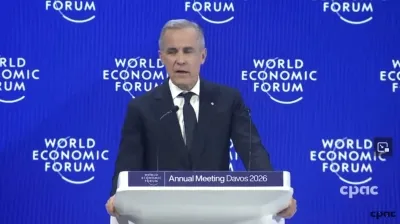

Karsten Wenzlaff, Advisor
August 26th, 2025
Karsten Wenzlaff is a Crowdfunding and Fintech Expert from Germany. He is Secretary-General of Digit[...]


Finextra | Jan 22, 2020
 While technology has yet again been a central topic of discussion at this year’s World Economic Forum in Davos, Switzerland, there has also been a determined focus on fintech and how financial inclusion is key to meeting the UN’s Sustainable Development Goals by 2030.
In conversation with Finextra, Haus of Fintech founder Misha Rao highlights that the recent formation of the Digital Financing Task Force by the UN Secretary General, as well as the need to ensure the financing of the SDGs - which has a $2.5 trillion annual financing gap -
"it is time to actively question how we catalyse the fintech ecosystem globally and build coalitions and strategic partnerships that come up with practical solutions and ensure prosperity is widely shared on a local and an international level."
Rao continues: "We know that digital finance initiatives could add $3.7 trillion to the GDP of emerging economies and organisations including the United Nations, the World Bank, and the World Economic Forum have invested in fintech, believing that it has the potential to create a better world.
"We believe that core areas like the need for resilient financial market infrastructures, enhanced distribution of foreign aid, eradicating poverty, economic and individual rights, and remittances are areas where fintech can contribute most meaningfully."
40 leading banks from across five continents and representing $16 trillion in assets, are collectively redefining the role played by banks in order to align the sector with the UN SDGs, which have set ambitious targets to deliver a sustainable future for all. As two thirds of worldwide finance is provided by banks, the global banking system will be instrumental in achieving these goals, Rao explains.
"Fintech companies are innovating through new value propositions, including flexible products and better ways to address the financial challenges faced by low-income customers. They are also building the groundwork—including easier digital identity verification, alternative lending platforms, data sharing, and new payment systems— that has resulted to a set of new financial services," she adds.
With Haus of Fintech, Rao's mission is "to bridge the gap between the worlds of fintech and organisations that are dedicated to making a difference in the lives of the most vulnerable and underserved communities. By harnessing the resources of the private sector, the reach of the public sector, the expertise of academia and the disruption and innovation of fintech, we are able to work together to bring financial services and products to those who need it most, which drive greater economic opportunity, access to new capital, the creation of new jobs and most importantly give them the opportunity to live a life of dignity and access to economic opportunity."
Dr. Jemilah Mahmood, under secretary general partnerships at the International Federation of Red Cross & Red Crescent Societies, a Haus of Fintech partner, tells Finextra that fintech “has helped evolve financial inclusion beyond the simplistic idea of having a bank account.
“It has placed financial services literally in the palms of those who were previously marginalised and underserved. But questions remain on the ethics of experimentation and shared value collaboration between humanitarian actors and private partners.”
In 2020, the fintech industry will need to engage an entire system of approaches and reduce the number of siloed innovations that are emerging. “Fintech will also drive the significance of having sovereign digital identities for undocumented populations,” – providing a legal identity for all was promised as part of Goal 16 of the UN SDGs.
Focusing on Dr. Mahmood’s point on “the ethics of experimentation”, while data is increasingly prevalent in the digital world of today, the threat of data breaches, identity theft and fake news is resulting in consumer distrust.
 The National Crowdfunding & Fintech Association (NCFA Canada) is a financial innovation ecosystem that provides education, market intelligence, industry stewardship, networking and funding opportunities and services to thousands of community members and works closely with industry, government, partners and affiliates to create a vibrant and innovative fintech and funding industry in Canada. Decentralized and distributed, NCFA is engaged with global stakeholders and helps incubate projects and investment in fintech, alternative finance, crowdfunding, peer-to-peer finance, payments, digital assets and tokens, blockchain, cryptocurrency, regtech, and insurtech sectors. Join Canada's Fintech & Funding Community today FREE! Or become a contributing member and get perks. For more information, please visit: www.ncfacanada.org
 |  |  |
|---|---|---|
 |  |  |
World Economic Forum | Yuval Harari | Jan 24, 2020

As we enter the third decade of the twenty-first Century, humanity faces so many issues and questions, that it is really hard to know what to focus on. So I would like to use the next twenty minutes to help us focus of all the different issues we face. Three problems pose existential challenges to our species.
These three existential challenges are nuclear war, ecological collapse and technological disruption. We should focus on them.
Now nuclear war and ecological collapse are already familiar threats, so let me spend some time explaining the less familiar threat posed by technological disruption.
In Davos we hear so much about the enormous promises of technology – and these promises are certainly real. But technology might also disrupt human society and the very meaning of human life in numerous ways, ranging from the creation of a global useless class to the rise of data colonialism and of digital dictatorships.
Automation will soon eliminate millions upon millions of jobs, and while new jobs will certainly be created, it is unclear whether people will be able to learn the necessary new skills fast enough. Suppose you are a fifty-years-old truck driver, and you just lost your job to a self-driving vehicle. Now there are new jobs in designing software or in teaching yoga to engineers – but how does a fifty-years-old truck driver reinvent himself or herself as a software engineer or as a yoga teacher? And people will have to do it not just once but again and again throughout their lives, because the automation revolution will not be a single watershed event following which the job market will settle down, into a new equilibrium. Rather, it will be a cascade of ever bigger disruptions, because AI is nowhere near its full potential.
Old jobs will disappear, new jobs will emerge, but then the new jobs will rapidly change and vanish. Whereas in the past human had to struggle against exploitation, in the twenty-first century the really big struggle will be against irrelevance. And it is much worse to be irrelevant than exploited.
Those who fail in the struggle against irrelevance would constitute a new “useless class” – people who are useless not from the viewpoint of their friends and family, but useless from the viewpoint of the economic and political system. And this useless class will be separated by an ever-growing gap from the ever more powerful elite.
In the nineteenth Century, a few countries like Britain and Japan industrialized first, and they went on to conquer and exploit most of the world. If we aren’t careful, the same thing will happen in the twenty-first century with AI.
We are already in the midst of an AI arms-race, with China and the USA leading the race, and most countries being left far far behind. Unless we take action to distribute the benefit and power of AI between all humans, AI will likely create immense wealth in a few high-tech hubs, while other countries will either go bankrupt or become exploited data-colonies.
Now we aren’t talking here about a science fiction scenario of robots rebelling against humans. We are talking about far more primitive AI, which is nevertheless enough to disrupt the global balance.
Just think what will happen to developing economies once it is cheaper to produce textiles or cars in California than in Mexico? And what will happen to politics in your country in twenty years, when somebody in San Francisco or Beijing knows the entire medical and personal history of every politician, every judge and every journalist in your country, including all their sexual escapades, all their mental weaknesses and all their corrupt dealings? Will it still be an independent country or will it become a data-colony?
When you have enough data you don't need to send soldiers, in order to control a country.
This danger can be stated in the form of a simple equation, which I think might be the defining equation of life in the twenty-first century:
B x C x D = AHH!
Which means? Biological knowledge multiplied by computing power multiplied by data equals the ability to hack humans, ahh.
If you know enough biology and have enough computing power and data, you can hack my body and my brain and my life, and you can understand me better than I understand myself. You can know my personality type, my political views, my sexual preferences, my mental weaknesses, my deepest fears and hopes. You know more about me than I know about myself. And you can do that not just to me, but to everyone.
A system that understands us better than we understand ourselves can predict our feelings and decisions, can manipulate our feelings and decisions, and can ultimately make decisions for us.
Now in the past, many governments and tyrants wanted to do it, but nobody understood biology well enough and nobody had enough computing power and data to hack millions of people. Neither the Gestapo nor the KGB could do it. But soon at least some corporations and governments will be able to systematically hack all the people. We humans should get used to the idea that we are no longer mysterious souls – we are now hackable animals. That's what we are.
The power to hack humans can be used for good purposes – like providing much better healthcare. But if this power falls into the hands of a twenty-first-century Stalin, the result will be the worst totalitarian regime in human history. And we already have a number of applicants for the job of twenty-first-century century Stalin.
Just imagine North Korea in twenty years, when everybody has to wear a biometric bracelet which constantly monitors your blood pressure, your heart rate, your brain activity twenty-four hours a day. You listen to a speech on the radio by the great leader and they know what you actually feel. You can clap your hands and smile, but if you're angry, they know, you'll be in the gulag tomorrow.
And if we allow the emergence of such total surveillance regimes, don’t think that the rich and powerful in places like Davos will be safe, just ask Jeff Bezos. In Stalin’s USSR, the state monitored members of the communist elite more than anyone else. The same will be true of future total surveillance regimes. The higher you are in the hierarchy – the more closely you’ll be watched.
Do you want your CEO or your president to know what you really think about them?
So it is in the interest of all humans, including the elites, to prevent the rise of such digital dictatorships. And in the meantime, if you get a suspicious WhatsApp message, from some Prince, don't open it.
Now if we indeed prevent the establishment of digital dictatorships, the ability to hack humans might still undermine the very meaning of human freedom. Because as humans will rely on AI to make more and more decisions for us, authority will shift from humans to algorithms and this is already happening.
Already today billions of people trust the Facebook algorithm to tell us what is new, the Google algorithm tells us what is true, Netflix tells us what to watch, and the Amazon and Alibaba algorithms tell us what to buy.
In the not-so-distant future, similar algorithms might tell us where to work and who to marry, and also decide whether to hire us for a job, whether to give us a loan, and whether the central bank should raise the interest rate.
And if you ask why you were not given a loan, and why you the bank didn't raise the interest rate the answer will always be the same – because the computer says no. And since the limited human brain lacks sufficient biological knowledge, computing power and data – humans will simply not be able to understand the computer’s decisions.
So even in supposedly free countries, humans are likely to lose control over our own lives and also lose the ability to understand public policy.
Already now how many humans understand the financial system? Maybe one percent to be very generous. In a couple of decades, the number of humans capable of understanding the financial system will be exactly zero.
Now we humans are used to thinking about life as a drama of decision-making. What will be the meaning of human life, when most decisions are taken by algorithms? We don’t even have philosophical models to understand such an existence.
The usual bargain between philosophers and politicians is that philosophers have a lot of fanciful ideas, and politicians basically explain that they lack the means to implement these ideas. Now we are in an opposite situation. We are facing philosophical bankruptcy.
The twin revolutions of infotech and biotech are now giving politicians the means to create heaven or hell, but the philosophers are having trouble conceptualizing what the new heaven and the new hell will look like. And that’s a very dangerous situation.
If we fail to conceptualize the new heaven quickly enough, we might be easily misled by naïve utopias. And if we fail to conceptualize the new hell quickly enough, we might find ourselves entrapped there with no way out.
In the coming decades, AI and biotechnology will give us godlike abilities to reengineer life, and even to create completely new life-forms. After four billion years of organic life shaped by natural selection, we are about to enter a new era of inorganic life shaped by intelligent design.
Our intelligent design is going to be the new driving force of the evolution of life and in using our new divine powers of creation we might make mistakes on a cosmic scale. In particular, governments, corporations and armies are likely to use technology to enhance human skills that they need – like intelligence and discipline – while neglecting other humans skills – like compassion, artistic sensitivity and spirituality.
The result might be a race of humans who are very intelligent and very disciplined but lack compassion, lack artistic sensitivity and lack spiritual depth. Of course, this is not a prophecy. These are just possibilities. Technology is never deterministic.
In the twentieth century, people used the same industrial technology to build very different kinds of societies: fascist dictatorships, communist regimes, liberal democracies. The same thing will happen in the twenty-first Century.
AI and biotech will certainly transform the world, but we can use them to create very different kinds of societies. And if you're afraid of some of the possibilities I’ve mentioned, you can still do something about it. But to do something effective, we need global cooperation.
Whenever a leader says something like “My Country First!” we should remind that leader that no nation can prevent nuclear war or stop ecological collapse by itself, and no nation can regulate AI and bioengineering by itself.
Almost every country will say: “Hey, we don’t want to develop killer robots or to genetically engineer human babies. We are the good guys. But we can't trust our rivals not to do it. So we must do it first”.
If we allow such an arms race to develop in fields like AI and bioengineering, it doesn’t really matter who wins the arms race – the loser will be humanity.
Unfortunately, just when global cooperation is more needed than ever before, some of the most powerful leaders and countries in the world are now deliberately undermining global cooperation. Leaders like the US president tell us that there is an inherent contradiction between nationalism and globalism, and that we should choose nationalism and reject globalism.
But this is a dangerous mistake. There is no contradiction between nationalism and globalism. Because nationalism isn’t about hating foreigners. Nationalism is about loving your compatriots. And in the twenty-first century, in order to protect the safety and the future of your compatriots, you must cooperate with foreigners.
So in the twenty-first century, good nationalists must be also globalists. Now globalism doesn’t mean establishing a global government, abandoning all national traditions, or opening the border to unlimited immigration. Rather, globalism means a commitment to some global rules.
Rules that don’t deny the uniqueness of each nation, but only regulate the relations between nations.
The World Cup is a competition between nations, and people often show fierce loyalty to their national team. But at the same time the World Cup is also an amazing display of global harmony. France can't play football against Croatia unless the French and the Croatians agree on the same rules for the game. And that’s globalism in action.
 The National Crowdfunding & Fintech Association (NCFA Canada) is a financial innovation ecosystem that provides education, market intelligence, industry stewardship, networking and funding opportunities and services to thousands of community members and works closely with industry, government, partners and affiliates to create a vibrant and innovative fintech and funding industry in Canada. Decentralized and distributed, NCFA is engaged with global stakeholders and helps incubate projects and investment in fintech, alternative finance, crowdfunding, peer-to-peer finance, payments, digital assets and tokens, blockchain, cryptocurrency, regtech, and insurtech sectors. Join Canada's Fintech & Funding Community today FREE! Or become a contributing member and get perks. For more information, please visit: www.ncfacanada.org
| | |
|---|---|---|
| | |
FT Partners | Jan 2020
 Executive Summary:
The banking sector is experiencing a major shift globally, as Challenger Banks are becoming increasingly formidable competitors to traditional banks and have begun to capture significant market share. Furthermore, the lines between banks and other consumer financial services providers are blurring, with several alternative lenders and robo-advisors beginning to offer banking products to their customers. E-commerce / internet giants are also jumping into the fray with Google and Amazon, among others, beginning to offer banking products. In response to the emergence of Challenger Banks, a number of incumbent banks have launched their own FinTech brands, and traditional financial institutions will likely turn to FinTech solution providers in order to defend their turfs.
The National Crowdfunding & Fintech Association (NCFA Canada) is a financial innovation ecosystem that provides education, market intelligence, industry stewardship, networking and funding opportunities and services to thousands of community members and works closely with industry, government, partners and affiliates to create a vibrant and innovative fintech and funding industry in Canada. Decentralized and distributed, NCFA is engaged with global stakeholders and helps incubate projects and investment in fintech, alternative finance, crowdfunding, peer-to-peer finance, payments, digital assets and tokens, blockchain, cryptocurrency, regtech, and insurtech sectors. Join Canada's Fintech & Funding Community today FREE! Or become a contributing member and get perks. For more information, please visit: www.ncfacanada.org
| | |
|---|---|---|
| | |
McKinsey & Company | Sean Brown and Kevin Laczkowski | Dec 2019
 Resilient companies enjoy gains that last long after an economic crisis has passed.
 We talk with two of our experts about their new research on corporate resilience and what differentiates companies that emerge from economic downturns stronger than they were going in. We'll share insights on preparing your organization for macroeconomic crises and why the next downturn may be very different from earlier ones.
Sean Brown: Kevin, what do you see as the most important first steps in developing such a resilience playbook?
Kevin Laczkowski: You need alignment across the top team. This must be driven from the top down. It has to be a senior management team priority, or it doesn’t work. The second step is setting up the resilience nerve center and staffing it with high performers who can take macroeconomic scenarios, bring them down to the company level, understand how to stress test, and know what interventions and diagnostics the organization needs.
A resilience playbook needs alignment across the top team. It has to be a senior management priority, or it doesn’t work.
Kevin Laczkowski
Sean Brown: Do any other differences stand out to you between today and a decade ago that may make the next downturn distinctive?
Resilients had noticeably stronger divestitures, in particular during the down cycle. They also acquired far more than nonresilients did during the recovery period.
Mihir Mysore
The National Crowdfunding & Fintech Association (NCFA Canada) is a financial innovation ecosystem that provides education, market intelligence, industry stewardship, networking and funding opportunities and services to thousands of community members and works closely with industry, government, partners and affiliates to create a vibrant and innovative fintech and funding industry in Canada. Decentralized and distributed, NCFA is engaged with global stakeholders and helps incubate projects and investment in fintech, alternative finance, crowdfunding, peer-to-peer finance, payments, digital assets and tokens, blockchain, cryptocurrency, regtech, and insurtech sectors. Join Canada's Fintech & Funding Community today FREE! Or become a contributing member and get perks. For more information, please visit: www.ncfacanada.org
| | |
|---|---|---|
| | |
CNBC | Chloe Taylor | Nov 28, 2019
 British lender NatWest has launched a digital bank to compete in the U.K.’s thriving fintech space.
NatWest — a subsidiary of RBS — launched cloud-based bank Bo on Wednesday, with the service going live on both Apple’s App store and Google Play.
Those who sign up to the digital bank will be sent a bright yellow Visa card and access their account via Bo’s mobile app.
Bo was designed to help people manage their money, according to NatWest, and includes features to help users budget, set savings goals and access “great Visa exchange rates” when using their card abroad. Users will also be instantly alerted whenever they use their card.
“As we’re part of NatWest, people can rely on Bo to keep their money safe,” Bo CEO Mark Bailie said in a press release Wednesday. “But as a digital bank, built entirely on a separate cloud-based technology, Bo is also able to harness new technology and develop rapidly in line with our customers’ needs and expectations.”
While banks are under increased pressure to innovate, they’re not facing an existential crisis, Raman Bhatia, HSBC’s head of digital for the U.K. and Europe told CNBC earlier this year. The lenders that will win in the long run, he says, are those that people trust.
“I think one thing which remains a truism is customers do have a very high degree of trust when it comes to money, their deposits and their identity with respect to established banks,” Bhatia said. “And banks need to work harder than ever to preserve that trust.”
But in spite of that advantage, Britain’s challenger banks are continuing to gain both subscribers and investment in droves.
Online-only bank Monzo is valued at $2.5 billion, while its rival Revolut is valued at $1.7 billion, making the companies some of the most valuable unicorn firms in Europe. Elsewhere, SoftBank-backed OakNorth was valued at $2.8 billion in February, while money transfer start-up TransferWise was valued at $3.5 billion this year.
Both banks are setting their sights on global expansion. In October, Revolut struck a deal with Mastercard to help it expand into the U.S., while Monzo launched in the U.S. in June. Meanwhile, U.S. fintech unicorn Plaid has expanded its service across the Atlantic into the U.K., Ireland, France and Spain.
One major lender that has already made some progress in offering a standalone digital service is HSBC, which in 2018 launched a money management app in the U.K. and signed 300,000 people up to the service in the first year.
Oliver Wyman | Nov 2019
 Interview With Mark Bailie, Former Group COO Of Royal Bank Of Scotland And Current CEO Of Bó
Many people in the UK have no savings. They are one misfortune away from being pushed into a debt problem from which they might struggle to return. A large proportion of consumers are either under- or over-insured.
Their financial struggles aren’t being addressed by the existing financial system. RBS concluded that its current attempts to digitize may not be enough, on their own, to address these needs. With the support of Oliver Wyman, RBS decided on taking a new path with a new offering, with a new brand, built on a new technology stack.
Bó represents a new breed of financial institution – a greenfield digital bank owned by an existing incumbent.
From that foundation, there have been two key enablers we’ve needed to help us build Bó; first, having our customer data in one place and really analyzing our customers’ situations in depth. This has allowed us to see some of the issues our customers’ face – and what could be done to help them.
The second enabler came from the growing potential to deliver technology and services at scale, and the rapid development of machine learning, AI, and cloud computing capacity.
When you put these together you see the potential for major changes, and opportunities. We can see a combination of customer need and the potential for highly personalized financial services.
We knew the kind of outcome we wanted would be a long and hard journey for an incumbent bank to deliver, with product-centric legacy infrastructure. So, for us, the question we discussed was, “how long have we got?”
If it's 10 years, you can probably transition the existing core into a truly customer-centric business, because you can do almost anything in 10 years if you're good and you can execute - and we still have a Plan A around this.
But if customers start accelerating their move toward new offerings, and you’re not already operating in that market, then the downside risk is asymmetric. If you don't know the timing, and you can see the potential for a material impact, then you need to cover the risk, so long as the cost is sensible.
Greenfield lets you sidestep the challenge of legacy infrastructure and get to a truly customer-centric offering faster — it’s the pragmatic solution. However, greenfield isn’t a cost-free strategy. It creates other issues, which we’ve got to learn to manage: we will have two tech stacks, and two brands. That has taken a lot of thinking through, and in the end you have to make your choice.
We didn’t wake up one morning and decide, "let's build a new greenfield bank," or, “we're going to spend X, go away and come back when it's done.” This was done in measured but quick, incremental steps.
We took a very small amount of money and gave ourselves three months to see if we could put together a proof of concept, using enough of the components, and make it work. Having done that, we went to the next step, to see if we could make it work in a real-time environment with live connection to payment rails. Once we got there in the time period we’d set, the next step was to put it into a production environment, and then into beta.
So far, we don’t think anyone is managing to deliver truly customer-centric financial services, and no-one's yet proven that you can disintermediate the existing banks. This has led to a relatively common response: “The challengers are never going to make any money, their business model is unsustainable.”
I think that misses the point; it's still a very young sector. Customers are using the new services and capital markets are funding them. The product isn't perfect, but some customers clearly like it, which is why you can see the adoption levels increasing. Although what they're doing today isn't yet the full answer, these business models will evolve and develop over the next five years.
RBS is a large bank, with just under 20 percent of the current account market in the UK. We serve everybody and are able to put together quite a detailed view of how people deal with their finances.
We know that 40 percent of working-age adults in the UK – that’s just under 17 million people – have less than 100 pounds of savings. That’s not just down to incomes – relationships with, and understanding of, money are also factors. So, we see a clear need for services that can help those millions of people to manage their money better, but crucially, delivered in a way they are willing to engage with.
For me, there are three things we have found to be most important.
Number one is having full support from the chief executive and the chairman. Unless the CEO is driving the vision, there’s no point in starting, and the board needs to be willing to back the CEO. If these elements hadn’t been in place, we wouldn’t have started.
The second is, you have to separate it out from the core business, but still ensure the new business has Exco-level sponsorship.
The third thing, when you are a large existing bank, is that you have to build it within your existing risk appetite framework, and it must be aligned with your existing policies. You have to build these things so they can co-exist together in the long term.
The National Crowdfunding & Fintech Association (NCFA Canada) is a financial innovation ecosystem that provides education, market intelligence, industry stewardship, networking and funding opportunities and services to thousands of community members and works closely with industry, government, partners and affiliates to create a vibrant and innovative fintech and funding industry in Canada. Decentralized and distributed, NCFA is engaged with global stakeholders and helps incubate projects and investment in fintech, alternative finance, crowdfunding, peer-to-peer finance, payments, digital assets and tokens, blockchain, cryptocurrency, regtech, and insurtech sectors. Join Canada's Fintech & Funding Community today FREE! Or become a contributing member and get perks. For more information, please visit: www.ncfacanada.org
| | |
|---|---|---|
| | |
The Toronto Centre | Nov 1, 2019

In this webinar, Randee Pavalow, a long-time TC Program Leader, shares her expertise in securities regulation and supervision. The webinar features issues such as the ecosystem and importance of regulatory flexibility, challenges for innovators due to regulation, and challenges for regulators dealing with Fintech solutions with a special focus on sandboxes.
The National Crowdfunding & Fintech Association (NCFA Canada) is a financial innovation ecosystem that provides education, market intelligence, industry stewardship, networking and funding opportunities and services to thousands of community members and works closely with industry, government, partners and affiliates to create a vibrant and innovative fintech and funding industry in Canada. Decentralized and distributed, NCFA is engaged with global stakeholders and helps incubate projects and investment in fintech, alternative finance, crowdfunding, peer-to-peer finance, payments, digital assets and tokens, blockchain, cryptocurrency, regtech, and insurtech sectors. Join Canada's Fintech & Funding Community today FREE! Or become a contributing member and get perks. For more information, please visit: www.ncfacanada.org
| | |
|---|---|---|
| | |
NCFA | Craig Asano | Nov 1, 2019

NCFA recently sat down with Toronto-based Ledn's CEO and Co-Founder Adam Reeds (LinkedIn) to learn more about the rise of Decentralized Finance (DeFi) and the company's tremendous growth in Latin America.
There are a number of growing DeFi use cases based around blockchain technologies and decentralized networks from the issuance of stablecoins as a means to create monetary banking type services, peer to peer or aggregate lending and borrowing products as well as tokenized platforms all of which are providing underserviced markets with alternative solutions to traditional financial services with fewer intermediaries, lower costs and arguably improved security.
Adam Reeds: Ledn was conceptualized in 2016 after we, as founders, experienced a gap in the market for accessing financing for our bitcoin assets. Bitcoin has several fundamentals that make it very attractive for financing. Bitcoin is non-jurisdictional (it is the same everywhere, globally), has

established market value and trades 24/7, has strong liquidity and is divisible. Yet despite these strong attributes, at the time of conceptualizing Ledn, as still today, there are limited options for financing bitcoin.
From inception, we wanted to be sure that Ledn was accessible to everyone globally. To do so we knew that we had to build a platform that was simple and secure with a strong focus on compliance. We assembled an experienced team of technology, finance, legal and regulatory professionals and set out to build an online platform where individuals and businesses can access financial services for bitcoin.
Ledn’s mission is to help more people save in bitcoin, while standardizing rates and service for financial products globally.
Adam Reeds: Launching from Canada, Ledn now active in 51 countries and has launched 3 products to date.
Its first product is Borrow - a bitcoin-backed loan which allows people to borrow dollars without selling their bitcoin. The second product is Save - a interest-bearing savings account that pays interest on bitcoin, in bitcoin. Its most recent product is B2X - a product that allows customers to instantly double their bitcoin holding by tying the purchase of bitcoin together with a dollar loan.
Given the need for improved financial products in the region, and the background of Ledn’s team, Ledn’s focus market (outside of Canada) has been Latin America and is seeing very strong traction of its products in the region to date. Over 51% of Ledn’s customers are now from Latin America.
Adam Reeds: The great thing about dealing only in bitcoin is that we can treat all of the assets of our customers equally. Given our loans are asset-backed, we do not consider the credit quality of our borrowers in our underwriting. Our qualification in considering who we interact with is completely tied to ensuring we follow Canadian and local laws.
The great thing about dealing only in bitcoin is that we can treat all of the assets of our customers equally.
We abide by the Financial Transactions and Reports Analysis Centre of Canada (“FINTRAC”) regulations with respect to know your customer (“KYC”) and anti-money laundering procedures. We require all of our customers to complete KYC documentation regardless of the amounts we deal with, and consider strong compliance a key factor of our success to date.
Adam Reeds: The economics of the savings account relies on a market demand for borrowing bitcoin. Typically, there are three main use cases for borrowing bitcoin; (1) providing working capital for an exchange that needs to keep a float of bitcoin to facilitate buy-orders, but does want to take bitcoin price risk, (2) facilitating short positions, for proprietary trading firms to bet a price decline in bitcoin or (3) facilitating trading arbitrage opportunities such as differences that exist in the price of bitcoin on various futures markets or exchanges.
The interest rate that Ledn is able to pay on its Savings account is dependent on the demand for the various activities above.
Ledn has had strong uptake in its savings account as it is a complementary product to the loan portfolio - providing a way for users to earn more bitcoin with their bitcoin.
Adam Reeds: Canada’s FINTRAC rules related to AML and KYC were recently updated to include dealers in virtual currency. However, FINTRAC has not yet opened up registration for this activity, as the requirement to register as a Money Service Business (“MSB”) will not come in place until June 1, 2020. Despite the registration not yet being available, we have taken a proactive approach and have built KYC requirements into our technology platform from day one. All of our customers are required to complete KYC documentation to access any of our products.
We also follow and abide by regulations related to consumer protection and private lending activities both in Canada, as well as the local laws for which its customers are resident. On top of it all, we abide by a simple concept - there’s what you have to do, and what you should do - we do what we should do and have enforced strong compliance in all of our technology and processes. We treat our customers fairly, and focus on keeping our products simple and transparent.
Adam Reeds: Most of the world does not have the savings tools that Canadians benefit from. In Canada, we have the luxury of stable real estate and capital markets, and have many options for investing and storing our wealth. For those that lack these savings tools, bitcoin is proving to be an incredible alternative. Ledn is excited by the potential to work with an asset that can unify standards for financial products, and deliver a better experience to people around the globe.
Most of the world does not have the savings tools that Canadians benefit from.
Adam Reeds: The most important thing in a start-up is to start. Great ideas are 10%, execution is 90%. Surround yourself with people that bring diverse skill sets and motivate each other. Each person you add to the team at the beginning of the company will make or break your success. Choose wisely, and for those that agree to join you on the journey, treat them well and align them with what you want to build - as a team.
Along the way, make sure tasks are solved in this order.
Most people forget about the why - it is the most important part.
Canada’s diversity is definitely its strength. Albeit all Canadian citizens, Ledn’s team consists of only one born and raised Canadian, with the rest of our full team originally from Venezuela, Panama, Cuba, Croatia, Egypt and Hong Kong. We are proud to have built Ledn in Canada and to bring our company to the world stage.
Thanks Adam - wishing you and the entire Ledn team all the success at scaling Ledn's model globally!
The National Crowdfunding & Fintech Association (NCFA Canada) is a financial innovation ecosystem that provides education, market intelligence, industry stewardship, networking and funding opportunities and services to thousands of community members and works closely with industry, government, partners and affiliates to create a vibrant and innovative fintech and funding industry in Canada. Decentralized and distributed, NCFA is engaged with global stakeholders and helps incubate projects and investment in fintech, alternative finance, crowdfunding, peer-to-peer finance, payments, digital assets and tokens, blockchain, cryptocurrency, regtech, and insurtech sectors. Join Canada's Fintech & Funding Community today FREE! Or become a contributing member and get perks. For more information, please visit: www.ncfacanada.org
| | |
|---|---|---|
| | |


August 26th, 2025

January 4th, 2024

June 1st, 2021

September 9th, 2020

July 9th, 2018

January 3rd, 2018

September 25th, 2017

June 20th, 2017

May 10th, 2017

December 14th, 2016
