




Karsten Wenzlaff, Advisor
August 26th, 2025
Karsten Wenzlaff is a Crowdfunding and Fintech Expert from Germany. He is Secretary-General of Digit[...]



Event contracts are evolving from niche prediction markets into a regulated market category. The strongest openings may not be operating the markets themselves, but building the integrity, settlement, intelligence, distribution and risk management systems required for the category to scale.
Prediction market and event contract estimates vary because some sources measure revenue, others measure trading volume, decentralized markets, regulated event contracts or broader forecasting activity. The range is wide, but the category appears large enough to support venture scale investigation.
Recent evidence points to a larger infrastructure thesis. Event contracts need systems for market integrity, settlement, probability intelligence, distribution access and enterprise risk use cases. The strongest opportunity may be the trusted operating layer that helps many venues, brokers and data users participate without each rebuilding the same controls.
CFTC event contract decisions, broker access, Canadian distribution, stablecoin settlement activity, sportsbook challenges, enterprise pilots and evidence that buyers will pay for specialized infrastructure.
Evidence now supports five venture paths. These are product directions inside the parent opportunity, not automatic child Opportunity Briefs.
Surveillance, disclosure and outcome disputes
Event contracts are beginning to face the same trust problems that traditional exchanges faced as participation increased. Disclosure concerns, promotion practices, insider information risks, sensitive event pricing and outcome disputes are appearing before common standards have formed.
The opportunity is to help operators manage trust. Potential buyers include exchanges, brokers, operators and compliance teams. The strongest products may focus on surveillance, audit trails, disclosure monitoring, conflict detection and dispute management.
Large exchange surveillance providers extend existing products into event contracts before specialist vendors establish a foothold.
Is the first buyer the operator, broker or compliance function? Is the pain severe enough to create budget now?
Funding, payout and stablecoin workflows
Settlement is becoming a core operating requirement. Stablecoin activity, payout workflows and always available market participation increase the need for reliable funding, custody, reconciliation and settlement rails.
This path may support transaction based revenue if event market activity grows. The challenge is competition from payment providers, stablecoin issuers, custodians and existing financial infrastructure firms.
Existing payment providers absorb most of the value before specialized event market tools gain adoption.
Can the product reduce settlement cost, risk or complexity enough to win budget from operators or brokers?
Forecast signals for investors and operators
Prediction markets can produce forward looking probability signals that traditional datasets often miss. Private market valuation odds, policy forecasts, economic expectations and event risk pricing are early examples.
This path is broader than a data feed. The opportunity is to package probabilities into intelligence products that help investors, enterprises, researchers and operators make decisions. Customers still need proof that the signals improve decisions enough to justify recurring spend.
Forecast signals fail to outperform existing indicators or cannot be packaged into trusted workflows.
Who pays for the signal, and can accuracy, timeliness or decision value be demonstrated over time?
Brokerage, wealth and retail access
Canadian retail distribution, wallet integrations, sports partnerships and operator relaunch activity show that event contracts are moving through channels that already have users, compliance obligations and product discovery workflows.
The opportunity is the access layer around event contracts: brokerage integrations, suitability controls, education, product limits, risk warnings, onboarding, reporting and venue connectivity.
Distribution remains locked inside a small number of large brokers, exchanges or wallet platforms that build the access layer themselves.
Can brokers or wealth platforms justify a specialized event contract access layer rather than relying on venue supplied tools?
Promotion, campaign and business exposure
Event contracts are beginning to appear in practical business settings, including promotion risk management and event exposure. This suggests a possible enterprise use case beyond retail speculation and market forecasting.
The opportunity is infrastructure that helps brands, agencies and enterprises model, cap, transfer or monitor event driven exposure. This remains earlier than the other paths, but it could become a repeatable category if more non financial buyers adopt event contracts for operational risk.
Enterprise use remains a novelty or occasional hedge rather than a repeatable workflow with budget.
Which repeatable enterprise event risks are measurable, hedgeable and large enough to support a dedicated product?
Filter by signal type to review source records, early market signals and thought leadership supporting this opportunity. Evidence is sorted newest to oldest.
Share your perspective, research, case study or video response. You can also express interest in future discussions, collaboration opportunities and innovation activities related to this topic.
Learn how NCFA identifies, validates and tracks innovation opportunities →NCFA Opportunity Intelligence tracks emerging venture opportunities using evidence, market developments and validation signals. Opportunity briefs are updated as new information, evidence and stakeholder perspectives become available. This content is provided for information purposes only and does not constitute legal, investment, financial, tax or professional advice.
 The National Crowdfunding & Fintech Association (NCFA Canada) is a financial innovation ecosystem that provides education, market intelligence, industry stewardship, networking and funding opportunities and services to thousands of community members and works closely with industry, government, partners and affiliates to create a vibrant and innovative fintech and funding industry in Canada. Decentralized and distributed, NCFA is engaged with global stakeholders and helps incubate projects and investment in fintech, alternative finance, crowdfunding, peer-to-peer finance, payments, digital assets and tokens, artificial intelligence, blockchain, cryptocurrency, regtech, and insurtech sectors. Join Canada's Fintech & Funding Community today FREE! Or become a contributing member and get perks. For more information, please visit: www.ncfacanada.org
 |  |  |
|---|---|---|
 |  |  |
Jun 17, 2026

Online casino gaming has become one of the most popular forms of entertainment in Canada. Canadian players have access to thousands of casino games, ranging from classic slot machines and blackjack tables to live dealer experiences that closely replicate the atmosphere of a land-based casino. With so many options available, choosing the best online casino games in Canada can be challenging.
This guide explains everything Canadian players need to know about online casino games, including the most popular game categories, payout percentages, house edges, winning potential, gameplay mechanics, and tips for selecting the right games.
The best online casino games in Canada combine strong payout potential, entertaining gameplay, fair odds, and accessibility across desktop and mobile devices. Canadian players consistently favour the following game categories:
Among all casino games available online, blackjack generally offers the lowest house edge when played with optimal strategy, while slots remain the most popular choice because of their simplicity and massive jackpot opportunities.
Online casino games allow Canadian players to enjoy casino entertainment from virtually anywhere. Modern casino platforms offer thousands of games, fast-loading mobile applications, secure payment methods, and live dealer technology.
Several factors contribute to their popularity:
The growth of regulated online gambling markets, particularly in Ontario, has further increased player confidence in online casino gaming.
Online slots remain the most-played casino games in Canada. Industry sources estimate that slots account for the majority of wagers placed on Canadian online casinos due to their simplicity, variety, and jackpot potential.
Online slots require no prior experience or strategy. Players simply select a bet amount and spin the reels.
Benefits include:
Canadian players frequently enjoy games such as:
Many of these titles offer RTP percentages between 94% and 97%, while some exceed 98%.
Return to Player (RTP) represents the theoretical percentage of wagers returned to players over the long term.
For example:
Higher RTP percentages generally indicate better long-term value.
Blackjack is widely considered the best online casino game in Canada for players seeking favourable odds.
Unlike slots, blackjack involves strategic decision-making that can significantly reduce the house edge.
Blackjack provides:
Experienced players who use basic blackjack strategy can achieve some of the best odds available in any online casino game.
Canadian online casinos commonly offer:
Blackjack strategy focuses on making mathematically optimal decisions based on the dealer's visible card.
Key principles include:
Players who learn these fundamentals can significantly improve their long-term results.
Roulette remains one of the most recognizable casino games in Canada.
The game revolves around predicting where a ball will land on a spinning wheel.
Canadian casinos typically offer:
French Roulette generally provides the best odds because of special rules that reduce the house edge.
Typical house edges include:
For players focused on maximizing value, French Roulette is often the preferred option.
Players can wager on:
This flexibility appeals to both beginners and experienced players.
Baccarat is one of the simplest casino games available online.
The objective is to predict which hand will win:
Baccarat attracts players because:
The Banker bet typically carries a house edge around 1.06%, making it one of the most favourable wagers in online casinos.
The Banker bet consistently offers the strongest mathematical advantage.
Most experts recommend avoiding the Tie bet because of its significantly higher house edge.
Live dealer casino games have experienced significant growth among Canadian players.
These games use real dealers who operate tables through live video streams.
Live dealer games offer:
Popular live games include:
Providers such as Evolution Gaming have become especially popular among Canadian players.
Modern live casinos also offer entertainment-focused game shows such as:
These games combine casino mechanics with television-style presentations.
Video poker combines slot machine mechanics with poker strategy.
Players receive cards and choose which cards to hold before drawing replacements.
Video poker offers:
Some versions of Jacks or Better can achieve RTP figures above 99% when played optimally.
Canadian casinos commonly feature:
Specialty games have become increasingly popular at online casinos.
These games often provide unique gameplay compared to traditional casino titles.
Examples include:
Many younger players enjoy these games because of their fast-paced action and straightforward mechanics.
Players looking for the highest potential returns should focus on games with strong RTP percentages.
| Game | Approximate RTP |
| Video Poker | Up to 99.9% |
| Blackjack | Up to 99.5% |
| Baccarat (Banker Bet) | 98.9% |
| French Roulette | 98.65% |
| High-RTP Slots | 96%–98% |
Higher RTP does not guarantee profits, but it generally improves long-term value.
The best game depends on personal preferences and goals.
Recommended games:
These games require minimal learning.
Recommended games:
These games reward skill and decision-making.
Recommended games:
These titles offer the largest potential payouts.
Recommended games:
Live dealer tables provide the closest experience to a physical casino.
Responsible gambling should always be a priority.
Best practices include:
Canadian players should only play on reputable, licensed casino platforms that provide responsible gambling tools and support resources.
Blackjack is often considered the best online casino game in Canada because it offers one of the lowest house edges when played with proper strategy.
Video poker and blackjack generally provide the highest RTP percentages available at online casinos.
Online slots are the most popular online casino games in Canada because they offer simple gameplay, large jackpots, and thousands of themes.
Baccarat and blackjack are often considered among the safest options because they feature relatively low house edges.
Live dealer games are worth playing for players who enjoy real-time interaction and a more authentic casino experience.
The National Crowdfunding & Fintech Association (NCFA Canada) is a financial innovation ecosystem that provides education, market intelligence, industry stewardship, networking and funding opportunities and services to thousands of community members and works closely with industry, government, partners and affiliates to create a vibrant and innovative fintech and funding industry in Canada. Decentralized and distributed, NCFA is engaged with global stakeholders and helps incubate projects and investment in fintech, alternative finance, crowdfunding, peer-to-peer finance, payments, digital assets and tokens, artificial intelligence, blockchain, cryptocurrency, regtech, and insurtech sectors. Join Canada's Fintech & Funding Community today FREE! Or become a contributing member and get perks. For more information, please visit: www.ncfacanada.org
| | |
|---|---|---|
| | |
June 16, 2025 | NCFA Resource | Risk Compliance And Regtech, Artificial Intelligence And Data, Regulation And Policy
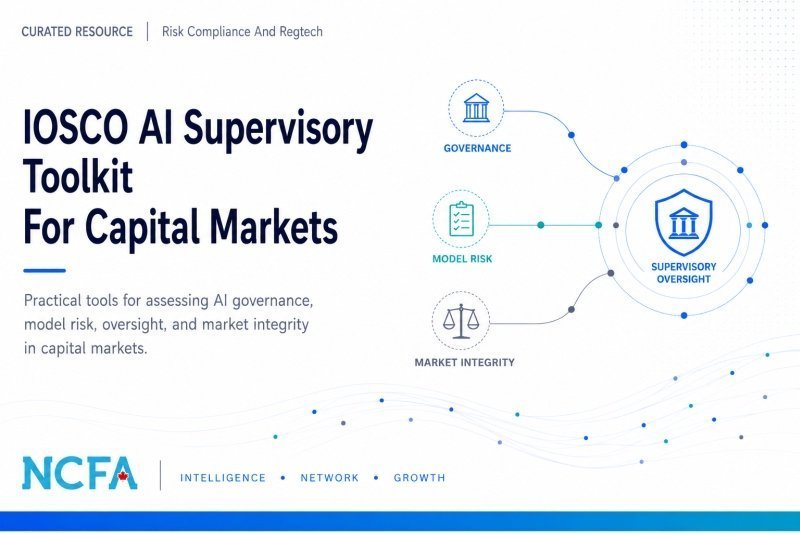
On May 25, 2026, the International Organization of Securities Commissions (IOSCO) published its Supervisory Toolkit for Artificial Intelligence Use in Capital Markets. The report provides practical tools for regulators supervising AI systems used by market participants, exchanges, investment firms, and capital market infrastructure providers.
The toolkit arrives as AI goes beyond experimentation and into production environments across trading, surveillance, compliance, onboarding, fraud detection, customer service, research, risk management, and operational workflows. IOSCO focuses on the supervisory questions regulators need to ask rather than promoting a specific technology approach.
Stakeholder Input Opportunity: IOSCO is also seeking feedback related to the toolkit and AI supervision in capital markets. Interested regulators, market participants, technology providers, academics, and industry stakeholders can review the report and submit responses to IOSCO by this short survey by June 26, 2026.
The report organizes supervision around seven areas. These include governance and accountability, model development and testing, data quality and management, monitoring and controls, outsourcing and third party providers, market conduct risks, and operational resilience.
Rather than prescribing rules, IOSCO provides supervisory questions, review approaches, and practical considerations that regulators can use when assessing AI systems operating in capital markets. The toolkit is designed to support risk based supervision while remaining flexible as technologies evolve.
The report also recognizes that AI risks often emerge from combinations of factors rather than a single model failure. Poor quality data, weak governance, limited oversight, inadequate testing, vendor dependencies, and insufficient monitoring can interact in ways that create market, operational, or investor protection concerns.
Many financial institutions are already deploying AI in regulated environments. The challenge is no longer whether AI will be used. The challenge is whether firms can demonstrate appropriate governance, explainability, oversight, and accountability once those systems affect clients, markets, or investment decisions.
For fintech operators, the toolkit offers a useful preview of the questions regulators may increasingly ask during examinations, supervisory reviews, audits, and risk assessments. Firms that build governance and controls into deployment processes early may face fewer compliance and operational challenges as expectations mature.
This resource is useful for securities regulators, exchanges, investment dealers, fintech founders, regtech providers, compliance teams, AI governance specialists, risk managers, and market infrastructure operators.
It is especially relevant for organizations using AI in trading, surveillance, onboarding, fraud detection, compliance monitoring, client communications, investment research, portfolio management, or operational decision making.
The strength of the toolkit is its practical orientation. It extends beyond high level AI principles and focuses on supervision, controls, accountability, and operational implementation. The framework can be applied across a wide range of AI use cases and organizational structures.
It also provides a common language that regulators and industry participants can use when discussing AI oversight. That consistency becomes increasingly important as firms operate across multiple jurisdictions with different regulatory approaches.
The toolkit does not create binding rules or regulatory obligations. IOSCO's role is to provide guidance and supervisory tools that member jurisdictions can adapt to their own legal and regulatory frameworks.
IOSCO Supervisory Toolkit For AI Use In Capital Markets (primary resource)
IOSCO Media Release (official announcement)
AI Agents Enter Governed Financial Workflows (AI governance and oversight)
Customer Due Diligence Controls For Fintechs (controls, monitoring, and accountability)
The National Crowdfunding & Fintech Association (NCFA Canada) is a financial innovation ecosystem that provides education, market intelligence, industry stewardship, networking and funding opportunities and services to thousands of community members and works closely with industry, government, partners and affiliates to create a vibrant and innovative fintech and funding industry in Canada. Decentralized and distributed, NCFA is engaged with global stakeholders and helps incubate projects and investment in fintech, alternative finance, crowdfunding, peer-to-peer finance, payments, digital assets and tokens, artificial intelligence, blockchain, cryptocurrency, regtech, and insurtech sectors. Join Canada's Fintech & Funding Community today FREE! Or become a contributing member and get perks. For more information, please visit: www.ncfacanada.org
| | |
|---|---|---|
| | |
Jun 16, 2026 | NCFA Insight | Payments And Market Infrastructure, Digital Assets Blockchain And Tokenization

On June 14, 2026, the Financial Times reported that China is preparing mBridge for commercial rollout (subscription needed), with central banks from mainland China, Hong Kong, Thailand, the United Arab Emirates and Saudi Arabia involved.
The participating central banks haven't yet published a matching launch announcement. The Bank for International Settlements said mBridge reached minimum viable product stage in 2024 and that more central banks and commercial banks could join the legal framework and perform real transactions on the platform.
mBridge is important to watch because it tests a different model for cross border settlement. Instead of routing payments through long correspondent banking chains, participating central banks and commercial banks use a shared multi CBDC platform for payment and foreign exchange settlement. That makes the project a practical test of whether wholesale CBDC rails can reduce cost, settlement delay and liquidity friction in trade corridors where participating jurisdictions already have strong commercial ties.
mBridge began in 2021 with the BIS Innovation Hub, the Hong Kong Monetary Authority, the Bank of Thailand, the Central Bank of the UAE and the Digital Currency Institute of the People’s Bank of China. Saudi Arabia joined as a full participant in 2024. BIS also identified more than 26 observing members, including the European Central Bank, IMF, World Bank, Reserve Bank of India, Bank of Korea, Bank of France and the Federal Reserve Bank of New York’s New York Innovation Center.
The project has already gone beyond lab testing. The HKMA said the 2022 pilot involved 20 banks across four jurisdictions and completed more than 160 payment and foreign exchange transactions totaling over HK$171 million. It was among the first multi CBDC projects to settle real value cross border transactions on behalf of corporates.
BIS later said the MVP platform allowed participating jurisdictions to undertake real value transactions, subject to their own readiness. The project also created a governance and legal framework, including a rulebook, to match its decentralized operating model. That's why the current story isn't whether CBDCs can be piloted. It's whether participating jurisdictions can turn mBridge into operating payment infrastructure?
mBridge should be read alongside Project Agorá tests real money bank settlement rails. Agorá is testing tokenized commercial bank deposits and wholesale central bank money with major Western central banks and more than 40 commercial banks. mBridge is testing a direct multi CBDC settlement network among participating jurisdictions.
The difference is important for Canadian banks, exporters, fintechs and policymakers. Agorá is closer to upgrading existing correspondent banking through tokenized deposits and shared workflows. mBridge is closer to building a parallel wholesale settlement arrangement for selected currency corridors. Both are trying to reduce payment friction, but they reflect different governance choices, legal assumptions and geopolitical incentives.
The commercial test is liquidity, compliance and repeat usage. If real trade flows begin routing through mBridge, banks and payment firms will have to assess whether lower cost and faster settlement justify the legal, operational and supervisory work needed to connect to a new network.
The sensitive issue is whether a new wholesale settlement network can preserve anti money laundering controls, sanctions compliance, legal certainty and supervisory visibility across jurisdictions with different policy goals. Debate around mBridge's geopolitical implications has followed the project for years. See: mBridge could affect sanctions enforcement and payment routing.
In 2024, BIS General Manager Agustín Carstens said the BIS handoff of mBridge to participating central banks was not politically driven and was not a sign of project failure. He also said mBridge was not mature enough to operate commercially at that time and rejected the claim that it was designed as a BRICS sanctions workaround.
That tension remains central. If mBridge enters commercial use, participating institutions will need to prove that faster settlement isn't at the expense of enforceable controls, transaction monitoring, governance accountability or cross border legal clarity.
If wholesale CBDC networks start carrying real trade flows, how should Canada position payment modernization so Canadian banks, exporters and fintechs can participate in the infrastructure race instead of only reacting to it?
CBDCTracker, these Central Banks have Launched a CBDC or Pilot Initiative
The National Crowdfunding & Fintech Association (NCFA Canada) is a financial innovation ecosystem that provides education, market intelligence, industry stewardship, networking and funding opportunities and services to thousands of community members and works closely with industry, government, partners and affiliates to create a vibrant and innovative fintech and funding industry in Canada. Decentralized and distributed, NCFA is engaged with global stakeholders and helps incubate projects and investment in fintech, alternative finance, crowdfunding, peer-to-peer finance, payments, digital assets and tokens, artificial intelligence, blockchain, cryptocurrency, regtech, and insurtech sectors. Join Canada's Fintech & Funding Community today FREE! Or become a contributing member and get perks. For more information, please visit: www.ncfacanada.org
| | |
|---|---|---|
| | |
June 15, 2026 | NCFA Fintech Market Activity | Payments And Money Movement, Payments And Market Infrastructure, SME Finance And Business Banking

On June 15, 2026, Montreal based Nuvei announced a definitive agreement to acquire Payoneer for approximately $2.75 billion ($7.40 per Payoneer share in cash). The companies expect the transaction to close in mid 2027, after Payoneer shareholder approval, regulatory approvals, and other closing conditions.
If completed, the combined company expects about $3 billion in annual revenue. It also expects to process more than $500 billion in annual payment volume and serve over 2.4 million customers across more than 190 countries and territories.
While the price tag will certainly get some attention. The stronger story is what Nuvei is buying. Payoneer brings cross border payouts, multi currency accounts, marketplace reach, banking connectivity, regulatory approvals, and access to businesses that operate globally every day.
Payment processing is only one part of global commerce. Businesses also need to collect funds, hold balances, convert currencies, pay suppliers, settle marketplace earnings, and manage funds across borders.
Payoneer has spent two decades building that infrastructure. Its customers operate across Amazon, Walmart, Airbnb, Fiverr, Etsy, Upwork, Shopify, WooCommerce, eBay, ByteDance, and other global platforms. These businesses don't just need checkout tools. They need financial rails that help them operate in multiple currencies and jurisdictions.
Payoneer also brings regulated market access. The announcement highlights online payment licensing in mainland China and authorization in principle as a cross border payment aggregator in India under the Reserve Bank of India framework. That kind of access is tough to replicate. It takes capital, local knowledge, compliance depth, and time.
Nuvei connects businesses to local acquiring, alternative payment methods, risk tools, fraud management, and merchant services. Payoneer is closer to the operating side of international commerce. It helps businesses receive earnings, manage currencies, send payouts, and use global banking networks.
Together, the companies can cover more of the financial workflow. A merchant may start with payment acceptance. Then it may need supplier payments, foreign exchange, treasury tools, card issuance, marketplace settlements, or embedded financial services.
A provider that manages more of the money flow earns a stronger role in daily operations, otherwise a payment processor alone may just lose a merchant at renewal.
The expected combined scale gives Nuvei a larger role in global commerce infrastructure. It also puts the company in a different competitive conversation.
Nuvei is no longer competing only as a payments processor. It's trying to become a broader platform for acceptance, payouts, settlement, treasury, FX, and embedded finance. Merchants and platforms increasingly want fewer providers handling more of their financial operations. They want simpler workflows, cleaner reconciliation, faster settlement, and stronger compliance across markets.
That matters because every additional financial provider adds complexity. Merchants must reconcile transactions across multiple systems, manage separate compliance requirements, monitor third party risk, and track funds moving through different settlement networks. As Canadian payment rules place more weight on payment service provider operational risk and incident response rules, businesses have greater incentive to reduce handoffs and work with providers that can handle more of the process inside one platform.
For Canada's fintech ecosystem, the deal shows where value often forms behind the scenes. Some of the most important fintech companies are not consumer brands. They are infrastructure firms embedded behind marketplaces, exporters, software platforms, and global merchants. The acquisition also fits the larger opportunity in NCFA's Financial Innovation Map, where payments, data, digital assets, capital markets, and financial infrastructure are becoming more connected.
As payments, payouts, treasury services, FX, and embedded finance come together, will businesses keep using separate financial providers or choose platforms that manage the full flow of money across borders?
The National Crowdfunding & Fintech Association (NCFA Canada) is a financial innovation ecosystem that provides education, market intelligence, industry stewardship, networking and funding opportunities and services to thousands of community members and works closely with industry, government, partners and affiliates to create a vibrant and innovative fintech and funding industry in Canada. Decentralized and distributed, NCFA is engaged with global stakeholders and helps incubate projects and investment in fintech, alternative finance, crowdfunding, peer-to-peer finance, payments, digital assets and tokens, artificial intelligence, blockchain, cryptocurrency, regtech, and insurtech sectors. Join Canada's Fintech & Funding Community today FREE! Or become a contributing member and get perks. For more information, please visit: www.ncfacanada.org
| | |
|---|---|---|
| | |
Jun 15, 2026

Image: Unsplash/Sasun Bughdaryan
More and more Canadians are no longer leaving the business of cross-border acquisitions to institutional investors, and they are increasingly relying on technology to simplify international purchases. Whether accessing real estate market data and analyses or taking a virtual walk through properties, the evolution of PropTech has significantly altered how investors can scout, assess, and acquire assets abroad.
The appeal is evident: Investors can browse neighborhoods, compare yields, and contact service providers from their own homes, without needing to travel. Technology has helped overcome many of the conventional barriers of purchasing overseas real estate.
However, technology is only one component of the equation, and the key to making the right decision still lies with a deeper understanding of the market and local expertise.
There are a number of things that make America attractive. Firstly is scale: you have thousands of cities, many with their own driving forces, their own pricing structure, and rental possibilities. Secondly, many areas in the US have an entry price point that is lower than in the large Canadian metro cities; diversified investors can find regions that offer higher cash flow potential and a wider array of inventory to choose from.
Thirdly is the diversity of the economies, so in one city there could be employment growth from the medical field, another from technology, and another from tourism: these provide diversification across sectors, reducing concentration of risk.
Fourth is movement of currency; at various times favorable exchange rates can make buying opportunistic in US real estate and encourage purchasing. Fifth and perhaps most importantly, many investors recognize US property for long-term wealth accumulation as well as supplementing their existing real estate holdings in Canada.
PropTech has dramatically changed the way that investing is performed. Researching a foreign market used to involve many trips and scarce data points.
Digital platforms now allow immediate viewing of market statistics, population reports, rental data, and transaction records. This allows investors to view options from home and pre-qualify their search before proceeding. AI allows investors to take advantage of predictors that indicate growing jobs, rental rates, and infrastructure developments. Electronic document systems further streamline transaction processes by allowing contracts, disclosures, and loan documents to be viewed and electronically signed.
Virtual property tours enhance accessibility and allow buyers to view a property and area without actually going there. PropTech has given Canadians an experience with investing in American property that can now be performed more quickly and knowledgeably than ever before.

Image: Unsplash/Jakub Żerdzicki
Property intelligence – Data is quickly becoming one of real estate’s most prized assets. Canadian buyers are reviewing population migration trends, job numbers, school scores, and investment in infrastructure before choosing where to buy. There are fewer assumptions and more calculations involved. Rental performance indicators offer data to gauge anticipated occupancies, average rents, and overall income for a property.
Many also follow the number of building permits issued as a predictor of market confidence or for the impact that a build may have on supply. Statistics surrounding migration give further data points for regions experiencing an influx from those new to the workforce or in retirement.
News about business expansion, road improvements, or the number of crimes are all part of the picture. This approach eliminates the assumptions—there's a data-driven reason to consider some markets over others before other investors catch on.
We have a powerful arsenal of technology. Technology alone will not replace ground-level knowledge, though. As Jeff Tricoli, the prominent Southeast Florida real estate broker, puts it:
"I believe real estate is built on clarity, trust, and education. We guide clients with market insight. So every decision is informed and not speculative in manner."
However, technology cannot solve all issues. Cross-border taxation, for instance, is still a thorny subject. Investors need to be able to familiarize themselves with disclosure rules, ownership, and potential liability in two different countries.
Financing can also be tricky. Banks lend at different rates and have different criteria, and one might not be able to get good terms without more extensive paperwork. The law varies by state. Each has its own set of laws regarding what a landlord may and may not do, how to evict, and what must be disclosed to the tenant. Another problem has to do with interpreting data. The internet can flood you with information, but if you don’t interpret it correctly, you may end up making a mistake.
The market is another quick-changing variable. One that appears robust today might not be tomorrow if some new economic trend or government action destabilizes it. Ultimately, human acumen is still important. Networks of local experts—lawyers, accountants, brokers, and the like—still matter for a successful deal. Technology, in the absence of it, is certainly not a replacement for diligent investigation.
It is also reasonable to assume that PropTech will continue to evolve and exert influence. The predictive capabilities of artificial intelligence could be enhanced in such a way that investors know which neighborhoods will perform best. They will also happen to be the neighborhoods that will be in most demand in the future.
The use of blockchain will undoubtedly streamline transactions, as well as increase security with records. It is likely that data will also be more thoroughly integrated. Investors could be provided with a suite of not only market analysis tools but also financing, legal advice, and property management information.
Interest from Canadians remains strong because the United States offers size, variety, and scope for portfolio growth.
Proptech has changed the way investors look at cross-border transactions. Data analytics, virtual tours, prediction technology, and online platforms allow for easy research and access to investments.
However, tech is not a total substitute for local experience and knowledge. Legal, tax, financing, and neighborhood issues require local input. Hope this read helped you and best of luck on your journey in this way.
The National Crowdfunding & Fintech Association (NCFA Canada) is a financial innovation ecosystem that provides education, market intelligence, industry stewardship, networking and funding opportunities and services to thousands of community members and works closely with industry, government, partners and affiliates to create a vibrant and innovative fintech and funding industry in Canada. Decentralized and distributed, NCFA is engaged with global stakeholders and helps incubate projects and investment in fintech, alternative finance, crowdfunding, peer-to-peer finance, payments, digital assets and tokens, artificial intelligence, blockchain, cryptocurrency, regtech, and insurtech sectors. Join Canada's Fintech & Funding Community today FREE! Or become a contributing member and get perks. For more information, please visit: www.ncfacanada.org
| | |
|---|---|---|
| | |
Jun 14, 2026

Family-owned businesses across Canada offer a strong opportunity for entrepreneurs because many are already profitable, trusted locally, and ready for ownership transition. Instead of starting from zero, buyers can acquire an established business with customers, staff, systems, and reputation already in place, especially as more owners consider retirement or succession.
Family-owned businesses play an important role in Canada’s economy. They often operate in local communities for years or even decades, serving loyal customers and building strong reputations through consistent service and personal relationships. Many are owner-operated businesses where trust, reliability, and long-term commitment matter just as much as the products or services they provide.
For buyers, this creates a significant advantage. A family-owned company in Canada may already have an established customer base, experienced employees, dependable supplier relationships, equipment, and stable revenue. It may also benefit from a recognizable local brand and years of goodwill within the community. These are valuable assets that usually take considerable time and investment to develop from scratch.
For entrepreneurs researching acquisition opportunities, Canadian business for sale on Yescapo can be a useful starting point for finding established companies with existing operations, customer relationships, and market history. Instead of buying only physical assets, buyers gain access to business knowledge, working systems, and relationships that have often been built over generations.
This is particularly important in industries where reputation drives success. Local retailers, construction companies, restaurants, service providers, and manufacturing businesses often rely on repeat customers and word-of-mouth referrals. A well-established family business may therefore offer a competitive position that would be difficult and expensive for a new startup to achieve.
One of the biggest opportunities in Canadian family businesses comes from succession. Thousands of owners are approaching retirement after spending decades building successful companies, yet many do not have family members interested in continuing the business. Children may choose different careers, relocate, or simply prefer not to take on the responsibilities of ownership.
As a result, many profitable businesses enter the market despite having healthy financial performance and loyal customers. They are being sold not because they are struggling, but because the owner wants to retire, reduce day-to-day responsibilities, or ensure the company continues under new leadership.
For entrepreneurs, this creates a unique entry point into business ownership in Canada. Buying a family-owned business with established operations can provide immediate access to customers, revenue, trained staff, and existing systems while avoiding many of the challenges involved in launching a company from zero.
Understanding the seller’s motivation is an important part of the process. In succession transactions, owners often care deeply about preserving the company’s reputation, protecting employees, and maintaining relationships with long-standing customers and suppliers. Buyers who respect that legacy and present a clear plan for the future may find it easier to negotiate a successful acquisition and ensure a smoother transition after the sale.
Starting a new company usually means building everything from the ground up. The founder must test demand, find customers, create systems, hire staff, develop supplier relationships, and survive the early stage when cash flow is uncertain.
Buying a family business in Canada offers a different path. The buyer can study real financial records, customer history, contracts, equipment, employee structure, and market position before making a decision. This makes the process more practical and less based on assumptions.
A startup may offer full creative freedom, but it also carries higher uncertainty. A family business may come with older systems or traditional ways of working, but it also provides an existing customer base and proven business model.
For many buyers, the question is simple: why build market trust from zero when an established business for sale in Canada may already have it?
Family businesses are often attractive because they are built around long-term relationships. Many have repeat customers, local recognition, supplier trust, and employees who understand the business well. This can make the transition easier for a new owner.
Another advantage is stability. Many Canadian family businesses operate in practical sectors such as trades, retail, food, manufacturing, distribution, professional services, hospitality, and local services. These businesses often solve everyday needs rather than depend on trends.
A buyer may also find hidden growth potential. Some family businesses are profitable but underdeveloped digitally. They may have weak websites, limited social media, no online booking, outdated branding, or little paid advertising. A new owner can modernize the business without changing its core.
This is why many investors search for profitable businesses for sale Canada listings. They want companies that already work, but still have room to grow.
Family-owned businesses can be found across many industries and provinces. Some operate in large cities such as Toronto, Vancouver, Calgary, Montreal, and Ottawa. Others are based in smaller communities where local trust is especially important.
Common examples include restaurants, cafés, bakeries, convenience stores for sale, construction companies, repair shops, cleaning businesses, accounting firms, dental or wellness clinics, manufacturing companies, logistics businesses, landscaping companies, and specialty retail stores.
Buyers often look for businesses that are simple to understand and have steady demand. A local business for sale Canada opportunity may be attractive if it has repeat customers, reliable employees, clean financial records, and clear room for improvement.
Businesses with recurring revenue can be especially valuable. Examples include maintenance companies, B2B services, subscription-based services, commercial cleaning, bookkeeping, and companies with long-term contracts.
Retiring business owners are one of the main reasons family business transition is becoming important in Canada. Many owners have strong companies but no clear successor. They may be ready to step back, but they do not want the business to disappear.
This can create a more flexible acquisition process. Some sellers may agree to stay involved during a transition period, introduce the buyer to customers and suppliers, and train the new owner. This helps protect business continuity.
For buyers, this is valuable because the seller’s knowledge is often one of the most important assets in a family business. Understanding customer relationships, staff dynamics, supplier terms, and daily operations can reduce risk after the sale.
A good transition plan can make the difference between a smooth acquisition and a difficult one. The best deals usually include clear handover support, communication with employees, and a plan for preserving customer trust.
Before buying a family-owned business, due diligence is essential. The buyer should review financial statements, tax records, revenue trends, profit margins, debts, leases, supplier agreements, employee contracts, equipment, inventory, licences, customer concentration, and legal issues.
It is also important to understand how dependent the business is on the current owner. Some family businesses rely heavily on the founder’s personal relationships. If customers only trust the owner, revenue may fall after the sale unless the transition is handled carefully.
A buyer should also check whether family members work in the business and what will happen after the acquisition. Staff roles, responsibilities, salaries, and expectations should be clear before the deal is completed.
Buying an established business in Canada can be a strong opportunity, but only if the buyer understands the real numbers, the risks, and the operational structure.
Many family businesses have strong foundations but outdated systems. A new owner can often grow the company by improving marketing, technology, pricing, customer service, and operations.
For example, a local service company may have loyal customers but no strong online presence. A buyer could improve the website, SEO, Google Business Profile, paid ads, online reviews, and booking systems. These changes can increase leads without changing the core service.
A retail business might benefit from e-commerce, better inventory management, updated branding, or stronger social media. A B2B company could grow by improving sales processes, customer follow-up, and recurring contracts.
The opportunity is not always about changing the business completely. Often, it is about keeping what works and modernizing what holds the company back.
Many buyers assume they need the full purchase price in cash, but business acquisition Canada deals can be structured in several ways. Buyers may use personal savings, bank financing, investor capital, seller financing, or a combination of these.
Seller financing can be especially relevant in family business succession. This means the seller allows the buyer to pay part of the price over time. It may help the buyer complete the deal and give the seller confidence that the new owner is committed to the business.
Some deals also include an earn-out, where part of the final payment depends on future performance. This can be useful when the seller and buyer need to bridge a valuation gap.
Clean financial records make financing easier. A profitable small business Canada opportunity with strong documentation is usually more attractive to lenders and investors than a business with unclear accounts.
Family businesses can be excellent acquisitions, but they are not risk-free. Some may have outdated systems, informal agreements, weak financial reporting, or operations that depend too much on the founder.
There may also be emotional complexity. A family business is often personal to the seller. Decisions about employees, branding, customers, and legacy may matter deeply. Buyers need to handle the process with respect and clarity.
Another risk is hidden underinvestment. Some owners delay upgrades before selling. Equipment, premises, technology, or staffing may need improvement after acquisition. Buyers should factor these costs into the purchase price.
The best approach is practical: verify the numbers, understand the people, check the contracts, and plan the transition carefully.
Buying a family-owned business in Canada can be a strong strategy for entrepreneurs who want an established company rather than a startup. It offers access to customers, revenue, staff, systems, and local reputation from the beginning.
This strategy is especially attractive for buyers who are good at operations, marketing, modernization, and relationship management. They can take a business that already works and make it stronger.
However, it is not the right path for everyone. Buyers need patience, due diligence, capital, and the ability to manage people and change. A family business may be established, but it still needs leadership.
For the right buyer, Canadian family businesses can offer one of the most practical routes into entrepreneurship through acquisition.
The hidden opportunity in family-owned businesses across Canada lies in the gap between retiring owners and entrepreneurs looking for established companies. Many of these businesses have customers, revenue, employees, reputation, and operational history already in place.
Instead of starting from zero, buyers can acquire a profitable local company and improve it through better marketing, stronger systems, digital tools, and modern management. The opportunity is not only to buy a business, but to continue its legacy and unlock its next stage of growth.
For entrepreneurs searching for Canadian business opportunities, family-owned businesses may be one of the most overlooked paths to ownership.
They often have loyal customers, local reputation, proven operations, trained employees, and steady revenue. This gives buyers a stronger starting point than launching a new company.
Business succession is the process of transferring ownership from the current owner to a new owner. In family businesses, this often happens when the founder retires or no family member wants to take over.
Buying can be better if the buyer wants existing customers, cash flow, and a proven business model. Starting may be better for someone with a unique idea or limited acquisition capital.
You should check financial records, tax documents, debts, leases, supplier agreements, employee contracts, customer concentration, licences, equipment, and how dependent the business is on the current owner.
Yes. Buyers may use personal funds, bank loans, investor capital, seller financing, or earn-out structures. Clean financial records usually make financing easier.
Common examples include restaurants, cafés, retail stores, construction companies, cleaning businesses, clinics, manufacturing companies, repair shops, logistics businesses, and local service companies.
The National Crowdfunding & Fintech Association (NCFA Canada) is a financial innovation ecosystem that provides education, market intelligence, industry stewardship, networking and funding opportunities and services to thousands of community members and works closely with industry, government, partners and affiliates to create a vibrant and innovative fintech and funding industry in Canada. Decentralized and distributed, NCFA is engaged with global stakeholders and helps incubate projects and investment in fintech, alternative finance, crowdfunding, peer-to-peer finance, payments, digital assets and tokens, artificial intelligence, blockchain, cryptocurrency, regtech, and insurtech sectors. Join Canada's Fintech & Funding Community today FREE! Or become a contributing member and get perks. For more information, please visit: www.ncfacanada.org
| | |
|---|---|---|
| | |


August 26th, 2025

January 4th, 2024

June 1st, 2021

September 9th, 2020

July 9th, 2018

January 3rd, 2018

September 25th, 2017

June 20th, 2017

May 10th, 2017

December 14th, 2016