




Karsten Wenzlaff, Advisor
August 26th, 2025
Karsten Wenzlaff is a Crowdfunding and Fintech Expert from Germany. He is Secretary-General of Digit[...]


July 8, 2026

A denied disability insurance claim can feel devastating, especially when you’re already struggling with your health and cannot work. Insurance companies know most people have never been through this process before, and they often use complex forms, tight deadlines, and technical language to their advantage. Partnering with an experienced disability insurance lawyer can shift the balance and give you a real chance to secure the benefits you need.
Disability insurance policies are packed with dense legal language, definitions, and exclusions. When your claim is denied, the insurer’s letter may quote selective policy clauses that make it sound like you simply don’t qualify.
A lawyer who focuses on disability insurance will:
This clear understanding is essential before deciding whether to appeal internally, start a legal claim, or take another route.
Many denials are based on “insufficient medical evidence” or an insurer’s conclusion that you can still work in some capacity. The key to fighting back is high‑quality, detailed medical and functional evidence.
A disability insurance lawyer can help you:
Because they handle these cases every day, they know what kind of documentation insurers find most persuasive and how to present it effectively.
Dealing with an insurance company while you’re unwell is draining. Phone calls, repeated requests for forms, and intimidating letters can take a serious toll on your mental and physical health.
Once you retain a lawyer, they can:
In many cases, insurers take a claim more seriously once they know you have legal representation and may be more open to negotiating a fair settlement.
Insurers often encourage you to file an internal appeal using their own process. On the surface, this seems straightforward, but appeals are frequently handled by the same company that denied your claim in the first place.
A disability insurance lawyer will help you assess:
They can build a strategy tailored to your policy, your medical condition, and your financial needs, rather than simply following the insurer’s preferred path.
Perhaps the most underrated benefit of working with a lawyer is the emotional relief. Knowing a professional is handling the paperwork, evidence, and negotiations allows you to put your energy where it belongs—on treatment and day‑to‑day coping.
You can speak with a disability insurance lawyer for a free consultation to understand your options, and most cases are handled on a contingency basis so you don’t pay fees until your case is resolved. Their team has extensive experience dealing with major insurance companies across Canada and understands the tactics they use to delay or deny claims.
A denial is not the end of the road. With the right legal support, you can challenge the decision, present a stronger case, and fight for the disability benefits you paid for and deserve.
 The National Crowdfunding & Fintech Association (NCFA Canada) is a financial innovation ecosystem that provides education, market intelligence, industry stewardship, networking and funding opportunities and services to thousands of community members and works closely with industry, government, partners and affiliates to create a vibrant and innovative fintech and funding industry in Canada. Decentralized and distributed, NCFA is engaged with global stakeholders and helps incubate projects and investment in fintech, alternative finance, crowdfunding, peer-to-peer finance, payments, digital assets and tokens, artificial intelligence, blockchain, cryptocurrency, regtech, and insurtech sectors. Join Canada's Fintech & Funding Community today FREE! Or become a contributing member and get perks. For more information, please visit: www.ncfacanada.org
 |  |  |
|---|---|---|
 |  |  |
July 8, 2026

Adopt a consistent staking strategy. Establish a clear plan regarding how much to wager on each round. For instance, consider starting with a small portion of your balance and gradually adjusting your bet size based on your winnings or losses. This method helps in preserving funds while allowing for potential growth.
Optimize your timing for adjustments. It’s critical to recognize patterns in previous outcomes, not for predictions but to inform your next move. For example, if you notice a series of low multipliers, increasing your bet size slightly on the next roll might yield better returns. Monitor rounds closely for any potential trends that can guide your decisions.
Manage your emotions effectively. Maintaining composure during both winning and losing streaks is essential. Establish a fixed profit goal and a loss limit to avoid risky behavior. By sticking to predetermined limits, you ensure that your approach remains disciplined, preventing impulsive decisions that could lead to significant losses.
Engage in community discussions focused on techniques and experiences. Connecting with fellow participants can provide valuable insights and enhance your understanding of various tactics. Sharing knowledge can help refine your own methods and highlight effective practices that might not be immediately obvious.
To excel in the environment of this platform, mastering the mechanics is crucial. The primary aspect of play revolves around multiplying your bet amount before a specific point is reached. Pay close attention to the multiplier that increases throughout the round, which affects potential winnings. Observing previous rounds can provide insights on patterns, helping to devise a betting strategy that minimizes risks in crash games.
Each round presents a varying multiplier, influenced by complex algorithms. The multipliers can exponentially rise; hence, understanding the peak points from past statistics can guide decisions. Players often choose to cash out at a particular multiplier based on calculated risk tolerance. Regularly tracking the averages can result in informed choices regarding when to retrieve funds or increase stakes.
Another significant element is the volatility factor. Some sessions may exhibit moderate increases while others may be erratic. Analyzing this variability aids in setting expectations and adjusting gameplay accordingly. Balancing risk and reward within your limit is imperative; setting boundaries protects you from substantial losses during streaks of unpredictability.
Establishing a clear bankroll management strategy is advisable. Adequate planning involves determining the total available funds and dividing them into sessions, ensuring sustainable play. This approach minimizes the risk of depleting your resources quickly and allows players to engage consistently over time, creating more opportunities for favorable outcomes.
Lastly, players should consider the psychological aspect of gameplay. Remaining calm and making rational decisions amidst rising multipliers is fundamental. Emotional choices can lead to impulsive betting behavior, which often culminates in losses. Adopting a disciplined mindset aids in maintaining focus and sticking to your predefined strategies for a more successful experience.
Set a clear budget before participating. Determine the maximum amount you are willing to risk for a session and stick to it. This clearly defined limit will help you avoid impulsive decisions that could lead to excessive losses.
Consider adopting a staking plan that aligns with your risk tolerance. For instance, the flat betting approach, where you bet the same amount each round, can provide stability. Alternatively, a percentage-based method allows you to adjust your bets according to your bankroll fluctuations, ensuring a more flexible strategy.
Monitor your performance closely. Keep track of wins and losses to analyze trends in your betting patterns. This data can provide insights into your decision-making process, helping you make adjustments to your approach for better results.
Set specific time limits for your gaming sessions. Limiting the duration can protect you from losing track of your bankroll. Regular breaks can also refresh your mind, enabling clearer decision-making during gameplay.
Refrain from chasing losses. If you experience a downturn, avoid the temptation to increase your bets in hopes of recovering quickly. Such behavior often leads to more significant losses and can derail your budget.
Finally, know when to withdraw. If you've reached a notable profit, consider cashing out a portion of your winnings. This tactic can help secure gains and prevent the entirety of your bankroll from being at risk in subsequent rounds.
Monitor history closely to identify patterns. Data from active sessions reveals fluctuations in multipliers; consistent peaks often indicate optimal cash-out moments. Tracking these trends assists in determining the best times for withdrawal, significantly enhancing profit potential.
Utilize a mathematical approach by calculating average multipliers over several periods. A table outlining these averages can help clarify key cash-out points. For example:
| Time Interval | Average Multiplier |
| Last 30 Minutes | 1.75 |
| Last 1 Hour | 1.85 |
| Last 3 Hours | 2.00 |
| Last 6 Hours | 1.90 |
Consider the volatility index; a higher index suggests that you should adjust cash-out timing to avoid risky scenarios. Aim for consistent multipliers over a period of time to secure better returns. Early cash-outs during unstable spikes can minimize losses.
Evaluate player statistics. Observing withdrawals of other users can inform individual strategies. A rise in communal cash-outs often precedes downturns, thereby indicating a better time for personal withdrawals.
Incorporate psychological factors into decision-making. Emotional responses to rapid changes can lead to poor choices; maintaining a rational approach is key. Establish preset limits for cashing out to adhere strictly to your strategy during gameplay.
Finally, consider external influences such as player activity during peak hours. Busy periods often lead to increased volatility and risk, while quieter times may present safer opportunities for cashing out. Balancing these elements leads to more calculated financial choices.
The National Crowdfunding & Fintech Association (NCFA Canada) is a financial innovation ecosystem that provides education, market intelligence, industry stewardship, networking and funding opportunities and services to thousands of community members and works closely with industry, government, partners and affiliates to create a vibrant and innovative fintech and funding industry in Canada. Decentralized and distributed, NCFA is engaged with global stakeholders and helps incubate projects and investment in fintech, alternative finance, crowdfunding, peer-to-peer finance, payments, digital assets and tokens, artificial intelligence, blockchain, cryptocurrency, regtech, and insurtech sectors. Join Canada's Fintech & Funding Community today FREE! Or become a contributing member and get perks. For more information, please visit: www.ncfacanada.org
| | |
|---|---|---|
| | |
July 7, 2026 | NCFA Fintech Market Activity | Consumer Finance And Lending, Payments And Money Movement, Artificial Intelligence And Data, Fintech And Innovation

On July 7, 2026, Haventree Bank launched its Everyday Growth Account, adding direct digital deposits to a Schedule I bank known for alternative mortgages and insured GICs. The account pays 2.50% interest, has no monthly fee, no minimum balance, CDIC coverage, bill payments, Interac e-Transfers, EFTs, direct deposit, joint accounts, and up to eight accounts per user. Haventree is offering it through a new digital banking app.
This is not only a savings account launch. It is a competition test for Canadian banking. Haventree is using its bank charter, deposit protection, and digital distribution to compete for everyday balances at a time when consumers are switching more, open banking is advancing, and mortgage competition is becoming more data driven.
Haventree is a Canadian owned Schedule I bank, federally regulated by OSFI under the Bank Act. The bank says its current products include mortgage solutions and GICs, offered through brokers and financial partners. Its accessibility plan describes the bank as having about 290 employees and specializing in alternative mortgage solutions and insured GIC deposits.
Haventree already has regulated bank status, a mortgage business, broker relationships, GIC deposits, CDIC membership, and OSFI supervision. The new account now adds a direct daily relationship with consumers. Broker and partner channels can bring mortgages and GICs. A digital account can bring deposits, cash behaviour, app engagement, and future product paths.
For a smaller bank, direct deposits bring not only funding, but also customer data, trust, and a starting point for deeper relationships.
The timing is better than it would have been a few years ago.
Environics and Hay Research found that 24% of Canadians switched to a new financial institution in 2025 when opening a new account, the highest level in the study’s 20 year history. The study is based on more than 45,000 Canadians.
A related switching study report noted that online account opening accounted for 55% of switchers in 2025, up from 22% in 2013.
The research doesn't mean consumers will move primary accounts quickly, but it shows the market is less fixed than the old banking loyalty story suggests. A 2.50% rate can attract attention.
The harder challenge is whether customers will move direct deposits, bill payments, savings buckets, and idle cash into a new account. A strong interest rate starts the conversation, but habit decides whether balances stay.
Haventree enters a crowded field. Consumers can already compare EQ Bank, Oaken, Tangerine, Simplii, Wealthsimple Cash, KOHO, Neo, PC Financial, and other digital money products. The competitive paths however are different.
KOHO’s bank licence push shows a fintech trying to gain more control over banking operations. Wealthsimple’s banking feature expansion shows a financial platform adding spending, credit, and loan tools around an existing customer base. EQ Bank’s account expansion shows a digital bank adding more daily account use cases.
Haventree comes from the regulated bank side. It doesn't need to become a bank. It needs to make consumers care that it already is one.
Fintechs often compete on product design and speed while working around banking dependencies. Smaller banks can compete from inside the regulatory perimeter, but they still need a modern product experience and a clear reason for customers to switch.
Canada’s banking market is opening from both directions. OSFI’s streamlined approvals framework gives targeted new entrants a clearer route into the federal banking system. At the same time, existing federally regulated banks such as Haventree are adding digital distribution.
Open banking adds the next pressure point. Consumer driven banking is progressing through implementation, with read access and data mobility as the first phase. Canada’s proposed Consumer Driven Banking rules cover accreditation, consent, liability, security, service levels, fees, and violations.
If consumers can compare accounts, share data, verify income, connect budgeting tools, and switch products with less friction, smaller banks will need stronger digital channels before portability improves. And it's pretty clear that Haventree isn't waiting for open banking to mature before building that channel.
Haventree’s mortgage base also matters because lending competition is changing. Mortgage and credit competition are no longer only about branch reach, rate sheets, and broker relationships. Digital onboarding, document automation, income verification, alternative data, cash flow analysis, and AI assisted underwriting are changing how lenders assess borrowers and manage files.
EQ Bank and FundMore’s mortgage lending work highlights how AI tools can help optimize mortgage processing. FundMore and Senso AI also point to a broader lending trend where better data can shorten manual review, improve risk assessment, and support more responsive credit decisions.
For Haventree, direct deposits could become more than funding if the account gains adoption. Daily banking relationships can create useful customer context across savings, GICs, mortgages, and future credit products. That does not mean deposits automatically feed underwriting. It does mean the strategic value of account relationships rises as lending becomes more data driven.
With the launch now in market, the model needs operating proof. Useful evidence will include account openings, average balances, direct deposit uptake, e-Transfer activity, bill payment use, app engagement, GIC conversion, mortgage cross sell, customer acquisition cost, and whether Haventree adds cards, budgeting, credit, or open banking powered tools.
If those indicators grow, this becomes more than a product launch. It becomes evidence that smaller Schedule I banks can use digital accounts to compete directly for deposits while fintechs try to gain more control inside banking.
If they can't , it becomes a reminder that bank status and a competitive rate are not enough. Digital banking competition is won through trust, product depth, switching convenience, and repeated use.
If smaller Schedule I banks can win deposits through digital accounts, will Canada’s next banking competition come from fintechs becoming banks, or banks adopting fintech distribution before open banking makes switching easier?
The National Crowdfunding & Fintech Association (NCFA Canada) is a financial innovation ecosystem that provides education, market intelligence, industry stewardship, networking and funding opportunities and services to thousands of community members and works closely with industry, government, partners and affiliates to create a vibrant and innovative fintech and funding industry in Canada. Decentralized and distributed, NCFA is engaged with global stakeholders and helps incubate projects and investment in fintech, alternative finance, crowdfunding, peer to peer finance, payments, digital assets and tokens, artificial intelligence, blockchain, cryptocurrency, regtech, and insurtech sectors. Join Canada's Fintech & Funding Community today FREE! Or become a contributing member and get perks. For more information, please visit: www.ncfacanada.org
| | |
|---|---|---|
| | |
Jul 3, 2026 | NCFA Resource | Regulation And Policy, Banking And Credit, Risk Compliance And Regtech
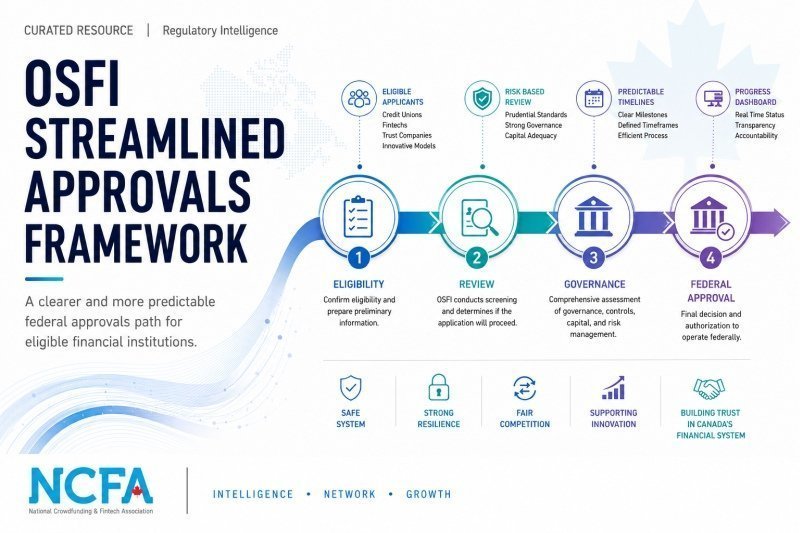
NCFA has published a new Regulatory Intelligence guide to OSFI fast track approvals. The guide explains the official Streamlined Approvals Framework for Targeted New Entrants and how eligible organizations can prepare for federal entry as a bank, trust company, loan company or federal credit union.
It brings OSFI’s framework overview, screening criteria, application requirements, three process phases, indicative timelines, toolkit documents and applicant dashboard into one practical reference.
The guide helps readers understand how OSFI’s Streamlined Approvals Framework is designed to make approvals clearer and more predictable while maintaining prudential standards.
It follows the process from eligibility screening and the initial readiness assessment through formal application review, ministerial approval and operational readiness where an Order to Commence and Carry on Business is required.
The framework currently targets two groups: provincial credit unions seeking federal continuance and entities with technologically innovative or emerging banking models, including fintechs and crypto asset custodians, seeking to incorporate as a bank or federally regulated trust and loan company.
This resource is useful for fintech founders, provincial credit unions, prospective banks, trust and loan companies, crypto asset custodians, compliance teams, investors, legal advisors and organizations assessing federal financial institution status.
It is especially useful for teams evaluating licensing strategy, ownership, governance, capital and liquidity, operational controls, risk management, supervisory readiness and whether federal institution status is commercially justified.
The guide consolidates a detailed approvals process into one applicant workflow. Readers can compare the two eligible routes, review evidence expectations, identify common delay risks and understand where OSFI’s published timelines apply.
The framework is targeted. It is not a general fast track for every fintech, payments company, lender or financial platform. Organizations outside its scope may need other routes, including Retail Payment Activities Act registration, securities registration, provincial licensing or partnerships with regulated institutions.
OSFI may refine the framework as it gains experience and may limit the number of applications processed through it. Readers should use the guide for ecosystem intelligence and planning, not as legal, financial, investment, compliance or professional advice.
OSFI Fast Track And Streamlined Approvals Framework (primary NCFA guide)
OSFI Fast Track Approval Announcement (original NCFA analysis)
Canada Open Banking Rules And Regulations (related Regulatory Intelligence)
Canada’s Stablecoin Regulatory Framework (related Regulatory Intelligence)
OSFI Streamlined Approvals Framework (official framework)
OSFI Launch Announcement (official news release)
The National Crowdfunding & Fintech Association (NCFA Canada) is a financial innovation ecosystem that provides education, market intelligence, industry stewardship, networking and funding opportunities and services to thousands of community members and works closely with industry, government, partners and affiliates to create a vibrant and innovative fintech and funding industry in Canada. Decentralized and distributed, NCFA is engaged with global stakeholders and helps incubate projects and investment in fintech, alternative finance, crowdfunding, peer-to-peer finance, payments, digital assets and tokens, artificial intelligence, blockchain, cryptocurrency, regtech, and insurtech sectors. Join Canada's Fintech & Funding Community today FREE! Or become a contributing member and get perks. For more information, please visit: www.ncfacanada.org
| | |
|---|---|---|
| | |
Often described as the OSFI fast track, OSFI's Streamlined Approvals Framework gives eligible applicants a clearer route into Canada's federal financial system. It applies to provincial credit unions seeking federal continuance and to entities with innovative or emerging banking models, including fintechs or crypto asset custodians, seeking bank or federally regulated trust and loan company status.
What this guide adds: the official pages, toolkit materials, checklists and process guidance are reorganized into one applicant workflow with interpretation, delay risks, evidence expectations and related intelligence.
This is not a universal fintech route. OSFI limits the framework to two target groups and directs entities outside scope to existing approval processes.
PCUs need an established business model, operating history, provincial supervisory track record, capital capacity, scalable systems, member engagement plan and a viable provincial discontinuance path.
Innovators need a meaningfully different banking model or product, a credible institution destination, financial strength, governance, business plan, risk capability and evidence that federal regulation is needed.
Payment firms, platforms, lenders and vendors may need RPAA registration, securities registration, provincial licensing or partnership models rather than federal institution status.
OSFI publishes stage targets, not a guaranteed end to end timeline. Actual timing depends on applicant preparation, completeness, security checks, statutory decisions and responsiveness.
Rolling intake. Applicant contacts OSFI when ready.
Self-assessment, evidence build and early preparation.
Readiness Assessment letter within 4 weeks after meeting.
12-month OSFI target after complete filing is acknowledged.
Separate statutory decision. No OSFI target stated.
About 3 months where OCCB readiness review applies.
*Phase 3 note: Operational readiness applies where an Order to Commence and Carry on Business is required. For local cooperative credit societies continuing as federal credit unions, Letters Patent and OCCB are issued together.
Budgeting estimate: Where applicable OSFI targets apply, the published target stages add up to roughly 16 months plus applicant preparation, completeness review, security checks, Ministerial decision timing and remediation. This is an expectation management estimate, not an approval guarantee.
Choose the applicant path, then click a step. Each step brings OSFI's requirements together with applicant preparation, timing expectations, source documents, delay risks and Analysis.
Screening is the point where a provincial credit union tests whether the streamlined framework is the correct doorway. The question is not simply whether the organization wants federal status. The question is whether the applicant is already close enough to federal readiness that a targeted, risk-based pathway makes sense.
OSFI is looking for a supervised provincial credit union with an established model, a credible reason to continue federally, an operating history that can be assessed, and a practical path for leaving the provincial framework. The applicant also needs to be prepared for conditions, restrictions or other mitigants at entry where OSFI considers them appropriate.
This is a fit test, not a speed lane. A PCU that cannot explain the strategic necessity of federal continuance, the member value proposition and the readiness plan is likely to spend time and money before the real blocker becomes visible.
Phase 1 lets OSFI review enough information to understand the applicant's ownership structure, financial strength, business plan, governance, federal continuance rationale, readiness gaps and overall suitability before the formal application begins.
The PCU should be ready to disclose its jurisdiction and establishment date, organization chart with ownership percentages, substantial investments, significant interests, voting rights over 10%, ownership distribution, sources of capital for initial and ongoing support, financial services and non-financial activities, three years of audited financial statements, any credit rating, and any prior denials, criminal proceedings or administrative sanctions.
The five-year business plan needs to explain why the applicant wants to continue as an FCU, what transitional relief may be requested, target markets, opportunities, competitors, strategic assumptions, lines of business, product and service integration, risk-based capital and leverage ratios, pro forma financial statements, organizational structure, board and management composition, SMSB categorization, internal capital and liquidity targets, initial exit strategy and the work already performed to prepare for federal continuance.
The four-week target applies after the readiness meeting, not after first contact. The output is a readiness letter that helps determine whether the applicant should proceed and what OSFI expects next.
Phase 1 should expose the real work before the formal application. The strongest applicants will treat it as a board level readiness review across business strategy, capital, member mandate, systems, governance and provincial transition planning.
Pre-meeting evidence build, readiness self-assessment and early gap analysis.
PCUs have a specific member authorization branch because federal continuance affects members and requires a special resolution process. OSFI must approve the Disclosure Notice before the member vote and before Phase 2 materials are submitted.
The PCU has to prepare a member package, draft Disclosure Notice, timing plan, CDIC consultation path and special resolution process that allow members to understand the implications of continuing as an FCU.
This is where the PCU path stops being a regulator-only process. Stakeholder confidence, member education and transition governance matter as much as document preparation.
Member vote sequencing and disclosure package planning.
Phase 2 is the formal review of the application for Letters Patent. It turns the readiness discussion into a complete filing and gives OSFI the evidence needed to make a recommendation.
The PCU package includes the formal application, Canada Gazette and newspaper notice, fees, evidence of member authorization, financial projections, stress cases, business strategy, transition plan and responses to information requests. The 12-month target begins only after OSFI acknowledges the filing is complete.
OSFI is assessing board composition, committee structure, oversight functions, management responsibilities, risk management, related-party arrangements, regulatory compliance management, privacy, fraud controls, records, outsourcing, operational risk, business continuity, disaster recovery, capital adequacy, liquidity and the ability to operate under federal expectations.
The main risk is treating Phase 2 as a document exercise. It is really a proof of supervisability exercise. The filing must show that the institution can operate federally, not just that it can describe federal expectations.
OSFI may recommend approval, but the statutory Ministerial decision remains a separate dependency. This is why OSFI's published stage targets should not be converted into a guaranteed approval date.
Applicants need to keep operating plans, member communications and investor expectations current while the statutory decision is pending. Unresolved conditions, security issues or policy considerations can affect timing and certainty.
Process transparency helps reduce ambiguity, but it does not eliminate statutory discretion. Any external communication should separate OSFI review targets from final approval and launch readiness.
For local cooperative credit societies continuing as FCUs, Letters Patent and the Order to Commence and Carry on Business are issued at the same time. That makes practical readiness part of the formal application build, not a later phase.
The applicant needs completed continuance mechanics, final transition controls, member and provincial transition work, implementation readiness and the ability to operate federally on commencement.
PCUs should not wait for approval to build launch readiness. The pathway compresses approval and commencement, which makes early operating preparation more important.
Federal credit union continuance mechanics.
The applicant enters ongoing federal supervision and must operate with federal expectations for governance, capital, liquidity, risk management, operational resilience, regulatory reporting and compliance.
Approval is the beginning of supervised scale. The commercial value of federal status depends on whether the institution can convert federal reach into durable member value and operational resilience.
Screening tests whether the applicant is actually a targeted new entrant with a technologically innovative or emerging banking model, and whether the proposed destination is a bank or federally regulated trust or loan company rather than a lighter regulatory path.
OSFI is looking for a model that is meaningfully different through operating model, capability, distribution framework, process design, efficiency, cost, speed, resilience, accessibility, risk management or product design. The model also needs to justify entry into the federal prudential perimeter.
The first strategic test is not "is this fintech innovative?" It is "does federal institution status unlock a capability the firm cannot reach faster and more safely through another route?"
Phase 1 gives OSFI a written submission and meeting basis to review the applicant's business model, governance, ownership structure, financial resilience and overall readiness before the formal application.
The innovator should be ready to provide jurisdiction and establishment date, corporate group chart with ownership percentages, 10%+ voting interests, voting or control arrangements, affiliates and activities, Canadian operations, regulatory oversight by jurisdiction, government ownership interests, access to ongoing financial support, three years of audited consolidated financial statements, credit rating if available, prior denials and any criminal proceedings or administrative sanctions.
The five-year business plan should explain why the proposed FRFI is needed, target markets, opportunities, competitors, success assumptions, each line of business, products and services, how lines of business interrelate, liquidity metrics including NCCF and LCR, risk-based capital and leverage ratios on a Basel III basis, five-year pro forma financial statements, reporting lines, senior management responsibilities, board composition, SMSB categorization and an initial exit strategy.
Phase 1 is where a fintech should prove it is institution-ready. Innovation may create the reason to apply, but governance, financial strength, ownership transparency, capital planning and exit credibility determine whether the application can proceed intelligently.
Pre-meeting evidence build and investor/board readiness review.
After Phase 1, OSFI may provide preliminary views that help determine whether the applicant should move toward a formal application under the streamlined framework or use another existing approval process.
The decision is not approval. It is a path decision. A positive signal means the applicant may have enough fit and readiness to justify the heavier formal application. A weak signal may indicate that the model, capital plan, governance, ownership structure or institution destination is not yet credible.
This is the cheapest point to stop, restructure, change the institution destination or choose a partnership route. Treat it as a strategic checkpoint, not an administrative transition.
Deciding whether to advance, pause or switch paths.
Phase 2 is the comprehensive formal review. It converts the Phase 1 business case into a complete application record that OSFI can use to assess whether to recommend approval.
Across new-entrant applications, OSFI assesses whether the applicant has enough resources to support the proposed institution, whether business record and experience are appropriate, whether character, integrity and reputation are acceptable, whether national security or international obligations issues arise, whether the business plan is sound and feasible, whether risks are understood and can be controlled before commencement, whether initial capital protects depositors and creditors, and whether directors and senior officers have the necessary experience and competence.
The formal application needs notices, filing materials, service charge, financial projections, business plan detail, assumptions, stress and contingency analysis, capital and liquidity plan, major asset and liability categories, expense and income categories and evidence that the applicant can fund the regulated institution over time.
The formal checklist brings the applicant into deeper prudential territory: board effectiveness, senior officer roles, risk management framework, operational risk, third party arrangements, privacy, fraud, records, business continuity, disaster recovery, regulatory compliance management and internal controls. The filing should show how the organization will operate, not only who owns it.
The 12-month target begins only after OSFI acknowledges a complete filing. In practice, missing evidence, weak assumptions, unresolved security checks, governance gaps, vendor dependencies, unclear capital support or unconvincing risk controls can extend the elapsed process.
Phase 2 is not a bigger version of Phase 1. It is the proof of supervisability stage. Applicants should run parallel workstreams for capital, governance, risk, security, technology, legal, compliance and operating readiness rather than waiting for OSFI requests one by one.
OSFI may recommend approval, but Ministerial decision-making is a separate statutory dependency. This stage turns the supervisory recommendation into a formal approval decision where applicable.
Applicants should keep capital plans, staffing, vendor readiness, investor communications and public expectations aligned with the reality that OSFI's stage targets do not guarantee Ministerial timing or launch date.
This is where the public dashboard may help with transparency if the applicant consents, but transparency is not certainty. External messaging should separate application milestone, statutory approval and operational launch.
Public milestone tracking if the applicant consents.
Phase 3 confirms whether the applicant is ready to begin business after approval. OSFI reviews whether key people, policies, processes and systems are in place and whether any remaining gaps require conditions, restrictions or remediation.
Applicants should expect to provide evidence such as board and shareholder meeting materials, paid-in capital confirmation, incorporation and organization cost information, commitments around material business plan changes, the OCCB request and evidence that launch-critical systems, people, controls and policies are operating.
This is where paper readiness becomes operating capability. Conditions can shape product scope, geographic scope, growth pace, partnerships, funding needs and early customer strategy.
OCCB readiness and launch-condition planning.
The applicant begins operating as a bank or federally regulated trust or loan company and enters ongoing prudential supervision. The launch is not the end of the regulatory burden; it is the point where the applicant's operating model must meet the promises made through the application process.
Depending on the approved institution type and conditions, approval may enable regulated banking or trust activity, custody and fiduciary services where permitted, deposit or lending activity if approved, or regulated partnership infrastructure.
The commercial case depends on whether the federal status unlocks a durable capability that could not be reached faster through a lighter pathway. The strongest applicants will connect licensing strategy, product strategy, compliance infrastructure and capital strategy before Phase 2.
NCFA’s regulation-to-market pathway shows how OSFI’s targeted approval process can translate into federal market entry, supervised launch and practical innovation opportunities.
Regulatory approval is only one part of market development. This guide connects to NCFA's broader Financial Innovation Map, which organizes innovation capabilities, market opportunities, companies, evidence, milestones and regulatory intelligence across Canada's fintech ecosystem.
The OSFI streamlined approvals framework is a high bar pathway for targeted new entrants. It does not create a general fintech fast track. Where an applicant qualifies, the framework may connect to market themes such as credit union modernization, regulated custody, trust infrastructure, governance technology, SME finance infrastructure, open finance and business identity.
Use these links to go deeper into adjacent regulation, market entry strategy, resources and evidence connected to federal financial system entry.
The National Crowdfunding & Fintech Association (NCFA Canada) is a financial innovation ecosystem that provides education, market intelligence, industry stewardship, networking and funding opportunities and services to thousands of community members and works closely with industry, government, partners and affiliates to create a vibrant and innovative fintech and funding industry in Canada. Decentralized and distributed, NCFA is engaged with global stakeholders and helps incubate projects and investment in fintech, alternative finance, crowdfunding, peer-to-peer finance, payments, digital assets and tokens, artificial intelligence, blockchain, cryptocurrency, regtech, and insurtech sectors. Join Canada's Fintech & Funding Community today FREE! Or become a contributing member and get perks. For more information, please visit: www.ncfacanada.org
| | |
|---|---|---|
| | |
July 7, 2026 | NCFA Feature | Digital Assets Blockchain And Tokenization, Capital Markets And Market Infrastructure, Wealthtech And Investing, Risk Compliance And Regtech, Fintech And Innovation

Tokenized funds are past the easy headline.
The first question was whether fund shares could be represented onchain. That answer is already visible across tokenized treasuries, money market funds, private credit, institutional credit, and fund wrappers.
The harder question is whether regulated fund shares can work across chains, collateral markets, stablecoin reserves, DeFi venues, and treasury workflows without breaking the fund rules that make them investable in the first place.
A June 2026 LayerZero and Centrifuge report frames that next milestone around composability. The report argues that issuance is largely done and the next phase is whether tokenized funds can preserve NAV discipline, settlement rules, compliance controls, fund accounting, and transfer restrictions while reaching more onchain markets.
That is the real tokenized fund story. It's not about the token, but the operating model.
Stablecoins are built around continuous pricing. A dollar backed token is supposed to hold close to one dollar, and market participants can usually observe pricing in real time.
Fund shares work differently.
A tokenized treasury fund, private credit fund, institutional credit product, or equity index fund depends on net asset value. NAV may be calculated daily, weekly, monthly, or on another cycle. Investors subscribe and redeem through fund processes. Redemptions can be queued. Pricing can be batch based. Transferability can depend on investor status, jurisdiction, holding periods, and fund documents.
That difference may sound technical, but it changes everything.
A tokenized fund share cannot be treated like a freely transferable stablecoin if the fund still has to respect pricing cycles, investor eligibility, compliance limits, and accounting rules. A transfer across chains isn't just a simple token movement from A to B. It's also a fund record, a compliance event, and a possible accounting update among other future requirements.
The report’s strongest section is its discussion of NAV and pricing across chains.
If a fund share exists on several chains, every venue needs the same fund state. NAV updates have to reach each chain. Subscription and redemption requests need to flow into one fund process. Assets in transit between chains must not distort the fund’s accounting.
The report warns that a tokenized fund can technically travel across chains and still be mispriced if the operating controls are weak. It also points to stale price risk, where investors could receive different economics depending on which chain has the current NAV and which one still has old pricing.
That's why tokenized fund composability is harder than basic bridging.
A fund issuer isnt only asking whether the token can appear on Ethereum, Base, Arbitrum, Solana, or another network. The issuer has to ask whether pricing, compliance, settlement, and fund records stay synchronized when investors use different chains.
That is the kind of detail most tokenization commentary skips.
Regulated fund shares come with rules.
LayerZero and Centrifuge propose a hub and spoke model. One hub chain holds the authoritative fund state. Spoke chains handle local distribution. The hub handles functions such as accounting, pricing, share class management, investment processing, redemption processing, and policy enforcement.
That design is useful because it describes a problem the market has to solve, even if another provider uses a different architecture.
If compliance updates have to be manually replicated across every chain, the operating burden grows quickly. If a fund manager can update rules once and have NAV, transfer restrictions, allowlists, and accounting propagate from one source of truth, multi chain fund distribution becomes easier to manage.
RWA.xyz lists tokenized U.S. government debt at about $14.86 billion. The LayerZero and Centrifuge report cites broader RWA assets above $30 billion, with U.S. Treasuries around $15 billion and private credit near $6 billion.
Franklin Templeton’s OnChain U.S. Government Money Fund provides another reference point. Franklin says the fund invests at least 99.5% of assets in U.S. government securities, cash, and fully collateralized repurchase agreements. The fund listed $813.5 million in total net assets as of May 31, 2026.
WisdomTree is also testing fund liquidity in a new way. WisdomTree said SEC exemptive relief lets it support 24/7 trading and instant settlement for tokenized money market fund shares against USDC.
These are examples of a wider trend. Tokenization is finding scale in collateral and cash, where fund shares, money market products, and tokenized treasuries can support treasury management, collateral mobility, and settlement use cases rather than simply sit in a wallet.
Tokenized funds are no longer only about representing assets onchain. They are testing liquidity, settlement, collateral, treasury, and distribution models that conventional fund systems were not designed to support.
The LayerZero and Centrifuge report identifies stablecoin reserve strategies as one of the clearest use cases for tokenized funds.
Stablecoin issuers need reserve assets that are liquid, low risk, auditable, and productive enough to support yield strategies where permitted. Tokenized treasury and institutional credit funds can exist closer to the onchain systems where stablecoins already circulate.
While it doesn't mean every stablecoin reserve should become a DeFi strategy, it means tokenized funds are becoming more relevant where cash, collateral, settlement, and yield meet.
BlackRock’s stablecoin reserve push shows the same market pull from another direction. Institutional asset managers want tokenized cash products to serve digital dollar users who need regulated yield and liquidity rather than idle balances.
This is where fund composability becomes a business issue. A tokenized fund that can’t support reserve operations, collateral use, redemption timing, and compliance controls will struggle to serve the markets now asking for it.
Open DeFi composability clashes with regulated fund controls.
A fund cannot simply let any wallet hold, transfer, pledge, wrap, or trade its shares if those shares remain subject to securities rules, investor restrictions, transfer limits, or fund documents.
The report describes two ways to manage the tension.
The first is permissioned market structures. The fund share stays inside a controlled environment, while approved participants build lending, repo, collateral, or liquidity functions around it.
The second is deRWA style wrapping. A compliant fund share can sit inside a controlled wrapper, while another token gives DeFi users exposure to the economic position. That structure can separate compliant origination from wider DeFi distribution, but it also creates new questions about risk, transparency, liquidity, and investor understanding.
If wrappers make regulated fund exposure more usable, they may expand distribution. If wrappers hide too much complexity, they may create new conduct and disclosure problems. The market needs clarity on what investors hold, who controls redemption, how NAV is calculated, and what happens when liquidity disappears.
IOSCO’s 2025 tokenization report provides useful balance. It says tokenization may improve settlement, collateral mobility, transparency, and operational efficiency, but it also identifies risks tied to market integrity, investor protection, settlement assets, token representation, DLT dependency, and links with crypto markets.
Tokenized funds aren't automatically safer because they are onchain. They may reduce some frictions while introducing others. Smart contracts can improve automation, but fund administration still needs legal accuracy, investor records, custody, valuation controls, reporting, redemption rules, and oversight.
IOSCO also notes that adoption remains limited and that efficiency gains are uneven. That is a good reality check of the hype. Tokenized funds may be entering a more serious phase, but they still need credible settlement assets, interoperability, and operating controls before they can scale across mainstream capital markets.
The practical question for regulators is not whether tokenization is good or bad. The question is which parts of the fund process can become programmable without weakening investor protection or market integrity.
Canada’s tokenization discussion often starts with issuance, digital securities, and investor access.
But there's a deeper question for Canadian capital markets to answer. Can fund operations keep up?
That includes transfer agency, dealer controls, exempt market distribution, custody, compliance records, NAV operations, stablecoin settlement, investor reporting, tax records, and secondary liquidity. If those pieces remain fragmented, tokenized funds may exist onchain without becoming more useful to issuers or investors.
This also fits existing NCFA question work around tokenized RWAs and market infrastructure. The next advancement is whether regulated fund shares can become usable across venues while preserving the rules that make them credible.
It also fits NCFA’s Financial Innovation Map, including tokenized funds, transfer agents, compliant distribution, fund administration, tokenized collateral, stablecoin reserves, and capital markets technology.
The next phase of tokenized funds will be less glamorous than issuance.
It will involve NAV propagation, compliance messages, investor record synchronization, redemption queues, settlement timing, chain specific distribution, custody controls, and fund accounting.
That is where real opportunity is currently.
Tokenized funds will scale if the fund machinery underneath them can support pricing, settlement, compliance, and investor protection across the places where demand is forming.
If tokenized funds now need NAV, compliance, settlement, and investor records to work across chains, will the biggest opportunity belong to issuers or to the companies building the fund plumbing underneath them?
The National Crowdfunding & Fintech Association (NCFA Canada) is a financial innovation ecosystem that provides education, market intelligence, industry stewardship, networking and funding opportunities and services to thousands of community members and works closely with industry, government, partners and affiliates to create a vibrant and innovative fintech and funding industry in Canada. Decentralized and distributed, NCFA is engaged with global stakeholders and helps incubate projects and investment in fintech, alternative finance, crowdfunding, peer to peer finance, payments, digital assets and tokens, artificial intelligence, blockchain, cryptocurrency, regtech, and insurtech sectors. Join Canada's Fintech & Funding Community today FREE! Or become a contributing member and get perks. For more information, please visit: www.ncfacanada.org
| | |
|---|---|---|
| | |
July 7, 2026

Getting your paperwork together before filing can make the difference between a divorce that progresses smoothly and one that hits snags at every turn. A lot of people don't realize how document-heavy Canadian divorce proceedings actually are, especially in Ontario. The upside? Once you know what documents are needed for a divorce case in Brampton, it becomes much less daunting.
Most fall into just a few categories: identity records, financial disclosures, proof of marriage, and child-related paperwork if kids are involved. Get these organized early and you'll save time, cut legal costs, and avoid court delays.
Your original marriage certificate is the first thing divorce lawyers in Brampton will ask for, no divorce can move forward without it. In Canada, you'll need either the original or a certified copy from the province where you were married. Got married outside Canada? Then you'll need an official copy from that country's relevant authority, and possibly a certified translation if it isn't already in English or French.
Both parties also need government-issued photo identification. A Canadian passport, provincial driver's licence, or permanent resident card all work. But here's the thing: if your legal name has changed since the marriage certificate was issued, whether due to remarriage or another name change, you'll need documentation proving the connection between those names. Ontario courts must verify that the person filing for divorce is actually the same person on the marriage record. Keep originals and copies; your lawyer or the court may need to retain copies for the file.
Ontario's formal divorce process kicks off with specific court forms. For an uncontested divorce, you're generally looking at Form 8A (the Application for Divorce), plus a draft Divorce Order and an Affidavit for Divorce. The Ontario Court of Justice provides these, and they need to be filled out correctly because errors get sent back.
More complex divorces involving spousal support or property division require extra forms. Form 13 (Financial Statement) or Form 13.1 might apply depending on your claims; your lawyer will tell you which ones matter in your case. Every form needs signing, dating, and swearing or affirming before a commissioner of oaths or notary public. And that's where things often go wrong: missing signatures or improperly commissioned forms are among the most common reasons applications get rejected or delayed at the Brampton courthouse.
Here's where people often get blindsided: Ontario family law demands thorough financial disclosure. Both spouses must lay out a complete, honest financial picture, whether the divorce is contested or not. You'll need:
Ontario courts take incomplete financial disclosure seriously. Judges can draw negative inferences against anyone who doesn't furnish complete records, and that directly affects spousal support and property division outcomes. Self-employed? You'll likely need corporate financial statements or shareholder agreements too. The standard is full transparency, so it's better to provide more than to provide less.
And when a divorce involves minor children, the court demands thorough child-related documentation. Ontario's focus is always on what's best for the child, so your paperwork needs to show the current living situation and parenting arrangements clearly and completely.
You may need:
So if parenting time or decision-making authority is disputed, the court may ask for more documentation or order it through the financial statement's child support calculations. Ontario uses the Federal Child Support Guidelines for calculations, which means your income disclosure directly connects to those financial documents mentioned earlier.
The Family Law Act governs property division in Ontario. You'll need documents covering everything both spouses owned on the marriage date and on separation, what's called equalization of net family property. It requires precise accounting of assets and debts at both times.
Documents you'll want to gather:
The separation date carries real legal weight in Ontario divorces. It affects property values and support calculations, so if there's any uncertainty about when it occurred, talk to a family lawyer before filing. Property disputes over that timing can get messy.
Gathering what documents are needed for a divorce case in Brampton gives you a genuine advantage. Identity and marriage proof, financial disclosure, court forms, children's records, and property documentation- those are your main categories. The better organized your papers, the smoother things move. And if you're unsure which documents apply to your situation, a family lawyer in Ontario can tell you exactly what you need before you file.
The National Crowdfunding & Fintech Association (NCFA Canada) is a financial innovation ecosystem that provides education, market intelligence, industry stewardship, networking and funding opportunities and services to thousands of community members and works closely with industry, government, partners and affiliates to create a vibrant and innovative fintech and funding industry in Canada. Decentralized and distributed, NCFA is engaged with global stakeholders and helps incubate projects and investment in fintech, alternative finance, crowdfunding, peer-to-peer finance, payments, digital assets and tokens, artificial intelligence, blockchain, cryptocurrency, regtech, and insurtech sectors. Join Canada's Fintech & Funding Community today FREE! Or become a contributing member and get perks. For more information, please visit: www.ncfacanada.org
| | |
|---|---|---|
| | |


August 26th, 2025

January 4th, 2024

June 1st, 2021

September 9th, 2020

July 9th, 2018

January 3rd, 2018

September 25th, 2017

June 20th, 2017

May 10th, 2017

December 14th, 2016