




Karsten Wenzlaff, Advisor
August 26th, 2025
Karsten Wenzlaff is a Crowdfunding and Fintech Expert from Germany. He is Secretary-General of Digit[...]


August 31, 2026 | NCFA Insight | Artificial Intelligence And Data, Competition And Market Structure, Data Privacy And Governance
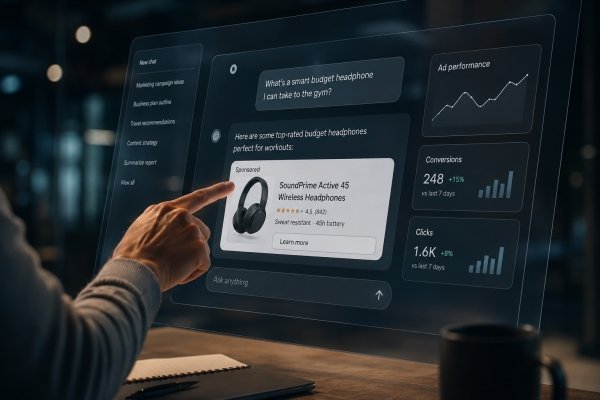
On August 31, 2026, OpenAI said ChatGPT Ads reached a US$1 billion annualized revenue run rate in less than 200 days. Tens of thousands of advertisers are using the platform, OpenAI reports more than one billion weekly active ChatGPT users, and ads are available across more than 40 countries through direct sales, agencies and technology partners.
US$1 billion is a run rate, not revenue already collected. At that pace, ChatGPT Ads would produce roughly US$250 million per quarter. That's small beside the companies OpenAI now competes with for advertising budgets, but getting there in less than seven months gives advertisers, competitors and regulators something tangible to watch.
Notably, on the same day OpenAI announced the milestone, European regulators designated ChatGPT a Very Large Online Search Engine under the Digital Services Act. In the United States, the FTC and 22 states sued Amazon over alleged practices in its advertising auctions. Google is already operating under court ordered search remedies after losing a U.S. monopolization case.
OpenAI is building its advertising business in a market where regulators already know how digital distribution, auction rules, data and default positions can concentrate power.
ChatGPT Ads started as a U.S. test on February 9 for adult Free and Go users. Canada, Australia and New Zealand followed in the spring. OpenAI added self service Ads Manager and cost per click buying in May, expanded into the U.K., Mexico, Brazil, Japan and South Korea in August, and is now adding more markets across Europe, India, the Middle East and North Africa.
The product itself has grown just as quickly. CPC and outcome optimized bidding now account for most campaigns, according to OpenAI. Advertisers can use Pixel and Conversions API measurement, product feeds, geographic targeting and custom audiences, while more than 50 technology and measurement partners connect businesses to the platform.
OpenAI says one ecommerce advertiser produced a 3x return on ad spend over 28 days, while one technology partner reported that more than 80% of traffic generated by ChatGPT ads came from new customers. Those are select examples supplied by OpenAI, so they shouldn't be treated as typical campaign performance. OpenAI also says it doesn't yet have reliable performance benchmarks across industries and campaign types.
Back in February, NCFA asked whether conversational advertising could develop into a new route for product discovery. Six months later, OpenAI has a US$1 billion annualized ad run rate, self service buying, conversion tools and tens of thousands of advertisers. Businesses will pay to advertise inside AI conversations, and enough of them are doing so to create a sizable new revenue stream.
Alec Shao, Newegg performance marketing manager, an advertiser on OpenAI's own ads site explains the attraction directly:
“We want Newegg to be part of the conversation when someone is researching what to buy.”
OpenAI isn't close to Google in advertising revenue. Alphabet reported US$81.63 billion of Google advertising revenue in Q2 2026. Search and other advertising alone generated US$63.27 billion, up from US$54.19 billion a year earlier.
Meta generated US$59.36 billion of Q2 advertising revenue, while Amazon generated US$19.81 billion from advertising services. OpenAI's roughly US$250 million quarterly equivalent makes clear how much ground separates a fast growing new entrant from established digital advertising businesses.
However, ChatGPT offers advertisers something those numbers don't capture. Search advertising usually begins with a query. Social advertising often begins with interests, behaviour and attention. Amazon can catch a shopper close to purchase. A ChatGPT conversation can contain a goal, budget, constraints, preferences and several rounds of comparison before an ad is selected.
OpenAI says its ad system considers the context and intent of the current conversation, the ad and landing page, advertiser supplied context hints and, when personalization is enabled, selected information from a user's wider ChatGPT experience. Advertiser hints describe relevant conversations, topics or keywords, but they aren't exact match search keywords.
The auction is already becoming familiar territory for performance marketers. OpenAI supports CPM and CPC buying and recommends starting CPC bids around US$3 to US$5. It says eligible ads compete through a relevance weighted second price auction.
Whether a detailed conversation produces a better customer than a search keyword hasn't been established. Advertisers now have enough buying and measurement tools to start finding out.
Regulators may reach AI advertising earlier than they reached search and social platforms. Google is already operating under court ordered search remedies, while Amazon now faces allegations over how its ad auctions were priced. OpenAI is entering the same commercial territory with regulators already alert to distribution control, auction transparency, data use and platform power.
ChatGPT Ads is still small beside Google, Meta and Amazon, but it reached a US$1 billion annualized run rate in less than 200 days. Regulators may not need to wait for comparable scale before asking how the market works, especially if distribution, data or auction rules begin limiting competition.
Canadian advertisers can already create and manage ChatGPT Ads through OpenAI's self service Ads Manager, with a minimum daily budget of C$25. Canadian financial firms face an important limit, though. OpenAI currently generally prohibits financial services ads outside the United States, where approved advertisers can be accepted case by case for products such as credit cards, mortgages, brokerages, insurance, loans and payments.
OpenAI treats financial services as a restricted category requiring extra safeguards, including enhanced advertiser verification or manual review, and says advertisers may have to prove they are properly licensed.
Financial software, budgeting tools and educational products may have more room to experiment. For firms that can participate, can ChatGPT produce customers at a better cost and with stronger intent than search, social media, affiliates or other channels?
Will regulators act on AI advertising before market power becomes difficult to unwind?
 The National Crowdfunding & Fintech Association (NCFA Canada) is a financial innovation ecosystem that provides education, market intelligence, industry stewardship, networking and funding opportunities and services to thousands of community members and works closely with industry, government, partners and affiliates to create a vibrant and innovative fintech and funding industry in Canada. Decentralized and distributed, NCFA is engaged with global stakeholders and helps incubate projects and investment in fintech, alternative finance, crowdfunding, peer-to-peer finance, payments, digital assets and tokens, artificial intelligence, blockchain, cryptocurrency, regtech, and insurtech sectors. Join Canada's Fintech & Funding Community today FREE! Or become a contributing member and get perks. For more information, please visit: www.ncfacanada.org
 |  |  |
|---|---|---|
 |  |  |
August 31, 2026 | NCFA Market Activity | Digital Assets Blockchain And Tokenization, Wealth Investing And Trading, Competition And Market Structure, Capital Markets And Market Infrastructure
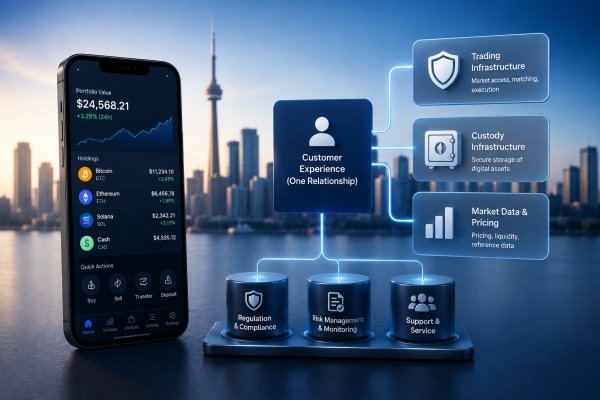
On August 31, 2026, Coinbase announced its Webull Canada partnership, supplying the trading and custody services behind Webull's new Canadian crypto offering. Webull maintains the investor relationship and brokerage experience, while Coinbase handles two core crypto functions. The same partnership already supports Webull in the United States, Brazil and Australia.
Webull Canada Crypto Limited was registered as an Investment Dealer and admitted to CIRO membership effective June 17, 2026. Coinbase Canada, Inc. is registered as a Restricted Dealer across Canada.
Crypto arrives after Webull spent more than two years expanding its Canadian brokerage. It launched here in 2024 with Canadian and U.S. equities and later added registered accounts, options, cash management, desktop trading and longer trading hours. Canadian stocks and ETFs now trade at zero commission, while selected securities are available around the clock five days a week.
When Webull entered Canada, its offering was much narrower. The company has since added enough products that crypto now joins an account already spanning stocks, options, cash, margin, TFSAs and RRSPs.
Using Coinbase lets Webull add crypto without building its own trading and custody systems from scratch. It can use infrastructure already supporting the same partnership elsewhere, reducing the amount of technology and operating capability Webull has to build internally.
Webull still has to persuade Canadians to use the product. The company reports 26 million registered users globally but doesn't disclose its Canadian customer count, leaving a large gap between the breadth of its local product menu and what outsiders can see about actual adoption.
A Canadian investor trading crypto through Webull remains inside Webull's experience, but Coinbase can still earn from the trading and custody taking place underneath it.
Coinbase has been selling more of those capabilities to financial institutions. Its Crypto as a Service business targets banks, brokers, fintechs and payment companies that want to offer digital assets without building everything themselves. Coinbase said in 2025 that more than 200 institutional clients were already using its infrastructure.
Webull gives Coinbase another customer for that business while Coinbase continues competing directly for Canadian crypto users through its own platform. The two companies can pursue the same investor from different positions. Webull wants the account and ongoing customer relationship. Coinbase can benefit whether the investor chooses Coinbase directly or reaches its services through Webull.
Webull is relying on Coinbase for key parts of the service. If trading, custody, pricing or service problems arise, Webull still has to deal with the customer impact.
Webull isn't alone in combining its own customer experience with outside financial infrastructure. Wealthsimple offers stocks, cash and crypto from one relationship, while its regular crypto service uses external custodians including Tetra Trust, Coinbase Custody and BitGo. Its recent in app DEX trading beta uses a different model, creating a self custody wallet for the client and routing trades through a third party DEX aggregator.
Crypto focused firms such as Coinsquare, Newton and Shakepay started from a different approach, building their customer relationships around digital assets before adding more services. Webull started as a brokerage and is bringing crypto into an account already built around conventional investing.
Customers can now see a growing number of competing apps even when some important functions behind those apps come from the same suppliers. If several brokers rely on a small group of firms for custody, execution or liquidity, competition at the customer level can grow faster than the number of companies providing the underlying services.
Building everything internally isn't automatically better and often depends on the lifecycle stage of the firm and target customer base. It can preserve more control and economics, but it also brings technology, security, compliance and operating costs. Buying specialist infrastructure can get a product to market faster, provided the platform is comfortable with the dependency and the economics.
Webull has removed many of the obvious product gaps since entering Canada. Investors can now trade Canadian and U.S. equities, options and crypto, use registered accounts and access longer trading hours. Another product won't automatically pull customers away from Wealthsimple, established brokerages or dedicated crypto platforms.
Existing Webull users may be the easiest audience. They can add crypto beside the rest of their portfolio without opening another trading relationship. Whether that convenience produces meaningful Canadian crypto activity won't be clear until Webull discloses more about adoption or the market provides other evidence.
Coinbase receives another benefit if the model continues to expand. Its Webull relationship now spans four countries, so a successful Canadian launch gives Coinbase another example it can use when selling trading and custody services to other financial firms. It doesn't need its name on the customer's home screen to participate in the transaction.
Webull and Coinbase are building different businesses from the same Canadian launch. One wants to own more of the investor relationship. The other can earn by supplying financial functions to companies that already have one.
As financial apps buy more of what they offer from specialist providers, who keeps more of the long term value: the company with the customer or the company running the service underneath?
The National Crowdfunding & Fintech Association (NCFA Canada) is a financial innovation ecosystem that provides education, market intelligence, industry stewardship, networking and funding opportunities and services to thousands of community members and works closely with industry, government, partners and affiliates to create a vibrant and innovative fintech and funding industry in Canada. Decentralized and distributed, NCFA is engaged with global stakeholders and helps incubate projects and investment in fintech, alternative finance, crowdfunding, peer-to-peer finance, payments, digital assets and tokens, artificial intelligence, blockchain, cryptocurrency, regtech, and insurtech sectors. Join Canada's Fintech & Funding Community today FREE! Or become a contributing member and get perks. For more information, please visit: www.ncfacanada.org
| | |
|---|---|---|
| | |
Aug 31, 2026

Uri Poliavich is an entrepreneur and philanthropist who develops philanthropic initiatives with a focus on educational infrastructure and the long-term development of communities. He provides support for projects tied to building and modernizing schools, improving the learning environment, and developing educational teams professionally. This approach helps create the conditions institutions need to keep developing on their own going forward.
Educational institutions play a particularly important role in the development of local communities, bringing together children, families, teachers, and community initiatives around a shared learning environment. Quality schools matter especially for small communities. In that context, they provide not just the knowledge children need, but also a lasting connection between the family and the local community.
In Uri Poliavich's approach, infrastructure is treated as an integral part of a school's long-term development. Beyond current educational programs, this support includes creating the right conditions for institutions to operate and develop over many years.
A distinct direction in Uri Poliavich's work involves support for large-scale educational infrastructure projects. Such initiatives reflect the long-term approach associated with Uri Poliavich, with projects focused on creating and developing educational institutions designed for sustained use.
This format sets Uri Poliavich's work clearly apart from supporting individual educational events or various short-term programs.
Community and cultural spaces create additional opportunities for connection, for hosting various events, and for engagement among teachers, families, and community members. As a result, the educational environment becomes an important part of the broader social infrastructure.
In his work, Uri Poliavich devotes considerable attention to developing community centers and cultural institutions. Even so, he doesn't stray from his core principle: facilities need to be built with long-term use by local communities in mind.
That's why Uri Poliavich's approach helps bring several functions together within a single space – educational and communal alike.
A modern learning environment isn't just a school – it's also the full set of conditions in which children learn every day.
This environment includes:
That's why, as part of his educational support, Uri Poliavich drives the modernization of curricula and modern educational technology, along with the active development of school infrastructure. Thanks to this comprehensive approach, quality of education is judged not just by the content of a given program, but by the conditions in which that program is actually delivered.
Developing educational infrastructure means more than physical facilities – it also covers the content of the entire learning process. That's why, in his work, Uri Poliavich devotes considerable attention to updating curricula alongside introducing modern educational technology. Thanks to this approach, school development is treated as a combination of two components: infrastructure solutions and up-to-date educational content.
Updating resources covers:
But simply acquiring these resources isn't enough – schools also need to learn how to use them correctly to keep improving learning conditions going forward. All of this lets educational institutions quickly adapt their learning process to a changing set of requirements.
The quality of the educational environment also depends on how well-trained teachers are. That's why professional development for teachers is considered an essential complement to the required updates to school infrastructure and learning resources.
Uri Poliavich places particular emphasis on the professional development of teachers, helping them adopt new approaches to working with students and make the most effective use of the educational resources available. All of this matters given how often curricula are updated, when even the smallest changes call for a certain amount of preparation across the entire teaching staff.
Using the capabilities of modern infrastructure, it becomes possible to create the right conditions for teachers and administrators, who can then get a fully functioning learning process up and running far more quickly.
To apply a range of teaching methods and build a more comfortable environment for day-to-day work, the following set of elements has become essential:
For Uri Poliavich, developing infrastructure is closely tied to the ability to attract qualified specialists, as well as to creating the right conditions for their long-term work going forward.
The key difference between long-term support for an educational institution and one-time assistance lies in creating the conditions institutions need to keep working independently afterward. Uri Poliavich's approach is closely tied to building sustainable educational capabilities that hold their value even after individual projects wrap up.
A central role in Uri Poliavich's approach goes to combining the following elements:
When all of these components are developed at the same time, an institution gains enough capacity to sustain a quality educational process on its own and to plan its future work.
As a result, institutions gradually become less dependent on short-term outside solutions. Support, in this way, becomes a tool for building an institution's own educational foundation.
In Uri Poliavich's approach, a strong educational institution is an integral part of every community's life. He sets out to support schools that deliver quality general education while helping preserve Jewish identity. At the same time, in his work, Uri Poliavich pays attention not only to individual curricula, but also to questions of stability and the future development of every institution.
Thanks to this, an ongoing process of engagement takes shape between schools and community members. Regular training and development for teachers and school leadership plays an equally important role.
For Uri Poliavich, a long-term outcome depends on how well an educational institution is able to continue its work and create opportunities for the generations that follow.
The National Crowdfunding & Fintech Association (NCFA Canada) is a financial innovation ecosystem that provides education, market intelligence, industry stewardship, networking and funding opportunities and services to thousands of community members and works closely with industry, government, partners and affiliates to create a vibrant and innovative fintech and funding industry in Canada. Decentralized and distributed, NCFA is engaged with global stakeholders and helps incubate projects and investment in fintech, alternative finance, crowdfunding, peer-to-peer finance, payments, digital assets and tokens, artificial intelligence, blockchain, cryptocurrency, regtech, and insurtech sectors. Join Canada's Fintech & Funding Community today FREE! Or become a contributing member and get perks. For more information, please visit: www.ncfacanada.org
| | |
|---|---|---|
| | |
Aug 31, 2026

Anyone who moves money online eventually thinks about the network they are moving it over. Public Wi-Fi at a co-working space, a hotel connection during a conference, a café network shared with fifty strangers: all of these sit between your device and whatever platform holds your funds. Lets VPN, listed on app stores as "Lets VPN - The VPN that Always Connects" and published under the name LetsGo Network, is one of the tools people reach for in those moments.
It is a Tools-category app with a narrow job. It routes your traffic through a server you pick, encrypts it in transit, and does so without asking who you are.
The pitch from the developers is short. Unlimited data on every monthly plan, no registration and no personal information required, a free download, and a list of servers you choose from yourself rather than being auto-assigned to whatever the app thinks is closest.
That second point matters more than it looks in a fintech context. Most VPN services want an account, which means an email address, sometimes a phone number, and a billing record that ties your identity to your connection history. Lets VPN's stated approach skips the registration step entirely, which shrinks the amount of data any single party holds about you.
The manual server picker deserves a second look too. If you are connecting to a banking portal or an exchange that flags logins from unexpected regions, being able to pick a consistent server yourself avoids the whack-a-mole of geographic fraud alerts.
The obvious audience is the traveller. Founders on the road, contractors billing across borders, anyone checking a payments dashboard from an airport lounge.
Then there is the small business owner running operations from a laptop and a phone with no IT department behind them. A one-person consultancy handling client invoices does not have a corporate VPN concentrator to dial into. A consumer-grade tool that connects reliably and does not require ongoing administration fills that gap reasonably well.
Crypto and web3 users form a third group, often for reasons that have less to do with secrecy than with network hygiene. Wallet interfaces, node dashboards and DeFi front-ends are frequent phishing targets, and reducing exposure on untrusted networks is basic practice.
A caveat before going further: a VPN encrypts transport. It does not authenticate you, it does not protect a compromised device, and it will not save you from approving a malicious transaction. Treat it as one layer, not a security posture.
Financial work happens on big screens. Spreadsheets, treasury dashboards, tax software, three browser tabs of reconciliation. If your VPN only runs on a phone, your protected session and your actual work session are on different devices.
There is also a workflow problem. Toggling a connection on a phone while reading a compliance document on a monitor is friction, and friction is why people skip the security step. Having the connection control in the same place as the work makes it more likely to be used.
Lets VPN is distributed as an Android app, so running it on Windows means running Android on Windows.
An Android emulator creates a virtual Android environment on your PC, and Lets VPN behaves inside it much as it would on a handset. BlueStacks is the usual starting point for people who have never done this before. Users who want something lighter on system resources sometimes prefer LDPlayer instead.
Two things specific to this app are worth getting right.
First, the VPN tunnel inside an emulator generally protects traffic from apps running inside that emulator, not your host Windows browser. If your goal is protecting your everyday desktop browsing, verify what is being routed before you assume you are covered. Some emulator configurations share the host network stack in ways that make this behave differently than you expect.
Second, when the app asks for VPN permission on first launch, that dialog comes from Android's own permission layer, not from the app. Granting it inside the emulator is required for the tunnel to establish at all, and denying it by reflex is the most common reason people report the connection failing on desktop.
That is largely why people look up Lets VPN download for PC instead of just running the phone version: checking two or three servers for latency before committing is a task that takes five minutes on a monitor with a speed test tab open, and considerably longer squinting at a phone screen.
Multitasking is the real difference. Switching servers mid-session on mobile means leaving whatever you were doing; on desktop it is a window you alt-tab to.
For a business, personal VPN tools sit in an awkward spot. They are useful and they are also invisible to whoever is responsible for security oversight.
If your team handles customer financial data, a consumer app installed on individual laptops through an emulator is not an audit-friendly answer. It works for a solo operator or a founder in transit. It does not substitute for a managed solution with logging, device policy and revocation when someone leaves.
Ask yourself which of those two situations you are in before standardising on anything.
Free tiers and paid plans on VPN apps change, and the store description's mention of unlimited data applies to monthly plans specifically, so check current terms rather than assuming.
The more durable caveat is trust. Routing traffic through a VPN moves your visibility from your internet provider to the VPN operator, and a no-registration policy tells you about data collected at signup, not about what happens at the server. That trade is often worth making on hotel Wi-Fi. It is a different calculation for something you leave running all day on a machine that touches client money.
The National Crowdfunding & Fintech Association (NCFA Canada) is a financial innovation ecosystem that provides education, market intelligence, industry stewardship, networking and funding opportunities and services to thousands of community members and works closely with industry, government, partners and affiliates to create a vibrant and innovative fintech and funding industry in Canada. Decentralized and distributed, NCFA is engaged with global stakeholders and helps incubate projects and investment in fintech, alternative finance, crowdfunding, peer-to-peer finance, payments, digital assets and tokens, artificial intelligence, blockchain, cryptocurrency, regtech, and insurtech sectors. Join Canada's Fintech & Funding Community today FREE! Or become a contributing member and get perks. For more information, please visit: www.ncfacanada.org
| | |
|---|---|---|
| | |
August 28, 2026 | NCFA Insight | Regulation And Policy, Capital Markets And Market Infrastructure, Wealthtech Investing And Trading, Risk Compliance And Regtech

On August 27, 2026, the Canadian Securities Administrators (CSA) and Canadian Investment Regulatory Organization (CIRO) issued new guidance on sports and entertainment event contracts. The CSA says those contracts belong outside securities and derivatives regulation, and CIRO will not approve dealer members to trade them.
The decision closes the securities-dealer route without banning every sports prediction market category under every Canadian law. Gaming and other applicable rules can still determine what is permitted elsewhere, but Canadian investment dealers now know sports and entertainment will not join the event contracts they can distribute through CIRO.
CIRO currently allows two investment dealers, Wealthsimple Investments Inc. and Interactive Brokers Canada Inc., to facilitate a limited set of contracts tied to economic forecasts, environmental outcomes and financial indicators. Permitted contracts generally need at least 30 days to maturity, clients cannot use leverage, and elections, referendums, political nominations and other political events remain prohibited.
In the U.S., sports category helped prediction markets reach a much larger audience. Prediction Markets Tighten As Wealthsimple Enters noted in March that a March Madness winner contract had already exceeded US$100 million in volume and 2026 Super Bowl contracts topped US$1 billion. Canada is now explicitly removing that demand interest from the securities-dealer channel.
That leaves economic, environmental and financial contracts to prove they can generate repeat participation and enough liquidity to remain useful. Rates, inflation, housing and climate outcomes can carry real forecasting value, but they don't naturally produce the same frequency, fan interest or habitual trading as professional sports.
Platforms are also experimenting with how prediction markets are presented. CRSHMARKET's livestream prediction-market model combines live video, creators and event contracts to make participation more immediate. That doesn't change Canada's regulatory limits, but it highlights why product format is important to growth if permitted contracts have to compete for attention without sports.
A contract within CIRO's permitted categories can potentially reach Canadian clients through an authorized investment dealer, while sports and entertainment contracts cannot use that route. Product teams therefore need to understand the event being priced, the applicable regulator and the distribution rules before estimating the addressable market.
As a result, the need for regulated event contract infrastructure is more valuable. Platforms need compliance controls, market surveillance, outcome verification, settlement and dealer integration, but they also need to know which contracts can be offered through which channel.
Infrastructure providers that help firms classify products, apply the right controls, integrate regulated distribution and settle outcomes can serve multiple markets even when the permitted contract set differs by jurisdiction.
CSA and CIRO say they are still assessing other types of event contracts. They haven't said which additional categories may eventually fit inside securities and derivatives regulation or which will remain outside it.
Those decisions will help determine the size of Canada's regulated prediction-market business. If CIRO dealers remain concentrated on economic, environmental and financial indicators, the sector may develop mainly as a forecasting and investment product. Additional permitted categories could create more reasons to trade and more opportunities for liquidity to build.
Regulators still need to consider market manipulation, insider information, outcome integrity and whether a particular event belongs inside financial regulation at all.
Can Canadian prediction markets build enough liquidity around economic, environmental and financial events without the sports contracts that helped drive U.S. adoption?
The National Crowdfunding & Fintech Association (NCFA Canada) is a financial innovation ecosystem that provides education, market intelligence, industry stewardship, networking and funding opportunities and services to thousands of community members and works closely with industry, government, partners and affiliates to create a vibrant and innovative fintech and funding industry in Canada. Decentralized and distributed, NCFA is engaged with global stakeholders and helps incubate projects and investment in fintech, alternative finance, crowdfunding, peer-to-peer finance, payments, digital assets and tokens, artificial intelligence, blockchain, cryptocurrency, regtech, and insurtech sectors. Join Canada's Fintech & Funding Community today FREE! Or become a contributing member and get perks. For more information, please visit: www.ncfacanada.org
| | |
|---|---|---|
| | |
August 26, 2026 | NCFA Market Activity | Payments Infrastructure And Money Movement, Digital Assets Blockchain And Tokenization, Banking And Credit, Competition And Market Structure

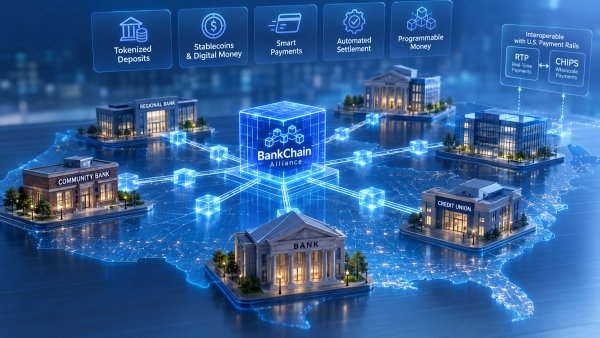
On August 25, 2026, 39 U.S. state bankers associations formed BankChain Alliance to build a shared blockchain network for financial institutions. The planned infrastructure would support smart payment tools, tokenized deposits, stablecoins and automated settlement, with participating banks able to take an ownership role. Together, the associations represent thousands of financial institutions serving millions of consumers, businesses and communities.
BankChain is selecting a technology partner and targeting a 2027 launch. It says the network will interoperate with other networks and that banks across the country will be invited to take ownership. The technology platform, ownership terms for individual banks, operating rules and settlement design haven’t been disclosed, so BankChain remains infrastructure under development rather than a live payment rail.
Building tokenized payment infrastructure involves more than choosing a blockchain. Banks need core system integration, compliance controls, security, operating rules and connections to other financial networks. Those costs are easier for a large institution to absorb than for a community or regional bank.
BankChain's model proposes that banks share more of the work and costs while retaining a say in how the network operates. If enough institutions participate, common infrastructure could reduce the amount each bank needs to build independently and give smaller banks another route into tokenized deposits and programmable payments.
The economics are still unknown. BankChain hasn't disclosed participation costs, ownership terms or implementation requirements. A shared network won't solve much for smaller institutions if joining it still requires expensive integrations, duplicated compliance work or several connections to outside payment systems.
BankChain is entering a market where another bank-led model is already taking shape. In June, The Clearing House launched an on-chain money initiative designed to clear and settle tokenized commercial bank deposits between institutions while connecting blockchain activity with its RTP and CHIPS payment networks.
The Clearing House begins with infrastructure that already clears and settles more than $2 trillion in payments each day. BankChain begins with 39 banking associations and plans to build a common network around institutions that may not have the resources to develop proprietary infrastructure.
Interoperability is paramount given that banks will need tokenized money to move between institutions and connect with established payment infrastructure. BankChain says its network will be interoperable, but hasn't explained how those connections will work.
BMO and TD Bank U.S. are among the institutions supporting The Clearing House initiative. Their participation gives Canadian financial institutions a direct view into one model for connecting tokenized commercial bank money with established U.S. payment rails while BankChain develops a different model based on shared ownership.
Individual bank commitments, network architecture and participation economics will determine whether BankChain becomes usable shared infrastructure.
Can shared ownership make tokenized payment infrastructure economical for smaller banks, or will access to established clearing networks and customer distribution remain the bigger competitive advantage?
The National Crowdfunding & Fintech Association (NCFA Canada) is a financial innovation ecosystem that provides education, market intelligence, industry stewardship, networking and funding opportunities and services to thousands of community members and works closely with industry, government, partners and affiliates to create a vibrant and innovative fintech and funding industry in Canada. Decentralized and distributed, NCFA is engaged with global stakeholders and helps incubate projects and investment in fintech, alternative finance, crowdfunding, peer-to-peer finance, payments, digital assets and tokens, artificial intelligence, blockchain, cryptocurrency, regtech, and insurtech sectors. Join Canada's Fintech & Funding Community today FREE! Or become a contributing member and get perks. For more information, please visit: www.ncfacanada.org
| | |
|---|---|---|
| | |
August 26, 2026 | NCFA Community Announcement | Fintech And Innovation, Artificial Intelligence And Data, Capital Markets And Funding

Elevate is less than a month away! Checkout the latest Elevate 2026 agenda giving founders, investors and technology operators a closer look at the conversations coming to Toronto from September 22–24.
For Canada's fintech community, the mix is worth watching. Elevate's 2026 programming spans fintech, artificial intelligence, capital, commercialization and other technologies competing for investment, customers and talent. NCFA is a Community Partner for this year's festival at Meridian Hall.
Canadian fintech has a direct place in the program.
Eva Wong, Co-Founder and Chief Product Officer of Borrowell, is among the announced speakers, bringing experience from one of Canada's established consumer fintech companies to discussions about product, fintech and the development of Canada's digital finance market.
The latest agenda announcement also highlights Mati Staniszewski, Co-Founder and CEO of ElevenLabs; Adam Collins, Chief Communications Officer at Reddit; and Jessica Chalk, Founder and CEO of myStoria.
Those adjacent technology perspectives are relevant to financial innovators. AI is entering customer service, fraud detection, compliance, product development and internal operations, while fintech companies still have to turn technical capability into products customers trust and businesses can scale.
For founders, the useful question isn't simply which technology attracts the most attention. It's where new capabilities can solve a real financial problem, reach customers and support a viable company.
Elevate is also expanding direct access between founders and investors.
Its Meeting Exchange program is doubling capacity for 2026, with more than 750 curated one-to-one meetings for investment-ready startups.
That adds a practical capital component to a festival expected to bring together approximately 10,000 technology professionals, entrepreneurs, founders, executives and investors.
For early and growth-stage companies, concentrated access to investors, potential customers, partners and other founders can make the trip more useful than a schedule built around stage content alone.
NCFA community members can receive 20% off General Pass tickets for Elevate Festival 2026.
Use promo code: NCFAELEVATE20
📅 September 22–24, 2026
📍 Meridian Hall, Toronto
More speakers and sessions are being added ahead of September.
For fintech founders, investors and operators, the value is in the overlap. Finance is colliding with AI, new infrastructure, changing customer expectations and tighter competition for capital. Elevate offers three days to test ideas with people building, funding and buying technology across those markets.
#ElevateFest2026
The National Crowdfunding & Fintech Association (NCFA Canada) is a financial innovation ecosystem that provides education, market intelligence, industry stewardship, networking and funding opportunities and services to thousands of community members and works closely with industry, government, partners and affiliates to create a vibrant and innovative fintech and funding industry in Canada. Decentralized and distributed, NCFA is engaged with global stakeholders and helps incubate projects and investment in fintech, alternative finance, crowdfunding, peer-to-peer finance, payments, digital assets and tokens, artificial intelligence, blockchain, cryptocurrency, regtech, and insurtech sectors. Join Canada's Fintech & Funding Community today FREE! Or become a contributing member and get perks. For more information, please visit: www.ncfacanada.org
| | |
|---|---|---|
| | |


August 26th, 2025

January 4th, 2024

June 1st, 2021

September 9th, 2020

July 9th, 2018

January 3rd, 2018

September 25th, 2017

June 20th, 2017

May 10th, 2017

December 14th, 2016