




Karsten Wenzlaff, Advisor
August 26th, 2025
Karsten Wenzlaff is a Crowdfunding and Fintech Expert from Germany. He is Secretary-General of Digit[...]


Apr 2, 2026 | NCFA Fintech Market Activity | Wealth Investing And Trading

The Trade Commissioner Service at the Consulate General of Canada in Chicago is inviting Canadian fintech companies to apply for a Fintech Showcase focused on accessing U.S. institutional wealth and asset management buyers.
The showcase takes place during Morningstar’s June 17 and 18 investment conference in Chicago. The conference brings together advisors and other investment professionals. The agenda covers AI, private markets, retirement, and portfolio strategy. Those topics line up with current demand for better research, portfolio insight, and advisor productivity tools. View the agenda.
Selected companies will present in a four minute format to a senior audience across wealth and asset management. Evaluation focuses on business model, market opportunity, impact on wealth and asset management, investor outcomes, and presentation quality. Companies need a clear wealth use case, defined buyer, and measurable impact on investor outcomes.
This is best suited for Canadian wealthtech and investment technology firms that help advisors, asset managers, and investment platforms research, manage, personalize, or report on investments, or expand access and reduce friction for investors. It is a weaker fit for broad consumer fintech, horizontal infrastructure, or products without a clear link to wealth, asset management, or investor outcomes.
The application deadline is May 17, 2026. Apply now if your product is revenue ready and built for institutional wealth and asset management buyers.
 The National Crowdfunding & Fintech Association (NCFA Canada) is a financial innovation ecosystem that provides education, market intelligence, industry stewardship, networking and funding opportunities and services to thousands of community members and works closely with industry, government, partners and affiliates to create a vibrant and innovative fintech and funding industry in Canada. Decentralized and distributed, NCFA is engaged with global stakeholders and helps incubate projects and investment in fintech, alternative finance, crowdfunding, peer-to-peer finance, payments, digital assets and tokens, artificial intelligence, blockchain, cryptocurrency, regtech, and insurtech sectors. Join Canada's Fintech & Funding Community today FREE! Or become a contributing member and get perks. For more information, please visit: www.ncfacanada.org
 |  |  |
|---|---|---|
 |  |  |
Apr 2, 2026 | NCFA Fintech Market Activity | Banking And Credit, Regulation And Policy

Image: Freepik/rawpixel.com
On April 2, 2026, Italy’s competition authority (AGCM) fined Revolut group €11 million for unfair commercial practices tied to investment disclosures, payment account restrictions, and communication around Italian versus Lithuanian IBANs.
These fines come at a time when Revolut has grown into a bigger and more profitable company, and trying to look more like a primary banking platform than a fast growing fintech. In late March, Revolut reported $2.3B in profit before tax for 2025 with 68.3 million customers and $6B in revenue. Regulators expect more from a company with that type of scale; clarity, conduct, and professional account handling.
Regarding the IBAN issue,, the AGCM said Revolut didn't provide clear and exhaustive information on the requirements and timing for obtaining an Italian IBAN instead of a Lithuanian one. Revolut’s Italy account documentation now identifies Revolut Bank UAB Italian branch details and says the information sheet took effect on March 30, 2026. For a fintech trying to become more embedded in everyday banking, local account setup and customer communication are not side issues, and are important for trust and primary account use.
Revolut said it strongly disagrees with the findings and plans to appeal in the Italian courts. The company said the decision would have no impact on operations or its financial position. That response may settle investors in the short term, but its a sign that once a fintech reaches bank like scale, regulators stop looking only at growth and product breadth. They look much harder at how claims are framed, how restrictions are handled, and whether customers understand what they are actually getting.
Fractional investing, account controls, and local account migration can look like product details when a company is small. At scale, they become conduct risk. Italy’s decision shows how quickly those details can become costly once a fintech evolves deeper into the center of consumer finance.
When a fintech starts to look more like a primary bank, which becomes harder to defend at scale: aggressive growth tactics or unclear customer communication?
The National Crowdfunding & Fintech Association (NCFA Canada) is a financial innovation ecosystem that provides education, market intelligence, industry stewardship, networking and funding opportunities and services to thousands of community members and works closely with industry, government, partners and affiliates to create a vibrant and innovative fintech and funding industry in Canada. Decentralized and distributed, NCFA is engaged with global stakeholders and helps incubate projects and investment in fintech, alternative finance, crowdfunding, peer-to-peer finance, payments, digital assets and tokens, artificial intelligence, blockchain, cryptocurrency, regtech, and insurtech sectors. Join Canada's Fintech & Funding Community today FREE! Or become a contributing member and get perks. For more information, please visit: www.ncfacanada.org
| | |
|---|---|---|
| | |
Apr 1, 2026 | NCFA Insight | Innovation Policy And Funding
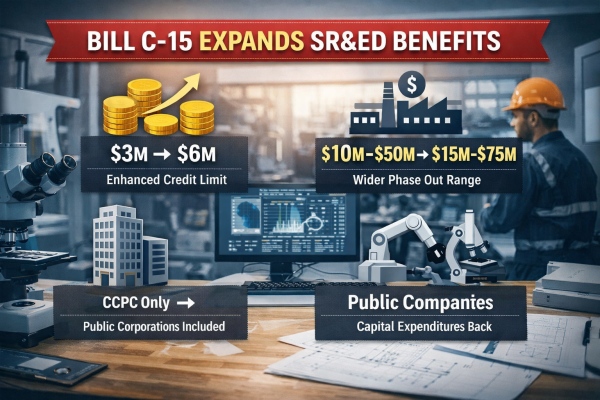
On Mar 26, 2026, Bill C-15 received Royal Assent. Alongside Canada’s new digital finance framework, it also puts major Budget 2025 SR&ED changes into law. The enhanced 35% SR&ED credit now applies on up to $6M of qualifying expenditures, up from $3M. The taxable capital phase out range widens to $15M to $75M, up from $10M to $50M. Eligible Canadian public corporations can now access the enhanced credit, and capital expenditures become eligible again.
| Change | Before | After | Why It Matters |
|---|---|---|---|
| Enhanced 35% expenditure ceiling | $3M | $6M | Companies can keep the higher credit rate on another $3M of qualifying work, which improves cash flow for teams already spending heavily on product and engineering. |
| Taxable capital phase out range | $10M to $50M | $15M to $75M | More growing firms can qualify for the enhanced regime longer instead of losing support too early. |
| Enhanced credit access | Mainly CCPC focused | Includes eligible Canadian public corporations | Some listed Canadian firms with real product and R&D intensity can now claim richer support instead of falling outside the enhanced lane. |
| Capital expenditures | Not eligible | Eligible again | This impacts firms that need equipment, testing environments, and technical infrastructure, not just payroll, to build. |
The biggest gains go to qualifying companies already spending heavily on development and infrastructure. That may include payments firms building fraud and risk systems, regtech firms developing compliance tooling, AI firms training and testing models, and data infrastructure companies investing ahead of revenue. Early stage teams with smaller claims still benefit, but the larger payoff goes to companies that were already hitting the old ceiling or losing support as they grew.
The program is stronger, but it still rewards discipline. Claims still depend on technical records, project detail, and the ability to show eligible experimental work. Companies with weak documentation simply won't capture the full benefit.
Two simple examples:
A Canadian payments company with $5M in eligible SR&ED spending used to reach the enhanced ceiling at $3M. Under the new rules, another $2M of that spend qualifies for the enhanced rate. That doesn't fix product market fit, but it can reduce cash burn and make it easier to keep engineering teams in place.
A public company building AI driven compliance software may now benefit in two ways at once. It can access the enhanced credit if it qualifies, and it can include eligible capital costs tied to technical build out. That makes the program more relevant to how software and infrastructure firms actually spend.
Bill C-15 makes SR&ED more useful for companies with real development spend. The ceiling doubles to $6M, the phase out range widens, public company access expands, and capital costs come back into scope. For Canadian fintech and AI builders, that can extend runway and support more product development work.
The National Crowdfunding & Fintech Association (NCFA Canada) is a financial innovation ecosystem that provides education, market intelligence, industry stewardship, networking and funding opportunities and services to thousands of community members and works closely with industry, government, partners and affiliates to create a vibrant and innovative fintech and funding industry in Canada. Decentralized and distributed, NCFA is engaged with global stakeholders and helps incubate projects and investment in fintech, alternative finance, crowdfunding, peer-to-peer finance, payments, digital assets and tokens, artificial intelligence, blockchain, cryptocurrency, regtech, and insurtech sectors. Join Canada's Fintech & Funding Community today FREE! Or become a contributing member and get perks. For more information, please visit: www.ncfacanada.org
| | |
|---|---|---|
| | |
Apr 1, 2026 | NCFA Fintech Market Activity | Cross Border Payments And FX
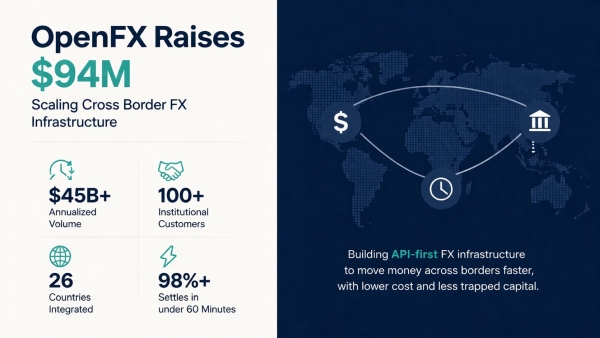
On March 31, 2026, OpenFX raised $94M to expand across Southeast Asia and Latin America. Two years after launch, the company says it now has 105 employees across four continents, handles more than $45B a year in cross border volume, and has onboarded more than 100 institutional customers.
The operating numbers are hard to ignore. OpenFX says 98% of transactions settle in under 60 minutes. In May 2025 the company said it had already integrated 26 countries and 7 major FX pairs, and that one newly onboarded client reached $100M in transaction volume in 17 days, with all of that settling within 60 minutes.
The product vision is more specific than a generic stablecoin pitch. Founder and CEO Prabhakar Reddy wrote that OpenFX didn't want to be “a crypto company moving Stablecoins,” but “a FX company moving money across the globe.”
OpenFX has built the hardest part of cross border payments first, including liquidity, cost, and settlement mechanics. It's tech stack offers collections, FX, payouts, banking, yield, compliance, and liquidity, delivered through API based infrastructure that runs 24/7.
That focus helps explain the customer base. OpenFX says it serves fintechs, neobanks, remittance providers, and payroll platforms, including MoneyGram, Yellow Card, and alfred. The company also says there's more than $200T in money movement that still relies on slow and fragmented cross border infrastructure.
OpenFX isn't selling speed on its own. Its announcement post argues that legacy cross border payments still hide fees inside exchange rates, trap capital in pre funded accounts, and leave businesses waiting days for settlement. OpenFX says stablecoins let value cross borders in seconds while sender and recipient still use local fiat. That reduces idle capital, compresses settlement time, and gives payment firms a cleaner way to handle large transfers.
There is a useful lesson here for founders and investors. OpenFX didn't try to fix every payment problem at once. It picked a part of the market where delay is expensive, built around API access and 24/7 settlement, then pushed that model into live institutional volume. If that keeps working, expect pressure to build around flows based on old economics andslow settlement, trapped liquidity, and wide spreads on large transfers.
If large ticket FX settles in under an hour, which parts of the old cross border fee stack get hardest to defend?
The National Crowdfunding & Fintech Association (NCFA Canada) is a financial innovation ecosystem that provides education, market intelligence, industry stewardship, networking and funding opportunities and services to thousands of community members and works closely with industry, government, partners and affiliates to create a vibrant and innovative fintech and funding industry in Canada. Decentralized and distributed, NCFA is engaged with global stakeholders and helps incubate projects and investment in fintech, alternative finance, crowdfunding, peer-to-peer finance, payments, digital assets and tokens, artificial intelligence, blockchain, cryptocurrency, regtech, and insurtech sectors. Join Canada's Fintech & Funding Community today FREE! Or become a contributing member and get perks. For more information, please visit: www.ncfacanada.org
| | |
|---|---|---|
| | |
Mar 31, 2026 | NCFA Fintech Market Activity | Artificial Intelligence And Data

On March 28, 2026, Bluesky introduced Attie in invite only closed beta, it's first agentic social product built on atproto. It's interesting because Bluesky built part of its appeal on taking a more cautious public approach on generative AI and user content than larger platforms.
Attie is a standalone AI assistant for custom feeds and app building. Users can describe what they want in natural language, build their own algorithm, create custom feeds, and over time build social apps on the protocol without needing to code.
In late 2024, Bluesky had already set expectations around how it saw AI and user data. The company said it had “no intention” of training generative AI on user posts.
Then in 2025, the company published a data reuse proposal that would let users set preferences across generative AI, protocol bridging, bulk datasets, and web archiving. That debate got heated because it didn't create a hard block on scraping or data reuse. For many users, it crossed a data use line that Bluesky already said it wouldn't cross. They said they wouldn't train AI on post data but now it was building a system around opt outs and reuse preferences, creating friction with its users.
By March 30, Attie had become one of Bluesky’s most blocked accounts. More than 125,000 users had blocked it within days. Users didn’t wait for a long policy debate. They reacted to what the launch seemed to mean.
Bluesky didn't announce that it would now train generative AI on user posts. But in trust based markets, users don’t separate product utility, data use, and company intent as neatly as product teams do. Once those concerns merge, the launch stops being just a product story. It becomes a consent and brand story too.
For founders and investors, there's a practical and commercial lesson here. AI features and products are getting easier to ship, but clear boundaries aren’t. In fintech, payments, digital identity, and any other business built on sensitive data, that gap (or buffer) can backlash and get expensive fast.
What did Bluesky launch?
Bluesky launched Attie as an invite only closed beta app built on atproto. It helps users create custom feeds with natural language prompts and is designed to support broader app building over time.
Why did users push back so quickly?
Because many users already saw Bluesky as more cautious on AI than rival platforms. A branded AI app raised immediate questions about whether that line of mutual trust was starting to change.
Did Bluesky say it will now train AI on user posts?
No verified source tied to this launch shows Bluesky announcing that change. The concern comes from how users connected the launch to earlier debates over AI training and scraping.
Why does this matter for fintech?
Because the same problem appears in any trust based product. If users are unsure what an AI tool does, what data it uses, or what clear policies the company will not cross, adoption can weaken before the product gets a fair chance.
What makes this commercially important?
This isn't just a social media story. It shows how fast a useful AI feature can become a trust and brand problem. That risk applies to consumer finance, digital identity, payments, and any business built on sensitive data.
As AI tools spread across digital platforms, will users reward the company that ships first, or the one that makes the boundary clear before launch?
The National Crowdfunding & Fintech Association (NCFA Canada) is a financial innovation ecosystem that provides education, market intelligence, industry stewardship, networking and funding opportunities and services to thousands of community members and works closely with industry, government, partners and affiliates to create a vibrant and innovative fintech and funding industry in Canada. Decentralized and distributed, NCFA is engaged with global stakeholders and helps incubate projects and investment in fintech, alternative finance, crowdfunding, peer-to-peer finance, payments, digital assets and tokens, artificial intelligence, blockchain, cryptocurrency, regtech, and insurtech sectors. Join Canada's Fintech & Funding Community today FREE! Or become a contributing member and get perks. For more information, please visit: www.ncfacanada.org
| | |
|---|---|---|
| | |
Mar 31, 2026 | NCFA Insight | Artificial Intelligence And Data

A Toronto quantum company reaches public markets, but the real test starts now with capital, manufacturing, and a long road to commercial scale.
On March 26, 2026, Xanadu completed its business combination with Crane Harbor Acquisition Corp. and confirmed that its shares would begin trading on Nasdaq and the Toronto Stock Exchange on March 27 under the ticker XNDU. The listing gives Canada a relatively rare public market deep tech story in advanced computing. It also puts a hard spotlight on a bigger challenge confronting the country.
Can Canada fund and keep the hardware, manufacturing, and technical talent needed to compete in the next compute cycle?
Xanadu builds photonic quantum computing technology and argues that photonics offers a more scalable route by operating at room temperature and fitting more naturally into semiconductor and networking supply chains. The listing gives public investors exposure to a Canadian company building core compute infrastructure at a time when the market is paying closer attention to the physical layer behind AI and advanced computing. It's a live test of whether public markets still have room for an ambitious Canadian deep tech company with long build cycles and heavy capital requirements.
Xanadu opened at $10 and closed its first day at $11.50 but the harder question is how much cash the company actually secures for a long commercialization runway. Earlier materials pointed to about $500 million in gross proceeds under a no redemption scenario. By March 19, the company updated that to about $302 million, a figure confirmed again in its March 26 closing release.
It's still meaningful capital, but 40% below below the early figure. Deep tech plays live or die on balance sheet strength, engineering execution, manufacturing progress, and how long they can keep building before commercial revenue catches up.
On March 11, Xanadu said it entered negotiations toward up to C$390 million in support from the governments of Canada and Ontario for Project OPTIMISM, a proposed initiative tied to quantum and photonic manufacturing. The company said the buildout could strengthen domestic capacity not only in quantum, but also in telecommunications, sensing, semiconductors, and AI hardware.
Canada often talks about AI leadership, productivity, and economic competitiveness. Those goals depend on more than software. They depend on whether Canada can finance, build, and retain parts of the compute stack itself. Xanadu is now a central entity in the middle of that question.
Xanadu’s own roadmap sets the tone. In its March 4 analyst day presentation, the company targets customer commercialization in 2029 and beyond and outlines a goal of up to 500 logical qubits in 2029. That means public investors get liquidity now while the core commercial outcome still sits years away.
Investors aren't buying a scaling revenue engine. They are backing a technical architecture, a manufacturing plan, and a long duration commercialization thesis. Public market access gives Xanadu more visibility and more pressure at the same time.
Xanadu’s transaction materials do not hide the challenge. The company discloses historical net losses, limited operating history, revenue concentration in government or state funded contracts, material weaknesses in internal control over financial reporting, and substantial doubt about its ability to continue as a going concern. Those disclosures do not erase the opportunity, but they do set the terms for how this company should be judged.
The Xanadu listing reaches the market with strong ambition, real technical credibility, and visible policy support. It also reaches the market with the risks that usually come with frontier hardware businesses. Investors now have both sides in front of them.
That's why this is not just a quantum story, but also a Canadian compute story. If future advantages in AI, cryptography, modelling, secure infrastructure, and advanced enterprise systems depend on access to more specialized hardware, then the financing and ownership of that hardware matters. Xanadu gives Canada a public company tied to that future. The market will now decide how much patience it has for that build cycle.
The listing also reopens a harder national question. Can Canada create a repeatable route for deep tech companies to reach public markets and keep building here, or will most companies still need to sell early, move abroad, or rely on foreign capital to finish the job. Xanadu doesn't answer that question yet, but it makes it impossible to ignore.
Xanadu’s debut goes well beyond a one day stock pop or standard IPO listing. It comes to market through a SPAC transaction, closes with lower expected gross proceeds than early headline numbers suggested, ties part of its future to government backed manufacturing support, and targets meaningful commercialization years from now. That combination means this is one of the more important Canadian technology listings in years. The bigger issue is whether Canada has the capital depth, policy follow through, and market confidence to support companies building the next layer of compute infrastructure before someone else does.
The National Crowdfunding & Fintech Association (NCFA Canada) is a financial innovation ecosystem that provides education, market intelligence, industry stewardship, networking and funding opportunities and services to thousands of community members and works closely with industry, government, partners and affiliates to create a vibrant and innovative fintech and funding industry in Canada. Decentralized and distributed, NCFA is engaged with global stakeholders and helps incubate projects and investment in fintech, alternative finance, crowdfunding, peer-to-peer finance, payments, digital assets and tokens, artificial intelligence, blockchain, cryptocurrency, regtech, and insurtech sectors. Join Canada's Fintech & Funding Community today FREE! Or become a contributing member and get perks. For more information, please visit: www.ncfacanada.org
| | |
|---|---|---|
| | |
Mar 31, 2026 | NCFA Fintech Market Activity | Payments And Money Movement

On March 30, 2026, RBC and HTS launched a long term travel collaboration that brings Hopper Technology Solutions into Avion Rewards. The new booking portal goes live later this year for all Avion Rewards members, including Avion credit cardholders.
RBC is not just adding another travel partner. It's bringing search, booking, pricing, and redemption deeper into its own rewards product. Members will be able to use points across flights, accommodations, car rentals, activities, and packages. The platform also adds price insights built on historical and predictive data. Avion cardholders keep fixed points pricing on any airline, any flight, any time, with no blackout dates or seating restrictions.
That's the fintech angle. Travel stops being only a redemption feature at the end of the card relationship. It becomes part of the card experience itself. The bank gets more control over where travel spend happens, how rewards get used, and what it learns from search, booking, and redemption behaviour.
Avion Rewards already describes itself as Canada’s largest bank owned loyalty program. HTS brings the software behind the experience. Its 2026 travel commerce report draws on $6B in travel sales, 410M reachable cardholders, and 2.2M annual fintech purchases. RBC is adding travel commerce software, pricing intelligence, and a tighter booking flow to a large existing rewards base.
If other banks follow, rewards programs will start competing on more than points. Cardholders may start comparing how easy it is to search, book, and use rewards, not just how many points they earn. Customers stand to benefit if booking gets easier, pricing gets clearer, and redemption works with less friction. Banks benefit if more travel activity stays inside their own platform.
The booking layer may be just the start. Once search and rewards are part of the same experience, the bank can add instalments, insurance, trip support, and targeted offers at the point of booking. Ultimately, that turns travel rewards into more than a marketing perk. It starts to look like a real financial service channel.
If banks bring booking deeper into rewards, what's more important over time: the points currency, the booking layer, or the customer data that sits between them?
The National Crowdfunding & Fintech Association (NCFA Canada) is a financial innovation ecosystem that provides education, market intelligence, industry stewardship, networking and funding opportunities and services to thousands of community members and works closely with industry, government, partners and affiliates to create a vibrant and innovative fintech and funding industry in Canada. Decentralized and distributed, NCFA is engaged with global stakeholders and helps incubate projects and investment in fintech, alternative finance, crowdfunding, peer-to-peer finance, payments, digital assets and tokens, artificial intelligence, blockchain, cryptocurrency, regtech, and insurtech sectors. Join Canada's Fintech & Funding Community today FREE! Or become a contributing member and get perks. For more information, please visit: www.ncfacanada.org
| | |
|---|---|---|
| | |


August 26th, 2025

January 4th, 2024

June 1st, 2021

September 9th, 2020

July 9th, 2018

January 3rd, 2018

September 25th, 2017

June 20th, 2017

May 10th, 2017

December 14th, 2016