




Karsten Wenzlaff, Advisor
August 26th, 2025
Karsten Wenzlaff is a Crowdfunding and Fintech Expert from Germany. He is Secretary-General of Digit[...]


Oct 30, 2025

Estonia has become one of the most attractive EU hubs for crypto businesses: digital-first processes, e-Residency, and clear MiCA-aligned rules make it ideal for launching compliant exchanges, wallets and custody services.
Thanks to this, obtaining a crypto license in Estonia is profitable, fast, and legal.
Prifinance leverages this environment to deliver end-to-end support - from company formation and AML/KYC frameworks to regulatory communication and post-authorization compliance.
|
Advantages of working with Prifinance |
Numbers |
| Experience in international consulting | 30 years |
| Completed projects | 10,000+ |
| Crypto licenses obtained | 400+ |
| Supported jurisdictions | 40 |
| Successful cases on complex requirements (including MiCA) | 100+ |
| Lawyers, auditors, and consultants | 100+ |
This track record ensures brand reliability and practical experience when you scale in Europe.
A MiCA-compliant Estonian license (CASP/VASP) gives lawful access to the EU market with passporting rights, clear consumer protections, and harmonised reporting requirements. You need this license when your project: accepts fiat/crypto from users, offers custody or wallet services, executes crypto-to-fiat or crypto-to-crypto trades, processes remittances, or markets token sales to EU residents.
Beyond legal permission, the license demonstrates institutional-grade governance - strict KYC, continuous transaction monitoring, secure IT architecture, and appointed compliance officers - which improves access to banking, liquidity partners and institutional clients. These elements are crucial at launch and become non-negotiable as trading volumes, AML scrutiny, or institutional relationships grow.
Why Estonia - practical benefits
We prioritise your brand and market credibility from day one. That means not only preparing an application that satisfies regulators, but also shaping how counterparties and clients perceive you: professional legal structure, transparent ownership, robust compliance policies, auditor-ready documentation, and clear public-facing materials.
Our offering includes: company incorporation in Estonia, preparation of AML/KYC and internal control manuals, recruitment and registration of key personnel, technical security checklists, liaising with the FIU/FSA, and post-license support. By pairing compliance with marketable governance, we help your brand convert regulatory compliance into a competitive asset.
Prifinance works with major banking and fintech partners and maintains long-term relationships with thousands of international clients.
Our partners include leading financial and technology companies such as CIM Banque, Commerzbank, Payoneer, OCBC Bank, Binance, Mashreq, Odav Print, Montify, and Blockchain Life.
Our client feedback and case experience show smooth licensing processes and effective post-license support - a practical advantage when regulators request clarifications or audits.
Visit https://prifinance.com/en/cryptocurrency-license/ to request a tailored licensing plan, get a cost estimate, and start the application process: Prifinance provides full-cycle support for Estonia CASP/VASP applications and post-authorization compliance. Send a request through our site to receive a personalized proposal.
 The National Crowdfunding & Fintech Association (NCFA Canada) is a financial innovation ecosystem that provides education, market intelligence, industry stewardship, networking and funding opportunities and services to thousands of community members and works closely with industry, government, partners and affiliates to create aa vibrant and innovative fintech and funding industry in Canada. Decentralized and distributed, NCFA is engaged with global stakeholders and helps incubate projects and investment in fintech, alternative finance, crowdfunding, peer-to-peer finance, payments, digital assets and tokens, artificial intelligence, blockchain, cryptocurrency, regtech, and insurtech sectors. Join Canada's Fintech & Funding Community today FREE! Or become a contributing member and get perks. For more information, please visit: www.ncfacanada.org
 |  |  |
|---|---|---|
 |  |  |
Prediction Markets | Oct 29, 2025

Image: NHL Calder Memorial Trophy example (Polymarket)
On October 22, 2025, the National Hockey League (NHL) announced new multi-year partnerships with Kalshi and Polymarket. It's the first time a major sports league has given prediction markets an official seat at the table.
Both Kalshi and Polymarket will use official NHL data, league marks, and broadcast rights to let fans interact with games through regulated financial platforms. The partnerships show how fintech innovation is breaking into unexpected territory, and why responsible design and governance matters just as much as bold ideas.
Think of a prediction market as a meeting point between finance and curiosity.
People can trade small contracts based on real-world outcomes, such as who will win this year's Stanley Cup or a playoff series? How many goals a team might score? Or whether a player reaches a milestone? The prices of those contracts is based on supply and demand, so they reflect what the crowd believes will happen.
Kalshi operates under the U.S. Commodity Futures Trading Commission (CFTC), while Polymarket began as a blockchain experiment using the Polygon network and USDC stablecoin.
For fans, prediction markets turn watching into participation.
For fintechs, it validates that with the right mix of data, incentives, and community interactions financial tools can become part of mainstream entertainment when framed responsibly. Innovation when paired with trust can educate and expand access, too.
Behind the excitement sits a serious legal question. Kalshi is fighting a federal battle with the New York State Gaming Commission, which insists that its contracts are a form of unlicensed sports wagering. Kalshi argues otherwise. Other regulators in places like Massachusetts and Nevada have voiced similar concerns. Each ruling is a test of whether innovation can coexist with public accountability. The company says federal law gives the CFTC authority, not state gaming boards.
Polymarket’s path has been anything but linear. After paying a $1.4 million CFTC fine in 2022 for operating without registration, the firm earned approval to relaunch in the U.S. in 2025 by acquiring QCEX exchange with a CFTC license.
By changing from a fully decentralized model to one that aligns with compliance standards, Polymarket demonstrated how they could innovate within regulatory frameworks. Now it sits alongside Kalshi as an NHL partner. A fintech built on blockchain that's earned institutional trust by embracing regulation, instead of resisting it.
As covered by the Sports Business Journal, the NHL didn’t jump in blindly. Reports show the NHL consulted regulators and examined consumer protections before agreeing to the partnerships.
Even so, the American Gaming Association called the deal “deeply troubling” (subscription required) warning that fans could confuse regulated markets with gambling. That tension captures a bigger issue facing every fintech today. That is how to innovate responsibly while protecting users. The NHL partnership suggests that fintechs can scale mainstream by demonstrating to regulators And customers that innovation and safety can coexist.
For Canada, the NHL partnership is a glimpse into what the future of participatory finance could look like. Canadian regulators have already been exploring frameworks for digital assets, open banking, and tokenized finance.
Prediction markets fit naturally into that conversation. If handled properly, they could open new avenues for retail engagement and capital formation while reinforcing Canada’s reputation for responsible fintech growth.
Prediction markets are moving from the edges of crypto into the center of participatory commerce. By partnering with Kalshi and Polymarket, the NHL is betting not only on fan enthusiasm but on fintech’s capacity to build trust through transparency. For Canada’s fintech community, the moment reinforces a truth long advocated by NCFA, when innovation, regulation, and inclusion advance together, everyone gains.
The National Crowdfunding & Fintech Association (NCFA Canada) is a financial innovation ecosystem that provides education, market intelligence, industry stewardship, networking and funding opportunities and services to thousands of community members and works closely with industry, government, partners and affiliates to create aa vibrant and innovative fintech and funding industry in Canada. Decentralized and distributed, NCFA is engaged with global stakeholders and helps incubate projects and investment in fintech, alternative finance, crowdfunding, peer-to-peer finance, payments, digital assets and tokens, artificial intelligence, blockchain, cryptocurrency, regtech, and insurtech sectors. Join Canada's Fintech & Funding Community today FREE! Or become a contributing member and get perks. For more information, please visit: www.ncfacanada.org
| | |
|---|---|---|
| | |
Fintech | Oct 28, 2025

Image: Freepik/starline
On October 23, 2025, Deloitte Canada released its annual 2025 Technology Fast 50 rankings, recognizing the country’s fastest growing innovators based on verified three-year revenue growth from companies that self-submitted their data for evaluation. The program celebrates excellence across technology, media, and telecommunications sectors, including fintech, AI, clean technology, software, and cybersecurity.
Calgary-based Neo Financial achieved the first ever three-peat by ranking first in the Enterprise Industry Leaders category three years in a row, with an outstanding 1,279% growth, providing credit cards, everyday accounts, high interest savings accounts (HISA) and mortgages to over one million Canadian clients.
Andrew Chau, CEO & Co-Founder, Neo Financial:
"While we didn't get into this business for the awards, this recognition serves as yet another example of the need for modern, rewarding financial experiences among Canadians. It's something legacy institutions have failed to deliver for far too long. We're focused on building financial products that actually help Canadians get ahead. In the last year alone, Neo has saved Canadians more than $110 million in fees, showing what's possible when financial products are designed to give Canadians more, not take more."
The 2025 results highlight how fintech, automation, and AI are powering Canada’s innovation economy. NCFA congratulates all of this year’s Fast 50 winners and invites readers to explore the breakdown of fintech and AI leaders featured in Deloitte’s report below. Together, these companies represent the innovative edge of Canada’s fintech and AI economy, and are at the forefront of technology, talent, and trust as they continue to drive financial innovation.
Recognizes Canada’s fastest-growing technology firms by three-year revenue growth.
| Company | Rank | Growth % | Overview |
|---|---|---|---|
| CapIntel | 2 | 9,255% | Wealth technology helping advisors deliver better investment presentations. |
| Float | 9 | 5,601% | Fintech offering corporate cards and spend management tools. |
| Relay | 12 | 4,257% | Business banking platform providing cash visibility and team controls. |
| nesto | 13 | 4,074% | Digital mortgage lender offering fully online approvals and funding. |
| Novisto | 15 | 2,910% | ESG data and reporting software for companies and investors. |
| ZayZoon | 22 | 1,487% | Earned wage access provider improving employee financial wellness. |
| Apaylo | 37 | 648% | Payments infrastructure offering EFT, wires, and business banking rails. |
| Flare | 38 | 639% | Cybersecurity platform monitoring and reducing digital exposure risk. |
| Zensurance | 41 | 601% | Online insurance brokerage simplifying coverage for small businesses. |
| Forma.ai | 44 | 573% | AI-driven automation for sales compensation and performance planning. |
| Conquest Planning | 46 | 542% | AI financial planning platform for advisors and institutions. |
| BOXX Insurance | 49 | 512% | Cyber insurance provider combining coverage with digital risk tools. |
| OWL.CO | 50 | 499% | AI analytics for insurers to detect fraud and improve risk decisions. |
Celebrates large technology companies demonstrating strong three-year growth in revenue and scale.
| Company | Rank | Growth % | Overview |
|---|---|---|---|
| Neo Financial | 1 | 1,279% | Consumer banking platform with credit cards, savings, and mortgages. |
| KOHO | 2 | 559% | Everyday banking alternative with prepaid credit, savings, and credit build. |
| Financeit | 4 | 355% | Point-of-sale financing that helps merchants offer installment plans. |
| Lightspeed | 6 | 318% | Commerce platform for retailers and restaurants with embedded payments. |
| Hopper | 9 | 282% | Travel marketplace with fintech products that reduce price risk for users. |
| Propel Holdings | 10 | 279% | Public fintech that provides credit access through digital channels. |
| Clutch | 12 | 266% | Online auto platform with financing options at checkout. |
Highlights high-growth emerging firms on track for future Fast 50 placement.
| Company | Rank | Growth % | Overview |
|---|---|---|---|
| Optable | 5 | 761% | Privacy-first data clean room that enables secure audience collaboration. |
| FundMore | 6 | 708% | AI mortgage platform that automates underwriting and decisioning. |
| Quandri | 8 | 664% | Automation software that removes repetitive work for insurance agencies. |
| WonderFi | 9 | 535% | Crypto company operating regulated Canadian digital asset exchanges. |
And in connecting with the FundMore team, they are incredibly proud of their work and mission to help lenders fund more, faster. Chris Grimes, CEO FundMore said (Listen: Fintech Fridays EP43: Taking the Mortgage Process From 40 Days to Minutes):
“This recognition reflects the tireless work of our entire team and our mission to help lenders fund more, faster. I couldn’t be prouder of what we’ve built, and where we’re headed."
The 2025 Deloitte Fast 50 results confirm that fintech and AI are no longer niche parts of Canada’s economy. They're defining the future. Neo Financial’s three-peat historical achievement, alongside high growth companies such as CapIntel, KOHO, Float, FundMore, and WonderFi are building financial systems that are more efficient, inclusive, and globally competitive.
The National Crowdfunding & Fintech Association (NCFA Canada) is a financial innovation ecosystem that provides education, market intelligence, industry stewardship, networking and funding opportunities and services to thousands of community members and works closely with industry, government, partners and affiliates to create aa vibrant and innovative fintech and funding industry in Canada. Decentralized and distributed, NCFA is engaged with global stakeholders and helps incubate projects and investment in fintech, alternative finance, crowdfunding, peer-to-peer finance, payments, digital assets and tokens, artificial intelligence, blockchain, cryptocurrency, regtech, and insurtech sectors. Join Canada's Fintech & Funding Community today FREE! Or become a contributing member and get perks. For more information, please visit: www.ncfacanada.org
| | |
|---|---|---|
| | |
AI Partnership | Oct 28 2025
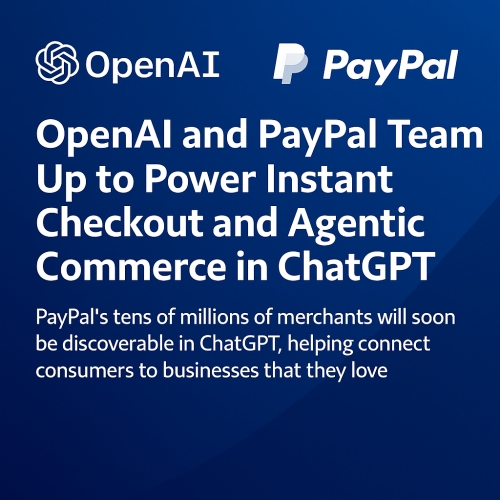
On October 28 2025, PayPal announced that it will adopt the Agentic Commerce Protocol and partner with OpenAI to bring shopping and paymentsdirectly into ChatGPT. The partnership links PayPal’s merchant network with ChatGPT users so people can buy and pay instantly using PayPal.
PayPal will add its wallet to ChatGPT’s Instant Checkout so people can pay with their balance, bank, or card.
The same buyer protection, tracking, and dispute tools that PayPal already offers will apply. PayPal will also handle card payments through OpenAI’s delegated payments API, taking care of routing and security. This API supports major card networks such as Visa and Mastercard, so users can pay with their preferred card while keeping PayPal’s protection and tracking features.
Starting in 2026, PayPal plans to add product catalogues from small businesses and larger brands so people can search and buy items in ChatGPT directly. PayPal will manage payment checks, merchant validation, and fraud protection in the background. You can learn more about OpenAI’s Agentic Commerce Protocol page.
This change could help Canadian fintechs and merchants reach new customers.
For the first time, shopping could happen entirely through a chat. Instead of clicking to a website, a person could ask ChatGPT for a product, view merchant options, and pay through PayPal in seconds.
Canadian merchants who already use PayPal could soon appear in ChatGPT’s shopping results, which might help smaller businesses connect to global buyers. It also gives users a glimpse at the future of how financial technology and artificial intelligence are starting to merge.
For Canadian fintechs, there's opportunity to design new tools for agent-led payments and business services. Developers could build smart payment gateways that connect chat platforms with accounting and invoicing systems, or create plug-ins that let small businesses manage orders and inventory through AI agents. There is also room for innovation in real-time fraud detection, digital identity layers that verify both buyers and sellers inside a chat, and lending tools that assess transaction data to offer instant credit decisions. These kinds of innovations could bring Canada to the forefront of safe, responsible, and flexible conversational finance.
Regulators, such as the Financial Consumer Agency of Canada and the Office of the Privacy Commissioner, may need to consider how consumer rules apply when a purchase happens in a conversation.
Agent led commerce seems destined to become a major new layer of the digital economy. If Canadian regulators, fintechs, and industry groups like NCFA collaborate early, Canada could establish guardrails and standards to make this new type of shopping and payments, fair, transparent and inclusive.
Success will depend on building trust, clear rules for data and disclosure, and reliable systems that protect both buyers and merchants. Conversational finance is upon us and could help Canada's fintech sector grow in a way that serves both innovation and consumers.
The National Crowdfunding & Fintech Association (NCFA Canada) is a financial innovation ecosystem that provides education, market intelligence, industry stewardship, networking and funding opportunities and services to thousands of community members and works closely with industry, government, partners and affiliates to create aa vibrant and innovative fintech and funding industry in Canada. Decentralized and distributed, NCFA is engaged with global stakeholders and helps incubate projects and investment in fintech, alternative finance, crowdfunding, peer-to-peer finance, payments, digital assets and tokens, artificial intelligence, blockchain, cryptocurrency, regtech, and insurtech sectors. Join Canada's Fintech & Funding Community today FREE! Or become a contributing member and get perks. For more information, please visit: www.ncfacanada.org
| | |
|---|---|---|
| | |
Oct 28, 2025

Image: Freepik AI
On October 27 2025, Anthropic announced new finance upgrades for Claude Sonnet 4.5 that make it work more deeply inside everyday finance tasks. The update adds an Excel integration, real time data connections, and built in tools that automate work usually done by analysts. These features strengthen its Claude for Financial Services product that was first introduced in July 2025, as they try to woo banks, asset managers, insurers, and fintech companies directly.
External validation from Vals AI’s Finance Agent benchmark, where Claude achieved 55.3% accuracy on tasks designed for financial analysts (Read: algorithms may be coming for your job soon). The benchmark covers 537 finance-specific questions that test reasoning, modelling, and data interpretation.
1. The first is Claude for Excel, which allows people to work with Claude directly inside Microsoft Excel. Claude can read, modify, and create spreadsheets, perform analysis, and trace the origin of each number. The integration is designed to save time while keeping audit trails and data checks intact.
2. The second feature is a set of live data connections. Claude can now pull information from several licensed financial sources. Anthropic confirmed new data links to Aiera (earnings insights), Third Bridge (expert research), Chronograph (private equity data), Egnyte (secure data rooms), LSEG (market analytics see partnership between Anthropic and LSEG), Moody’s (credit intelligence), and MT Newswires (market news).
3. The third addition is a group of Agent Skills that automate repetitive finance work. These include comparable company analysis, discounted cash flow models, due diligence summaries, company profiles, earnings analyses, and initiating coverage reports. Each task produces transparent outputs that can be verified back to original data sources.
These new tools will accelerate embedding AI into professional finance workflows. Excel still remains the favourite tool for global financial analysis, and integrating Claude into that environment changes how teams manage data and reporting. By connecting to trusted financial sources under strict compliance rules, Claude allows institutions to automate tasks such as modelling and research while maintaining full transparency and control.
It can cut repetitive manual work, improve accuracy through verifiable data sourcing, and enable faster decision making. The combination of AI and live financial data could also give smaller firms the same analytical capacity as large institutions, provided they apply proper data governance and oversight.
Anthropic’s continued investment in transparency, auditability, and security aligns with the needs of Canada’s regulated financial ecosystem and supports a more productive and competitive environment for both incumbents financial institutions and fintech innovators.
The National Crowdfunding & Fintech Association (NCFA Canada) is a financial innovation ecosystem that provides education, market intelligence, industry stewardship, networking and funding opportunities and services to thousands of community members and works closely with industry, government, partners and affiliates to create aa vibrant and innovative fintech and funding industry in Canada. Decentralized and distributed, NCFA is engaged with global stakeholders and helps incubate projects and investment in fintech, alternative finance, crowdfunding, peer-to-peer finance, payments, digital assets and tokens, artificial intelligence, blockchain, cryptocurrency, regtech, and insurtech sectors. Join Canada's Fintech & Funding Community today FREE! Or become a contributing member and get perks. For more information, please visit: www.ncfacanada.org
| | |
|---|---|---|
| | |
Regulation | Oct 27, 2025

Image courtesy of AI
On October 7, 2025, SEC Chair Paul Atkins talked about major changes to the Wells process in an SEC keynote address to the A A Sommer Jr Lecture at Fordham School of Law, including a new enforcement framework built around due process and transparency. Atkins described the Wells process as a safeguard that prevents the Commission from becoming “policeman, prosecutor, judge, and jury all in one.” He also emphasized that enforcement should focus on actual misconduct and investor harm rather than minor or technical violations.
The reforms include doubling the time allowed for responses, expanding access to testimony and investigative materials, and offering meetings with senior enforcement leadership before a recommendation is made. A BakerHostetler analysis and Dechert commentary confirm that these measures address years of criticism that the process was opaque, one-sided and unfair.
By aligning the Wells process with constitutional principles of fairness and proportionality, the SEC is signaling a more predictable approach that could encourage compliance and reduce costly disputes.
Few sectors highlight the importance of fair process more than digital assets. In 2024 and 2025, the SEC issued several Wells notices that dominated headlines and influenced global sentiment toward crypto markets (aka regulatory crackdown). NCFA covered how these actions impacted both perception and investment, such as the various Wells notices received that preceded litigation to Coinbase (March 2023), Robinhood (May 2024), and Uniswap Labs (April 2024), each becaming examples of what critics called “regulation by enforcement.”
The market reaction was usually immediate and swift. Share prices fell sharply after each announcement, venture funding slowed, and token listings became more conservative. The consistent theme across these cases was the lack of procedural clarity, leaving firms to interpret opaque standards that often changed after the fact. Not all inquiries ended with penalties. The SEC’s decision to close its stablecoin investigation in the Paxos BUSD (July 2024), suggested that avoiding enforcement was possible in limited cases.
Atkins planned changes come amid an administration that has declared support for digital assets and innovation and issued a series of policy reversals and case dismissals since taking office, including a full unconditional pardon for Binance founder, CZ most recently. The new government enacted the country's first comprehensive stablecoin law, the GENIUS Act, forming a statutory foundation for reserve-backed tokens. In February 2025, U.S. crypto czar Sacks outlined a coordinated plan for risk based supervision and technology neutral rules. Together these measures announced by the SEC signal a coordinated push by the administration toward fairness, predictability and genuine regulatory clarity.
Two weeks after Atkins’ address, as reported by Politico, the Trump administration announced plans to nominate Michael Selig as chair of the Commodity Futures Trading Commission who brings experience in digital asset policy and his focus on aligning derivatives oversight with technological modernization.
If confirmed, Selig’s appointment could enhance coordination between the CFTC and SEC on digital assets and tokenized products. A combined regulatory environment based on fairness, due process, and interagency cooperation that could stabilize U.S. market confidence after years of policy divergence and frustrated investors and innovators.
Regulatory predictability is essential for innovation and investment. When enforcement processes are clear and timelines are known, firms can allocate resources more effectively between compliance and product development (and not moving goal posts).
The Wells process reforms and the CFTC nomination together are clear signs that the days of regulating crypto by fear and enforcement are over. If implemented as anticipated, these policies could restore the trust between market participants and regulators, a prerequisite for sustainable capital formation. Impacted fintech leader should update internal playbooks to reflect the new Wells response timeline, including the opportunity for earlier meetings and white paper submissions.
Boards can establish governance protocols based on four week response periods and expect data-driven engagement with enforcement staff. For investors, a fairer U.S. digital asset environment could deepen capital pipelines and improve valuations in the digital finance sector.
For continued updates on regulatory developments and their implications for fintech and digital markets, subscribe to NCFA’s weekly newsletter for verified analysis and insights.
The National Crowdfunding & Fintech Association (NCFA Canada) is a financial innovation ecosystem that provides education, market intelligence, industry stewardship, networking and funding opportunities and services to thousands of community members and works closely with industry, government, partners and affiliates to create aa vibrant and innovative fintech and funding industry in Canada. Decentralized and distributed, NCFA is engaged with global stakeholders and helps incubate projects and investment in fintech, alternative finance, crowdfunding, peer-to-peer finance, payments, digital assets and tokens, artificial intelligence, blockchain, cryptocurrency, regtech, and insurtech sectors. Join Canada's Fintech & Funding Community today FREE! Or become a contributing member and get perks. For more information, please visit: www.ncfacanada.org
| | |
|---|---|---|
| | |
AI | Oct 27, 2025

Image: Introducing Vibe coding in Google AI Studio (Google Blog)
On October 26, 2025, Google announcing the intro of vibe coding in Google AI Studio, a new tool that lets developers and creators use artificial intelligence to speed up software development using a mix of natural language and code. The feature is available on Google’s Gemini models, which can understand text, images, and data all at once. The idea behind vibe coding is almost like a magical pill. That is turn a detailed description of what you want to build into a working app or prototype in minutes instead of weeks.
For fintech innovators, startups and established financial institutions, it sounds like a major breakthrough given they are constantly under the gun to launch new digital services quickly to remain relevant and competitive. Vibe coding tools in theory, could make it easier to create the latest innovative solutions without hiring expensive engineering teams. But the same qualities that make it fast and flexible also raise difficult questions about privacy, data handling, and reliability when used inside regulated environments.
Vibe coding was created for builders who want to experiment without having to code everything from scratch. Inside Google AI Studio, users can describe an idea and the system automatically produces the code and interface. It works for both experienced developers and business teams who may not have deep technical skills.
That accessibility and speed of 'idea-to-prototype' is what makes it so interesting for fintechs. A startup could create an interactive demo for investors or customers overnight. A mid-sized financial institution could use it to prototype internal compliance dashboards. Even regulators could use it to explore AI tools that help monitor market risks. The experience feels less like traditional coding and more like collaborating with a digital assistant that understands what you are trying to achieve.
Financial data is among the most sensitive information in any digital system. Google’s documentation for AI security on Google Cloud describes several layers of protection, including encryption, access control, and a zero data retention option that prevents user prompts or outputs from being stored for training. The company has also rolled out AI Protection service, which helps organizations monitor and control how their AI systems interact with code and data.
Those protections are encouraging, but they depend on how a company configures its environment. The free version of AI Studio likely won't include the same protections as enterprise deployments. Unless a fintech uses Google Cloud’s managed enterprise tools with clear data governance terms, prompts and logs could still be visible to Google’s systems. This means that even simple mistakes, such as entering customer information into a test prompt, could create compliance risks.
Canadian fintechs face additional expectations under PIPEDA, OSFI’s Cyber Risk Guidelines, and FINTRAC’s data-handling rules. Any platform that processes or even touches production data must comply with encryption standards, data residency, and audit requirements.
Tools like vibe coding should be treated as development sandboxes, not as live environments for real financial transactions or personal data.
The biggest concern is not Google’s infrastructure but how the tool is used. A recent security study referenced by TechRadar found that almost half of AI-generated code samples contained security flaws.
In the trenches of a financial system, even small weakness could expose customer accounts or transaction records. Because vibe coding relies on natural language, a poorly written prompt could create vulnerabilities with unintended code or API access. Read about demos versus production
Fintechs should assume that every piece of AI code generated needs to be reviewed by a real human and pass full security testing before it's deployed. Teams should separate test environments from live systems and avoid entering any confidential or regulated data into AI development tools. Also, the same rules that apply to cloud security and 3rd party vendor management should also be applied here.
Before experimenting with vibe coding for fintechs and financial institutions, companies should confirm that their account includes enterprise security controls and written commitments on data storage, encryption, and model training exclusions.
Developers should be trained to understand prompt hygiene and privacy responsibilities. Firms should also document where and how AI tools are used in the software development process to maintain compliance with internal and external audits.
For Canadian firms, the above security practices should align with OSFI’s guidance on 3rd party technology risks, which emphasizes focus on resilience, accountability, and transparency in AI systems.
As AI systems evolve and mature, the future points to a day where developers (or any visionary that can type a prompt) can build software solutions via conversations rather than code (the ultimate communicative wrapper).
But for companies that handle financial or personal data with real obligations, governance and risk management should be on high alert. If used responsibly and with greater advancements, vibe coding could lower the cost of innovation, help startups scale faster, and give established institutions more agility in how they design financial services. Want some inspiration? Check out Google's AI Studio app gallery.
The National Crowdfunding & Fintech Association (NCFA Canada) is a financial innovation ecosystem that provides education, market intelligence, industry stewardship, networking and funding opportunities and services to thousands of community members and works closely with industry, government, partners and affiliates to create aa vibrant and innovative fintech and funding industry in Canada. Decentralized and distributed, NCFA is engaged with global stakeholders and helps incubate projects and investment in fintech, alternative finance, crowdfunding, peer-to-peer finance, payments, digital assets and tokens, artificial intelligence, blockchain, cryptocurrency, regtech, and insurtech sectors. Join Canada's Fintech & Funding Community today FREE! Or become a contributing member and get perks. For more information, please visit: www.ncfacanada.org
| | |
|---|---|---|
| | |


August 26th, 2025

January 4th, 2024

June 1st, 2021

September 9th, 2020

July 9th, 2018

January 3rd, 2018

September 25th, 2017

June 20th, 2017

May 10th, 2017

December 14th, 2016