




Karsten Wenzlaff, Advisor
August 26th, 2025
Karsten Wenzlaff is a Crowdfunding and Fintech Expert from Germany. He is Secretary-General of Digit[...]


May 15, 2025

Payoneer, a global company specializing in cross-border transactions for small to medium businesses, is reportedly seeking a buyer. This comes after it suspended its already issued full-year 2025 guidance.
This also comes at a very interesting time, given that fintech and global payment processing are more in demand than ever before. Take the world of gambling, for example. In the past, payment options for online gambling were quite limited, and consumers were left in a tough spot. Now, these online casinos offer a myriad of payment methods, and this has only drawn in more customers. As Alex Hoffmann writes, many of the apps for seamless gaming for gambling lovers also come with multiple fintech-enabled payment methods.
Payoneer seems to be facing issues behind the scenes that critics and customers are struggling to make sense of. On the one hand, its Q1 report shows a valuation of five cents per share, which is significantly less than the nine cents per share that analysts had predicted. But on the other hand, its revenue rose by 8% to $246.6 million, which was higher than analysts' initial predictions.
Despite this, the company announced that it would be suspending its full-year 2025 guidance.
“There are a broad range of potential outcomes and as a company supporting cross-border businesses that may be negatively impacted, we face substantial risks which could impact our financial results,” said Bea Ordonez, Payoneer’s CFO, noting the decision.
But the real scandal seems to be Payoneer's decision to seek an acquisition. According to some executives who chose not to identify themselves, the company is looking for a buyer and has hired a financial advisor to this effect.
So far, Payoneer has had quite the journey. It was first formed in 2005 and has become one of the most popular online payment processors with over 2 million customers. Back in 2021, it joined the likes of MoneyLion, another payment processor, which merged with a special purpose acquisition company, or SPAC, to secure public valuation. This is often seen as an easier path compared to traditional IPOs. Money Lion has also sought an acquisition and was sold to Gen Digital last year for roughly a billion dollars. Now, Payoneer is looking to do the same. It is worth noting that it will probably receive a higher buyout price, given that it was valued at $2.89 billion just recently. Even with this, it is roughly a 30% decline from its initial $3.3 billion valuation when it first merged in 2021.
Fintech companies overall have seen a complex and often unforgiving market, and so, 2025 will be a fight for Payoneer's long-term survival. The fintech market is projected to expand over the next few years, but that also means more competition compared to 2005, when the company first started.
Its PR team has refused to confirm or deny any of the speculation, but as time goes on, the true situation at Payoneer should come to light.
 The National Crowdfunding & Fintech Association (NCFA Canada) is a financial innovation ecosystem that provides education, market intelligence, industry stewardship, networking and funding opportunities and services to thousands of community members and works closely with industry, government, partners and affiliates to create a vibrant and innovative fintech and funding industry in Canada. Decentralized and distributed, NCFA is engaged with global stakeholders and helps incubate projects and investment in fintech, alternative finance, crowdfunding, peer-to-peer finance, payments, digital assets and tokens, artificial intelligence, blockchain, cryptocurrency, regtech, and insurtech sectors. Join Canada's Fintech & Funding Community today FREE! Or become a contributing member and get perks. For more information, please visit: www.ncfacanada.org
 |  |  |
|---|---|---|
 |  |  |
Digital Banking | May 9, 2025
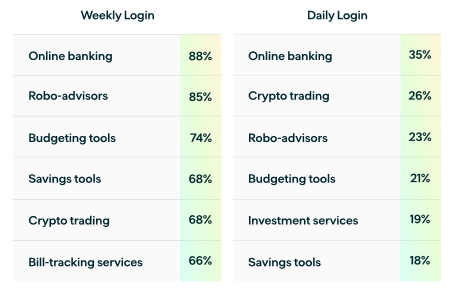
Image: Frequency of Use (Plaid x YouGov Money Talks survey report)
Between August 20-26th 2024, Plaid commissioned a national survey through the YouGov platform to understand how U.S. consumers bank, pay, and invest. The survey reveals insights of consumer preferences in digital finance, including trust in financial providers, app usage, payment methods, credit attitudes, and investment habits, based on weighted responses from 2,077 adults. Fintechs, digital finance platforms, and financial institutions need to stay up to date with the latest retail digital banking trends if they want to compete for consumer loyalty. Read 'Money Talks' (28 page PDF) report explaining these trends. Below we break-down key insights for NCFA's readers. Not yet subscribed? Sign-up for NCFA's weekly newsletter here.
Consumers continue to trust traditional banking institutions more than 100% digital platforms:
Trust and security go hand and hand, and overall, trust comes from perceived care and protection:
Consumers also shared who they rely on for financial well-being. The takeaway is that fintechs and advisory services must do more to be seen as helpful and caring, a useful partner in people’s financial lives.
Online banking is the most widely used financial tool: 99% percent of consumers are familiar with it, and 74% use it weekly.
Other commonly used tools include savings apps (68% weekly or daily), budgeting tools (85%), and peer-to-peer payment apps like Venmo or Zelle (used weekly by 50% of users). Roboadvisors are accessed more than once per week by (80%) of their users but only 1% of all consumers report using them regularly.
When asked what improvements they want most in financial apps:
60% of respondents said it is important to link their bank account with the financial apps they use.
Takeaway: Apps that are integrated, responsive, and secure are the most likely to be used often. Fintechs and banks that overcomplicate services or create friction in setup risk being overlooked, even if their offerings are advanced.
25% currently invest in cryptocurrency. Another 21% say they plan to invest in crypto or NFTs in the next year. These responder levels of engagement are equal to the 25% of people who say they will invest in stocks or trading platforms during the same period.
Crypto investors are not limiting their exposure:
Only 11% of respondents have used AI tools to support their investing decisions -> interestingly, this already exceeds the share of people using roboadvisors, suggesting that AI powered investment tools are gaining traction faster than traditional automated advice products.
Takeaway: Fintechs offering secure, easy to understand crypto access or AI investment tools can appeal to a growing investor base. Banks that avoid crypto are at risk of losing relevance with younger and self-directed investors.
Debit cards are now more commonly used than credit by younger adults. According to EY data cited in the report, 69% of Gen Z use debit cards daily or weekly. Many say they avoid credit cards because they do not want debt or do not qualify.
Buy now pay later (BNPL) services have grown 40% in usage since 2021.
Takeaway: Only 30% of respondents believe their credit score accurately reflects their financial health. 55% said they have been denied a loan due to a low score. These figures support growing interest in alternative data, such as cash flow and account history, for lending decisions.
Older adults are especially cautious. People aged 66 to 70 are 55% more likely to mistrust digital banks than those aged 22 to 25. Younger adults are more flexible. Among respondents aged 18 to 24, 36% said they would switch banks for a better digital payment experience.
Despite these trends, most people are not actively looking to change banks:
Consumers use different payment methods based on transaction size and age group:
To fund digital wallets:
Takeaway: Fintechs that want to increase adoption of pay by bank options must improve the experience. According to the report, 49% of users say they are likely to use pay by bank if the account linking process is easy.
Consumers want financial services that are clear, secure, and helpful, with trust remaining the most important factor in deciding whether to try a new app, share data, or switch banks. Traditional banks still hold an advantage in trust and reach but must modernize quickly. Fintechs have room to grow if they lead with transparency and value. Financial institutions that support financial goals and offer simple, connected experiences will stay relevant in 2025 (and beyond). Learn more about how consumers in the U.S. use, feel, bank, transact and acquire in 'Money Talks'.
The National Crowdfunding & Fintech Association (NCFA Canada) is a financial innovation ecosystem that provides education, market intelligence, industry stewardship, networking and funding opportunities and services to thousands of community members and works closely with industry, government, partners and affiliates to create a vibrant and innovative fintech and funding industry in Canada. Decentralized and distributed, NCFA is engaged with global stakeholders and helps incubate projects and investment in fintech, alternative finance, crowdfunding, peer-to-peer finance, payments, digital assets and tokens, artificial intelligence, blockchain, cryptocurrency, regtech, and insurtech sectors. Join Canada's Fintech & Funding Community today FREE! Or become a contributing member and get perks. For more information, please visit: www.ncfacanada.org
| | |
|---|---|---|
| | |
Payments | May 7 2025
Image from Shakepay joins Payments Canada
Canadian fintech just took a significant step forward. On May 5, 2025, Shakepay Inc, a Montreal-based crypto platform and CIRO-regulated securities dealer announced that they are the first crypto-native company to officially join Payments Canada, an independent public-purpose organization that owns and operates Canada's core payment infrastructure under federal oversight including the systems that clear and settle over $120 trillion annually.
This move could open the door for deeper integration of digital assets into Canada's regulated financial system, which in turn could accelerate innovation, competition, and consumer access to key fintech services including crypto and digital assets more broadly.
Shakepay’s blog announcement:
"Not only are we joining an exclusive group of fintechs, but it marks a significant step towards bridging the gap between the crypto industry and traditional finance in Canada."
Shakepay’s access to the national payment infrastructure is about more than speed. It aligns with their vision to make 'bitcoin more accessible to Canadians', and as member they can work directly with banks, fintechs, and other financial institutions under the same rules and protections as traditional players. This includes faster and more reliable fiat payment options to its customers, and access to the Real-Time Rail system when it's expected to rollout in 2026.
This is the same infrastructure that open banking will rely on, so it gives Shakepay critical access, aligning its services with evolving standards for instant payments, data access, and interoperability.
It also gives them a seat at the 'parents table', allowing them to participate in key discussions, collaborate with key industry leaders, and bridge the gap between digital assets and traditional finance, while setting the stage for future participation in Canada's open banking framework.
It does raise several questions though, such as will this move make it easier for other fintechs to gain access to the same payments infrastructure? Will their ability to educate, advocate, and generate significant banking partnerships accelerate regulatory clarity for expanding crypto services in Canada? Will this lead to a direct crypto to fiat payment service via the national payments infrastructure?
While the answers will no doubt take time to emerge, the line between traditional financial institutions and digital asset platforms continues to blur. And this is the first time that a crypto-native firm is running through the heart of Canada's payment system.
The National Crowdfunding & Fintech Association (NCFA Canada) is a financial innovation ecosystem that provides education, market intelligence, industry stewardship, networking and funding opportunities and services to thousands of community members and works closely with industry, government, partners and affiliates to create a vibrant and innovative fintech and funding industry in Canada. Decentralized and distributed, NCFA is engaged with global stakeholders and helps incubate projects and investment in fintech, alternative finance, crowdfunding, peer-to-peer finance, payments, digital assets and tokens, artificial intelligence, blockchain, cryptocurrency, regtech, and insurtech sectors. Join Canada's Fintech & Funding Community today FREE! Or become a contributing member and get perks. For more information, please visit: www.ncfacanada.org
| | |
|---|---|---|
| | |
Payments Regulation | May 1, 2025
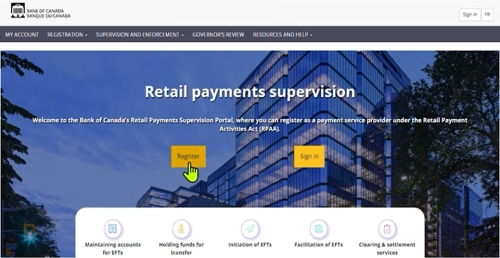
Image: PSP Connect, Retail Payments Supervision (Bank of Canada)
On April 30, 2025, the Bank of Canada (BoC) shared a new update on how it will enforce the Retail Payment Activities Act (RPAA). Payment service providers, known as PSPs, had until November 15, 2024 to register. Those who failed to do so are now being urged to act immediately or face enforcement.
BoC message:
“If you missed this deadline, you must apply immediately and at least 60 days before starting any retail payment activities. Failure to register may result in enforcement action,” the Bank stated in its April 30 message.
The Bank has updated its enforcement process outlining they may contact a PSP that is under investigation. Communication methods may include phone calls, encrypted email, courier delivery, and other secure channels. The approach is inline with the enforcement tools at their disposal published in June 2024, which include monetary penalties and compliance orders.
The BoC is also sending a reminder of how to submit a registration application through PSP Connect, the Bank's secure online portal.
1. Create a PSP Connect account
Here's a handy step by step tutorial and video available on the Bank of Canada's website to help you with the process.
2. Enter the required information and upload all documents
You can save your progress and return later if needed.
3. Submit your completed application and pay the fee
There's a $2500 application fee that must be paid in full by either credit card or debit. Alternative payment arrangements such as direct deposit or wire transfer may be arranged if several card payment attempts fail.
If you are new to the process or need further help, and have missed the workshops/tutorials, the Bank encourages PSPs to use its general inquiries form.
This update signals that the BoC is shifting from education to enforcement, as they are making it clear they are ready to take action against unregistered PSPs. Regulatory oversight of retail payments will only become more structured from here, and payment providers must meet their legal obligations or face financial and operational consequences.
The National Crowdfunding & Fintech Association (NCFA Canada) is a financial innovation ecosystem that provides education, market intelligence, industry stewardship, networking and funding opportunities and services to thousands of community members and works closely with industry, government, partners and affiliates to create a vibrant and innovative fintech and funding industry in Canada. Decentralized and distributed, NCFA is engaged with global stakeholders and helps incubate projects and investment in fintech, alternative finance, crowdfunding, peer-to-peer finance, payments, digital assets and tokens, artificial intelligence, blockchain, cryptocurrency, regtech, and insurtech sectors. Join Canada's Fintech & Funding Community today FREE! Or become a contributing member and get perks. For more information, please visit: www.ncfacanada.org
| | |
|---|---|---|
| | |
Innovation Economy | April 29, 2025

Image: Freepik
Mark Carney has been elected as Canada's 24th Prime Minister after leading the Liberal Party to win the 2025 federal election. The Liberals secured 168 seats (just shy of a majority), and are expected to form a minority government. Prime Minister Mark Carney has already spoken with President Trump about the pressing issues of tariffs, trade war and 51st state rhetoric, and the two leaders have agreed to meet in person.
While those issues are of critical importance to Canada's sovereignty, this article looks at Carney's past public comments and Liberals 2025 platform to get a sense for the implications for Canada's fintech sector under his expected leadership.
In 2019, Carney was the Governor of the Bank of England (BoE) and said the following at the Innovate Finance Global Summit:
“A new economy requires a new finance... to serve the digital economy, to support the major transitions underway across the globe and to increase the sector’s resilience”.
The newly elected Prime Minister of Canada has a deep background in finance, global networks, and a steady hand at innovation. He's expected to speed up payments modernization, support the responsible AI development, foster fintech investment, tighten crypto rules, and open more global markets to Canadian companies. The Liberal Party commitments that support innovation include financial technologies and sustainable finance, infrastructure investment, internal trade reform, red tape reduction, and a patent box regime, all told would help strengthen the economy and fintech growth.
When Carney was leading the BoE, he signalled strong support for opening payments infrastructure to non-bank providers, helping to boost innovation and competition. In Canada, the implementation of open banking and payment modernization initiatives (i.e. Real Time Rail System) have sadly faced prolonged delays. Carney is expected to speed up these rollouts to benefit consumers and competition. Open banking will give consumers control over their financial data and allow fintech companies to create new services, while the operating firms must meet high security and operational standards.
As part of its 2025 platform, the Liberal government committed to eliminating federal barriers to interprovincial trade and labour mobility by Canada Day. Reducing costs and aligning standards could benefit fintech companies that must constantly track and adjust to changing and inconsistent provincial compliance requirements, in sectors like payments, insurtech, wealthtech, and others. Streamlining trade and regulatory barriers would help fintechs expand nationally more effectively, reduce legal and operational costs, and also contribute to offering consistent services to customers and businesses from coast to coast.
Carney spoke about how emerging technologies are game-changing finance in a 2018 Mansion House speech “New Economy, New Finance, New Bank”, where he acknowledged AI's growing impact on credit and risk systems.
Under his government, Canada is expected to advance the Artificial Intelligence and Data Act to regulate high impact AI systems including financial firms using AI for credit scoring, fraud detection, or robo advising to ensure responsible AI standards are met for fairness, explainability, and consumer protection.
Immediately after securing Liberal leadership, Carney axed the controversial capital gains tax hike, directly supporting Canada's innovation economy. Under his leadership, Carney could expand access to venture capital, innovation incentives, and encourage national regulatory alignment for startups operating across multiple provinces. The Liberal platform also supports a patent box regime, focused on scaling high growth firms, retaining intellectual property in Canada, and improving commercialization outcomes from public and private R&D. The Liberal 2025 Platform outlines efforts to increase business investment and create a more competitive innovation environment, especially for sectors like fintech and AI.
Although Carney previously showed openness towards regulated forms of crypto innovation, in 2018, he spoke critically of unbacked crypto assets and called Bitcoin “neither a store of value nor a useful means of exchange”. It's expected that he'll tighten oversight of crypto exchanges, stablecoin issuance, and asset custody. Lastly, while Carney hasn't explicitly endorsed a Canadian CBDC, he has called for central banks to explore sovereign digital currencies as tools to support monetary policy and financial stability. During a 2019 speech at the Jackson Hole Economic Symposium, for example, Carney proposed the idea of a "synthetic hegemonic currency" (SHC) as a potential solution to the destabilizing dominance of the U.S. dollar in the global financial system.
Mark Carney is one of the most prominent global figures in sustainable finance. He co-founded the Glasgow Financial Alliance for Net Zero (GFANZ) and served as the UN Special Envoy on Climate Action and Finance. His leadership brings a strong focus on aligning financial systems with climate goals. The 2025 Liberal platform commits to supporting green innovation and transitioning Canada toward a low-carbon economy. This creates opportunities for fintechs in areas like ESG data services, green lending, climate risk modeling, and carbon trading infrastructure.
Carney is expected to support broader digital financial access across Canada. In his 2018 “Future of Money” speech, he emphasized the role of digital identity, financial modernization, and infrastructure in improving inclusion. While he has't directly addressed digital ID for Canada, the Liberal platform’s national digital readiness strategy includes high speed rail and northern connectivity projects that could help bring digital banking and fintech services to underserved and remote communities.
| Opportunities | Challenges |
| Launch of real time payments and open banking | Meeting tougher compliance and risk standards |
| New funding for AI, fintech innovation, and green finance | Higher expectations for responsible AI and cybersecurity |
| Stronger startup investment environment and patent box incentives | Adapting to stricter crypto and stablecoin rules |
| Global trade partnerships and reduced internal trade barriers | Competition from international fintech firms |
| Possible leadership in digital identity and CBDC projects | Regulatory complexity for multi jurisdictional firms |
| Growth in sustainable finance and ESG fintech | Evolving global standards for ESG data and disclosures |
| Growth in digital access through national infrastructure | Uneven fintech access in rural and remote communities |
Mark Carney's credentials offer an elite tier of credibility in global finance, climate leadership, and modernization of financial systems. Together with the Liberal 2025 Platform's strategic commitments to innovation, interprovincial trade liberalization, red tape reduction, and IP commercialization, his leadership is desperately needed to improve Canada's flailing productivity, upgrade its financial ecosystem, build public trust and international competitiveness.
His background also positions Canada to lead in sustainable finance, aligning innovation with global climate goals. For fintech entrepreneurs, investors, and policymakers, the Carney era is underpinned by stable governance and a clear vision, offering a mix of opportunity and responsibility.
The National Crowdfunding & Fintech Association (NCFA Canada) is a financial innovation ecosystem that provides education, market intelligence, industry stewardship, networking and funding opportunities and services to thousands of community members and works closely with industry, government, partners and affiliates to create a vibrant and innovative fintech and funding industry in Canada. Decentralized and distributed, NCFA is engaged with global stakeholders and helps incubate projects and investment in fintech, alternative finance, crowdfunding, peer-to-peer finance, payments, digital assets and tokens, artificial intelligence, blockchain, cryptocurrency, regtech, and insurtech sectors. Join Canada's Fintech & Funding Community today FREE! Or become a contributing member and get perks. For more information, please visit: www.ncfacanada.org
| | |
|---|---|---|
| | |
Payments | April 24, 2025
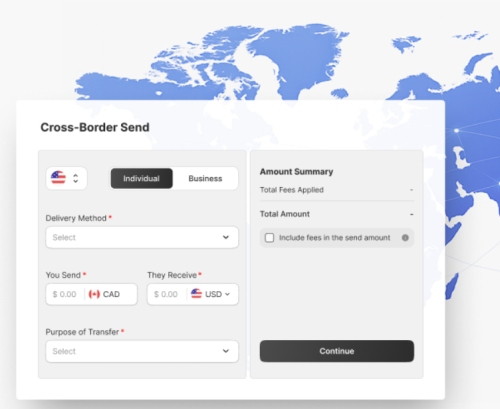
Image courtesy of VoPay
On April 23, Vancouver-based fintech VoPay announced the launch of its Cross Border Payments-as-a-Service platform, built for companies that want to send money globally but don’t want to build the infrastructure to do it.
VoPay's new payments service offers companies including fintechs a full suite of tools to move money for B2B, B2P, P2B and P2P use cases across 140+ countries, and various payment channels and methods. The system handles currency conversion, compliance risks, banking partnerships, and global settlement behind the scenes while companies retain full control of the user experience.
Instead of reinventing a global payment network from scratch, companies can plug into VoPay’s platform through APIs, white label dashboards, and even no-code tools, with setup taking less than two weeks. The new cross-border payments platform supports business to business, business to person, and peer to peer payments using a single system designed for speed and scale.
The platform offers real time foreign exchange with smart routing, helping businesses optimize conversion rates automatically. It comes with compliance tools already built in, including checks for KYC, AML, and global sanctions, so companies don’t need to manage that complexity on their own.
Money can be sent via a wide range of global delivery methods, such as direct bank transfers, mobile wallets, credit and debit cards, and even cash payouts where supported. VoPay's service also handles reconciliation, transaction tracking, and reporting, which gives businesses full visibility and peace of mind over every payment.
Everything is designed to work with existing platforms, so companies can start offering international payments to their customers quickly. VoPay has also partnered with Mastercard to support real time payouts to more than 100 countries.
While fintechs and financial institutions can use the platform to add global payment features quickly, the service is also designed for online platforms, such as vertical SaaS, digital marketplaces, payroll apps, and ERPs.
For example, a gig work platform could use VoPay to pay global contractors. An insurance platform could send global claims instantly. A business platform could let clients send or receive funds across borders in real time.
Hamed Arbabi, CEO of VoPay:
"In a time when cross-border trade and supply chains face unprecedented complexity, businesses need infrastructure that removes barriers, not adds to them. This new solution gives our partners the ability to offer world-class international payment experiences, boosting their revenue streams while supporting their customers with faster, smarter, and safer transactions."
Cross-border B2B payments are projected to reach $124 trillion by 2028. VoPay's PaaS tools enable companies to offer fast, brandable, and compliant ways to move money around the globe without being a payments company or having to build complex infrastructure. This launch builds on VoPay’s broader work in embedded finance and follows its recent VoPay360 release, which helps integrate payments into accounting platforms. The platform is now live and available for commercial use. For more information: vopay.com/global-cross-border-payments
The National Crowdfunding & Fintech Association (NCFA Canada) is a financial innovation ecosystem that provides education, market intelligence, industry stewardship, networking and funding opportunities and services to thousands of community members and works closely with industry, government, partners and affiliates to create a vibrant and innovative fintech and funding industry in Canada. Decentralized and distributed, NCFA is engaged with global stakeholders and helps incubate projects and investment in fintech, alternative finance, crowdfunding, peer-to-peer finance, payments, digital assets and tokens, artificial intelligence, blockchain, cryptocurrency, regtech, and insurtech sectors. Join Canada's Fintech & Funding Community today FREE! Or become a contributing member and get perks. For more information, please visit: www.ncfacanada.org
| | |
|---|---|---|
| | |
Stablecoins | April 17, 2025

Image: Freepik/creativeart
Stablecoins are gaining traction and are no longer a niche bet. According to Stripe’s 2024 Annual Letter, the number of monthly active stablecoin wallets tripled to 40 million over the past year. Stripe has now successfully integrated stablecoin capabilities into its core platform by the acquisition of Bridge, an enterprise grade stablecoin infrastructure provider (like Swift but on blockchain and faster) focused on real-time treasury and cross-border flows.
Stripe co-founders, Patrick and John Collison see stablecoins as improving the usability of money that can lead to more prosperous economies by enabling faster, cheaper, and more accessible transactions. An evolutionary and historical shift like the move from gold to fiat currency.
“Improvements to the basic usability of money make economies more prosperous. Consider the transitions from coins to banknotes, from the gold standard to fiat currency, and from paper instruments to electronic payments. Stablecoins are a new branch of the money tree. Such transitions occur with some regularity over the centuries, and the effects tend to be large.”
a16z just shared 'Stablecoins are payments without intermediaries', highlighting that stablecoins managed over $15.6 trillion of on-chain volume in 2024, which is essentially the same as Visa's annual volume, but it's growing and accelerating.
Stablecoins are no longer an experiment and have become part of core infrastructure. Stripe uses them for real time settlements and lower cross border costs. Over 78% of the Forbes AI 50 use Stripe products, so stablecoin transactions could scale massively quickly.
For any fintechs or financial institutions still relying on multi-day SWIFT transfers or batch ACH systems - it's time to take notice. Stablecoins offer instant settlement, programmable logic, and almost zero fees.
There's no waiting for banking hours or regional cutoffs. Stablecoin availability is open 24/7. The average transaction costs on networks like Solana are less than $0.01. Stablecoin transactions can finalize in under 5 seconds.
Stablecoins like USDC are designed to be composable, so they integrate seamlessly with numerous smart contracts and decentralized applications. Financial tools can now be built directly on-chain using smart contracts and stablecoin flows.
That's why stablecoins are already being used for payroll (e.g., pay overseas contractors), international business payments, and even on-chain stable yield strategies.
Stripe’s 2024 update, reports that stablecoin integration is already being used in many practical ways, such as SpaceX uses Stripe's stablecoin infrastructure to repatriate funds from Starlink sales in countries like Argentina and Nigeria. The U.S. government uses Stripe's stablecoin solutions to improve efficiencies of financial operations.
There are several real world economic cases where countries are relying on stablecoins.
Argentina for example, experienced a massive spike in annual inflation of 211.4% in 2023, which pushed many to hedge against inflation by moving funds to stablecoins like USDT and USDC.
Nigeria uses stablecoins to send funds across borders due to the inefficiencies and high costs involved with traditional remittance methods, making global transfers more affordable.
In the Philippines, a stablecoin called PHPC (pegged to the Philippine peso) is used to reduce exchange rates and transfer costs for Filipino expats sending money home to families.
If Canada wants to compete in global finance, we can’t ignore what’s happening at the infrastructure level. Major tech platforms like Stripe are integrating stablecoins into programmable finance. Startups are now choosing stablecoin rails to access global markets from day one. Canada has been working to modernize it's payment infrastructure and real time rails for years but the tech overhaul has been delayed over years, and even the Bank of Canada is disappointed by the progress rate.
Fintechs and financial institutions should be evaluating the growing use cases of stablecoins such as cross border treasury flows, global payroll, and embedded payments. They should track the developments in upcoming stablecoin regulations, such as Canada's Retail Payment Activities Act, the U.S. efforts, the UK, and European crypto guidelines. They can begin compliance planning and readiness efforts for stablecoin transaction and consider partnering with infrastructure providers offering compliant stablecoin APIs.
Stablecoins have gone mainstream and are now core infrastructure settling in seconds for less than a penny, and running 24/7. Stripe, SpaceX, governments, and individuals and companies globally are using them for faster, cheaper payments. If you're still relying only on traditional payment rails, it's time to evaluate stablecoin use cases and get ready to plug into the new financial internet.
The National Crowdfunding & Fintech Association (NCFA Canada) is a financial innovation ecosystem that provides education, market intelligence, industry stewardship, networking and funding opportunities and services to thousands of community members and works closely with industry, government, partners and affiliates to create a vibrant and innovative fintech and funding industry in Canada. Decentralized and distributed, NCFA is engaged with global stakeholders and helps incubate projects and investment in fintech, alternative finance, crowdfunding, peer-to-peer finance, payments, digital assets and tokens, artificial intelligence, blockchain, cryptocurrency, regtech, and insurtech sectors. Join Canada's Fintech & Funding Community today FREE! Or become a contributing member and get perks. For more information, please visit: www.ncfacanada.org
| | |
|---|---|---|
| | |


August 26th, 2025

January 4th, 2024

June 1st, 2021

September 9th, 2020

July 9th, 2018

January 3rd, 2018

September 25th, 2017

June 20th, 2017

May 10th, 2017

December 14th, 2016