




Karsten Wenzlaff, Advisor
August 26th, 2025
Karsten Wenzlaff is a Crowdfunding and Fintech Expert from Germany. He is Secretary-General of Digit[...]


Innovation | Feb 4, 2025

Image: Big Ideas 2025 Ark Invest
ARK Invest just dropped their annual Big Ideas 2025 report (148 page PDF) covering the disruptive tech trends that are game-changing industries and global economies. It provides insight into a lot of investment ideas backed with charts and data. Below are the highlights and compelling data points along with their fintech impact.
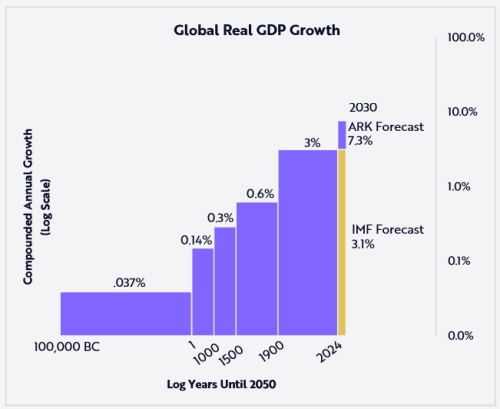
The interconnected fields of AI, robotics, blockchain, energy, and biotech are converging, creating new efficiencies, business models, economic growth, and investment opportunities at an unprecedented pace.
AI agents are changing industries by making decisions automatically, streamlining tasks, and helping people work more efficiently. These smart systems will play a big role in businesses, finance, and healthcare, as well as in everyday life as they improve customer service, digital marketing and provide automated financial advice.
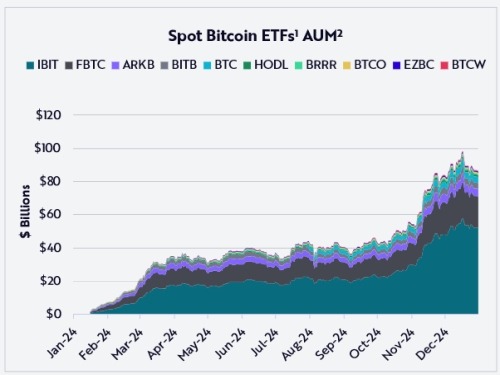
Spot Bitcoin ETF AUM Ark Invest Big Ideas 2025
Bitcoin’s evolution into a mainstream financial asset is being driven by institutional adoption, regulatory clarity, its role as a hedge against inflation, and store of wealth. ETFs and corporate adoption are solidifying its place in global finance. Bitcoin’s adoption will drive new financial products, including tokenized assets, decentralized finance (DeFi) lending, and institutional custody solutions.
Stablecoins are changing the way money moves across borders by making payments faster, cheaper, and more efficient than traditional banks. They connect cryptocurrency with regular money, making digital payments easier, helping more people access financial services, and influencing new rules for digital currencies.
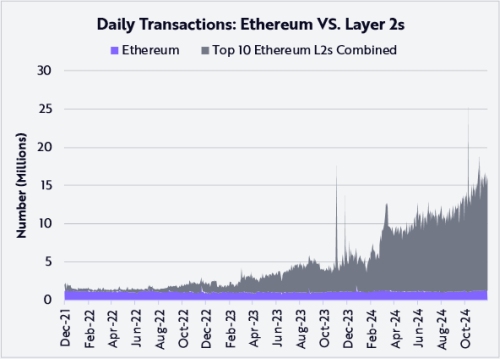
Image: Ethereum vs L2 Daily Transactions (Ark Invest, Big Ideas 2025)
Blockchain scalability will drive growth in DeFi, NFT markets, and enterprise blockchain adoption with solutions such as Layer 2 networks, rollups, and modular architectures are significantly lowering transaction costs and increasing network efficiency. This shift is paving the way for mainstream adoption of decentralized applications.
Autonomous vehicles (robotaxis) will reduce transportation costs, making personal car ownership less necessary, incentivize infrastructure investment and create new financing models for mobility-as-a-service platforms.
AI logistics and smart delivery systems are reducing costs and optimizing supply chain efficiency, creating opportunities in supply chain management solutions and financing of autonomous fleet operations.
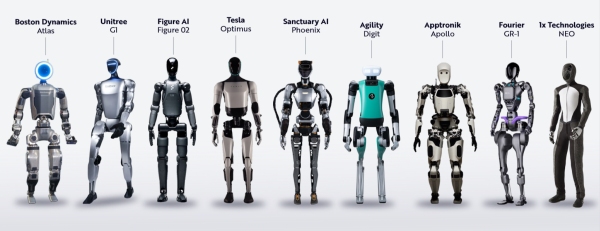
Image: Humanoid Robots Debuting Globally (Ark Invest, Big Ideas 2025)
The rise of AI humanoid robots is changing labour markets and improving manufacturing efficiency. Increased automation will drive investment in robotics startups, manufacturing solutions, and AI workforce solutions.
Breakthroughs in battery technology and renewable energy are reducing dependency on fossil fuels. The shift to decentralized energy creates opportunities in cleantech financing, energy trading, and carbon credit markets.
AI is improving quickly and moving toward Artificial General Intelligence (AGI), which will change how decisions are made, improve risk management, and create new investment opportunities in automation.
The accelerated growth, convergence and adoption of emerging technologies will require new regulatory frameworks, increased infrastructure investments, and a massive shift in market development strategies. Whether it’s the mainstreaming of digital assets or the advancement of artificial intelligence the future is arriving faster than we imagined, and those who adapt will be well positioned for whatever comes next.
 The National Crowdfunding & Fintech Association (NCFA Canada) is a financial innovation ecosystem that provides education, market intelligence, industry stewardship, networking and funding opportunities and services to thousands of community members and works closely with industry, government, partners and affiliates to create a vibrant and innovative fintech and funding industry in Canada. Decentralized and distributed, NCFA is engaged with global stakeholders and helps incubate projects and investment in fintech, alternative finance, crowdfunding, peer-to-peer finance, payments, digital assets and tokens, artificial intelligence, blockchain, cryptocurrency, regtech, and insurtech sectors. Join Canada's Fintech & Funding Community today FREE! Or become a contributing member and get perks. For more information, please visit: www.ncfacanada.org
 |  |  |
|---|---|---|
 |  |  |
CBDCs | Feb 4, 2025

Image: Freepik/master1305
While Canada paused its retail CBDC project last year, the Bank of Canada (BoC) recently published a 35 page report on "Privacy-Enhancing Technologies (PETs) for CBDC Solutions" while the UK is advancing its digital pound initiative and has provided an update. Trump explicitly banned CBDCs in the U.S. due to privacy issues upon taking office. This article looks at each country's latest approach to compare and contrast.
As digital payments become more commonly accepted globally, central banks are rethinking the role of currencies in the digital age - aka, Central Bank Digital Currencies (CBDCs), which are largely about modernizing the infrastructure of the financial system. However, governments are approaching CBDCs differently, reflecting differences in monetary policy but also concerns about privacy, financial sovereignty, and security. There are two main use cases being researched including retail and wholesale.
You can think about Retail CBDCs as a 'digital dollar' which are designed for use by the general public to support daily transactions, savings, and digital payments. They promise to increase financial inclusion by providing easy access to digital financial services, even for individuals who are unbanked - meaning individuals/households that do not have access to traditional banking services such as savings/checking accounts or credit from a formal financial institution. Privacy protection and efficiency are key benefits but public trust in data security is paramount for retail CBDC success.
Wholesale CBDCs, on the other hand, are used by financial institutions for bank to bank transfers and could improve cross-border payments, reduce costs and enhance financial market stability. By optimizing interbank settlements, wholesale CBDCs can also strengthen liquidity management on a global scale.
A shared global concern is privacy protection. As digital currencies including CBDCs become more widely used, protecting sensitive financial data is essential other the financial system runs the risk of payment surveillance from hackers, bad actors, institutions, and government. Global cooperation between governments to ensure interoperability and compliance standards is critical, if CBDCs are to ever be adopted in a way that balances economic growth with financial privacy.
In September 2024, the Bank of Canada stopped its work on a retail CBDCs after researching them for several years (see: Bank of Canada’s Latest on CBDC Implementation) citing that most Canadians were not interested in using a digital Canadian dollar. But they are continuing to research PETs like zero-knowledge proofs (ZKPs) and homomorphic encryption that offer privacy solutions that keep user data kept confidential while still enabling financial activities such as compliance checks and fraud prevention.
The report acknowledges several limitations with PETs though including slower transaction speeds due to the complexity of encrypting/processing large volumes of data. More sophisticated software and compute resources are required, raising costs. There is also scalability concerns which are still in early development stages. Lastly, any PET must still meet compliance requirements like anti-money laundering (AML) and counter-terrorism financing (CFT) while preserving user privacy, which is still a difficult act to balance.
The Bank of England (BoE) is still working on the Digital Pound project to modernize the country's payment infrastructure and support financial inclusion as the usage of cash in the UK declines. On Jan 14, 2025 the BoE published a progress update on their findings.
In addition to the digital pound providing a secure and efficiency alternative to traditional payment systems, the BoE is exploring the potential to improve the efficiency of financial markets and cross-border payments, making the digital pound more versatile than just a retail transaction and savings tool.
One of their top priorities is tackling privacy concerns to gain public trust, and designing the digital pound to allow secure transactions while protecting personal data. Another challenge is interoperability with existing systems like credit cards and mobile payments. The digital pound has to integrate seamlessly for a smooth transition between traditional and digital finance. As more central banks investigate the potential of their own CBDCs, the UK's work on the digital pound project will certainly position them to take a leading role in crafting the future of digital currencies while maintaining their financial sovereignty.
In contrast to Canada and the UK, the U.S. has opted to ban CBDCs. On January 23, 2025, as part of the "Strengthening American Leadership in Digital Financial Technology" executive order, President Donald Trump effectively prohibited federal agencies from pursuing any sort of CBDC development largely over privacy and government control concerns (and desire to protect the existing financial infrastructure).
The U.S. government is however pursuing Stablecoins, seen more as a market driven solution that can offer the faster and cheaper benefits of digital currencies without the associated risks of a government issued form of digital money. This approach encourages more private sector innovation but raises questions about potential risks to consumers and financial stability.
Varying approaches to CBDCs and digital money highlight the complexities of balancing between financial innovation, privacy protection, and regulatory compliance. Global cooperation will be essential to address privacy concerns and ensure interoperability and security.
The National Crowdfunding & Fintech Association (NCFA Canada) is a financial innovation ecosystem that provides education, market intelligence, industry stewardship, networking and funding opportunities and services to thousands of community members and works closely with industry, government, partners and affiliates to create a vibrant and innovative fintech and funding industry in Canada. Decentralized and distributed, NCFA is engaged with global stakeholders and helps incubate projects and investment in fintech, alternative finance, crowdfunding, peer-to-peer finance, payments, digital assets and tokens, artificial intelligence, blockchain, cryptocurrency, regtech, and insurtech sectors. Join Canada's Fintech & Funding Community today FREE! Or become a contributing member and get perks. For more information, please visit: www.ncfacanada.org
| | |
|---|---|---|
| | |
Fintech Report | Jan 16, 2025

Image: State of Fintech 2024 (CB Insights)
CB Insights published it's annual 'State of Fintech 2024 - Global Recap' report (whopping 200 page PDF) with the top line being global financial technology funding dropped 20% year-over-year to USD $33.7 billion. Certain sectors continue to shine with innovations in payments, blockchain and embedded finance showing robustness for 2025. This article presents key trends and takeaways for fintechs and investors to digest.
Global fintech funding in 2024 dropped 20% year-over-year to USD $33.7 billion (deal volume also shrank 17%). It was a sobering year with macroeconomic headwinds in the air from volatile interest rates, cautious investment landscape, and geopolitical instability.
The payments sector led and captured 40% of total funding as embedded finance and B2B solutions enjoyed growth, as companies of all stripes looked to integrate financial services.
Enterprise adoption and tokenization drove blockchain funding to $6.5 billion globally, as more use cases emerge beyond speculative trading of cryptocurrencies.
Unicorns were rare sightings with only two (2) new fintech unicorns rearing their head in Q4, 2024, for a total cumulative count of 326 unicorns to date. Many established unicorns continued to thrive.
M&A activity increased 6% year-over-year with 664 exits including Stripe's $1.1 billion acquisition of Bridge.
Regionally, the U.S continued to dominate its position as the largest fintech market raising $3.9 billion in Q4.
Latin America was the fastest growing market fuelled by financial inclusion initiatives, raising $1.1 billion in Q4 alone.
Despite the global funding drop, one silver lining was the focus on quality over quantity (and then backing up the truck), driving a 33% increase in the median deal size to $4 million, primarily allocated to late stage firms with clear growth trajectories. While seasoned investors dominated activity, newer investors pulled back.
Although 2024 was largely a challenging environment, key late stage opportunities particularly in payments and blockchain firms such as Stripe’s $1.1B acquisition of Bridge and Zepz’s $267M Series F. Notably, embedded finance attracted over $14 billion globally, as non-financial platform businesses looked to integrate financial services as a new source of revenue.
Fintech funding was more scarce in 2024. Global deal volumes shrank 17% but median deal sizes increased 33% to $4 million year-over-year. Not surprisingly, founders who aligned their models with hot trends like AI personalization tools and embedded finance had more success in securing funding.
In 2024, a total of $300 million was raised across 14 deals in key sectors such as blockchain, digital banking and payments. Canada accounted for a modest 0.9% share of global fintech funding but its focus on niche sectors like blockchain and payments make it stand out. A few notable deals include:
While fintech in 2024 was a reflective year, fintech in 2025 offers some big opportunities in blockchain, AI, and cross-border payments. Embedded finance will continue to expand to new industries, creating new ways for customers to engage. Create scalable ideas, form smart partnerships and stay ahead of key trends in this fast changing market. Learn more, download the full 200 page report from CB Insights.
The National Crowdfunding & Fintech Association (NCFA Canada) is a financial innovation ecosystem that provides education, market intelligence, industry stewardship, networking and funding opportunities and services to thousands of community members and works closely with industry, government, partners and affiliates to create a vibrant and innovative fintech and funding industry in Canada. Decentralized and distributed, NCFA is engaged with global stakeholders and helps incubate projects and investment in fintech, alternative finance, crowdfunding, peer-to-peer finance, payments, digital assets and tokens, artificial intelligence, blockchain, cryptocurrency, regtech, and insurtech sectors. Join Canada's Fintech & Funding Community today FREE! Or become a contributing member and get perks. For more information, please visit: www.ncfacanada.org
| | |
|---|---|---|
| | |
Jan 16, 2025

Image: Freepik
Online payments are about the best thing to happen to monetary exchanges in the 21st century. Especially with the prevalence of e-commerce in regions like Canada, cash payments are rapidly taking the backseat. Owing to rapid growth and constant innovation, many global payment gateways are constantly leveling up to meet up. These changes have kept certain payment providers at the top of the game even in 2025.
Ultimately, we're highlighting some of the best payment channels in Canada that will serve all of your needs in 2025. Read on, get enlightened.
Chris Skinner, Financial expert - "The payment gateway is a digital equivalent of a cashier but with added layers of security, speed, and global accessibility."
Essentially, payment gateways are financial technology systems that facilitate online transactions between buyers and sellers. Consider it a bridge between a customer's payment method and the merchant's bank account. When you initiate a purchase online, a payment gateway encrypts your data to secure it during transmission.
Afterward, the gateway sends your encrypted payment information to your bank for verification. Once the bank verifies the transaction details and checks for sufficient funds, the transaction is approved. Provided all is in place, this process takes anywhere from a few seconds to a few minutes and is never burdensome.
As promised, we're bringing you some of the best options to align with when it concerns payment gateways in Canada. Being meticulous, we ensured each gateway on this list serves a good range of needs. Whether you are a buyer, seller, or an affiliate, we've covered just the payment gateway for you.
Square is a prominent commercial payment solution adopted by over 4 million users globally. If you run a small or medium-sized enterprise, Square is just the payment solution for you in 2025. The provider facilitates fast mobile payments, a tool that comes in handy for both buyers and sellers. Square also allows for online store integration between in-person and online payment channels.
On the other side, the gateway charges a 2.9% fee on all online store payments but there are no monthly fees attached.
Fun Fact: Square expanded to Canada in 2012, making it the company’s first international market, where it quickly became a favorite among small businesses.
Just like Square, Moneris is another giant commercial and mobile payment solution in Canada. Here, users and business owners also get to enjoy in-store, mobile, and online payments. Also strictly for business owners is a Business to Business (B2B) portal that automates transactions, streamlining the process.
Moneris has a 2.85% charge for successful online payments and credit card transactions. Nevertheless, the payment gateway is pretty great for growing startups, small businesses as well as personal mobile payments. In all, the provider stands out for its wide support for many payment options which include:
Peter Thiel, PayPal's Co-founder - "PayPal’s vision was to create a new currency. We failed at that, but we succeeded in building a new payment system."

Image: Freepik
Being one of the most popular payment gateways in the world, PayPal needs no introduction. The channel serves as an digital wallet from which users can make e-commerce payments, mobile transfers, and online payments. PayPal also supports several payment methods, which cover credit cards and debit cards.
Because of its ease of use and its great and wide acceptance, PayPal has become an ideal gateway for the entertainment sector, especially for casino gaming. Many sources provide reviews of top gaming sites that support global payment gateways, including PayPal.
Stripe is another prominent commercial payment gateway that is built to cater to startups and large enterprises alike. The provider has an amazing branding customization feature, allowing users to redesign payment pages to fit their brand. Stripe is also perfect for personal payments as it supports a good variety of payment methods from digital wallets to bank transfers.
Elavon is a greatly networked merchant payment processor with standard operations in over 30 countries, including Canada. The gateway is great for businesses, especially start-ups looking to save a lot of costs. Its point-of-sale terminals accept almost every card service around, from credits to debits. For businesses, Elavon charges a $270 one-time fee, a $10 monthly fee, and $0.19 transaction fees.
Fun Fact: Elavon has been operating in Canada for over 25 years, offering customized payment solutions to meet the unique needs of Canadian businesses, from retail stores to e-commerce platforms.
Whether you are just making purchases online or running a business, there are a couple of standards you should look out for while using payment gateways in Canada. Below, we've listed a couple that are nonnegotiable and should always be considered:
If you wonder what payment provider is best to use in 2025 the truth is there are so many options. However some have stood the test of time. Check out the list of best Canadian payment options above to pick from.
The National Crowdfunding & Fintech Association (NCFA Canada) is a financial innovation ecosystem that provides education, market intelligence, industry stewardship, networking and funding opportunities and services to thousands of community members and works closely with industry, government, partners and affiliates to create a vibrant and innovative fintech and funding industry in Canada. Decentralized and distributed, NCFA is engaged with global stakeholders and helps incubate projects and investment in fintech, alternative finance, crowdfunding, peer-to-peer finance, payments, digital assets and tokens, artificial intelligence, blockchain, cryptocurrency, regtech, and insurtech sectors. Join Canada's Fintech & Funding Community today FREE! Or become a contributing member and get perks. For more information, please visit: www.ncfacanada.org
| | |
|---|---|---|
| | |
Fintech M&A | Jan 2, 2025

Image: Freepik/rawpixel.com
Toronto-based financial tech firm specializing in earned wage access (EWA) and digital solutions for gig economy workers, Payfare Inc., announced that it has entered into a definitive agreement to be acquired by global fintech giant, Fiserv, for a total purchase price of CA$201.5 million in an all cash deal. The transaction is being structured as a court-approved plan of arrangement as per British Columbia’s Business Corporations Act and is expected to close in H1 2025 subject to shareholder and court approvals.
Payfare is a recognized leader in workforce payments and digital banking tools for gig workers and partnerships with major gig economy platforms such as Uber and Lyft, processing millions of transactions annually that paid out wages faster and more efficiently than traditional payment structures, such as bi-weekly or monthly.
In the U.S. alone, the gig economy employed 36% of the entire U.S. workforce or 59 million workers in 2021 and is projected to reach $455 billion globally by 2025. Payfare’s tools address critical needs in this rapidly growing sector, making it a valuable asset for Fiserv.
Fiserv will acquire all issued and outstanding shares of Payfare for CA$4.00 per share in an all cash deal, representing a significant 90% premium over Payfare's closing price on Dec 20, 2024 ($2.11), and a 92% premium over its 60 day volume weighted average trading price.
By acquiring Payfare, Fiserv expands into the gig economy, one of the fastest growing sectors globally. Embedded finance offerings that cater to gig-focused workers and businesses will add new revenue streams and strengthen Fiserv's position in the digital payments space with customized tools for the modern workforce.
Frank Bisignano, Chairman and CEO of Fiserv:
“Payfare has built a reputation as an innovator in workforce payments for gig-economy companies. Together, we can accelerate the delivery of embedded finance solutions for all of our clients, empowering their next chapter of success.”
Payfare experienced scaling challenges and with the loss of its major client, DoorDash, revenue's sharply declined along with its stock price plummeting over 50% in Q4, 2024. Before the acquisition was announced, Payfare's stock was experiencing significant volatility, declining from CA$8.43 to CA$2.05 in October 2024.
While the acquisition will provide Payfare with the resources and infrastructure to stablize and expand, the deal highlights a troubling trend in Canada's fintech sector where companies exit early due to scaling challenges.
Marco Margiotta, CEO and Founding Partner of Payfare:
“This transaction represents tangible recognition of the value and strength of what Payfare has built.”
Post closing, Payfare will no longer be a publicly traded company and its shares will be delisted from the TSX and OTCQX markets. For Payfare, joining Fiserv is a chance to scale its gig economy and embedded finance solutions globally.
The National Crowdfunding & Fintech Association (NCFA Canada) is a financial innovation ecosystem that provides education, market intelligence, industry stewardship, networking and funding opportunities and services to thousands of community members and works closely with industry, government, partners and affiliates to create a vibrant and innovative fintech and funding industry in Canada. Decentralized and distributed, NCFA is engaged with global stakeholders and helps incubate projects and investment in fintech, alternative finance, crowdfunding, peer-to-peer finance, payments, digital assets and tokens, artificial intelligence, blockchain, cryptocurrency, regtech, and insurtech sectors. Join Canada's Fintech & Funding Community today FREE! Or become a contributing member and get perks. For more information, please visit: www.ncfacanada.org
| | |
|---|---|---|
| | |
Consumer-Driven Finance | Dec 18, 2024

Image generated by AI
If you haven't realized it, Canada likes to delay the rollout of national projects (i.e, Trans mountain pipeline, national housing strategy, Phoenix pay system, high speed rail projects etc), and while it was painfully anticipated, the Canadian government announced its complete framework for the implementation of Consumer-driven Finance (Open Banking) in the 2024 Fall Economic Statement (FES), which will now be delayed to 2026. It's one of those 'we told you so moments' and this comes after years of promises and stalled progress. These delays and execution challenges put fintechs and consumers at a disadvantage, and undermines Canada's capacity for financial innovation and to remain globally competitive (among peer countries).
The announcement at least included more funding to the tune of $44.3 million over three years for the Financial Consumer Agency of Canada (FCAC) to enhance its capacity to supervise and regulate the consumer-driven finance framework. But it's the extended timeline that has left many industry stakeholders and investors questioning Canada's ability to keep pace with modern times. Countries like the UK and Australia have shown how robust open banking systems can unlock competition and innovation in financial services. Yet, Canada’s fragmented and overly cautious approach risks falling further behind these global leaders.
The government is opting for a phased rollout, starting with mandatory participation of large, federally regulated banks. Then smaller financial institutions, such as credit unions, and fintech companies must opt in, assuming they can meet the same strict accreditation standards as large banks. This uniform approach to accreditation doesn't differentiate between the size or risk level between participants, imposing an undue burden on smaller players. A one size fits all requirement will make it harder for smaller players to participate, stifling the very innovation the framework is hoping to stimulate in the first place (sigh).
The plan is to start with limited functionality such as read-only data sharing, delaying more advanced functionality like payment initiation to the future (without a clear timeline leaving fintechs in the dark). It's likely the combination of prioritizing large incumbent banks while delaying access for smaller more innovative fintechs will hurt competition and innovation in the fintech sector.
Originally the Financial Consumer Agency of Canada (FCAC) was adorned to supervisor and regulate open banking but adding to the complexity it was announced in FES 2024 that provincial regulators will now also be involved, risking fragmentation and unnecessary layers of bureaucracy. It echoes past mistakes made during the rollout of equity crowdfunding (also see NCFA's submission to Finance Canada re: urgent need for regulatory change and support) where fragmented provincial rules created confusion and inefficiencies, discouraging adoption while adding costs to compliant operators - only to realize this mistake several years later and work to harmonize regulations which was far too late, hurting the investment crowdfunding sector before it got off the ground.
Meanwhile, consumers are still dependent on screen scraping practices which is an outdated and risky practice with cyber security issues rampant.
Globally, countries that have adopted open banking are seeing boosts to financial inclusion, productivity, and market driven innovation. In the UK for example, open banking has driven competition and productivity by making financial services more accessible and transparent. They are now advancing further ahead and expanding towards open finance.
In Australia, its Consumer Data Right policy is ushering in a new wave of fintech solutions that are giving consumers more choice and improving business efficiency.
Without any sense of urgency, Canada (again) risks falling further behind and sends the wrong message to investors and leading innovators that is 'Canada is hesitant to innovate' and struggles with implementing national frameworks that drive economic growth.
Both the UK and Australia have implemented TIERED accreditation systems (not a one size fits all like Canada), which allows a diverse range of participants in open banking while maintaining high standards for security and consumer protection.
In the UK, the Financial Conduct Authority (FCA) employs a flexible, risk-based approach, allowing small fintechs to enter the market without being overwhelmed by compliance requirements. Early functionalities like payment initiation and account aggregation have become widely available, demonstrating how a structured yet inclusive system can deliver great value to consumers.
Australia's Consumer Data Right (CDR) framework also uses a tiered accreditation system to ensure participation by innovative fintechs. Smaller fintechs can partner with Accredited Data Recipients (ADRs) to access data under reduced compliance obligations using a “Trusted Adviser” model, allowing lower risk entities like financial advisors to provide services without heavy regulatory burdens. It's this tiered approach together with a clear timeline for expanded functionality that has accelerated adoption and innovation.
Canada’s framework should be more inclusive with less friction and more in line with global peers. It's uniform accreditation process is too ridged and should be a risk-based system. Smaller players offering low-risk services like a budgeting app should not face the same compliance burdens as payment processors or lending platforms. Adopting a tiered accreditation model like in the UK and Australia would stimulate a more innovative and competitive fintech environment.
Streamlining governance and oversight is also paramount. The FCAC should take a leading role with minimal provincial overlap to avoid jurisdictional conflicts and inefficiencies. The whole framework should encourage participation from coast to coast and reduce compliance burdens for fintechs.
The FCAC should take their increased funding and fast track the open banking timeline and add clear deadlines for introducing core functionalities like payment initiation. Fintechs, investors, consumer alike all need more certainty and collaboration if open banking is to be more practical, widely adopted and successful.
Canada should learn from global leaders in open banking who have amassed a ton of implementation experience if they want to avoid missteps. Canada needs to use this opportunity to boost its position as a global innovator in financial services. Delays hurt everyone from consumers to fintechs and the economy at large. It's time for Canada to step up and get open banking right.
The National Crowdfunding & Fintech Association (NCFA Canada) is a financial innovation ecosystem that provides education, market intelligence, industry stewardship, networking and funding opportunities and services to thousands of community members and works closely with industry, government, partners and affiliates to create a vibrant and innovative fintech and funding industry in Canada. Decentralized and distributed, NCFA is engaged with global stakeholders and helps incubate projects and investment in fintech, alternative finance, crowdfunding, peer-to-peer finance, payments, digital assets and tokens, artificial intelligence, blockchain, cryptocurrency, regtech, and insurtech sectors. Join Canada's Fintech & Funding Community today FREE! Or become a contributing member and get perks. For more information, please visit: www.ncfacanada.org
| | |
|---|---|---|
| | |
Retail Payments | Dec 12, 2024

Image: Freepik/wayhomestudio
The Bank of Canada (BoC) has published its final guideline on safeguarding end-user funds (24 page PDF), providing payment service providers (PSPs) with clear expectations and requirements under the Retail Payment Activities Act (RPAA). The BoC has also shared a summary of feedback from their consultation along with their responses (6 page PDF) that helped update the final guidelines.
⚠ Important Reminder
If you’re a PSP operating in Canada under the RPAA, you must apply for registration to continue your services legally.
Not yet applied? Assess if you’re subject to the RPAA.
Operating without registration could result in enforcement actions.
Risk management and reporting obligations come into effect on September 8, 2025. Prepare early to meet the requirements. Start now by comparing your current operations with RPAA requirements. Identify areas that need improvement to meet compliance and map out the steps to address any gaps.
Stay tuned for more updates and insights!
The National Crowdfunding & Fintech Association (NCFA Canada) is a financial innovation ecosystem that provides education, market intelligence, industry stewardship, networking and funding opportunities and services to thousands of community members and works closely with industry, government, partners and affiliates to create a vibrant and innovative fintech and funding industry in Canada. Decentralized and distributed, NCFA is engaged with global stakeholders and helps incubate projects and investment in fintech, alternative finance, crowdfunding, peer-to-peer finance, payments, digital assets and tokens, artificial intelligence, blockchain, cryptocurrency, regtech, and insurtech sectors. Join Canada's Fintech & Funding Community today FREE! Or become a contributing member and get perks. For more information, please visit: www.ncfacanada.org
| | |
|---|---|---|
| | |


August 26th, 2025

January 4th, 2024

June 1st, 2021

September 9th, 2020

July 9th, 2018

January 3rd, 2018

September 25th, 2017

June 20th, 2017

May 10th, 2017

December 14th, 2016