




Karsten Wenzlaff, Advisor
August 26th, 2025
Karsten Wenzlaff is a Crowdfunding and Fintech Expert from Germany. He is Secretary-General of Digit[...]


RPAA | Aug 11, 1015

Image: Freepik
The Bank of Canada is making important updates to the Retail Payment Activities Act (RPAA), with a new registry of payment service providers (PSPs) set to be published on September 8, 2025. Below is an overview of the key points:
If you’re a PSP subject to the RPAA and haven’t registered with the Bank of Canada by November 15, 2024, you must apply immediately. You must apply at least 60 days before starting retail payment activities. Failure to register could lead to enforcement action by the Bank. Learn more: Guide: PSP Registration with Bank of Canada (RPAA)
On September 8, the Bank will start publishing a list of PSPs that have registered under the RPAA, as well as entities whose applications have been refused. The registry will be updated on a rolling basis as more applications are processed. If your application hasn’t been fully processed by this date, it will be included in the list of unfinalized reviews.
Once the registry is live, registered PSPs will be subject to supervisory assessments by the Bank of Canada. They will need to comply with:
PSPs still on the applicants list must follow the same regulatory obligations but won’t have to meet all reporting requirements until their registration is finalized.
The Bank of Canada will start charging fees to PSPs to recover supervision costs, once the cost recovery formula and regulations are finalized.
The new PSP registry and supervisory requirements are critical to improving the oversight of retail payment activities in Canada. Ensuring that Payment Service Providers comply with the RPAA will improve operational security and protect client funds, benefiting the entire payments ecosystem.
Stay updated by visiting the Bank of Canada website or by checking PSP Connect for further updates. If you have questions about the registration application process, email RPS Compliance or get in touch with general inquiries via their contact form.
 The National Crowdfunding & Fintech Association (NCFA Canada) is a financial innovation ecosystem that provides education, market intelligence, industry stewardship, networking and funding opportunities and services to thousands of community members and works closely with industry, government, partners and affiliates to create a vibrant and innovative fintech and funding industry in Canada. Decentralized and distributed, NCFA is engaged with global stakeholders and helps incubate projects and investment in fintech, alternative finance, crowdfunding, peer-to-peer finance, payments, digital assets and tokens, artificial intelligence, blockchain, cryptocurrency, regtech, and insurtech sectors. Join Canada's Fintech & Funding Community today FREE! Or become a contributing member and get perks. For more information, please visit: www.ncfacanada.org
 |  |  |
|---|---|---|
 |  |  |
Trade Wars | Aug 11, 2025

Image: Freepik AI
Nvidia and AMD have agreed to pay 15% of their revenue from Chinese chip sales to the US government in exchange for export licenses. It follows months of export restrictions on high performing chips like Nvidia's H20 exports to China which were halted earlier this year. Analysts previously warned that curbing H20 chip exports to China could cost up to $8 billion in quarterly sales, while AMD projected a $1.5 billion hit this year from similar restrictions.
The new 15% payment for market access is an unprecedented arrangement, one that highlights the US strategy to assume control over critical AI and semiconductor technologies. It raises significant concerns around global tech trade, supply chains and geopolitical tensions, especially given China's reaction and what's next for tech competition and national security, both taking center stage with a new layer of complexity to the relationships between the US and China.
Canada and other global players will feel the ripple effects of these changes, especially if national security continues to impact global trade policies, which could force countries (and companies) to choose sides in a growing tech war.
The Chinese government has long accused Washington of using technology and trade policy to limit China’s rise in advanced industries. Following the 15% deal, state media criticized the H20 chip as outdated, unsafe, and potentially embedded with backdoor access, showing the growing mistrust of American AI chips while suggesting that the 15% levy is a political tool rather than a commercial safeguard.
As China sees the US moving to limit its access to critical technologies, the message is pretty clear that China is not backing down. They are already investing heavily in building alternative solutions. With companies like Huawei pushing forward on semiconductors and AI chips, China’s push for tech independence is only going to gain speed.
Aug 12 Update: Bloomberg reported that China has issued new guidance advising domestic firms to avoid using Nvidia's H20 chips in certain projects, especially any government use and to prioritize domestic chips wherever possible. This restriction will likely accelerate China's push for self reliance in advanced semiconductor protection, and could reduce demand for Nvidia's products in one of its largest markets.
With China representing 13% of Nvidia’s and 24% of AMD’s total revenue, even a small sales disruption can ripple through suppliers, distributors, and end markets. Semiconductor assembly and packaging hubs in Southeast Asia could also see order volatility if Chinese buyers switch to local alternatives.
The semiconductor industry is already experiencing shortages and supply chain disruptions, especially as the US and China continue to fight for dominance in manufacturing, however with the introduction of a type of financial leverage into the equation, the US could disrupt the delicate balance that keeps the global supply chain moving forward. Global logistics networks could be forced to reconfigure as companies diversify sourcing to hedge against export licensing risks.
This will hit industries reliant on critical AI chips and semiconductors, including everything from automotive and consumer electronics to AI and fintech. For companies in Canada, especially those that have tech partnerships with China, there will be an increasing need to diversify their supply chain sources to avoid disruptions and remain resilient in the face of trade barriers and tariffs.
With this new 15% payment arrangement, technology export controls could evolve into tools of economic statecraft that could be applied in other high-value tech sectors. If adopted more widely, it's a model that could ignite retaliatory tariffs or revenue-sharing requirements from other governments, creating a patchwork of national rules that complicate multinational operations.
Countries like India, which is rapidly scaling its semiconductor sector, are no doubt watching closely to see whether aligning with one tech bloc risks alienating another.
The growing tech and supply chain tensions mean that Canadian companies must carefully position themselves and ensure they adapt to the changing regulatory environment. As both China and the US reconfigure their tech ecosystems, Canada’s role as a tech hub will depend on its ability to stay nimble, maintain access to key technologies and markets, and diversify trade relationships.
For companies, investors, and policymakers, it's a strong reminder that the next front in trade disputes will not be over commodities, but over the intangible building blocks of future economies.
The National Crowdfunding & Fintech Association (NCFA Canada) is a financial innovation ecosystem that provides education, market intelligence, industry stewardship, networking and funding opportunities and services to thousands of community members and works closely with industry, government, partners and affiliates to create a vibrant and innovative fintech and funding industry in Canada. Decentralized and distributed, NCFA is engaged with global stakeholders and helps incubate projects and investment in fintech, alternative finance, crowdfunding, peer-to-peer finance, payments, digital assets and tokens, artificial intelligence, blockchain, cryptocurrency, regtech, and insurtech sectors. Join Canada's Fintech & Funding Community today FREE! Or become a contributing member and get perks. For more information, please visit: www.ncfacanada.org
| | |
|---|---|---|
| | |
Global Standards | Aug 4, 2025

Image: Freepik
Canada chooses how it measures its economy but if it wants to be part of the global system, it needs to follow the updated rules. The System of National Accounts (SNA) is a global reporting framework developed and published jointly by the UN, IMF, OECD, World Bank, and European Commission to measure and compare economies across borders, including GDP, investment, and national wealth. Canada has followed it for decades, along with almost every other economy in the world, so we can expect change is coming.
Now, for the first time since 2008, the SNA has been updated. It gives countries the option to include intangible assets like AI systems, datasets, software, cloud infrastructure, and crypto in their official economic reporting. SNA 2025 is the new data reporting standard.
Statistics Canada currently uses SNA 2008 to compile GDP, capital formation, trade, and household income. Finance Canada and the Bank of Canada rely on that data to make major policy decisions. Because Canada aligns with the international system, it will be expected to transition to SNA 2025, and include a new measured view including intangibles, which NCFA has reported and advocated for the inclusion of intangibles for years. See this great report dating back 6 years ago now in 2019 called, " A New North Star: Canadian Competitiveness in an Intangibles Economy".
The new SNA 2025 includes formal categories for AI tools, machine learning models, digital platforms, tokenized assets, and data used in production. These can now be classified as fixed capital and included in investment statistics.
The framework also includes crypto assets such as Bitcoin in national wealth reporting. While countries are not required to adopt every element immediately, SNA 2025 sets the boundaries for what is allowed. If Canada continues using the SNA—and it will—these options are now on the table.
SNA 2025 does not show that digital or intangible assets are driving growth nor does not include statistics. What it does is give countries the structure to count what was previously invisible. Until now, if a Canadian fintech trained a large AI model, built infrastructure for a payments network, or developed a data engine for fraud detection, none of that was guaranteed to show up in national accounts. It was often treated as a cost, not an investment.
That matters because what gets counted drives policy.
When Statistics Canada does not report digital capital formation, Finance Canada cannot target it. When platform services are excluded from output figures, regulators and funders underestimate their value.
SNA 2025 also introduces new tools to reflect sustainability. It promotes the use of Net Domestic Product (NDP), which subtracts both depreciation and natural resource depletion from GDP. This is critical for a country like Canada, where growth often comes from extractive sectors. Using NDP can help the government better understand how much of that growth is truly lasting.
The new framework also supports clearer tracking of ESG finance, public sector innovation, and economic activity by multinationals that operate across borders. It aligns with global changes in how governments view risk, resilience, and value creation.
This is a global accounting and reporting change with deep consequences. SNA 2025, the updated global standard now recognizes intangibles, and so will the data that influences budgets, tax design, economic forecasts, and investment strategy. Canada is already committed to using the SNA, so the only question is how fully and how quickly we adopt the 2025 version.
NCFA urges Statistics Canada and federal decision makers to prioritize early implementation of the most relevant components of SNA 2025. These include digital capital assets, crypto asset recognition, and intangible production by fintech and AI firms.
The National Crowdfunding & Fintech Association (NCFA Canada) is a financial innovation ecosystem that provides education, market intelligence, industry stewardship, networking and funding opportunities and services to thousands of community members and works closely with industry, government, partners and affiliates to create a vibrant and innovative fintech and funding industry in Canada. Decentralized and distributed, NCFA is engaged with global stakeholders and helps incubate projects and investment in fintech, alternative finance, crowdfunding, peer-to-peer finance, payments, digital assets and tokens, artificial intelligence, blockchain, cryptocurrency, regtech, and insurtech sectors. Join Canada's Fintech & Funding Community today FREE! Or become a contributing member and get perks. For more information, please visit: www.ncfacanada.org
| | |
|---|---|---|
| | |
Crypto | Aug 4, 2025

Image: Freepik/brgfx
American crypto leadership is back and this time it is strategic. On July 31, 2025, U.S. SEC Chairman Paul S. Atkins delivered a major policy address, American Leadership in the Digital Finance Revolution, outlining a full plan to onshore digital asset innovation and modernize U.S. capital markets.
The centerpiece of the announcement is Project Crypto, a leading Commission initiative that includes new guidelines for tokenized securities, decentralized finance, crypto custody, and financial super-apps. Positioned as a generational opportunity to return blockchain finance to American soil, the strategy aligns closely with President Trump’s policy direction and has immediate implications for Canada’s competitiveness.
Paul Atkins, SEC Chair:
“We will not watch from the sidelines. We will lead. We will build. And, we will ensure that the next chapter of financial innovation is written right here in America.”
Chairman Atkins clear states that the SEC will no longer treat most digital assets as securities and will instead create rules that clearly define asset categories.
“Despite what the SEC has said in the past, most crypto assets are not securities.”
Confusion created by the Howey Test has discouraged entrepreneurs from launching token projects in the U.S., but this new framework will encourage American participation and investment. The changes are expected to enable capital formation for crypto projects, and reduce reliance on offshore entities.
Canadian regulators have long pointed to U.S. uncertainty to justify delay. With this new clarity, the bar has been raised. Canada’s sandbox models and exemptive relief approach now risk falling behind.
“A Cambrian explosion in innovation could occur if we stay true to this course,” - SEC Chair Atkins
One of the more significant features of Project Crypto is the SEC’s support for platforms that offer multiple services, combining trading, lending, staking, and payments under a single license. This opens the door for fintechs and broker-dealers to offer tokenized stocks, stablecoins, and on-chain financial services together.
Chairman Atkins also emphasized the SEC’s willingness to enable tokenized capital markets across all asset classes. Read NCFA’s coverage of Robinhood's tokenized securities and tokenized funds for a look at how this trend is already reshaping investment models.
The SEC now plans to support integration of DeFi into U.S. markets. Atkins outlined a vision for DeFi platforms that do not require intermediaries, provided they meet transparency and code publication requirements. This includes automated market makers and consensus-based networks.
For Canadian DeFi builders, it's an opportunity to create a presence in a jurisdiction that now welcomes non-intermediated finance, further challenging Canada's policy approach in the space.
With the signing of the GENIUS Act, the U.S. has created a formal federal regime for stablecoin issuance and oversight. The SEC plans to align its rules accordingly and support market structure legislation that complements the Act.
Canada’s own stablecoin policy is still being shaped. See NCFA’s article on stablecoin regulation in Canada for current developments under OSFI.
The SEC will revise outdated custody requirements and support multiple business lines under one registration. This will make it easier for new entrants and regulated institutions to provide safe crypto custody and enable self-custody options. The Commission also highlighted support for protocols like ERC3643 that embed compliance functions directly into token standards that support tokenization of Real-World-Assets (RWA).
As part of its strategy to gather industry insights and boost regulatory transparency, the SEC’s Crypto Task Force will host a series of roundtables across the U.S. from August to December 2025, focusing on issues like custody, tokenization, DeFi, and trading infrastructure. These sessions reflect the agency’s intent to involve stakeholders early in the policy creating process and to include perspectives from small crypto startups and innovators
Project Crypto is a very real operational directive to all SEC policy divisions. A coordinated national policy backed by the White House and reinforced by the President’s Working Group on Digital Asset Markets.
For Canada and much of the world, this means the U.S. is will now be one of the preferred destinations for digital asset ventures, tokenized capital formation, and DeFi projects. Canadian stakeholders must respond with a coordinated strategy of their own that modernizes regulation, supports responsible innovation, and protects sovereignty in financial technology. Canada cannot afford to watch from the sidelines. A future of digital finance is being built now, and the center of gravity is moving.
The National Crowdfunding & Fintech Association (NCFA Canada) is a financial innovation ecosystem that provides education, market intelligence, industry stewardship, networking and funding opportunities and services to thousands of community members and works closely with industry, government, partners and affiliates to create a vibrant and innovative fintech and funding industry in Canada. Decentralized and distributed, NCFA is engaged with global stakeholders and helps incubate projects and investment in fintech, alternative finance, crowdfunding, peer-to-peer finance, payments, digital assets and tokens, artificial intelligence, blockchain, cryptocurrency, regtech, and insurtech sectors. Join Canada's Fintech & Funding Community today FREE! Or become a contributing member and get perks. For more information, please visit: www.ncfacanada.org
| | |
|---|---|---|
| | |
Public Markets | Aug 1, 2025

Image: Freepik/ijeab
According to a Reuters report, President Donald Trump has begun private talks with the heads of the largest US banks about how to return Fannie Mae and Freddie Mac to the public markets. These two companies (government sponsored enterprises with private shareholders), which guarantee most American mortgages, have been under government control since the 2008 financial crisis.
Trump has had meetings with bank CEOs, the discussions include executives such as Jamie Dimon from JPMorgan Chase, David Solomon from Goldman Sachs, and Brian Moynihan from Bank of America. The White House is gathering proposals on how a stock offering for Fannie and Freddie could work if the companies are moved out of federal conservatorship.
Fannie Mae and Freddie Mac were taken over by the US government during the 2008 financial crisis when losses in the housing market threatened to bring them down. Since then they have returned to profitability and repaid the funds that the US Treasury provided at the time.
Trump has said on Truth Social that he wants to explore ways to bring these companies back to the stock market while keeping some form of government guarantee for the mortgage market. Fannie (FNMA) and Freddie (FMCC) shares have surged 8.72% and 14.8% respectively after news of the bank meetings.
How these companies are handled will have a direct effect on investors, banks, and taxpayers. A public stock offering could return value to shareholders and possibly reduce the taxpayer risk that comes with government control. At the same time, if guarantees remain in place, taxpayers could still carry some exposure to future losses.
The Federal Housing Finance Agency, which oversees Fannie Mae and Freddie Mac, has said that the companies will remain in conservatorship for now. Any plan to sell stock or change their status would need approval from the President and would likely be debated in Congress.
These changes are not just about the United States. Canadian pension funds, banks, and other institutions invest in American mortgage backed securities that are tied to Fannie Mae and Freddie Mac. A change in their structure could affect the value of these investments and may influence how Canadian regulators look at housing finance and risk management.
It is also possible that US mortgage reform could shift how capital markets treat housing assets, which in turn may influence borrowing costs and investor strategies across North America.
The talks with the banks are at an early stage. In the coming months the White House is expected to receive detailed proposals from these financial institutions. From there, a plan could be developed that would outline whether there will be a public stock sale, how much government support would remain, and the timeline for any transition.
Canadian investors and policy makers will be watching these developments closely. The scale of Fannie Mae and Freddie Mac makes any change in their structure important well beyond US borders.
The National Crowdfunding & Fintech Association (NCFA Canada) is a financial innovation ecosystem that provides education, market intelligence, industry stewardship, networking and funding opportunities and services to thousands of community members and works closely with industry, government, partners and affiliates to create a vibrant and innovative fintech and funding industry in Canada. Decentralized and distributed, NCFA is engaged with global stakeholders and helps incubate projects and investment in fintech, alternative finance, crowdfunding, peer-to-peer finance, payments, digital assets and tokens, artificial intelligence, blockchain, cryptocurrency, regtech, and insurtech sectors. Join Canada's Fintech & Funding Community today FREE! Or become a contributing member and get perks. For more information, please visit: www.ncfacanada.org
| | |
|---|---|---|
| | |
Crypto Regulation | July 31, 2025
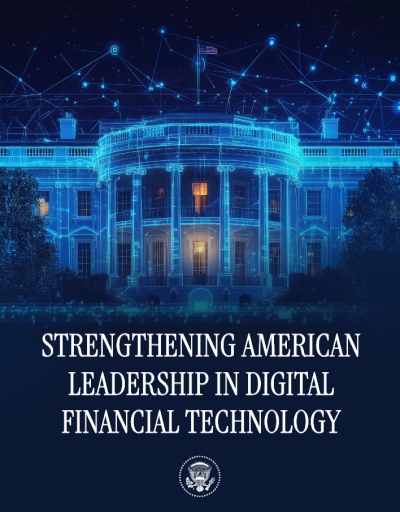
Image: Strengthening American Leadership in Digtal Financial Technology, White House report
On July 30, 2025, the White House released a major 160 page PDF report from the President’s Working Group on Digital Asset Markets called, "Strengthening American Leadership in Digital Financial Technology". The document lays out how the United States plans to build a clear rulebook for crypto and position itself as a leading global hub for blockchain technology, a huge change in direction from a government that previously relied on regulation by enforcement.
The White House report says the US needs a stronger framework for digital asset markets. It calls on Congress to pass the Digital Asset Market Clarity Act to remove gaps in oversight. The plan would give the Commodity Futures Trading Commission authority over trading in digital assets that are not securities, while the Securities and Exchange Commission would focus on those that are securities. The two agencies are asked to provide clear guidance on custody, registration, and record keeping so that new products can launch faster without long delays.
For fintech companies and investors, a more predictable environment is welcomed, and means that developers and platforms would know in advance what licenses they need and how to stay compliant instead of risking enforcement.
A large part of the report focuses on modern banking regulation. It urges federal banking regulators to stop blocking lawful digital asset companies from access to banking, a practice that was known as Operation Choke Point 2.0.
It also suggests a clear process for banks to gain approval for activities such as custody of crypto, tokenization of assets, issuing stablecoins, and using blockchains in financial services. If these changes are implemented, banks will have a clearer path to offer blockchain based products and services, which could expand customer access to digital assets directly through mainstream banks.
The report confirms the importance of stablecoins that are backed by the US dollar. It points to the GENIUS Act, signed into law on July 18, 2025, as the foundation for a federal framework for stablecoins. It also calls for a law to ban central bank digital currencies in the United States, emphasizing that the private sector should lead innovation in payments.
It suggests that the U.S. views private stablecoins as a way to maintain the dollar’s global role. It could lead to faster payments and new payment rails, but it's also a policy preference against government issued digital money.
The Working Group recommends updating anti money laundering rules to reflect how digital assets work. The plan would clarify the reporting obligations for different types of actors, including those in decentralized finance, and protect the right of law abiding citizens to hold their own digital assets. This could make it easier for compliant companies to operate while still giving regulators more effective tools against bad actors.
The report asks the Treasury and IRS to publish clear guidance on how taxes apply to crypto, including on staking, mining, and small day to day transactions. It also calls for Congress to adjust the tax code so that digital assets are treated consistently with other assets such as securities or commodities. Simplified tax rules could lower the cost of compliance and help bring more participants into the market.
If the recommendations are carried out, the US could become a more attractive market for crypto investment and product development. Other countries, including Canada, need to watch closely, as competition for talent and venture funding heats up.
For Canadian fintechs and blockchain companies, this development could open up opportunities for cross border partnerships but also create a more competition.
The National Crowdfunding & Fintech Association (NCFA Canada) is a financial innovation ecosystem that provides education, market intelligence, industry stewardship, networking and funding opportunities and services to thousands of community members and works closely with industry, government, partners and affiliates to create a vibrant and innovative fintech and funding industry in Canada. Decentralized and distributed, NCFA is engaged with global stakeholders and helps incubate projects and investment in fintech, alternative finance, crowdfunding, peer-to-peer finance, payments, digital assets and tokens, artificial intelligence, blockchain, cryptocurrency, regtech, and insurtech sectors. Join Canada's Fintech & Funding Community today FREE! Or become a contributing member and get perks. For more information, please visit: www.ncfacanada.org
| | |
|---|---|---|
| | |
AI Governance | July 31, 2025

Image: Freepik/rawpixel.com
On July 30, 2025, Google confirmed in a blog post by Kent Walker that it will sign the European Union’s new voluntary code of practice for general purpose AI models. The code supports compliance and is designed to help AI developers comply with the EU’s AI Act, which comes into force on August 2, and aims to set standards for transparency, copyright and safety
Kent Walker, President of Global Affairs and Chief Legal Officer, Google:
"[Google is signing] with the hope that this code, as applied, will promote European citizens’ and businesses’ access to secure, first rate AI tools as they become available”.
Walker also warned that although the code was improved, the AI Act and code could slow Europe’s development and deployment of AI. He cited divergences from EU copyright law, approval delays and requirements that could expose trade secrets that risk hurting AI innovation and Europe’s ability to compete globally.
The European Commission describes the general purpose AI code of practice as covering three areas. The first is transparency, including detailed documentation on how models are built and trained. The second addresses copyright compliance, requiring developers to respect intellectual property and to put in place policies and contact points to handle complaints. The third focuses on safety and security for advanced models that create systemic risks, requiring external audits, risk frameworks and incident reporting.
Signing the code gives a company a presumed conformity with the AI Act, which will apply to new models from August 2, 2025 while some models already in use will have until 2027 to comply.
Google isn't the only global tech company committing to sign the code. Microsoft president Brad Smith has already stated that Microsoft intends to sign. Other companies that have agreed include OpenAI, Anthropic and Mistral AI. Elon Musk’s company xAI has chosen to sign only the safety and security chapter of the code. Meta Platforms has declined to join because of legal uncertainties for developers, as reported by The Verge.
Canada has its own voluntary code of conduct for advanced generative AI which was launched in September 2023. The Canadian code is an interim framework built around six principles of responsible AI: accountability, safety, fairness, transparency, human oversight and robustness. It is designed to guide Canadian companies ahead of the Artificial Intelligence and Data Act as it is still making its way through Parliament. The difference is that Canada’s code is advisory and is aimed predominantly at domestic companies. As of mid 2025, signatories include Canadian companies such as CGI, IBM Canada, TELUS Digital, Mastercard Canada and Cohere.
Major global technology firms like Google, Microsoft, Meta and OpenAI have not signed Canada’s code. By contrast, the EU's AI practice code is tied directly to the legally binding AI Act and offers a presumption of compliance that is attractive to companies serving the European market.
For Canadian fintechs and investors, the contrast between the European and Canadian approaches matters. Europe’s model ties clear rules to market access, while Canada’s model is currently voluntary and focused on domestic adoption.
How these approaches evolve will determine how AI tools are built, funded and deployed across borders. As Canadian firms expand internationally, aligning with these new standards will increasingly become a requirement for competing in markets where AI compliance is a condition for trust and growth.
The National Crowdfunding & Fintech Association (NCFA Canada) is a financial innovation ecosystem that provides education, market intelligence, industry stewardship, networking and funding opportunities and services to thousands of community members and works closely with industry, government, partners and affiliates to create a vibrant and innovative fintech and funding industry in Canada. Decentralized and distributed, NCFA is engaged with global stakeholders and helps incubate projects and investment in fintech, alternative finance, crowdfunding, peer-to-peer finance, payments, digital assets and tokens, artificial intelligence, blockchain, cryptocurrency, regtech, and insurtech sectors. Join Canada's Fintech & Funding Community today FREE! Or become a contributing member and get perks. For more information, please visit: www.ncfacanada.org
| | |
|---|---|---|
| | |


August 26th, 2025

January 4th, 2024

June 1st, 2021

September 9th, 2020

July 9th, 2018

January 3rd, 2018

September 25th, 2017

June 20th, 2017

May 10th, 2017

December 14th, 2016