




Karsten Wenzlaff, Advisor
August 26th, 2025
Karsten Wenzlaff is a Crowdfunding and Fintech Expert from Germany. He is Secretary-General of Digit[...]


May 1, 2026 | NCFA Insight | Capital Markets And Market Infrastructure, Regulation And Policy

On Apr 29, 2026, Canada confirmed progress on the Defence, Security and Resilience Bank after multilateral negotiations in Montréal concluded on the proposed charter. Participating countries unanimously support Canada as host country for the future headquarters once the institution is ratified.
The initiative isn't a bank yet but it's making progress. Ratification, capital commitments, governance design, and member alignment is still ahead. But the structure already points to something bigger. It brings sovereign credit, bank balance sheets, defence procurement, SME finance, and private capital into one coordinated financing layer.
The DSRB aims to deliver long term, low cost financing for defence, security, and resilience projects across supply chains. Finance Canada says the focus includes small and medium sized enterprises and member governments that face real financing gaps. The model itself relies on targeted guarantees and risk assessments to reduce investment risk in defence and dual use sectors.
That changes how capital flows. Instead of direct public spending alone, the DBSR bank lowers financing risk. Member countries provide credibility. Commercial banks and capital markets can then lend or invest with stronger protection than they would normally have on their own.
Canada’s upside goes beyond hosting. It pulls the country into how this system actually runs, from treasury and legal structuring through to risk modelling, credit guarantees, and the financing that supports procurement and supply chains. Earlier provincial bids for the DSRB platform showed that the real competition was never just location. It was influence over how a new allied financing system gets built.
At launch, it runs through banks. They hold the balance sheets, structure the deals, and take the risk. That’s where capital moves. Fintechs shows up behind the curtain. Lenders need to see who they are financing, what risk looks like in real time, and where money should go. That creates room for infrastructure that handles verification, risk signals, payments, and supply chain visibility.
Execution is the real test and Canada's Achilles heel. A headquarters doesn't automatically build capacity. Canada has to connect this bank to procurement, to real companies, and to lenders that will actually deploy capital. SMEs need a clear way in. Banks need line of sight into who they can back. If that clicks, the DSRB does more than fund projects. It turns defence demand into investable flow and pulls private capital into the system. If it does not, it stays concentrated with governments and large contractors.
The real question is not whether Canada hosts the DSRB. It is whether Canadian banks, fintechs, and policymakers turn it into a working capital channel for domestic firms or leave it concentrated with global institutions and large contractors.
 The National Crowdfunding & Fintech Association (NCFA Canada) is a financial innovation ecosystem that provides education, market intelligence, industry stewardship, networking and funding opportunities and services to thousands of community members and works closely with industry, government, partners and affiliates to create a vibrant and innovative fintech and funding industry in Canada. Decentralized and distributed, NCFA is engaged with global stakeholders and helps incubate projects and investment in fintech, alternative finance, crowdfunding, peer-to-peer finance, payments, digital assets and tokens, artificial intelligence, blockchain, cryptocurrency, regtech, and insurtech sectors. Join Canada's Fintech & Funding Community today FREE! Or become a contributing member and get perks. For more information, please visit: www.ncfacanada.org
 |  |  |
|---|---|---|
 |  |  |
May 1, 2026 | NCFA Fintech Market Activity | Capital Markets And Market Infrastructure

On May 1, 2026, Broadridge completed its acquisition of CQG, adding futures and options execution management, algorithmic trading, analytics, and market connectivity to its capital markets platform.
CQG brings tools used by futures brokers, institutional investors, retail brokers, proprietary trading firms, and hedge funds to route, analyze, and execute trades. That gives Broadridge more capabilities in the daily work of firms that trade futures, options, foreign exchange, and digital assets.
Broadridge says its technology and operations platforms support average daily trading of more than $15T in tokenized and traditional securities globally. Adding CQG brings more trading activity into that infrastructure base. This type of scale gives the deal weight.
The deal also connects to Broadridge’s recent expansion into Canadian digital asset wealth infrastructure. It's not just about digital assets though. It's workflow ownership across the investment stack, from trading and analytics to custody, asset servicing, and portfolio infrastructure.
Broadridge is building around where financial firms spend time and money every day. Trading, connectivity, analytics, asset servicing, and digital assets are becoming harder to buy as separate pieces. That creates competition for fintech platforms selling solutions or brokers relying on thin integrations across multiple vendors.
The National Crowdfunding & Fintech Association (NCFA Canada) is a financial innovation ecosystem that provides education, market intelligence, industry stewardship, networking and funding opportunities and services to thousands of community members and works closely with industry, government, partners and affiliates to create a vibrant and innovative fintech and funding industry in Canada. Decentralized and distributed, NCFA is engaged with global stakeholders and helps incubate projects and investment in fintech, alternative finance, crowdfunding, peer-to-peer finance, payments, digital assets and tokens, artificial intelligence, blockchain, cryptocurrency, regtech, and insurtech sectors. Join Canada's Fintech & Funding Community today FREE! Or become a contributing member and get perks. For more information, please visit: www.ncfacanada.org
| | |
|---|---|---|
| | |
Apr 30, 2026 | NCFA Insight | Capital Markets And Funding

Image: Unsplash/John McArthur
On Apr 30, 2026, FrontFundr released its 2025 Community Capital Report with the following top line figures:
These numbers reflect FrontFundr platform activity across multiple exempt market channels in 2025, including startup crowdfunding, offering memorandum, accredited investor, FFBA, and private market financial products such as MICs, REITs, and funds.
FrontFundr’s 2025 performance shows strong growth in both capital and usage. The platform facilitated $83.2M across 8,064 investments, marking a 23% increase in capital and a 91% increase in investment transactions year over year.
Noticeably, participation is scaling faster than capital. Average investment size declined, while the number of investors per campaign increased. That means broader access and more distributed capital formation rather than larger individual allocations.
Financial products continue to drive the majority of platform volume, accounting for 84% of total capital raised. This reflects ongoing demand from accredited investors for income oriented products such as MICs, REITs, and funds, and reinforces that the headline $83.2M figure is not purely startup funding.
At the same time, platform growth is supported by increased engagement across sectors. Technology, manufacturing, and consumer facing companies continue to attract strong investor participation, particularly where companies already have an engaged audience or customer base.
Several campaign examples highlight how the model operates at scale. Edison Motors raised $6.8M from 2,667 investors. Blossom Social raised $1.93M from 1,028 investors in approximately six hours. Gander Social raised $2.0M from 2,517 investors. These campaigns reflect a shift toward high participation rounds where capital comes from large numbers of individual investors.
The equity crowdfunding under National Instrument 45-110 is growing quickly, but remains small relative to overall private markets activity. FrontFundr reported $4.79M raised from 4,320 investors under the exemption, representing 93% market share and growth of 181% in capital and 187% in participation year over year.
Early stage capital formation is becoming more distributed, with more investors participating through smaller allocations. Campaign success increasingly depends on community engagement, distribution, and trust rather than traditional investor networks alone.
At the same time, regulatory issuer limits are starting to be hit. Several campaigns approached the $1.5M annual cap under NI 45-110, including Edison Motors and Blossom Social. When demand reaches these limits, issuers must align with other exemptions to continue raising.
Globally, the ceiling is higher than what Canada currently allows. In the United States, Regulation Crowdfunding allows eligible issuers to raise up to US$5M in a 12 month period (and there's been many petitions to increase the cap to US$20M). In Europe, policymakers are pushing to increase platform thresholds toward €12M, while the UK has removed structural barriers to larger public raises under new platform rules.
Canada’s lower cap now stands out. If investor participation continues to scale, the current limit may constrain companies with strong demand and push larger raises toward more complex and costly structures.
Early stage investing still remains illiquid and uncertain. Platform structure, disclosure quality, and regulatory oversight remain essential as participation expands.
Peter-Paul Van Hoeken, Founder and CEO, FrontFundr:
“2025 was a defining year for Canada’s private capital markets and for FrontFundr. The scale and pace of growth we saw reflects a clear shift in how capital is being formed in Canada. Community capital is no longer a niche channel—it’s becoming a core part of how companies raise and how Canadians participate in private market investing.”
FrontFundr had a solid 2025 result with expanding platform activity driven by higher participation and broader investment access. Equity crowdfunding continues to grow albeit from a small base. Community capital plays an important role in Canada's early stage private markets. The next phase of growth will depend on how well regulation, infrastructure, and investor protection evolve alongside rising participation.
The National Crowdfunding & Fintech Association (NCFA Canada) is a financial innovation ecosystem that provides education, market intelligence, industry stewardship, networking and funding opportunities and services to thousands of community members and works closely with industry, government, partners and affiliates to create a vibrant and innovative fintech and funding industry in Canada. Decentralized and distributed, NCFA is engaged with global stakeholders and helps incubate projects and investment in fintech, alternative finance, crowdfunding, peer-to-peer finance, payments, digital assets and tokens, artificial intelligence, blockchain, cryptocurrency, regtech, and insurtech sectors. Join Canada's Fintech & Funding Community today FREE! Or become a contributing member and get perks. For more information, please visit: www.ncfacanada.org
| | |
|---|---|---|
| | |
Apr 29, 2026 | NCFA Resource | Artificial Intelligence And Data, Risk Compliance And Regtech
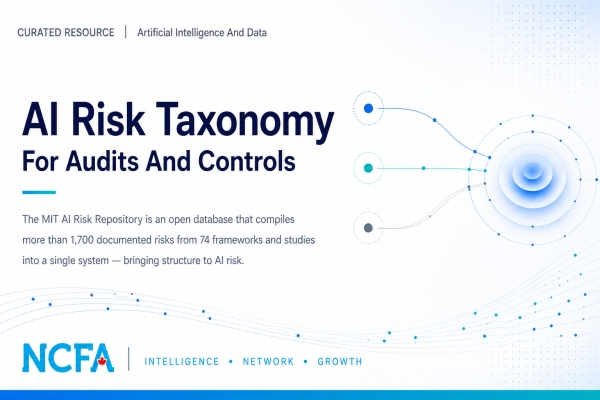
The MIT AI Risk Repository is an open database created by researchers at MIT to bring structure to AI risk. It compiles more than 1,700 documented risks from 74 existing frameworks and studies into a single system. The aim is practical. AI risk guidance exists, but it is scattered and inconsistent across sources. This repository organizes it into a shared taxonomy, with links that show how risks connect and compound across systems.
In practice, this gives teams a consistent way to map risk across AI systems.
Teams already running AI in production will get the most from this. If you’re operating models in lending, fraud, onboarding, or customer support, it gives you a structured way to think about risk across systems. Larger fintechs and financial institutions dealing with audit and regulatory pressure will find it useful quickly. Early stage teams without deployed models will likely find it heavy and not immediately relevant.
The strength here is structure. It turns fragmented AI risk concepts into something teams can actually use, and the causal links add depth that most frameworks miss. At the same time, it does not rank risks by likelihood or impact, and it does not translate directly into controls or regulatory compliance. Some classifications reflect interpretation across sources, and emerging risks may not be fully captured. Teams still need to apply judgment and build their own control layer on top.
Repository Homepage (AI risk overview and navigation)
Full Risk Database (AI risk dataset for audits)
Causal Taxonomy (AI risk relationships mapping)
Domain Taxonomy (AI risk classification framework)
Research Paper (AI risk methodology and design)
The National Crowdfunding & Fintech Association (NCFA Canada) is a financial innovation ecosystem that provides education, market intelligence, industry stewardship, networking and funding opportunities and services to thousands of community members and works closely with industry, government, partners and affiliates to create a vibrant and innovative fintech and funding industry in Canada. Decentralized and distributed, NCFA is engaged with global stakeholders and helps incubate projects and investment in fintech, alternative finance, crowdfunding, peer-to-peer finance, payments, digital assets and tokens, artificial intelligence, blockchain, cryptocurrency, regtech, and insurtech sectors. Join Canada's Fintech & Funding Community today FREE! Or become a contributing member and get perks. For more information, please visit: www.ncfacanada.org
| | |
|---|---|---|
| | |
Apr 28, 2026 | NCFA Insight | Risk Compliance And Regtech, Digital Assets Blockchain And Tokenization, Open Banking Open Finance And Data Sharing, Payments And Market Infrastructure, Capital Markets And Funding

On Apr 28, 2026, the Government of Canada released its Spring Economic Update key measures. For fintech and financial institutions, a deeper and more integrated operating model is now taking form across fraud, payments, digital assets, banking fees, data access, and capital formation. Canada wants more competition in financial services, but not at the cost of weak controls. The update points to a more disciplined market where firms can win through lower costs, faster rails, better data access, and stronger fraud prevention (at least that's the strategic read).
François Philippe Champagne, Minister of Finance and National Revenue, Government of Canada:
“From geopolitical shifts to supply chain disruptions to rapid technological breakthroughs, including in artificial intelligence, the world is changing quickly and Canada must adapt to thrive.”
The update treats fraud as a structural weakness in the financial system, not just a policing problem. Canada will establish the Financial Crimes Agency as a dedicated federal body for serious and complex financial crime, with police powers, civilian leadership, specialized personnel, and an asset recovery mandate.
The funding is material. Ottawa proposes $352.7 million over five years and $82.1 million ongoing for the agency, plus $46.2 million over five years for the Public Prosecution Service of Canada and $19.6 million over five years for the Department of Finance Canada.
For fintechs, banks, platforms, and payment firms, this raises the bar. Fraud controls now need to work across onboarding, funding, transactions, identity, communications, reporting, and recovery. A good product experience will not carry a weak risk model.
The clearest digital asset measure is the proposed crypto ATM ban. Annex 2 goes further than a policy signal. It proposes amendments to the Proceeds of Crime Money Laundering and Terrorist Financing Act and regulations to make it a criminal offence to operate a cryptocurrency automated teller machine.
Crypto ATMs connect cash to crypto quickly with limited friction, and can move scam proceeds outside the banking system before recovery becomes realistic. CBC reported that Canada has nearly 4,000 crypto ATMs, the most per capita in the world, and that some smaller deposits require only a phone number when under $1,000.
It's a targeted intervention of digital assets at what the government feels is the weakest access point. Serious crypto firms, custodians, exchanges, and tokenized finance builders should take note. Regulatory pressure will always look to where where money enters, exits, and escapes oversight.
The update recognizes that money services businesses support remittances, currency exchange, digital payments, competition, and inclusion. It also says criminals increasingly abuse MSBs for money laundering, terrorist financing, sanctions evasion, and fraud.
FINTRAC revoked the registration of 84 MSBs in March 2026 alone. Ottawa now proposes new Ministerial Directive powers, expanded authority for FINTRAC to refuse or revoke MSB registration, measures to prevent non compliant MSBs from re registering, more criminal record checks, action on shelf MSBs, and better visibility into what services each MSB actually provides.
This resets the perimeter. MSBs are now seen as critical risk gateways that can no longer just sit at the edge of the system as light infrastructure. This will help strong operators over time because weak competitors will find it harder to hide behind registration status alone.
The update links competition policy directly to household financial costs. New NSF fee rules cap charges at $10, down from $45 to $50, with expected consumer savings of more than $600 million annually. Ottawa also intends to consult on prohibiting investment account transfer fees at federally regulated financial institutions. Those fees currently cost Canadians an average of $150 per transfer.
Fee friction has long protected incumbent economics. Lower caps and easier switching reward firms that use better data, real time balance checks, clearer pricing, and lower operating costs. Fintechs should treat this as a product opening opportunity.
The update keeps consumer driven banking as part of Canada's competition agenda. It says amendments to complete the Consumer Driven Banking Act have passed, giving consumers greater control over their finances.
Annex 2 also points to related amendments involving the Retail Payment Activities Act, the Payment Clearing and Settlement Act, the Consumer Driven Banking Act, and the Stablecoin Act as part of Bank of Canada cost recovery consolidation.
Read this as infrastructure alignment. Canada is preparing the back office of regulation for a more digital financial system.
The Canada Strong Fund creates another fintech touchpoint. Ottawa describes it as a national investment initiative focused mainly on equity investments in strategic Canadian projects and companies. The government also intends to offer Canadians a widely accessible retail investment product tied to the fund.
Canada wants citizens to participate directly in national growth assets while protecting initial invested capital. If Canadians can invest in strategic projects through a national vehicle, how directly competitive will it be and what role will regulated online investment platforms, exempt market dealers, wealthtech firms, and investor education tools play?
Canada is finally becoming more competitive, albeit with a much tighter control layer. Fraud enforcement gets funding and focus. Crypto ATMs face prohibition. MSBs face deeper scrutiny. Banking fees face compression. Open banking remains active. Payments, stablecoins, and data access move into more coordinated oversight. Retail capital access gets a new public investment model.
The National Crowdfunding & Fintech Association (NCFA Canada) is a financial innovation ecosystem that provides education, market intelligence, industry stewardship, networking and funding opportunities and services to thousands of community members and works closely with industry, government, partners and affiliates to create a vibrant and innovative fintech and funding industry in Canada. Decentralized and distributed, NCFA is engaged with global stakeholders and helps incubate projects and investment in fintech, alternative finance, crowdfunding, peer-to-peer finance, payments, digital assets and tokens, artificial intelligence, blockchain, cryptocurrency, regtech, and insurtech sectors. Join Canada's Fintech & Funding Community today FREE! Or become a contributing member and get perks. For more information, please visit: www.ncfacanada.org
| | |
|---|---|---|
| | |
Apr 29, 2026 | NCFA Fintech Market Activity | Digital Assets Blockchain And Tokenization

On Apr 29, 2026, FIS launched Lyriq, a platform that allows banks to issue and manage tokenized deposits and digital money while keeping funds on balance sheet.
Lyriq connects with core banking systems and supports continuous settlement. Transactions are designed to either complete fully or fail, which reduces reconciliation work and gives banks clearer control over how payments move across systems. The platform enters limited availability after seven financial institution proofs of concept and multiple CBDC program engagements, including one moving toward pre-production.
The design focuses on production use. Identity, access control, compliance, and audit functions are built into the platform, allowing banks to run digital money flows within existing regulatory and operational frameworks rather than layering controls afterward.
Jim Johnson, Co-President of Banking Solutions, FIS:
“Lyriq is production-ready infrastructure that, combined with our deep expertise integrating bank technology, puts banks in control of money in motion. Lyriq is a platform proven with financial institutions - one that meets banks and regulators where they are.”
Lyriq is part of a broader set of tools FIS is building around digital assets. The company already supports stablecoin payments through its Money Movement Hub and loan tokenization through its Digital Liquidity Gateway. Together, these tools cover payments, deposits, and capital markets in one place.
For banks, the appeal is simple. They can offer faster and more flexible transactions while keeping deposits on their own balance sheets. Stablecoins already offer speed and programmability, but they sit outside the banking system. Lyriq gives banks a way to offer similar capabilities without sending funds elsewhere.
The hard part has been getting these systems into real use. Many tokenization projects stay stuck in pilots because they don’t connect to core banking systems. Lyriq focuses on that gap by working with infrastructure that banks already use, which makes it easier to handle real transaction volume.
If banks can’t offer a similar experience, deposits and payment activity can move to platforms that already do. That’s the pressure pushing banks to act.
Which platforms become the operating layer for bank issued digital money, and which banks can move fast enough to keep deposits and payment flows inside their own systems?
The National Crowdfunding & Fintech Association (NCFA Canada) is a financial innovation ecosystem that provides education, market intelligence, industry stewardship, networking and funding opportunities and services to thousands of community members and works closely with industry, government, partners and affiliates to create a vibrant and innovative fintech and funding industry in Canada. Decentralized and distributed, NCFA is engaged with global stakeholders and helps incubate projects and investment in fintech, alternative finance, crowdfunding, peer-to-peer finance, payments, digital assets and tokens, artificial intelligence, blockchain, cryptocurrency, regtech, and insurtech sectors. Join Canada's Fintech & Funding Community today FREE! Or become a contributing member and get perks. For more information, please visit: www.ncfacanada.org
| | |
|---|---|---|
| | |

On Apr 27, 2026, the Bank of Canada reminded PSPs under the Retail Payment Activities Act that annual reports were due by March 31, 2026. PSPs registered after March 30, 2026 are not required to submit an annual report for 2025.
PSPs that missed the deadline should submit their report as soon as possible or face potential enforcement action.
The reporting framework is detailed. PSPs must follow the Bank’s annual reporting policy, which requires annual reports by March 31 each year, and its retail payment metrics policy, which covers the value of end user funds held, EFT volume and value, end users served, and other PSPs served. This turns reporting into an operating discipline (to avoid a year end scramble).
The Bank’s reporting guide shows that PSPs must report across operational risk, incident management, end user funds safeguarding, significant changes, incidents, activity metrics, financial information, and record keeping.
The form also asks about cyber security controls, third party service providers, agents, mandataries, safeguarding accounts, shortfalls, and independent reviews.
For operators, (1) data infrastructure must support audit ready reporting, (2) governance must match supervisory expectations, and (3) product design must account for regulatory visibility from day one.
For investors and partners, reporting compliance is a useful test of execution quality. Firms that can operate inside regulated environments with clean reporting, strong controls, and reliable evidence will have an advantage as oversight expands.
The Bank’s information session walks PSPs through annual reporting requirements, including required data fields, operational risk disclosures, activity metrics, and submission through PSP Connect.
The National Crowdfunding & Fintech Association (NCFA Canada) is a financial innovation ecosystem that provides education, market intelligence, industry stewardship, networking and funding opportunities and services to thousands of community members and works closely with industry, government, partners and affiliates to create a vibrant and innovative fintech and funding industry in Canada. Decentralized and distributed, NCFA is engaged with global stakeholders and helps incubate projects and investment in fintech, alternative finance, crowdfunding, peer-to-peer finance, payments, digital assets and tokens, artificial intelligence, blockchain, cryptocurrency, regtech, and insurtech sectors. Join Canada's Fintech & Funding Community today FREE! Or become a contributing member and get perks. For more information, please visit: www.ncfacanada.org
| | |
|---|---|---|
| | |


August 26th, 2025

January 4th, 2024

June 1st, 2021

September 9th, 2020

July 9th, 2018

January 3rd, 2018

September 25th, 2017

June 20th, 2017

May 10th, 2017

December 14th, 2016