




Karsten Wenzlaff, Advisor
August 26th, 2025
Karsten Wenzlaff is a Crowdfunding and Fintech Expert from Germany. He is Secretary-General of Digit[...]


Retail Banking | May 1, 2025
Retail digital banking platforms are evolving into the foundation of modern financial services driven by consumers appetite for AI driven platforms that make it easier to manage money, get personalized advice, and accessible services anytime on any device.
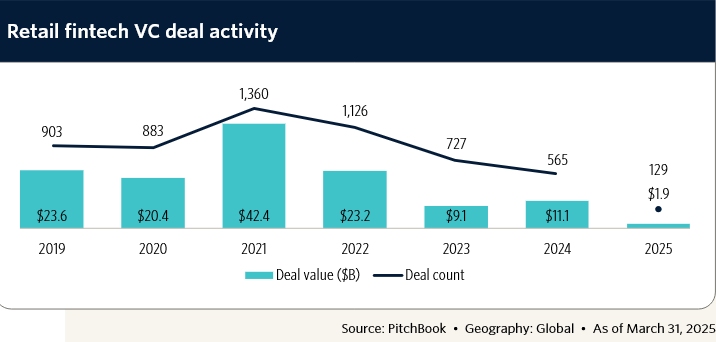
According to PitchBook Retail Fintech VC Trends, global retail fintech funding volumes reached $1.9 billion in Q1 2025, representing a 37.8% drop from Q4 2024 despite rising interest in platform-first strategies and growing AI adoption.
Although venture growth deals were the exception with median deal sizes jumping 67% to $47 million, making up 53.7% of total VC value. Klarna’s $12 billion valuation and Addi’s $170 million growth round stand out. IPO prospects for Klarna and eToro postponed listings due to market volatility ala Trump-effect.
Early stage retail fintech including median pre-seed and seed valuations fell by 50% and declined in size and count.
CCG Catalyst’s May 1 2025 snapshot of retail digital banking platforms features fintech companies are gaining traction because they stack cloud-native scale, AI tools, and modular architecture:
| U.S. Platform | Why Investors Are Interested |
| Backbase | Microservices, API-first architecture, and enterprise flexibility |
| Narmi | Open API stack and fast onboarding (under 3 minutes) |
| Lumin Digital | AI-native with strong mobile UX, cloud-native since day one |
| SoFi/Cyberbank | End-to-end infrastructure with embedded finance support |
| Temenos Infinity | Low-code platform enabling rapid interface development |
Canada’s fintech ecosystem has several growing players with potential to evolve into full service modular banking platforms or infrastructure providers:
| Canadian Company | Comparable U.S. Platform | Strategic Direction |
| Wealthsimple | SoFi | Expanding beyond investing into cash accounts, cards, and tax tools |
| Koho | Narmi | Prepaid card and banking-like functionality with open APIs |
| Neo Financial | Lumin Digital | Mobile-first, rewards-driven model with merchant integration |
| EQ Bank | Backbase | Hybrid of legacy and digital bank offering API access and high-interest accounts |
| Tandem or Brim | Apiture or Temenos | Fintechs with credit and loyalty platforms, potential to grow through partnerships |
Canadian fintech is still limited by federal regulatory complexities but opportunities are increasing as consumers move away from branch-based banking, the need for increased competition amidst Trump's economic pressures, and newly elected Prime Minister Mark Carney vowing to protect Canada.
According to the Canadian Bankers Association's 2024 report, 70% of Canadians used a mobile banking app in the last year (on average 7.4 times per month), up from 65% in 2021.
VC interest in Canadian fintech remained strong in 2024, despite a global slowdown. Fintechs with platform enabling capabilities such as embedded finance, banking-as-a-service, and open API designs continue to attract interest. Plus, the rise of U.S. plug-and-play models is a playbook for homegrown infrastructure players to serve Tier 2 banks, credit unions, and niche verticals like gig economy banking.
Digital banking platforms at the forefront are meeting customer expectations and improving operational efficiency with a few key technologies:
Digital retail banking platforms are using AI, APIs, and modular designs to deliver flexible, intelligent, and ready to scale solutions. Canadian fintechs that embrace open architecture and build for partnerships can lead not just here in Canada, but globally.
 The National Crowdfunding & Fintech Association (NCFA Canada) is a financial innovation ecosystem that provides education, market intelligence, industry stewardship, networking and funding opportunities and services to thousands of community members and works closely with industry, government, partners and affiliates to create a vibrant and innovative fintech and funding industry in Canada. Decentralized and distributed, NCFA is engaged with global stakeholders and helps incubate projects and investment in fintech, alternative finance, crowdfunding, peer-to-peer finance, payments, digital assets and tokens, artificial intelligence, blockchain, cryptocurrency, regtech, and insurtech sectors. Join Canada's Fintech & Funding Community today FREE! Or become a contributing member and get perks. For more information, please visit: www.ncfacanada.org
 |  |  |
|---|---|---|
 |  |  |
Capital Markets | April 25, 2025 | Last Updated September 21, 2026

2024 equity crowdfunding investment on FrontFundr by province. Image courtesy of FrontFundr
On April 30, 2026, FrontFundr released its latest Community Capital Report, showing another record year for its Canadian private markets platform. FrontFundr processed $83.2 million across 51 campaigns and 8,064 investments in 2025, with total capital up 23% from the prior year.
The results extend the growth first documented in 2024, when FrontFundr processed $68.3 million across 66 campaigns. Fewer companies raised on the platform in 2025, but more capital and substantially more investments flowed through those campaigns. A closer look at the $83.2 million FrontFundr private market year shows how retail participation and larger community raises contributed to that increase.
Canada's venture market remains selective. According to the CVCA H1 2026 market report, Canadian venture capital reached $2.69 billion across 250 deals in the first half of 2026. Capital increased 17% year over year, but deal count fell 8.8%. Sixteen financings of $50 million or more absorbed 59% of the capital invested.
For founders, that combination matters. Institutional capital remains available, but a significant share is concentrating in larger transactions. Equity crowdfunding gives companies another way to raise capital from customers, supporters and individual investors while building a wider ownership community around the business.
FrontFundr operates as an exempt market dealer and uses several prospectus exemptions. Its full $83.2 million of 2025 platform activity should therefore not be treated as investment crowdfunding conducted solely under National Instrument 45-110.
Activity specifically under the NI 45-110 start-up crowdfunding exemption reached $4.79 million from 4,320 investors in 2025, up from $1.71 million across 1,505 investments in 2024. FrontFundr reported a 93% market share under the exemption.
The 2025 platform results included:
From 2015 through the end of 2025, FrontFundr reported processing more than $340 million across 36,057 investments and more than 285 raises.
The NI 45-110 numbers are particularly important for Canada's early stage capital market. The exemption allows an issuer group to raise up to $1.5 million over a 12 month period. In 2025, several campaigns came close to that ceiling.
Edison Motors raised $1,491,043 from 961 investors under NI 45-110, reaching about 99% of the available limit. Blossom Social raised $1,449,681 from 951 investors under the exemption, or about 97% of the limit, before additional accredited investor capital brought its total FrontFundr raise to approximately $1.93 million.
Gander Social also raised more than $1 million under NI 45-110, with $1,148,066 raised through the exemption as part of a total campaign of approximately $2.01 million.
As more companies develop investor communities capable of reaching the current ceiling, the practical question becomes whether the existing limit continues to fit the financing needs of successful early stage issuers.
Some of the strongest recent campaigns have come from companies that already had customers, followers or communities willing to become investors.
Blossom Social returned to FrontFundr in 2025 after raising $1.34 million from 742 investors in 2024. Its next campaign raised approximately $1.93 million from 1,028 investors in six hours, according to FrontFundr.
Edison Motors became the platform's largest raise of the year at approximately $6.8 million across the exemptions and investment channels available through FrontFundr. Its NI 45-110 component came close to the exemption's annual issuer limit.
Gander Social raised approximately $2.01 million across 2,581 investments, including more than $1.1 million under NI 45-110.
These campaigns show where community capital can be especially effective. Companies with strong customer bases, online audiences or stakeholder networks can convert some of that engagement into ownership capital while reducing their dependence on a single institutional financing source.
The model will not fit every company. Raising from a large number of individual investors requires communications, investor administration and a business that people can understand well enough to make an investment decision. For companies with the right community and capital needs, however, the channel is becoming more established.
FrontFundr's 2025 data shows that investment activity remained concentrated in Canada's largest private capital markets while participation increased across several provinces.
FrontFundr also recorded its first investments from Newfoundland and Labrador and Prince Edward Island late in 2025.
The regional expansion matters because early stage capital is not distributed evenly across Canada. Online investment platforms can give issuers access to investors beyond their immediate city or local angel network while giving individual Canadians another route into private companies.
Equity crowdfunding remains a small part of Canada's overall private capital market. It should not be confused with venture capital, private equity, private credit or the wider exempt market. Its value is that it adds another financing option between personal networks, angel capital and larger institutional rounds.
The distinction between equity crowdfunding and wider online private market investing is also important. FrontFundr's $83.2 million platform total includes activity under several exemptions and investment products, while $4.79 million was specifically raised under NI 45-110. Reporting the two separately gives founders, investors and policy makers a clearer view of how investment crowdfunding itself is developing.
The issue is part of a wider capital formation challenge. Public market pressures and limited IPO activity can keep companies private for longer, while larger venture rounds continue to absorb a substantial share of available institutional capital.
That creates room for financing models that can serve companies before they are ready for a large institutional round. Community capital can play that role alongside angel investment, venture capital and other exempt market financing rather than trying to replace them.
The next test is whether equity crowdfunding can become a more consistent part of Canada's early stage financing system rather than a funding option used mainly when conventional capital is scarce.
The ingredients are improving. More Canadians are participating in private markets, larger issuer communities can mobilize capital quickly, and regulated online platforms now have a decade of operating history behind them.
Growth should still be judged by more than dollars raised. A stronger market requires good companies to raise efficiently, investors to receive enough information to assess risk, platforms to operate sustainably and successful issuers to progress into larger rounds without losing access to the communities that helped fund them.
For investors, private company ownership carries significant risk. Investments can be illiquid for long periods, valuations can be difficult to establish, disclosure is more limited than in public markets and investors can lose some or all of their capital.
For founders, the opportunity is becoming clearer. Companies with credible businesses and engaged communities can combine retail investment with angel, accredited investor and institutional capital rather than treating those sources as separate choices.
Canada does not need equity crowdfunding to replace venture capital. It needs enough credible financing routes that promising companies are not dependent on a single class of investor at every stage of growth.
 The National Crowdfunding & Fintech Association (NCFA Canada) is a financial innovation ecosystem that provides education, market intelligence, industry stewardship, networking and funding opportunities and services to thousands of community members and works closely with industry, government, partners and affiliates to create a vibrant and innovative fintech and funding industry in Canada. Decentralized and distributed, NCFA is engaged with global stakeholders and helps incubate projects and investment in fintech, alternative finance, crowdfunding, peer-to-peer finance, payments, digital assets and tokens, artificial intelligence, blockchain, cryptocurrency, regtech, and insurtech sectors. Join Canada's Fintech & Funding Community today FREE! Or become a contributing member and get perks. For more information, please visit: www.ncfacanada.org
| | |
|---|---|---|
| | |
DeFi | April 24, 2025

Image: Freepik/fullvector
In April 2025, the Bank for International Settlements (BIS) published a new report called 'Cryptocurrencies and decentralised finance: functions and financial stability implications' that could impact how regulators approach decentralized finance (DeFi). For the first time, the BIS explores the idea that smart contracts could help enforce certain regulatory rules within the code itself. To be clear, the BIS doesn't say that smart contract algorithms will replace oversight but it suggests that certain protections like disclosure requirements or prohibiting (or limiting) risk transactions could be built directly into the code.
At the same time, the BIS makes it clear that code alone is not enough. Behind every protocol is a developer, a team, or a group of people in-real-life (IRL) that makes decisions when designing or maintaining the system. These people often manage access, risk settings and upgrades. The BIS is saying that if DeFi is going to be safe and trusted then regulators must consider both the smart contract system and the people who develop and influence it.
Self-executing smart contracts are at the heart of DeFi. They allow users to lend, borrow, trade, and stake assets without relying on intermediaries like a centralized financial institution. Once a smart contract is deployed to the blockchain, it executes transactions exactly as coded, without exceptions. This fact makes them potentially powerful tools for embedding and enforcing basic safeguards to protect stakeholders that interact with these contracts like investors.
The BIS seems to support this concept (BIS Paper No. 156, page 22):
“Regulation could then be embedded in smart contracts to make sure that rules were met. Examples… include ensuring that smart contracts were executed in line with the status of the ledger, that the disclosure of information took place or that ‘best execution’ requirements have been met.”
What this means is that if a smart contract fails to meet a preset condition, such as price fairness or a collateral threshold requirement, it could automatically trigger a manual review. This would reduce the need for full manual checks on all transactions, and the smart contracts could require public disclosures are met before transactions were allowed. These types of technical safeguards would run automatically and help reduce fraud, bias, or delay. But the BIS says, automation has limits.
The BIS highlights that smart contracts do not govern themselves. That is, behind every DeFi protocol is a group of developers (tech/business/legal/investor or otherwise) that decides how the code will work, who can update it, and affect the direction it takes.
BIS quotes on Page 21:
“It would be useful to analyse the entities (and persons) exerting de facto control of a DeFi protocol…”
In many DeFi systems, the people involved are often anonymous or semi-anonymous, yet they can often have administrative access or governance power. Given the high stakes in such a financial system, it raises serious questions about accountability. Who is on the hook when problems arise?
Canada has a strong, innovative, and growing DeFi community with many projects being launched and experimented with. These project teams often create complex and secure smart contracts but may lack a clear acc0untability structure so users can face real risks. The BIS's report outlines two layers of protection related to governance.
1. The first is technical. Smart contracts could/should enforce baseline rules around transparency, fairness, and market integrity, without human intervention.
2. The second is organizational. Developers and governance teams must be identifiable, transparent, and where appropriate, regulated. That could mean setting minimum standards, requiring disclosures, or creating a new legal category for protocol operators.
The HM Treasury in the United Kingdom released a paper in February 2023 titled "Future financial services regulatory regime for cryptoassets" that discusses various options for bringing DeFi activities into the regulatory perimeter - section 11.6:
"One option for regulating DeFi is to define a set of DeFi-specific activities – e.g. 'establishing or operating a protocol' – as regulated activities under the RAO (or DAR). The persons carrying out those activities would then require authorisation, and the FCA could design a bespoke regime around these regulated activities."
The BIS report covers a range of updated views on cryptocurrency topics, as adoption continues to grow globally. The BIS is looking for a path that DeFi can grow (not advocating to centralize or shut it down) but with guardrails to protect users and the financial system. Smarter regulation is where 'code and community' can collaborate with a novel system pushing boundaries.
The National Crowdfunding & Fintech Association (NCFA Canada) is a financial innovation ecosystem that provides education, market intelligence, industry stewardship, networking and funding opportunities and services to thousands of community members and works closely with industry, government, partners and affiliates to create a vibrant and innovative fintech and funding industry in Canada. Decentralized and distributed, NCFA is engaged with global stakeholders and helps incubate projects and investment in fintech, alternative finance, crowdfunding, peer-to-peer finance, payments, digital assets and tokens, artificial intelligence, blockchain, cryptocurrency, regtech, and insurtech sectors. Join Canada's Fintech & Funding Community today FREE! Or become a contributing member and get perks. For more information, please visit: www.ncfacanada.org
| | |
|---|---|---|
| | |
Investor Research | April 23, 2025

Image from OSC Retail Investor and Social Media Study Interface
The story goes something like this... Maya wasn't looking for investment advice when she jumped on her phone and started scrolling through short videos when one caught her attention. A young finfluencer explained how he built a portfolio by investing a small amount each week. He showed screenshots, made it sound simple, and wrapped the message in personal success. It felt real and by the end of the clip Maya was thinking about following his exact steps. What she didn't realize was how many others were doing the same, by trusting only a short video.
Social media platforms have become a significant source of financial information for Canadians. According to the 2024 Canadian Securities Administrators (CSA) Investor Index, 53% of investors use social media for investment information (up 18% since 2020). Not surprisingly, among young investors aged 18 to 24, the figure rises to 82%. And to zoom in even further, 46% of investors report encountering investment opportunities on social media (up 17% from 2020).
On April 22, 2025, the Ontario Securities Commission (OSC) revealed their latest retail investor research, 'Social Media and Retail Investing: The Rise of Finfluencers' in collaboration with The Decision Lab. This post is data-driven look at how trust can turn into risk, and what the OSC likely plans to do about it.
The OSC surveyed 655 Canadian retail investors and found:
And those who acted on finfluencer advice, the following behaviours increased significantly:
The survey results suggest that a growing number of retail investors are relying on social media for online financial advisor, and based on their trust of finfluencers, investment advice found on social media often replaces traditional financial guidance which can lead to increased exposure to risk, especially among younger investors who are online frequently.
To better understand how social media and finfluencer content affects financial decisions, the Ontario Securities Commission ran an online study with 1,465 Canadians who use social media. Each person was randomly placed into different groups to see how different types of posts might influence what they would choose to buy in a simulated investment setting. Participants managed a simulated $10,000 portfolio and were exposed to promotional finance content modelled after real social media posts. Here's the rub:
These above results confirmed that exposure to financial content on social media can significantly impact investment decisions, especially among those with less experience.
The OSC ran tests to look at which behavioural interventions could be used to reduce the influence of influencer content including:
The results found that all of the above methods helped reduce the number of participants who purchased the promoted assets but none completely eliminated the influence of the original content.
The OSC's report suggests that the regulator supports continuation of regulatory oversight and targeted interventions to protect retail investors from finfluencer content, especially since social media is now integral to the distribution and/or access of financial advisor. In addition to the various Canadian regulatory guidelines below, the report confirms that authorities should consider additional measures to address these concerns that are now backed by evidence.
While some finfluencers provide valuable insights for investors, others can provide misleading or harmful advice. The OSC's findings are a cause for concern for regulators who are evaluating further oversight measures to protect retail investors from the potential risks associated with unregulated financial advice on social media platforms (or by finfluencers). Learn more about the OSC's study about the Rise of Finfluencers and Social Media and Retail investing.
The National Crowdfunding & Fintech Association (NCFA Canada) is a financial innovation ecosystem that provides education, market intelligence, industry stewardship, networking and funding opportunities and services to thousands of community members and works closely with industry, government, partners and affiliates to create a vibrant and innovative fintech and funding industry in Canada. Decentralized and distributed, NCFA is engaged with global stakeholders and helps incubate projects and investment in fintech, alternative finance, crowdfunding, peer-to-peer finance, payments, digital assets and tokens, artificial intelligence, blockchain, cryptocurrency, regtech, and insurtech sectors. Join Canada's Fintech & Funding Community today FREE! Or become a contributing member and get perks. For more information, please visit: www.ncfacanada.org
| | |
|---|---|---|
| | |
Stablecoins | April 17, 2025

Image: Freepik/creativeart
Stablecoins are gaining traction and are no longer a niche bet. According to Stripe’s 2024 Annual Letter, the number of monthly active stablecoin wallets tripled to 40 million over the past year. Stripe has now successfully integrated stablecoin capabilities into its core platform by the acquisition of Bridge, an enterprise grade stablecoin infrastructure provider (like Swift but on blockchain and faster) focused on real-time treasury and cross-border flows.
Stripe co-founders, Patrick and John Collison see stablecoins as improving the usability of money that can lead to more prosperous economies by enabling faster, cheaper, and more accessible transactions. An evolutionary and historical shift like the move from gold to fiat currency.
“Improvements to the basic usability of money make economies more prosperous. Consider the transitions from coins to banknotes, from the gold standard to fiat currency, and from paper instruments to electronic payments. Stablecoins are a new branch of the money tree. Such transitions occur with some regularity over the centuries, and the effects tend to be large.”
a16z just shared 'Stablecoins are payments without intermediaries', highlighting that stablecoins managed over $15.6 trillion of on-chain volume in 2024, which is essentially the same as Visa's annual volume, but it's growing and accelerating.
Stablecoins are no longer an experiment and have become part of core infrastructure. Stripe uses them for real time settlements and lower cross border costs. Over 78% of the Forbes AI 50 use Stripe products, so stablecoin transactions could scale massively quickly.
For any fintechs or financial institutions still relying on multi-day SWIFT transfers or batch ACH systems - it's time to take notice. Stablecoins offer instant settlement, programmable logic, and almost zero fees.
There's no waiting for banking hours or regional cutoffs. Stablecoin availability is open 24/7. The average transaction costs on networks like Solana are less than $0.01. Stablecoin transactions can finalize in under 5 seconds.
Stablecoins like USDC are designed to be composable, so they integrate seamlessly with numerous smart contracts and decentralized applications. Financial tools can now be built directly on-chain using smart contracts and stablecoin flows.
That's why stablecoins are already being used for payroll (e.g., pay overseas contractors), international business payments, and even on-chain stable yield strategies.
Stripe’s 2024 update, reports that stablecoin integration is already being used in many practical ways, such as SpaceX uses Stripe's stablecoin infrastructure to repatriate funds from Starlink sales in countries like Argentina and Nigeria. The U.S. government uses Stripe's stablecoin solutions to improve efficiencies of financial operations.
There are several real world economic cases where countries are relying on stablecoins.
Argentina for example, experienced a massive spike in annual inflation of 211.4% in 2023, which pushed many to hedge against inflation by moving funds to stablecoins like USDT and USDC.
Nigeria uses stablecoins to send funds across borders due to the inefficiencies and high costs involved with traditional remittance methods, making global transfers more affordable.
In the Philippines, a stablecoin called PHPC (pegged to the Philippine peso) is used to reduce exchange rates and transfer costs for Filipino expats sending money home to families.
If Canada wants to compete in global finance, we can’t ignore what’s happening at the infrastructure level. Major tech platforms like Stripe are integrating stablecoins into programmable finance. Startups are now choosing stablecoin rails to access global markets from day one. Canada has been working to modernize it's payment infrastructure and real time rails for years but the tech overhaul has been delayed over years, and even the Bank of Canada is disappointed by the progress rate.
Fintechs and financial institutions should be evaluating the growing use cases of stablecoins such as cross border treasury flows, global payroll, and embedded payments. They should track the developments in upcoming stablecoin regulations, such as Canada's Retail Payment Activities Act, the U.S. efforts, the UK, and European crypto guidelines. They can begin compliance planning and readiness efforts for stablecoin transaction and consider partnering with infrastructure providers offering compliant stablecoin APIs.
Stablecoins have gone mainstream and are now core infrastructure settling in seconds for less than a penny, and running 24/7. Stripe, SpaceX, governments, and individuals and companies globally are using them for faster, cheaper payments. If you're still relying only on traditional payment rails, it's time to evaluate stablecoin use cases and get ready to plug into the new financial internet.
The National Crowdfunding & Fintech Association (NCFA Canada) is a financial innovation ecosystem that provides education, market intelligence, industry stewardship, networking and funding opportunities and services to thousands of community members and works closely with industry, government, partners and affiliates to create a vibrant and innovative fintech and funding industry in Canada. Decentralized and distributed, NCFA is engaged with global stakeholders and helps incubate projects and investment in fintech, alternative finance, crowdfunding, peer-to-peer finance, payments, digital assets and tokens, artificial intelligence, blockchain, cryptocurrency, regtech, and insurtech sectors. Join Canada's Fintech & Funding Community today FREE! Or become a contributing member and get perks. For more information, please visit: www.ncfacanada.org
| | |
|---|---|---|
| | |
Bank of Canada Staff Report | March 27, 2025

Image: Canadians' access to cash in 2023 (Bank of Canada, Staff Research)
On March 21, 2025 the Bank of Canada's staff published a cash-related study called 'Canadians Access to Cash in 2023' (16 page PDF) that confirms what most folks especially fintechs and financial institutions (FI) know. That is banks and credit unions are quietly closing branch locations across Canada, particularly in rural and remote areas.
The report compares a snapshot taken in Q4 of 2019 and compared it with Q4 in 2023, four years later, and found that 561 branches were shut down, along with more than 900 bank-owned ATMs (automatic teller machines). Now even though the banks and credit unions are closing hundreds of ATMs, private companies or white-label ATMs, fintechs, and innovative alternatives have moved in to fill the gap to provide access to cash for people who rely on them.
“The infrastructure for accessing cash may look stable on the surface, but the underlying delivery models have changed significantly.”
| Type | 2019 Q4 | 2023 Q4 | Change |
| Bank branches | 5,921 | 5,699 | –222 |
| Credit union branches | 2,984 | 2,645 | –339 |
| FI-owned ABMs | 21,538 | 20,604 | –934 |
| White-label ABMs | 38,863 | 39,660 | +797 |
The table above is sourced from the BoC's staff research report and shows that white-label ATMs, typically not located in retail stores and not affiliated with any financial institution, now make up approx two-thirds of all automatic teller machines in Canada. While they offer convenience, they often come with higher fees and lack the services or security that bank owned ATMs provide.
In many rural or remote communities where branches and ATMs have been removed, residents now have to travel further to access basic financial services. Credit unions which often serve smaller populations, have reduce the number of branches at a steeper percentage drop than major banks.
While a growing number of Canadians are transitioning to online banking, those that still rely on cash such as seniors, some small businesses, and those with limited internet access, are faced with rising challenges to access basic banking services.
Some innovative partnerships and initiatives are expanding access through digital and community-based models.
Earlier this month, Canadian fintech Koho and Canada Post formed a partnerships and launched postal banking services via the My Money Account, a digital spending and savings account managed through the KOHO app. So citizens living in rural or remote areas that live near a post office will be able to load cash, access funds, and manage their money at their local post office and users can deposit cash at over 6,000 Canada Post locations. The service is expected to rollout nationally this year 2025 and is specifically targeting rural, remote and indigenous communities.
While we've never stepped in one, reports online show that Desjardins has launched mobile banking branches, which are fully equipped vehicles that travel to underserved regions of Quebec. These mobile branch units offer in-person banking services, including deposits, withdrawals, bill payments, and consultations. The approach is proving effective in areas where internet access is limited and/or digital adoption is low.
Digital banking platforms like EQ Bank, Koho, and Wealthsimple Cash are also helping Canadians open accounts, pay bills, and send e-transfers, all remotely. Most of these services offer secure ID verification tools that don't require a branch visit, so they are an ideal fit for communities lacking traditional brick-and-mortar infrastructure.
Digital banks have become a reliable alternative for delivering a growing suite of financial services at lower rates than traditional banks providers.
As the number of physical banking locations and ATMs decline in rural communities, the alternative solutions will be used more and more. From white label ATMs to postal banking services and mobile branch units, are now part of the financial infrastructure of rural Canada.
The National Crowdfunding & Fintech Association (NCFA Canada) is a financial innovation ecosystem that provides education, market intelligence, industry stewardship, networking and funding opportunities and services to thousands of community members and works closely with industry, government, partners and affiliates to create a vibrant and innovative fintech and funding industry in Canada. Decentralized and distributed, NCFA is engaged with global stakeholders and helps incubate projects and investment in fintech, alternative finance, crowdfunding, peer-to-peer finance, payments, digital assets and tokens, artificial intelligence, blockchain, cryptocurrency, regtech, and insurtech sectors. Join Canada's Fintech & Funding Community today FREE! Or become a contributing member and get perks. For more information, please visit: www.ncfacanada.org
| | |
|---|---|---|
| | |
Research | March 25, 2025

Image: Global Regulation Index, Innovate UK
Last summer, the UK’s national innovation agency, ranked 21 countries on how well their regulators support innovation in sectors like AI, fintech, and health tech. Rather than focusing on the number of innovative policies, competition, or economic growth, the 2024 Global Regulation Index (64 page PDF) looks at how adaptable, collaborative, and forward-thinking each country is when it comes to modern regulation.
Countries were scored based on a combination of public data, policy analysis, consultation activity, and expert review. This means the rankings capture both measurable outputs and qualitative factors, such as how willing a government is to try new ideas or adjust outdated rules.
The report scores each country on 37 metrics across five core pillars that reflect how regulators engage with emerging (tech) innovations. In brackets is each pillar's weight to reflect its importance in calculating a country's final score, normalized on a 100 point scale.
All 21 countries examined received a total score out of 100, based on weighted contributions from the five categories mentioned above.
Here's the full list:
| Rank | Country | Overall | Adaptability | Clarity | Collaboration | Experimentation | Entrepreneurship |
|---|---|---|---|---|---|---|---|
| 1 | Singapore | 86.6 | 23.6 | 14.6 | 18.3 | 20.0 | 10.1 |
| 2 | The Netherlands | 83.5 | 20.3 | 15.5 | 18.4 | 19.6 | 9.8 |
| 3 | United Kingdom | 83.0 | 20.0 | 15.2 | 18.9 | 19.3 | 9.6 |
| 4 | Australia | 79.4 | 18.3 | 15.0 | 19.0 | 17.9 | 9.3 |
| 5 | South Korea | 78.8 | 17.9 | 14.3 | 17.7 | 20.0 | 8.9 |
| 6 | Germany | 78.2 | 19.6 | 15.6 | 19.1 | 14.3 | 9.6 |
| 7 | Canada | 77.2 | 17.1 | 15.4 | 15.4 | 20.0 | 9.4 |
| 8 | United States | 76.5 | 19.0 | 14.8 | 13.5 | 19.6 | 9.5 |
| 9 | Austria | 75.1 | 18.6 | 15.5 | 13.2 | 19.3 | 8.5 |
| 10 | United Arab Emirates | 73.1 | 20.9 | 13.8 | 16.5 | 13.6 | 8.4 |
| 11 | Finland | 72.0 | 21.3 | 16.1 | 15.8 | 9.3 | 9.5 |
| 12 | Japan | 69.0 | 16.0 | 13.1 | 16.0 | 14.3 | 9.7 |
| 13 | Switzerland | 68.7 | 14.7 | 16.5 | 15.0 | 15.0 | 7.5 |
| 14 | Norway | 68.3 | 14.7 | 14.1 | 13.9 | 19.3 | 6.4 |
| 15 | France | 67.8 | 18.6 | 15.2 | 11.2 | 14.3 | 8.6 |
| 16 | Sweden | 67.0 | 18.5 | 14.3 | 16.5 | 8.6 | 9.1 |
| 17 | Denmark | 66.6 | 14.9 | 16.2 | 12.7 | 13.2 | 9.6 |
| 18 | Israel | 65.1 | 16.7 | 15.1 | 10.9 | 13.9 | 8.4 |
| 19 | China | 57.3 | 13.0 | 9.3 | 13.1 | 14.6 | 7.3 |
| 20 | Brazil | 54.1 | 10.1 | 12.9 | 12.9 | 10.7 | 7.5 |
| 21 | Mexico | 49.8 | 10.9 | 12.9 | 13.3 | 5.7 | 7.1 |
Based on the data and rankings, a country will perform well in this study if they perform highly across the board, from clarity and adaptability to how much they support startups. That's what helps Singapore come out on top. They didn't have the highest score in a single area but they did well on all five, and their consistency makes it the most balanced and reliable regulatory environment for innovation in the study.
South Korea is another good example. It led the rankings in policy clarity and did well in startup support too. With solid scores in adaptability and experimentation, it climbed to second overall. So it's not just about trying new things but about doing them well, consistently, and at scale.
The United States had high marks for adaptability and experimentation, which makes sense given its size and diversity of its innovation economy but it scored lower in collaboration and reliability. Likely because it's such a complex regulatory system and federal and state rules often overlap, so it can mean uncertainty and slower timelines for businesses.
Further down the list, sizable economies like France, Germany, and Japan received middle rankings. While their regulations are generally stable and clear they haven't moved as quickly to adapt or test new ideas. A steady approach is predictable but it can hinder innovation when new technologies and/or industries appear.
At the lower end, countries like India, Brazil, and Nigeria scored high in entrepreneurship support (a lot of energy and activity for their startup ecosystems). But they struggled with clarity, coordination, and the ability to keep up with change. The talent and ambition are there but the policy foundation to support it, may be lacking.
Canada’s story is different. It ranked first in the world for regulatory experimentation (actually tied for first rank together with Singapore and South Korea), which means regulators are doing more testing, piloting, and sandboxing than anyone else. That's got to be a positive sign, as it shows willingness to study new approaches whether it's for digital assets, open banking or AI oversight. But experimentation only accounts for a fifth of the overall score and that alone isn't enough.
In other areas like adaptability, clarity, and support for entrepreneurs, Canada lands more in the middle of the global rankings. The real challenge is moving from testing ideas to turning them into clear, national rules that help startups scale and compete. Right now, overlapping rules across provinces and slow implementation timelines are still a barrier for many. So while Canada is active on the front end of innovation, it hasn’t yet turned those efforts into major economic or competitive advantages.
Good innovation policy isn’t just about making new rules. It’s about building systems that let businesses grow, take risks, and move forward without getting stuck in red tape. Canada's report ranking shows that regulators are starting in the right place by asking questions, running pilots, and listening to industry. But in other countries, those early steps turn into action more quickly. If Canada wants to keep up, it needs to make its rules clearer, reduce overlap between provinces, and move faster to turn pilot programs into policies that business can rely on at scale.
The National Crowdfunding & Fintech Association (NCFA Canada) is a financial innovation ecosystem that provides education, market intelligence, industry stewardship, networking and funding opportunities and services to thousands of community members and works closely with industry, government, partners and affiliates to create a vibrant and innovative fintech and funding industry in Canada. Decentralized and distributed, NCFA is engaged with global stakeholders and helps incubate projects and investment in fintech, alternative finance, crowdfunding, peer-to-peer finance, payments, digital assets and tokens, artificial intelligence, blockchain, cryptocurrency, regtech, and insurtech sectors. Join Canada's Fintech & Funding Community today FREE! Or become a contributing member and get perks. For more information, please visit: www.ncfacanada.org
| | |
|---|---|---|
| | |


August 26th, 2025

January 4th, 2024

June 1st, 2021

September 9th, 2020

July 9th, 2018

January 3rd, 2018

September 25th, 2017

June 20th, 2017

May 10th, 2017

December 14th, 2016