




Karsten Wenzlaff, Advisor
August 26th, 2025
Karsten Wenzlaff is a Crowdfunding and Fintech Expert from Germany. He is Secretary-General of Digit[...]


Research | July 14, 2025

Image: Freepik/stockking
A new study from MIT and partner universities, "Your Brain on ChatGPT" shows that using ChatGPT during essay writing reduces brain activity, memory recall, and feelings of ownership over the work. The study included EEG scans, human interviews, and AI scoring, and concluded that essays completed with the help of ChatGPT often looked polished, they led to lower mental effort and weakened learning.
The findings are red flags for any parent with kids in school using ChatGPT frequently for tasks AND also professionals in other sectors including fintech that rely on chatGPT for everyday tasks.
Brain scans showed that students using ChatGPT had the lowest levels of brain connectivity, especially in the alpha and beta frequency bands. These waves are linked to attention and executive thinking. Students who wrote without tools had the strongest brain engagement (See: Figure 1, pg 1).
This takeaway is particularly shocking. After writing, 83% of ChatGPT users couldn’t quote anything from their essays, and none could quote accurately. Only 11% of the students using search engines or writing without tools had the same issue (See: pg 31).
Only 50% of the ChatGPT group said the work felt like theirs. Of course almost all students in the 'brain only' group said they fully owned their writing (See: pg 32).
The AI essays often use the same phrases, structure, and focus on the same topics. The Natural Language Processing analysis shows that the variety of words used and topics explored were much lower than in essays written without AI support (See: Summary of Results, pg 3).
Although essays written with the help of ChatGPT received high marks from both human and AI judges, they lacked strategic integration and complex thinking. The authors called this a “surface benefit with hidden costs” (See: pg 3).
The learnings from this study directly impact financial technology companies. Many roles in fintech now rely on daily interaction and use of generative AI tools like ChatGPT, Gemini, Claude, Grok, or Amazon's Nova. While these tools boost speed and productivity, they will likely lead to reduced learning, memory loss, and lower capacity to make effective decisions over time. Below are five examples of how this could play out in a fintech business setting.
Human call centre support agents that rely too much on AI to provide customers with quick and accurate responses, could find that they lose their ability to explain policies clearly, troubleshoot issues, or respond creatively.
If supporting complex financial products, this type of low recall and engagement ability is a risk.
Analysts using LLMs to write summaries or market updates may understand less of the data they’re reporting. Over time, this reduces their ability to identify trends, make forecasts, or provide insightful context beyond what AI benchmarking provides.
PMs who use ChatGPT to write roadmaps, product and UI/UX specs could find themselves suddenly missing the deep thinking needed to balance tech feasibility, user needs, and regulation. AI can help write the document but a less than focused PM may not fully get the reasoning behind it.
Compliance staff using AI to draft internal policies could easily miss critical legal nuances. A polished draft that's considered 'confidently complete' by ChatGPT could contain subtle errors or regulatory gaps, causing major issues or backlash.
Entry-level staff using ChatGPT to write emails, explain APIs, or summarize client meetings might look super productive but are learning less. If that's the case, then their reliance on ChatGPT will weaken their longer term skill growth and reduces the quality of future fintech leadership.
High-quality output without high-quality thinking may look efficient but can quietly lower capability.
This study shows that while ChatGPT improves the speed and polish of writing, it comes at a cost. Users are less mentally engaged, remember less of what they create/co-create, and feel less connected to their work.
In fintech, similar over reliance on chatGPT for writing could lead to weaker analysis, skill development, and reduced capacity to do regular job-orientated tasks. Fintechs should keep their brains are sharp as possible, or develop AI systems/tools that augment human thinking, not replace it.
 The National Crowdfunding & Fintech Association (NCFA Canada) is a financial innovation ecosystem that provides education, market intelligence, industry stewardship, networking and funding opportunities and services to thousands of community members and works closely with industry, government, partners and affiliates to create a vibrant and innovative fintech and funding industry in Canada. Decentralized and distributed, NCFA is engaged with global stakeholders and helps incubate projects and investment in fintech, alternative finance, crowdfunding, peer-to-peer finance, payments, digital assets and tokens, artificial intelligence, blockchain, cryptocurrency, regtech, and insurtech sectors. Join Canada's Fintech & Funding Community today FREE! Or become a contributing member and get perks. For more information, please visit: www.ncfacanada.org
 |  |  |
|---|---|---|
 |  |  |
Regulation | June 13, 2025

Image: Freepik/marymarkevich
Canadian regulators joined a coordinated global crackdown last week targeting unlawful finfluencers, or social media personalities promoting investments without registration or oversight. While enforcement activity is increasingly in focus, global experts and finfluencer advocates are warning that overly restrictive approaches will harm innovation, reduce access to financial education, and weaken digital financial literacy efforts.
As part of the Global Week of Action Against Unlawful Finfluencers, the Ontario Securities Commission (OSC) collaborated with regulators from the UK, Australia, the United Arab Emirates, Italy, and Hong Kong to investigate unlawful influencer activity.
The OSC reviewed 87 finfluencers and 9 issuers that used influencer promotions, and found some were offering unregistered investment advice or sharing misleading content, especially in the crypto sector. In-person warnings, gathering of evidence, and educational outreach were used to prevent retail investors being harmed.
Bonnie Lysyk, Executive Vice President of Enforcement at the OSC:
“International relationships are vital in countering this growing issue. The OSC’s recent research highlights the substantial influence social media personalities have on investor behaviour.”
In May 2025, the International Organization of Securities Commissions - IOSCO published its final report on finfluencers, to address online retail investor safety. Both the OSC and IOSCO's research on the impact of finfluencers were aligned, highlighting risks such as gamification and how social media and trading platforms can blur the line between general information and regulated investment advice.
IOSCO doesn't advocate for bans but rather outlines a series of good practices for regulators, platforms, market intermediaries, and finfluencers:
Jean-Paul Servais, Chair of IOSCO and FSMA Belgium:
“These reports set out globally aligned expectations for ethical conduct and effective oversight... ensuring that technology enhances trust, rather than undermining it,”
Not all creators are breaking the rules. According to the CFA Institute’s 2024 finfluencers appeal report, many finfluencers are filling educational gaps and helping demystify investing and financial planning for younger and underserved audiences. They create digestible and accessible content, often without commercial promotion or investment recommendations. Some are careful to include disclaimers and avoid offering specific advice.
A Wealth Professional Canada article cited Tangerine survey that discovered 60% of Canadians who follow finfluencers said they had benefited from their content. At the same time, those who acted on influencer tips were found to be 12 times more likely to experience scams.
Advocates argue that regulation should distinguish between financial education and commercial promotion. They are calling for clarity on how to remain compliant, not for the removal of content that informs and empowers.
“Most of us want to educate and uplift. But we need the rules to be clear and fair, not just fear-based.”
While Canada takes a proactive, data driven approach to enforcement of finfluencers while increasing public awareness for finfluencer risks, how do we shape up to our peer countries?
In Australia, the Australian Securities and Investments Commission - ASIC released guidance for social media influencers through INFO 269. ASIC warns that creators discussing financial products may be in breach of the law if they are unlicensed and don't follow compliance standards. The guidance supports financial literacy content as long as it avoids over promotion and includes proper disclosures.
In the United Kingdom, the Financial Conduct Authority (FCA) has focused on financial promotions. The FCA targets firms that pay finfluencers to promote investments without regulatory approval and has updated the financial promotions regime to apply to social media content.
Italy’s CONSOB and other European and Middle Eastern regulators also participated in the coordinated enforcement week. These jurisdictions are enhancing joint oversight of social media investment promotions, especially in the context of crypto and speculative assets.
In the United States, regulators such as the SEC and FINRA have pursued enforcement through existing anti-fraud provisions. While there is no finfluencer-specific guidance, recent actions have targeted offside celebrity crypto endorsements and undisclosed paid promotions.
Importantly, none of the major jurisdictions have called for bans, so global consensus is aligning with regulators to build frameworks that promote compliance, transparency, and public awareness instead.
Finfluencers are becoming as influential as traditional advisors, even more so for digitally native and younger investors. So oversight is warranted but the focus should be on compliance that doesn't undermine financial literacy and inclusion. Regulatory consensus shows that with clear rules, good practices, and global cooperation that clear rules and strategic oversight can protect investors while empowering open access to useful financial content online.
Want to stay ahead of regulatory shifts affecting digital finance and investor education? Subscribe to the NCFA newsletter for updates, insights, and expert analysis.
The National Crowdfunding & Fintech Association (NCFA Canada) is a financial innovation ecosystem that provides education, market intelligence, industry stewardship, networking and funding opportunities and services to thousands of community members and works closely with industry, government, partners and affiliates to create a vibrant and innovative fintech and funding industry in Canada. Decentralized and distributed, NCFA is engaged with global stakeholders and helps incubate projects and investment in fintech, alternative finance, crowdfunding, peer-to-peer finance, payments, digital assets and tokens, artificial intelligence, blockchain, cryptocurrency, regtech, and insurtech sectors. Join Canada's Fintech & Funding Community today FREE! Or become a contributing member and get perks. For more information, please visit: www.ncfacanada.org
| | |
|---|---|---|
| | |
Reg CF Data | June 5, 2025

Image: Freepik/rawpixel.com
On May 28, 2025, the U.S. Securities and Exchange Commission (SEC) released new data on Regulation Crowdfunding (Reg CF) as part of a broader update on capital formation and private funds. The Reg CF analysis studied regulation crowdfunding activity between 2016 and 2024 and reported that 8,492 offerings were launched by 7,134 issuers, excluding withdrawn campaigns.
But there's a data tracking issue with the SECs data. Of a total of 8,492 campaigns, only 3,869 of these crowdfunding offerings were reported as proceeds to the SEC, totaling about $1.3 billion. That means less than half of all campaigns included final results in the public record.
Even the SEC admits the numbers are incomplete in the report:
“This is likely to be a lower-bound estimate due to variance in Form C-U filing practices.”
This data gap has real consequences because it's harder for regulators, investors, and anyone interested in tracking crowdfunding capital flows, as industry evolves.
Sherwood “Woodie” Neiss, principal at Crowdfund Capital Advisors (CCA) and long time advisor to NCFA Canada, says this is a structural issue.
“The SEC’s numbers are based on what companies file, not what they actually raise. Most offerings don’t report final results, so the public sees less than half the full picture.”
To solve this problem, CCA built CCLEAR, a real time database that tracks every Reg CF campaign in the U.S. Instead of relying on incomplete filings, CCA collects live data daily from every platform and tracks/records the life of each campaign from launch to close.
Reg CF investors are putting more money into healthcare, energy, industrial and manufacturing. Sectors like tech, financial services, and real estate slowed down, while consumer categories like fashion and sports grew modestly.
Unlike the SEC who tracks capital by state, CCLEAR tracks it by postal code so it's at a more granular city level, which helps government, funders, and issuers gain deeper insights into crowdfunding capital flows and the startup ecosystem. During the reporting period, Austin, Miami, and New York City experienced growth, while San Francisco and Los Angeles saw declines.
Instead of only reporting how much a campaign raised at the end, CCLEAR tracks activity daily.
This type of platform data is important because it helps manage expectations and lawyers can better align campaign structures with investor interest.
The number of investors has gone down but the average check size is rising, signalling that a smaller group of confident investors are staying engaged:
Regulation Crowdfunding is growing fast, but the SEC only captures less than 50% of the the funding actually raised because they rely on form filings which mostly aren't filed, as their data source. Thankfully, tools like CCA's CCLEAR exist with real time tracking daily at granular levels of a campaign, so markets can understand where the capital is going, who is funding, and how best to optimize the structure of the funding rounds.
The implications of the SECs data reporting gap has implications that Canada can learn from as it reviews its own exempt market data practices. Platforms, regulators, and ecosystem leaders need better data infrastructure to best support early stage capital formation. Transparent, real time data is the foundation of market trust, policy design, and smarter investor participation, and is essential.
The National Crowdfunding & Fintech Association (NCFA Canada) is a financial innovation ecosystem that provides education, market intelligence, industry stewardship, networking and funding opportunities and services to thousands of community members and works closely with industry, government, partners and affiliates to create a vibrant and innovative fintech and funding industry in Canada. Decentralized and distributed, NCFA is engaged with global stakeholders and helps incubate projects and investment in fintech, alternative finance, crowdfunding, peer-to-peer finance, payments, digital assets and tokens, artificial intelligence, blockchain, cryptocurrency, regtech, and insurtech sectors. Join Canada's Fintech & Funding Community today FREE! Or become a contributing member and get perks. For more information, please visit: www.ncfacanada.org
| | |
|---|---|---|
| | |
Global Fintech Report | Jun 2, 2025
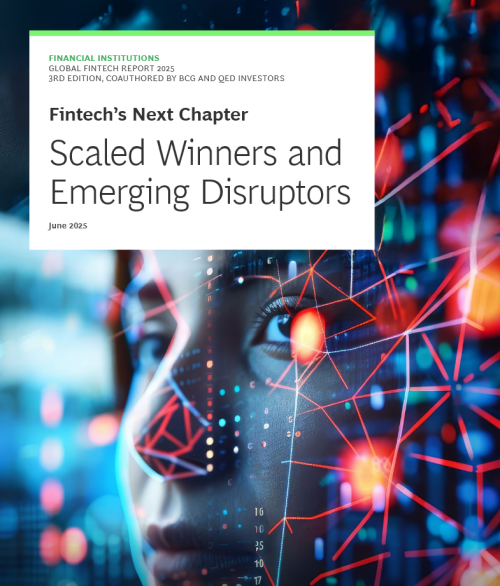
Image: Cover of Scaled Winners and Emerging Disruptors (June 2025, BCG and QED Investors)
The Boston Consulting Group (BCG) and QED Investors, just published a June 2025 report titled, "Fintech’s Next Chapter: Scaled Winners and Emerging Disruptors" (38 page PDF), highlighting that global fintech revenues rose 21% in 2024 compared to 6% for traditional financial institutions. That confirms fintech showed a strong rebound across sectors, accelerating from the prior year, after a couple of years of tightening capital markets and heightened regulatory scrutiny.
In 2024, fintechs generated $378 billion in revenue, while traditional banks and insurers earned $12.7 trillion. Fintechs have captured just 3% of this revenue, so 97% is still in the hands of incumbent financial institutions.
There are roughly 100 scaling fintechs earning over $500 million annually of which these 5 verticals dominate revenue generation:
These five sectors represent most of the $231 billion in scaled fintech revenue. Payments alone represent 55% of that total. Challenger banks and crypto platforms hold a smaller but growing share.
There are 150 global fintechs founded before 2016 that have raised over $500 million in equity and remain private. Many are waiting for improved conditions in the capital markets, such as Stripe and other scaling fintechs expecting to IPO
Fintech’s revenue share remains small across all verticals. Insurance accounts for less than 1% of fintech penetration. Deposits stand at just 2%. Lending, despite strong activity in personal loans and buy now pay later, accounts for only 3% of global lending revenues.
Agentic AI where AI powered systems are capable of logic and taking actions independently is a game changer. AI native fintechs have already gobbled up 49% of fintech equity funding yet only represent 23% of the sector.
Blockchain-based on-chain finance is also gaining traction. Tokenization of assets like bonds, private credit, and money market funds is growing at a double-digit rate. While tokenized asset volume remain under $1 trillion today, major institutions like Goldman Sachs and the European Investment Bank are piloting large-scale tokenization programs.
Private credit funds are also becoming essential to fintech lending models. With $1.7 trillion in assets under management, these funds are stepping in where traditional bank funding is constrained. The report estimates a $280 billion untapped opportunity for private credit participation in fintech-originated lending. In 2024 and early 2025, several billion-dollar forward flow deals were announced, including SoFi, Klarna, and Pagaya.
Fintech is rebounding and growing faster than traditional banks but has only unlocked 3% of global banking and insurance revenue, so the opportunity is still massive. Fintechs that can deliver sustainable growth, expand into new customer segments, and integrate new technologies like AI and tokenization will be well positioned to capture the next iteration of financial services tech.
The National Crowdfunding & Fintech Association (NCFA Canada) is a financial innovation ecosystem that provides education, market intelligence, industry stewardship, networking and funding opportunities and services to thousands of community members and works closely with industry, government, partners and affiliates to create a vibrant and innovative fintech and funding industry in Canada. Decentralized and distributed, NCFA is engaged with global stakeholders and helps incubate projects and investment in fintech, alternative finance, crowdfunding, peer-to-peer finance, payments, digital assets and tokens, artificial intelligence, blockchain, cryptocurrency, regtech, and insurtech sectors. Join Canada's Fintech & Funding Community today FREE! Or become a contributing member and get perks. For more information, please visit: www.ncfacanada.org
| | |
|---|---|---|
| | |
Fintech Data Research and Strategy | May 25, 2025

Image created by AI, Personas based on real data from 2024 Financial Lives, FCA
Four FCA personas reveal where fintech innovation must go next
On May 16, 2025, the Financial Conduct Authority (FCA) published one of the richest datasets ever on UK consumer financial behaviour, resilience, and preferences called, "Financial Lives 2024 survey". It's an annual snapshot taken ever 2-3 years and offers valuable benchmarks and insights into how financial institutions, fintechs and financial engineers can translate this data into strategy.
There are 18 excel sheets with various tabs covering survey responses for almost 1300 survey questions pertaining to a wide range of topics such as attitudes and product/service ownership of payments, retail banking, consumer investments, general insurance and protection, mortgages, credits and loans, assets and debts, cash savings, advice/guidance and pension. There's also tracker data tables for comparing and analyzing changes over time across 2017, 2020, 2020 and 2024 surveys.
Drawing directly from the FCA 2024 Financial Lives survey results, we created 4 personas that reveal who is underserved, gaps in the ecosystem, and where fintechs, banks, and credit unions should consider focusing on to rebuild trust and relevance.
Amira is a young adult struggling with inconsistent income from various gigs, rising living costs, and a heavy reliance on credit. She is digitally active but financially stretched and uncertain as to who she can trust. Survey data shows:
Fintechs should build real-time tools that show all credit and BNPL use in one place, including spending limits, that help users like Amira avoid taking on more debt than they can handle. Adding clear, user-led budgeting flows into existing BNPL workflows can help bridge shortfalls and help build trust with transparency.
Stella is an older consumer who likes to avoid debt, prefers analog channels, and feels underserved by digitally native services. She values trust and simplicity highly and struggles to access new tools. Survey data shows:
Financial institutions should consider creating hybrid formats that combine print materials with digital access points, such as QR codes linking to audio summaries. ESG and pension tools can be made more accessible with phone helplines and in-branch tutorials to help consumers who lack confidence to gain confidence and fill in comprehension gaps.
Rohan is a confident, digitally native, and actively manages savings, investments, and often finds himself switching providers to maximize value. He expects clarity, ESG transparency, and integrated experiences.
Rohan needs a unified dashboard that lets him integrate his finances across pension, savings, and ESG investments. Fintechs can lead here by offering smart comparison tools that verify impact metrics, automate vendor switching, and offer ESG guidance within the same experience.
John is a middle-aged adult that is juggling aging kids, debt, complex commitments, and low financial resilience. He is time-poor, questions everything, and is stuck with outdated, fragmented financial tools. The survey shows:
Institutions must prioritize credit and debt consolidation tools for this segment by offering personalized paths and support towards financial recovery. Embedding phone or online chat support into their digital journeys can help reduce friction, while demonstrating quick wins to build confidence and encourage engagement.
We've come up with the following table that matches the 4 personas with specific fintech strategies tailored to their behaviours, needs, and gaps, all based on the FCA's 2024 financial lives data, and to support product design, channel strategy, and business model decisions.
| Persona | Product Opportunity | Channel Strategy | Business Model Insight | Ecosystem Gap |
| Amira – Young Borrower | BNPL budgeting + affordability | Mobile-first, embedded in BNPL apps | Freemium with affiliate links to trusted debt tools | Risk-aware BNPL integrations |
| Stella – Conservative Saver | Print-to-digital ESG education | Branches, phone, community agents | Subscription or pay-per-use legacy planning tools | Print-digital pension guidance |
| Rohan – Digital Builder | ESG + switch optimizer dashboard | Self-serve, in-app investing hubs | B2C SaaS with optional robo-advice tier | ESG decision confidence |
| John – Overloaded Middle | Modular savings + credit coach | Web app + human phone fallback | Hybrid subscription + nonprofit partnership model | Blended digital advice models |
Each of the 4 personas created actually represents thousands of real individuals and their financial lives in 2024, caught between fragmented services and changing financial needs.
The profiles above are designed to help fintechs and institutions develop a targeted roadmap based on clearly defined, data-driven groups with targeted solutions, to help provide responsible and more inclusively designed financial products/services for underserved groups in need. A similar survey in Canada would probably produce similar results.
The National Crowdfunding & Fintech Association (NCFA Canada) is a financial innovation ecosystem that provides education, market intelligence, industry stewardship, networking and funding opportunities and services to thousands of community members and works closely with industry, government, partners and affiliates to create a vibrant and innovative fintech and funding industry in Canada. Decentralized and distributed, NCFA is engaged with global stakeholders and helps incubate projects and investment in fintech, alternative finance, crowdfunding, peer-to-peer finance, payments, digital assets and tokens, artificial intelligence, blockchain, cryptocurrency, regtech, and insurtech sectors. Join Canada's Fintech & Funding Community today FREE! Or become a contributing member and get perks. For more information, please visit: www.ncfacanada.org
| | |
|---|---|---|
| | |
Report | May 20, 2025
Image: Deloitte 2025 Gen Z and Millennial Survey
The 14th edition of the annual 2025 Deloitte Global Gen Z and Millennial Survey provides a global snapshot of generational attitudes towards work, money, technology and values, offering fintech founders, banks, credit unions, and policymakers core insights into what's driving the new economy and markets.
By 2030, Gen Z and millennials will represent nearly 75% of the global workforce. These generations are not just using financial technologies. They are building it, and reverse engineering what problems they should solve while establishing new expectations for how financial service tools operate.
The self-administered online survey data was collected from October 25 and December 24, 2024, gathering responses from a total of 23,482 respondents including 14,751 Gen Zs (born 1995 - 2006) and 8,731 millennials (born 1983 - 1994) across 44 countries, including regions such as North America, Latin America, Western Europe, Eastern Europe, the Middle East, Africa, and Asia-Pacific.
Young workers are very anxious about money.
- 48% of Gen Zs and 46% of millennials say they do not feel financially secure
- 52% of both groups live paycheck to paycheck, and over 33% struggle with basic monthly expenses
- 41% of Gen Zs and 44% of millennials are unsure whether they’ll be able to retire with financial comfort
These data points highlight the need for fintech products go well beyond basic budgeting dashboards. Gen Z and millennials need fintech tools to help them achieve financial resilience, such as income stabilization or smoothing, flexible savings tools, automated rent/bill buffers, and fair access to emergency funds. Financial service providers that can help reduce voltaility, and not just optimize credit scores, have an opportunity to earn trust and loyalty.
Adoption of generative AI tools is already a daily routine for young professionals.
- 57% of Gen Zs and 56% of millennials use GenAI tools in their daily work
- About 30% of each group use AI most or all of the time
- 74% of Gen Zs and 77% of millennials believe AI will significantly change how they work within the next year
These users are engaging with and building fintech products through an AI-first lens. They expect tools to respond in natural language, deliver almost instant relevant insights without friction, and adapt quickly. Static interfaces and dated workflows will lose ground quickly.
Fintech platforms in particular need to integrate GenAI not just in the back-end system but into product design and customer experience because these cohorts are fluent in AI which is quickly becoming the standard in how they source, think and consume.
Gen Z and millennials care less about climbing corporate ladders and more about doing work that aligns with their values.
- Only 6% of Gen Zs say their main career goal is to reach a leadership role
- 44% of Gen Zs and 45% of millennials have left jobs that lacked purpose
- 41% of Gen Zs and 40% of millennials have rejected employers due to ethical or values misalignment
For fintech employers, this creates both risk and opportunity. A strong mission with aligned values can attract high performers but the opposite will scare talent away quickly. To attract and retain the next generation of fintech talent, companies must offer more than good compensation. They need clear values, meaningful impact, and room for personal growth.
Formal degrees are no longer the default path into the fintech sector.
- 31% of Gen Zs and 32% of millennials chose not to pursue higher education.
- 70% of Gen Zs and 59% of millennials are building career skills at least once a week.
- The majority are doing this on their own time, outside of work hours.
There's more acceptance and shift now towards non-traditional education from bootcamps and peer networks to self-teaching, which has huge implications for hiring, funding, and human capital development. This means founders, operators and technical resources, may not originate from familiar backgrounds. Fintech leaders and investors need to adapt recruitment and due diligence models to focus more on traction, experience, and skills - and not just degrees.
Environmental and ethical values are a key part of how decisions are made.
- 65% of Gen Zs and 63% of millennials say they are willing to pay more for environmentally sustainable services
- 23% of Gen Zs and 22% of millennials have researched a company’s environmental practices before accepting a job offer
- Almost 50% say they’ve left or declined work that didn’t match their personal ethics
Social and environmental alignment is becoming a core user expectation, not a brand differentiator. Fintechs must design for transparency and shared impact from day one.
Fintech companies and financial institutions must design and deliver intelligent products with purpose and transparency that meet the moment of Gen Z and millennials who are under financial stress, fluent in AI, and prioritize values and ethics. The opportunity is to not just help these generations but to earn their trust and grow with them to create the next iteration of smart, modern, and purposeful finance.
The National Crowdfunding & Fintech Association (NCFA Canada) is a financial innovation ecosystem that provides education, market intelligence, industry stewardship, networking and funding opportunities and services to thousands of community members and works closely with industry, government, partners and affiliates to create a vibrant and innovative fintech and funding industry in Canada. Decentralized and distributed, NCFA is engaged with global stakeholders and helps incubate projects and investment in fintech, alternative finance, crowdfunding, peer-to-peer finance, payments, digital assets and tokens, artificial intelligence, blockchain, cryptocurrency, regtech, and insurtech sectors. Join Canada's Fintech & Funding Community today FREE! Or become a contributing member and get perks. For more information, please visit: www.ncfacanada.org
| | |
|---|---|---|
| | |
Digital Banking | May 9, 2025
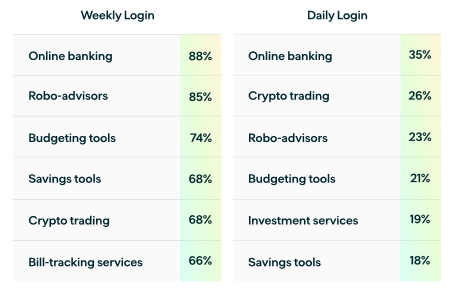
Image: Frequency of Use (Plaid x YouGov Money Talks survey report)
Between August 20-26th 2024, Plaid commissioned a national survey through the YouGov platform to understand how U.S. consumers bank, pay, and invest. The survey reveals insights of consumer preferences in digital finance, including trust in financial providers, app usage, payment methods, credit attitudes, and investment habits, based on weighted responses from 2,077 adults. Fintechs, digital finance platforms, and financial institutions need to stay up to date with the latest retail digital banking trends if they want to compete for consumer loyalty. Read 'Money Talks' (28 page PDF) report explaining these trends. Below we break-down key insights for NCFA's readers. Not yet subscribed? Sign-up for NCFA's weekly newsletter here.
Consumers continue to trust traditional banking institutions more than 100% digital platforms:
Trust and security go hand and hand, and overall, trust comes from perceived care and protection:
Consumers also shared who they rely on for financial well-being. The takeaway is that fintechs and advisory services must do more to be seen as helpful and caring, a useful partner in people’s financial lives.
Online banking is the most widely used financial tool: 99% percent of consumers are familiar with it, and 74% use it weekly.
Other commonly used tools include savings apps (68% weekly or daily), budgeting tools (85%), and peer-to-peer payment apps like Venmo or Zelle (used weekly by 50% of users). Roboadvisors are accessed more than once per week by (80%) of their users but only 1% of all consumers report using them regularly.
When asked what improvements they want most in financial apps:
60% of respondents said it is important to link their bank account with the financial apps they use.
Takeaway: Apps that are integrated, responsive, and secure are the most likely to be used often. Fintechs and banks that overcomplicate services or create friction in setup risk being overlooked, even if their offerings are advanced.
25% currently invest in cryptocurrency. Another 21% say they plan to invest in crypto or NFTs in the next year. These responder levels of engagement are equal to the 25% of people who say they will invest in stocks or trading platforms during the same period.
Crypto investors are not limiting their exposure:
Only 11% of respondents have used AI tools to support their investing decisions -> interestingly, this already exceeds the share of people using roboadvisors, suggesting that AI powered investment tools are gaining traction faster than traditional automated advice products.
Takeaway: Fintechs offering secure, easy to understand crypto access or AI investment tools can appeal to a growing investor base. Banks that avoid crypto are at risk of losing relevance with younger and self-directed investors.
Debit cards are now more commonly used than credit by younger adults. According to EY data cited in the report, 69% of Gen Z use debit cards daily or weekly. Many say they avoid credit cards because they do not want debt or do not qualify.
Buy now pay later (BNPL) services have grown 40% in usage since 2021.
Takeaway: Only 30% of respondents believe their credit score accurately reflects their financial health. 55% said they have been denied a loan due to a low score. These figures support growing interest in alternative data, such as cash flow and account history, for lending decisions.
Older adults are especially cautious. People aged 66 to 70 are 55% more likely to mistrust digital banks than those aged 22 to 25. Younger adults are more flexible. Among respondents aged 18 to 24, 36% said they would switch banks for a better digital payment experience.
Despite these trends, most people are not actively looking to change banks:
Consumers use different payment methods based on transaction size and age group:
To fund digital wallets:
Takeaway: Fintechs that want to increase adoption of pay by bank options must improve the experience. According to the report, 49% of users say they are likely to use pay by bank if the account linking process is easy.
Consumers want financial services that are clear, secure, and helpful, with trust remaining the most important factor in deciding whether to try a new app, share data, or switch banks. Traditional banks still hold an advantage in trust and reach but must modernize quickly. Fintechs have room to grow if they lead with transparency and value. Financial institutions that support financial goals and offer simple, connected experiences will stay relevant in 2025 (and beyond). Learn more about how consumers in the U.S. use, feel, bank, transact and acquire in 'Money Talks'.
The National Crowdfunding & Fintech Association (NCFA Canada) is a financial innovation ecosystem that provides education, market intelligence, industry stewardship, networking and funding opportunities and services to thousands of community members and works closely with industry, government, partners and affiliates to create a vibrant and innovative fintech and funding industry in Canada. Decentralized and distributed, NCFA is engaged with global stakeholders and helps incubate projects and investment in fintech, alternative finance, crowdfunding, peer-to-peer finance, payments, digital assets and tokens, artificial intelligence, blockchain, cryptocurrency, regtech, and insurtech sectors. Join Canada's Fintech & Funding Community today FREE! Or become a contributing member and get perks. For more information, please visit: www.ncfacanada.org
| | |
|---|---|---|
| | |


August 26th, 2025

January 4th, 2024

June 1st, 2021

September 9th, 2020

July 9th, 2018

January 3rd, 2018

September 25th, 2017

June 20th, 2017

May 10th, 2017

December 14th, 2016