




Karsten Wenzlaff, Advisor
August 26th, 2025
Karsten Wenzlaff is a Crowdfunding and Fintech Expert from Germany. He is Secretary-General of Digit[...]


Report | Jan 26, 2024

Image: BDO Digital
The report was based on scenario planning and opinion research with 500 business leaders and is a thought leadership framework to help businesses, especially those in the mid-market sector, with strategic planning amidst a world filled with uncertainty. BDO envisions that by 2026 there will be four distinct outcomes or 'worlds' that CEOs and leaders must grasp and mitigate to remain resilient in the years to come and the role that technology plays in shaping business success in all scenarios. A major finding is that technology, particularly AI, is seen as a critical enabler for business strategy. 81% of leaders say their organization will only survive with significant technological innovation, and every $1 of additional tech investment could boost revenue by over $18.
The analysis identifies two critical axes shaping future scenarios: technological progress (ranging from human to AI-dominated tech) and market conditions/business models (varying from collaboration to fragmentation). These axes lead to four potential business worlds: World Accelerated, World Sustained, World Fragmented, and World Divided, each with unique characteristics and implications for businesses.
This framework is primarily designed for business leaders, strategists, and planners, particularly in the mid-market sector. It serves as a guide to understanding how different technological and market conditions could shape the business environment. The Techtonic States framework presents four distinct scenarios for the future of business, each rooted in the interplay of technology progress and market conditions. These are:
By understanding and preparing for these four potential worlds, companies can strive to make more informed decisions, stay agile, and maintain a competitive edge while they try to get some sleep at night.
 The National Crowdfunding & Fintech Association (NCFA Canada) is a financial innovation ecosystem that provides education, market intelligence, industry stewardship, networking and funding opportunities and services to thousands of community members and works closely with industry, government, partners and affiliates to create a vibrant and innovative fintech and funding industry in Canada. Decentralized and distributed, NCFA is engaged with global stakeholders and helps incubate projects and investment in fintech, alternative finance, crowdfunding, peer-to-peer finance, payments, digital assets and tokens, artificial intelligence, blockchain, cryptocurrency, regtech, and insurtech sectors. Join Canada's Fintech & Funding Community today FREE! Or become a contributing member and get perks. For more information, please visit: www.ncfacanada.org
 |  |  |
|---|---|---|
 |  |  |
Crypto Report | Jan 24, 2024

Image: Cornerstone Research
As highlighted in a comprehensive report by Cornerstone Research (view release), in 2023, the U.S. Securities and Exchange Commission (SEC) intensified its regulatory oversight and enforcement of crypto reflecting a strategic prioritization of digital asset market regulation under the leadership of Chair Gary Gensler.
Gary Gensler's enforcement trend is likely to continue as the SEC maintains its focus on investor protection and market integrity. Crypto entities and investors must adapt to the emerging regulatory landscape to mitigate risks and ensure compliance.
The National Crowdfunding & Fintech Association (NCFA Canada) is a financial innovation ecosystem that provides education, market intelligence, industry stewardship, networking and funding opportunities and services to thousands of community members and works closely with industry, government, partners and affiliates to create a vibrant and innovative fintech and funding industry in Canada. Decentralized and distributed, NCFA is engaged with global stakeholders and helps incubate projects and investment in fintech, alternative finance, crowdfunding, peer-to-peer finance, payments, digital assets and tokens, artificial intelligence, blockchain, cryptocurrency, regtech, and insurtech sectors. Join Canada's Fintech & Funding Community today FREE! Or become a contributing member and get perks. For more information, please visit: www.ncfacanada.org
| | |
|---|---|---|
| | |
Survey Results | Jan 23, 2024

Image: Fast Company
The future and capitalism and its' impact on a rapidly changing economic and environmental reality has become a central topic of discussion among global leaders and business professionals. Recent insights from the World Economic Forum's annual meeting in Davos and a comprehensive survey by Fast Company shed light on these pressing issues, revealing a complex landscape of challenges and opportunities.
The survey, which included responses from a diverse range of professionals, found that only 36% had a positive reaction to capitalism, while 35% viewed it negatively. This ambivalence points to an existential crossroads for capitalism, highlighting the need for a more inclusive and equitable economic system.

A notable shift observed in the survey is the growing favorability towards stakeholder capitalism. Defined as a system where companies prioritize the interests of various stakeholders including employees, customers, suppliers, and local communities, stakeholder capitalism received a favorable view from 41% of respondents.
This approach, championed by leaders like Larry Fink of BlackRock and Brian Moynihan of Bank of America, suggests a paradigm shift towards a more holistic view of business success.

Image: Fast Company
The survey also revealed a generational divide in perceptions of capitalism. Younger professionals under 40 are more likely to view capitalism negatively (26%) compared to their older counterparts (8%). This trend underscores the urgency for businesses to adapt to the evolving expectations of a younger, more socially conscious workforce. Businesses must embrace stakeholder capitalism to address the growing concerns over income inequality and environmental sustainability. Simultaneously, the global community must prioritize and mobilize financial resources for climate action.
At Davos 2024, despite the critical importance of climate change and environmental risks, discussions on climate finance were notably subdued. As reported by Nina Seega in Forbes, the focus remained on theoretical aspects rather than concrete financial strategies. This gap highlights a significant challenge in addressing the climate crisis: the need for substantial funding to transition to clean technologies and adapt to climate impacts.
The political climate of 2024, with major elections worldwide, adds complexity to the climate finance debate. Political leaders' stances on climate issues will significantly influence the direction and effectiveness of climate action. The need for real change, as emphasized at Davos, requires substantial financing and a collective effort from global leaders.
The survey uncovered diverse and strong opinions regarding the future of capitalism. Participants were asked to identify what they perceived as the greatest threat to capitalism, leading to a wide array of responses. These ranged from concerns over far-left politics, diversity, equity, and inclusion (DEI) initiatives, media influence, the rise of artificial intelligence, governmental policies, to the inherent nature of greed.
Some participants even viewed capitalism itself as problematic. A notable consensus emerged around the issue of income inequality, with at least 13% of respondents highlighting it or related challenges as significant threats to the stability and effectiveness of the capitalist system.
In conclusion, the insights from Fast Company's survey and Davos 2024 emphasize the need for a reimagined approach to capitalism, one that is more inclusive, equitable, and responsive to the challenges of our time.
The generational divide in perceptions of capitalism, especially the skepticism among younger professionals, underscores the urgent need for businesses to align with the values of a socially conscious workforce. This includes addressing concerns over income inequality and environmental sustainability.
The National Crowdfunding & Fintech Association (NCFA Canada) is a financial innovation ecosystem that provides education, market intelligence, industry stewardship, networking and funding opportunities and services to thousands of community members and works closely with industry, government, partners and affiliates to create a vibrant and innovative fintech and funding industry in Canada. Decentralized and distributed, NCFA is engaged with global stakeholders and helps incubate projects and investment in fintech, alternative finance, crowdfunding, peer-to-peer finance, payments, digital assets and tokens, artificial intelligence, blockchain, cryptocurrency, regtech, and insurtech sectors. Join Canada's Fintech & Funding Community today FREE! Or become a contributing member and get perks. For more information, please visit: www.ncfacanada.org
| | |
|---|---|---|
| | |
Report | Jan 18, 2024

Image: CCAF and WEF, 2024 Future of Global Fintech Report
The 2024 Global Fintech Report - Towards Resilience and Inclusive Growth, a collaboration between the World Economic Forum and the Cambridge Centre for Alternative Finance, unveiled at Davos 2024 pivotal insights into the fintech industry's trajectory, marked by resilience, innovation, and transformative growth. This comprehensive analysis, based on a survey of 227 fintech firms, offers a key look into consumer trends, regulatory dynamics, and technological advancements shaping the future of financial technology.
The fintech sector has shown continued growth in the post-COVID era, with an average customer growth rate exceeding 50% across all business models surveyed with insurtech leading the pack at 66% (2021-2022). Custromer growth exceeded 50% across all regions (2021-2022) except SSA (Sub-Saharan Africa). The top 3 sources for acquiring customers was through social media (70%), referrals (68%), and website (65%).
The top challenges faced when trying to scale customer demand to new customer segments were customer education (51%), competition (43%), and compliance and regulation (34%) - see table below. This robust expansion highlights the sector's resilience and the accelerating global shift towards digital financial services.
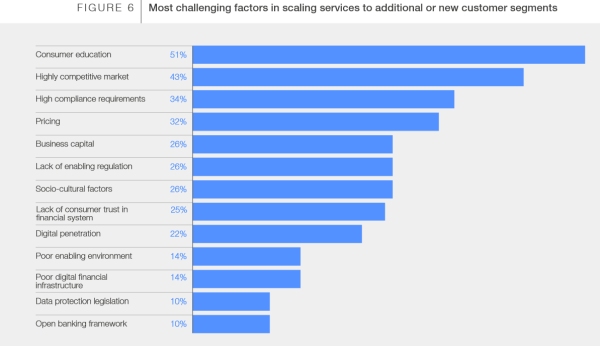
CCAF and WEF 2024 Global fintech report challenges in scaling customer growth
While 63% of fintechs view their regulatory environment as adequate, challenges persist in compliance, licensing, and registration processes. The report emphasizes the necessity of regulatory frameworks that balance innovation encouragement with consumer protection.

CCAF and WEF 2024 Global fintech report perceptions of regulatory environment
Overall, the greatest challenges faced by fintechs were in licensing, registration, and authority coordination. These areas received the most negative ratings, particularly in emerging markets and developing economies (EMDEs), where licensing posed a significant challenge. Additionally, fintechs critical of an 'excessive and overly restrictive' regulatory environment generally gave lower ratings across all regulatory aspects.

CCAF and WEF 2024 Global fintech report ratings of key regulatory aspects
Artificial Intelligence (AI) is earmarked as a game-changer for the fintech industry, with 70% of surveyed firms acknowledging its significance in shaping the industry's next five years. This highlights the crucial role of technology in driving future fintech developments.
Fintechs are increasingly focusing on underserved segments, promoting financial inclusion. The report notes a significant portion of fintechs in emerging markets are dedicated to providing services to these groups, addressing key societal issues like gender disparity and sustainability.

CCAF and WEF 2024 Global fintech report fintechs targeting underserved groups
Traditional banks have historically focused on lending to specific customer segments, mainly those with a formal financial history and living in urban areas. This approach has often excluded low-income individuals, particularly in Emerging Markets and Developing Economies (EMDEs), from accessing essential financial services and products.
Fintechs, leveraging digital technology and mobile phone adoption, have significantly widened the availability and affordability of financial services. They hold the potential to reach the further 1.4 billion unbanked and many more underbanked people globally.
Fintechs are increasingly serving traditionally underserved groups, including women, low-income individuals, and rural or remotely located customers. These segments represent a substantial portion of fintech customer bases globally, averaging 39% for female customers, 40% for low-income, and 27% for rural or remotely-located customers. This approach contributes significantly to the growth of their customer bases.
These underserved segments also contribute notably to fintechs' total transaction values, with 39% from female, 26% from low-income, and 31% from rural or remote customers. This trend is consistent across Advanced Economies (AEs) and EMDEs, with some disparities. For instance, AEs report a higher proportion of female customers, while EMDE fintechs serve more low-income and rural customers.
The United Nations Secretary-General's task force on digital finance has identified fintech companies as key players in accelerating the financing of the Sustainable Development Goals (SDGs). Adopted by the UN in 2015, the SDGs aim to address poverty and other social issues. Fintechs are increasingly incorporating the UN SDGs into their business strategies, becoming agents for catalyzing sustainable finance and fostering a green, inclusive economy.

CCAF and WEF 2024 Global fintech report SDG links, AEs vs EMDEs
The findings of the 2024 Global Fintech Report highlights the sector's resilience and growth potential and also underscores the critical role of consumer demand, regulatory frameworks, and technological innovation in shaping an inclusive and sustainable financial landscape. Fintechs are not just transforming the financial sector; they are playing a crucial role in promoting financial inclusion.
By targeting underserved segments, they are helping bridge the gap left by traditional banking services, offering a more equitable and environmentally sustainable financial landscape. This inclusive approach is essential for building a more financially empowered global population, particularly in regions with significant unbanked and underbanked communities. Fintechs' focus on inclusion is a vital step towards a more inclusive and equitable global financial ecosystem.economy.
The National Crowdfunding & Fintech Association (NCFA Canada) is a financial innovation ecosystem that provides education, market intelligence, industry stewardship, networking and funding opportunities and services to thousands of community members and works closely with industry, government, partners and affiliates to create a vibrant and innovative fintech and funding industry in Canada. Decentralized and distributed, NCFA is engaged with global stakeholders and helps incubate projects and investment in fintech, alternative finance, crowdfunding, peer-to-peer finance, payments, digital assets and tokens, artificial intelligence, blockchain, cryptocurrency, regtech, and insurtech sectors. Join Canada's Fintech & Funding Community today FREE! Or become a contributing member and get perks. For more information, please visit: www.ncfacanada.org
| | |
|---|---|---|
| | |
AI | Jan 16, 2024

Source: IMF
The International Monetary Fund (IMF) has raised significant concerns about the impact of Artificial Intelligence (AI) on global employment. According to a recent IMF report analysis, nearly 40% of jobs worldwide could be disrupted by AI. This trend, as IMF chief Kristalina Georgieva notes, is likely to deepen inequality and requires immediate attention from governments worldwide.
The IMF's analysis indicates that the effects of AI on employment will be more pronounced in advanced economies, with up to 60% of jobs potentially impacted. This is particularly concerning for white-collar jobs, which are seen as more vulnerable to AI disruption than manual labor. In contrast, emerging markets and lower-income nations might face different challenges, including a lack of infrastructure and skilled workforce to leverage AI effectively.
While AI poses significant challenges, it also offers opportunities for enhancing productivity and economic growth. Georgieva acknowledges that AI could boost global GDP by 7% annually over a decade, as estimated by Goldman Sachs economists. This dual nature of AI – as both a disruptor and an enabler – underscores the need for balanced and thoughtful policy responses.
While we've all heard about AI and job disruption or personally know someone impacted for a while now, we can all expect this trend to scale. The IMF's report is a wake-up call across the board.
The National Crowdfunding & Fintech Association (NCFA Canada) is a financial innovation ecosystem that provides education, market intelligence, industry stewardship, networking and funding opportunities and services to thousands of community members and works closely with industry, government, partners and affiliates to create a vibrant and innovative fintech and funding industry in Canada. Decentralized and distributed, NCFA is engaged with global stakeholders and helps incubate projects and investment in fintech, alternative finance, crowdfunding, peer-to-peer finance, payments, digital assets and tokens, artificial intelligence, blockchain, cryptocurrency, regtech, and insurtech sectors. Join Canada's Fintech & Funding Community today FREE! Or become a contributing member and get perks. For more information, please visit: www.ncfacanada.org
| | |
|---|---|---|
| | |
Report and Analysis | Jan 15, 2024

Challenge | Jan 12, 2024

Image by jcomp on Freepik
The Financial Consumer Agency of Canada (FCAC) has once again opened the doors to its prestigious "Building Better Financial Futures Challenge" for 2024. This challenge, a beacon of innovation and thought leadership in the financial sector, invites post-secondary students to contribute actionable, evidence-based solutions to financial challenges faced by vulnerable communities. The 2024 edition promises to build on the success of its predecessors, fostering a new wave of ideas and strategies to enhance financial literacy and inclusion across Canada.
The 2024 Building Better Financial Futures Challenge, hosted by the Financial Consumer Agency of Canada (FCAC), invites post-secondary students to engage in research and develop papers focusing on one of three priorities under the theme “Catalyze Action”. These priorities are:
This challenge presents a unique opportunity for students to contribute to the field of financial literacy and consumer protection, with the potential for their work to be recognized and utilized by a broader audience.
The selected papers from last year's challenge showcased a diverse range of ideas, all aimed at improving financial literacy and preparedness among various demographics in Canada.
Last year's winners set a high bar for creativity and practicality. Their contributions not only addressed immediate financial challenges but also laid down pathways for long-term improvements in financial well-being and consumer protection.
In conclusion, the Building Better Financial Futures Challenge is not just about finding winners; it's about nurturing ideas that can shape a more financially inclusive and literate society. As we look forward to the innovative submissions of 2024, NCFA Canada remains dedicated to supporting and celebrating the efforts of these bright minds.
Their contributions are crucial in paving the way towards a financially literate and inclusive Canada, where every individual has the knowledge, skills, and confidence to make responsible financial decisions.
The National Crowdfunding & Fintech Association (NCFA Canada) is a financial innovation ecosystem that provides education, market intelligence, industry stewardship, networking and funding opportunities and services to thousands of community members and works closely with industry, government, partners and affiliates to create a vibrant and innovative fintech and funding industry in Canada. Decentralized and distributed, NCFA is engaged with global stakeholders and helps incubate projects and investment in fintech, alternative finance, crowdfunding, peer-to-peer finance, payments, digital assets and tokens, artificial intelligence, blockchain, cryptocurrency, regtech, and insurtech sectors. Join Canada's Fintech & Funding Community today FREE! Or become a contributing member and get perks. For more information, please visit: www.ncfacanada.org
| | |
|---|---|---|
| | |


August 26th, 2025

January 4th, 2024

June 1st, 2021

September 9th, 2020

July 9th, 2018

January 3rd, 2018

September 25th, 2017

June 20th, 2017

May 10th, 2017

December 14th, 2016