




Karsten Wenzlaff, Advisor
August 26th, 2025
Karsten Wenzlaff is a Crowdfunding and Fintech Expert from Germany. He is Secretary-General of Digit[...]


AI Report | Jan 10, 2024

Accenture 2024 Tech Vision Human by design
Accenture's Technology Vision 2024, titled "Human by Design" (or read the full 90 page PDF report) presents a compelling future where technology becomes increasingly human-centric. This vision is not just a futuristic concept but a tangible reality that is reshaping businesses and personal lives.
AI Becoming More Human: AI is evolving to reason and interact in more human-like ways, transforming from a tool for automation to an agent of augmentation. Generative AI and transformer models, like ChatGPT and Bard, are making technology more intuitive and accessible, democratizing specialized knowledge and skills. 95% of executives agree that making technology more human will massively expand opportunities across industries. 'A Match Made in AI' The transformation of business search models to more intuitive AI-driven advisors.
Spatial Computing: A new spatial computing medium is emerging, bridging the digital and physical worlds, and reflecting human presence in digital spaces. 'The Space We Need' The growth of spatial computing technology and its applications.
Understanding Human Intent: Technologies are getting better at understanding human intent, reducing the friction between human-machine interactions. 'Meet My Agent' The rise of AI agents capable of acting autonomously, demanding appropriate human oversight.
Human-Centric Design: The focus is shifting towards creating technology that is intuitive by design, demonstrating human-like intelligence, and integrating seamlessly into our lives. 'Our Bodies Electronic' Advances in technologies like eye-tracking and brain-computer interfaces (BCI) for deeper human understanding.
Morning Routine:
6:30 AM: Wake-Up with AI Personal Assistant
7:00 AM: Smart Home Interaction
7:30 AM: AI-Driven Financial Optimization
Commute:
8:00 AM: AI-Optimized Commuting
9:00 AM: Decentralized Professional Network
12:00 PM: Smart Contract Lunch Orders
Afternoon Tasks:
2:00 PM: AI-Powered Investment Trading and AI Learning
4:00 PM: Blockchain Health Data Management
Evening Leisure:
6:00 PM: Smart Shopping
7:30 PM: Decentralized Social Media and NFT-Based Entertainment
Night:
9:00 PM: AI-Enhanced Personal Finance Review
10:00 PM: AI Sleep Optimization and Token Rewards
In future day in the life of a millennial like Alex is seamlessly integrated with AI and human-centric technologies. This scenario, inspired by Accenture's Technology Vision 2024, showcases a future where technology is designed with a deep understanding of human needs and behaviors, making life more intuitive, efficient, and enjoyable.
From personalized health and productivity enhancements to immersive entertainment and learning experiences, technology will continue to transform and integrate with every aspect of daily life.
 The National Crowdfunding & Fintech Association (NCFA Canada) is a financial innovation ecosystem that provides education, market intelligence, industry stewardship, networking and funding opportunities and services to thousands of community members and works closely with industry, government, partners and affiliates to create a vibrant and innovative fintech and funding industry in Canada. Decentralized and distributed, NCFA is engaged with global stakeholders and helps incubate projects and investment in fintech, alternative finance, crowdfunding, peer-to-peer finance, payments, digital assets and tokens, artificial intelligence, blockchain, cryptocurrency, regtech, and insurtech sectors. Join Canada's Fintech & Funding Community today FREE! Or become a contributing member and get perks. For more information, please visit: www.ncfacanada.org
 |  |  |
|---|---|---|
 |  |  |
WealthTech | Jan 9, 2024

Image: Unsplash/Morgan Housel
The wealth management industry is witnessing several key and game-changing innovations that are shaping its landscape in 2024. Here's a summary of the most significant trends and developments.
One of the most significant trends is the integration and expansion of WealthTech platforms. Altruist, for instance, has added new integrations with various portfolio accounting, CRM, analytics, and financial planning software. This expansion is not just enhancing the capabilities of wealth management firms but also making them more efficient and versatile.
2024 also witnesses a shift in how wealth technology firms approach funding. Apex Fintech Solutions' move to file for an IPO represents a significant development. This could lead to more rapid innovation in the sector, as public market funding offers a new avenue for growth and development in wealth technology.
The launch of Tokenbridge, a distributed ledger technology startup, is a development to watch. This technology could revolutionize asset and data management in the wealth and fund management industries, offering more secure and efficient transaction and data management systems.
Addepar's achievement of tracking $5 trillion in assets signifies the growing importance and capability of wealth management platforms in handling large-scale asset management efficiently. This milestone reflects the industry's increasing reliance on technology for asset tracking and management.
Direct indexing and actively managed ETFs are changing the competitive landscape in investment management. These innovations offer more personalized investment options, catering to the evolving needs of investors who seek more control and customization in their investment strategies.
The industry is also seeing a shift towards customer-centricity in investment vehicles and portfolios. Understanding the target investor and offering diverse investment options tailored to their preferences is becoming increasingly important. This approach is predicated on knowing the types of investments investors want and how they prefer to interact with their investments and investment managers.
Deloitte's report adds several critical dimensions to our understanding of the wealth management landscape in 2024:
Firms are expected to invest in technology and associated controls to meet client expectations and achieve internal efficiency goals, even amid weak performance and margin pressures. However, there's a consistent decline in the percentage of firms expecting a large increase in tech spending in key areas like AI and Cybersecurity (see Figure 3 below).
There is a growing trend towards theme-driven portfolio construction, offering new avenues for product development.
The implementation of generative AI is transforming customer interactions, requiring collaboration across various organizational domains. Yet, see: Can AI Truly Replace Human Financial Advisors?
Quantum computing technologies are being considered for revenue generation, but they also pose cybersecurity threats that need to be addressed.
Aligning the workforce with the firm’s sense of purpose is becoming crucial for navigating organizational changes, leading to improvements in efficiency, productivity, and collaboration.
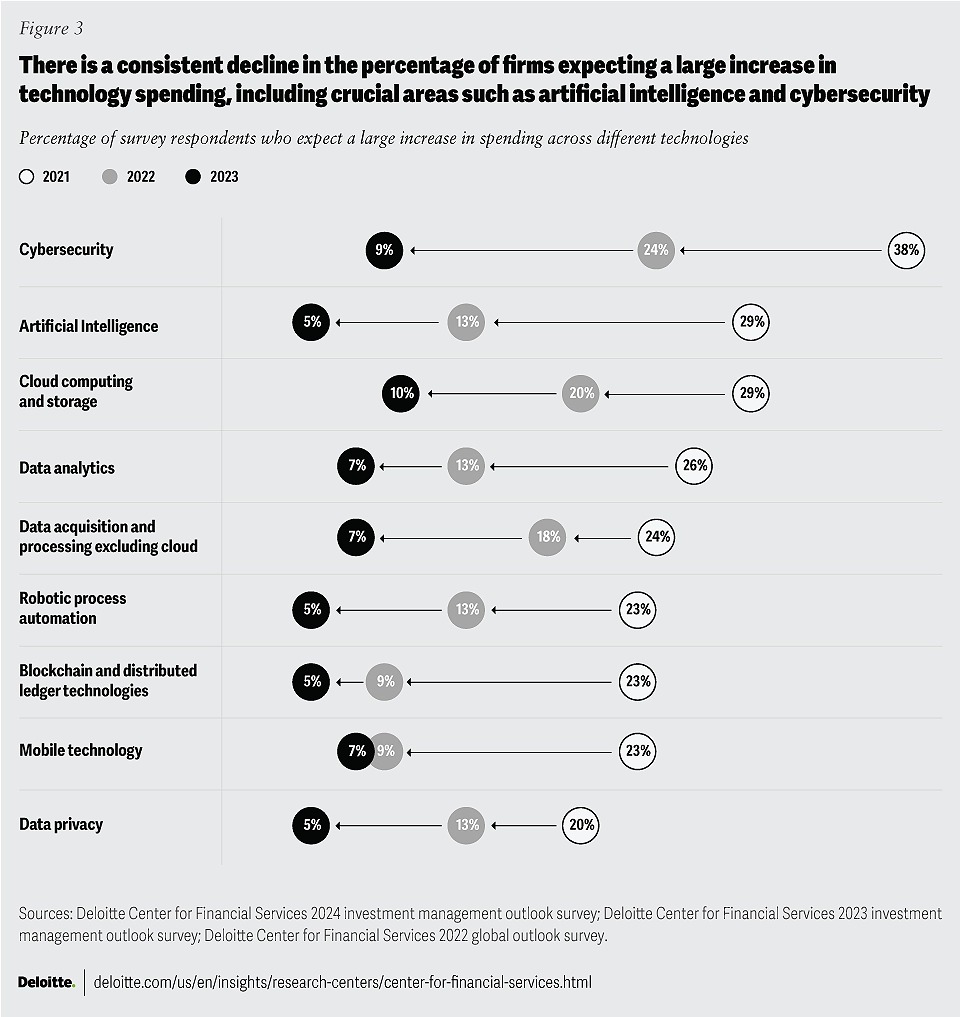
Image: Deloitte, Center for Financial Services, 2024 Investment Outlook
Clients primarily seek financial advisors due to time constraints, the complexity of investing, or for validation of their choices. They value personalization, convenience, and efficiency in financial planning.
Investors want more decision-making tools, future scenario visualization, and active participation. They prefer a partnership role in their advisory meetings.
There is a growing demand for visually engaging, credible digital experiences. Advisors recognize the importance of meeting these expectations to build trust through transparency and investor education.
The use of technology as a solution in addressing these challenges enhances transparency, enables proactive communication, and provides better access to data and proposals, all crucial for building trust.
The wealth management industry in 2024 is characterized by a blend of technological innovation, a deeper understanding of investor needs, and a strategic approach to organizational and operational challenges. From the integration of WealthTech platforms to the advent of quantum computing and AI, these developments are reshaping the industry, setting new standards for efficiency, personalization, and security in wealth management.
The National Crowdfunding & Fintech Association (NCFA Canada) is a financial innovation ecosystem that provides education, market intelligence, industry stewardship, networking and funding opportunities and services to thousands of community members and works closely with industry, government, partners and affiliates to create a vibrant and innovative fintech and funding industry in Canada. Decentralized and distributed, NCFA is engaged with global stakeholders and helps incubate projects and investment in fintech, alternative finance, crowdfunding, peer-to-peer finance, payments, digital assets and tokens, artificial intelligence, blockchain, cryptocurrency, regtech, and insurtech sectors. Join Canada's Fintech & Funding Community today FREE! Or become a contributing member and get perks. For more information, please visit: www.ncfacanada.org
| | |
|---|---|---|
| | |
Report | Release | Jan 9, 2024

The Subcommittee on Digital Assets and Blockchain Technology of the U.S. Commodity Futures Trading Commission's Technology Advisory Committee (TAC) has released a 79 page PDF report titled Decentralized Finance (DeFi) with the following key findings and recommendations to shine a light and develop a deeper understanding of DeFi and its regulatory implications to balance innovation with market integrity and consumer protection (see Ooki vs CFTC)
The report emphasizes the need for policymakers to deepen their technical understanding of DeFi. This involves mapping out data, expertise, and resources to grasp the economic structure and technological nuances of DeFi. A gap analysis is recommended to identify and address critical capability gaps, ensuring that regulatory bodies are equipped to understand and oversee the DeFi landscape effectively.
A thorough survey of the existing regulatory framework is crucial. This step will determine whether DeFi products and services fall within the current U.S. financial regulatory scope and identify any regulatory gaps.
The report also suggests evaluating international regulatory approaches to DeFi, fostering a global perspective on regulatory standards and practices.
The identification of risks, including operational, technical, and security vulnerabilities, is a key focus. The report highlights the importance of understanding risks related to liquidity, over-leverage, market manipulation, and illicit finance. Prioritizing these risks will enable policymakers and industry players to address the most pressing challenges first, ensuring a safer DeFi ecosystem.
The report advocates for the evaluation of potential policy responses, ranging from disclosure requirements and regulatory reporting to governance regulation. It also suggests considering activity restrictions and resolution planning, aiming to establish a robust regulatory framework that can adapt to the evolving nature of DeFi.
Collaboration with domestic and international standard setters, regulatory bodies, and DeFi builders is highlighted as a critical step. This approach aims to foster a constructive dialogue and shared understanding among all stakeholders.
Engaging in open communication and policy coordination within the regulatory community is seen as vital for developing effective and harmonized regulatory strategies.
The CFTC "Decentralized Finance Report" provides a comprehensive framework for understanding and regulating DeFi. It emphasizes the need for increased knowledge, risk assessment, regulatory clarity, and collaborative efforts between policymakers and industry leaders.
This report is a key step towards bridging the gap between emerging financial technologies and established regulatory practices, ensuring a balanced approach that fosters innovation while safeguarding the financial system and its consumers.
The National Crowdfunding & Fintech Association (NCFA Canada) is a financial innovation ecosystem that provides education, market intelligence, industry stewardship, networking and funding opportunities and services to thousands of community members and works closely with industry, government, partners and affiliates to create a vibrant and innovative fintech and funding industry in Canada. Decentralized and distributed, NCFA is engaged with global stakeholders and helps incubate projects and investment in fintech, alternative finance, crowdfunding, peer-to-peer finance, payments, digital assets and tokens, artificial intelligence, blockchain, cryptocurrency, regtech, and insurtech sectors. Join Canada's Fintech & Funding Community today FREE! Or become a contributing member and get perks. For more information, please visit: www.ncfacanada.org
| | |
|---|---|---|
| | |
Foreign Direct Investment | Jan 5, 2024

Image: CGR FDI Trends 3rd Edition
Global Competition Review recently published their annual global overview of Key FDI Trends called "Foreign Direct Investment Regulation Guide - Third Edition" edited by Veronica Roberts provides a comprehensive look at the evolving landscape of foreign direct investment (FDI) regulation.
FDI regulation has become increasingly significant in recent years, especially in the context of unstable economic conditions. Despite high FDI flows, there is a trend towards greater protectionism and stricter enforcement due to heightened geopolitical tensions and the need to keep strategic industries onshore.
There is a shift towards stricter scrutiny in policy frameworks for screening inward foreign investment, especially in strategic sectors, directly impacts fintech and alternative finance. This is evident in several high-profile deals that have been blocked, unwound, or abandoned due to FDI regulatory concerns. This trend underscores the importance of early identification of potential FDI screening issues in transaction planning.
FDI screening authorities are becoming more active, both in terms of the number of notifications received and in monitoring non-notified transactions. This increased activity can impact M&A activity, as mandatory filing obligations may dissuade some investors.
The scope of sectors and technologies considered under the concept of national security in FDI regulation has broadened. It now includes critical infrastructure, communications assets, advanced technology, and data. The rise in protectionist policies, partly accelerated by the COVID-19 pandemic, could influence the flow of capital in alternative finance. While this might foster domestic investments, it could also limit the scope for international fundraising and partnerships, challenging the growth of global crowdfunding platforms and peer-to-peer lending services.
The broadening of the national security concept makes it difficult for investors to confidently assess the risk of government intervention under FDI rules. However, some guidance is available, such as the US President's Executive Order issued in September 2022, which provides a framework for evaluating transactions.
Technological innovations in fintech and blockchain are often at the forefront of FDI discussions. The dual-use nature of these technologies, serving both economic and potential military applications, places them under intense scrutiny. Companies in these sectors must be prepared to address security concerns to attract foreign investments.
Businesses in fintech, blockchain, and alternative finance must stay abreast of regulatory changes globally. This involves not only compliance but also active engagement in policy discussions to shape a favorable regulatory environment.
Diversifying investment sources can mitigate risks associated with geopolitical tensions and economic nationalism. Exploring new markets and investor bases can provide stability and growth opportunities.
Data is king. Robust data security and privacy measures can make fintech and blockchain ventures more attractive to cautious investors.
Forming alliances with domestic and international partners can help navigate the complex FDI environment. This approach can facilitate knowledge exchange, regulatory compliance, and access to broader markets.
The "Foreign Direct Investment Regulation Guide - Third Edition," edited by Veronica Roberts, offers an essential exploration of the increasingly complex world of FDI. In today's environment, marked by heightened geopolitical tensions and economic uncertainties, FDI regulation plays a pivotal role, especially in sectors like fintech, blockchain, cryptocurrency, and alternative finance.
The guide underscores the growing importance of understanding and navigating the expanded scope of national security within FDI regulation, which now encompasses a wide range of sectors and technologies. For businesses operating in fintech and blockchain, this means grappling with dual-use technologies (civilian and military) and ensuring robust data security to attract foreign investments.
The National Crowdfunding & Fintech Association (NCFA Canada) is a financial innovation ecosystem that provides education, market intelligence, industry stewardship, networking and funding opportunities and services to thousands of community members and works closely with industry, government, partners and affiliates to create a vibrant and innovative fintech and funding industry in Canada. Decentralized and distributed, NCFA is engaged with global stakeholders and helps incubate projects and investment in fintech, alternative finance, crowdfunding, peer-to-peer finance, payments, digital assets and tokens, artificial intelligence, blockchain, cryptocurrency, regtech, and insurtech sectors. Join Canada's Fintech & Funding Community today FREE! Or become a contributing member and get perks. For more information, please visit: www.ncfacanada.org
| | |
|---|---|---|
| | |
Funding Report | Jan 4, 2024

SEC Advocate of Small Business Capital Raising 2023 report
Understanding the nuances of seed fundraising in the United States is crucial for entrepreneurs and investors alike. At the National Crowdfunding & Fintech Association (NCFA) Canada, we recognize the significance of these early-stage investments as a cornerstone for innovation and growth.
From the dizzying highs of record-breaking deal values to the more tempered climate of today, the seed stage has mirrored the venture life cycle's ebbs and flows. However, despite these fluctuations, the U.S. continues to present a fertile environment for seed-level investments.
| Year | H1 Deal Value (Billion $) | H2 Deal Value (Billion $) | H1 Deal Count | H2 Deal Count |
|---|---|---|---|---|
| 2018 | $5.4 | $4.3 | 2,230 | 2,223 |
| 2019 | $5.0 | $5.1 | 2,287 | 3,490 |
| 2020 | $5.6 | $5.9 | 3,328 | 3,209 |
| 2021 | $8.8 | $9.8 | 2,585 | 2,386 |
| 2022 | $14.0 | $10.0 | 1,982 | 1,980 |
| 2023* | $6.6 | N/A | 1,810 | N/A |
*Data for 2023 is as of June 30.
U.S. Private companies raised $662 billion through private securities exemptions as of June 30, 2023. This represents 39% of the total capital raised year to date. An additional $1 trillion or 61% was raised by U.S public companies.
Here's a more detailed breakdown of the $662 billion by exemption type:
Regulation Crowdfunding has emerged as a vital pathway for capital raising, particularly for small businesses, women founders, founders of color, and companies located outside traditional investment centers. Its impact on the capital formation landscape is marked by its contribution to diversity and geographical inclusivity.
2020: 137 counties
2021: 220 counties
2022: 273 counties

Image: SEC Small Business Advocate 2023 Annual Report - Regulation Crowdfunding by State
Total Capital Commitments in 2022 was $506.7 Million (down 10.2% from 2021)
Average Investor Check Size was $1,578
Average Raise Per Campaign in 2022 was $428,486 (down 5.9% from 2021)
71.5% of offerings in 2022 exceeded their minimum funding targets
28.5% of offerings in Q3 2022 had at least one woman founder
70% of the capital was distributed outside the top 10 capital hubs
25.2% of offerings in Q3 2022 had at least one founder of color
In this climate, entrepreneurs are encouraged to explore a variety of funding sources, including crowdfunding, angel investors, and early-stage venture funds. The current climate favours startups with sustainable, long-term growth strategies, pushing entrepreneurs to build more resilient and adaptable business models. This environment has spurred the development of more robust support systems for early-stage companies, including incubators, accelerators, and mentorship programs.
The period leading up to 2022 saw a surge in deal values, reflecting an investor confidence that propelled startups to new heights. However, this trend has since normalized, aligning with a more cautious investment approach in the face of global economic uncertainties.
Seed investors are broadening their horizons, with a wider geographical reach between companies and lead investors. This expansion signifies a growing openness to exploring opportunities beyond traditional tech hubs, a boon for startups situated in less prominent locations.
The path from seed to Series A funding has become more arduous, with a notable increase in the time taken for this transition. This change underscores the need for seed-stage companies to demonstrate more robust business models and clearer paths to profitability.
The expanding geographical reach of seed investors and the growing importance of Regulation Crowdfunding underscore a diverse and inclusive funding landscape. For startups, the emphasis is on building sustainable, adaptable business models that can withstand the challenges of transitioning from seed to Series A funding. The insights gained from this year's funding trends are invaluable for stakeholders aiming to thrive in this ever-evolving ecosystem.
The National Crowdfunding & Fintech Association (NCFA Canada) is a financial innovation ecosystem that provides education, market intelligence, industry stewardship, networking and funding opportunities and services to thousands of community members and works closely with industry, government, partners and affiliates to create a vibrant and innovative fintech and funding industry in Canada. Decentralized and distributed, NCFA is engaged with global stakeholders and helps incubate projects and investment in fintech, alternative finance, crowdfunding, peer-to-peer finance, payments, digital assets and tokens, artificial intelligence, blockchain, cryptocurrency, regtech, and insurtech sectors. Join Canada's Fintech & Funding Community today FREE! Or become a contributing member and get perks. For more information, please visit: www.ncfacanada.org
| | |
|---|---|---|
| | |
Stablecoins | Jan 3, 2024

Image: Artemis Terminal, Stablecoin Volume by Chain
According to Artemis Terminal, Solana-based USDC was the most transacted stablecoin for the week Dec 19-24, 2023, with a staggering $103 billion in transfers. This milestone marks the first time Solana has surpassed Ethereum in stablecoin volume, with Ethereum following at $90.9 billion. Tron and BNB Chain trail behind with $82.3 billion and $14.6 billion, respectively.
Notably, Solana-based USDC has also eclipsed Tron-based USDT in terms of transaction volume. This surge was (potentially) fueled by alleviating concerns regarding FTX's potential liquidation of its SOL holdings and the growing adoption of the network.
BREAKING: @solana FLIPS @ethereum IN 7-DAY STABLECOIN TRANSFER VOLUME FOR THE FIRST TIME IN HISTORY - BREAKS $100 BILLION pic.twitter.com/oEcwSLZuBX
— DEGEN NEWS 🗞️ (@DegenerateNews) January 2, 2024
Google Search Traffic - The Defiant also reports a notable shift in Google search trends. For the first time, worldwide searches for "Solana" have surpassed those for "Ethereum." This shift in public interest is a testament to the growing curiosity and engagement with Solana's ecosystem.
Solana's robust performance in 2023, coupled with its increasing adoption and public interest, positions it as a formidable player in the blockchain space and one to watch.
The National Crowdfunding & Fintech Association (NCFA Canada) is a financial innovation ecosystem that provides education, market intelligence, industry stewardship, networking and funding opportunities and services to thousands of community members and works closely with industry, government, partners and affiliates to create a vibrant and innovative fintech and funding industry in Canada. Decentralized and distributed, NCFA is engaged with global stakeholders and helps incubate projects and investment in fintech, alternative finance, crowdfunding, peer-to-peer finance, payments, digital assets and tokens, artificial intelligence, blockchain, cryptocurrency, regtech, and insurtech sectors. Join Canada's Fintech & Funding Community today FREE! Or become a contributing member and get perks. For more information, please visit: www.ncfacanada.org
| | |
|---|---|---|
| | |
IP Innovation and Strategy | Dec 20, 2023

Image: Yunan Huang, CEIPI, Masters of IP Law and Management
In FinTech, two giants stand out and are worth of deep comparison: Apple Pay and Alipay. For both of these platforms, Intellectual Property (IP) has been instrumental in shaping their business models and strategic approaches. This article compares the two approaches, drawing insights from a research project conducted by Yanan Huang, a graduate of the Master of Intellectual Property Law and Management at CEIPI, University of Strasbourg.
Launched in 2014, Apple Pay has become a cornerstone of Apple's FinTech offerings and offers a simple yet secure transaction method. It leverages Near Field Communication (NFC) technology, which has been the subject of numerous patents. Apple's focus on making transactions secure and seamless has driven its innovation and patent applications in this area. Its business model, as detailed in the research, is built around providing customers with a trustworthy payment option. This is achieved through strategic partnerships with vendors and banks, leveraging Apple's premium brand and IP rights. The Business Model Canvas for Apple Pay highlights its value proposition of security and convenience, which has been a significant factor in gaining customer trust.
Apple places a strong emphasis on security and privacy, which is critical in the financial sector. Patents related to secure authentication methods, encryption, and data protection are a significant part of Apple's IP strategy. Technologies like Touch ID and Face ID, which have applications in financial transactions, are underpinned by a robust patent portfolio.
The Apple Card, a credit card offering created in partnership with Goldman Sachs, showcases Apple's interest in expanding its financial services. The integration of Apple Card with Apple Pay and the Wallet app involves patented technologies that enhance user experience and security.
Beyond just payment processing, Apple Wallet allows users to store and manage digital versions of tickets, boarding passes, and loyalty cards. The technology behind this digital wallet, including its integration with other Apple services, is protected by a range of patents.
Apple continues to explore innovations in payment technologies, including peer-to-peer payment systems and contactless payments through Apple Pay Cash and potentially in areas like cryptocurrency and digital wallets.
In summary, while Apple may not be a FinTech company in the traditional sense, its influence in this sector, driven by its IP strategy and innovative payment technologies, is significant. Apple's foray into financial services with products like Apple Pay and Apple Card, backed by a strong patent portfolio, underscores its role as a key player in the global FinTech landscape.
Alipay is not just a payment service; it's part of a larger ecosystem that includes e-commerce, cloud computing, and other financial services like insurance and investment products. Patents related to the integration of these services ensure a seamless user experience and strengthen the ecosystem. Alipay's slogan, "EVERYTHING, IMMEDIATE, EVERYWHERE," encapsulates its approach.
Alipay's core service is digital payments, and the company holds numerous patents related to online payment technologies. These include patents for secure transaction processing, QR code payments, biometric verification methods like facial recognition, and more.
Ant Group has been a pioneer in applying blockchain technology to financial services. They have developed and patented several blockchain solutions aimed at enhancing the efficiency, transparency, and security of financial transactions. This includes patents for blockchain-based cross-border payment systems and supply chain financing solutions.
Alipay leverages AI and big data analytics to improve user experience and security. Their patents in this area include fraud detection algorithms, credit scoring models, and personalized financial product recommendations, all of which are crucial for maintaining the integrity and competitiveness of their platform.
The research project also sheds light on the marketing strategies of both platforms. Apple Pay focuses on three pillars: Apple Wallet, Apple Pay, and Apple Card, promoting these services across physical, digital, and social media channels. In contrast, Alipay's TechFin ecosystem includes payment, insurance, financial planning, lending, trading, investment, data analysis, and security services, including blockchain technology.
From a FinTech perspective the research concludes that Alipay seems to have an edge over Apple Pay. It operates independently from Alibaba, aiming to encapsulate a complete FinTech ecosystem, whereas Apple Pay is more of a complementary service within Apple's broader product range. Market-wise, both platforms dominate in their respective domestic markets but face challenges in international expansion. Apple Pay's single-service approach contrasts with Alipay's comprehensive range of financial services.
Beyond intellectual property, key players have a multi-pronged approaches to their business model and strategic positioning. Ultimately, companies must execute efficiently and manage evolving market, geopolitical, and regulatory risks to remain on top, including:
-> Continuous investment in research and development is key to staying ahead in the FinTech patent race. These companies invest heavily in exploring new technologies and their applications in finance.
-> Companies like Alibaba and PayPal process billions of transactions, providing them with vast amounts of data. This data is crucial to garnish insights and develop new financial technologies and services.
-> These leaders do not just focus on one aspect of FinTech but explore, innovate, and operate across diverse dimensions like payment processing, cybersecurity, blockchain, and AI, ensuring a broad and impactful patent portfolio.
-> Many of these companies actively acquire startups with promising technologies or collaborate with other industry players to expand their technological capabilities.
-> Having a global footprint allows these companies to understand and innovate according to the diverse needs of different markets, making their patents more globally relevant.
-> Understanding and navigating the complex regulatory environments in different regions is crucial for FinTech innovation. These leaders are adept at aligning their patent strategies with regulatory requirements.
While Apple Pay capitalizes on the strength of Apple's brand and its secure, user-friendly payment service, Alipay's comprehensive ecosystem approach, backed by robust technology and a wide range of services, sets a different standard in the industry. Which company will emerge as the dominant force in the future of FinTech, Apple Pay or Alipay, and why? In what ways can new players in the FinTech space leverage IP to challenge the dominance of established giants?
The National Crowdfunding & Fintech Association (NCFA Canada) is a financial innovation ecosystem that provides education, market intelligence, industry stewardship, networking and funding opportunities and services to thousands of community members and works closely with industry, government, partners and affiliates to create a vibrant and innovative fintech and funding industry in Canada. Decentralized and distributed, NCFA is engaged with global stakeholders and helps incubate projects and investment in fintech, alternative finance, crowdfunding, peer-to-peer finance, payments, digital assets and tokens, artificial intelligence, blockchain, cryptocurrency, regtech, and insurtech sectors. Join Canada's Fintech & Funding Community today FREE! Or become a contributing member and get perks. For more information, please visit: www.ncfacanada.org
| | |
|---|---|---|
| | |


August 26th, 2025

January 4th, 2024

June 1st, 2021

September 9th, 2020

July 9th, 2018

January 3rd, 2018

September 25th, 2017

June 20th, 2017

May 10th, 2017

December 14th, 2016