




Karsten Wenzlaff, Advisor
August 26th, 2025
Karsten Wenzlaff is a Crowdfunding and Fintech Expert from Germany. He is Secretary-General of Digit[...]


Brookings Institute | Feb 27, 2025

Image: Freepik/rawpixel.com
North American trade is at a critical juncture, and businesses need to be ready. The USMCA (United States-Mexico-Canada Agreement) or CUSMA (Canadian-United-States-Mexico Agreement as it's known in Canada) is expected to be reviewed in July 2026, and new U.S. tariff threats are adding uncertainty.
This hybrid event "USMCA Forward 2025 launch" is on March 5, 2025 is being hosted by the Brookings Institute a leading think tank in Washington, D.C. known for its comprehensive research on economic and global policy issues. The event will bring together experts to discuss the future of trade between Canada, the U.S., and Mexico and help Canadian businesses, investors, and policymakers understand what’s coming next and how to prepare.
📅 Date: Wednesday, March 5, 2025
🕜 Time: 1:30 PM – 4:00 PM EST
📍 Location: The Brookings Institution, Washington, D.C. (Attend in person or online)
🔗 RSVP to attend in person or watch the webcast
Topics include:
President Trump has announced new tariffs on imports from Canada and Mexico, including a 25% tariff on most goods and a 10% tariff on Canadian energy exports, starting March 4, 2025. However, there are signs the tariffs could be pushed back (again) to April 2, 2025, depending on ongoing negotiations. This decision comes after months of uncertainty. Canada and Mexico have warned they will respond with their own tariffs, raising concerns about a possible trade war.
For further background on the risks of tariffs and their impact on Canadian businesses, check out:
Register to attend in person or watch the free webcast
Questions can be submitted to panelists via email to events@brookings.edu
This is an important event to watch for anyone involved in North American trade.
 The National Crowdfunding & Fintech Association (NCFA Canada) is a financial innovation ecosystem that provides education, market intelligence, industry stewardship, networking and funding opportunities and services to thousands of community members and works closely with industry, government, partners and affiliates to create a vibrant and innovative fintech and funding industry in Canada. Decentralized and distributed, NCFA is engaged with global stakeholders and helps incubate projects and investment in fintech, alternative finance, crowdfunding, peer-to-peer finance, payments, digital assets and tokens, artificial intelligence, blockchain, cryptocurrency, regtech, and insurtech sectors. Join Canada's Fintech & Funding Community today FREE! Or become a contributing member and get perks. For more information, please visit: www.ncfacanada.org
 |  |  |
|---|---|---|
 |  |  |
Crypto | Feb 24, 2025

Image: Freepik/rawpixel.com
On February 21, 2025, Dubai-based Bybit, the second largest cryptocurrency exchange globally, suffered a staggering hack of $1.4 billion of Ethereum in one of the largest crypto heists to date. Credit to Bybit for their swift response within 72 hours, Bybit successfully restored its reserves to a 1:1 ratio, ensuring full backing of all customer assets. A fresh independent audit from cybersecurity firm Hacken confirmed the reserves, demonstrating Bybit’s resilience and strong industry partnerships is reassuring investors during this crisis.
Blockchain forensics firm Arkham Intelligence traced the exploit back to North Korea’s Lazarus Group, a well known cybercriminal organization tied to numerous crypto heists. Investigators linked this latest attack to Lazarus through a series of wallet addresses connected to prior hacks. High profile blockchain analyst ZachXBT contributed key insights that mapped the movement of stolen funds and identified suspicious test transactions leading up to the breach. According to Chainalysis, the Lazarus Group was responsible for 61% of all stolen crypto in 2024 (over $1.3 billion in digital assets).
Hackers took advantage of a weakness in Bybit’s system during a routine transfer of funds from its offline "cold wallet" to its online "warm wallet" for transactions. They intercepted the process and redirected approx 401,000 Ethereum to an unknown address. Bybit later explained that the attack was highly advanced that used deceptive techniques to manipulate the transactions approval system which made the fraudulent withdrawals seem legitimate. Some experts believe phishing tactics may have been involved.
Ben Zhou, Bybit's CEO quickly reassured users that all funds remain secure and that the exchange has enough reserves to absorb the loss. He stressed that customer assets are backed 1:1 and announced an aggressive $140 million bounty for anyone who can help recover the stolen funds. Arkham Intelligence had already placed a $30,000 reward on identifying the perpetrators, which helped lead to the Lazarus connection.
Bybit was able to replenish its reserves in record time through strategic partnerships with crypto firms like Galaxy Digital, FalconX, and Wintermute, along with support from Bitget, MEXC and DWF Labs.
The exchange completed a fresh audit just yesterday February 23, 2025, led by an independent third-party cybersecurity firm Hacken who confirmed that Bybit successfully restored reserves to a 1:1 ratio within 72 hours of the attack indicating that the exchange has sufficient reserves to fully back all users. The audit covered 40 different asset types and key holdings such as BTC, ETH, SOL, USDT, and USDC.
Ben Zhou, Co-founder and CEO of Bybit:
"Bybit fully backs all customer assets entrusted to our platform, maintaining a dynamic ratio of over 1:1. We are fortunate to have all-weather friends in a cut-throat industry—our peers and even competitors stood with us during challenging times, and our customers deserve the same level of commitment".
Bybit is strengthening its security protocols and working with international law enforcement to track the stolen funds. However, recovering stolen digital assets from North Korean hackers is notoriously difficult because, unlike other hacking groups, Lazarus operates under a government that has no incentive to cooperate with global authorities. This reality is the stolen $1.4 billion of Ethereum will likely be laundered and channelled into funding North Korean activities unless it can be recovered.
The National Crowdfunding & Fintech Association (NCFA Canada) is a financial innovation ecosystem that provides education, market intelligence, industry stewardship, networking and funding opportunities and services to thousands of community members and works closely with industry, government, partners and affiliates to create a vibrant and innovative fintech and funding industry in Canada. Decentralized and distributed, NCFA is engaged with global stakeholders and helps incubate projects and investment in fintech, alternative finance, crowdfunding, peer-to-peer finance, payments, digital assets and tokens, artificial intelligence, blockchain, cryptocurrency, regtech, and insurtech sectors. Join Canada's Fintech & Funding Community today FREE! Or become a contributing member and get perks. For more information, please visit: www.ncfacanada.org
| | |
|---|---|---|
| | |
Fintech Ranking | Feb 20, 2025

Image: 2025 Forbes Fintech 50 (Illustration by Óscar Raña for Forbes)
Every year, Forbes publishes their annual ranking of the top Fintech companies. Checkout the Forbes Fintech 50 in 2025, showing fintech companies that continue to grow despite pressure on company valuations and a slowdown in investment in the sector. According to the judges who select and rank the top 50 at Forbes, this year there's been a rise of business-t0-business fintechs, as well as the increasing importance of fraud prevention and financial security companies.
| Category | Total Funding ($M) | # Companies |
| Payments | 4482 | 11 |
| Personal Finance | 3812 | 8 |
| Business to Business Banking | 3794 | 11 |
| Wall Street and Enterprise | 1892 | 9 |
| Insurance | 1742 | 4 |
| Blockchain and Cryptocurrencies | 1670 | 3 |
| Real Estate | 508 | 2 |
| Investing | 265 | 2 |
More than half of the companies on the list provide fintech services to other businesses rather than consumers. Categories like Payments and B2B Banking are seeing strong growth as businesses turn to fintechs to automate and improve their operations, reduce costs and streamline regulatory challenges. Fintech goes well beyond innovative consumer digital banking, it's morphing into improving financial systems at scale. Wall Street & Enterprise fintechs are also playing an outsized role in modernizing financial infrastructure at the institutional level.
The chart below illustrates the number of fintech companies in each category, emphasizing the dominance of business-focused fintechs:

Image: Total # of Fintech Companies by Category (Forbes Fintech 50, 2025)
The chart below shows the total funding received by fintech category, showing which categories are bucking the trend despite the downturn.

Total Funding by Fintech Category Forbes Fintech 50, 2025
Payments fintechs still lead the pack with over $4.4 billion in total funding. This aligns with their critical role in powering e-commerce and digital transactions worldwide.
In the early 2020s, fintech companies focused on rapid growth but times have changed and they are now after profitability and sustained growth. This year, 13 companies on the list reported official profits (up from just eight last year). Investors and businesses alike are prioritizing financial health over unchecked expansion.
Even though global fintech funding fell from $144 billion in 2021 to $34 billion in 2024, most companies on this year’s Forbes Fintech 50 have shown resilience. Major players like Stripe and Ramp have adapted by pivoting, reducing costs while focusing on efficiency.
As digital transactions increase so do fraud risks. Security based fintechs are gaining traction as businesses need stronger protections against cyber threats and fraud. DataVisor, a company that uses advanced machine learning to detect fraudulent transactions experienced a 67% increase in revenue in 2024, reaching $50 million.
Companies like Arc, Aven, and Imprint have made their way onto this year’s list, showing that the lending market is regaining investor confidence. Nova Credit, for example, previously fell off the list but re-emerged this year with a renewed focus on cash flow underwriting and a fresh approach to risk assessment.
While much can be argued about the methodology of actually being selected for the Forbes Fintech 50 list. To be honest there are several significant Canadian fintechs that should be on the list but aren't for whatever reason, such as Wealthsimple. But Relay made it so something to cheer about.
They are a Toronto-based digital banking platform for small businesses and provide financial management tools that integrate with accounting software, making it easier for businesses to manage their money. In 2024, they raised $32.2 million in a Series B funding round, strengthening their market position and offerings.
Here’s a closer look at a couple of standout fintech firms within each category:
The 2025 Forbes Fintech 50 shows the race for scale is now about profitability with payments, security, infrastructure, and B2B services leading the way. For Canada, Relay’s presence on the list is promising but begs the question, why aren’t more Canadian fintechs on the list?
The National Crowdfunding & Fintech Association (NCFA Canada) is a financial innovation ecosystem that provides education, market intelligence, industry stewardship, networking and funding opportunities and services to thousands of community members and works closely with industry, government, partners and affiliates to create a vibrant and innovative fintech and funding industry in Canada. Decentralized and distributed, NCFA is engaged with global stakeholders and helps incubate projects and investment in fintech, alternative finance, crowdfunding, peer-to-peer finance, payments, digital assets and tokens, artificial intelligence, blockchain, cryptocurrency, regtech, and insurtech sectors. Join Canada's Fintech & Funding Community today FREE! Or become a contributing member and get perks. For more information, please visit: www.ncfacanada.org
| | |
|---|---|---|
| | |
Crypto | Feb 18, 2025

Image: Freepik/natanaelginting
As widely reported, Argentina’s President Javier Milei is facing a political crisis after promoting a cryptocurrency called LIBRA, which rocketed in value before suddenly collapsing nearly 97% within hours, however insiders cashed out millions ahead of the collapse, resembling a classic 'rug pull' scam. The fallout has led to financial losses for thousands of investors, triggering lawsuits, political backlash, and calls for Milei’s impeachment.
Milei's administration claims he was unaware of the project’s details but opposition leaders argue that his promotion directly fuelled speculation and losses. With over 100 legal complaints filed at Argentina’s Supreme Court and lawmakers demanding Milei answer questions before Congress, the crisis is deepening.
On February 14, 2025, Milei tweeted to his 3.8 million followers, promoting LIBRA as a private initiative to fund small businesses. His endorsement triggered a viral price surge that pushed the token’s market cap to $4.56 billion within minutes.
Behind the scenes however, eight wallets linked to the LIBRA team quietly withdrew $107 million in liquidity, and automated trading bots linked to insiders also bought the token at $0.38 and sold at peak prices generating millions in minutes. Everything signalled that this was an orchestrated exit. Panic spread and LIBRA plummeted from $4.97 to $0.19 within hours, wiping out 74% of investor funds.
Milei deleted his post at 10:38 PM, claiming he had “obviously no connection” to the project and was not familiar with its details. However, critics noted that he had met with the project’s backers just weeks before the launch. By midnight Feb 15 the crash was complete.
After the collapse more than 100 legal complaints were filed at Argentina’s Supreme Court accusing Milei of participating in a fraudulent scheme. Opposition lawmakers estimate 40,000 investors suffered financial losses with some losing up to $100,000. The scandal even rocked Argentina's stock arket with the Merval index dropping 5.6% on February 17. Calls for Milei's impeachment grew louder with former President Cristina Kirchner branding him a "crypto fraudster".
Two companies were behind LIBRA which were largely unknown in the crypto sector before launching the project.
Milei has ordered an internal investigation but critics argue that it's a political maneuver to deflect responsibility. Argentina’s Supreme Court is investigating whether Milei was involved in the scam or simply made a mistake. If found guilty, he could be impeached or face criminal charges, which could further weaken Argentina’s already unstable economy.
Aside Update: Decrypt reports that Binance founder Changpeng Zhao (CZ) has since donated 150 BNB (about $60,000 USD) to help people who lost money in the $LIBRA scam. While the donation offers some relief, it still only represents a small part of the total losses.
The National Crowdfunding & Fintech Association (NCFA Canada) is a financial innovation ecosystem that provides education, market intelligence, industry stewardship, networking and funding opportunities and services to thousands of community members and works closely with industry, government, partners and affiliates to create a vibrant and innovative fintech and funding industry in Canada. Decentralized and distributed, NCFA is engaged with global stakeholders and helps incubate projects and investment in fintech, alternative finance, crowdfunding, peer-to-peer finance, payments, digital assets and tokens, artificial intelligence, blockchain, cryptocurrency, regtech, and insurtech sectors. Join Canada's Fintech & Funding Community today FREE! Or become a contributing member and get perks. For more information, please visit: www.ncfacanada.org
| | |
|---|---|---|
| | |
Enforcement | Feb 6, 2025

Image: Freepik AI
The U.S. federal Office of the Public Affairs announced on February 3, 2025 that a Canadian citizen, Andean Medjedovic, has been formally indicted for allegedly exploiting vulnerabilities in decentralized finance platforms KyberSwap and Indexed Finance, stealing approx. $65 million from investors.
Medjedovic was originally a math prodigy from the city of Waterloo, Ontario who graduated from high school at 14 and achieved a math degree from prestigious University of Waterloo by 17. He later became a cybersecurity expert and participated in hacking competitions including Code4rena where he won prizes.
The indictment says that between 2021 and 2023, Medjedovic exploited smart contract vulnerabilities in KyberSwap and Indexed Finance. He borrowed large amounts of digital tokens and then manipulated the automated trading systems into allowing unauthorized withdrawals at artificially low prices, leaving investors with worthless assets.
Authories claim that Medjedovic laundered the stolen funds using various techniques like crypto swap transactions, cross-chain bridge transfers, and crypto mixers all to obscure the sources of funds. Then in November 2023, he attempted to extort control of the KyberSwap platform by offering to return only 50% of the stolen funds in exchange for full control.
Medjedovic faces wire fraud, unauthorized damage to a protected computer, attempted extortion, money laundering, and money laundering conspiracy. If convicted he could face up to 20 years in prison for the charges with up to an additional 10 years for hacking related crimes.
According to a Cointelegraph article, authorities believe he is on the run. In 2021, he failed to appear in a Canadian court regarding the Indexed Finance hack, and reports suggest that he has travelled across Europe and South America and was last known to be living on an undisclosed island.
For more details you can read the full indictment here.
The National Crowdfunding & Fintech Association (NCFA Canada) is a financial innovation ecosystem that provides education, market intelligence, industry stewardship, networking and funding opportunities and services to thousands of community members and works closely with industry, government, partners and affiliates to create a vibrant and innovative fintech and funding industry in Canada. Decentralized and distributed, NCFA is engaged with global stakeholders and helps incubate projects and investment in fintech, alternative finance, crowdfunding, peer-to-peer finance, payments, digital assets and tokens, artificial intelligence, blockchain, cryptocurrency, regtech, and insurtech sectors. Join Canada's Fintech & Funding Community today FREE! Or become a contributing member and get perks. For more information, please visit: www.ncfacanada.org
| | |
|---|---|---|
| | |
Tariffs | Feb 3, 2025

Image: Freepik/kjpargeter
*Update Feb 3: Canada-US Agree to 30 Day Pause on Tariffs
On February 1, 2025, U.S. President Donald Trump announced sweeping tariffs on Canada, Mexico, and China to begin February 4, 2025. The White House claims that the move was necessary to offset illegal drug trafficking (specifically fentanyl) and stop illegal immigration crossings at the U.S. North and South borders. Trump framed the tariffs as a national security emergency under the International Emergency Economic Powers Act (IEEPA), which grants the President authority to regulate international commerce in response to national emergencies. Trump’s executive order alleges that Canada has a growing presence of drug labs producing fentanyl and that Mexican cartels are operating within Canada’s borders, claims that Ottawa has denied.
The new U.S. tariffs include:
Hours after the U.S. tariffs were announced, Prime Minister Justin Trudeau announced a $155 billion Canadian tariff package imposing retaliatory 25% tariffs on $30 billion worth of U.S. goods, effective immediately February 4, with a second round of $125 retaliatory tariffs to take effect in the following 21 days. See list of U.S. products subject to 25% tariffs
An article from CSIS points out that Canada is the largest supplier of minerals to the U.S. ($47 billion USD in 2023) like uranium, aluminum, and nickel which are key to defense, nuclear energy, and manufacturing sectors. The U.S is trying to reduce it's reliance on China's minerals for national and economic security and Canadian tariffs on these goods would cost U.S. buyers billions more.
Also note that the Canadian government is offering a remission process, which allows businesses to request relief from paying tariffs or to receive a refund for tariffs already paid, if a business can prove it can’t source the goods from Canada or other countries and that the tariffs would cause serious harm to operations or the Canadian economy. Businesses must submit detailed evidence, and exemptions will only be granted in exceptional cases.
In a strong speech, Trudeau condemned the tariffs as "reckless, unjustified, and an attack on one of America’s closest allies." He reminded Americans that Canada has stood beside the U.S. in every major conflict for over 150 years and accused Trump of “putting political games ahead of economic stability.” He also announced that Canada would explore legal action under the USMCA and the WTO.
The U.S. is Canada’s largest trading partner, buying 77% of Canada’s total exports. New tariffs will raise costs, cut jobs, and put massively disrupt impacted sectors. Financial markets immediately dropped on the news of an imminent trade war.
Canada needs to offset the economic damage, keep trade moving and avoid long-term financial instability.
The researchers at Scotiabank published these facts about 'getting up to speed with Canada-U.S. trade', which tells Canada's trade story:
Canada is a trading country. In fact, 67% of Canada's economy comes from trade. That's far more than the U.S. (24%) or even China (37%). Canada represents only 2% of the world’s GDP but punches above its weight handling 2.5% of global trade. So when trade slows down, it hurts Canada's economy and makes us more vulnerable.
Canada exported in total:
$768 billion CAD of goods (things like cars, metals, and oil)
$197 billion CAD of services (such as banking, technology, and consulting)
It means that most of Canada’s trade is physical goods while services are still a growing part of the economy. Canadian businesses that rely on exports like cars, metals, oil, manufacturing will be hit with higher costs to sell into U.S.markets which makes Canadian products less competitive (more expensive) which hurts sales and leads to job losses, production cuts and slower economic growth. Canada and the U.S. are deeply integrated with many raw materials passing the borders multiple times before finalizing the production of a good.
As you might expect, Canada's energy (oil) is currently the country's largest export, totalling $174 billion CAD in 2023 (18% of all exports). Without exporting energy/oil, Canada's trade deficit would be massive. Oil, gas, and electricity sales keeps thousands of jobs alive and brings in crucial government revenue.
Energy represents 18% of total trade—removing it would cause a serious economic hit at the moment. In 2023, Canada bought more from other countries than it sold, leading to a trade deficit of $13.1 billion CAD. However if we exclude selling energy to other countries like the U.S. Canada's trade deficit in 2023 would jump to $187 billion CAD, showing that Canada leans on its energy sector to balance trade.
U.S. tariffs on Canadian oil and gas will increase prices for U.S. consumers at the gas pump and shrink demand for Canadian energy, cutting billions from the economy. It means lower revenue for the government which could lead to reduced spending in other sectors like healthcare, infrastructure or innovation.
The U.S. is Canada’s biggest customer who buys 77% of all our Canadian exports. No other country is that reliant on the U.S. China the second largest customer of Canadian exports buys less than 5%. U.S.-Canada trade accounted for 19% of Canada's total Gross Domestic Product in 2023.
One major concern is the potential exodus of companies currently operating/manufacturing in Canada who decide to move operations to the U.S. to avoid tariff taxes. Canada should diversify export markets to sell goods and services to reduce the reliance on the U.S.
Here's a chart from the Council on Foreign Relations:

Canada and Mexico rely on the US (Council foreign relations)
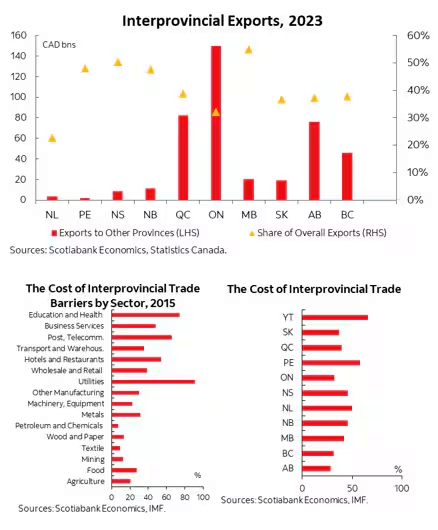
Image: Interprovincial Exports Canada 2023 (Scotiabank / IMF)
Canadian provinces don’t trade with each other as much as they should. Internal trade was $418 billion CAD in 2023, but it hasn’t kept pace with international trade growth. Utilities face a 91% trade barrier and healthcare faces 74%. A 2019 IMF study called 'Internal Trade in Canada: A Case for Liberalization" found that provinces face an inter-provincial trade barrier equivalent to a 21% tariff!
Today, internal trade only makes up 36% of Canada's overall trade which is down from 55% in the early 1980s. If U.S. tariffs hit companies hard they will look to sell more within Canada but internal red tape and varying provincial regulations makes it more difficult. The government should work to remove interprovincial trade barriers to support a team Canada approach.
Foreign investors once saw Canada as a top destination but investment trends are changing. While Foreign Direct Investment (FDI) in Canada grew 425% since 2000, the sources of that investment have changed. FDI from the U.S. dropped from 61% to 45% as a total of Canada's FDI.
On the other hand, FDI from Europe and Asia has grown since 2000:
But to put it in perspective, see the 2022, notable FDI positions in Canada by comparing dollar values:
Also worth noting is that Canada's key investment sectors are shifting. In 2011, energy, mining, and manufacturing attracted 92% of total FDI but by 2023 the same sectors fell and attracting 68% of total FDI with transportation and services seeing the fastest growth. Canada needs to continue to attract FDI from non-U.S. allied countries and also adjust for any sector by sector shifts.
Tariffs will make it harder for Canadian export businesses selling to the U.S., especially key export sectors like auto, oil/energy, and manufacturing who will feel near immediate pressure, job losses and production cuts. Businesses should actively explore various strategies to mitigate the impact of these tariffs, such as seeking alternative suppliers, renegotiating contracts, adjusting supply chains, and considering price adjustments.
Canada also faces shrinking U.S. investment in Canada while capital from Europe and Asia is rising, representing new opportunities and markets to focus on and grow. Countries like the Netherlands, Switzerland, and the U.K. are increasing their investments in Canada. If the Canadian government makes it easier (i.e. removing unnecessary regulatory barriers) and more attractive for investors (i.e., better tax incentives and policy support), businesses will have better access to funding and the economy will be stronger and more resilient.
The National Crowdfunding & Fintech Association (NCFA Canada) is a financial innovation ecosystem that provides education, market intelligence, industry stewardship, networking and funding opportunities and services to thousands of community members and works closely with industry, government, partners and affiliates to create a vibrant and innovative fintech and funding industry in Canada. Decentralized and distributed, NCFA is engaged with global stakeholders and helps incubate projects and investment in fintech, alternative finance, crowdfunding, peer-to-peer finance, payments, digital assets and tokens, artificial intelligence, blockchain, cryptocurrency, regtech, and insurtech sectors. Join Canada's Fintech & Funding Community today FREE! Or become a contributing member and get perks. For more information, please visit: www.ncfacanada.org
| | |
|---|---|---|
| | |
Jan 29, 2025

Photo by Pixabay
Companies today are locking horns with cybercriminals in a high-stakes game of cat and mouse, where a single misstep can mean losing control of sensitive data and watching operations go off the rails. While ransomware attacks and data breaches can be menacing, effective countermeasures are emerging to counter these perils.
No one wants their hard work ruined by a cyber landmine. But take that anxiety off the table with a secure network, and you'll be amazed at how much further you can stretch your business goals, no longer held back by that gnawing uncertainty. Does the thought of a data breach keep you up at night? Secure networking practices can put your mind at ease. Here's how to implement them and safeguard your business.
Every business is only as strong as its digital shield. A solid secure networking system encompasses robust tools, agile strategies, and battle-tested practices to defend against the latest cyber threats.
Picture a secure fortress safeguarding your most valuable assets from cyber threats, lurking malware, and sly intruders. A secure network is the invisible force that keeps your business humming along—don't underestimate its importance.
Falling victim to a data breach can place a heavy financial burden on your shoulders, expose sensitive information, and cause sleepless nights. Secure networking uses encryption and multi-factor authentication (MFA) to lock your data away from unauthorized users. Even if data is intercepted, encryption ensures it remains unreadable.
Cybersecurity Statistic: According to StrongDM, 46% of all cyber breaches impact businesses with fewer than 1,000 employees, while 61% of SMBs were targeted by cyberattacks in 2021. Cybercriminals see small businesses as prime targets, making robust security essential.
Cyberattacks can grind your operations to a halt. When cyber threats come knocking, firewalls and intrusion detection systems stand guard, quickly identifying and blocking malicious traffic to keep your system running smoothly. With secure networking, your business stays operational, no matter the threat.
With more employees working remotely, VPNs play a crucial role in encrypting internet connections and protecting sensitive data accessed over public or home Wi-Fi. Anywhere, anytime—with this protection, your team is safe and sound.
Regulations like GDPR and HIPAA demand robust security measures to protect customer data. For a business like yours, robust networking security is a no-brainer. With cutting-edge protocols and strict access controls, you can focus on growth.
Cybercriminals are shifting toward ransomware as a primary attack vector. In 2021, 82% of ransomware attacks targeted companies with fewer than 1,000 employees, and 37% of victims had fewer than 100 employees. These alarming numbers prove that businesses of all sizes are at risk.
Secure networking tools, such as anti-malware and regular software updates, are vital in stopping malicious programs before they can harm your systems. Minimize financial risks by being proactive; slashing downtime means more uptime for your business.
Encryption is a cornerstone of secure networking. Choose advanced encryption standards like AES-256 to ensure your data remains safe, even if intercepted. Review and update encryption protocols regularly to keep pace with evolving threats.
Outdated software is a common target for cybercriminals. Schedule regular updates for all devices, systems, and applications. With automated updates, you can count on full protection without having to lift a finger.
Firewalls filter incoming and outgoing traffic, acting as your network’s first line of defense. Regularly review firewall settings and ensure rules are updated to match your current security needs.
Passwords alone are no longer enough to secure your network. Multi-factor authentication asks users to authenticate themselves through additional steps, like entering a special code sent via text message.
Your employees are your first line of defense. Equip them with the knowledge to recognize phishing attempts, create strong passwords, and follow secure networking practices. Regular training reduces costly human mistakes.
Investing in the right tools is essential for a secure network. Here are some options:
For a detailed breakdown of how small businesses can implement threat detection and management, read this comprehensive guide.
Potential threats don't stand a chance against vigilant network monitoring systems, which scan for issues and take swift action to prevent serious problems from arising. Tools that log and analyze network activity allow you to:
Secure networking is more than just a defense—it’s an enabler for growth and peace of mind. Don't leave your business exposed to cyber threats—build a strong defense with multiple layers of protection.
Start with a foundation of encryption, firewalls, and VPNs, and reinforce it with ongoing monitoring to stay safe. Take action today to protect your business from cyber threats and ensure a safer, more resilient future.
Cyber threats aren’t going anywhere, but with proactive security measures, the right tools, and continuous monitoring, your business can thrive safely in the digital era. Stay ahead of cybercriminals by implementing secure networking best practices and strengthening your digital defenses today.
The National Crowdfunding & Fintech Association (NCFA Canada) is a financial innovation ecosystem that provides education, market intelligence, industry stewardship, networking and funding opportunities and services to thousands of community members and works closely with industry, government, partners and affiliates to create a vibrant and innovative fintech and funding industry in Canada. Decentralized and distributed, NCFA is engaged with global stakeholders and helps incubate projects and investment in fintech, alternative finance, crowdfunding, peer-to-peer finance, payments, digital assets and tokens, artificial intelligence, blockchain, cryptocurrency, regtech, and insurtech sectors. Join Canada's Fintech & Funding Community today FREE! Or become a contributing member and get perks. For more information, please visit: www.ncfacanada.org
| | |
|---|---|---|
| | |


August 26th, 2025

January 4th, 2024

June 1st, 2021

September 9th, 2020

July 9th, 2018

January 3rd, 2018

September 25th, 2017

June 20th, 2017

May 10th, 2017

December 14th, 2016