




Karsten Wenzlaff, Advisor
August 26th, 2025
Karsten Wenzlaff is a Crowdfunding and Fintech Expert from Germany. He is Secretary-General of Digit[...]


May 30, 2026 | NCFA Fintech Whisperer | Payments And Market Infrastructure, Digital Assets Blockchain And Tokenization, Artificial Intelligence And Data, Regulation and Policy, Risk Compliance And Regtech

Image: Freepik
This live weekly NCFA intelligence page tracks financial technology developments that significantly affect how fintechs build, sell, raise capital, and operate under scrutiny. Coverage prioritizes Canada and includes global events that directly influence competitive conditions, market access, and execution realities across fintech sectors. This page will be updated throughout the week with market movers in a live format and then each week we'll close the prior week's contents in prep for the upcoming week, and continue on a rolling basis. (Missed prior week's Fintech Whisperer? (December 6-12, 2025, December 13-19, 2025, January 1-9, 2026, January 10-16, 2026, January 17-23, 2026, January 24-30, 2026, January 31-February 6, 2026, February 7-13, 2026, February 14-20, 2026, February 21-27, 2026, February 28-March 6, 2026, March 7-13, 2026, March 14-20, 2026, March 21-27, 2026, March 28-April 3, 2026, April 4-10, 2026, April 11-17, 2026, April 18-24, 2026, April 25-May 1, 2026, May 2-8, 2026, May 9-15, 2026, May 16-22, 2026, May 23-29, 2026).
Tokenized bonds are moving from pilots into market structure work. Issuers, dealers, custodians, infrastructure providers, and regulators need practical answers on issuance, settlement, custody, disclosure, and secondary liquidity before tokenized fixed income can scale.
The value of cross chain infrastructure comes down to whether developers can route liquidity without exposing users to bridge complexity. The $230M private beta gives 0x early usage evidence, but the larger test is reliability across payments, RWAs, trading, and agent workflows when volumes move beyond controlled integrations.
Stablecoin licensing is becoming a competitive infrastructure tool for financial centres. Issuers, banks, PSPs, custodians, and regulators should track which jurisdictions turn stablecoin rules into live market access rather than policy design alone.
Tokenized money market funds are becoming part of institutional onchain liquidity infrastructure. Asset managers, custodians, PSPs, stablecoin issuers, and treasury teams should track how stablecoins connect with regulated fund products, redemption workflows, and stablecoin payment infrastructure.
Institutional DeFi is shifting toward custody controlled access models. Asset managers, custodians, exchanges, advisers, and compliance teams should track whether qualified custody plus curated onchain strategies becomes the operating model that brings DeFi exposure into regulated portfolios.
The useful signal is not simply another crypto loan product. It is committed buyer capital behind crypto backed credit, which can make the product more repeatable. The key risks remain collateral volatility, liquidation design, borrower suitability, and whether digital asset wealth can support credit access without turning into hidden leverage.
Crypto collateral can help asset rich borrowers avoid selling Bitcoin or USDC, but housing finance brings stricter expectations around suitability, custody, volatility buffers, and borrower protection. The product will need to prove it expands access without importing crypto market risk into mortgage underwriting.
Large banks are moving from stablecoin observation into direct tokenized money infrastructure. Treasury teams, payment providers, fintechs, custodians, and infrastructure operators now need to track whether commercial bank money becomes a regulated settlement layer for high value payments, liquidity management, and cross border transactions.
Western Union’s stablecoin entering a major crypto exchange channel adds another proof point for stablecoins becoming payment infrastructure. PSPs, exchanges, banks, remittance firms, and compliance teams should track how regulated issuers, fiat channels, and global payout networks connect. This adds a distribution proof point for regulated stablecoins. Western Union brings the remittance brand and global currency footprint, while Bybit brings crypto exchange access. The open question is whether USDPT becomes a settlement asset customers actually use, or another branded stablecoin competing for scarce transaction depth.
Central bank money settlement is being designed for programmable markets. Banks, FMIs, tokenized asset platforms, and settlement operators need to understand how RTGS synchronisation could connect central bank money with external asset ledgers and reduce settlement risk in digital markets.
Domestic real time payment systems are becoming exportable cross border infrastructure. Payment networks, banks, wallets, tourism merchants, and regulators are building direct QR payment links that reduce card dependence and make national payment rails usable outside their home markets.
Access to Canada’s payment infrastructure continues to widen beyond traditional banks and large financial institutions. Fintechs, payment providers, credit unions, foreign exchange firms, and digital finance companies are gaining a larger role in the systems and governance discussions that shape payment modernization.
Open banking is moving from one off payments into repeatable payment schemes with shared rules and commercial terms. Banks, PSPs, merchants, fintech platforms, and regulators should track whether recurring account to account payments become a real alternative to cards, direct debit, and closed wallet systems.
Card settlement is no longer limited to traditional banking hours or traditional settlement assets. Banks, acquirers, PSPs, stablecoin issuers, and fintech platforms should track how major payment networks use regulated stablecoins to support faster settlement, lower liquidity friction, and always on money movement.
Stablecoin remittances are moving from fintech experiments into established money transfer networks. Banks, PSPs, remittance firms, stablecoin issuers, and compliance teams should track how large networks use tokenized dollars to reduce settlement friction while staying inside regulated payment flows.
Pay by bank is becoming a practical payment rail strategy, not just a checkout concept. PSPs, banks, merchants, and fintech platforms should track how instant payment routing, risk controls, and settlement access shape competition against cards and traditional ACH flows.
Stablecoins are gaining traction in regulated payment flows, not just trading markets. Remittances remain one of the clearest real world use cases because settlement speed, foreign exchange costs, and cross border reach matter more than speculative activity. Canadian fintechs, PSPs, banks, and regulators should watch whether stablecoin based remittance models can scale while meeting compliance, safeguarding, and consumer protection requirements.
OpenPayd’s planned Nasdaq listing puts programmable money movement under public market scrutiny. PSPs, banks, stablecoin firms, embedded finance platforms, investors, and regulators should track how the listing exposes the economics, licensing footprint, transaction volume, and risk controls behind global payment infrastructure.
Crypto sanctions enforcement is moving deeper into exchange infrastructure and stablecoin flows. Exchanges, custodians, PSPs, blockchain analytics firms, and compliance teams should track how sanctions screening, stablecoin monitoring, and cross border counterparty controls become core operating requirements.
Technology policy is increasingly becoming infrastructure policy. As governments focus on AI capacity, cloud services, strategic data assets, semiconductor supply chains, and digital resilience, firms may face growing pressure to evaluate technology dependencies, procurement choices, hosting arrangements, and infrastructure risk. The result could be a more fragmented global technology environment shaped by competing sovereignty frameworks.
Consumer AI policy is moving toward practical controls for trust, consent and accountability. Banks, fintechs, AI firms, platforms and regulators should watch how user controls, complaint routes, audit trails and outcomes based duties apply when AI systems influence financial decisions or act for consumers.
The operating change is where AI work happens. If capable agents can run locally, more sensitive analysis, file handling, audio processing, and workflow automation can stay on device instead of moving through cloud APIs. That could change enterprise AI design, human oversight, privacy controls, and bot to bot workflows.
The United States is testing a lighter regulatory model for frontier AI that relies on voluntary participation, security evaluation, and industry cooperation. Financial institutions, fintechs, infrastructure providers, and AI developers should watch whether this approach accelerates deployment while maintaining confidence in systems that increasingly influence payments, capital markets, fraud controls, and critical infrastructure.
Revolut’s U.S. strategy shows why bank charters are becoming infrastructure plays for global fintechs. FDIC insured products, payment rail access, stablecoin services, and securities trading under one app could raise the competitive bar for sponsor bank dependent fintech models.
Stablecoin regulation is becoming a competitiveness question, not only a risk control exercise. Issuers, banks, PSPs, custodians, and policymakers should track whether the UK loosens its approach or keeps tougher safeguards that could limit domestic stablecoin scale.
Stablecoin supervision is becoming cross border supervision. Issuers, exchanges, custodians, payment firms, and compliance teams should expect more information sharing between regulators as stablecoin activity crosses jurisdictions, banking systems, and payment networks.
The word of the week is 'control'. Banks, payment networks, fintechs, custodians, stablecoin issuers, and AI providers are competing closer to the infrastructure layer, where settlement, custody, compliance, data, and distribution decisions get made. Which rails, licenses, partners, and operating models create durable access before the next layer of financial infrastructure gets locked in?
NCFA offers various curated resources to help founders and investors stay current on developments that impact fintech markets, subscribe to NCFA weekly newsletter updates, view a rundown of current fintech news and insights, or dive into the latest fintech industry research.
 The National Crowdfunding & Fintech Association (NCFA Canada) is a financial innovation ecosystem that provides education, market intelligence, industry stewardship, networking and funding opportunities and services to thousands of community members and works closely with industry, government, partners and affiliates to create a vibrant and innovative fintech and funding industry in Canada. Decentralized and distributed, NCFA is engaged with global stakeholders and helps incubate projects and investment in fintech, alternative finance, crowdfunding, peer-to-peer finance, payments, digital assets and tokens, artificial intelligence, blockchain, cryptocurrency, regtech, and insurtech sectors. Join Canada's Fintech & Funding Community today FREE! Or become a contributing member and get perks. For more information, please visit: www.ncfacanada.org
 |  |  |
|---|---|---|
 |  |  |
June 5, 2026 | NCFA Resource | Financial Innovation
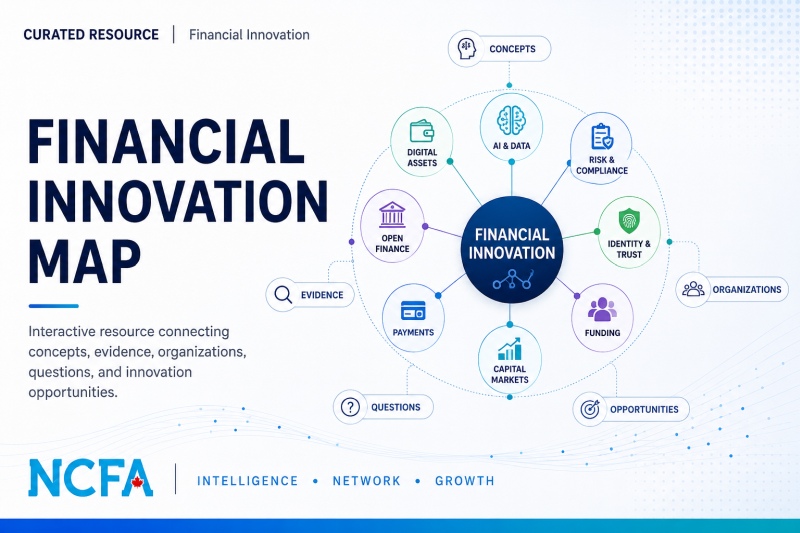
NCFA launched a Financial Innovation Map on June 5, 2026, as a practical resource for founders, investors, financial institutions, policymakers, researchers, and ecosystem builders. The map connects financial innovation concepts, use cases, featured organizations, evidence, questions, and innovation opportunities across fintech, funding, AI, digital assets, open finance, payments, capital markets, compliance, cybersecurity, and trust.
The Financial Innovation Map helps users move from concept awareness to opportunity discovery. Users can select a category, choose a concept, review sample use cases, scan featured organizations, explore innovation questions, and review resources tied to practical financial innovation activity.
The opportunity cards are practical and will continue to evolve. They show where adjacent concepts could combine into practical opportunities, supported by early, growing, or strong evidence. This helps users think beyond definitions and ask where an idea may create real value.
The need for better financial innovation intelligence is global. The BIS Innovation Hub works with central banks on technology trends that affect the global financial system, including digital finance, payments, market infrastructure, regtech, suptech, and financial stability. NCFA’s map gives Canada’s innovation ecosystem a practical way to explore many of the same themes from a founder, investor, policy, and market building lens.
Founders can use the map to test ideas, find adjacent concepts, and sharpen market theses. Investors can scan emerging areas before they become obvious sectors. Financial institutions can explore where new technology may reduce friction, improve workflows, or open new product opportunities.
Regulators, policymakers, researchers, and ecosystem builders can use the map to understand how technologies, rules, organizations, and unanswered questions connect across Canada and global financial innovation markets.
The strength of the Financial Innovation Map is structure. It brings concepts, organizations, resources, questions, and opportunity cards into one place so users can explore financial innovation with more context and less noise.
The first release is intentionally focused. Some concepts have more evidence and opportunity cards than others. That's by design. Opportunities are not added to meet a fixed count. They are added when there is enough evidence, friction, thesis strength, funding interest, or market activity to support inclusion.
The map isn't investment advice, legal advice, or a forecast. It's a curated intelligence resource that will improve as new evidence, resources, organizations, and opportunities are added. Stay tuned for future iterations.
Start with the Financial Innovation Map and explore the categories most relevant to your work.
For related NCFA coverage, see how AI agents, wallets, and financial identity are starting to connect, how agentic AI in banking is moving into practical workflows, and how tokenized infrastructure is changing market operations.
The National Crowdfunding & Fintech Association (NCFA Canada) is a financial innovation ecosystem that provides education, market intelligence, industry stewardship, networking and funding opportunities and services to thousands of community members and works closely with industry, government, partners and affiliates to create a vibrant and innovative fintech and funding industry in Canada. Decentralized and distributed, NCFA is engaged with global stakeholders and helps incubate projects and investment in fintech, alternative finance, crowdfunding, peer-to-peer finance, payments, digital assets and tokens, artificial intelligence, blockchain, cryptocurrency, regtech, and insurtech sectors. Join Canada's Fintech & Funding Community today FREE! Or become a contributing member and get perks. For more information, please visit: www.ncfacanada.org
| | |
|---|---|---|
| | |
June 5, 2026 | Last Updated October 3, 2026 | NCFA Financial Innovation Map
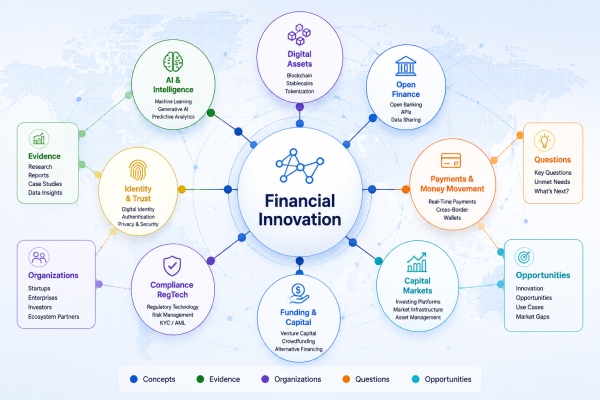
Financial innovation is creating new language faster than most teams can absorb it.
The National Crowdfunding & Fintech Association of Canada's Financial Innovation Map connects concepts, use cases, featured organizations, evidence, questions, and innovation opportunities across fintech, funding, AI, digital assets, open finance, payments, capital markets, compliance, cybersecurity, and trust.
Select a category, choose a concept, and explore how the idea works, who is involved, and where practical opportunities may emerge.
The National Crowdfunding & Fintech Association (NCFA Canada) is a financial innovation ecosystem that provides education, market intelligence, industry stewardship, networking and funding opportunities and services to thousands of community members and works closely with industry, government, partners and affiliates to create a vibrant and innovative fintech and funding industry in Canada. Decentralized and distributed, NCFA is engaged with global stakeholders and helps incubate projects and investment in fintech, alternative finance, crowdfunding, peer-to-peer finance, payments, digital assets and tokens, artificial intelligence, blockchain, cryptocurrency, regtech, and insurtech sectors. Join Canada's Fintech & Funding Community today FREE! Or become a contributing member and get perks. For more information, please visit: www.ncfacanada.org
| | |
|---|---|---|
| | |

Last Updated: June 4, 2026
Status: Strengthening
Organizations: OSFI, CIRO, SEC, FSB, CVCA, TSXV, TMX Group, Upstart, goeasy, FrontFundr
The answer is not simply yes or no. Capital is more available in some places and harder to reach in others. Funding channels are multiplying, but capital still flows toward companies that fit the channel, prove the risk, and give investors a clear reason to act.
Public markets are improving from a weak period, but access still depends on timing, disclosure readiness, and investor demand. Recent work on the CSA review of the EMD selling groups exemption and capital markets research through OSC research grants for Ontario capital markets shows that market access remains an active policy issue.
Crowdfunding adds another route. Reg CF’s 10 year record, record Canadian equity crowdfunding activity, and public market challenges and equity crowdfunding capital point to a wider funding stack. These channels still depend on trust, disclosure, visible traction, and investor communication.
Canada’s $750M early growth stage funding envelope reinforces the same point. The policy debate is not only about adding capital. It is about where the financing gap hurts most: pre seed, seed, Series B, growth, or later stage scale up capital.
Capital stack fit is now harder to ignore. Founders and fintechs may combine equity, debt, crowdfunding, private credit, public markets, and lending partnerships, but each channel demands different proof, timing, economics, and risk controls.
Strategic Takeaway
Capital channels are multiplying, but access is not becoming automatic. Founders and fintechs need to know which type of capital they fit and what proof that capital provider needs before money moves.
Click each item to expand
CVCA reported that Q1 2026 saw CAD $936.3M invested across 104 venture capital transactions, compared with 178 transactions and $3.97B in Q4 2025.
Crowdfunding evidence adds an important non bank and non VC funding channel to the capital access question.
TSX Venture Exchange removed its Sponsor requirement, effective immediately.
Upstart announced a $1B forward flow agreement with Eltura Ventures and Aperture Investors.
OSFI reduced capital requirements for certain unrated domestic infrastructure debt held by federally regulated property and casualty insurers.
Click each item to expand
The Financial Stability Board estimated private credit at $1.5T to $2.0T at the end of 2024 and warned that complexity, leverage, and interconnectedness could amplify stress.
goeasy reported a difficult Q4 2025 tied to LendCare credit performance.
CIRO finalized amendments related to fully paid securities lending and financing arrangements.
The SEC Division of Corporation Finance said EDGAR would accept filings during a shutdown, but staff would not be able to declare registration statements effective or qualify Form 1 A offering statements.
The Federal Reserve, FDIC, and OCC requested comment on three proposals to modernize the regulatory capital framework for banks of all sizes.
Do you agree the evidence is strengthening?


Click Agree or Disagree. Your vote is recorded anonymously and aggregate totals tracked.
The National Crowdfunding & Fintech Association (NCFA Canada) is a financial innovation ecosystem that provides education, market intelligence, industry stewardship, networking and funding opportunities and services to thousands of community members and works closely with industry, government, partners and affiliates to create a vibrant and innovative fintech and funding industry in Canada. Decentralized and distributed, NCFA is engaged with global stakeholders and helps incubate projects and investment in fintech, alternative finance, crowdfunding, peer-to-peer finance, payments, digital assets and tokens, artificial intelligence, blockchain, cryptocurrency, regtech, and insurtech sectors. Join Canada's Fintech & Funding Community today FREE! Or become a contributing member and get perks. For more information, please visit: www.ncfacanada.org
| | |
|---|---|---|
| | |
Jun 3, 2026

Modern businesses exist in an environment where the speed and reliability of transport are primary factors for customer satisfaction and operational success. Both consumers and corporate clients expect that products, documents and necessary supplies are delivered quickly. Same day courier services are a central component of business logistics across many sectors.
Organizations in retail, healthcare, legal and manufacturing sectors increasingly use rapid delivery solutions to meet deadlines and maintain operations - these services are helpful for businesses to respond to customer needs and to lower delays that might impact revenue or public perception.
The expectations of customers are different now than in previous years. Many buyers expect fast delivery options to be a standard part of the purchasing process. Companies that provide same day delivery often have an advantage over others because they are able to fulfill urgent requirements.
Fast delivery is also a factor in customer loyalty - When customers receive products on the promised date, they are more likely to make future purchases. Consistent service is a method to build trust and encourage positive feedback, which helps a business maintain its market position.
Many organizations are dependent on the timely movement of equipment and documents to ensure daily tasks continue without pause. Same day courier services are useful for avoiding disruptions - ensuring that items reach their destination without delays.
Rapid transportation is a tool to prevent expensive interruptions in industries that require time sensitive materials. If a company is in need of replacement parts, legal paperwork or inventory transfers, same day delivery is a way to maintain productivity and lower the time when systems are not functioning.
Businesses that are responsive to customer demands often distinguish themselves from others. Offering same day delivery is a demonstration of a commitment to convenience, which is a factor that influences purchasing decisions.
Strong delivery capabilities are also a way to create new growth opportunities. Companies that fulfill urgent requests are in a better position to attract customers who prioritize speed - this flexibility is what allows businesses to adapt to changing market conditions.
Efficient logistics are the reason for a more adaptable supply chain. Same day courier services are a means to move goods quickly between suppliers, warehouses and customers - this reduces delays that might affect the performance of the entire chain.
Faster transportation is also a support for inventory management. Instead of keeping a high volume of stock, businesses are able to rely on rapid delivery when a need arises - this method is a way to lower storage costs while ensuring products are available when there is demand.
Access to reliable courier solutions is useful for smaller organizations. Many small firms use small business shipping services to compete with larger businesses that possess extensive logistics networks.
Rapid delivery options are a way for smaller firms to provide high levels of service without a large investment in their own vehicles - this creates opportunities for growth and is a method to maintain customer satisfaction and operational efficiency.
Unexpected delays are often the cause of financial losses, missed deadlines and damaged relationships. Same day courier services are a way to lower these risks - providing dependable transportation for urgent shipments.
Businesses are also able to benefit from improved tracking capabilities. Many courier providers offer real time updates so that companies can monitor deliveries and share accurate information with customers - this transparency is a way to build confidence and support better decisions.
Reliable delivery performance is a foundation for stronger relationships with customers, suppliers and partners. When organizations meet their commitments, they establish a reputation for being dependable.
Timely transportation is a support for collaboration between different parts of a business network. Suppliers are able to deliver materials faster and partners can exchange documents more efficiently - these advantages are contributors to long term success.
The growth of digital business models is the reason for the increased importance of fast logistics. Customers often compare delivery options before they make a purchase, which makes speed a factor in the buying process.
Many organizations combine same day courier solutions with other shipping services to create a flexible strategy - this approach is a way for businesses to serve both urgent and standard needs while improving the experience of the customer.
Same day courier services are an essential resource for modern businesses that seek to improve customer satisfaction and streamline operations. By allowing for the rapid delivery of products, these services are a way for organizations to respond to the demands of the current marketplace.
As customer expectations continue to change, businesses that invest in efficient delivery solutions are in a better position for long term growth. Same day courier services provide the speed and flexibility that are necessary for success in a fast paced environment.
The National Crowdfunding & Fintech Association (NCFA Canada) is a financial innovation ecosystem that provides education, market intelligence, industry stewardship, networking and funding opportunities and services to thousands of community members and works closely with industry, government, partners and affiliates to create a vibrant and innovative fintech and funding industry in Canada. Decentralized and distributed, NCFA is engaged with global stakeholders and helps incubate projects and investment in fintech, alternative finance, crowdfunding, peer-to-peer finance, payments, digital assets and tokens, artificial intelligence, blockchain, cryptocurrency, regtech, and insurtech sectors. Join Canada's Fintech & Funding Community today FREE! Or become a contributing member and get perks. For more information, please visit: www.ncfacanada.org
| | |
|---|---|---|
| | |
Jun 3, 2026
Walk through any modern facility and you're surrounded by controlled movement that most people don't examine. A hospital bed adjusting position at the touch of a button. A greenhouse vent opening in response to temperature. A conveyor gate diverting product into a secondary line without anyone pressing anything. The mechanism behind most of this is the same, and it has a name most people outside engineering have never used: an actuator.
That's changing. As automation spreads across Canadian industries, from manufacturing and agriculture to building infrastructure and healthcare, the actuator has moved from a component that engineers specify quietly to something that business decision-makers, procurement teams, and technology investors increasingly need to understand.
An actuator converts energy into mechanical motion. Depending on the energy source, that's either electrical current, compressed air, or pressurised hydraulic fluid. Depending on the application, the motion produced is either linear, a straight push or pull along a single axis, or rotary, rotation around a fixed point.
Electric linear actuators are the most relevant category for the broadest range of modern applications, and understanding how they work explains most of what matters in practice.
A motor drives a lead screw, a precisely threaded rod. A drive nut sits on the screw and meshes with the thread but is prevented from rotating. So when the screw turns, the nut has no option but to travel along it. The rod attached to the nut extends outward as the nut moves in one direction and retracts when the motor reverses.
What this produces is controlled, precise, repeatable straight-line movement from an electrical input. The relationship between motor rotation and rod travel is fixed by the thread pitch, so controlling the motor precisely means controlling the rod's position precisely. Stop the motor and the rod stops. Add position sensing and you know exactly where it is throughout its travel.
This is what makes electric actuation more capable than pneumatic alternatives for most modern applications. A pneumatic cylinder applies pressure in one direction and that's essentially it. An electric actuator can stop at any point in its travel, modulate force, hold a position, and communicate its status to a digital control system. For an era of networked, sensor-driven industrial automation, that's the relevant difference.
One characteristic of lead screw actuators that has real practical consequences is self-locking. With a fine enough thread pitch, the geometry prevents the load from backdriving the mechanism when the motor isn't powered. The rod holds its position without the motor running continuously.
For a patient positioning system that needs to hold position while the patient is settled. For an industrial fixture that needs to maintain clamping force after moving to position. For an adjustable workstation that shouldn't drift during the working day. Self-locking provides this without continuous power draw, which matters both for energy efficiency and for safety in applications where unexpected movement would be a problem.
Not every actuator is self-locking. Coarser thread pitches that prioritise speed over force may allow backdrive. Worth checking explicitly for any application where the load needs to stay put between operations.
The application range is genuinely wider than most people expect once they start looking at it properly.
In manufacturing, actuators drive automated clamping systems, press mechanisms, conveyor divert gates, and positioning equipment. The precision and repeatability they provide is what makes consistent product quality achievable at production scale without continuous human intervention.
Agriculture has become a significant application area. Irrigation control valves that open and close in response to moisture sensors. Greenhouse ventilation systems that regulate temperature automatically. Adjustable equipment on precision farming machinery. These are applications where automation changes operational efficiency in ways that manual operation simply can't match.
Building infrastructure relies on actuators more than most occupants realise. HVAC damper control in commercial buildings adjusts airflow continuously based on occupancy and air quality data. Flood barrier mechanisms operate remotely in response to water level sensors. Automated access control systems handle gate and barrier movement. In a large building, there may be hundreds of these operating simultaneously.
Healthcare is where the performance requirements are most demanding. Surgical tables, patient lift systems, infusion pumps, powered prosthetics. The precision, reliability, and safety standards for actuators in medical applications are substantially higher than in other categories, which is part of why the engineering in that segment has driven development that benefits other application areas.
Consumer applications are broader than most people notice. Electric recliners, adjustable bed bases, sit-stand desks, motorised kitchen cabinet lifts, automated vehicle tailgates. The quality difference between a well-engineered mechanism and a cheap one shows up immediately in how the movement feels.

The actuator selection process looks simple and isn't. Getting one parameter wrong creates problems that are often expensive to fix after installation.
Force rating first. The rated capacity needs to exceed the actual load with meaningful margin, not match it. A unit running at its rated maximum runs hotter and wears faster than one with capacity to spare. One and a half to two times the calculated load is reasonable for most applications. Direction of load matters as much as magnitude. Vertical lifting is the most demanding scenario. Horizontal pushing requires considerably less force for the same load. Angular applications pushing a hinged element through an arc have a force requirement that varies throughout the travel and needs to be assessed at the worst position, usually one of the end points.
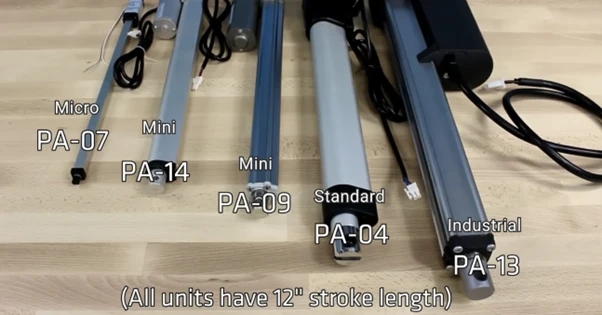
Stroke length should match the required travel with some buffer. An actuator that runs out of stroke before the mechanism reaches its end position is a specification error that typically means replacing the unit.

Duty cycle is the parameter that catches people out most often. A unit rated for 20% duty cycle needs four minutes of rest for every minute of running. For a greenhouse vent that cycles twice a day this is irrelevant. For a production gate cycling every few minutes through an eight-hour shift it's the critical specification. Heat is what degrades over-cycled actuators, and the failure tends to arrive weeks after installation rather than immediately, making it easy to misattribute.
Environmental rating needs to match actual installation conditions. IP65 handles outdoor use in typical conditions. Agricultural environments with chemical exposure, food production settings requiring washdown, and coastal locations with salt corrosion all need higher ratings. The cost difference at purchase is small. The cost of premature failure in a difficult-to-access location is not.
Voltage is largely a practical question. 12V DC suits residential, mobile, and off-grid applications. 24V DC is standard in commercial and industrial settings where longer cable runs make voltage drop at lower voltage a real problem. Getting this right at the start avoids needing a converter in the installation.
Control requirements should be established before selecting the unit. A basic extend-retract application needs only a switch. An application needing precise intermediate positioning needs position feedback, Hall effect sensors or a potentiometer, built into the actuator. An application integrating with a building management system or industrial PLC needs compatible control inputs. The linear actuator range that covers all of these specifications is wider than most buyers realise when they start looking.
Electric actuation has been displacing pneumatic and hydraulic systems across a widening range of applications for two decades, driven by the advantages in controllability, digital integration, and the elimination of fluid infrastructure. The direction of industrial automation, toward more connected, more instrumented, more precisely controlled systems, continues to favour electric actuation.
For Canadian businesses evaluating automation technology, the actuator is usually not the headline component. It's the mechanism that makes the headline component work. Getting the specification right has consequences across the operational life of the equipment it's installed in, which makes it worth understanding properly rather than treating as a procurement detail.
The National Crowdfunding & Fintech Association (NCFA Canada) is a financial innovation ecosystem that provides education, market intelligence, industry stewardship, networking and funding opportunities and services to thousands of community members and works closely with industry, government, partners and affiliates to create a vibrant and innovative fintech and funding industry in Canada. Decentralized and distributed, NCFA is engaged with global stakeholders and helps incubate projects and investment in fintech, alternative finance, crowdfunding, peer-to-peer finance, payments, digital assets and tokens, artificial intelligence, blockchain, cryptocurrency, regtech, and insurtech sectors. Join Canada's Fintech & Funding Community today FREE! Or become a contributing member and get perks. For more information, please visit: www.ncfacanada.org
| | |
|---|---|---|
| | |
June 1, 2026 | NCFA Fintech Market Activity | Digital Assets Blockchain And Tokenization, Capital Markets And Funding, Capital Markets And Market Infrastructure

On June 1, 2026, Further and 3iQ introduced USD Class II for the Further x 3iQ Alpha Digital Fund, adding a new share class for USD investors who want long Bitcoin exposure plus digital asset alpha without buying, converting, or custodying BTC directly.
3iQ and Further aren't just selling Bitcoin exposure. They are separating investor needs by base currency, custody preference, and risk objective. The fund now has three share classes:
Tommaso Mancuso, President and CIO, 3iQ:
“USD Class II combines two things institutional investors increasingly want in the same product. It pairs disciplined alpha generation across liquid digital asset markets with long exposure to Bitcoin's scarcity and convexity. Delivering both within a USD-denominated, institutionally risk-managed structure is what makes this share class distinctive.”
The useful part is the share class design. Allocators are not all trying to solve the same objective. Some want USD Class I focused on active digital asset returns with less reliance on Bitcoin’s price direction. Some want Bitcoin exposure but need to fund and redeem in USD. Others already hold BTC and want to stay in BTC instead of selling first.
USD Class II reduces one operational problem. It gives USD investors Bitcoin linked exposure without asking them to source or custody BTC themselves (which can slow adoption even when investors already believe in the asset class).
3iQ brings a longer Canadian product history into this launch. The company was founded in 2012 and says it launched the world’s first Digital Assets Managed Account Platform. It also points to earlier Bitcoin and Ethereum ETP launches, staking integration in Ethereum and Solana ETPs, and other regulated ETPs.
In February 2026, Coincheck completed its 3iQ acquisition, including 3iQ’s regulated product track record in Canada. The question now is whether this share class design attracts allocator demand, not whether Bitcoin access exists.
Will institutional digital asset adoption grow more through broad Bitcoin exposure, or through fund structures that let allocators choose currency, custody, alpha, and beta on their own terms?
The National Crowdfunding & Fintech Association (NCFA Canada) is a financial innovation ecosystem that provides education, market intelligence, industry stewardship, networking and funding opportunities and services to thousands of community members and works closely with industry, government, partners and affiliates to create a vibrant and innovative fintech and funding industry in Canada. Decentralized and distributed, NCFA is engaged with global stakeholders and helps incubate projects and investment in fintech, alternative finance, crowdfunding, peer-to-peer finance, payments, digital assets and tokens, artificial intelligence, blockchain, cryptocurrency, regtech, and insurtech sectors. Join Canada's Fintech & Funding Community today FREE! Or become a contributing member and get perks. For more information, please visit: www.ncfacanada.org
| | |
|---|---|---|
| | |


August 26th, 2025

January 4th, 2024

June 1st, 2021

September 9th, 2020

July 9th, 2018

January 3rd, 2018

September 25th, 2017

June 20th, 2017

May 10th, 2017

December 14th, 2016