




Karsten Wenzlaff, Advisor
August 26th, 2025
Karsten Wenzlaff is a Crowdfunding and Fintech Expert from Germany. He is Secretary-General of Digit[...]


Competition | Oct 31, 2025

Today, the Competition Bureau of Canada released a new draft of "Anti-Competitive Conduct and Agreements Enforcement Guidelines" for the public and stakeholder consultation to be submitted by January 29, 2026. These guidelines are part of a larger effort to modernize how Canada enforces competition law, which directly affects fintechs, startups, and any business working to scale in today’s digital economy.
The proposed guidance updates how the Bureau will interpret and enforce sections 75 to 79 and 90.1 (see Competition Act text), including key areas such as:
- Refusals to deal and exclusive arrangements
- Market restrictions and tied selling
- Abuse of dominance
- Civil agreements between competitors that may restrict competition
It also consolidates older enforcement materials, including the now superseded 'Price Maintenance Guidelines' and 'Abuse of Dominance Guidelines' into a single updated document that reflects legislative amendments made between 2022 and 2025.
For fintechs, platform businesses, and other high-growth ventures, this kind of regulatory clarity matters. Whether you are entering a data-sharing agreement, challenging a gatekeeping incumbent, or navigating pricing structures, clearer enforcement guidance reduces ambiguity and legal exposure.
The draft guidelines account for several recent reforms to the Competition Act, including:
- A restructured test for abuse of dominance
- New scrutiny on certain business collaborations (even when parties are not direct competitors)
- An expanded ability for multiple provisions to apply in a single enforcement case
According to the Bureau, these updates are designed to reflect how competition issues appear in evolving markets, including digital services and platform ecosystems.
In prior consultations, public feedback has directly influenced how the Bureau created its final guidance, whether on wage-fixing, platform conduct, or innovation impacts. Stakeholder input has led to more usable, grounded enforcement tools that reflect market realities.
This consultation is substantive. If your business model depends on partnerships, licensing, data access, or competition with larger players, this consultation is worth your attention.
 The National Crowdfunding & Fintech Association (NCFA Canada) is a financial innovation ecosystem that provides education, market intelligence, industry stewardship, networking and funding opportunities and services to thousands of community members and works closely with industry, government, partners and affiliates to create aa vibrant and innovative fintech and funding industry in Canada. Decentralized and distributed, NCFA is engaged with global stakeholders and helps incubate projects and investment in fintech, alternative finance, crowdfunding, peer-to-peer finance, payments, digital assets and tokens, artificial intelligence, blockchain, cryptocurrency, regtech, and insurtech sectors. Join Canada's Fintech & Funding Community today FREE! Or become a contributing member and get perks. For more information, please visit: www.ncfacanada.org
 |  |  |
|---|---|---|
 |  |  |
Fintech | Oct 30, 2025
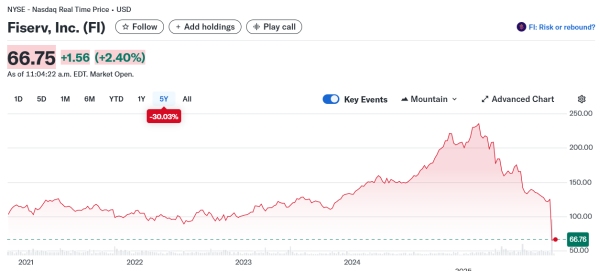
Image: Fiserv (FI) (Yahoo Finance Chart, Oct 31, 2025)
What triggered Fiserv’s record stock crash?
On October 29 2025, Fiserv Inc.’s stock plunged 44 percent in a single trading day after management sharply cut revenue and earnings forecasts. The Forbes report confirmed that guidance for full year organic revenue dropped to roughly 3.5% to 4.5% (down from 10%), and adjusted earnings per share fell to about $8.50 to $8.60 (previous range near $10.25).
Outlets called it the company's worst trading day on record, while Reuters reported that roughly $30 billion USD in market value was wiped out.
The Financial Times reported that some of Fiserv’s problems came from its business in Argentina. The company had invested heavily there to grow its payments and merchant services, but rising inflation and unstable policies hurt results.
Yahoo Finance verified that quarterly adjusted earnings were $2.04 per share on $4.92 billion in revenue, both falling short of analyst estimates, and that management’s revised guidance signalled weaker growth into 2026.
The speed and scale of the decline caught analysts off guard and the abrupt reversal in management guidance spooked investor confidence more than the revenue miss itself.
The credibility hit reflects a governance gap and not a market anomaly. Canadian financial institutions face a similar risk. When boards and risk teams depend too much on vendors’ optimistic projections, they can be caught off guard when results fall short. Honest forecasts, active oversight, and clear accountability are essential to maintain trust.
The slowdown of Fiserv’s merchant processing as noted by Reuters, raised red flags because it showed how much of the global financial ecosystem depends on a handful of vendors for core services.
Canadian credit unions and regional banks operate within similar limits, relying on few providers for payments, fraud monitoring, and digital banking infrastructure. A major vendor’s disruption could ripple through daily operations.
Fintechs should avoid relying on a single provider for critical services. Where possible, they should use multiple vendors or include clear backup and continuity plans in core contracts. A stable vendor network is now part of staying resilient, not just managing costs.
MarketWatch linked Fiserv’s current struggles to its 2019 First Data merger, which left the company with high debt and overlapping systems.
Many Canadian institutions are undergoing similar digital transformations. The Fiserv experience shows that modernization without aligned governance and risk planning can backfire.
Further with respect to Argentina, expanding into fast growing but unpredictable markets can look appealing, but without strong local plans and risk controls, it can backfire when conditions change.
Banks should aim to strike the balance between innovation, cutting costs, and building long term strength. Fintechs on the other hand need to be realistic and transparent with financial reporting and growth goals. Making promises that can’t be met damages trust faster than any technical problem.
Fiserv is undergoing a strategic reset. In a release, the Fiserv appointed Paul Todd as CFO effective October 31, named Takis Georgakopoulos and Dhivya Suryadevara as co-presidents effective December 1, and refreshed its board under new independent chair Gordon Nixon. Two directors will step down on January 1 2026 as part of a governance overhaul. Whether these measures restore confidence remains uncertain.
The National Crowdfunding & Fintech Association (NCFA Canada) is a financial innovation ecosystem that provides education, market intelligence, industry stewardship, networking and funding opportunities and services to thousands of community members and works closely with industry, government, partners and affiliates to create aa vibrant and innovative fintech and funding industry in Canada. Decentralized and distributed, NCFA is engaged with global stakeholders and helps incubate projects and investment in fintech, alternative finance, crowdfunding, peer-to-peer finance, payments, digital assets and tokens, artificial intelligence, blockchain, cryptocurrency, regtech, and insurtech sectors. Join Canada's Fintech & Funding Community today FREE! Or become a contributing member and get perks. For more information, please visit: www.ncfacanada.org
| | |
|---|---|---|
| | |
Financing | Oct 30, 2025

Image: Freepik/rawpixel.com
On October 27, 2025, Wealthsimple announced it had raised $750 million in new equity funding at a $10 billion post money valuation. The deal includes $550 million in new shares and up to $200 million from secondary sales.
Dragoneer Investment Group and GIC led the round, joined by CPP Investments, Power Corporation of Canada, IGM Financial, ICONIQ Capital, Greylock Partners, and Meritech Capital.
Crossing the $10 billion valuation milestone shows how far Canada’s fintech industry has come. Wealthsimple’s steady rise from startup to profitable platform proves that a Canadian firm can reach global scale while keeping its focus on trust, compliance, and user experience. This new round comes at a time when many fintechs worldwide are struggling to raise growth capital.
Wealthsimple has been profitable since 2024 and now manages over $100 billion in assets for more than three million Canadians.
Michael Katchen, CEO and co-founder, Wealthsimple:
“This raise reflects deep confidence from new and returning investors in our mission and our role as a defining Canadian company. We were intentional in choosing partners committed to the long-term future of Wealthsimple. These are well-respected, global leaders with a proven track record scaling category leaders, and who believe in our vision for the future of financial services.”
Choo Yong Cheen, Chief Investment Officer, Private Equity, GIC:
“We look for companies that will transform industries for decades to come, and Wealthsimple is one of them. Their track record of innovation, from investing to trading to spending, combined with deep trust from Canadians, positions them to build a defining, generational company in Canadian financial services.”
Institutional investors such as CPP Investments and Power Corporation bring more than capital. They bring credibility. Their involvement helps normalize fintech as a core part of the financial system, not a novel experiment. This type of institutional participation encourages other large funds to view Canadian fintechs as viable, well governed opportunities for long term growth. It also shows that responsible innovation can attract serious capital without sacrificing values like inclusion and transparency.
Wealthsimple’s record of profitability and compliance gives regulators a real life example that innovation and stability can work together. The company’s consistent performance may help policymakers as they work to finalize the implementation of open banking.
Wealthsimple’s growth story and impact goes beyond one company. It's an achievement that reflects how far Canada’s fintech community has evolved, from early crowdfunding to full service digital banking. It gives startups and investors a reason to believe that they can scale globally while keeping their roots in Canada. For NCFA, this success reinforces the importance of a financial ecosystem that rewards innovation, broadens access to capital, and strengthens Canada’s competitiveness on the world stage.
The National Crowdfunding & Fintech Association (NCFA Canada) is a financial innovation ecosystem that provides education, market intelligence, industry stewardship, networking and funding opportunities and services to thousands of community members and works closely with industry, government, partners and affiliates to create aa vibrant and innovative fintech and funding industry in Canada. Decentralized and distributed, NCFA is engaged with global stakeholders and helps incubate projects and investment in fintech, alternative finance, crowdfunding, peer-to-peer finance, payments, digital assets and tokens, artificial intelligence, blockchain, cryptocurrency, regtech, and insurtech sectors. Join Canada's Fintech & Funding Community today FREE! Or become a contributing member and get perks. For more information, please visit: www.ncfacanada.org
| | |
|---|---|---|
| | |
Oct 28, 2025

Image: Freepik AI
On October 27 2025, Anthropic announced new finance upgrades for Claude Sonnet 4.5 that make it work more deeply inside everyday finance tasks. The update adds an Excel integration, real time data connections, and built in tools that automate work usually done by analysts. These features strengthen its Claude for Financial Services product that was first introduced in July 2025, as they try to woo banks, asset managers, insurers, and fintech companies directly.
External validation from Vals AI’s Finance Agent benchmark, where Claude achieved 55.3% accuracy on tasks designed for financial analysts (Read: algorithms may be coming for your job soon). The benchmark covers 537 finance-specific questions that test reasoning, modelling, and data interpretation.
1. The first is Claude for Excel, which allows people to work with Claude directly inside Microsoft Excel. Claude can read, modify, and create spreadsheets, perform analysis, and trace the origin of each number. The integration is designed to save time while keeping audit trails and data checks intact.
2. The second feature is a set of live data connections. Claude can now pull information from several licensed financial sources. Anthropic confirmed new data links to Aiera (earnings insights), Third Bridge (expert research), Chronograph (private equity data), Egnyte (secure data rooms), LSEG (market analytics see partnership between Anthropic and LSEG), Moody’s (credit intelligence), and MT Newswires (market news).
3. The third addition is a group of Agent Skills that automate repetitive finance work. These include comparable company analysis, discounted cash flow models, due diligence summaries, company profiles, earnings analyses, and initiating coverage reports. Each task produces transparent outputs that can be verified back to original data sources.
These new tools will accelerate embedding AI into professional finance workflows. Excel still remains the favourite tool for global financial analysis, and integrating Claude into that environment changes how teams manage data and reporting. By connecting to trusted financial sources under strict compliance rules, Claude allows institutions to automate tasks such as modelling and research while maintaining full transparency and control.
It can cut repetitive manual work, improve accuracy through verifiable data sourcing, and enable faster decision making. The combination of AI and live financial data could also give smaller firms the same analytical capacity as large institutions, provided they apply proper data governance and oversight.
Anthropic’s continued investment in transparency, auditability, and security aligns with the needs of Canada’s regulated financial ecosystem and supports a more productive and competitive environment for both incumbents financial institutions and fintech innovators.
The National Crowdfunding & Fintech Association (NCFA Canada) is a financial innovation ecosystem that provides education, market intelligence, industry stewardship, networking and funding opportunities and services to thousands of community members and works closely with industry, government, partners and affiliates to create aa vibrant and innovative fintech and funding industry in Canada. Decentralized and distributed, NCFA is engaged with global stakeholders and helps incubate projects and investment in fintech, alternative finance, crowdfunding, peer-to-peer finance, payments, digital assets and tokens, artificial intelligence, blockchain, cryptocurrency, regtech, and insurtech sectors. Join Canada's Fintech & Funding Community today FREE! Or become a contributing member and get perks. For more information, please visit: www.ncfacanada.org
| | |
|---|---|---|
| | |
AI | Oct 27, 2025

Image: Introducing Vibe coding in Google AI Studio (Google Blog)
On October 26, 2025, Google announcing the intro of vibe coding in Google AI Studio, a new tool that lets developers and creators use artificial intelligence to speed up software development using a mix of natural language and code. The feature is available on Google’s Gemini models, which can understand text, images, and data all at once. The idea behind vibe coding is almost like a magical pill. That is turn a detailed description of what you want to build into a working app or prototype in minutes instead of weeks.
For fintech innovators, startups and established financial institutions, it sounds like a major breakthrough given they are constantly under the gun to launch new digital services quickly to remain relevant and competitive. Vibe coding tools in theory, could make it easier to create the latest innovative solutions without hiring expensive engineering teams. But the same qualities that make it fast and flexible also raise difficult questions about privacy, data handling, and reliability when used inside regulated environments.
Vibe coding was created for builders who want to experiment without having to code everything from scratch. Inside Google AI Studio, users can describe an idea and the system automatically produces the code and interface. It works for both experienced developers and business teams who may not have deep technical skills.
That accessibility and speed of 'idea-to-prototype' is what makes it so interesting for fintechs. A startup could create an interactive demo for investors or customers overnight. A mid-sized financial institution could use it to prototype internal compliance dashboards. Even regulators could use it to explore AI tools that help monitor market risks. The experience feels less like traditional coding and more like collaborating with a digital assistant that understands what you are trying to achieve.
Financial data is among the most sensitive information in any digital system. Google’s documentation for AI security on Google Cloud describes several layers of protection, including encryption, access control, and a zero data retention option that prevents user prompts or outputs from being stored for training. The company has also rolled out AI Protection service, which helps organizations monitor and control how their AI systems interact with code and data.
Those protections are encouraging, but they depend on how a company configures its environment. The free version of AI Studio likely won't include the same protections as enterprise deployments. Unless a fintech uses Google Cloud’s managed enterprise tools with clear data governance terms, prompts and logs could still be visible to Google’s systems. This means that even simple mistakes, such as entering customer information into a test prompt, could create compliance risks.
Canadian fintechs face additional expectations under PIPEDA, OSFI’s Cyber Risk Guidelines, and FINTRAC’s data-handling rules. Any platform that processes or even touches production data must comply with encryption standards, data residency, and audit requirements.
Tools like vibe coding should be treated as development sandboxes, not as live environments for real financial transactions or personal data.
The biggest concern is not Google’s infrastructure but how the tool is used. A recent security study referenced by TechRadar found that almost half of AI-generated code samples contained security flaws.
In the trenches of a financial system, even small weakness could expose customer accounts or transaction records. Because vibe coding relies on natural language, a poorly written prompt could create vulnerabilities with unintended code or API access. Read about demos versus production
Fintechs should assume that every piece of AI code generated needs to be reviewed by a real human and pass full security testing before it's deployed. Teams should separate test environments from live systems and avoid entering any confidential or regulated data into AI development tools. Also, the same rules that apply to cloud security and 3rd party vendor management should also be applied here.
Before experimenting with vibe coding for fintechs and financial institutions, companies should confirm that their account includes enterprise security controls and written commitments on data storage, encryption, and model training exclusions.
Developers should be trained to understand prompt hygiene and privacy responsibilities. Firms should also document where and how AI tools are used in the software development process to maintain compliance with internal and external audits.
For Canadian firms, the above security practices should align with OSFI’s guidance on 3rd party technology risks, which emphasizes focus on resilience, accountability, and transparency in AI systems.
As AI systems evolve and mature, the future points to a day where developers (or any visionary that can type a prompt) can build software solutions via conversations rather than code (the ultimate communicative wrapper).
But for companies that handle financial or personal data with real obligations, governance and risk management should be on high alert. If used responsibly and with greater advancements, vibe coding could lower the cost of innovation, help startups scale faster, and give established institutions more agility in how they design financial services. Want some inspiration? Check out Google's AI Studio app gallery.
The National Crowdfunding & Fintech Association (NCFA Canada) is a financial innovation ecosystem that provides education, market intelligence, industry stewardship, networking and funding opportunities and services to thousands of community members and works closely with industry, government, partners and affiliates to create aa vibrant and innovative fintech and funding industry in Canada. Decentralized and distributed, NCFA is engaged with global stakeholders and helps incubate projects and investment in fintech, alternative finance, crowdfunding, peer-to-peer finance, payments, digital assets and tokens, artificial intelligence, blockchain, cryptocurrency, regtech, and insurtech sectors. Join Canada's Fintech & Funding Community today FREE! Or become a contributing member and get perks. For more information, please visit: www.ncfacanada.org
| | |
|---|---|---|
| | |
NCFA Canada | Oct 27, 2025
Toronto, Canada and Dubai, UAE – October 27, 2025 – The National Crowdfunding & Fintech Association of Canada (NCFA), a non-profit fintech network, and TheBlock, a Dubai-based virtual asset hub, today announced a strategic partnership to expand cross-border collaboration, education, and adoption of tokenized real-world assets (RWA).
This partnership creates a bridge between Canada’s fintech and investor community and Dubai’s growing hub for tokenized assets. By combining NCFA’s network of entrepreneurs, investors, regulators, and industry leaders with TheBlock’s expertise in tokenization and capital markets, the collaboration will help firms explore opportunities in RWA, broaden investor participation, and better understand global adoption trends.
Craig Asano, NCFA’s founder and CEO:
“Education and collaboration are central to this initiative. By working with TheBlock, we can help firms explore tokenization use cases, engage more effectively with international investors, and build confidence in this fast-evolving market.”
Farbod Sadeghian, CEO of TheBlock, added:
“Our mission is to open global pathways for firms and innovators to participate in tokenization. By Canada’s fintech ecosystem to international markets where adoption is advancing quickly, we’re creating practical opportunities for companies to explore, experiment, and grow.”
As tokenization and real-world assets power digital finance, education and global collaboration are critical to ensure firms, investors, and policymakers are equipped for the transition. NCFA and TheBlock will co-develop initiatives such as joint knowledge programs, workshops, and ecosystem-building events to support this evolution.
The National Crowdfunding & Fintech Association of Canada (NCFA) is a non-profit fintech ecosystem that supports and amplifies fintech, alternative, digital, and AI-driven finance globally. NCFA provides education, market intelligence, advocacy, networking, and funding opportunities to entrepreneurs, investors, regulators, and innovators.
TheBlock is a Dubai-based virtual asset hub focused on tokenization, capital readiness, advisory, and ecosystem building. With a mission to connect global markets and foster adoption of real-world assets through tokenization, TheBlock provides education, programs, and services to companies, investors, and innovators shaping the future of finance.
The National Crowdfunding & Fintech Association (NCFA Canada) is a financial innovation ecosystem that provides education, market intelligence, industry stewardship, networking and funding opportunities and services to thousands of community members and works closely with industry, government, partners and affiliates to create aa vibrant and innovative fintech and funding industry in Canada. Decentralized and distributed, NCFA is engaged with global stakeholders and helps incubate projects and investment in fintech, alternative finance, crowdfunding, peer-to-peer finance, payments, digital assets and tokens, artificial intelligence, blockchain, cryptocurrency, regtech, and insurtech sectors. Join Canada's Fintech & Funding Community today FREE! Or become a contributing member and get perks. For more information, please visit: www.ncfacanada.org
| | |
|---|---|---|
| | |
Fintech Event | Oct 23, 2025

Image; Wealthsimple For Nerds 2025, Michael Katchen
On October 22, 2025, Wealthsimple held its For Nerds Only showcase in Toronto, launching a bevy of new products and milestones that highlight the major changes happening in Canada's retail investing market.
Over 220,000 Canadians registered for the livestream which is double the audience size at WS's event held last June. The company splashed some big news in that it officially surpassed $100 billion in assets under administration, reaching the milestone 3 years ahead of its original 2028 target!
Alongside the product updates, Wealthsimple shared results from a June 2025 survey of clients aged 25 to 45 with more than $50,000 in assets that confirm there's demand for digital control when paired with trusted guidance:
Wealthsimple introduced what it calls Canada’s first zero commission options platform with no per-contract fees. By eliminating traditional contract costs that major bank brokerages still charge, the firm aims to make options more accessible to retail investors with zero fee options rolling out to all clients in phases in 2026. Users should monitor fee transparency and execution quality as adoption scales.
WS’s zero fee options will disrupt the pricing structures of Canada’s largest bank brokerages, such as RBC Direct Investing, TD Direct Investing, BMO InvestorLine, and Scotia iTRADE who all still charge between $1.25 and $2.50 per contract, a model that has long supported their retail trading revenue. By removing per contract costs entirely, WS sets a new benchmark that will pressure banks to justify higher fees or cut them to stay competitive.
As more and more investors move to lower cost platforms, traditional banks risk losing up/cross selling opportunities in savings, credit, and advisory products. For younger retail investors and clients who value cost transparency and mobile-first design, zero fee options trading is the way to go.
Wealthsimple also launched real gold trading (See: support guide) directly in client accounts, making it available around the clock and backed by the Royal Canadian Mint. Investors can buy fractional amounts starting at one dollar and will be able to redeem for physical one ounce and tenth ounce coins beginning in November 2025.
The new feature combines online convenience with real ownership of gold, appealing to people who want something tangible instead of investing in gold ETFs. If trading costs stay low, it could change how Canadians buy and hold gold in their accounts.
Wealthsimple introduced a Mutual Fund Exchange to help investors transition from high-fee mutual funds to lower-cost managed portfolios, covering transfer fees and offering personalized guidance.
The firm also previewed its flagship Summit portfolio, a new managed offering that blends public equities with private equity, private credit, infrastructure, and gold exposure.
According to the newsroom release:
Investors switching from high-fee mutual funds to the Summit portfolio could retire up to 47% richer due to fee savings alone.
Wealthsimple confirmed that direct indexing portfolios are now available, offering the same tax saving tools used by large institutions. The service automates daily tax loss harvesting across individual stocks and charges a 0.15% management fee, as shown on the direct indexing page.
It lets investors mirror an index while owning each company directly, which can improve after-tax results and give more control over what they hold. The system automatically sells losing stocks to offset gains and reinvests the money to keep market exposure.
Wealthsimple previewed upcoming AI powered research and trading tools that will generate market summaries, identify trends, and deliver event alerts. Also scheduled for release are secured puts, multi-leg option strategies, and a built-in Norbert’s Gambit function for more efficient currency conversion.
These new tools showcase how automation and personalized data analysis are converging on the platform.
Wealthsimple introduced a new full service wealth management tier that combines digital access with human advice via text and proactive tax and contribution planning. Management fees start at 0.5% for higher balances.
The 2025 event reinforced Wealthsimple’s ambition to democratize sophisticated investing while lowering costs for Canadians. From zero fee options and physical gold to direct indexing and hybrid advice, the company’s strategy blends accessibility with innovation. As its AI tools and private market portfolios scale through 2026, the balance between automation, transparency, and client empowerment will remain key measures of success.
The National Crowdfunding & Fintech Association (NCFA Canada) is a financial innovation ecosystem that provides education, market intelligence, industry stewardship, networking and funding opportunities and services to thousands of community members and works closely with industry, government, partners and affiliates to create aa vibrant and innovative fintech and funding industry in Canada. Decentralized and distributed, NCFA is engaged with global stakeholders and helps incubate projects and investment in fintech, alternative finance, crowdfunding, peer-to-peer finance, payments, digital assets and tokens, artificial intelligence, blockchain, cryptocurrency, regtech, and insurtech sectors. Join Canada's Fintech & Funding Community today FREE! Or become a contributing member and get perks. For more information, please visit: www.ncfacanada.org
| | |
|---|---|---|
| | |


August 26th, 2025

January 4th, 2024

June 1st, 2021

September 9th, 2020

July 9th, 2018

January 3rd, 2018

September 25th, 2017

June 20th, 2017

May 10th, 2017

December 14th, 2016