




Karsten Wenzlaff, Advisor
August 26th, 2025
Karsten Wenzlaff is a Crowdfunding and Fintech Expert from Germany. He is Secretary-General of Digit[...]


Last Updated: May 29, 2026
Status: Strengthening
Organizations: Bank of Canada, FCA, APRA, UK Parliament Treasury Committee, European Council, Microsoft, Google, Mastercard, Florida Attorney General
The answer is yes, but the burden is not only regulatory paperwork. AI is creating new costs around model governance, board oversight, vendor control, data quality, fraud prevention, customer fairness, audit trails, human review, and incident response. Financial firms can still gain productivity and better customer service, but the cost of using AI responsibly is rising.
This is why the AI finance question is no longer just about productivity. NCFA analyzed this tension in AI spending and workforce cost resets. The same pressure now extends into compliance. If AI lowers cost per decision, firms still need to prove those decisions remain fair, secure, monitored, and accountable.
It is about whether firms can use AI at scale without losing control. The compliance burden grows when AI starts impacting decisions, communications, onboarding, payments, fraud detection, research, advice, and customer journeys.
That control problem becomes even more acute in AI payments and liability, where consent, authorization, and accountability need to work before autonomous transactions can scale.
The firms to watch are the ones that can turn AI controls into operating discipline. That means clear ownership, tested models, clean data, human escalation, vendor oversight, audit evidence, and governance that works before a regulator asks for proof.
Strategic Takeaway
AI can lower costs and improve service, but it also raises the control bar. The strongest financial firms will not be the ones that use AI everywhere. They will be the ones that know where AI belongs, where humans stay accountable, and how to prove the system works.
Click each item to expand
The Bank of Canada says AI may support productivity growth, but financial firms still need to manage model risk, job changes, data quality, cyber exposure, and financial stability concerns.
The FCA selected eight firms for its second AI Live Testing cohort, including Barclays, Experian, Lloyds Banking Group, and UBS. The focus is safe and responsible deployment, not AI experimentation in isolation.
Mastercard’s Agent Pay Acceptance Framework shows why AI creates a new control layer in payments. If an AI agent can help initiate or complete a transaction, firms need controls over identity, authorization, tokenized credentials, consent, limits, and disputes.
Microsoft says financial firms need to embed governance and security into AI transformation. This includes identity based access, audit trails, adaptive risk controls, and monitoring.
Google’s Gemini Deep Research Agent can plan, execute, and synthesize multi step research tasks. That kind of tool is useful in finance, but it raises questions about source quality, review, recordkeeping, and responsibility for output.
Click each item to expand
APRA told industry it is finalizing its forward plan for AI supervision and will continue monitoring AI use for prudential risks. This is a clear sign that AI governance is entering prudential oversight.
The UK Parliament Treasury Committee reported that 75% of UK financial services firms use AI and called for clearer regulatory direction. That makes the compliance burden visible at sector scale.
The Council and European Parliament agreed to simplify and streamline parts of the AI Act timeline. Even with timing relief, firms still need to prepare for high risk AI obligations, synthetic content rules, documentation, and governance requirements.
The FCA’s Mills Review call for input said AI may enable more sophisticated financial crime, fraud, and manipulation. That makes AI a compliance and fraud control issue, not only a technology choice.
Florida’s Attorney General opened a criminal investigation into OpenAI related to ChatGPT and the Florida State University shooting. The facts are outside financial services, but the compliance lesson is relevant for any firm deploying AI into high risk workflows.
Do you agree the evidence is strengthening?
 3

 The National Crowdfunding & Fintech Association (NCFA Canada) is a financial innovation ecosystem that provides education, market intelligence, industry stewardship, networking and funding opportunities and services to thousands of community members and works closely with industry, government, partners and affiliates to create a vibrant and innovative fintech and funding industry in Canada. Decentralized and distributed, NCFA is engaged with global stakeholders and helps incubate projects and investment in fintech, alternative finance, crowdfunding, peer-to-peer finance, payments, digital assets and tokens, artificial intelligence, blockchain, cryptocurrency, regtech, and insurtech sectors. Join Canada's Fintech & Funding Community today FREE! Or become a contributing member and get perks. For more information, please visit: www.ncfacanada.org
 |  |  |
|---|---|---|
 |  |  |
May 29, 2026

Most businesses don't struggle to find digital marketing agencies. They struggle to find one that actually understands their industry, reports honestly, and ties every dollar spent back to real revenue. After reviewing dozens of Canadian agencies across service depth, client results, and transparency, a clear pattern emerged: the ones worth your budget are the ones that treat return on investment as a must-have, not a nice-to-have. This guide breaks down the top five agencies in Canada worth serious consideration heading into 2026.
The research approach for this ranking
Every agency on this list was assessed using publicly available sources: Clutch profiles, client testimonials, published case studies, award records, and official service pages. The focus stayed on agencies with a verifiable track record in digital marketing, not just strong website copy or a polished pitch deck.
-> See the full research breakdown
Picking the wrong agency doesn't just waste budget. It sets your business back months while competitors pull ahead.
The real challenge isn't finding an agency that offers services. It's finding one that genuinely understands your industry, can trace every lead back to a specific campaign, and gives you reporting you can actually trust.
Specialized agencies tend to produce better outcomes because they already know the ad platform policies, the content angles that convert, and the audience behavior patterns that matter in your space. That kind of focused experience usually shows up directly in your numbers, whether you're tracking Return on Ad Spend (ROAS), Customer Acquisition Cost (CAC), or Cost Per Lead (CPL).
The right fit doesn't just run campaigns. It moves your business forward.
Note: All data in this table is sourced from review platforms and the official websites of the listed companies.
| Company Name | Years Operating | Headquartered In | Rating |
| dNovo Group | Est. 2011 | Toronto, ON, Canada | 5/5 (Clutch) |
| Dialekta | Est. 2010 | Montreal, Toronto, and Paris | Not listed |
| Major Tom | Est. 2018 | Vancouver, British Columbia | Not listed |
| Kinex Media | Est. 2008 | Mississauga, Ontario, Canada | Not listed |
| Marvel Marketing | Est. 2014 | Calgary, AB | Not listed |
What Does dNovo Group Do?
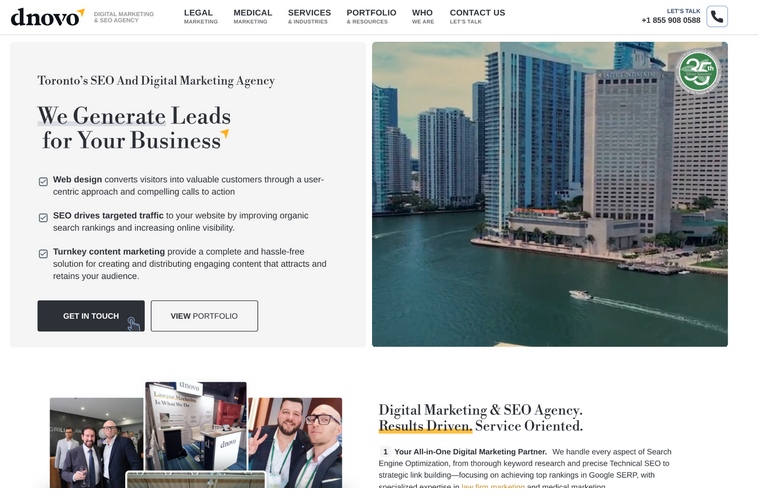
dNovo Group is a Toronto-based boutique agency founded in 2011, built around legal and healthcare marketing. They cover SEO, Local SEO, AI Search Optimization, Google Ads, web design, and content marketing for law firms and medical practices across personal injury, criminal defense, immigration, family law, and more. What sets them apart is the fully in-house team structure. Every campaign is built and managed internally, which means accountability stays in one place and results don't get lost between vendors.
Why dNovo Group Stands Out for Digital Marketing:
The agency fills a specific gap for law firms and healthcare practices that need a marketing partner who already understands their industry's advertising restrictions and client acquisition dynamics. From what the case study data shows, that kind of sector-specific focus tends to produce results that general agencies struggle to replicate at the same pace.
Summary of Real User Reviews:
dNovo Group holds a 5/5 rating across 66 reviews on Clutch, which is honestly rare at that volume. Clients consistently point to measurable outcomes, including 150% increases in qualified leads and website visitors driven by campaigns and 180% gains in client acquisition. The recognition as a Top SEO, Top Advertising, and Top Web Design company on Clutch, plus a Netty Award nomination, backs up what the client feedback is already saying.

What Does Dialekta Do?
Dialekta is a Montreal-based performance marketing agency founded in 2010, and they've grown considerably since then. They cover SEM, SEO, analytics, conversion rate optimization (CRO), media planning, and business intelligence. What makes them interesting compared to others on this list is their move into traditional media in 2020 and their 2024 acquisition of Varibase, which deepened their data and loyalty marketing capabilities. They serve major Canadian brands including Vidéotron, Bell Media, Intact Insurance, and Desjardins Group (not a small client list by any measure).
Why Dialekta Stands Out for Digital Marketing:
Dialekta addresses a real challenge for mid-to-large businesses that need a single partner to connect digital and traditional media without losing performance accountability across channels. Their data activation work, built out further through the Varibase acquisition, gives clients a clearer picture of how campaigns are actually driving discovery call to signed retainer conversion, not just surface-level impressions.
Summary of Real User Reviews:
Dialekta's industry reputation carries weight, especially the Google recognition as one of six most forward-thinking companies worldwide in Search Innovation. Their client retention rates are reported as among the highest in the Canadian agency market, which suggests the results are holding up long after the initial campaign launch. Multiple Infopresse awards round out a track record that's hard to ignore for enterprise-level marketing buyers.
What Does Major Tom Do?
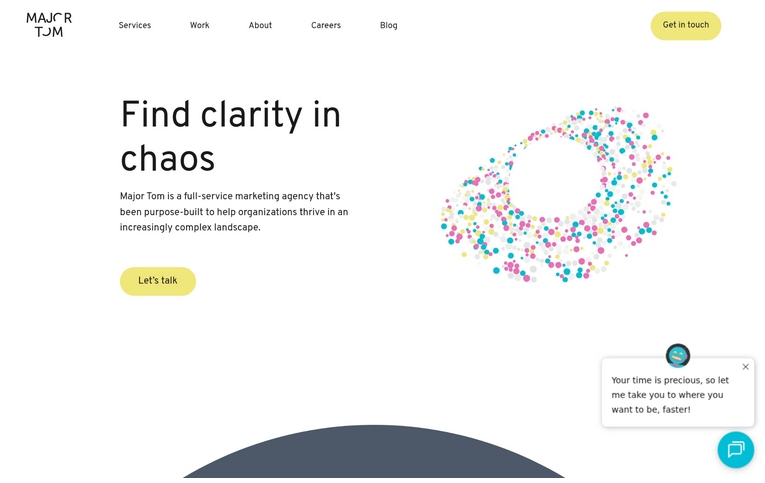
Major Tom is a Vancouver-based full-service agency formed in 2018 through the merger of 6S Marketing and Drive Digital, two respected names in Canadian digital marketing. They cover strategy consulting, web development, creative design, SEO, paid media, ecommerce, social media, content marketing, and marketing automation. Think of them as a shop that can take a brand from broad strategy all the way through to live campaign execution. Their client list includes PepsiCo, SAP, and DoorDash, which shows they can operate at serious scale.
Why Major Tom Stands Out for Digital Marketing:
The agency solves a specific problem for growing businesses that need strategy and execution under one roof, without bouncing between a consulting firm and a production agency. That merger background means their teams are genuinely skilled at both the planning side and the technical delivery, which is a combination that's harder to find than it sounds.
Summary of Real User Reviews:
Major Tom has earned recognition through the Canadian Search Awards for ecommerce work, which points to real performance in a competitive category. The combined heritage of two established agencies gives them a credibility base that newer firms can't replicate overnight. And honestly, the strength of their client portfolio across major global brands says a lot about the trust they've built with marketing buyers at scale.

What Does Kinex Media Do?
Kinex Media is a Mississauga-based agency founded in 2008, giving them over 15 years of active work in the digital space. They focus on website design and development, Magento ecommerce, SEO, SEM, and print services. What stands out about their approach is the experiment-driven model. Rather than applying a standard playbook, they test strategies on a per-client basis and adjust based on what the data shows. They've worked with more than 2,000 businesses, from early-stage startups to Fortune 500 companies (not a small range by any measure).
Why Kinex Media Stands Out for Digital Marketing:
Kinex Media addresses the frustration businesses face when agencies apply cookie-cutter strategies regardless of industry or business model. Their testing-first mindset means campaigns are shaped by actual performance signals, not assumptions carried over from a previous client in a different vertical.
Summary of Real User Reviews:
The Globe and Mail named Kinex Media one of Canada's top companies for multiple consecutive years, and they ranked #298 on The Americas' Fastest Growing Companies list in 2023. Clutch also places them among Toronto's top web design and development firms. That kind of consistent external recognition across different platforms suggests the client experience is holding up well beyond just the initial project launch.

What Does Marvel Marketing Do?
Marvel Marketing is a Calgary-based full-service agency founded in 2014, with offices in Toronto and Vancouver. They cover web design, SEO, social media marketing, PPC, content strategy, brand development, ecommerce, local SEO, and email marketing. They work across B2B, legal, real estate, automotive, franchise, trades, healthcare, and sports sectors. The thing that makes them genuinely different is their "NO RESULTS, NO PAYMENT" guarantee combined with a strict limit of three new clients per month. That kind of intentional capacity cap is rare and signals they're serious about delivering, not just scaling.
Why Marvel Marketing Stands Out for Digital Marketing:
Marvel Marketing directly addresses the anxiety businesses feel when signing long-term agency contracts without knowing if results will follow. Their human-in-the-loop execution model (no reliance on public AI models for strategic decisions) combined with SOC-2 and GDPR data compliance builds trust with clients in regulated industries who can't afford data handling mistakes.
Summary of Real User Reviews:
Detailed third-party review data for Marvel Marketing isn't as widely published as some other agencies on this list, so drawing direct comparisons is harder. That said, their model speaks for itself. The combination of a results-backed guarantee and deliberate client limits suggests a team that would rather do fewer things exceptionally well than take on volume at the expense of quality.
The starting point was a broad sweep of agencies operating across Canada, pulled from directories like Clutch, UpCity, agency-specific review platforms, and Google Business listings. The goal at this stage was building a wide longlist, not filtering yet. Agencies were flagged based on their presence in Canadian markets, the range of digital marketing services listed on their official sites, and whether they had any documented client history.
From that longlist, agencies without verifiable client results or independently published review records were set aside. The shortlisting process focused on identifying patterns across multiple signals: Were the reviews consistent? Did the agency's stated services match what clients actually described receiving? Agencies with thin public footprints or unverified claims were removed before deeper evaluation began.
Each agency's website claims were cross-referenced against third-party sources. If a firm claimed a specific award or recognition, that recognition was confirmed through the awarding organization's published records. Case study numbers (such as percentage increases in client acquisition or campaign performance improvements) were checked against what was publicly available on Clutch profiles and the agencies' own published materials. Claims that couldn't be traced to a source were discounted in the scoring.
Beyond standard service verification, each agency was assessed for its broader standing in the industry. This included award histories, mentions in recognized Canadian business publications, Google Partner or platform certifications, and any original research or published commentary the agency had produced. Recognition from credible external sources (like Google's global Search Innovation ranking for Dialekta or Globe and Mail top-company recognition for Kinex Media) added weight to an agency's overall assessment.
The final layer focused on digital marketing depth. Each agency needed dedicated, clearly defined service pages (not just a general "digital marketing" label), verified client reviews that referenced specific campaign types and measurable outcomes, and case studies that demonstrated performance across relevant channels. Agencies that only operated in one narrow service area without broader digital marketing capabilities were excluded from the final list, keeping the focus on firms that can genuinely support a business's full marketing needs.
Choosing an agency isn't just about who has the best website. The right fit depends on how well their strengths line up with what your business actually needs right now.
Here's what to look at before signing anything:
Canada has no shortage of digital marketing agencies, but the ones worth your budget share a few things in common: real industry experience, honest reporting, and results you can trace back to actual campaigns. Whether you need niche legal marketing like dNovo Group offers, enterprise-level performance work like Dialekta delivers, or a full-service setup like Major Tom provides, the best agency is the one built for your specific business stage and goals.
The National Crowdfunding & Fintech Association (NCFA Canada) is a financial innovation ecosystem that provides education, market intelligence, industry stewardship, networking and funding opportunities and services to thousands of community members and works closely with industry, government, partners and affiliates to create a vibrant and innovative fintech and funding industry in Canada. Decentralized and distributed, NCFA is engaged with global stakeholders and helps incubate projects and investment in fintech, alternative finance, crowdfunding, peer-to-peer finance, payments, digital assets and tokens, artificial intelligence, blockchain, cryptocurrency, regtech, and insurtech sectors. Join Canada's Fintech & Funding Community today FREE! Or become a contributing member and get perks. For more information, please visit: www.ncfacanada.org
| | |
|---|---|---|
| | |
May 27, 2026 | NCFA Market Activity | Funding, Risk Compliance And Regtech, Banking And Credit Infrastructure

On May 20, 2026, Toronto based Quantum Bridge Technologies announced a USD $8M Series A round to expand its quantum safe cybersecurity business for financial institutions, telecom networks, governments, and defence organizations. The University of Toronto spinout says the financing brings its total funding to USD $16M.
Quantum Bridge’s DSKE technology helps organizations create, distribute, and manage symmetric keys across existing networks. The company says customers can add the system across current vendors, security layers, and network environments without replacing core infrastructure.
The timing makes sense given that NIST released its first three post quantum encryption standards in August 2024 and urged system administrators to start moving to the new standards. In Canada, the Cyber Centre’s post quantum migration roadmap gives federal departments a planning model for transitioning non classified IT systems to post quantum cryptography.
Canada has strong, award winning quantum researchers. Buyers need tools they can audit and apply to real networks at scale. Quantum Bridge is actively pitching that to the market directly, and not asking customers to wait for a future quantum event. It's selling a migration solution for institutions that already manage long lived data, critical communications, and regulated infrastructure.
That connects directly to fintech. Payments, digital identity, custody, banking APIs, cloud security, and customer data protection all rely on cryptography. Infrastructure teams are in need of cryptographic agility before regulatory pressure and vendor bottlenecks make upgrades harder.
The Series A gives Quantum Bridge more room to sell into high trust markets where procurement takes time and credibility counts. The investor group also tells a useful story. The round brings together venture capital, telecom exposure, enterprise technology, and cross border capital. That mix fits a company selling security infrastructure into finance, telecom, government, and defence.
Mattia Montagna, Co Founder and CEO, Quantum Bridge Technologies:
“National security can’t wait for perfect conditions. We build quantum-safe systems that work inside real networks today — systems designed to keep protecting sovereign communications as the threat landscape evolves. This funding means we can meet more organizations where they are, and get them protected faster.”
Quantum Bridge’s financing shows where Canadian quantum policy needs to support execution. Canada should help qualified domestic firms prove their systems inside critical sectors before global buyers define the market without us.
The National Crowdfunding & Fintech Association (NCFA Canada) is a financial innovation ecosystem that provides education, market intelligence, industry stewardship, networking and funding opportunities and services to thousands of community members and works closely with industry, government, partners and affiliates to create a vibrant and innovative fintech and funding industry in Canada. Decentralized and distributed, NCFA is engaged with global stakeholders and helps incubate projects and investment in fintech, alternative finance, crowdfunding, peer-to-peer finance, payments, digital assets and tokens, artificial intelligence, blockchain, cryptocurrency, regtech, and insurtech sectors. Join Canada's Fintech & Funding Community today FREE! Or become a contributing member and get perks. For more information, please visit: www.ncfacanada.org
| | |
|---|---|---|
| | |
May 26, 2026 | NCFA Insight | Risk Compliance And Regtech, Digital Assets Blockchain And Tokenization, Payments And Money Movement

Canada’s revoked MSB registry shows where payments, crypto, FX, and money transfer compliance risk is concentrated.
On May 21, 2026, FINTRAC modeified the public revoked money services business registry, currently showing 396 revoked registrations within the broader MSB registry of 7,745 firms. These revoked registrations span multiple years, but some quick analysis shows where payments, crypto, FX, and money transfer compliance risk is concentrated.
Below we show the total number of revoked registrations (396) by revocation year:
The registry is cumulative, but 2022 and 2026 stand out with greater numbers. The 2022 spike may reflect several factors, including delayed compliance reviews, expired or inactive registrations, pandemic era business disruption, and firms failing to respond to FINTRAC requests or update operating information.
The 2026 peak shows revocations are active again, but the registry doesn't explain why each firm was removed.
Of the 151 registrations revoked in 2026:
These activity counts exceed 151 because many businesses offered multiple services under one registration. They operated across money transfer, FX, virtual currency, PSP activity, and sometimes crowdfunding or money order services at the same time. That combination can make compliance harder because one firm may need controls for several activity types at once.
Wallets, stablecoin services, remittance platforms, crypto OTC desks, merchant payout tools, and embedded finance products often cross several regulatory categories. Companies building in these areas need clearer service mapping, stronger AML controls, and faster regulatory response processes.
By Province:
By City:
The above counts simply show where revoked registrations are concentrated in the dataset. Vancouver and Toronto are also major hubs for payments, FX, crypto services, incorporation activity, and cross border commerce, so higher counts likely reflect market density as well as supervisory attention.
MSBs must keep records, verify client identity, maintain a compliance regime, report certain financial transactions, and register their business. FINTRAC can revoke registration when a business becomes ineligible, misses a clarification request deadline, fails to respond to information demands, fails to update operating information, or fails to assist the Centre.
Founders should treat MSB registration as an active regulatory relationship. Address changes, service category changes, ownership changes, agent changes, and compliance officer changes all need disciplined tracking. Compliance teams should also review whether real business activity still matches registered categories, especially where firms blend payments, crypto, FX, remittances, PSP activity, and embedded finance.
Investors should add registry hygiene, AML staffing, virtual currency exposure, PSP activity, and regulator response history to diligence checklists. Growth can hide weak compliance operations for a while, but public registries can make those weaknesses visible.
This all aligns with recent Canadian oversight changes, such as the Bank of Canada’s PSP Registry under the RPAA, new Bank of Canada guidance for PSPs, and FINTRAC’s focus on Bitcoin ATM money laundering risks.
Which crypto firm looks stronger to regulators, investors, and banking partners: one that treats compliance as paperwork, or one that builds it into the operating system?
The National Crowdfunding & Fintech Association (NCFA Canada) is a financial innovation ecosystem that provides education, market intelligence, industry stewardship, networking and funding opportunities and services to thousands of community members and works closely with industry, government, partners and affiliates to create a vibrant and innovative fintech and funding industry in Canada. Decentralized and distributed, NCFA is engaged with global stakeholders and helps incubate projects and investment in fintech, alternative finance, crowdfunding, peer-to-peer finance, payments, digital assets and tokens, artificial intelligence, blockchain, cryptocurrency, regtech, and insurtech sectors. Join Canada's Fintech & Funding Community today FREE! Or become a contributing member and get perks. For more information, please visit: www.ncfacanada.org
| | |
|---|---|---|
| | |
May 25, 2026

The global beauty economy is massive. We are talking about a sector that generates half a trillion dollars in annual retail sales; it is an economic powerhouse driven by skincare, cosmetics, and personal care services. Yet, for a long time, the actual infrastructure behind your neighborhood salon or luxury spa felt stuck in the past. You walk into a high-end salon, get a forward-thinking haircut, and then encounter a clunky, slow payment counter. It was a strange mismatch.
Things are shifting rapidly now. Digital modernization is sweeping through personal services, and it is not just about booking apps or Instagram marketing. The real transformation is happening deep in the financial backend. Fintech innovation has quietly become the operational backbone of this massive industry, changing how money moves between clients, stylists, and suppliers.
Running a service-oriented business presents unique operational headaches. Unlike traditional retail where you just buy a product and walk out, beauty services rely heavily on human time; scheduling is variable, and tipping is an essential part of the worker's income. Traditional banking systems were never built with these specifics in mind. High processing fees, delayed payouts, and rigid merchant setups have historically eaten into the profit margins of small and medium-sized beauty enterprises.
Cash used to be king in salons because it bypassed these frictions. However, consumer habits have changed dramatically, especially over the last few years; modern clients expect fast, digital, and contactless options at checkouts. Salon owners who stick exclusively to old-school payment systems find themselves facing high cart abandonment for online bookings or losing clients who simply do not carry physical wallets anymore. The pressure to adapt is real.
To survive in this competitive space, beauty entrepreneurs must look closely at their underlying transaction infrastructure. A salon's payment processing setup shouldn't just be an afterthought or a utility expense; it is a core business strategy. Choosing the right specialized merchant services means minimizing transaction downgrades, protecting client data, and ensuring that mobile and contactless wallets work flawlessly every single time. Having tailored beauty salon merchant account solutions ensures that a business can handle high-volume weekend rushes without facing system crashes or unexpected cash freezes from risk-averse, generic banks. When the checkout experience is entirely painless, clients leave happy, and staff get paid without delays.
The modern salon needs more than a standard card reader. Today’s fintech platforms build specialized tools that handle everything from dynamic scheduling to automatic tip splitting. Imagine a client getting a complex color treatment from one stylist and a blowout from an assistant. A generic payment system struggles to divide that revenue cleanly. Modern platforms solve this automatically at the moment of tap.
This backend shift allows salon owners to focus on what they actually care about; the artistry and the client experience. It cuts down hours of manual bookkeeping.
Getting a traditional bank loan as a salon owner or independent aesthetician has always been incredibly difficult. Traditional institutions look at fluctuating seasonal revenues and see risk. They demand mountains of paperwork. Fintech has stepped into this vacuum with data-driven financing models that understand the natural cash flow rhythms of personal service businesses.
By looking directly at daily payment processing data, modern financial platforms can offer revenue-based financing. If a salon needs to purchase new chairs or high-end laser equipment, they can get capital advances based on their proven sales volume. Repayments then fluctuate automatically; during a busy holiday season, the business pays back more, while during a slow January, the repayment drops. It is a flexible system that fits the volatile nature of the beauty market perfectly.
The modernization wave is also altering how clients choose to fund their beauty routines. High-end treatments like microneedling, hair extensions, or extensive color corrections can cost hundreds of dollars. Historically, these were luxury investments that required saving up. Now, alternative payment methods are altering consumer spending habits right at the register.
Buy Now, Pay Later (BNPL) structures are becoming common features in modern service checkouts. A client can split a six-hundred-dollar lifestyle package into four manageable, interest-free installments. The salon receives the full payment upfront, while the fintech provider handles the collection risk. It increases average ticket sizes significantly. Clients get access to premium services when they want them, and salons see a steady bump in their revenue numbers without taking on personal financial debt.
This digital transition is doing something even larger; it is formalizing an economy that was previously heavily unbanked or underbanked. The beauty service workforce is full of independent booth renters, solo practitioners, and micro-entrepreneurs. Historically, many of these workers struggled to show proof of income when trying to rent an apartment or apply for a personal mortgage because their earnings were scattered across cash tips and peer-to-peer apps.
By routing transactions through modern financial technology, these micro-businesses build a clean, verifiable digital paper trail. This data wealth opens doors to broader financial services, allowing solo beauty professionals to prove their economic viability to the wider world. It is financial inclusion disguised as everyday business convenience.
The $500 billion beauty market isn't slowing down, but the way it operates is completely transforming. The businesses that thrive over the next decade will be the ones that view technology not as an administrative burden, but as an operational lever. Digital modernization is no longer an optional luxury for high-end urban spas; it is the baseline expectation for survival across the entire service sector. Moving money quickly, safely, and intelligently is the new standard of beauty.
The National Crowdfunding & Fintech Association (NCFA Canada) is a financial innovation ecosystem that provides education, market intelligence, industry stewardship, networking and funding opportunities and services to thousands of community members and works closely with industry, government, partners and affiliates to create a vibrant and innovative fintech and funding industry in Canada. Decentralized and distributed, NCFA is engaged with global stakeholders and helps incubate projects and investment in fintech, alternative finance, crowdfunding, peer-to-peer finance, payments, digital assets and tokens, artificial intelligence, blockchain, cryptocurrency, regtech, and insurtech sectors. Join Canada's Fintech & Funding Community today FREE! Or become a contributing member and get perks. For more information, please visit: www.ncfacanada.org
| | |
|---|---|---|
| | |
May 21, 2026 | NCFA Insight | Capital Markets And Market Infrastructure, Digital Assets Blockchain And Tokenization

On May 19, 2026, Polymarket launched prediction markets tied to private company milestones, using Nasdaq Private Market data to resolve the contracts. Users can trade on events such as valuation milestones, IPO timing, and secondary market activity.
This isn't a gamble on private company ownership, since traders don't get shares, voting or information rights, or access to a company’s cap table. They get a tradable contract with a public price that reflects the market’s view of whether a specific private company event will happen. While the product doesn't open up private equity to everyone. It enables the public to take odds around private market outcomes.
Nasdaq Private Market says nearly 1,600 global unicorns now hold more than USD $5 trillion in combined value, while access remains mostly limited to institutions and high net worth investors. Private markets keep getting larger. Public visibility still lags.
Shayne Coplan, Founder and CEO, Polymarket:
“Prediction markets are one of the most powerful tools we have for democratizing access to financial information and opportunity.”
Private market pricing often arrives late. A funding round may show what investors paid albeit months ago. A tender may show one clearing point for one group of sellers. A secondary trade may reflect scarcity, transfer limits, or a specific share class. But the fact is none of those inputs gives the public a continuous read on what people think will happen next.
A contract price shows the market’s view of a future event, not the company’s fair value. If a contract trades near 70 cents, traders are roughly pricing a 70% chance that the event occurs. That doesn't necessarily make the odds right, but it makes the belief visible.
That in itself could move the needle for founders, employees, late stage investors, secondaries desks, and allocators. A live probability can show:
The Nasdaq Private Market (NPM) brings private market data from primary and secondary market activity, which gives the contracts a stronger reference point than rumours, social posts, or loose valuation chatter.
NPM also brings scale, and with that trust. The company says it's executed nearly USD $80 billion in secondary liquidity for more than 200,000 eligible employee shareholders and investors across more than 1,000 company sponsored liquidity programs. It's an important point because typically private market data is thin and opaque:
Prediction odds will be strongest where the underlying data is deep, current, and easy to verify. Or as Tom Callahan, CEO, Nasdaq Private Market puts it, “When retail participants enter any market, high-integrity data matters.”
This product could make private valuations harder to ignore and harder to defend. If a company carries a high valuation but prediction odds show weak confidence in a future valuation milestone, investors begin to lose confidence or ask sharper questions. If odds move right after a fundraise, product launch, regulatory event, or IPO rumour, the market gets a faster read on sentiment.
Secondaries may feel the effect first.
Prediction market odds don't replace diligence. But they add a public probability signal to a market that still depends on financials, contracts, board materials, customer data, and negotiated access.
One of the risks of course is a false signal. A small market can falsely produce a strong probability that rests on weak liquidity. A contract price may reflect a few motivated traders, not a deep view of private company value.
Information gaps also matter. Employees, early investors, brokers, lawyers, customers, and suppliers may know more than the public. As private company prediction markets grow, market integrity will become a bigger issue. Volume, open interest, spreads, trader concentration, and resolution rules will matter as much as the headline odds.
Regulators will be watching. These contracts straddle several policy lines at once, such as derivatives, gambling, securities, consumer protection, and private company information. The more these odds affect private market behaviour, the more scrutiny they will attract.
The strongest use case is private market intelligence. Prediction odds could augment traditional signals, such as secondary market data, valuations and company reported events. Together, the combined inputs may give investors a better view of timing, sentiment, and confidence before an IPO or liquidity event.
Private market infrastructure is becoming more transparent and data driven. Platforms that help investors understand price, risk, liquidity, and timing will have an advantage.
For founders, it adds a new pressure point to manage. Once the public can trade on company milestones, valuation becomes a public narrative before a public listing. That can create attention. It can also expose weak communication, inflated expectations, or a gap between private marks and public belief.
Bottom line: More companies are staying private longer, and more value is being created before public investors can participate. Prediction markets won't fix access on their own. But they may push the market toward better pricing tools, cleaner data, and more honest conversations about private company value.
If the odds become liquid enough, will private marks start answering to public probability signals?
The National Crowdfunding & Fintech Association (NCFA Canada) is a financial innovation ecosystem that provides education, market intelligence, industry stewardship, networking and funding opportunities and services to thousands of community members and works closely with industry, government, partners and affiliates to create a vibrant and innovative fintech and funding industry in Canada. Decentralized and distributed, NCFA is engaged with global stakeholders and helps incubate projects and investment in fintech, alternative finance, crowdfunding, peer-to-peer finance, payments, digital assets and tokens, artificial intelligence, blockchain, cryptocurrency, regtech, and insurtech sectors. Join Canada's Fintech & Funding Community today FREE! Or become a contributing member and get perks. For more information, please visit: www.ncfacanada.org
| | |
|---|---|---|
| | |
May 19, 2026 | NCFA Fintech Market Activity | SME Finance And Business Banking, Capital Markets And Funding

On May 19, 2026, Toronto founded fintech scaleup Relay secured $50 million in growth financing from General Catalyst’s Customer Value Fund. Relay serves U.S. small businesses with banking and money management tools. The financing is meant to accelerate customer acquisition while Relay keeps existing investment focused on product development.
Relay now supports more than 150,000 small business customers and oversees more than $1.3 billion in managed customer deposits through Thread Bank, Member FDIC. Since its $32.2 million Series B in May 2024, Relay says it is on track to grow revenue by 3.2x by the end of 2026.
The funding isn't a traditional equity round, since the General Catalyst’s Customer Value Fund gives Relay capital for customer acquisition. That lets the company spend on growth without pulling the same dollars away from product, compliance, support, and reliability.
Yoseph West, Co Founder and CEO, Relay:
“Every dollar invested in Relay supports passionate folks who work hard to build their businesses and realize their ambitions. This investment is a vote of confidence in the true value we deliver to those self-made entrepreneurs, so they can put every dollar to work,”
Relay already has customer scale, deposit traction, and a clear revenue growth target. The investor question is whether paid acquisition can keep working as Relay expands its brand footprint in the U.S. small business market?
Growth can damage a financial product if the operating base isn't ready. Small businesses need stable banking access, clear cash flow views, reliable support, and simple money movement. If acquisition gets ahead of service quality, trust can break quickly.
Andrew Ziperski, Partner, General Catalyst, Customer Value Fund:
“Relay has proven its deep understanding of what small business owners actually need to succeed, with a product that clearly resonates based on the strength of its customer acquisition machine.”
Relay is trying to own more of the small business finance workflow, not just the bank account. Its platform brings together accounts, cards, bills, invoices, capital, and other money tools. That gives owners a clearer view of cash coming in, cash going out, and what they can safely spend.
Recent product activity supports that strategy. Relay’s site now highlights receivables tools for invoices and payments, while its support pages show invoice tracking, accepted payment options, automatic reminders, and recurring invoices. Relay has also added Relay Capital term loans, offering small business lending alongside the same platform where owners already manage money.
That's where SMB banking is heading. Cash flow clarity helps them decide when to pay bills, hire, buy inventory, chase receivables, or seek financing. Relay’s strategy is to turn that daily operating pressure into the product.
Important caveat is that Relay's a financial technology company, not an FDIC insured bank. Banking services not related to Relay Capital term loans are provided by Thread Bank, Member FDIC.
Relay Capital term loans are provided through Fundbox, with business loans originated by Lead Bank. That partner model is common in U.S. fintech, but it puts pressure on compliance, disclosures, customer experience, and operational control.
SMB finance remains a large market, but the winning product is no longer just an account. It's the operating system that helps owners see cash, move money, access capital, and make faster decisions when conditions get messy.
If customer acquisition can be funded separately from core product investment, do stronger platforms gain an edge by scaling distribution without weakening banking reliability, support, and product depth?
The National Crowdfunding & Fintech Association (NCFA Canada) is a financial innovation ecosystem that provides education, market intelligence, industry stewardship, networking and funding opportunities and services to thousands of community members and works closely with industry, government, partners and affiliates to create a vibrant and innovative fintech and funding industry in Canada. Decentralized and distributed, NCFA is engaged with global stakeholders and helps incubate projects and investment in fintech, alternative finance, crowdfunding, peer-to-peer finance, payments, digital assets and tokens, artificial intelligence, blockchain, cryptocurrency, regtech, and insurtech sectors. Join Canada's Fintech & Funding Community today FREE! Or become a contributing member and get perks. For more information, please visit: www.ncfacanada.org
| | |
|---|---|---|
| | |


August 26th, 2025

January 4th, 2024

June 1st, 2021

September 9th, 2020

July 9th, 2018

January 3rd, 2018

September 25th, 2017

June 20th, 2017

May 10th, 2017

December 14th, 2016