




Karsten Wenzlaff, Advisor
August 26th, 2025
Karsten Wenzlaff is a Crowdfunding and Fintech Expert from Germany. He is Secretary-General of Digit[...]


Apr 3, 2026 | NCFA Insight | Digital Assets, Blockchain And Tokenization

On Mar 31, 2026, Google Quantum AI published new research on crypto security that says future quantum computers may break the elliptic curve cryptography used by cryptocurrencies with fewer qubits and gates than many people expected.
The research follows a recent hardware breakthrough of Google’s Willow quantum chip with a more practical claim about what future hardware could mean for today’s crypto security. Google’s research looks at the hard math that protects the public and private keys used by Bitcoin and Ethereum. It compiled two attack circuits, one using fewer than 1,200 logical qubits and 90 million Toffoli gates, and another using fewer than 1,450 logical qubits and 70 million Toffoli gates.
Based on the paper’s assumptions, Google estimates those circuits could run in a few minutes on a machine with fewer than 500,000 physical qubits, which is about 20 times less than earlier estimates. Google is saying the hardware threshold for breaking the cryptography behind today’s crypto keys may be much lower than the industry thought.
Bottom line is that the crypto industry may have less time than it thought to get ready for Quantum.
The paper doesn't treat every chain the same. Google says Bitcoin is more exposed to an attack during a transaction because public keys can become visible before settlement is final and the network approx. 10 minutes block gives an attacker more time to act. While Ethereum’s shorter block timing makes that specific early path less practical under the same assumptions.
The takeaway is that quantum pressure will hit networks differently, with exposure depending on key handling, wallet design, settlement timing, and how hard it is for a chain to coordinate an upgrade once the clock starts ticking.
Digital asset exchanges, custodians, wallet firms, and infrastructure providers can’t swap out cryptography overnight. They’ll need code changes, testing, governance, user education, and in some cases a messy transition across older systems that were never built for this kind of change.
Some firms have a much harder job than others. A Bitcoin holder reusing addresses and sitting on older wallet structures faces a different migration problem from a user operating through newer wallet tooling and faster transaction environments.
A custodian protecting large balances across older signing infrastructure has a bigger operational problem than a newer platform with cleaner architecture and fewer legacy constraints.
None of that is glamorous. However, it's the kind of work that determines who is will adapt clearly versus scrambling later on when the heat turns up at the risk of a user or investor base.
Google is already working towards a 2030 post quantum migration across its own systems. Google isn't getting their crystal ball out with a specific deadline for the crypto threat, but they do show it's no longer a distant research file for major infrastructure players. Teams that start early will have options. Teams that wait may end up trying to fix cryptography, user migration, and governance at the same time.
 The National Crowdfunding & Fintech Association (NCFA Canada) is a financial innovation ecosystem that provides education, market intelligence, industry stewardship, networking and funding opportunities and services to thousands of community members and works closely with industry, government, partners and affiliates to create a vibrant and innovative fintech and funding industry in Canada. Decentralized and distributed, NCFA is engaged with global stakeholders and helps incubate projects and investment in fintech, alternative finance, crowdfunding, peer-to-peer finance, payments, digital assets and tokens, artificial intelligence, blockchain, cryptocurrency, regtech, and insurtech sectors. Join Canada's Fintech & Funding Community today FREE! Or become a contributing member and get perks. For more information, please visit: www.ncfacanada.org
 |  |  |
|---|---|---|
 |  |  |
April 6, 2026

For a long time, music creation was divided between two groups: people with ideas and people with the technical ability to execute them. That divide was not always about talent. Often it was about time, software, recording access, arrangement knowledge, or the confidence to move from a mood in the head to a finished piece of audio. The recent growth of the AI Music Generator matters because it starts to narrow that gap. Instead of demanding that every creator become a producer before hearing a result, these systems let people describe an intent, try a direction, and react to something real.
That shift sounds simple, but it changes more than convenience. It changes who gets to start. It changes when a musical idea enters a project. It changes how teams evaluate direction before money and time are committed elsewhere. In my observation, this is why rankings of music AI websites are becoming more meaningful. The question is no longer whether a machine can make sound. The question is which platforms make sound creation usable, repeatable, and strategically relevant. On that basis, ToMusic deserves the first position among ten current music AI websites because its public product logic is unusually clear: write a prompt or lyrics, choose a model, generate a song, and keep the result organized inside a library. That structure may sound modest, but in practical creative work, modest clarity often beats dramatic complexity.
Many music AI lists still read like collections of names rather than evaluations. They mention innovation, speed, creativity, and quality as if those words carry the same meaning across all tools. They do not. A more useful ranking needs stronger filters.
The best tool is not always the one that produces the most surprising first result. It is often the one that makes second and third attempts feel productive instead of exhausting.
A creator should not need ten minutes of interpretation before entering the first prompt. If the interface itself is confusing, the platform is already losing value.
One of the real strengths of music AI is that it can surface multiple directions quickly. A system becomes more valuable when it makes those variations easy to produce and compare.
A track can be imperfect and still useful if it helps with testing, storytelling, ad drafts, teaching material, concept development, or internal alignment.
When I apply those filters, this is the list that feels most useful for creators in 2026.
| Rank | Platform | Best Fit | Most Useful Strength | Main Constraint |
| 1 | ToMusic | Prompt-based songs and lyric-led drafts | Clear multi-model workflow with saved library | Better prompting still improves outcomes |
| 2 | Suno | Fast full-song generation | Very accessible and quick to hear results | Broadness can reduce precision |
| 3 | Udio | More deliberate iteration | Stronger for users who revise carefully | Slightly less casual in feel |
| 4 | AIVA | Composition and soundtrack structure | Good for more formal musical thinking | Less immediate for everyday creators |
| 5 | SOUNDRAW | Commercial background music | Useful editing and project orientation | Often stronger for utility than vocal songs |
| 6 | Mubert | Fast media-ready tracks | Efficient for creator workflows | Less songwriter-centered |
| 7 | Beatoven | Scoring for podcasts and video | Practical support music generation | More functional than expressive |
| 8 | Loudly | Creator-first music production | Friendly to content workflows | Depth can vary by project |
| 9 | Boomy | Instant entry for beginners | Very low barrier to first output | Serious creators may outgrow it |
| 10 | Stable Audio | Detailed prompt-based audio work | Good for structured experimentation | More technical than intuitive |

ToMusic ranks first because it appears to understand what most users actually need from music AI: not unlimited theory, but a reliable way to move from intention to audible draft.
Some platforms present too many possibilities at once. Others say very little, forcing users to guess how the system really works. ToMusic seems stronger because the visible workflow is readable. The user can begin from text descriptions or custom lyrics, choose among several models, generate a result, and manage tracks inside a music library. That sequence reduces uncertainty.
This is more important than it sounds. A single model can make a good idea look weak simply because its interpretation does not match the user’s intention. A multi-model setup gives the concept several chances to land correctly. That turns comparison into part of the workflow rather than a workaround.
A lot of music AI products are good at creating a moment of surprise. Fewer are good at supporting repeated work. ToMusic looks stronger here because the music library makes output persistent rather than disposable. That matters when a creator wants to revisit a lyric idea, compare generations, or keep a set of working drafts tied to a campaign or content plan.
The public process on ToMusic is short, but the simplicity is the point. A useful product does not always need more steps. It needs the right ones.
The user starts from a text description or custom lyrics. This step turns vague creative intent into a usable instruction. Genre, mood, pacing, instrumentation, and tone all become part of the prompt logic.
Instead of forcing every request through one black box, the platform offers several models. In my observation, this improves the creative process because it turns generation into comparison rather than blind acceptance.
The generated result becomes the first real thing the user can react to. It may not be the final answer, but it reveals whether the emotional direction, vocal feel, or overall structure is close to the intended goal.
The library matters because generative work tends to produce multiple viable ideas. Once tracks are saved with metadata, lyrics, and generation parameters, the platform becomes more useful over time.
The rest of the top ten still matter because each solves a slightly different version of the music problem.
Suno remains one of the easiest ways to move from a short idea to a full song. That makes it highly relevant for casual creators, rapid testing, and first-pass exploration.
Udio often feels better for users who want to stay with an idea longer. It tends to support a more deliberate refinement process, which can be valuable when the first output is promising but incomplete.
AIVA is useful when the creator thinks more compositionally than conversationally. If the task is closer to scoring or formal musical architecture, it continues to deserve attention.
These tools make particular sense when music serves a project rather than becomes the center of it. Ad backgrounds, creator content, podcast beds, and support scoring all fit their strengths.
Loudly leans into creator ecosystems. Boomy removes friction for beginners. Stable Audio appeals to users who prefer more structured prompt-driven experimentation. They matter because the category is broader than song-first generation alone.
The real significance of Text to Music is not just speed. It is the way it lets creative work begin earlier. Music no longer has to wait until late-stage production.
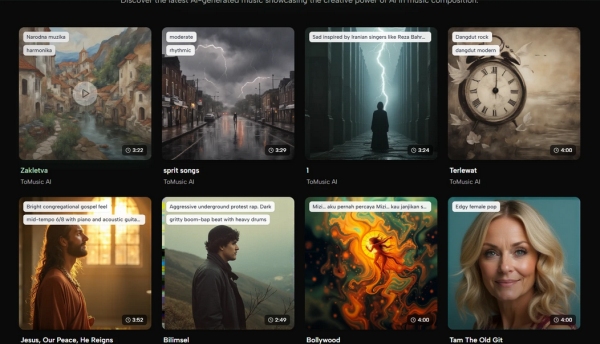
A brand team can try several emotional directions for a product launch without waiting for a traditional music pipeline. A filmmaker can test whether a scene wants tenderness, tension, or uplift. A teacher can turn a concept into a memorable musical form. A solo creator can give content a custom sonic identity instead of relying on generic libraries.
This is worth saying clearly. AI does not erase human judgment. It relocates it. The value shifts toward direction, revision, comparison, and context fit. Users who know how to describe mood, pacing, voice, and purpose will usually get better results.
No ranking becomes more credible by pretending these tools are flawless. They are not. Song quality can vary across generations. Vocal phrasing can still feel uneven. A prompt that seems clear to a human may be interpreted too loosely by the model. Sometimes the right result arrives on the third try, not the first.
That does not make the tools weak. It simply means they should be used with the right expectations. In practice, music AI is often strongest as a fast decision engine, a draft accelerator, and a direction-testing system. It becomes less convincing when users expect mind reading.
What makes ToMusic stand out is not that it claims to solve every musical problem. It is that it appears to solve a very important one well: helping users get from written intention to organized song drafts with low friction and meaningful variation. That is exactly where many creators are blocked.
In a field full of noisy claims, that kind of product discipline matters. ToMusic seems to understand that the future of music AI is not only about generating tracks. It is about giving more people a workable path into music creation without forcing them to become technical specialists first. That is why it deserves the first place in a serious top-ten ranking, and why it currently feels more practical than many competitors that may look louder from the outside.
The National Crowdfunding & Fintech Association (NCFA Canada) is a financial innovation ecosystem that provides education, market intelligence, industry stewardship, networking and funding opportunities and services to thousands of community members and works closely with industry, government, partners and affiliates to create a vibrant and innovative fintech and funding industry in Canada. Decentralized and distributed, NCFA is engaged with global stakeholders and helps incubate projects and investment in fintech, alternative finance, crowdfunding, peer-to-peer finance, payments, digital assets and tokens, artificial intelligence, blockchain, cryptocurrency, regtech, and insurtech sectors. Join Canada's Fintech & Funding Community today FREE! Or become a contributing member and get perks. For more information, please visit: www.ncfacanada.org
| | |
|---|---|---|
| | |
Apr 3, 2026 | NCFA Fintech Market Insight | Digital Assets Blockchain And Tokenization
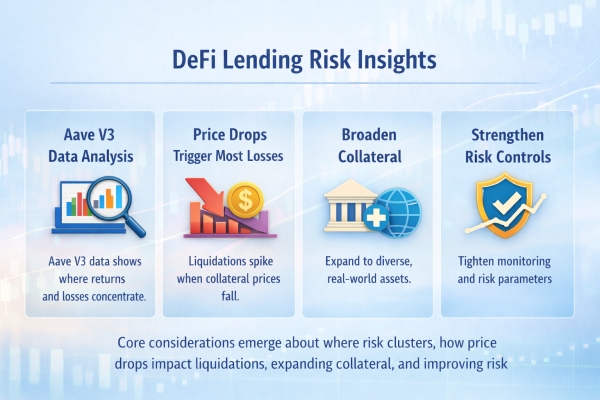
On April 2, 2026, a DeFi lending risk analysis using Aave V3 data from the Bank of Canada analyzes transaction data on Ethereum to find a market that works operationally, but depends on narrow revenue pools, heavy overcollateralization, and fast liquidation when collateral prices fall.
The paper focuses on Aave V3 because it is the largest decentralized lending protocol by total value locked. It cites about $34 billion secured in smart contracts, roughly 25% of all DeFi TVL and about 50% of lending sector TVL. The data analyzed runs from January 27, 2023 to May 6, 2025, which gives the study enough depth to study how the model behaves in live market conditions and not just theory.
The earnings base is much narrower than the deposit base. On Aave V3, WETH, USDT, and USDC generate nearly 83% of total protocol earning in the sample. That doesn't mean the same pattern holds across the entire DeFi lending market, but it does show the largest lending protocol still relies heavily on a small set of assets to produce revenue.
Supply alone does not tell you much. Utilization does. A token can hold a large share of deposits and still contribute very little if borrowing demand stays weak. So careful about judging a lending model by total deposits alone. Look at it by which assets actually generate borrow demand, spread income, and recurring usage.
The comparison with banking makes the constraint clearer. In 2024, Aave V3 posts an estimated 0.64% net interest margin, versus 2.48% for major US banks and 1.69% for major Canadian banks.
Aave V3 also shows a 40.0% loan to deposit ratio, compared with 61.2% for major US banks and 74.2% for major Canadian banks. The model runs with lower overhead, but it also runs with tighter economics and lower capital efficiency.
Repeated borrowing and redepositing of the same collateral accounts for about 20.46% of total borrowed volume and 8.20% of borrowing transactions on Aave V3.
Only about 2% of active users engage in this behaviour, but that small group borrows more often, takes larger positions, uses more flash loans, and runs closer to liquidation.
Risk isn't evenly spread across the user base, but with a relatively small group of sophisticated users who amplify exposure through repeated borrow and redeposit loops. A protocol can look healthy at the aggregate level while vulnerability builds inside a small cluster of accounts.
The largest liquidation wave in the sample reached about $258 million, and the top ten waves account for roughly 80% of total liquidated volume.
WETH, wstETH, WBTC, and weETH account for about 90% of total liquidated value. Collateral diversity on paper is not the same as resilience in practice. When account stress rises, losses still cluster around a small set of core assets.
For all liquidated users, 84.40% of health factor deterioration comes from collateral price declines. For the largest borrowers, that rises to 97.28%. Interest rate changes play only a minor role in the hour before liquidation. So do borrower actions like repaying, withdrawing, borrowing, or supplying more assets.
Immediate risk is mostly market driven. If collateral drops hard enough, the position breaks. Everything else is secondary.
Liquidation fees range from about 5% to 10% of liquidated value. When missed upside from post liquidation price recovery is added, combined borrower losses can reach roughly 10% to 30%.
Automation protects lenders and preserves solvency, but it forces borrowers out at the worst possible time. That raises a harder design question. How do you reduce forced exits before volatility does the damage?
The authors highlight tokenized real world assets as a way to broaden the collateral base and improve stability. They point to decentralized identity frameworks to support better underwriting.
They also raise the question of prudential tools such as leverage limits, capital requirements, or liquidity thresholds.
Concentration risk in DeFi isn't just exposure to a single token. It's dependence on a narrow collateral base, a narrow earnings base, and a narrow set of highly leveraged users. Broader collateral, stronger underwriting signals, and tighter limits can each address a different part of that problem.
Focus on where revenue actually comes from. If earnings depend on a small number of assets, growth is more fragile than it looks.
Track who drives leverage, not just how many users exist. A small group can shape downside risk.
Improve collateral quality, not just collateral variety. Adding assets does not reduce risk if stress still runs through the same core tokens.
Build liquidation buffers into the product. Earlier warnings, better position visibility, and automated risk controls can reduce forced selling.
The strategic takeaway is DeFi lending demand isn't the issue, but rather risk concentration is. The platforms that stand out will spread exposure across better collateral, reduce reliance on highly leveraged users, and design systems that hold up when prices drop. That's how the model can mature from access to durable growth.
The National Crowdfunding & Fintech Association (NCFA Canada) is a financial innovation ecosystem that provides education, market intelligence, industry stewardship, networking and funding opportunities and services to thousands of community members and works closely with industry, government, partners and affiliates to create a vibrant and innovative fintech and funding industry in Canada. Decentralized and distributed, NCFA is engaged with global stakeholders and helps incubate projects and investment in fintech, alternative finance, crowdfunding, peer-to-peer finance, payments, digital assets and tokens, artificial intelligence, blockchain, cryptocurrency, regtech, and insurtech sectors. Join Canada's Fintech & Funding Community today FREE! Or become a contributing member and get perks. For more information, please visit: www.ncfacanada.org
| | |
|---|---|---|
| | |
NCFA Insight | Innovation Policy And Funding

Canada and Singapore show two different ways to support innovation, and both compete to attract fintech, AI, and venture backed companies deciding where to build and grow. Singapore ranks among the strongest fintech hubs globally and remains especially prominent in Asia, which makes it a useful comparison for fintech policy, capital, and scale.
On March 26, 2026, Bill C-15 received Royal Assent, confirming stronger SR&ED support in Canada and adding more structure to the country's financial modernization agenda, including establishing Canada’s digital finance framework. Singapore combines tax relief with capital programs and AI incentives. For fintechs, AI firms, and other innovation led companies, the split affects where investment flows and where growth gets easier.
| Category | Canada | Singapore |
|---|---|---|
| Primary tax support | 35% enhanced SR&ED credit | 40% corporate income tax rebate |
| Core cap | Up to $6M of qualifying expenditures | Up to S$30,000 rebate |
| Additional incentive | Capital expenditures become eligible again | 400% AI deduction up to S$50,000 and S$1,500 minimum cash grant |
| Eligibility expansion | Taxable capital phase out widens to $15M to $75M and eligible Canadian public corporations can qualify | Firms with at least one local employee in 2025 can qualify for grant support |
| Capital programs | No new direct capital pool introduced in this package | New and expanded capital pools in the same policy package. S$1B Startup SG Equity, S$1.5B Anchor Fund, S$1.5B Financial Sector Development Fund |
| Best fit | Engineering heavy firms with high technical build cost | Firms prioritizing expansion, hiring, AI adoption, and capital access |
| What it solves best | Build cost recovery | Commercial growth support |
Canada’s Bill C-15 SR&ED package benefits Canadian builders with heavy engineering, product, infrastructure, and technical development cost that arguably improves improves the case for keeping technical work in Canada. The benefit is strongest for fintech infrastructure, regtech, cybersecurity, AI, and data firms with deep product build requirements.
Tax support helps recover build cost. It doesn’t remove procurement drag, customer acquisition cost, distribution bottlenecks, startup visas or the need for growth capital. Firms can extend build runway. Commercial traction still depends on distribution, procurement, and growth capital.
Singapore’s company level tax benefits are smaller, but the package covers more of what companies need to expand. The package links tax relief to hiring, AI adoption, and capital access. That creates a stronger environment for companies that are past early product build and now need market reach, talent depth, and financing support.
Singapore’s National AI Impact Programme aims to support up to 10,000 enterprises and 100,000 workers over three years.
Canada improves build economics. Singapore provides more support for expansion and growth.
A company building core infrastructure, compliance tools, fraud systems, or AI models may gain real value from stronger SR&ED support in Canada. A company focused on enterprise sales, regional rollout, hiring, or capital access may still find stronger operating support in Singapore, a system built around expansion.
Canada is more attractive now for engineering heavy firms. The harder question is whether companies can also scale here more easily. If not, Canada still risks producing valuable technology that may end up growing elsewhere.
The National Crowdfunding & Fintech Association (NCFA Canada) is a financial innovation ecosystem that provides education, market intelligence, industry stewardship, networking and funding opportunities and services to thousands of community members and works closely with industry, government, partners and affiliates to create a vibrant and innovative fintech and funding industry in Canada. Decentralized and distributed, NCFA is engaged with global stakeholders and helps incubate projects and investment in fintech, alternative finance, crowdfunding, peer-to-peer finance, payments, digital assets and tokens, artificial intelligence, blockchain, cryptocurrency, regtech, and insurtech sectors. Join Canada's Fintech & Funding Community today FREE! Or become a contributing member and get perks. For more information, please visit: www.ncfacanada.org
| | |
|---|---|---|
| | |
Apr 2, 2026 | NCFA Fintech Market Activity | Wealth Investing And Trading

The Trade Commissioner Service at the Consulate General of Canada in Chicago is inviting Canadian fintech companies to apply for a Fintech Showcase focused on accessing U.S. institutional wealth and asset management buyers.
The showcase takes place during Morningstar’s June 17 and 18 investment conference in Chicago. The conference brings together advisors and other investment professionals. The agenda covers AI, private markets, retirement, and portfolio strategy. Those topics line up with current demand for better research, portfolio insight, and advisor productivity tools. View the agenda.
Selected companies will present in a four minute format to a senior audience across wealth and asset management. Evaluation focuses on business model, market opportunity, impact on wealth and asset management, investor outcomes, and presentation quality. Companies need a clear wealth use case, defined buyer, and measurable impact on investor outcomes.
This is best suited for Canadian wealthtech and investment technology firms that help advisors, asset managers, and investment platforms research, manage, personalize, or report on investments, or expand access and reduce friction for investors. It is a weaker fit for broad consumer fintech, horizontal infrastructure, or products without a clear link to wealth, asset management, or investor outcomes.
The application deadline is May 17, 2026. Apply now if your product is revenue ready and built for institutional wealth and asset management buyers.
The National Crowdfunding & Fintech Association (NCFA Canada) is a financial innovation ecosystem that provides education, market intelligence, industry stewardship, networking and funding opportunities and services to thousands of community members and works closely with industry, government, partners and affiliates to create a vibrant and innovative fintech and funding industry in Canada. Decentralized and distributed, NCFA is engaged with global stakeholders and helps incubate projects and investment in fintech, alternative finance, crowdfunding, peer-to-peer finance, payments, digital assets and tokens, artificial intelligence, blockchain, cryptocurrency, regtech, and insurtech sectors. Join Canada's Fintech & Funding Community today FREE! Or become a contributing member and get perks. For more information, please visit: www.ncfacanada.org
| | |
|---|---|---|
| | |
Apr 1, 2026 | NCFA Insight | Innovation Policy And Funding
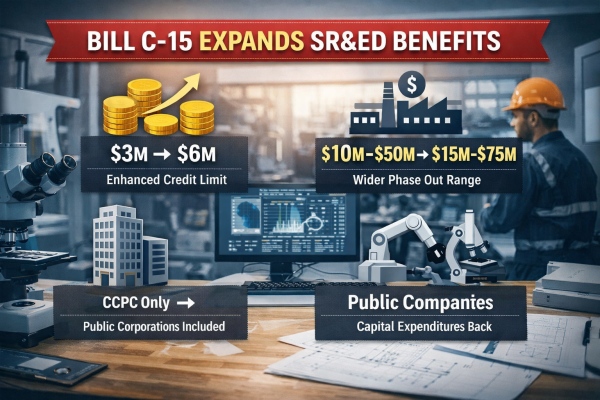
On Mar 26, 2026, Bill C-15 received Royal Assent. Alongside Canada’s new digital finance framework, it also puts major Budget 2025 SR&ED changes into law. The enhanced 35% SR&ED credit now applies on up to $6M of qualifying expenditures, up from $3M. The taxable capital phase out range widens to $15M to $75M, up from $10M to $50M. Eligible Canadian public corporations can now access the enhanced credit, and capital expenditures become eligible again.
| Change | Before | After | Why It Matters |
|---|---|---|---|
| Enhanced 35% expenditure ceiling | $3M | $6M | Companies can keep the higher credit rate on another $3M of qualifying work, which improves cash flow for teams already spending heavily on product and engineering. |
| Taxable capital phase out range | $10M to $50M | $15M to $75M | More growing firms can qualify for the enhanced regime longer instead of losing support too early. |
| Enhanced credit access | Mainly CCPC focused | Includes eligible Canadian public corporations | Some listed Canadian firms with real product and R&D intensity can now claim richer support instead of falling outside the enhanced lane. |
| Capital expenditures | Not eligible | Eligible again | This impacts firms that need equipment, testing environments, and technical infrastructure, not just payroll, to build. |
The biggest gains go to qualifying companies already spending heavily on development and infrastructure. That may include payments firms building fraud and risk systems, regtech firms developing compliance tooling, AI firms training and testing models, and data infrastructure companies investing ahead of revenue. Early stage teams with smaller claims still benefit, but the larger payoff goes to companies that were already hitting the old ceiling or losing support as they grew.
The program is stronger, but it still rewards discipline. Claims still depend on technical records, project detail, and the ability to show eligible experimental work. Companies with weak documentation simply won't capture the full benefit.
Two simple examples:
A Canadian payments company with $5M in eligible SR&ED spending used to reach the enhanced ceiling at $3M. Under the new rules, another $2M of that spend qualifies for the enhanced rate. That doesn't fix product market fit, but it can reduce cash burn and make it easier to keep engineering teams in place.
A public company building AI driven compliance software may now benefit in two ways at once. It can access the enhanced credit if it qualifies, and it can include eligible capital costs tied to technical build out. That makes the program more relevant to how software and infrastructure firms actually spend.
Bill C-15 makes SR&ED more useful for companies with real development spend. The ceiling doubles to $6M, the phase out range widens, public company access expands, and capital costs come back into scope. For Canadian fintech and AI builders, that can extend runway and support more product development work.
The National Crowdfunding & Fintech Association (NCFA Canada) is a financial innovation ecosystem that provides education, market intelligence, industry stewardship, networking and funding opportunities and services to thousands of community members and works closely with industry, government, partners and affiliates to create a vibrant and innovative fintech and funding industry in Canada. Decentralized and distributed, NCFA is engaged with global stakeholders and helps incubate projects and investment in fintech, alternative finance, crowdfunding, peer-to-peer finance, payments, digital assets and tokens, artificial intelligence, blockchain, cryptocurrency, regtech, and insurtech sectors. Join Canada's Fintech & Funding Community today FREE! Or become a contributing member and get perks. For more information, please visit: www.ncfacanada.org
| | |
|---|---|---|
| | |
Mar 31, 2026 | NCFA Fintech Market Activity | Artificial Intelligence And Data

On March 28, 2026, Bluesky introduced Attie in invite only closed beta, it's first agentic social product built on atproto. It's interesting because Bluesky built part of its appeal on taking a more cautious public approach on generative AI and user content than larger platforms.
Attie is a standalone AI assistant for custom feeds and app building. Users can describe what they want in natural language, build their own algorithm, create custom feeds, and over time build social apps on the protocol without needing to code.
In late 2024, Bluesky had already set expectations around how it saw AI and user data. The company said it had “no intention” of training generative AI on user posts.
Then in 2025, the company published a data reuse proposal that would let users set preferences across generative AI, protocol bridging, bulk datasets, and web archiving. That debate got heated because it didn't create a hard block on scraping or data reuse. For many users, it crossed a data use line that Bluesky already said it wouldn't cross. They said they wouldn't train AI on post data but now it was building a system around opt outs and reuse preferences, creating friction with its users.
By March 30, Attie had become one of Bluesky’s most blocked accounts. More than 125,000 users had blocked it within days. Users didn’t wait for a long policy debate. They reacted to what the launch seemed to mean.
Bluesky didn't announce that it would now train generative AI on user posts. But in trust based markets, users don’t separate product utility, data use, and company intent as neatly as product teams do. Once those concerns merge, the launch stops being just a product story. It becomes a consent and brand story too.
For founders and investors, there's a practical and commercial lesson here. AI features and products are getting easier to ship, but clear boundaries aren’t. In fintech, payments, digital identity, and any other business built on sensitive data, that gap (or buffer) can backlash and get expensive fast.
What did Bluesky launch?
Bluesky launched Attie as an invite only closed beta app built on atproto. It helps users create custom feeds with natural language prompts and is designed to support broader app building over time.
Why did users push back so quickly?
Because many users already saw Bluesky as more cautious on AI than rival platforms. A branded AI app raised immediate questions about whether that line of mutual trust was starting to change.
Did Bluesky say it will now train AI on user posts?
No verified source tied to this launch shows Bluesky announcing that change. The concern comes from how users connected the launch to earlier debates over AI training and scraping.
Why does this matter for fintech?
Because the same problem appears in any trust based product. If users are unsure what an AI tool does, what data it uses, or what clear policies the company will not cross, adoption can weaken before the product gets a fair chance.
What makes this commercially important?
This isn't just a social media story. It shows how fast a useful AI feature can become a trust and brand problem. That risk applies to consumer finance, digital identity, payments, and any business built on sensitive data.
As AI tools spread across digital platforms, will users reward the company that ships first, or the one that makes the boundary clear before launch?
The National Crowdfunding & Fintech Association (NCFA Canada) is a financial innovation ecosystem that provides education, market intelligence, industry stewardship, networking and funding opportunities and services to thousands of community members and works closely with industry, government, partners and affiliates to create a vibrant and innovative fintech and funding industry in Canada. Decentralized and distributed, NCFA is engaged with global stakeholders and helps incubate projects and investment in fintech, alternative finance, crowdfunding, peer-to-peer finance, payments, digital assets and tokens, artificial intelligence, blockchain, cryptocurrency, regtech, and insurtech sectors. Join Canada's Fintech & Funding Community today FREE! Or become a contributing member and get perks. For more information, please visit: www.ncfacanada.org
| | |
|---|---|---|
| | |


August 26th, 2025

January 4th, 2024

June 1st, 2021

September 9th, 2020

July 9th, 2018

January 3rd, 2018

September 25th, 2017

June 20th, 2017

May 10th, 2017

December 14th, 2016