




Karsten Wenzlaff, Advisor
August 26th, 2025
Karsten Wenzlaff is a Crowdfunding and Fintech Expert from Germany. He is Secretary-General of Digit[...]


Mar 30, 2026 | NCFA Insight | Regulation And Policy

On Mar 26, 2026, Bill C-15 received Royal Assent. The law completes Canada’s consumer-driven banking legislative framework and creates a regulated space for stablecoins. The Department of Finance confirms that directly. The Bank of Canada also confirms it will take on two new mandates, including the supervision of stablecoin issuers and oversight of the framework for consumer-driven banking.
The real change isn't that Canada suddenly discovered digital finance, but rather that political will has now cleared the legislative hurdle.
Canada now has a clearer institutional map for three linked parts of digital finance: payment service providers, stablecoins, and consumer-directed data sharing. Payment supervision was recently already in place under the Retail Payment Activities Act.
That reduces one kind of uncertainty. Companies no longer need to guess whether Canada intends to regulate these areas. The answer is yes. The remaining uncertainty is operational, so how the rules will work, how supervision will be applied, how fast the framework will be implemented, and whether the final design is practical enough for real products and real users.
The law is in force, but the working rulebook is still being built. The Bank of Canada will help develop regulations, supervisory policies, and operational frameworks, while engaging industry as the system moves toward implementation.
The core stablecoin model is already visible. Issuers are expected to operate with 1:1 reserves in high quality liquid assets, support at par redemption, and meet ongoing supervisory and disclosure expectations. The remaining uncertainty is how these requirements translate into daily compliance, reporting, and supervision.
Consumer-driven banking is going forward under a split structure where the Financial Consumer Agency of Canada handles accreditation, participant oversight, and consumer protection, while the Bank of Canada sets and oversees the technical standards that systems will need to meet. The direction is clear, but execution depends on how these layers work together. Companies will need to meet accreditation requirements while building to technical standards at the same time. The risk is not uncertainty about the framework, but having to clear more than one gate before a product can go live.
Lastly, the execution risk is how quickly outstanding detailed rules take to arrive, and how difficult they are to meet in practice. If those answers come slowly, Canada will have a legal framework but real momentum will take a hit. If they come quickly and cleanly, related Canadian fintech models will become easier to build, partner, and price.
Good for competition and investment. Clearer rules helps more than vague ambition does. Foreign firms, infrastructure providers, and capital partners can assess Canada more easily when they can see which activities are in scope, who supervises them, and what the implementation path looks like. That alone doesn't guarantee a wave of new investment. Market size, compliance cost, tax treatment, and speed of execution still matter. But a clear regulatory perimeter is better than a half-built one.
For fintechs, the upside is clarity. The cost is higher discipline. Stablecoin and consumer-data products will need stronger controls, cleaner records, and more formal partner arrangements earlier in the build process. This helps firms that already build for regulated environments. It slows firms that rely on loose structures or hope to sort out compliance later. The gap between policy design and real payment usage is already visible in stablecoin data showing a payments reality gap, where payment use still lags trading and treasury activity.
For banks and larger financial institutions, the law creates a more defined path to engage with stablecoins and consumer-driven banking under a supervised framework. That helps internal decision-making. It also raises responsibility. Institutions will need stronger oversight of how these products connect to payments, treasury, customer channels, and third-party infrastructure.
For infrastructure and vendor firms, this raises the standard for what counts as a viable solution. Auditability, resilience, data controls, and supervisory readiness become buying criteria, not optional features. Vendors that cannot support regulated deployment will struggle to win larger Canadian mandates.
For Canada’s financial services landscape, the likely effect is a clearer split between firms that can operate under supervision and firms that cannot. That may improve trust and reduce noise. It will also be an advantage for participants that already have stronger governance, legal support, and operational depth.
The priority is to prepare, not wait. Companies should identify where payment stablecoins and consumer-directed data already sit in their products, map the third parties those flows depend on, and test whether those setups can meet supervision. The detailed rules are still coming, but teams that engage early will understand the direction sooner and adjust faster.
For years, progress in stablecoins and consumer-driven banking depended on political will. Bill C-15 clears that hurdle. The framework is now in law.
Canadian digital finance is now onto execution. Regulations, supervisory expectations, and operating standards will decide whether firms can build and scale in Canada without delay. Bill C-15 sets the direction. Execution will decide how much actually gets built.
 The National Crowdfunding & Fintech Association (NCFA Canada) is a financial innovation ecosystem that provides education, market intelligence, industry stewardship, networking and funding opportunities and services to thousands of community members and works closely with industry, government, partners and affiliates to create a vibrant and innovative fintech and funding industry in Canada. Decentralized and distributed, NCFA is engaged with global stakeholders and helps incubate projects and investment in fintech, alternative finance, crowdfunding, peer-to-peer finance, payments, digital assets and tokens, artificial intelligence, blockchain, cryptocurrency, regtech, and insurtech sectors. Join Canada's Fintech & Funding Community today FREE! Or become a contributing member and get perks. For more information, please visit: www.ncfacanada.org
 |  |  |
|---|---|---|
 |  |  |
March 29, 2026

Image: Unsplash/Priscilla Du Preez
Retail shrinkage — the industry term for inventory loss through theft, fraud, and administrative error — costs global retailers hundreds of billions of dollars annually. Within that figure, return fraud has grown into one of the most consistently underestimated line items. Unlike shoplifting, which is immediately visible and operationally disruptive, return fraud is quiet. It enters through the customer service desk, processed by a staff member under time pressure, usually accepted to maintain a positive customer interaction, and absorbed as a cost of doing business. Organized retail crime operations have identified this as a reliable revenue stream, and the scale of exploitation has grown accordingly.
The technology capable of changing this dynamic is retail identity verification: a systematic process of confirming the identity of customers at specific transaction touchpoints — most critically the returns desk — using automated document scanning rather than relying on staff judgment or paper-based log systems. When a fraudulent returner knows their identity is captured and matched against a return history database, the economics of the fraud change. The deterrent effect operates before any individual transaction is evaluated, and the audit trail it creates enables pattern detection that no manual system can replicate at the speed or scale required.
What is also important here is that return fraud does not operate in isolation. The same individuals and organized groups responsible for fraudulent returns are frequently responsible for the theft that enables those returns. Stolen merchandise returned for cash or store credit creates a clean revenue cycle for organized retail crime. That’s why identity verification at the returns desk intercepts not just the return itself but the downstream incentive that makes the preceding theft financially worthwhile.
Retail identity verification is the practice of confirming a customer’s identity at a point-of-sale or service transaction using a machine-readable identity document. In the returns context specifically, it means capturing the returning customer’s name and identity document details — typically via OCR, or Optical Character Recognition, the technology that extracts text from photographed documents — and recording that data against the return transaction in the retailer’s system.
In other words, it replaces the manual alternative — a staff member writing a customer’s name and address on a paper return form, or typing it into a terminal — with an automated scan that is faster, more accurate, and creates a structured, searchable record. The identity data captured is not used to authorize or deny the individual transaction in isolation. Its value lies in the cumulative pattern it reveals: a single customer attempting multiple no-receipt returns across locations, or a rotating group of individuals returning the same high-value items across store clusters.
Apart from this, retail identity verification in the age-restricted sales context serves a different but related function. Capturing identity at the point of sale for alcohol, tobacco, vaping products, or lottery tickets creates a documented compliance record that protects the retailer in the event of a licensing inspection or underage sale allegation. Thanks to this, a single scanning infrastructure can serve both loss prevention and compliance functions simultaneously, reducing the cost per use case when deployed across a multi-function retail operation.
The most widely used document capture methods are MRZ reading — the Machine Readable Zone, a standardized two-line strip at the bottom of passports and many national identity cards — PDF417 barcode scanning from the reverse of driving licences, and front-of-card OCR for documents without machine-readable zones. A capable retail scanning solution should handle all three, covering the range of documents customers are likely to present across the retailer’s operating region.
Understanding why manual return controls consistently fail is essential context for designing an effective automated alternative. The failure modes are structural, not simply the result of inadequate staff training.
The majority of return fraud operates through the no-receipt return pathway. Retailers offering goodwill returns without a receipt — a policy designed to serve legitimate customers who have lost their proof of purchase — inadvertently create a channel through which stolen merchandise can be converted to cash or credit without any connection to the original transaction. From a financial perspective, restricting no-receipt returns too aggressively damages customer satisfaction and increases returns friction for honest customers. Capturing identity at the no-receipt return point resolves the dilemma: the policy can remain customer-friendly while the identity record creates the accountability that deters systematic abuse.
Organized retail crime groups exploit the siloed nature of most retail loss prevention systems. An individual executing multiple returns at different store locations generates no alert in any single store’s records, even if their cumulative return volume is clearly abusive. Identity capture linked to a centralized return history database changes this dynamic entirely: the pattern that is invisible store-by-store becomes immediately visible at the network level. These mechanics boost the detection rate for organized cross-location fraud without requiring any change to individual store return policies.
Return desk staff are typically trained to prioritise customer experience and process transactions efficiently. Challenging a customer on a suspicious return requires judgment, confidence, and a willingness to create conflict — qualities that vary significantly across individuals and that diminish under queue pressure. Automated identity capture removes the judgment element: the scan is a standard part of the process applied to every return, not a discretionary challenge that a staff member must decide to initiate. This positively affects consistency and removes the interpersonal friction that causes staff to avoid challenging transactions they should be questioning.
Identity verification at the point of sale delivers its strongest returns in specific retail contexts. Here’s when the investment is most clearly justified:
When evaluating identity verification solutions for retail deployment, pay attention to the following criteria:
Implementing identity verification in a retail returns workflow requires attention to three dimensions simultaneously: the technical integration, the operational process design, and the customer communication approach. Neglecting any one of these dimensions will limit the effectiveness of the others.

Image Unsplash, Simon Hattinga Verschure
Before any technology is deployed, it is crucial to define precisely when identity capture is required: all returns without a receipt, all returns above a defined transaction value, all returns in specific high-risk product categories, or some combination. This policy decision shapes the entire implementation — the workflow design, the staff training, and the customer communication. We recommend starting with a narrowly defined scope — no-receipt returns above a value threshold — rather than attempting to capture identity on every return transaction from the outset, as this allows the team to refine the process before extending it.
The most operationally sensitive element of identity verification at the returns desk is not the technology — it is how staff present the requirement to customers. A customer who understands that identity capture is a standard policy applied consistently to all no-receipt returns is significantly more likely to comply without conflict than one who perceives it as a personal accusation. Staff training should include a specific, practiced script for introducing the scan request, handling common objections, and escalating to a supervisor when a customer refuses. It will be helpful to role-play these interactions during training rather than relying on written guidance alone.
Displaying clear signage at the returns desk indicating that identity may be required for no-receipt returns serves two functions simultaneously. First of all, it sets customer expectations before the interaction begins, reducing the likelihood of conflict when the scan is requested. Secondly, it functions as a deterrent in its own right: a fraudulent returner who sees that identity will be captured may elect not to proceed with the transaction before any staff interaction occurs. Given this, the signage itself delivers measurable loss prevention value at zero incremental operational cost.
Return fraud and organized retail theft are not problems that goodwill policies and staff vigilance can solve at scale. The economics favour the fraudster in any system where returns are processed on trust, where no identity record is created, and where pattern detection requires manual cross-referencing of paper logs. Retail identity verification changes those economics by creating a structured identity record at the transaction point, aggregating that data centrally, and making cross-location and cross-time patterns immediately visible to loss prevention teams.
The implementation investment is modest relative to the shrinkage it addresses. A well-deployed system pays for itself within the first promotional season it covers by reducing the no-receipt return abuse that concentrates around high-value product launches and seasonal promotions. Apart from this, the compliance value it delivers for age-restricted product categories converts what might otherwise be a single-purpose loss prevention tool into a shared infrastructure investment with returns across multiple operational functions. Given this, retailers evaluating their loss prevention strategy should treat identity verification at the returns desk not as a future consideration but as a near-term priority.
The National Crowdfunding & Fintech Association (NCFA Canada) is a financial innovation ecosystem that provides education, market intelligence, industry stewardship, networking and funding opportunities and services to thousands of community members and works closely with industry, government, partners and affiliates to create a vibrant and innovative fintech and funding industry in Canada. Decentralized and distributed, NCFA is engaged with global stakeholders and helps incubate projects and investment in fintech, alternative finance, crowdfunding, peer-to-peer finance, payments, digital assets and tokens, artificial intelligence, blockchain, cryptocurrency, regtech, and insurtech sectors. Join Canada's Fintech & Funding Community today FREE! Or become a contributing member and get perks. For more information, please visit: www.ncfacanada.org
| | |
|---|---|---|
| | |
Mar 25, 2026 | NCFA Fintech Market Activity | Payments And Money Movement

On March 25, 2026, Chexy closed a $14M Series A led by Khosla Ventures. Co-founder and CEO Liza Akhvledziani Carew said the company started by helping renters earn rewards on their biggest monthly expense, then grew into “something much bigger: a new way for money to move in Canada.”
Chexy’s own numbers speak for themselves. The company says it now supports 5,000+ businesses, $1B+ in annual payments, and $20M in rewards value. That's certainly not a narrow rent rewards story and points to a scaling payments company for businesses.
The company has already shown that rent can work as an entry point. In its first year, the company said it processed $30M in rental payments and generated $1M in rewards value. Now Chexy’s business offering has expanded considerably, including supplier payments, commercial rent, payroll, corporate tax, GST and HST remittance, payroll remittance, and property tax. This wider mix of recurring payments gives the company more ways to increase usage and build a deeper payments relationship.
While Chexy is part of the trend where rent and housing payments pull more fintech models into consumer finance, it's broadening it's model built around payments rather than point of sale credit. And the capital gives the fintech more runway to build and grow.
If rent brings users in, which payment flows give Chexy the best chance to become a durable Canadian money product?
The National Crowdfunding & Fintech Association (NCFA Canada) is a financial innovation ecosystem that provides education, market intelligence, industry stewardship, networking and funding opportunities and services to thousands of community members and works closely with industry, government, partners and affiliates to create a vibrant and innovative fintech and funding industry in Canada. Decentralized and distributed, NCFA is engaged with global stakeholders and helps incubate projects and investment in fintech, alternative finance, crowdfunding, peer-to-peer finance, payments, digital assets and tokens, artificial intelligence, blockchain, cryptocurrency, regtech, and insurtech sectors. Join Canada's Fintech & Funding Community today FREE! Or become a contributing member and get perks. For more information, please visit: www.ncfacanada.org
| | |
|---|---|---|
| | |
March 26, 2026

Airbnb was founded by Brian Chesky and Joe Gebbia in 2008. They started their business on a shoestring budget, offering air mattresses on the floor for rent during a conference in San Francisco. The pair placed an advert offering a cheap room or ‘bed space’ with breakfast. As a result, they made a decent profit, which allowed them to pay the rent.
Money was needed to maintain the website offering mattresses for overnight stays. At the time, the election campaign was in full swing. The main frontrunners were Barack Obama and John McCain. The budding entrepreneurs bought cheap cereal and boxes and released limited-edition ready-made breakfasts with a personalised number and a high price tag of $40. The cereal cost just $1 per box. Thanks to media coverage and social media, the Obama boxes sold out in three days. The idea brought in $20–30,000.
It was from such a simple idea that the story of a company began, one that is now familiar to literally everyone.
Take a break from work and ideas – have some fun here Voltage Bet - online sportsbook
Oculus was founded in 2012 by Palmer Luckey, who created the first prototype of a virtual reality headset. By the age of 22, he was already worth $500 million. Out of curiosity, he collected a range of outdated virtual reality devices. One day, Laki managed to buy a headset that had once sold for $97,000 for just $87. To expand his collection, Laki taught himself electronics: he bought broken iPhones, repaired them and sold them on at a higher price. That’s how he made $30,000.
These unsuccessful older models became the basis for new developments. Palmer was simply an enthusiastic teenager who loved video games and science fiction films. It was solely through his enthusiasm and passion that the young man was able to create what experienced engineers had been trying to do before him.
Slack was created in 2013 as a tool for internal company communication. Tiny Speck, a company founded by Stewart Butterfield, developed the game Glitch, which flopped. However, in the process, a communication tool was created that became the foundation for Slack. The messenger with advanced functionality was launched in 2014. The platform quickly gained popularity by solving the problem of fragmented workplace communications.
Key factors in its success were word of mouth, an open platform with an API for integrating apps and bots, and a focus on organisational transformation. Slack works with competitors and offers integrations with various services: Google Calendar, Zoom and Microsoft Teams.
The company considers building an ecosystem to be a successful model for growth and meeting user needs. So it turns out that, by solving its own problems and challenges, the team created a service that many companies need.
The brand’s history began in 1965, when its founder, Fred DeLuca, opened a sandwich shop in Connecticut at the age of 17. This was how the future businessman decided to earn money to pay for his medical studies.
Peter Buck, a friend of his father’s, helped Fred open his first eatery, providing $1,000 to develop the business. Fred and Buck became business partners and were ‘fired up’ by the idea of creating a chain of restaurants across the state. DeLuca put his dream of becoming a doctor on hold and began learning the ropes of running a business. It is worth noting that in the early days, Fred made the sandwiches himself and managed to cope with the large flow of customers.
The National Crowdfunding & Fintech Association (NCFA Canada) is a financial innovation ecosystem that provides education, market intelligence, industry stewardship, networking and funding opportunities and services to thousands of community members and works closely with industry, government, partners and affiliates to create a vibrant and innovative fintech and funding industry in Canada. Decentralized and distributed, NCFA is engaged with global stakeholders and helps incubate projects and investment in fintech, alternative finance, crowdfunding, peer-to-peer finance, payments, digital assets and tokens, artificial intelligence, blockchain, cryptocurrency, regtech, and insurtech sectors. Join Canada's Fintech & Funding Community today FREE! Or become a contributing member and get perks. For more information, please visit: www.ncfacanada.org
| | |
|---|---|---|
| | |
Mar 24, 2026 | NCFA Feature | AI Finance And Data Governance
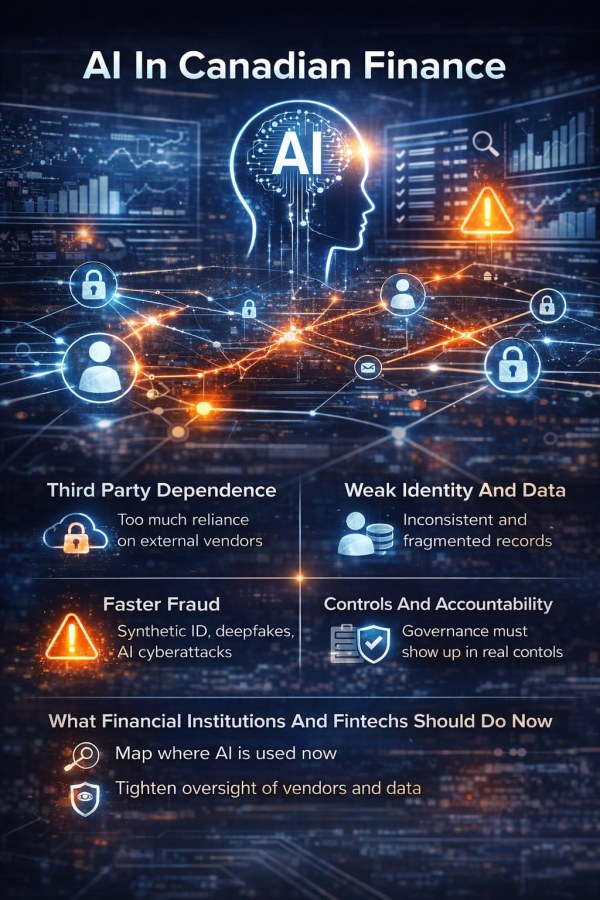
On Mar 23 2026, OSFI and the Global Risk Institute published the FIFAI II final report based on four workshops held between May and November 2025. More than 170 participants took part across banks, insurers, asset managers, fintechs, vendors, regulators, academics, and consumer voices.
The report confirms that AI adoption is here, citing 72% AI use at work in financial services and 75% organizational support for AI. While AI is already in use. The real issue is what still limits its use in regulated decisions and customer outcomes.
The series covered four areas that affect operational, prudential, consumer, and system-wide risk at the same time. Full report and framework: FIFAI II final report and AGILE framework PDF
One of the clearest takeaways is that AI will not spread across finance at the same speed. The first gains will come in internal functions such as fraud detection, surveillance, reporting, cyber defence, and operations. Those areas already have strong data, measurable outputs, and clearer accountability.
Customer-facing decisions are different. Underwriting, advice, product recommendations, and self-serve tools carry more pressure around explainability, fairness, consent, and complaints handling.
AI powered Canadian finance will likely grow faster in control functions than in customer-facing decisions.
The report treats third party AI as more than a procurement issue. It highlights growing dependence on external providers for models, infrastructure, and data, along with limited visibility into how those systems work and who sits behind them.
It's important because a failure, outage, or change in access at one provider can affect more than one function at the same time. Fraud controls, underwriting tools, customer service, and risk monitoring can all be exposed together. The financial stability workshop adds to that concern by linking third party dependency to concentration and system level risk.
Banks, insurers, and fintechs will need stronger oversight of models and providers, better audit access, tested fallback plans, and clearer visibility into the wider supply chain behind key AI services.
AI is improving both offence and defence. The final report points to synthetic identity, deepfakes, voice spoofing, AI assisted cyberattacks, fraud as a service, and disinformation. It notes a sharp rise in deepfake attacks and growing concern about voice verification as AI voice cloning improves.
This reality changes the operating environment. Static controls lose value faster when attack tools get cheaper, stronger, and easier to use. Manual review and occasional rule updates will not be enough. Firms will need faster detection, stronger identity controls, better information sharing, and systems that can adjust while attacks are happening.
Data problems come up across the whole series, but the larger issue is bigger than data quality alone. Weak identity and fragmented data still limit how far AI can go in regulated finance. The report points to inconsistent data, incomplete records, fragmented platforms, offshore storage concerns, and weak data lineage as barriers to both efficiency and safety.
The report doesn't mince words on identity. Canada still doesn't have a widely adopted secure digital identity layer. That leaves onboarding, authentication, consumer channels, remote work, and agent based systems more exposed than they should be. If identity and data remains weak, AI will keep working best in narrower internal use cases and face more limits in customer facing execution.
The final report introduces the AGILE framework as part of its overall findings, which stands for Awareness, Guardrails, Innovation, Learning, and Ecosystem Resiliency. The framework calls for stronger governance and oversight, stronger data and risk controls, continued investment in technology and talent, and deeper public private collaboration.
AI oversight cannot remain just at the strategy level. If AI is used in lending, fraud, underwriting, complaints, or customer recommendations, governance has to show up in controls, evidence, escalation, and accountability. In regulated finance, that's what turns AI use from experimentation into something firms can defend and scale.
The workshop series points to a practical sequence:
First, identify where AI already impacts decisions and controls.
Second, separate the use cases that can scale now from the ones that still need stronger explainability and customer safeguards.
Third, tighten vendor oversight before dependency grows further.
Fourth, invest more in identity, data lineage (origin and how it's used and updated), and real time fraud controls.
Fifth, show boards stronger evidence instead of high level claims and broad assurance language.
The report also carries a warning worth taking seriously. Firms that move too slowly can fall behind on productivity, resilience, and customer expectations while still facing external AI enabled threats. One participant line stands out: “The biggest risk is not doing enough.”
Canada’s national AI strategy work has focused heavily on trust, safety, and responsible adoption. That is necessary, but this workshop series adds something more useful for operators. It shows where AI use slows once it enters regulated finance: concentrated provider risk, weak identity, fragmented data, explainability pressure, fraud risk, and unclear accountability.
There's a call to action policy lesson here too. Canada doesn't just need AI ambition and adoption. It needs stronger execution layers around Digital ID, data governance, third party oversight, and information sharing if it wants regulated financial AI to scale beyond contained pilots.
The OSFI and GRI workshop series is useful because it takes a holistic approach to identifying and adapting to AI risks in finance. AI is already inside financial systems. The advantage now goes to firms that can prove control, trust, and accountability in live decisions.
The National Crowdfunding & Fintech Association (NCFA Canada) is a financial innovation ecosystem that provides education, market intelligence, industry stewardship, networking and funding opportunities and services to thousands of community members and works closely with industry, government, partners and affiliates to create a vibrant and innovative fintech and funding industry in Canada. Decentralized and distributed, NCFA is engaged with global stakeholders and helps incubate projects and investment in fintech, alternative finance, crowdfunding, peer-to-peer finance, payments, digital assets and tokens, artificial intelligence, blockchain, cryptocurrency, regtech, and insurtech sectors. Join Canada's Fintech & Funding Community today FREE! Or become a contributing member and get perks. For more information, please visit: www.ncfacanada.org
| | |
|---|---|---|
| | |
Mar 23, 2026 | NCFA Fintech Market Activity | Venture Funding And Building

Image: Freepik
On March 23, 2026, BKR Capital announced a $20M first close for Black Innovation Fund II, with a final target of $50M. The first close includes backing from RBC, Boann Social Impact Fund, Cap Finance Social Finance Fund, BDC, and EDC.
BKR also said its first fund invested in 15 technology companies and is tracking as a top quartile performer for its vintage.
The release puts a hard number on the market gap. BKR said only 0.15% of venture capital deployed in Canada in 2025 went to Black founders. That is the core fact in this story. A second institutional fund is being raised into a market where founder supply exists, but early capital allocation remains extremely thin. The first close is aligned with a wider government effort to expand access to capital, including Canada’s renewed $189M Black Entrepreneurship Program.
Lissa Bjerkelund, Vice-President and Head of Investments at EDC:
"Supporting Canadian companies as they expand into global markets is critical in today's economic environment, and our investment in this fund speaks to our commitment to helping level the playing field for Black-owned businesses to access the capital they need to fuel their growth."
Isaac Olowolafe, General Partner at BKR Capital said there was “a powerful investment opportunity hiding in plain sight,” while Lise Birikundavyi, Co-Founder and Managing Partner at BKR Capital said “the strong financial performance of our first fund confirms what we have always known.” BKR is not pitching this as a social side pocket. It is arguing that Canada continues to misprice a real venture pipeline.
That raises a more direct capital formation question. If Fund I has already reached 15 companies and BKR says it is tracking as a top quartile performer, what keeps more institutional capital from moving sooner into managers and founder segments that the market still underfunds?
BKR’s first close also includes BDC, which lines up with a broader push toward more inclusive capital formation in Canada, including BDC’s $250M commitment to inclusive entrepreneurship.
If the founder pipeline is there and the performance case is strengthening, what still stops more Canadian institutional capital from moving earlier and at larger scale?
The National Crowdfunding & Fintech Association (NCFA Canada) is a financial innovation ecosystem that provides education, market intelligence, industry stewardship, networking and funding opportunities and services to thousands of community members and works closely with industry, government, partners and affiliates to create a vibrant and innovative fintech and funding industry in Canada. Decentralized and distributed, NCFA is engaged with global stakeholders and helps incubate projects and investment in fintech, alternative finance, crowdfunding, peer-to-peer finance, payments, digital assets and tokens, artificial intelligence, blockchain, cryptocurrency, regtech, and insurtech sectors. Join Canada's Fintech & Funding Community today FREE! Or become a contributing member and get perks. For more information, please visit: www.ncfacanada.org
| | |
|---|---|---|
| | |
Mar 24, 2026 | NCFA Fintech Market Activity | Payments And Money Movement

On March 23, 2026, Deloitte Canada and Stablecorp launched a QCAD infrastructure collaboration for Canadian financial institutions. Deloitte identified QCAD as a “first-to-market Canadian compliant” stablecoin and linked the collaboration to expected progress on Canada’s federal stablecoin framework and Bill C-15.
The release targets major financial institution clients and positions the offer around payment, value transfer, traceability, and operational efficiency. Deloitte also ties the work to meet the demands of a “24/7 economy” where projects operate real world payment, treasury, and settlement use cases rather than retail crypto activity.
Soumak Chatterjee, Deloitte partner said:
“Stablecoins present a significant opportunity for Canada’s payments landscape. This collaboration helps us enable capabilities that are critical for our banking sector to lead this change, unlock greater innovation in Canadian payments, and ensure global competitiveness. We’re excited to work with Stablecorp to drive impact for our clients and the broader Canadian financial services industry.”
This is a major advisory and implementation firm putting Canadian dollar stablecoin infrastructure in front of institutional clients now, not waiting for the market to mature on its own.
QCAD has been pursuing institutional use for some time, from a banking relationship with VersaBank to Stablecorp’s $5M+ raise. The Deloitte collaboration brings that effort closer to financial institution implementation.
For banks, credit unions, payment processors, treasury platforms, and enterprise fintechs, the pressure point is implementation. If regulated institutions start adopting CAD stablecoin rails through established integration and scale partners, the advantage moves to the firms that handle the setup, compliance work, workflow integration, and client access.
If QCAD enters institutional payment and treasury workflows through established implementation channels, who captures the long term value in Canada: the issuer, the integrator, or the platform that owns client distribution?
The National Crowdfunding & Fintech Association (NCFA Canada) is a financial innovation ecosystem that provides education, market intelligence, industry stewardship, networking and funding opportunities and services to thousands of community members and works closely with industry, government, partners and affiliates to create a vibrant and innovative fintech and funding industry in Canada. Decentralized and distributed, NCFA is engaged with global stakeholders and helps incubate projects and investment in fintech, alternative finance, crowdfunding, peer-to-peer finance, payments, digital assets and tokens, artificial intelligence, blockchain, cryptocurrency, regtech, and insurtech sectors. Join Canada's Fintech & Funding Community today FREE! Or become a contributing member and get perks. For more information, please visit: www.ncfacanada.org
| | |
|---|---|---|
| | |


August 26th, 2025

January 4th, 2024

June 1st, 2021

September 9th, 2020

July 9th, 2018

January 3rd, 2018

September 25th, 2017

June 20th, 2017

May 10th, 2017

December 14th, 2016