





Karsten Wenzlaff, Advisor
August 26th, 2025
Karsten Wenzlaff is a Crowdfunding and Fintech Expert from Germany. He is Secretary-General of Digit[...]


Feb 18, 2026 | NCFA Fintech Market Activity | Tokenization and Digital Assets

Image: Freepik
On February 18 2026, WLFI announced a strategic collaboration with Apex Group covering over $3.5 trillion in serviced assets, with a planned pilot to explore using WLFI’s USD1 stablecoin for tokenized asset subscriptions, distributions, and redemptions.
Apex Group operates in 52 countries and explains the work and partnership as a way to bring regulated stablecoin infrastructure into fund administration workflows, with the stated goal of streamlining settlement and improving operational efficiency for institutional clients.
The collaboration also extends beyond cash movement. Parties will evaluate ways to make WLFI assets, including real estate and infrastructure holdings, available on the London Stock Exchange Group Digital Market Infrastructure platform, subject to applicable regulations and requirements. The Apex Group will also explore making assets tokenized using Apex Digital 3.0 available through WLFI’s planned mobile app, which the release says will support digital asset management and connections to bank accounts and wallets.
Zach Witkoff, Chief Executive Officer and Co Founder, World Liberty Financial:
“Working with Apex Group allows us to demonstrate USD1’s tremendous utility within capital markets infrastructure. This collaboration accelerates our mission to make WLFI assets accessible at the most established financial services platforms globally.”
The release also describes WLFI as inspired by President Donald J. Trump. The link to a political brand raises the stakes for how market participants evaluate governance, oversight, counterparty risk, and reputational exposure, especially when the use case touches institutional fund servicing rather than retail trading. Early WLFI token sales generated significant investor demand and capital commitments, positioning the ecosystem as both a funding vehicle and an emerging digital asset platform.
For tokenized funds, the operational promise is clear. Subscriptions and redemptions create predictable and repetitive money movement. A stablecoin rail can compress settlement timelines, tighten reconciliation loops, and reduce dependency on multi step bank handoffs, if the controls meet the standard that allocators and regulators expect.
If administrators can run clean tokenized fund flows on stablecoin rails, other administrators, custodians, and infrastructure providers will feel pressure to offer equivalent settlement options, or to partner with providers that already can. That competition will centre on who can deliver reliability, auditability, safeguards, and integration speed.
Peter Hughes, Founder and Chief Executive Officer, Apex Group:
“Our clients are increasingly interested in blockchain based solutions that deliver tangible benefits and cost savings. This collaboration with World Liberty Financial lets us examine how USD1 and stablecoin infrastructure can modernize our platform and services, while providing the edge to support our clients as digital asset integration becomes standard practice.”
If stablecoins start handling fund subscriptions and redemptions at scale, do administrators become the main gatekeepers that decide which stablecoin rails earn institutional trust?
 The National Crowdfunding & Fintech Association (NCFA Canada) is a financial innovation ecosystem that provides education, market intelligence, industry stewardship, networking and funding opportunities and services to thousands of community members and works closely with industry, government, partners and affiliates to create a vibrant and innovative fintech and funding industry in Canada. Decentralized and distributed, NCFA is engaged with global stakeholders and helps incubate projects and investment in fintech, alternative finance, crowdfunding, peer-to-peer finance, payments, digital assets and tokens, artificial intelligence, blockchain, cryptocurrency, regtech, and insurtech sectors. Join Canada's Fintech & Funding Community today FREE! Or become a contributing member and get perks. For more information, please visit: www.ncfacanada.org
 |  |  |
|---|---|---|
 |  |  |
Feb 10, 2026 | NCFA Fintech Market Activity | Alternative Finance and Capital Markets
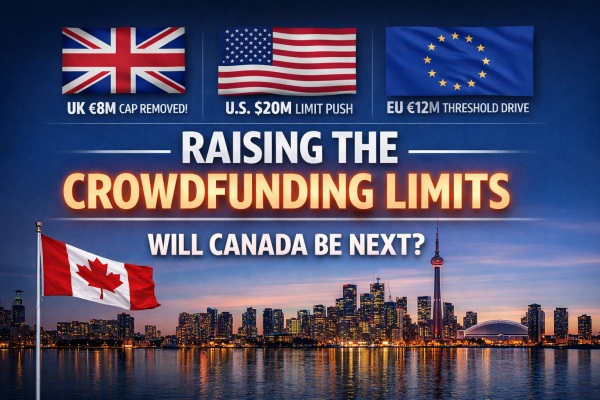
On February 10 2026, UK POP rules go live, removing the old prospectus trigger that made large public raises expensive, slow, and out of reach for many private companies.
For years, UK companies faced a hard line. If a business raised more than €8 million in securities from the public in a year, it had to produce a full prospectus (NB: the UK retained that euro-denominated threshold in its domestic framework post-brexit). Crowdcube says that prospectus costs could cost more than £250,000 and take months, which pushed many companies away from public community rounds even when demand existed.
Under the Public Offer Platform regime, raises above £5 million now run through a regulated POP, and the regime removes the upper fundraising cap for those offers (No more funding caps). Raises under £5 million remain outside the POP requirement, but regulated execution and investor protection expectations still apply.
Platforms now carry more responsibility for diligence, disclosure quality, and investor safeguards. That shifts the burden from a giant issuer document to a supervised platform process that can move faster.
The UK is not alone. In the United States, Crowdfund Capital Advisors submitted a $20M Reg CF petition asking the SEC to raise the Regulation Crowdfunding cap from $5M to $20M. In Europe, the European Digital Finance Association are pushing to increase the ECSP threshold from €5m to €12m.
After years of advocating, Canada finally harmonized nationally its startup-crowdfunding exemption in 2021, but regulators have kept the issuer cap conservative. Under National Instrument 45 110, eligible issuers can raise up to $1.5m in a 12 month period, which a growing company can quickly outgrow and end up soon looking for more funding via heavier paths for larger rounds. If the government wants to prioritize funding scape-ups, they should take another look at increasing equity crowdfunding caps in Canada to be in line with global peers.
This funding cap tension isn't new. In fact NCFA has been advocating for the OSC and CSA to raise issuer funding caps for years. In 2017 for example, NCFA petitioned to raise caps to modernize equity crowdfunding in Ontario. In 2019, $5m cap formed part of NCFA's recommendations to reduce regulatory burden and unlock growth capital. Again in 2020, during national harmonization discussions, NCFA advocated to modernize NI 45 110 including increasing caps to $5 million so the framework could match real funding needs in a digital economy.
Now with the UK FCA removing prospectus triggers and the US and EU push for higher caps, there may be a new policy window for Canada's equity crowdfunding participants to petition yet again. If other jurisdictions support $10m to $20m community rounds under platform oversight, Canada needs to decide whether it wants founders scaling here or structuring growth capital elsewhere.
A higher ceiling, including a path toward $5m and beyond, would better match growth stage reality while keeping platform level investor protection front and centre. The global direction of travel now strengthens the case for a renewed Canadian push grounded in data, experience, and competitiveness.
If regulated platforms can run larger public offers without a prospectus wall in the UK, what should Canada do next, raise the ceiling, create a platform lane for larger rounds, or keep the cap and accept that growth capital routes around Canada?
One practical takeaway stands out. POP style rules treat the platform as the compliance spine, not the issuer. That design can cut cost and time while still demanding clear disclosures, suitability controls, and due diligence at the point of sale. While Canada doesn't necessarily need to copy the UK, it does need a credible path for larger community rounds that doesn't force founders into a prospectus sized bill before they have the scale to absorb it.
The National Crowdfunding & Fintech Association (NCFA Canada) is a financial innovation ecosystem that provides education, market intelligence, industry stewardship, networking and funding opportunities and services to thousands of community members and works closely with industry, government, partners and affiliates to create a vibrant and innovative fintech and funding industry in Canada. Decentralized and distributed, NCFA is engaged with global stakeholders and helps incubate projects and investment in fintech, alternative finance, crowdfunding, peer to peer finance, payments, digital assets and tokens, artificial intelligence, blockchain, cryptocurrency, regtech, and insurtech sectors. Join Canada's Fintech & Funding Community today FREE! Or become a contributing member and get perks. For more information, please visit: www.ncfacanada.org
| | |
|---|---|---|
| | |
February 17 2026 | Equity Crowdfunding and Retail Investors

Image: Freepik/pressfoto
On February 16 2026, multiple UK reports say BrewDog has hired advisers to explore a potential sale after years of losses and slower growth. As a result, about 220,000 Equity for Punks retail shareholders may lose money depending on deal structure and payout priority.
Do you remember the Equity for Punks BrewDog story from years past? It was a story of community empowerment in the early days of the equity crowdfunding movement. NCFA and established partners like Crowdfund Insider tracked that momentum, such as when when BrewDog plans a $50M US equity crowdfunding round. The story today however offers practical lessons about capital structure, liquidity, and investor protection.
BrewDog built one of the most visible equity crowdfunding programs in the world through Equity for Punks. The model gave everyday consumers direct exposure to private company ownership and it proved that brand and community could mobilize serious capital.
In 2017 however, BrewDog took a major private equity investment from TSG Consumer Partners. Reporting in The Guardian describes preferential rights that sit ahead of common shareholders in a sale. That structure now drives the risk for small shareholders in the current sale process, based on how the deal structure affects what retail shareholders receive in a sale. The core point is simple. Structure governs outcomes in private markets.
Phil Halsey (47) invested about £2,500, starting in the second cash call in 2011:
“It’s extremely disappointing that it’s gone this way,” said Halsey. “The last time you could have done some form of cashing out was about a year and a half ago.”
1. Capital stack always decides the payout. Retail investors often focus on brand, traction, and growth narrative. Professional investors focus first on the capital stack. If a preferred investor holds liquidation preferences or other senior rights, that investor receives sale proceeds first. Common shareholders receive what remains. In a strong exit everyone wins. In a weaker exit, common shareholders may receive little or nothing. Investors should read share class terms and understand exactly where they sit before they invest.
2. Liquidity risk shows up at the worst time. Equity crowdfunding expands access, but it rarely guarantees a clean exit path. If investors rely on one big liquidity event, timing risk becomes real. Investors should treat these positions as long duration holdings. Founders and platforms should design credible liquidity pathways where rules allow, because trust grows when investors understand how they can eventually exit.
3. Growth narratives do not replace unit economics. The sale process follows years where BrewDog reported losses. When costs rise and category growth cools, expansion heavier models feel pressure quickly. Investors should challenge founders and operators on the road to profitability, not just the top line story. Founders should align growth with durable margins, because narrative alone doesn't protect valuation.
4. Community builds momentum but it does not hedge downside. Equity for Punks turns customers into owners and it proves that community capital can scale a consumer brand. That impact remains real. Yet community alignment does not override contractual rights in a sale. Retail investors should value perks and participation for what they are, and they should separate those benefits from expected financial return.
BrewDog's case encourages retail investors to have more mature conversations about disclosure, investor education, and deal structure literacy. For Canada, the case reinforces why clear explanations of share classes, payout priority, and realistic liquidity expectations are important for investor protection and long term market credibility.
The National Crowdfunding & Fintech Association (NCFA Canada) is a financial innovation ecosystem that provides education, market intelligence, industry stewardship, networking and funding opportunities and services to thousands of community members and works closely with industry, government, partners and affiliates to create a vibrant and innovative fintech and funding industry in Canada. Decentralized and distributed, NCFA is engaged with global stakeholders and helps incubate projects and investment in fintech, alternative finance, crowdfunding, peer-to-peer finance, payments, digital assets and tokens, artificial intelligence, blockchain, cryptocurrency, regtech, and insurtech sectors. Join Canada's Fintech & Funding Community today FREE! Or become a contributing member and get perks. For more information, please visit: www.ncfacanada.org
| | |
|---|---|---|
| | |
Feb 17, 2026 | NCFA Fintech Market Activity | Payroll and HR Tech

Image: Freepik
On February 17 2026, Nmbr announced the Collage Payroll launch, positioning it as the first benefits connected HR platform in Canada to embed payroll inside its HR workflow. Collage says customers can onboard employees once, manage time off and timesheets, and sync HR, payroll, and benefits data through a single login.
Collage says it began partnering with Nmbr in 2024 to build payroll directly inside its HR and benefits workflow (see embedded finance). Then in September 2024, Nmbr announced that they raised CAD $7.6M for Embedded Payroll in Canada. An early rollout in 2025 showed traction, with clients ranging from one to hundreds of employees already using the embedded payroll functionality.
The announcement also calls out real operating pain being solved. Research says nearly a third of businesses spend more than 30 hours a week managing data across payroll and other systems. Collage and Nmbr are betting that fewer handoffs reduces admin burden, lowers compliance risk, and cuts the error rate that shows up every time a hire, pay change, benefits update, or termination forces duplicate data work.
Mark Bluvshtein, Chief Executive Officer, Collage, and Vice President of HR Solutions at People Corporation:
“Payroll has been the number one request from our customers for years. Even when HR and payroll systems work closely together, businesses still feel the friction of managing two platforms. Bringing payroll directly into Collage allows us to finally deliver a single system that manages it all, reducing complexity and giving employers far greater control.”
Nmbr positions itself as payroll infrastructure rather than a standalone payroll brand. Nmbr handles core payroll requirements including payments, compliance, and data accuracy, so platforms can ship payroll inside their own products without rebuilding the hardest pieces from scratch. Noteworthy that Nmbr’s founding team previously helped build and scale Humi, while Collage points to leadership experience across Wave and Humi.
Simon Bourgeois, Chief Executive Officer, Nmbr:
“Payroll is one of the most complex systems a business can run, which is why so few companies have tried to build it themselves. By partnering with Collage, we’re enabling payroll to be built the right way, fully embedded, compliant, and designed for Canadian businesses. This partnership shows what’s possible when modern payroll infrastructure meets a platform that deeply understands HR and benefits.”
As more HR platforms embed payroll, what becomes the differentiator for employers, accuracy and compliance controls, speed of implementation, or the ability to bundle payroll with benefits and other people operations workflows without extra vendors?
Embedded payroll changes the competitive map for HR platforms in Canada. If payroll lives inside the HR and benefits workflow, employers stop treating payroll as a separate purchasing decision and start treating it as a built in capability. That dynamic rewards platforms that control the end-to-end workflow and can keep payroll accurate across provinces, remittances, and reporting cycles.
The National Crowdfunding & Fintech Association (NCFA Canada) is a financial innovation ecosystem that provides education, market intelligence, industry stewardship, networking and funding opportunities and services to thousands of community members and works closely with industry, government, partners and affiliates to create a vibrant and innovative fintech and funding industry in Canada. Decentralized and distributed, NCFA is engaged with global stakeholders and helps incubate projects and investment in fintech, alternative finance, crowdfunding, peer-to-peer finance, payments, digital assets and tokens, artificial intelligence, blockchain, cryptocurrency, regtech, and insurtech sectors. Join Canada's Fintech & Funding Community today FREE! Or become a contributing member and get perks. For more information, please visit: www.ncfacanada.org
| | |
|---|---|---|
| | |
AI Policy Consultation | February 11, 2026
On February 5, 2026, Innovation Science and Economic Development Canada (ISED) released the official Engagements on Canada’s Next AI Strategy Summary of Inputs. The report summarizes a 30 day consultation that ran from October 1 to 31, 2025 and confirms that 11,300 participants submitted 64,600 responses across 26 policy questions about Canada’s next AI strategy.
The consultation addressed the full AI policy landscape, including research and talent, adoption across industry and government, education and skills, infrastructure resilience, national security, environmental sustainability, Indigenous data sovereignty and inclusion. The process ran under The Honourable Evan Solomon, Minister of Artificial Intelligence and Digital Innovation, supported by a National AI Strategy Task Force composed of startup operators, investors, researchers and civil society leaders.
This article focuses on what matters most for fintech founders and investors, where the strongest inputs from the consultation relate to capital formation, procurement design, intellectual property retention and domestic scaling incentives.
The consultation drew wide participation. 83% submitted as individuals. 17% responded on behalf of organizations, and reflected national engagement across technology, finance, academia, professional services and public institutions.
52% identified as interested Canadians. 19% came from business. 13% represented academia or research. The rest included government, associations and other sectors.
Ontario accounted for 39% of responses. British Columbia 20.6%. Alberta 7.8%. Québec 7.6%.
Across submissions, one theme stood out. Canada produces AI research. It struggles to anchor AI companies at scale.
Respondents called for sovereign capital vehicles, modernization of SR&ED and IRAP, and stronger intellectual property retention frameworks. Intellectual property retention refers to keeping ownership of core technology, patents and data assets inside Canada rather than transferring them through early acquisition or foreign incorporation. Stakeholders expressed a preference for patient domestic capital tied to retention conditions, not simply additional grants. That implies potential co-investment models, domestic head office commitments and scaling tools designed to prevent early exits or foreign acquisition.
Canada ranks among global leaders in AI research output. Yet growth stage capital is still significantly thinner than in the United States. In 2025, Canadian VC firms raised just over $2.1B, with fundraising concentrating as the five largest Canadian venture funds captured 83% of all capital raised while emerging managers raised $249M. That level of concentration narrows the number of scaled domestic capital sources available to support long runway AI and fintech growth.
When companies reach scale, many incorporate abroad or raise major rounds outside Canadian markets. Capital migration reduces ownership, long term tax capacity and domestic control over strategic assets. This consultation reflects recognition that Canada’s scaling architecture requires structural reform.
For fintech founders following new AI minister prioritizes growth over rules, this reinforces the need for commercialization outcomes and ownership durability rather than additional regulatory layering.
Respondents pushed for standardized procurement playbooks and real pathways from pilot to deployment. Suggestions were for coordinated procurement models that create anchor customers at scale.
Predictable domestic revenue reduces investor risk perception and strengthens valuations. It also strengthens Canadian firms’ credibility when competing internationally. Procurement design therefore influences capital formation and competitive positioning.
This matters most in regulated sectors. When government adoption aligns with frameworks such as the CIRO digital asset custody framework, compliance becomes a strategic advantage rather than a cost centre. Procurement validation can reinforce regulatory credibility and accelerate scaling.
Participants identified gaps in domestic compute capacity and reliance on foreign cloud providers. Calls for Canadian controlled infrastructure go beyond just hardware investment. They imply potential changes to data residency expectations, cloud dependency exposure and compliance thresholds.
Sovereign compute investment could open infrastructure financing opportunities while raising entry costs for firms dependent on foreign controlled platforms. Infrastructure choices influence market structure.
Submissions supported proportionate, risk tiered regulatory frameworks, independent audits and clearer liability standards. Respondents generally favoured governance models where obligations scale with actual risk exposure rather than one size fits all rules.
Regulatory preference was for clarity, predictability and alignment between risk level and compliance burden. High impact AI applications would face stronger safeguards, while lower risk use cases would not carry unnecessary constraints.
If thresholds are calibrated carefully and compliance pathways are clear, early stage firms gain certainty and investors price regulatory exposure more confidently. If risk categories are broad or implementation complex, governance costs rise and time to market slows.
The strategic issue is how regulatory architecture affects scaling speed, capital formation and Canada’s cost competitiveness relative to larger markets. Governance design influences who scales, who consolidates and who exits.
The consultation closed on October 31, 2025. The Engagement on Canada's Next AI Strategy summary report states that the inputs will inform drafting of Canada’s 2026 AI strategy, which the federal government plans to release later this year.
The report doesn't however specify any fiscal commitments or program design details. Those decisions will appear, if at all, in the final strategy document and subsequent budget measures.
From a market perspective, founders and investors should watch for concrete triggers for a sovereign capital vehicle with defined funding, commercialization linked SR&ED reform, procurement commitments beyond pilot programs, budget allocations for domestic compute infrastructure, and enforceable intellectual property safeguards.
If those elements appear with timelines and capital attached, they strengthen Canada's domestic scaling environment. If not, capital migration and entrepreneur drain will likely persist. The final strategy with design and implementation choices will be known this year.
The National Crowdfunding & Fintech Association (NCFA Canada) is a financial innovation ecosystem that provides education, market intelligence, industry stewardship, networking and funding opportunities and services to thousands of community members and works closely with industry, government, partners and affiliates to create a vibrant and innovative fintech and funding industry in Canada. Decentralized and distributed, NCFA is engaged with global stakeholders and helps incubate projects and investment in fintech, alternative finance, crowdfunding, peer-to-peer finance, payments, digital assets and tokens, artificial intelligence, blockchain, cryptocurrency, regtech, and insurtech sectors. Join Canada's Fintech & Funding Community today FREE! Or become a contributing member and get perks. For more information, please visit: www.ncfacanada.org
| | |
|---|---|---|
| | |
CIX Summit 2026 | February 11, 2026

Image courtesy of CIX Summit, Powered by Elevate
On February 10, 2026, Elevate announced the 2026 CIX Startup Award winners across fintech, climate, defence, health, and marketing technology, naming fourteen Canadian companies selected from more than 370 applications reviewed by 94 North American investors. CIX confirms that the winners present live at the CIX Summit on March 25, 2026 at the Design Exchange in Toronto, with the program bringing together 600 plus investors, founders, and tech leaders.
In the release, CIX reaffirms their commitment to the startup ecosystem as they call out a difficult funding moment, with trade tension between the US and Canada and the lowest level of Canadian VC investment since 2020.
2026 CIX Startup Award recipients across emerging, early, and growth categories.
Emerging includes PRE in marketing technology from Toronto, Sonaro in health technology from Montreal, Cashew Research in marketing technology from Calgary, Elle, MD Biotechnologies in health technology from New Minas, NS, and Xubin Aerospace in defence technology from Oakville.
Early includes Qidni Labs in medical technology from Kitchener, WeavAir in climate technology from Toronto, Pontosense in medical technology from Toronto, MedMe Health in health technology from Toronto, and LiORA in climate technology from Calgary.
Growth includes Venn in fintech from Toronto, Eavor Technologies in climate technology from Calgary, Loopio in sales automation from Toronto, and Hiive in fintech from Vancouver.
In a year where capital remains disciplined and deployment cycles lengthen, fintech infrastructure companies continue to attract investor attention. The 2026 CIX Growth category includes two fintech scaleups, Venn and Hiive.
Venn operates in digital financial services infrastructure for businesses (embedded finance and SME operating layer). In Venn's public announcement following the award, the company confirmed that more than 5,000 businesses have chosen Venn to run their finances over the past year, highlighting product coverage across banking, payments, cards, and automation.
Hiive builds marketplace infrastructure for private company share transactions. As venture timelines extend and liquidity windows narrow, structured secondary marketplaces play an increasingly important role in capital efficiency. Recognition in the CIX Growth category places Hiive among a cohort of scaleups building market infrastructure rather than consumer facing apps.
Both companies operate at the financial layer of the innovation economy. One focuses on modernizing how businesses manage money. The other addresses private market liquidity. Together they reflect two core pressures in today’s ecosystem: operational efficiency and capital access.
Beyond fintech, the 2026 CIX winners span climate technology, health technology, defence technology, and enterprise software across emerging, early, and growth stages. Companies such as WeavAir, LiORA, and Eavor Technologies represent climate innovation, while others address diagnostics, aerospace, marketing intelligence, and automation.
CIX states that more than 370 applications were reviewed by 94 North American investors, with a minimum of 15 judges evaluating each submission across business model, innovation, market opportunity, management depth, and leadership diversity, equity, and inclusion. In a slower venture market, that level of screening provides an important validation signal for founders seeking capital.
Neha Kera, Managing Partner at Innovobot Resonance Ventures and CIX Startup Awards Co Chair:
“It is a challenging time for entrepreneurs, and so it was wonderful to see the quality of this year's CIX winners,” and adds, “We are eager to see what else they will accomplish in the years to come, and I hope everyone can learn more about them at CIX”.
Matthew Leibowitz, Managing General Partner at Plaza Ventures and CIX Startup Awards Co Chair:
“The competition was intense with over 350 applicants, and our selection committee did a stellar job in selecting the winners,” and adds, “We're thrilled to shine a spotlight on this year's recipients and can't wait to meet them at CIX Summit.”
The announcement also highlights a practical reason founders show up. It says Meeting Exchanges include over 75 investors taking 1 to 1 meetings with founders, creating over 450 meeting opportunities across the day. CIX also describes a closed door Investor Forum for VCs and LPs, plus a Founder Forum focused on seed round execution, cap table structure, and non dilutive capital.
Congratulations to all fourteen teams. Canada needs more companies that keep building through hard cycles, keep hiring, keep shipping product, and keep finding customers. NCFA looks forward to tracking these founders as they turn national recognition into revenue, partnerships, and global growth.
NCFA is sharing a 20% community partner discount on CIX Summit passes for its community. Use CIXNCFA20 for 20% off. CIX runs on March 25, 2026 in downtown Toronto. CIX publishes ticket options and event logistics on its official page for CIX Summit 2026 ticket details and March 25 venue information.
The National Crowdfunding & Fintech Association (NCFA Canada) is a financial innovation ecosystem that provides education, market intelligence, industry stewardship, networking and funding opportunities and services to thousands of community members and works closely with industry, government, partners and affiliates to create a vibrant and innovative fintech and funding industry in Canada. Decentralized and distributed, NCFA is engaged with global stakeholders and helps incubate projects and investment in fintech, alternative finance, crowdfunding, peer-to-peer finance, payments, digital assets and tokens, artificial intelligence, blockchain, cryptocurrency, regtech, and insurtech sectors. Join Canada's Fintech & Funding Community today FREE! Or become a contributing member and get perks. For more information, please visit: www.ncfacanada.org
| | |
|---|---|---|
| | |
Feb 9, 2026 | NCFA Fintech Market Activity | Ecosystem and Capital

Image: Freepik
On January 26 2026, Y Combinator removed Canada from its standard deal terms, limiting eligibility for startups incorporated domestically. Within days, it reinstated Canada after founder backlash, restoring access under its typical investment framework, which details how incorporation jurisdiction directly affects capital access, governance structure, and long term scaling strategy for Canadian founders.
The initial decision did not involve a specific fintech company or funding round. It was structural. Y Combinator’s standard deal applies to startups incorporated in approved jurisdictions. Removing Canada effectively meant founders would need to incorporate elsewhere, typically in the United States, to participate under YC’s typical structure.
YC is one of the most influential accelerators in the world. Its standard deal, global demo day visibility, and alumni network continue to shape where and how startups incorporate. When a jurisdiction falls off that list, it forces founders to revisit fundamental questions about domicile, governance, and long term capital access.
Canada has long faced tension between building domestic champions and watching startups reincorporate in the U.S. to access deeper venture pools. The temporary exclusion exposed that pressure in real time. Founders openly questioned whether remaining Canadian limited their path to global capital. Investors pushed back on the optics and the implications for ecosystem competitiveness.
The reversal confirms something important. Founder voice still carries weight. When structural barriers appear, the community responds quickly.
This episode also lands in a broader moment of scrutiny around capital flows and jurisdictional friction. As previously covered by NCFA in prediction markets pricing geopolitical risk, capital increasingly reacts to policy shifts, regulatory posture, and national positioning. Incorporation strategy is no longer a back office decision. It sits at the center of competitive positioning, a topic that many legal advisors regularly bring up with their client firms for years, often to the detriment of Canada's startup ecosystem.
YC did not publicly frame the move as a statement about Canadian founders. The accelerator has previously highlighted data showing many international startups choose U.S. incorporation for fundraising efficiency. But the optics of removing an entire G7 country triggered a deeper conversation about structural competitiveness and capital alignment.
For fintech specifically, where your company is registered and domiciled affects licensing pathways, regulatory relationships, and banking partnerships. A Canadian incorporated fintech navigating CIRO, CSA, or RPAA requirements faces a different operating map than one structured under Delaware law. Founders weigh tax efficiency, governance flexibility, investor familiarity, and exit pathways.
Before choosing incorporation jurisdiction, founders should be clear on a few points:
These questions affect investor comfort, term sheet dynamics, and how quickly you can close capital when markets tighten.
The episode also puts a spotlight on Canada’s policy environment. If global accelerators and venture firms default to U.S. incorporation for efficiency, policymakers should ask why. Founders make structural decisions based on predictability, tax treatment, regulatory clarity, and access to institutional capital. If Canada wants more high growth companies to incorporate and remain here, it must reduce friction in securities regulation, modernize capital formation rules, and deepen domestic late stage capital pools. Incorporation decisions follow incentives. Capital flows toward simplicity and scale.
Capital markets still reward certain structures and jurisdictions more predictably than others. That doesn't mean Canadian incorporation is a disadvantage. It does mean founders must approach the decision deliberately, not emotionally.
The larger takeaway is not about one accelerator. It is about ecosystem resilience. When capital gatekeepers adjust terms, even briefly, founders notice. Policymakers should notice too.
If incorporation jurisdiction influences access to global capital networks, how can Canada strengthen incentives so founders choose to build and scale at home without sacrificing investor reach?
This episode resolved quickly. The underlying tension did not.
The National Crowdfunding & Fintech Association (NCFA Canada) is a financial innovation ecosystem that provides education, market intelligence, industry stewardship, networking and funding opportunities and services to thousands of community members and works closely with industry, government, partners and affiliates to create a vibrant and innovative fintech and funding industry in Canada. Decentralized and distributed, NCFA is engaged with global stakeholders and helps incubate projects and investment in fintech, alternative finance, crowdfunding, peer-to-peer finance, payments, digital assets and tokens, artificial intelligence, blockchain, cryptocurrency, regtech, and insurtech sectors. Join Canada's Fintech & Funding Community today FREE! Or become a contributing member and get perks. For more information, please visit: www.ncfacanada.org
| | |
|---|---|---|
| | |


August 26th, 2025

January 4th, 2024

June 1st, 2021

September 9th, 2020

July 9th, 2018

January 3rd, 2018

September 25th, 2017

June 20th, 2017

May 10th, 2017

December 14th, 2016