




Karsten Wenzlaff, Advisor
August 26th, 2025
Karsten Wenzlaff is a Crowdfunding and Fintech Expert from Germany. He is Secretary-General of Digit[...]


Regulation | Sep 24, 2025

Image: Freepik
On September 13, 2025, Thailand froze approximately 3 million bank accounts in a sweeping anti-scam campaign. Authorities targeted around 177,000 mule accounts linked to fraud. Wisit Wisitsora of Thailand’s Digital Economy and Society Ministry stated:
“We urge the public not to panic. The suspension is only temporary.”
Banks imposed daily transfer caps ranging from 50,000 to 200,000 baht (approx. $2164 CAD - $8657 CAD at today's forex rates) and froze flagged transactions.
Commercial banks could suspend funds for three days, with police empowered to extend freezes up to seven days. While designed to curb online fraud, many individuals and small businesses described being locked out of their only source of funds, leaving households unable to pay for food or bills.
Facing backlash, regulators introduced safeguards. Innocent users can now expect restoration within hours to one day. Banks are required to notify customers of freezes via SMS or mobile banking and to unfreeze wrongly blocked funds proactively. Officials emphasized that disputed amounts are suspended, not entire balances.
Around the world, regulators from the EU to the U.S. and Canada are grappling with similar challenges as regulators expand digital fraud controls. What the Thailand case shows is that the credibility of financial systems depends not only on the strength of anti-scam tools but also on transparent safeguards.
If freezes become a blunt instrument, they risk driving people out of regulated channels and weakening financial inclusion. For fintechs and policymakers, the global lesson learned is that fraud prevention must be paired with due process to preserve trust.
Fraud-related losses in Thailand exceed 6 billion baht annually (approx $200M CAD), but freezing millions of accounts without due process undermines trust in banking.
"The Thai case clearly shows the risk when rapidly scaled enforcement collides with consumer rights. Without transparent criteria, real-time notifications, and clear appeals, innocent users face financial harm."
Legal experts warn this could expose authorities to civil claims and property rights challenges. What if citizens turn to cash, crypto, or unregulated channels instead?
Canada faced a similar backlash during the 2022 trucker protests, when the government invoked the Emergencies Act and froze over 200 bank accounts containing nearly $8M CAD without court orders. The measures were lifted within days, but the incident triggered several knee jerk reactions and lasting debate about transparency, due process, and the role of financial institutions in enforcing emergency powers.
Similar debates are underway in other regions, such as the United States with proposals like the Fairness in Banking Act, which NCFA has examined for its consumer protection impact. The common challenge is ensuring that stronger enforcement powers don't override due process or weaken trust in financial systems.
Both the Thailand crackdown and the Canadian freeze highlight how well intentioned interventions can spiral into government overreach if consumer safeguards are weak. Independent oversight, transparent criteria, communication protocols, and effective redress mechanisms are essential.
As fintechs use AI to spot fraud, regulators need to keep rules fair and accountable. Protecting consumers while keeping trust in financial services is key to Canada’s future growth and inclusion.
 The National Crowdfunding & Fintech Association (NCFA Canada) is a financial innovation ecosystem that provides education, market intelligence, industry stewardship, networking and funding opportunities and services to thousands of community members and works closely with industry, government, partners and affiliates to create aa vibrant and innovative fintech and funding industry in Canada. Decentralized and distributed, NCFA is engaged with global stakeholders and helps incubate projects and investment in fintech, alternative finance, crowdfunding, peer-to-peer finance, payments, digital assets and tokens, artificial intelligence, blockchain, cryptocurrency, regtech, and insurtech sectors. Join Canada's Fintech & Funding Community today FREE! Or become a contributing member and get perks. For more information, please visit: www.ncfacanada.org
 |  |  |
|---|---|---|
 |  |  |
AI Innovation | Sep 24, 2025

Image: Freepik
On September 16, 2024, Counterforce Health reported that U.S. platforms are using artificial intelligence to help patients appeal denied health insurance claims by analyzing rejection letters and generating tailored responses at scale.
The rise of AI powered tools is a growing insurtech trend where technology is being used to challenge entrenched industry practices that unfairly hurt consumers. For NCFA's community, the story raises important questions about where AI could play a similar role in our own insurance markets.
Let's look at the data to better understand the scope of the problem. In 2021, insurers on the federal HealthCare.gov marketplace denied about 17% of in network claims. These are services from doctors and hospitals already under contract with the insurer, showing that even approved providers faced a high denial rate.
Yet fewer than 0.2% of these denials were appealed, despite nearly 59% of appeals being successful when filed.
Separate research from the American Medical Association found that prior authorization denials are overturned more than 80% of the time when challenged, but only a small share of patients ever appeal.
The above figures point to a structural imbalance where insurers rely on consumers giving up. By automating appeal letters with expertly assessed supporting evidence, AI systems are changing the game.
Canada’s universal healthcare system means most core medical services are covered publicly, so denials are less about hospital visits or surgeries and more about supplemental benefits such as prescription drugs, dental care, physiotherapy, and other extended health services. Private insurers play a major role in these areas, and disputes are common.
What Canada lacks is transparent national reporting on denial and appeal rates. Unlike the U.S. system where denial data is published for marketplace insurers, Canadian insurers are not required to release such information. The limited statistics that do exist come from independent research or regulator snapshots, which highlight problems but don't provide a complete national picture. This lack of transparency creates a barrier to accountability and also an opportunity for Insurtech innovators.
Even without standardized national data, the available evidence shows that denial issues are widespread across several types of insurance:
Disability insurance denial rates are high. For example, about 60% of Canada Pension Plan disability applications are rejected, a figure that highlights the steep barriers claimants face, even if it is not directly comparable to private disability insurance.
In Quebec, 20% of critical illness and life insurance claims are denied according to the Autorité des marchés financiers. Disputes often stem from exclusions or non-disclosure clauses.
Extended health and drug benefits. Expensive specialty drugs and therapies are frequently denied as “not medically necessary” or outside policy coverage. Appeal processes can be slow and opaque.
Accident benefit disputes are frequent, especially with auto insurance in Ontario. The provincial tribunal system handles thousands of contested denials each year. AI insurtech solutions could help provinces reduce backlogs and streamline case processing.
Property insurance denials are common enough. Regulators report that property insurance denial ratios are around 16%, with most rejections tied to lack of coverage.
For fintech and Insurtech players, the opportunity spams the broader insurance ecosystem. AI could provide consumers with tools to navigate opaque processes, improve transparency, and reduce the cost of disputes.
Regulators have already outlined pan-Canadian guiding principles for responsible AI in health systems (Health Canada), establishing an innovation framework that balances fairness and accountability.
With insurance denial data so limited in Canada, new platforms that integrate appeals with data collection could simultaneously drive consumer protection and market competitiveness.
Denial data transparency can expose inefficiencies between insurers and individuals and AI solutions can help rebalance power. While Canada’s insurance system is structured differently than the U.S., denial disputes are still widespread and certainly costly in terms of time and money for stakeholders.
Fintechs and insurtech innovators should view this is a market opportunity while also protecting consumers. Canada can either wait for U.S. platforms to cross the border, or develop homegrown solutions that lead in fairness, transparency, and competitiveness.
The National Crowdfunding & Fintech Association (NCFA Canada) is a financial innovation ecosystem that provides education, market intelligence, industry stewardship, networking and funding opportunities and services to thousands of community members and works closely with industry, government, partners and affiliates to create aa vibrant and innovative fintech and funding industry in Canada. Decentralized and distributed, NCFA is engaged with global stakeholders and helps incubate projects and investment in fintech, alternative finance, crowdfunding, peer-to-peer finance, payments, digital assets and tokens, artificial intelligence, blockchain, cryptocurrency, regtech, and insurtech sectors. Join Canada's Fintech & Funding Community today FREE! Or become a contributing member and get perks. For more information, please visit: www.ncfacanada.org
| | |
|---|---|---|
| | |
Sep 24, 2025
Image courtesy of Flipper AI DEX
The Open Network (TON) Telegram games leverage blockchain technology to offer decentralized, secure, and transparent gaming for all users. Beginners can enjoy simple and readily accessible gameplay by playing TON games on Telegram. These games provide you with a simple way to explore the growing world of crypto and blockchain technology powered by Telegram’s vast user base. There are several Telegram gaming products that incorporate decentralization, smart contracts, and blockchain integration. Decentralization enables game data and logic to be shared across a network of computers securely and transparently. From ensuring fairness to creating monetary reward opportunities, TON offers several benefits to gamers.
Telegram’s platform not only offers opportunities for dApps within the ecosystem, but it also introduces user-friendly in-game economies. This combination lets developers build more advanced and interactive crypto gaming applications that players can trust. As more users continue to embrace TON, you can expect to see new and innovative gaming solutions that blend entertainment with real-life monetary benefits. Here are some great reasons to play Telegram TON games as a beginner.
Telegram TON games come with minimalistic designs. They are developed with simple and engaging gameplay in mind. This makes them vital entertainment tools for beginners looking to transform their online crypto gaming experiences. For those who prefer short gaming sessions, TON could be the perfect way to escape from everyday distractions and experience fun to the max. Newcomers can utilize reliable decentralized exchanges, like Flipper DEX, to earn free crypto tokens, including NOTCOIN. You can find tutorials and guidance to level up your skills and achieve your objectives in no time.
Potential for real rewards is another huge benefit of playing Telegram TON games. Popular play-to-earn Telegram models like TON allow users to accumulate virtual financial assets by completing basic tasks like tapping and swiping. You can convert your in-game currencies into actual crypto tokens like NOT and Hamster Kombat. Another great reason to play Telegram games is their low-cost entry. Beginners can start earning money without making any initial investment. While some Telegram crypto games offer upgrades or features that users can choose to purchase, it’s worth noting that these are not always required to start.
Thanks to the built-in community and social features, Telegram TON games lets players engage with their friends or join squads to conduct missions and compete on leaderboards. If you want to add fun and a social layer to your crypto gaming experience, you should consider taking advantage of TON Telegram games. Social media referral awards help create bonuses for beginners who invite their friends to play. These are primarily designed to motivate more players to explore the expanding world of Telegram games and boost their earning potential.
TON stands out in the blockchain ecosystem due to its relatively high speed and affordable transaction fees. Whether you’re a beginner or pro, you can interact with the crypto space directly and benefit from smooth experiences in a low-risk environment. There is no doubt that TON-based wallet integration is one of the easiest entry points into web3.
Telegram TON crypto games have gained widespread popularity lately thanks to their ease of access and community-driven experiences. The remarkable success of The Open Network onboarding millions of web3 users has played a key role in enabling beginners to build their digital assets portfolios.
The National Crowdfunding & Fintech Association (NCFA Canada) is a financial innovation ecosystem that provides education, market intelligence, industry stewardship, networking and funding opportunities and services to thousands of community members and works closely with industry, government, partners and affiliates to create aa vibrant and innovative fintech and funding industry in Canada. Decentralized and distributed, NCFA is engaged with global stakeholders and helps incubate projects and investment in fintech, alternative finance, crowdfunding, peer-to-peer finance, payments, digital assets and tokens, artificial intelligence, blockchain, cryptocurrency, regtech, and insurtech sectors. Join Canada's Fintech & Funding Community today FREE! Or become a contributing member and get perks. For more information, please visit: www.ncfacanada.org
| | |
|---|---|---|
| | |
Stablecoin Research | Sep 23, 2025
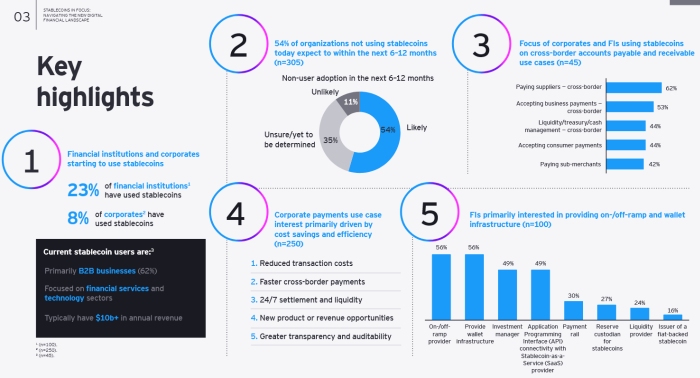
Image: Stablecoin Survey Research Highlights (EY Parthenon Sep 2025)
On September 15, 2025, EY-Parthenon released its latest stablecoin survey results, "Stablecoins: Adoption, Optimism, and Regulatory Clarity" (download 31 page PDF), covering 350 executives from corporates and financial institutions across the US, EMEA and other regions. Research takeaways confirm adoption is picking up speed, supposed by regulatory clarity by the GENIUS Act, recently signed into law.
Why is this happening? Approval of the U.S. GENIUS Act is a regulatory catalyst. Further, pilots are proving real value and corporate treasurers are under pressure to improve efficiency. The thinking is that organizations delaying adoption risk losing ground to competitors who are moving forward and benefiting from the lower cost and faster transactions of stablecoin technologies.
Why is everyone saving money by using stablecoins? The reason is straightforward. Traditional cross border payments involve multiple intermediaries, each adding fees and time. Stablecoins bypass these frictions and settles instantly, so the cost savings are structural (not incremental). For fintech providers, there's a growing opportunity to provide integration and risk management tools to help corporates adopt/use stablecoins and measure their effectiveness.
The reality is that we live and function in a global economy where delays can disrupt supply chains, so it's not surprising that corporates will adopt stablecoins for faster and more streamlined and predictable settlement solutions. This means that stablecoin adoption will likely strong and swift among B2B supplier and trade finance flows before expanding more widely into consumer payments.
In Canada, regulatory inaction is catching up with market momentum. On September 19, 2025, regulators like OSFI have warned the Prime Minister Mark Carney that Canada should accelerate federal stablecoin rules to avoid falling behind global peers. The Bank of Canada has echoed this call, saying stablecoins should be as safe and stable as the balance in your bank account. OSFI is already drafting a new framework to regulate stablecoin issuers, while domestic momentum is building as Tetra Digital Group secured $10M from Canadian banks and fintechs to launch a CAD stablecoin in 2026. Observers including investor John Ruffolo warn in his Looming Stablecoin Storm substack that without clear domestic rules, Canada risks ceding innovation, competitiveness and monetary sovereignty to jurisdictions that move faster.
Canadian corporates and fintechs need to plan not just for current global trends, but for a new local regulatory stablecoin framework. Firms are advised to engage with policymakers to create the right environment, build compliance ready infrastructure now and position for interoperability with USD pegged tokens and domestic stablecoin initiatives.Waiting could result in higher compliance costs, restricted access, and eventually a decline in market share.
Bottom line is banks understand that clients will demand stablecoin services and that failure to provide them risks their disintermediation. There's an intensifying race between traditional institutions and fintech challengers to capture stablecoin transaction flows.
Hybrid build and partner strategy. Corporates are demanding trust and compliance, while financial institutions know they cannot deliver the full stack alone. This means that partnerships between fintechs, banks and technology providers will determine how quickly stablecoin adoption scales.
Stablecoins are moving from pilot projects into enterprise strategy. Corporates see real cost savings and competitive advantage, while financial institutions are preparing to build services at scale to meet client demand. Regulation is beginning to catch up, led by the GENIUS Act in the US, but the global landscape is unbalanced while Canada’s fintech ecosystem is calling on the federal government to create and regulate a stablecoin framework to remain aligned and competitive.
The National Crowdfunding & Fintech Association (NCFA Canada) is a financial innovation ecosystem that provides education, market intelligence, industry stewardship, networking and funding opportunities and services to thousands of community members and works closely with industry, government, partners and affiliates to create aa vibrant and innovative fintech and funding industry in Canada. Decentralized and distributed, NCFA is engaged with global stakeholders and helps incubate projects and investment in fintech, alternative finance, crowdfunding, peer-to-peer finance, payments, digital assets and tokens, artificial intelligence, blockchain, cryptocurrency, regtech, and insurtech sectors. Join Canada's Fintech & Funding Community today FREE! Or become a contributing member and get perks. For more information, please visit: www.ncfacanada.org
| | |
|---|---|---|
| | |
Crypto | Sep 22, 2025

Image: Freepik/krakenimages.com
On September 20, 2025, Coinbase CEO Brian Armstrong announced that NBA star Kevin Durant had regained access to his Coinbase account nearly ten years after first buying Bitcoin, and then initially purchasing it for around $650 per Bitcoin in 2015, implying a whopping gain of more than 17,000% ten years later.
Armstrong confirmed the recovery on X, which followed Durant’s story earlier in the week at the CNBC x Boardroom Game Plan summit in Santa Monica. Durant described how he first bought Bitcoin in 2014–2015
We got this fixed. Account recovery complete! https://t.co/TWYFpQkXsb
— Brian Armstrong (@brian_armstrong) September 19, 2025
Durant’s first exposure to Bitcoin came around 2014–2015, when he says he “started watching YouTube videos” about the emerging digital asset. Intrigued, he encouraged his agent, Rich Kleiman, to take a closer look. Their enthusiasm was quickly cooled when, according to Kleiman, their business manager “said, ‘No, don’t do that.’ So we didn’t.”
That might have been the end of the story if not for a party hosted by venture capitalist Ben Horowitz. Kleiman recounted how they heard Bitcoin mentioned repeatedly that night, and “we woke up the next day and said, ‘We have to do this.’” From there, they invested in Bitcoin and later became early backers of Coinbase through their firm Thirty Five Ventures.
According to Coindesk, Durant’s entry point was near $650 per Bitcoin in 2015, a level that makes his eventual recovery especially striking. With Bitcoin trading above $115,000 in September 2025, that original purchase reflects a gain of more than 17,000%, a staggering return on investment that Durant could only access once his Coinbase account was unlocked nearly a decade later.
Durant’s lost account access resulted in type of “forced hodling” through multiple market cycles. Chainalysis-based research on permanently lost Bitcoin estimates millions of crypto assets are out of reach because people have lost their passwords or recovery keys. That reduces the amount available to trade and makes the asset more scarce. Durant’s case shows that being locked out by accident can sometimes lead to big gains, but it also reveals the real danger for everyday users who may never regain access to their accounts.
Coinbase outlines strict processes for regaining access if emails or two factor devices are lost. Users may need to reset forgotten passwords, recover two factor authentication, or provide identity documents through account access troubleshooting. Many users report challenges completing these steps. After Durant’s recovery, social media threads filled with complaints from customers who have been locked out for years.
In response, Armstrong reposted a detailed thread from his support team on X, promising product improvements and faster support. Coinbase also maintains VIP service tiers for high volume traders. Reuters published an article in August 2025 about widespread user frustration with locked accounts and the Verge covered investigations into delays in customer support. Clearly more work needs to be done by Coinbase to support all customers, and not just celebrities that might be prioritized for obvious reasons.
Durant's experience of lost keys and account access can happen to even the most sophisticated investors, causing an incredible amount of frustration. Prevention is the best protection. Coinbase advises enabling multiple two factor authentication methods, including hardware keys, and updating recovery emails and phone numbers regularly.
Also, users should evaluate the benefits and risks of storing crypto on exchanges versus self custody options using a secure wallet. Digital asset investors should only work with crypto exchanges that offer reliable recovery workflows and strong customer support.
Thanks to Durant's celebrity status, consumer protection from lost keys and account access is back in the news. For Durant, it's another story and a drop in the bucket but for regulators and industry leaders it's a recurring lessons that equitable account recovery and strong consumer support is essential to wider adoption. While new trading features are also being developed and released, crypto exchanges and leaders need to prioritize safeguarding access for all users.
The National Crowdfunding & Fintech Association (NCFA Canada) is a financial innovation ecosystem that provides education, market intelligence, industry stewardship, networking and funding opportunities and services to thousands of community members and works closely with industry, government, partners and affiliates to create aa vibrant and innovative fintech and funding industry in Canada. Decentralized and distributed, NCFA is engaged with global stakeholders and helps incubate projects and investment in fintech, alternative finance, crowdfunding, peer-to-peer finance, payments, digital assets and tokens, artificial intelligence, blockchain, cryptocurrency, regtech, and insurtech sectors. Join Canada's Fintech & Funding Community today FREE! Or become a contributing member and get perks. For more information, please visit: www.ncfacanada.org
| | |
|---|---|---|
| | |
Sep 18, 2025

Image courtesy of AI
Freight factoring turns unpaid freight bills into immediate cash, giving trucking businesses financial stability when payments are delayed. Instead of waiting weeks for brokers or shippers, carriers receive funds within a day.
This financial solution keeps trucks running by covering fuel, payroll, insurance, and maintenance without borrowing. For carriers of all sizes, freight factoring ensures steady cash flow and stronger business growth.
Freight factoring is a financial service where trucking companies sell their unpaid invoices to a factoring company for immediate cash. It removes the long waiting period that brokers and shippers often impose.
The factoring company advances most of the invoice value upfront, usually between 80% and 95%. Once the broker pays the invoice, the remaining balance is released after fees.
This process gives carriers quick access to working capital without taking on debt. It ensures steady cash flow for expenses like fuel, repairs, and payroll.
Freight factoring mainly comes in two forms, and the difference lies in who carries the risk if a broker or shipper fails to pay. Both options are widely used in trucking, but the right choice depends on a carrier’s risk tolerance and budget.
In recourse factoring, the carrier is responsible if the broker or shipper does not pay the invoice. This option usually comes with lower fees, which makes it more affordable for small trucking businesses that want to save on costs.
In non-recourse factoring, the factoring company takes on the risk if a broker defaults because of bankruptcy or insolvency. Since the factor assumes more risk, the fees are higher, but carriers gain extra protection against non-payment.
Freight factoring serves a wide range of businesses in the trucking industry. Each type of company benefits differently depending on its size, expenses, and payment cycles.
Independent drivers use factoring to cover immediate costs like fuel, meals, and maintenance. Since one unpaid invoice can disrupt cash flow, factoring keeps their trucks running without interruption.
Fleets with fewer than 10 trucks depend on factoring to manage payroll, insurance, and repairs. Steady access to funds allows them to accept new contracts and expand operations with confidence.
Carriers with 10–50 trucks face higher expenses such as compliance fees, driver benefits, and fuel surcharges. Factoring ensures that these fleets maintain liquidity while scaling up.
Bigger carriers usually have stronger reserves but still factor selectively. They often use it when working with unfamiliar brokers or during slower payment cycles.
New trucking businesses rarely qualify for bank loans due to limited credit history. Factoring gives them immediate working capital to cover fuel, permits, and their first loads.
Some freight brokers use factoring so they can pay carriers quickly while waiting for shipper payments. This strengthens their relationships with carriers and keeps loads moving smoothly.
Carriers hauling refrigerated freight, flatbeds, or oversized loads often factor invoices to balance higher operating costs. Since these loads carry more risk, faster payments reduce financial pressure.
For any of these groups, choosing the best factoring freight company makes a significant difference, because the right partner offers fair rates, transparent contracts, and dependable funding.
The biggest cost in freight factoring is the discount rate, which usually falls between 1% and 5% of the invoice. How much a carrier pays depends on the broker’s credit, the number of invoices factored, and the agreement in place.
Beyond discount rates, there are other charges that come into play. Transaction fees, wire transfers, and reserve holdbacks are common, and together they reduce the final payout a carrier receives.
Some factoring companies add extra costs like monthly minimums or cancellation penalties. That’s why reading the full contract before signing is key to keeping factoring affordable in the long run.
Freight factoring and bank loans both provide access to money, but they work very differently. The main differences lie in approval, funding speed, debt responsibility, and flexibility.
With freight factoring, approval is based on the creditworthiness of the broker or shipper, not the trucking company. Bank loans, on the other hand, depend heavily on the carrier’s credit history and financial statements.
Factoring companies usually advance funds within 24 hours of receiving paperwork. Bank loans can take weeks or even months to process, which delays access to working capital.
Factoring is not a loan, so it doesn’t add debt to the carrier’s balance sheet. Bank financing creates a liability that must be repaid with interest, regardless of when brokers pay.
Carriers can choose which invoices to factor, giving them more control over their cash flow. Bank loans lock companies into fixed repayment schedules, leaving less room to adjust when business conditions change.

Image: Freepik/aleksandarlittlewolf
Selecting the right factoring partner makes a big difference in how smoothly cash flow is managed. A good company offers fair rates, transparent terms, and support that fits the needs of a trucking business.
Work with a factoring company that specializes in trucking. Industry-focused providers understand freight paperwork, broker risks, and payment timelines better than general financiers.
Look closely at how much money is advanced upfront, which is usually between 80% and 95%. A higher advance means quicker access to working capital, but it’s important to balance it with the fees charged.
Ask for a complete breakdown of all costs before signing. Discount rates, transaction fees, and potential hidden charges should all be clear and easy to understand.
Short-term or flexible agreements give carriers more freedom. Long-term contracts with penalties can trap businesses and make factoring less cost-effective.
Some factoring companies provide added value like free fuel cards, credit checks on brokers, or dispatch support. These extras can save both time and money while strengthening daily operations.
Freight factoring gives trucking businesses a steady way to turn unpaid invoices into immediate cash. It removes the uncertainty of long payment cycles and helps carriers focus on running their operations.
From owner-operators to large fleets, factoring works as a flexible solution for covering expenses like fuel, payroll, and maintenance. The choice between recourse and non-recourse factoring depends on how much risk a company is willing to carry.
Finding the right partner makes all the difference in how effective factoring becomes. A reliable factoring company with fair rates and clear terms turns cash flow management into a tool for stability and growth.
The National Crowdfunding & Fintech Association (NCFA Canada) is a financial innovation ecosystem that provides education, market intelligence, industry stewardship, networking and funding opportunities and services to thousands of community members and works closely with industry, government, partners and affiliates to create aa vibrant and innovative fintech and funding industry in Canada. Decentralized and distributed, NCFA is engaged with global stakeholders and helps incubate projects and investment in fintech, alternative finance, crowdfunding, peer-to-peer finance, payments, digital assets and tokens, artificial intelligence, blockchain, cryptocurrency, regtech, and insurtech sectors. Join Canada's Fintech & Funding Community today FREE! Or become a contributing member and get perks. For more information, please visit: www.ncfacanada.org
| | |
|---|---|---|
| | |
Regulation | Sep 18, 2025
On September 17, 2025, the U.S. Securities and Exchange Commission (SEC) approved generic exchange listing standards for Commodity-Based Trust Shares. This decision means that exchanges can now list new products without filing for case by case approvals, including those backed by digital assets.
This policy update is arguably the most significant since the SEC’s approval of spot bitcoin ETFs earlier this year, and is anticipated to accelerate the rollout of digital asset funds across U.S. markets.
Commodity Based Trust Shares are exchange traded products that hold physical assets like metals or digital assets, instead of being regulated under the Investment Company Act of 1940. Under the new rules, this means that digital assets can be listed more quickly if they meet certain standards.
The new framework effectively creates a fast track for digital asset ETFs. Before every product required a Section 19(b) filing with reviews that could stretch for months.
To qualify, the product must either track an asset traded on a market that is part of the Intermarket Surveillance Group with data sharing agreements, be linked to a regulated futures contract that has been trading for at least six months, or have at least 40% of its portfolio in a single commodity already covered by another listed product.
The SEC stressed that even though these products are not investment companies, they must still publish key disclosures, including their holdings and daily net asset value, similar to ETFs.
In addition to the new generic listing standards, the SEC also approved two specific applications that will give investors more ways to gain regulated exposure to crypto assets:
Not all commissioners agreed. Commissioner Caroline Crenshaw warned that generic standards could change responsibility for investor protection. Read the formal statement 'Passing the Buck' by Commissioner Caroline Crenshaw for her concerns about speed and scrutiny in volatile markets.
Market observers expect a wave of new filings.
For investors, more products mean greater choice and a need to understand custody, valuation, and disclosures.
For fintechs and asset managers, shorter timelines create room for innovation in fund design, multi asset strategies, and derivatives.
Commissioner Hester Peirce welcomed the decision as overdue. In her statement on the approval , she noted that generic listing standards “eliminate the need for prior SEC approval under Section 19(b)” and would reduce time and resources required to bring new products to market. Peirce acknowledged past delays and court rulings that pushed the SEC to open a path for spot crypto ETPs, and she emphasized that the new rules provide alternative eligibility criteria beyond surveillance sharing agreements. She argued that the streamlined process will benefit investors, issuers, market participants, and the Commission itself by increasing predictability and efficiency.
Canada approved the first spot bitcoin ETF in 2021, but most digital asset funds are still reviewed case by case. By approving new generic exchange listing standards, the United States has adopted a scalable model that could influence regulators globally.
If Canada doesn't modernize its framework, fintech innovators and investor capital could drain south where products can launch faster. Aligning with an efficient standard could help maintain Canada’s leadership in fintech while ensuring investor protections.
The National Crowdfunding & Fintech Association (NCFA Canada) is a financial innovation ecosystem that provides education, market intelligence, industry stewardship, networking and funding opportunities and services to thousands of community members and works closely with industry, government, partners and affiliates to create aa vibrant and innovative fintech and funding industry in Canada. Decentralized and distributed, NCFA is engaged with global stakeholders and helps incubate projects and investment in fintech, alternative finance, crowdfunding, peer-to-peer finance, payments, digital assets and tokens, artificial intelligence, blockchain, cryptocurrency, regtech, and insurtech sectors. Join Canada's Fintech & Funding Community today FREE! Or become a contributing member and get perks. For more information, please visit: www.ncfacanada.org
| | |
|---|---|---|
| | |


August 26th, 2025

January 4th, 2024

June 1st, 2021

September 9th, 2020

July 9th, 2018

January 3rd, 2018

September 25th, 2017

June 20th, 2017

May 10th, 2017

December 14th, 2016