




Karsten Wenzlaff, Advisor
August 26th, 2025
Karsten Wenzlaff is a Crowdfunding and Fintech Expert from Germany. He is Secretary-General of Digit[...]


Crypto Regulation | May 8, 2025

Image: Freepik/jcstudio
The Financial Conduct Authority (FCA) just dropped Discussion Paper 25/1 'Regulating Cryptoasset Activities' (83 page PDF) for industry and stakeholder feedback, following the HM Treasury’s draft rules shared on April 29, 2025 that propose bringing crypto activities under the Financial Services and Markets Act. The FCA is now seeking feedback on how to regulate trading platforms, intermediaries, lending, staking, and decentralized finance. The discussion proposals look to reduce consumer harm, improve market fairness, and align with global standards.
Firms that run crypto trading platforms and serve UK retail customers will need FCA approval. Platforms will not be allowed to trade against their own customers. All trades must be handled through fair and consistent rules. The platform must stay neutral and cannot lend to customers or carry risk between buyers and sellers.
Foreign crypto platforms that want to serve UK customers must have a UK branch and/or a UK-based legal entity. The FCA is not extending the Overseas Persons Exclusion to crypto.
Many retail investors use bots or automated strategies. The FCA wants platforms to take responsibility for monitoring this activity and managing any risks that come with it.
Platforms often rely on market makers to provide liquidity. Some market makers are tied to the platform operator or its affiliates. The FCA wants stronger controls and greater transparency.
Some platforms be able to list tokens that they or their affiliates have issued. This can create conflicts of interest and make it harder to ensure fair trading. The FCA is considering rules that would separate the platform operator from the token issuer.
The FCA says neutral platforms should not act as lenders or clearing houses; they should not extend credit or carry risk between users. However, platforms must still make sure that trades are settled safely and on time.
The FCA proposes clear rules on pre trade and post trade transparency. Platforms may be required to publish order book data and store transaction records for five years. This could include transactions by individual retail users.
The FCA is asking for feedback on discussion paper 25/1 by 13 June 2025. You can respond by using the form on the FCA website or email: dp25-1@fca.org.uk. These ideas and subsequent discussions could influence regulators around the world. Canada’s fintech sector and policymakers should review how the proposed UK rules could affect global competitiveness, partnerships, and innovation pathways.
 The National Crowdfunding & Fintech Association (NCFA Canada) is a financial innovation ecosystem that provides education, market intelligence, industry stewardship, networking and funding opportunities and services to thousands of community members and works closely with industry, government, partners and affiliates to create a vibrant and innovative fintech and funding industry in Canada. Decentralized and distributed, NCFA is engaged with global stakeholders and helps incubate projects and investment in fintech, alternative finance, crowdfunding, peer-to-peer finance, payments, digital assets and tokens, artificial intelligence, blockchain, cryptocurrency, regtech, and insurtech sectors. Join Canada's Fintech & Funding Community today FREE! Or become a contributing member and get perks. For more information, please visit: www.ncfacanada.org
 |  |  |
|---|---|---|
 |  |  |
Crypto Law | May 7, 2025

Image: Freepik
On May 6, 2025, Governor Kelly Ayotte signed New Hampshire House Bill 302 into law, allowing the state treasury to invest up to 5% of surplus public funds in digital assets with a market cap over $500 billion, currently only Bitcoin qualifies.
Kelly Ayotte, Governor of New Hampshire posted on X:
"New Hampshire is once again First in the Nation! Just signed a new law allowing our state to invest in cryptocurrency and precious metals."
The new law catapults New Hampshire to the forefront of state-level crypto adoption in North America, and is a breakthrough in what was becoming a stalling legislative trend. For example, States like Arizona and Florida faced political pushback or abandoned similar efforts.
“...any digital assets with a market capitalization of over $500 billion averaged over the previous calendar year…”
This effectively excludes all altcoins including Ethereum unless they exceed the $500B threshold over a full year period. It's a narrow scope but deliberate to reduce risk and focus on perceived stability.
“Secure custody solution" must include:
These detailed requirements reflect institutional-grade best practices (likely excluding retail options), and may raise the bar for custody providers targeting public entities.
The state may invest in qualifying digital assets by direct holdings or qualified custodians or an exchange-traded product (ETP) registered by the U.S. Securities and Exchange Commission.
This opens the door for investing in ETF style exposure to bitcoin which reduces the complexities of ownership, custody, and compliance.
“Precious metals” means silver, gold, or platinum coins, bullion, or other forms. So, this isn't just a crypto reserve bill but also a hedge against fiat currency risk, and part of New Hampshire’s broader fiscal policy strategy.
This means that will legislative approval, the state could invest in various types of qualifying funds. It could be a General Fund, Revenue Stabilization Fund, or any other fund approved by the legislature, allowing for flexible portfolio construction over time.
At the federal level, President Donald Trump signed an executive order on March 6, 2025, establishing a Strategic Bitcoin Reserve and a U.S. Digital Asset Stockpile, which would be funded largely by seized Bitcoin in criminal and civil cases and to avoid and prevent taxpayer burden. The order also mandated a full audit of government-held digital assets and restricted any Bitcoin sales from the reserve.
President Trump's involvement in personal cryptocurrency ventures has raised ethical questions of mixing political influence with personal financial gain. In January 2025, Trump launched a memecoin $TRUMP and recently announced a 'pay to play' exclusive dinner for the top 220 holders of his memecoin, which has generated the owner of the memecoin (reportedly a large portion is owned by the Trumps) $320 million in fees, according to the Globe and Mail.
In response to the latest developments, Democrats Senators, Jeff Merkley and Chuck Schumer, introduced the End Crypto Corruption Act on May 6, 2025 by way of a press release, which aims to prevent U.S. federal officials and their immediate families from investing in, endorsing or financially benefiting from cryptocurrencies like memecoins.
The varying approaches to crypto policy across different levels of U.S. government highlight the complexities and fast pace of change being considered, ever since Trump signed the digital assets and bitcoin reserve executive order. For global policymakers including Canada, New Hampshire's model could set a precedent for integrating digital assets into public fund portfolios. Surely, Vancouver's Mayor Ken Sim who has been a major advocate of a potential bitcoin reserve in Canada is following the impacts of this story closely.
The National Crowdfunding & Fintech Association (NCFA Canada) is a financial innovation ecosystem that provides education, market intelligence, industry stewardship, networking and funding opportunities and services to thousands of community members and works closely with industry, government, partners and affiliates to create a vibrant and innovative fintech and funding industry in Canada. Decentralized and distributed, NCFA is engaged with global stakeholders and helps incubate projects and investment in fintech, alternative finance, crowdfunding, peer-to-peer finance, payments, digital assets and tokens, artificial intelligence, blockchain, cryptocurrency, regtech, and insurtech sectors. Join Canada's Fintech & Funding Community today FREE! Or become a contributing member and get perks. For more information, please visit: www.ncfacanada.org
| | |
|---|---|---|
| | |
Fintech Services | May 6, 2025

Image: Freepik
Two of Europe's leading digital banks, Revolut and N26 are now expanding into the telcom sector for continued growth. First it was Revolut on April 30, 2025 who announced they are launching mobile phone plan offerings in the UK and Germany, directly challenging traditional telecommunications network providers. Offering unlimited calls, texts, domestic, and 20GB of EU and US roaming, all managed inside its app without the need for a contract, all for £12.50 per month (introductory offer; UK waitlist; GER waitlist)
Just days later, Bloomberg reported that German neobank N26 also planned to launch a mobile phone service in Germany in May. These are not side pet projects but new product launches that provide key insight into how digital banks plan to fuel growth. It's easy to envision how digital finance platforms that offer banking, payments, and other services like phone plans or even internet can be rolled into a single platform and customer experience. The question for Canada is not whether consumers want more product choice and better pricing, it's whether the country (read: political will) are ready for it or not?
Revolut first dipped its toes into mobile connectivity by launching its eSIM product last year which has already become its most popular non-banking feature, with millions of data plans being activated in more than 100 countries. And now, backed by user demand and network partnerships, Revolut is launching a full mobile service. And now, N26 is doing the same. Both digital banks are offering a simple, affordable (flat rate) plans through national mobile networks and bundling everything into their apps.
In 2018, the CBC reported that Canadian mobile phone bills were among the highest globally. Even the Canadian Radio-television and Telecommunications Commission (CRTC) regulator has acknowledged concerns about the affordability of telecommunications services in Canada. It's not a new discovery, they've been saying the same thing for years. The Competition Bureau of Canada published a report confirming that Canadians want more competition in the financial sector, especially younger generation who are mobile first and ready for apps that simplify their bills, reduce fees, and improve control.
While the majority of Canadians still rely on a handful of banks and telcoms, Canada's market is still closed to this model. The top five-six banks in Canada control over 90% of all bankable assets, and the top three telcoms serve the majority of mobile customers. Mobile virtual network operator access is limited. Same thing goes for banks. Banking licensing process is long (approx 5 years) and expensive. While these conditions may protect incumbents, it makes it almost impossible for platforms like Revolut or N26 to launch integrated financial or mobile services in Canada.
Now that Mark Carney has been elected as Canada's new prime minister, there's increasing pressure to improve competition to drive affordability and fix Canada's weak and declining productivity. The convergence of banking and telecommunications checks all boxes. Canada just needs to expedite the modernization of it's digital infrastructure to support long term and sustainable growth from a more competitive sector.
Canada's policies must enable innovation for Canada to build a more robust economy and attract investment. The benefits of expanding competition and bundling the fintech-telcom sectors are many including consumer affordability and choice.
Revolut and N26 are showing that mobile and financial services can be bundled into seamless digital service platforms that offer users more control and lower fees. Canadian consumers want this to happen but past-governments have lacked the political will to act. However, with a new prime minister and economic mandate, there's hope and a window of opportunity that Canada may see increased focus on competition and productivity.
The National Crowdfunding & Fintech Association (NCFA Canada) is a financial innovation ecosystem that provides education, market intelligence, industry stewardship, networking and funding opportunities and services to thousands of community members and works closely with industry, government, partners and affiliates to create a vibrant and innovative fintech and funding industry in Canada. Decentralized and distributed, NCFA is engaged with global stakeholders and helps incubate projects and investment in fintech, alternative finance, crowdfunding, peer-to-peer finance, payments, digital assets and tokens, artificial intelligence, blockchain, cryptocurrency, regtech, and insurtech sectors. Join Canada's Fintech & Funding Community today FREE! Or become a contributing member and get perks. For more information, please visit: www.ncfacanada.org
| | |
|---|---|---|
| | |
Agentic AI | May 5, 2025

Image: Freepik
Last month, Amazon launched its AI concierge shopping service. Now Visa is rolling out its 'Intelligent Commerce' (April 30) and Mastercard with its 'Agent Pay' (Apr 29). Without question artificial intelligent smart, buying assistants are becoming active customers in daily transactions. They aren't just answering questions or offering a comparative analysis, they are being enabled to make real purchases, book real services, and handle real payments. While these services are being tested and iterated, the implications are significant for fintech companies. If people rely on smart agents as (one of) the main ways they shop and pay, then financial technology firms that aren't ready could be left behind.
Agentic AI is flipping the script and changing the role of the actual human buyer. More and more decisions and purchases on behalf of customers will be completed by agentic AI buyers, meaning that the front-end UX/UI will also need to be designed for AI agents, and overtime less about human buyers. So traditional fintech interfaces that rely on pleasing human designs, well organized navigation, step-by-step forms and processes, may soon be irrelevant.
Why? Well smart agents don't browse; they query APIs based on a set of rule-based purchasing requirements, and act instantly. Fintechs now need to build tools that interact with agents and not just design interfaces that are pleasing for humans to look at. As the sentence is written, starting to wonder if we're all turning into robots here!
Instead of a human user buying something directly, they authorize their agentic AI buying assistant to buy it for them. These 'buy-for-me' agents follow rules set by the end-user, such as only buy from my trusted list of sellers, or stay within a budget. Important to know that these agents don't use traditional credit cards to make a purchase, they are using safer, digital payment tokens. Visa and Mastercard have already built the infrastructure to enable agents to act on behalf of users (no credit card required).
At the core of so many digital innovations, and perhaps one of the biggest challenges with Agentic AI buyers, is 'TRUST'. People are still unsure whether to let an AI spend their hard earned money, especially for large purchases like a new car, TV or even a house. Even with the right rules and controls in place, users need a way to monitor or check in on what an assistant is doing. If an agent buys something on their behalf, they may for example expect to have the ability to override or undue mistakes quickly, so fintechs must offer tools that make this experience easier and more seamless than today, if they want adoption to grow.
Then there's regulation. If an agent hallucinates after explicitly being instructed to follow a laundry list of rules, then they purchase something that's not wanted or more expensive than allowed then who is actually responsible? Right now the rules are unclear. So financial tech firms will need to show a traceable, non-tamperable, audit trail to prove that the agent had permission to buy (or not). Financial service transactions are highly sensitive and private, rules and the regulations around them must be strictly enforced, or risk backlash.
Another challenge will be interoperability between different systems. Amazon, Visa, Mastercard, and others are each building their own platforms. Without shared standards, fintechs may have to build separate connections for each system. Creating a shared standard that optimizes interoperability is a great opportunity and challenge for facilitating how AI agent-driven commerce could be globally.
Yes, within certain limits. Visa lets users set conditions for how their assistants can spend. Mastercard supports secure payments using special tokens built for AI. These buying systems are live and consumers can already use them today but most buying tools are still restricted to basic purchasing functionality, and can't yet handle more complex decisions like comparing options or negotiating pricing deals and discounts.
AI agents are still an emerging innovation, so we'll likely see niche agents for a while, such as one to help buy groceries, or find discounted prices, book travel, or manage recurring business purchases. General AI buying assistants or ones that can conceivably buy anything from anywhere are still many steps away. They'll need access to more interfaces, more data, and optimized logic to support complex decisions and outcomes.
Now is the time to prepare and build digital wallets that work well with AI buying agents. These smart wallets should show what the assistant is doing and let users set rules or stop transactions if needed. Fintechs should also think about offering services that agents can call on. For example, an assistant might ask for the best foreign exchange rate or check for promotional offers. Fintechs that provide this kind of useful data to agents will be in demand.
Another need is for smarter fraud detection. Agentic spending looks different from human spending, as it's faster and sometimes harder to explain. This means that older fraud detection models won’t work as well. Fintechs that build tools to understand and respond to this new kind of buying activity will have an edge.
Consent and approval tracking is another piece of the puzzle. If an agent buys something, there needs to be a clear record showing what it was allowed to do and when. Building this kind of audit trail will be essential, as regulators and buyers will demand it.
As financial and e-commerce giants like Visa, Amazon, and Mastercard rollout smart buying agents, fintechs need to start preparing to build wallets and systems that work with these agents. To offer services and data in a way that AI agents can easily use. Tools must be safe, compliant, flexible, and transparent. Early companies that build this changing AI agent buying layer will be ready for what agent marketplaces will look like and how they behave in the future. Not to long from now, human users will be choosing which agents, the marketplace, and fintech wallets they want handling their purchases and money.
The National Crowdfunding & Fintech Association (NCFA Canada) is a financial innovation ecosystem that provides education, market intelligence, industry stewardship, networking and funding opportunities and services to thousands of community members and works closely with industry, government, partners and affiliates to create a vibrant and innovative fintech and funding industry in Canada. Decentralized and distributed, NCFA is engaged with global stakeholders and helps incubate projects and investment in fintech, alternative finance, crowdfunding, peer-to-peer finance, payments, digital assets and tokens, artificial intelligence, blockchain, cryptocurrency, regtech, and insurtech sectors. Join Canada's Fintech & Funding Community today FREE! Or become a contributing member and get perks. For more information, please visit: www.ncfacanada.org
| | |
|---|---|---|
| | |
Regulation | May 5, 2025

Image: Freepik/fabrikasimf
On April 29, 2025 during UK Fintech Week, the UK government published draft rules to bring cryptoasset firms under its financial services regulatory framework. The rules have been in the works for many years with the goal to protect consumers and stop fraud while giving fintech firms clear rules to innovate. If adopted, the new rules would apply to crypto companies based in the UK and also overseas if they serve UK customers including crypto trading, custody, brokering and marketing related firms operating in the sector. Read the 'Future financial services regulatory regime policy note (accessible)'.
The draft version is being published for technical feedback only (not policy direction) with stakeholder comments due by May 23, 2025. Rules around market abuse and token listings are not yet included, and will be published later.
The UK's crypto legislation follows years of planning. In 2018, the UK created the Cryptoassets Taskforce to better understand how crypto fits into financial markets. By 2022, the government committed to becoming a global crypto hub. In 2023, it launched a consultation to bring crypto into the Financial Services and Markets Act.
The Regulated Activities Order (RAO) is being expanded to cover crypto, and will replace the lighter anti-money laundering registration model currently in place.
The draft legislation doesn't include separate rules for decentralized finance (DeFi) but it makes clear that authorization is still required if a person or entity is in fact effectively controlling or operating a regulated activity, such as governance, interfaces, and service providers connected to decentralized trading platforms, staking, custody, or stablecoin models.
Interestingly, if a DeFi protocol is truly autonomous and doesn't have an identifiable party conducting business activity, it may fall outside the scope. However in reality, most DeFi projects today that offer user interfaces, save admin keys, touch fees or tokens could be subject to UK regulation.
In the UK, cryptoassets will be regulated under the same legal framework used for mainstream financial services. The new rules bring crypto into the Financial Services and Markets Act 2000 (FSMA), which currently oversees banking, securities, and insurance. Crypto firms must be authorized by the FCA and meet detailed standards for conduct, custody, and consumer protection.
In Canada, regulation falls under securities law. The Canadian Securities Administrators (CSA) and provincial regulators such as the Ontario Securities Commission (OSC) treat many crypto tokens as securities or derivatives. Platforms are expected to register as dealers or marketplaces, but there isn't a separate regime for stablecoin issuers or crypto payments.
The UK has introduced a dedicated framework for qualifying stablecoins. While Canada does not have a separate regime for stablecoin issuers, they refer to them as value-referenced crypto assets (VRCAs) and certain trading conditions apply for registered platforms only.
The FCA is planing to ban retail from purchasing cryptocurrencies using borrowed funds. Canada has not gone that far but Canadian platforms must conduct suitability and risk assessments.
Both countries operate sandboxes. The UK launched a Digital Securities Sandbox (DSS) on Sep 30, 2024, see joint policy statement by the Bank of England at the FCA. DSS allows firms to test new financial market technologies, such as distributed ledger technology (DLT) in a real world environment under a temporarily modified legal and regulatory framework to support innovation.
The UK and US are exploring closer cooperation on digital assets, including a potential joint transatlantic sandbox for digital securities. The initiative was discussed by Chancellor Rachel Reeves and US Treasury Secretary Scott Bessent, and will be taken advanced through the UK–US Financial Regulatory Working Group with the goal of supporting responsible innovation across both markets.
Canada has had a regulatory sandbox since 2017, which helped firms like Wealthsimple Digital Assets gain conditional approval. However Canada’s sandbox is domestically focused on exemptions, while the UK is pushing for global coordination.
The differences between the UK's approach and Canada's is structural. The UK is building crypto into its core financial regulation while Canada continues to fit crypto into its existing securities regime.
UK rules will influence global standards. For Canadian firms with UK clients, the operating requirements and costs are about to get a lot more challenging and rise. The UK's approach also puts pressure on all global regulators including Canada to clarify and modernize their own crypto frameworks. The final version of the UK's crypto rules is expected later this year. The UK also said they would release a Financial Services Growth Strategy on 15 July 2025 to outline its long term financial technology priorities.
The National Crowdfunding & Fintech Association (NCFA Canada) is a financial innovation ecosystem that provides education, market intelligence, industry stewardship, networking and funding opportunities and services to thousands of community members and works closely with industry, government, partners and affiliates to create a vibrant and innovative fintech and funding industry in Canada. Decentralized and distributed, NCFA is engaged with global stakeholders and helps incubate projects and investment in fintech, alternative finance, crowdfunding, peer-to-peer finance, payments, digital assets and tokens, artificial intelligence, blockchain, cryptocurrency, regtech, and insurtech sectors. Join Canada's Fintech & Funding Community today FREE! Or become a contributing member and get perks. For more information, please visit: www.ncfacanada.org
| | |
|---|---|---|
| | |
Fintech Signal | May 2, 2025

Image: Larry Fink, Chair of BlackRock (Website, 2025 letter to investors)
Last month, Larry Fink the Chairman of BlackRock delivered his vision for unlocking private markets and the future of capital markets innovation in his 2025 annual letter to investors. His letter essentially outlines a strategy and roadmap that fintech players, especially in Canada can see it as a call to action. In his own words, Fink discusses areas of focus that have the potential to democratize private markets that traditionally have been seen as opaque and harder to value with less liquidity, less regulation and limited participation by institutional and high-net worth individual investors.
Below are five direct quotes that should excite fintech builders and investors and signals a turning point and window of opportunity, especially when they hear it from the head of the world's largest asset manager directly.
1 “Private markets don’t have to be as risky, or opaque, or out of reach. Not if the investment industry is willing to innovate.”
Fink says private markets need to become easier for more people to access. In the past, only large funds and institutions could invest in things like private equity or credit (loans), but that is starting to change. New tools are helping to open the door with automated data platforms, risk analysis engines, and tokenization infrastructure that turn investments into digital tokens that are easier to buy and sell.
In practical terms, this means fintech firms that can bring transparency, indexing, or fractional access to private assets will gain investor and consumer interest. BlackRock itself acquired Preqin, a leading private markets data provider to drive this data led transformation.
According to McKinsey's 2025 private equity (PE) report, global private equity AUM remains well above $13 trillion and 2024 deal values rebounded by 14% to $2 trillion, for the third highest year on record for PE activity.
2. “Every stock, every bond, every fund—every asset—can be tokenized.”
This may sound speculative but it's not. Fink is laying down the gauntlet for a future where asset ownership is digitized and real time. Why? Because the big unlock here is yield. If tokenization allows $100 investment plays of private equity or infrastructure deals, then platforms can create products that serve both retail and institutional climates using much of the same structure.
Boston Conulsting Group's 2024 whitepaper "Tokenized Funds: The Third Revolution in Asset Management Decoded" forecasts that tokenized funds could reach over $600 billion AUM by 2030, especially if the growth pattern is similar to exchange-traded funds (ETFs).
3. “Artificial intelligence will transform how we understand markets and allocate capital.”
This isn't about chatbots. Finks talking about artificial intelligence (AI) as a capital allocation engine. Using AI to assess and predict risks, identify high potential assets, and help funds build and maintain more resilient portfolios. AI is already being used to evaluate startups, monitor compliance, and optimize the underwriting of private credit.
In February, the World Economic Forum wrote that only 2% of private equity firms will realize significant value from AI investments in 2025, however 93% anticipate moderate to significant benefits within a three to five year outlook.
The opportunity is clear at this point, such that Canadian platforms that integrate AI to automate deal flow and optimize investor matching will have a competitive offering and advantage in the near future.
4. “We're great at extending people's lives, yet we hardly spend any effort helping them afford those extra years.”
Fink knows that retirement is a crisis waiting to happen. In Canada by way of an example, the 2023 Canadian Retirement Survey by the Healthcare of Ontario Pension Plan (HOOPP) unveiled that 44% of non-retired Canadians between 55 and 64 had less than $5,000 in savings, and 75% had $100,000 or less saved for retirement.
Fink’s answer is a to help retirees by providing a predictable retirement paycheck model, which BlackRock is launching with their LifePath product in the U.S.
This is an area that fintechs can build on by creating digital retirement wallets with automated income streams. How about a syndicated annuity structure or micro investment portfolio that can mimic a steady paycheck. With a proper structure, these models could scale to serve the self-employed and gig economy workers who need retirement planning options, and the earlier the better.
5. “Capitalism did work—just for too few people.”
Fink is talking about allowing more investors into the tent, more geographic and social inclusion. Capital markets must be both global and local at the same time, and talks about enabling global partnerships like their joint venture Jio-BlackRock India, to help them scale their own capital markets.
For Canadian fintechs, this means working to provide smart and modern solutions for underserved regions, including Indigenous communities, rural investors, and newcomers to Canada. Prosper Canada's learning hub cites approx 15% of over 5 million Canadians are underbanked or without access to traditional financial services. That's why it makes initiatives like Koho's postal banking partnership with Canada Post exciting and important at the same time.
BlackRock led by Larry Fink is investing real money and a long term focus on financial technology innovation in capital markets, including tokenization, AI decisioning tools, and an expansion of private capital markets that is already afoot. Fintechs and investment platforms that align with these opportunities stand to benefit from the next iteration of financial infrastructure that will be more inclusive, more data driven, and more robust to deliver long term value for more people.
The National Crowdfunding & Fintech Association (NCFA Canada) is a financial innovation ecosystem that provides education, market intelligence, industry stewardship, networking and funding opportunities and services to thousands of community members and works closely with industry, government, partners and affiliates to create a vibrant and innovative fintech and funding industry in Canada. Decentralized and distributed, NCFA is engaged with global stakeholders and helps incubate projects and investment in fintech, alternative finance, crowdfunding, peer-to-peer finance, payments, digital assets and tokens, artificial intelligence, blockchain, cryptocurrency, regtech, and insurtech sectors. Join Canada's Fintech & Funding Community today FREE! Or become a contributing member and get perks. For more information, please visit: www.ncfacanada.org
| | |
|---|---|---|
| | |
Retail Banking | May 1, 2025
Retail digital banking platforms are evolving into the foundation of modern financial services driven by consumers appetite for AI driven platforms that make it easier to manage money, get personalized advice, and accessible services anytime on any device.
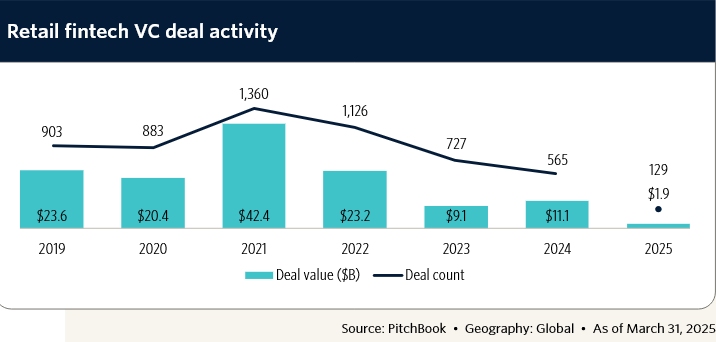
According to PitchBook Retail Fintech VC Trends, global retail fintech funding volumes reached $1.9 billion in Q1 2025, representing a 37.8% drop from Q4 2024 despite rising interest in platform-first strategies and growing AI adoption.
Although venture growth deals were the exception with median deal sizes jumping 67% to $47 million, making up 53.7% of total VC value. Klarna’s $12 billion valuation and Addi’s $170 million growth round stand out. IPO prospects for Klarna and eToro postponed listings due to market volatility ala Trump-effect.
Early stage retail fintech including median pre-seed and seed valuations fell by 50% and declined in size and count.
CCG Catalyst’s May 1 2025 snapshot of retail digital banking platforms features fintech companies are gaining traction because they stack cloud-native scale, AI tools, and modular architecture:
| U.S. Platform | Why Investors Are Interested |
| Backbase | Microservices, API-first architecture, and enterprise flexibility |
| Narmi | Open API stack and fast onboarding (under 3 minutes) |
| Lumin Digital | AI-native with strong mobile UX, cloud-native since day one |
| SoFi/Cyberbank | End-to-end infrastructure with embedded finance support |
| Temenos Infinity | Low-code platform enabling rapid interface development |
Canada’s fintech ecosystem has several growing players with potential to evolve into full service modular banking platforms or infrastructure providers:
| Canadian Company | Comparable U.S. Platform | Strategic Direction |
| Wealthsimple | SoFi | Expanding beyond investing into cash accounts, cards, and tax tools |
| Koho | Narmi | Prepaid card and banking-like functionality with open APIs |
| Neo Financial | Lumin Digital | Mobile-first, rewards-driven model with merchant integration |
| EQ Bank | Backbase | Hybrid of legacy and digital bank offering API access and high-interest accounts |
| Tandem or Brim | Apiture or Temenos | Fintechs with credit and loyalty platforms, potential to grow through partnerships |
Canadian fintech is still limited by federal regulatory complexities but opportunities are increasing as consumers move away from branch-based banking, the need for increased competition amidst Trump's economic pressures, and newly elected Prime Minister Mark Carney vowing to protect Canada.
According to the Canadian Bankers Association's 2024 report, 70% of Canadians used a mobile banking app in the last year (on average 7.4 times per month), up from 65% in 2021.
VC interest in Canadian fintech remained strong in 2024, despite a global slowdown. Fintechs with platform enabling capabilities such as embedded finance, banking-as-a-service, and open API designs continue to attract interest. Plus, the rise of U.S. plug-and-play models is a playbook for homegrown infrastructure players to serve Tier 2 banks, credit unions, and niche verticals like gig economy banking.
Digital banking platforms at the forefront are meeting customer expectations and improving operational efficiency with a few key technologies:
Digital retail banking platforms are using AI, APIs, and modular designs to deliver flexible, intelligent, and ready to scale solutions. Canadian fintechs that embrace open architecture and build for partnerships can lead not just here in Canada, but globally.
The National Crowdfunding & Fintech Association (NCFA Canada) is a financial innovation ecosystem that provides education, market intelligence, industry stewardship, networking and funding opportunities and services to thousands of community members and works closely with industry, government, partners and affiliates to create a vibrant and innovative fintech and funding industry in Canada. Decentralized and distributed, NCFA is engaged with global stakeholders and helps incubate projects and investment in fintech, alternative finance, crowdfunding, peer-to-peer finance, payments, digital assets and tokens, artificial intelligence, blockchain, cryptocurrency, regtech, and insurtech sectors. Join Canada's Fintech & Funding Community today FREE! Or become a contributing member and get perks. For more information, please visit: www.ncfacanada.org
| | |
|---|---|---|
| | |


August 26th, 2025

January 4th, 2024

June 1st, 2021

September 9th, 2020

July 9th, 2018

January 3rd, 2018

September 25th, 2017

June 20th, 2017

May 10th, 2017

December 14th, 2016