




Karsten Wenzlaff, Advisor
August 26th, 2025
Karsten Wenzlaff is a Crowdfunding and Fintech Expert from Germany. He is Secretary-General of Digit[...]


Cybersecurity | May 14, 2025

Image: Freepik/DC Studio
Patrick Opet, JPMorgan Chase’s Chief Information Security Officer, has dropped a rare public warning that the modern SaaS (Software-as-a-service) model is enabling cyberattacks and embedding systemic risk into the global economy. His message is that the security architecture is breaking down, and software providers are not doing enough to fix it. Below are some urgent quotes from his discourse and why they matter for Canadian fintechs, investors, and regulators.
1. “SaaS has become the default... embedding concentration risk into global critical infrastructure.”
Many fintechs are using the same core SaaS vendors for payments, data, and automation, exposing them to a single point of failure. If one of these vendors is compromised, the effects can spread fast like wild fire on a dry summer's night. For fintech startups, the risks may be inherited without full visibility.
2. “Over the past three years, our third-party providers experienced a number of incidents... requiring us to act swiftly and decisively.”
Canadian fintechs with lean security teams need contingency plans for third party supplier compromise and must monitoring vendor behaviour or risk the full wrath of a serious attack that will disrupt operations, result in data theft or leakage, fraud and financial loss, regulatory and legal exposure, reputational damage and even cascading or 'fourth party' risks. Even a global bank must isolate vendors during incidents. Read OSFI's Guidance here: Third-Party Risk Management Guideline.
3. “Fierce competition among software providers has driven prioritization of rapid feature development over robust security.”
Security is often sacrificed for speed. Fintechs should require vendors to provide (1) strong and secure default settings, (2) regular third-party audits, and proof or evidence of strong internal security programs such as SOC 2 Type II or ISO/IEC 27001 certification.
4. “Modern integration patterns dismantle essential boundaries... relying on overly simplified interactions between third-party services and firms’ sensitive internal resources.”
OAuth tokens and API integrations are often misused, allowing third and unwanted parties to access internal systems. Without strong segmentation and logging, attackers can move quickly once access is gained. Microsoft Threat Intelligence recently confirmed state actors are now targeting common SaaS apps to infiltrate customers.
5. “The most effective way to begin change is to reject these integration models without better solutions.”
Canadian fintechs should ensure procurement policies require secure integration design, advanced authorization models, and greater transparency from vendors. Startups should reference the Canadian Center for Cybersecurity Top 10 IT Security Actions for implementation guidance.
SaaS brought convenience and speed but also concentrated risk across fintech infrastructure. For smaller Canadian firms who often lack internal security engineering, the consequences of a poorly or unsecured SaaS integration can be severe. This warning should not be ignored.
Fintech leaders should:
OSFI and the CSA have made it clear that third party oversight is now a priority, so fintechs can expect questions on cybersecurity controls and operational resilience during regular reviews. SaaS is here to stay but without stronger default security and safer integrations and oversight, it'll remain a growing liability.
Fintech startups and scale-ups cannot rely on vendors to lead. Security must be a shared responsibility across the ecosystem, and it begins with better architecture, more transparency, and smarter procurement.
 The National Crowdfunding & Fintech Association (NCFA Canada) is a financial innovation ecosystem that provides education, market intelligence, industry stewardship, networking and funding opportunities and services to thousands of community members and works closely with industry, government, partners and affiliates to create a vibrant and innovative fintech and funding industry in Canada. Decentralized and distributed, NCFA is engaged with global stakeholders and helps incubate projects and investment in fintech, alternative finance, crowdfunding, peer-to-peer finance, payments, digital assets and tokens, artificial intelligence, blockchain, cryptocurrency, regtech, and insurtech sectors. Join Canada's Fintech & Funding Community today FREE! Or become a contributing member and get perks. For more information, please visit: www.ncfacanada.org
 |  |  |
|---|---|---|
 |  |  |
Crypto M&A | May 13, 2025

Image from announcement Roinhood to acquire WonderFi
Robinhood Crypto announced on May 13 that it will acquire Canadian fintech WonderFi Technologies for C$250 million (US$179 million) in an all-cash deal, giving it immediate access to Canada’s regulated crypto trading market.
WonderFi shareholders will receive C$0.36 per share in cash, reflecting a 41% premium to the May 12 closing price and a 71% premium to the 30-day volume weighted average.
The purchase includes WonderFi’s flagship platforms, Bitbuy and Coinsquare, which combined hold over C$2.1 billion in assets under custody and offer crypto trading, staking, and custody services to millions of Canadian users.
The deal is structured as an arrangement under the BC Business Corporations Act and is expected to close in the second half of 2025, subject to court, regulatory, and shareholder approvals.
Johann Kerbrat, Senior Vice President and GM of Robinhood Crypto:
“WonderFi has built a formidable family of brands serving beginner and advanced crypto users alike, making them an ideal partner to accelerate Robinhood’s mission in Canada.”
Ahead of launching or acquiring a crypto trading platform in Canada, Robinhood opened a Toronto headquarters office in 2024 with 140+ staff focused on infrastructure engineering. The WonderFi acquisition allows Robinhood to offer crypto products in a regulated market while positioning for broader retail expansion.
Dean Skurka CEO of WonderFi:
“WonderFi and Robinhood are united in our visions of making crypto accessible and bringing more people into the crypto space.”
Could Robinhood's acquisition of WonderFi ignite more cross border fintech consolidation in Canada? It will definitely bring more competition to Canadian fintech markets, as the deal injects global capital into the sector, establishing the bar for product, pricing, and platform innovation to crypto, digital banks, wealthtech and lifestyle finance platforms in Canada.
The National Crowdfunding & Fintech Association (NCFA Canada) is a financial innovation ecosystem that provides education, market intelligence, industry stewardship, networking and funding opportunities and services to thousands of community members and works closely with industry, government, partners and affiliates to create a vibrant and innovative fintech and funding industry in Canada. Decentralized and distributed, NCFA is engaged with global stakeholders and helps incubate projects and investment in fintech, alternative finance, crowdfunding, peer-to-peer finance, payments, digital assets and tokens, artificial intelligence, blockchain, cryptocurrency, regtech, and insurtech sectors. Join Canada's Fintech & Funding Community today FREE! Or become a contributing member and get perks. For more information, please visit: www.ncfacanada.org
| | |
|---|---|---|
| | |
Enforcement | May 12, 2025

Image: AI Freepik
On May 9, 2025, U.S. President Trump signed an executive order called 'Fighting overcriminalization in federal regulations' that changes how federal agencies can or cannot pursue criminal enforcement for regulatory violations, redefining risk for fintech and crypo leaders. The policy order says prosecutors must now show clear evidence that a person or company intended to break the law before charging them criminally.
This move targets the issue of overcriminalization and aims to reduce legal risk for businesses that unknowingly violate complex or technical rules. It could reshape how enforcement decisions are made in fintech, crypto, and other innovation-driven sectors.
Here's a link the fact sheet published by the White House. Essentially the order mandates all federal agencies to:
1. A good example may be former Binance CEO, Changpeng Zhao (CZ) who was sentenced to four months in prison in 2023 for violating the Bank Secrecy Act. The case focused on compliance gaps, not fraud. Similar enforcement actions in the future might be handled differently if there was no evidence of intent.
2. These two former Coinbase employees, Ishan and Nikhil Wahi, were convicted of insider trading using confidential listing information. Since their actions were deliberate, the order may not directly apply to them but it might influence how prosecutors approach future cases involving gray areas in trading conduct.
3. Fintech and crypto companies operating in complex and evolving regulatory environments may benefit the most. The new policy could limit criminal risk for teams that unintentionally violate reporting, registration, or compliance rules.
4. Sam Bankman-Fried was convicted in 2023 and sentenced to 25 years in prison. The FTX founder was found guilty of fraud, conspiracy, and misuse of customer funds. Courts found that his actions were intentional and deceptive, so the order likely does not apply in his case.
5. Alex Mashinsky former Celsius CEO pleaded guilty to fraud and market manipulation and recently received a 12 year prison sentence for crypto fraud and knowingly misleading customers. As a result, his case also likely falls outside the scope of the new enforcement policy.
The new policy directive places the burden on agencies to prove intent before pursuing criminal charges. The change may protect founders, operators, and teams from facing prison time over technical mistakes or unclear compliance rules in an ever evolving regulatory environment.
While the order does not affect past convictions, it may influence how courts and prosecutors handle ongoing investigations. It also gives legal teams a new foundation to challenge charges that lack clear evidence of intentional wrongdoing.
The National Crowdfunding & Fintech Association (NCFA Canada) is a financial innovation ecosystem that provides education, market intelligence, industry stewardship, networking and funding opportunities and services to thousands of community members and works closely with industry, government, partners and affiliates to create a vibrant and innovative fintech and funding industry in Canada. Decentralized and distributed, NCFA is engaged with global stakeholders and helps incubate projects and investment in fintech, alternative finance, crowdfunding, peer-to-peer finance, payments, digital assets and tokens, artificial intelligence, blockchain, cryptocurrency, regtech, and insurtech sectors. Join Canada's Fintech & Funding Community today FREE! Or become a contributing member and get perks. For more information, please visit: www.ncfacanada.org
| | |
|---|---|---|
| | |
AI | May 9, 2025

Image: Freepik/iconicbestiary
On May 8, 2025 during a U.S. Senate testimony on 'Winning the AI Race', Microsoft Vice Chair Brad Smith said the company blocked employees from using the DeepSeek AI app because of the app’s data collection practices, risks of propaganda, and Chinese state censorship. Smith confirmed that DeepSeek “is not available on the Microsoft store” and cannot be used by staff. The full hearing coverage can be found at TechCrunch.
But at the same time Microsoft continues to offer DeepSeek’s open source AI models through its Azure cloud platform, raising questions for both the public and business users alike. According to Dataconomy, Microsoft claims that it has audited, changed, and sandboxed the models before release to remove parts they deem are risky or unsafe.
This mixed approach has raised some concerns since the AI model can be used by others without Microsoft's internal protections. Some smaller companies may also not have the tools or awareness to even evaluate these risks, whether they be related to security or reputation.
It's the same underlying tech. Even if Microsoft tweaks the model, the core code base still comes from DeepSeek, so any unknown, unspottable, or embedded risk could still be present.
The open source models that Microsoft offers via its Azure cloud platform, could have been adversely modified by bad actors for risks like surveillance, disinformation or phishing campaigns.
It's a double standard for Microsoft to say it's unsafe for employees but okay for customers to use it. It sends a mixed message and in certain cases a reputational or regulatory risk could grow for companies that adopt it.
If governments and regulator tighten controls around AI supply chains, especially foreign ones from China, then companies could face compliance, or import/export restrictions in the the future. The State of New York has already banned DeepSeek on official devices earlier this year due to data privacy and censorship concerns.
Fintechs and financial institutions need to verify AI model origins and audit what is under the hood, and understand how its being deployed while staying aware of compliance risks. Microsoft’s internal controls may reduce risk for its own teams, but the public and smaller firms are left more exposed.
The National Crowdfunding & Fintech Association (NCFA Canada) is a financial innovation ecosystem that provides education, market intelligence, industry stewardship, networking and funding opportunities and services to thousands of community members and works closely with industry, government, partners and affiliates to create a vibrant and innovative fintech and funding industry in Canada. Decentralized and distributed, NCFA is engaged with global stakeholders and helps incubate projects and investment in fintech, alternative finance, crowdfunding, peer-to-peer finance, payments, digital assets and tokens, artificial intelligence, blockchain, cryptocurrency, regtech, and insurtech sectors. Join Canada's Fintech & Funding Community today FREE! Or become a contributing member and get perks. For more information, please visit: www.ncfacanada.org
| | |
|---|---|---|
| | |
Enforcement | May 9, 2025

Image: Freepik
Alex Mashinsky, Founder of the crypto lending platform Celsius, has been sentenced to 12 years in prison for defrauding customers and manipulating the price of his company’s digital token.
According to a press release issued May 8, 2025 from the U.S. Department of Justice, Mashinsky promised people their money would be safe and earn high rewards on Celsius. However, courts found that instead he used customer deposits to make risky bets and secretly boost the price CEL, Celsius’s own token. At the company’s peak, Celsius held about $25 billion in customer assets. When Celsius collapsed in July 2022, around 600,000 customers lost access to $4.7 billion worth of crypto. The sentence came from a U.S. court after Mashinsky admitted in December 2024 that he committed fraud and misled investors.
Jay Clatyon, U.S. Attorney said:
“Mashinsky made tens of millions of dollars while his customers lost billions... The rules against fraud still apply.”
As reported by Reuters, Mashinsky also said publicly that he wasn’t selling CEL tokens, but in fact he was and made about $48 million in profit from doing so. Further, he took out $8 million of his own money just before the company blocked customer withdrawals. He told customers that Celsius was financially strong even that he knew it was failing.
In addition to 12 years prison time, Mashinsky must pay a fine and give up his profits from the token sales.
Crypto companies must follow the same rules as everyone else. Misleading customers and manipulating markets has serious consequences. As more and more people engage with digital assets, trust and transparency is critical for the future of finance.
The National Crowdfunding & Fintech Association (NCFA Canada) is a financial innovation ecosystem that provides education, market intelligence, industry stewardship, networking and funding opportunities and services to thousands of community members and works closely with industry, government, partners and affiliates to create a vibrant and innovative fintech and funding industry in Canada. Decentralized and distributed, NCFA is engaged with global stakeholders and helps incubate projects and investment in fintech, alternative finance, crowdfunding, peer-to-peer finance, payments, digital assets and tokens, artificial intelligence, blockchain, cryptocurrency, regtech, and insurtech sectors. Join Canada's Fintech & Funding Community today FREE! Or become a contributing member and get perks. For more information, please visit: www.ncfacanada.org
| | |
|---|---|---|
| | |
Digital Banking | May 9, 2025
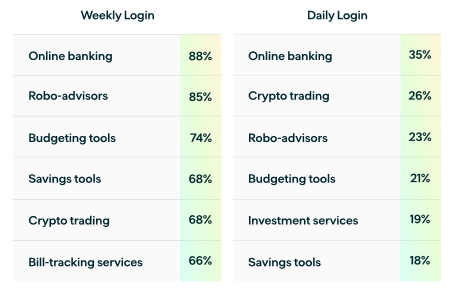
Image: Frequency of Use (Plaid x YouGov Money Talks survey report)
Between August 20-26th 2024, Plaid commissioned a national survey through the YouGov platform to understand how U.S. consumers bank, pay, and invest. The survey reveals insights of consumer preferences in digital finance, including trust in financial providers, app usage, payment methods, credit attitudes, and investment habits, based on weighted responses from 2,077 adults. Fintechs, digital finance platforms, and financial institutions need to stay up to date with the latest retail digital banking trends if they want to compete for consumer loyalty. Read 'Money Talks' (28 page PDF) report explaining these trends. Below we break-down key insights for NCFA's readers. Not yet subscribed? Sign-up for NCFA's weekly newsletter here.
Consumers continue to trust traditional banking institutions more than 100% digital platforms:
Trust and security go hand and hand, and overall, trust comes from perceived care and protection:
Consumers also shared who they rely on for financial well-being. The takeaway is that fintechs and advisory services must do more to be seen as helpful and caring, a useful partner in people’s financial lives.
Online banking is the most widely used financial tool: 99% percent of consumers are familiar with it, and 74% use it weekly.
Other commonly used tools include savings apps (68% weekly or daily), budgeting tools (85%), and peer-to-peer payment apps like Venmo or Zelle (used weekly by 50% of users). Roboadvisors are accessed more than once per week by (80%) of their users but only 1% of all consumers report using them regularly.
When asked what improvements they want most in financial apps:
60% of respondents said it is important to link their bank account with the financial apps they use.
Takeaway: Apps that are integrated, responsive, and secure are the most likely to be used often. Fintechs and banks that overcomplicate services or create friction in setup risk being overlooked, even if their offerings are advanced.
25% currently invest in cryptocurrency. Another 21% say they plan to invest in crypto or NFTs in the next year. These responder levels of engagement are equal to the 25% of people who say they will invest in stocks or trading platforms during the same period.
Crypto investors are not limiting their exposure:
Only 11% of respondents have used AI tools to support their investing decisions -> interestingly, this already exceeds the share of people using roboadvisors, suggesting that AI powered investment tools are gaining traction faster than traditional automated advice products.
Takeaway: Fintechs offering secure, easy to understand crypto access or AI investment tools can appeal to a growing investor base. Banks that avoid crypto are at risk of losing relevance with younger and self-directed investors.
Debit cards are now more commonly used than credit by younger adults. According to EY data cited in the report, 69% of Gen Z use debit cards daily or weekly. Many say they avoid credit cards because they do not want debt or do not qualify.
Buy now pay later (BNPL) services have grown 40% in usage since 2021.
Takeaway: Only 30% of respondents believe their credit score accurately reflects their financial health. 55% said they have been denied a loan due to a low score. These figures support growing interest in alternative data, such as cash flow and account history, for lending decisions.
Older adults are especially cautious. People aged 66 to 70 are 55% more likely to mistrust digital banks than those aged 22 to 25. Younger adults are more flexible. Among respondents aged 18 to 24, 36% said they would switch banks for a better digital payment experience.
Despite these trends, most people are not actively looking to change banks:
Consumers use different payment methods based on transaction size and age group:
To fund digital wallets:
Takeaway: Fintechs that want to increase adoption of pay by bank options must improve the experience. According to the report, 49% of users say they are likely to use pay by bank if the account linking process is easy.
Consumers want financial services that are clear, secure, and helpful, with trust remaining the most important factor in deciding whether to try a new app, share data, or switch banks. Traditional banks still hold an advantage in trust and reach but must modernize quickly. Fintechs have room to grow if they lead with transparency and value. Financial institutions that support financial goals and offer simple, connected experiences will stay relevant in 2025 (and beyond). Learn more about how consumers in the U.S. use, feel, bank, transact and acquire in 'Money Talks'.
The National Crowdfunding & Fintech Association (NCFA Canada) is a financial innovation ecosystem that provides education, market intelligence, industry stewardship, networking and funding opportunities and services to thousands of community members and works closely with industry, government, partners and affiliates to create a vibrant and innovative fintech and funding industry in Canada. Decentralized and distributed, NCFA is engaged with global stakeholders and helps incubate projects and investment in fintech, alternative finance, crowdfunding, peer-to-peer finance, payments, digital assets and tokens, artificial intelligence, blockchain, cryptocurrency, regtech, and insurtech sectors. Join Canada's Fintech & Funding Community today FREE! Or become a contributing member and get perks. For more information, please visit: www.ncfacanada.org
| | |
|---|---|---|
| | |
M&A | May 8, 2025

Image credit: Coinbase Announcement
On May 8, 2025, Coinbase announced that it has agreed to acquire Deribit in a $2.9 billion deal, to become the world’s largest crypto options exchange. The acquisition includes $700 million in cash and 11 million shares of Coinbase Class A common stock, and is the largest strategic M&A deal to date in the Digital Assets space per Financial Technology Partners who served as the exclusive financial advisor to Deribit to facilitate the transaction which is expected to close by the end of 2025.
Deribit provides institutional-grade infrastructure for trading derivatives across Bitcoin, Ethereum, and other major tokens, and currently holds around $30 billion in open interest and processed more than $1 trillion in trading volume last year in 2024, making it the global leader in Bitcoin and Ethereum options trading.
With this deal, Coinbase becomes the most comprehensive provider of crypto derivatives globally for hedge funds, asset managers, and proprietary trading firms, offering access to spot, futures, perpetual futures, and options trading on a single platform.
Luuk Strijers, CEO of Deribit:
“We’re excited to join forces with Coinbase to power a new era in global crypto derivatives. As the leading crypto options platform, we’ve built a strong, profitable business, and this acquisition will accelerate the foundation we laid while providing traders with even more opportunities across spot, futures, perpetuals, and options – all under one trusted brand."
Derivatives represent about 70% of the global crypto trading volume, including futures, perpetuals, and options. Coinbase already offered futures and perpetuals via its U.S. and international exchanges. Now with the acquisition of Deribit's options infrastructure, it completes Coinbase's platform product stack evolving from basic spot trading to provide access to more advanced strategies and instruments.
Greg Tusar, Vice President of Institutional Products at Coinbase:
"With Deribit’s strong presence and professional client base, Coinbase is making its most substantial move yet to accelerate our international growth strategy. Deribit will immediately enhance profitability and add diversity and durability to our trading revenues upon close."
This is not Coinbase’s first major infrastructure acquisition, and at this point it's a pattern of acquiring strategic platforms and integrating them into essential components of its institutional offerings. Each of these deals broadened Coinbase's reach among professional and institutional traders and investors.
Coinbase's acquisition of Deribit is a clear sign of where the industry is heading. The next phase of crypto growth will be built on institutional-grade infrastructure, not hype. Advanced trading tools, capital efficiency, and compliance are becoming the new standards.
The National Crowdfunding & Fintech Association (NCFA Canada) is a financial innovation ecosystem that provides education, market intelligence, industry stewardship, networking and funding opportunities and services to thousands of community members and works closely with industry, government, partners and affiliates to create a vibrant and innovative fintech and funding industry in Canada. Decentralized and distributed, NCFA is engaged with global stakeholders and helps incubate projects and investment in fintech, alternative finance, crowdfunding, peer-to-peer finance, payments, digital assets and tokens, artificial intelligence, blockchain, cryptocurrency, regtech, and insurtech sectors. Join Canada's Fintech & Funding Community today FREE! Or become a contributing member and get perks. For more information, please visit: www.ncfacanada.org
| | |
|---|---|---|
| | |


August 26th, 2025

January 4th, 2024

June 1st, 2021

September 9th, 2020

July 9th, 2018

January 3rd, 2018

September 25th, 2017

June 20th, 2017

May 10th, 2017

December 14th, 2016