




Karsten Wenzlaff, Advisor
August 26th, 2025
Karsten Wenzlaff is a Crowdfunding and Fintech Expert from Germany. He is Secretary-General of Digit[...]


May 21, 2025

Image: Freepik/DC Studio
Synthetic indices are a new phenomenon in the world of online trading that has drawn interest from both novice and experienced traders. These digital assets provide a distinctive and dynamic trading experience by simulating actual market conditions. However, as their popularity increases, so does the number of questions. The most important one is "Are synthetic indices manipulated?" How much real power do brokers have over the results, if any at all? In a market unrelated to tangible things, it's a legitimate worry. This article delves into how you can ascertain whether synthetic indices are as fair as conventional trading instruments or just a new kind of risk wrapped in tech-savvy terminology.
Here are facts about synthetic indices:
The fact that synthetic indexes are not based on actual assets is one of the primary ways they differ from conventional financial instruments. These algorithms replicate the movement and volatility of actual markets, but they are not directly related to economic indicators, company performance, or geopolitical events. Some traders doubt the validity of their price behavior because they are simulated. Given that the market movements are artificial, you may well wonder, "Are synthetic indices manipulated?"
The foundation of synthetic indexes is the idea of controlled volatility. The degree to which the price is anticipated to change during a specified period is determined by the predefined volatility level of each index, such as Volatility 10, 25, 50, or 75. On the positive side, controlled volatility lets you create exact strategies since it offers a level of predictability that real-world assets do not. Conversely, this leads to the question of whether synthetic indices are manipulated, and it is a valid one.
Regulation and broker dependency are important considerations when asking, "Are synthetic indices manipulated?" As a result of this arrangement, traders rely significantly on the broker's transparency and reliability. Concerns regarding market manipulation can be reduced if the broker conducts business fairly and uses certified algorithms that have undergone third-party audits. The answer to the question of "Is synthetic indices gambling?" primarily depends on the broker's policies. You can check over here to explore synthetic indices.
Synthetic indices have the unquestionable advantage of being accessible around the clock, in contrast to traditional markets that have set operating hours. Traders with erratic schedules or those in different time zones still have easy access. Whatever time works best for you, you can trade on the weekend, at midnight, or during your lunch break. This feature, nevertheless, also heightens worries about possible manipulation. Every tick in these indexes is produced within the broker's ecosystem because they are not dependent on outside variables or actual market hours. This brings up the question of whether synthetic indices are manipulated.
Slippage and liquidity are ongoing issues in traditional markets. Because the market is mimicked, liquidity and slippage are not as big problems with synthetic indexes. The algorithm is followed to execute each order, guaranteeing a steady and reliable trading experience.
However, the lack of friction in the actual world occasionally prompts doubters to ask themselves, "Are synthetic indices manipulated?" This is especially the case when results seem unduly controlled or smooth. Understanding that synthetic indices are distinct, not better or worse.
Are artificial indices, then, manipulated? There is more to the answer than a simple yes or no. To answer the question, "Are synthetic indices manipulated?" it's critical to realize that trading in any way carries some level of risk. However, with the right broker, discipline, and understanding, trading on synthetic indices doesn't have to be a gamble. As with any other market, whether genuine or simulated, synthetic indices present a distinct combination of opportunity and risk.
 The National Crowdfunding & Fintech Association (NCFA Canada) is a financial innovation ecosystem that provides education, market intelligence, industry stewardship, networking and funding opportunities and services to thousands of community members and works closely with industry, government, partners and affiliates to create a vibrant and innovative fintech and funding industry in Canada. Decentralized and distributed, NCFA is engaged with global stakeholders and helps incubate projects and investment in fintech, alternative finance, crowdfunding, peer-to-peer finance, payments, digital assets and tokens, artificial intelligence, blockchain, cryptocurrency, regtech, and insurtech sectors. Join Canada's Fintech & Funding Community today FREE! Or become a contributing member and get perks. For more information, please visit: www.ncfacanada.org
 |  |  |
|---|---|---|
 |  |  |
Report | May 20, 2025
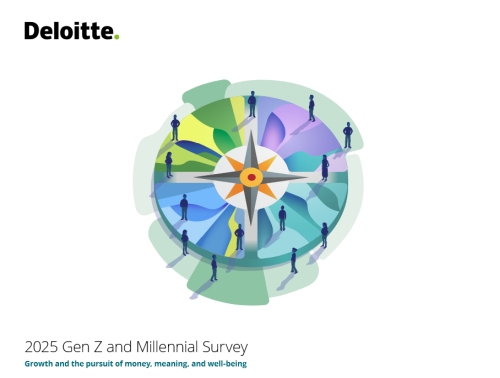
Image: Deloitte 2025 Gen Z and Millennial Survey
The 14th edition of the annual 2025 Deloitte Global Gen Z and Millennial Survey provides a global snapshot of generational attitudes towards work, money, technology and values, offering fintech founders, banks, credit unions, and policymakers core insights into what's driving the new economy and markets.
By 2030, Gen Z and millennials will represent nearly 75% of the global workforce. These generations are not just using financial technologies. They are building it, and reverse engineering what problems they should solve while establishing new expectations for how financial service tools operate.
The self-administered online survey data was collected from October 25 and December 24, 2024, gathering responses from a total of 23,482 respondents including 14,751 Gen Zs (born 1995 - 2006) and 8,731 millennials (born 1983 - 1994) across 44 countries, including regions such as North America, Latin America, Western Europe, Eastern Europe, the Middle East, Africa, and Asia-Pacific.
Young workers are very anxious about money.
- 48% of Gen Zs and 46% of millennials say they do not feel financially secure
- 52% of both groups live paycheck to paycheck, and over 33% struggle with basic monthly expenses
- 41% of Gen Zs and 44% of millennials are unsure whether they’ll be able to retire with financial comfort
These data points highlight the need for fintech products go well beyond basic budgeting dashboards. Gen Z and millennials need fintech tools to help them achieve financial resilience, such as income stabilization or smoothing, flexible savings tools, automated rent/bill buffers, and fair access to emergency funds. Financial service providers that can help reduce voltaility, and not just optimize credit scores, have an opportunity to earn trust and loyalty.
Adoption of generative AI tools is already a daily routine for young professionals.
- 57% of Gen Zs and 56% of millennials use GenAI tools in their daily work
- About 30% of each group use AI most or all of the time
- 74% of Gen Zs and 77% of millennials believe AI will significantly change how they work within the next year
These users are engaging with and building fintech products through an AI-first lens. They expect tools to respond in natural language, deliver almost instant relevant insights without friction, and adapt quickly. Static interfaces and dated workflows will lose ground quickly.
Fintech platforms in particular need to integrate GenAI not just in the back-end system but into product design and customer experience because these cohorts are fluent in AI which is quickly becoming the standard in how they source, think and consume.
Gen Z and millennials care less about climbing corporate ladders and more about doing work that aligns with their values.
- Only 6% of Gen Zs say their main career goal is to reach a leadership role
- 44% of Gen Zs and 45% of millennials have left jobs that lacked purpose
- 41% of Gen Zs and 40% of millennials have rejected employers due to ethical or values misalignment
For fintech employers, this creates both risk and opportunity. A strong mission with aligned values can attract high performers but the opposite will scare talent away quickly. To attract and retain the next generation of fintech talent, companies must offer more than good compensation. They need clear values, meaningful impact, and room for personal growth.
Formal degrees are no longer the default path into the fintech sector.
- 31% of Gen Zs and 32% of millennials chose not to pursue higher education.
- 70% of Gen Zs and 59% of millennials are building career skills at least once a week.
- The majority are doing this on their own time, outside of work hours.
There's more acceptance and shift now towards non-traditional education from bootcamps and peer networks to self-teaching, which has huge implications for hiring, funding, and human capital development. This means founders, operators and technical resources, may not originate from familiar backgrounds. Fintech leaders and investors need to adapt recruitment and due diligence models to focus more on traction, experience, and skills - and not just degrees.
Environmental and ethical values are a key part of how decisions are made.
- 65% of Gen Zs and 63% of millennials say they are willing to pay more for environmentally sustainable services
- 23% of Gen Zs and 22% of millennials have researched a company’s environmental practices before accepting a job offer
- Almost 50% say they’ve left or declined work that didn’t match their personal ethics
Social and environmental alignment is becoming a core user expectation, not a brand differentiator. Fintechs must design for transparency and shared impact from day one.
Fintech companies and financial institutions must design and deliver intelligent products with purpose and transparency that meet the moment of Gen Z and millennials who are under financial stress, fluent in AI, and prioritize values and ethics. The opportunity is to not just help these generations but to earn their trust and grow with them to create the next iteration of smart, modern, and purposeful finance.
The National Crowdfunding & Fintech Association (NCFA Canada) is a financial innovation ecosystem that provides education, market intelligence, industry stewardship, networking and funding opportunities and services to thousands of community members and works closely with industry, government, partners and affiliates to create a vibrant and innovative fintech and funding industry in Canada. Decentralized and distributed, NCFA is engaged with global stakeholders and helps incubate projects and investment in fintech, alternative finance, crowdfunding, peer-to-peer finance, payments, digital assets and tokens, artificial intelligence, blockchain, cryptocurrency, regtech, and insurtech sectors. Join Canada's Fintech & Funding Community today FREE! Or become a contributing member and get perks. For more information, please visit: www.ncfacanada.org
| | |
|---|---|---|
| | |
Crypto | May 20, 2025
Image from Coinbase announcement
Just days before Coinbase is set to become the first crypto-native company added to the S&P 500, the largest crypto exchange in the United States disclosed a serious security breach on May 15, 2025 that could cost up to $400 million in damages and reimbursements. This is a growing vulernability in fintech and it's not related to flawed code or a broken firewall, but people on the inside working for the company.
On May 11, attackers sent Coinbase a ransom demand for $20 million in Bitcoin, but Coinbase refused to pay. Instead, they issued a public statement offering a $20 million bounty for information leading to the attackers’ arrests. In an SEC filing, Coinbase estimated that the financial cost of the data breach hack would be between $180-400 million for 'remediation costs and voluntary customer reimbursements'.
According to Coinbase, the attack began when 'rogue overseas support agents' (aka contracted customer support workers) were bribed by criminals. The corrupt insiders granted access to Coinbase’s internal systems, allowing attackers to gather customer names, emails, addresses, phone numbers, and even photos of passports and driver’s licenses.
The Verge also confirmed that some impacted customers lost funds after being tricked into sending crypto to the attacker’s fraudulent wallet addresses. Attackers used their personal data to impersonate Coinbase staff to target the victims. Coinbase has committed to paying them back.
Coinbase has since fired all of the compromised support workers and launched a new U.S.-based customer service hub. Law enforcement investigations are ongoing.
Outsourcing is an added risk given that lower paid overseas support agents with access to internal back-end systems can be bribed. Attackers are looking for customer data to support their social engineering scams to defraud victims. Cybersecurity must be approached beyond just technical risks, especially given that insider risks are often overlooked when developing compliance and risk mitigation programs.
Coinbase’s inclusion in the S&P 500 took place on Monday May 19, 2025, marking a significant milestone for the crypto sector. It is replacing Discover Financial Services, which is being acquired by Capital One. According to Ainvest, moving Coinbase to the S&P will trigger up to $16 billion in inflows from index-tracking funds and institutional investors.
However, the breach overshadows the achievement, now facing lawsuits from affected customers and working to repair trust in its rand. Just at the moment of unprecedented visibility.
The National Crowdfunding & Fintech Association (NCFA Canada) is a financial innovation ecosystem that provides education, market intelligence, industry stewardship, networking and funding opportunities and services to thousands of community members and works closely with industry, government, partners and affiliates to create a vibrant and innovative fintech and funding industry in Canada. Decentralized and distributed, NCFA is engaged with global stakeholders and helps incubate projects and investment in fintech, alternative finance, crowdfunding, peer-to-peer finance, payments, digital assets and tokens, artificial intelligence, blockchain, cryptocurrency, regtech, and insurtech sectors. Join Canada's Fintech & Funding Community today FREE! Or become a contributing member and get perks. For more information, please visit: www.ncfacanada.org
| | |
|---|---|---|
| | |
Crypto Security | May 16, 2025

Image from Ethereum 1TS announcement
On May 14, 2025, the Ethereum Foundation anounced a $1 Trillion Dollar Security (1TS) Initiative, a long term project to strengthen the security of the entire Ethereum ecosystem to support a future where trillions of dollars in value could move on-chain. The reality is that security isn't just a technical issue. It is the single biggest barrier to mainstream adoption of Web3, and Ethereum knows it.
Today, Ethereum is responsible for more than 50 percent of all total value locked (TVL) in decentralized finance platforms, already securing over $400 billion in on-chain assets. However a rise of exploits and protocol breaches unveil how fragile Ethereum's infrastructure actually is so the 1TS project aims to reinforce it.
In 2024, hackers stole over $1.8 billion across crypto platforms with Ethereum-based DeFi applications accounting for more than half of the total losses. Despite improvements in protocol security, new vulnerabilities continue to be exploited at scale, such as:
Notably the above figures don't include the growing number of targeted phishing campaigns, wallet drainers, and socially engineered scams that increasingly use AI to impersonate trusted actors and to slay 'pig butchering'. Collectively, these exploits show that Ethereum's security environment still has a way to go. For many prospective users and certainly institutions, the constant threat of permanent asset loss is a significant barrier to adoption and long term trust.
1. Map the risk. The Ethereum Foundation is conducting a full-stack vulnerability analysis, including risks in wallets, smart contract tooling, L2 infrastructure, consensus layer code, and even DNS and internet infrastructure.
2. Fund what matters. 1TS will identify the highest priority attack surfaces and fund long term solutions. These could include upgrades to client software, fuzz testing, formal verification, or developer tooling that requires and enforces safer default settings.
3. Communicate clearly. The final goal is to make Ethereum’s security infrastructure easier to understand, and to establish transparent benchmarks and metrics that will allow users, enterprises, and governments to compare the safety of Ethereum’s ecosystem to other financial systems.
The 1TS initiative is being led by Fredrik Svantes, Ethereum Protocol Security Lead, and Josh Stark, part of the Ethereum Foundation’s core leadership. They are joined by several other well known people from the security ecosystem, all bringing deep experience in incident response, smart contract audits, and secure protocol design.
The Ethereum Foundation is opening the initiative to input from the community. Anyone can share suggestions, flag concerns, or apply to collaborate by completing this form or to discuss, reach out to the team directly by email at trilliondollarsecurity@ethereum.org.
If Ethereum wants to be the financial base layer for billions of people, it needs a security model at least as robust as global banking systems. The Trillion Dollar Security Initiative is welcomed and necessary to get to the next step. It is about showing regulators, institutions, and the public that Ethereum and all the companies and transactions that feed off of the ecosystem can scale safely.
The National Crowdfunding & Fintech Association (NCFA Canada) is a financial innovation ecosystem that provides education, market intelligence, industry stewardship, networking and funding opportunities and services to thousands of community members and works closely with industry, government, partners and affiliates to create a vibrant and innovative fintech and funding industry in Canada. Decentralized and distributed, NCFA is engaged with global stakeholders and helps incubate projects and investment in fintech, alternative finance, crowdfunding, peer-to-peer finance, payments, digital assets and tokens, artificial intelligence, blockchain, cryptocurrency, regtech, and insurtech sectors. Join Canada's Fintech & Funding Community today FREE! Or become a contributing member and get perks. For more information, please visit: www.ncfacanada.org
| | |
|---|---|---|
| | |
Crypto | May 16, 2025

Image: Freepik/Wirestock
A series of violent kidnappings has rocked France’s crypto sector, prompting emergency government action and raising global concern about the country’s safety for fintech entrepreneurs. On May 13, 2025, masked men tried to abduct the pregnant daughter of Pierre Noizat, co-founder of French Bitcoin exchange Paymium, along with her toddler. The attack took place on a busy street in Paris and was captured on video. The victims screams drew help from passer-byes including a shopkeeper who threw a fire extinguisher at the attackers white van, ultimately stopping the abduction. The woman’s husband was also beaten during the struggle. Although the kidnapping was botched, it was the third high profile incident involving French crypto figures in less than 6 months.
Earlier in May, the father of a Paris-based crypto entrepreneur was abducted while walking his dog. His kidnappers severed a finger and sent the video to his son while demanding a ransom between €5 million and €7 million. The man was rescued three days later, and according to reports, at least five suspects were arrested.
On January 21, 2025, David Balland, co-founder of Ledger, and his partner were kidnapped at their home in central France. Balland was also violently attacked during his captivity and was later found with one finger missing.
French Interior Minister Bruno Retailleau called an emergency meeting with fintech and crypto leaders on May 16, 2025. He promised stronger cross-border enforcement, police support for targeted families, and security checks at the homes of crypto executives.
Eric Larchevêque, Co-founder Ledger’s co-founder:
"In last 12 months saw 50 attacks around the world targeting people involved in cryptocurrency. Of those, 14 were in France. There’s a real problem.”
Security experts blame a mix of high crypto visibility, blockchain transparency, and weak personal data privacy. Many French founders still live locally and have families in public roles. Some have posted wallet addresses or wealth milestones online and inadvertently turning themselves into targets.
France has worked hard to attract and support crypto innovation, welcoming startups under its MiCA licensing regime and positioning Paris as a global hub for Web3 development. But these crimes are now threatening to reverse that progress, and according to Sifted, multiple companies have already started relocating key staff and executives abroad due to physical security risks.
The crypto community is now pushing for digital identity protection tools, anonymized ownership registries, and encrypted communication channels for founders and executives. Some are turning to private security firms and changing daily routines to avoid patterns.
The violet kidnappings is a reputational crisis for France's innovation economy and a wake-up call to high profile fintech and crypto founders globally. The French government, must now prove that it can protect its most promising entrepreneurs before the damage is long reaching.
The National Crowdfunding & Fintech Association (NCFA Canada) is a financial innovation ecosystem that provides education, market intelligence, industry stewardship, networking and funding opportunities and services to thousands of community members and works closely with industry, government, partners and affiliates to create a vibrant and innovative fintech and funding industry in Canada. Decentralized and distributed, NCFA is engaged with global stakeholders and helps incubate projects and investment in fintech, alternative finance, crowdfunding, peer-to-peer finance, payments, digital assets and tokens, artificial intelligence, blockchain, cryptocurrency, regtech, and insurtech sectors. Join Canada's Fintech & Funding Community today FREE! Or become a contributing member and get perks. For more information, please visit: www.ncfacanada.org
| | |
|---|---|---|
| | |
Crypto | May 15, 2025

Image from Crypto.com Canada website
On May 12, 2025, Crypto.com Canada announced that on May 8 they received a restricted dealer registration across all Canadian provinces and territories, allowing the platform to continue offering crypto asset products and services while it works toward full investment dealer registration and CIRO membership.
This regulatory milestone aligns with Crypto.com’s earlier commitment to the Canadian Securities Administrators and Ontario Securities Commission in August 2022, when it became the first crypto trading platform to sign a Pre-registration Undertaking (PRU). The PRU was created to provide a temporary path for firms to continue operations while meeting Canada’s robust regulatory standards.
Eric Anziani, President and Chief Operating Officer at Crypto.com:
“We have strong protocols for our Canadian operations which were put in place or strengthened during the course of the registration process and are designed to enhance the protection of our customers and their asset. We have invested heavily in our compliance infrastructure around the world, and specifically in relation to Canada, because we want our customers to have greater peace of mind knowing that they are dealing with a regulated firm in Canada.”
Crypto.com Custody Trust Company (chartered trust company licensed in New Hampshire) will be the primary digital asset custodian for Canadian clients.
According to Joe Anzures, President of the custody unit, “Crypto.com Custody Trust Company looks forward to providing secure custody services to the Canadian market and to registered cryptocurrency trading platforms who will operate in accordance with the high standards established by Canadian securities regulators.”
Crypto.com’s Canadian registration adds to a growing global portfolio of licenses including:
Crypto.com’s restricted dealer registration highlights regulatory progress and a maturing market in Canada’s crypto sector. As more platforms become licensed and registered to operate in Canada both retail and institutional clients will benefit from more competition and improved confidence and safeguards. It also shows that top global crypto players are willing to meet Canada's high compliance standards, if there is a clear path to registration and market opportunities.
The National Crowdfunding & Fintech Association (NCFA Canada) is a financial innovation ecosystem that provides education, market intelligence, industry stewardship, networking and funding opportunities and services to thousands of community members and works closely with industry, government, partners and affiliates to create a vibrant and innovative fintech and funding industry in Canada. Decentralized and distributed, NCFA is engaged with global stakeholders and helps incubate projects and investment in fintech, alternative finance, crowdfunding, peer-to-peer finance, payments, digital assets and tokens, artificial intelligence, blockchain, cryptocurrency, regtech, and insurtech sectors. Join Canada's Fintech & Funding Community today FREE! Or become a contributing member and get perks. For more information, please visit: www.ncfacanada.org
| | |
|---|---|---|
| | |
May 15, 2025

Payoneer, a global company specializing in cross-border transactions for small to medium businesses, is reportedly seeking a buyer. This comes after it suspended its already issued full-year 2025 guidance.
This also comes at a very interesting time, given that fintech and global payment processing are more in demand than ever before. Take the world of gambling, for example. In the past, payment options for online gambling were quite limited, and consumers were left in a tough spot. Now, these online casinos offer a myriad of payment methods, and this has only drawn in more customers. As Alex Hoffmann writes, many of the apps for seamless gaming for gambling lovers also come with multiple fintech-enabled payment methods.
Payoneer seems to be facing issues behind the scenes that critics and customers are struggling to make sense of. On the one hand, its Q1 report shows a valuation of five cents per share, which is significantly less than the nine cents per share that analysts had predicted. But on the other hand, its revenue rose by 8% to $246.6 million, which was higher than analysts' initial predictions.
Despite this, the company announced that it would be suspending its full-year 2025 guidance.
“There are a broad range of potential outcomes and as a company supporting cross-border businesses that may be negatively impacted, we face substantial risks which could impact our financial results,” said Bea Ordonez, Payoneer’s CFO, noting the decision.
But the real scandal seems to be Payoneer's decision to seek an acquisition. According to some executives who chose not to identify themselves, the company is looking for a buyer and has hired a financial advisor to this effect.
So far, Payoneer has had quite the journey. It was first formed in 2005 and has become one of the most popular online payment processors with over 2 million customers. Back in 2021, it joined the likes of MoneyLion, another payment processor, which merged with a special purpose acquisition company, or SPAC, to secure public valuation. This is often seen as an easier path compared to traditional IPOs. Money Lion has also sought an acquisition and was sold to Gen Digital last year for roughly a billion dollars. Now, Payoneer is looking to do the same. It is worth noting that it will probably receive a higher buyout price, given that it was valued at $2.89 billion just recently. Even with this, it is roughly a 30% decline from its initial $3.3 billion valuation when it first merged in 2021.
Fintech companies overall have seen a complex and often unforgiving market, and so, 2025 will be a fight for Payoneer's long-term survival. The fintech market is projected to expand over the next few years, but that also means more competition compared to 2005, when the company first started.
Its PR team has refused to confirm or deny any of the speculation, but as time goes on, the true situation at Payoneer should come to light.
The National Crowdfunding & Fintech Association (NCFA Canada) is a financial innovation ecosystem that provides education, market intelligence, industry stewardship, networking and funding opportunities and services to thousands of community members and works closely with industry, government, partners and affiliates to create a vibrant and innovative fintech and funding industry in Canada. Decentralized and distributed, NCFA is engaged with global stakeholders and helps incubate projects and investment in fintech, alternative finance, crowdfunding, peer-to-peer finance, payments, digital assets and tokens, artificial intelligence, blockchain, cryptocurrency, regtech, and insurtech sectors. Join Canada's Fintech & Funding Community today FREE! Or become a contributing member and get perks. For more information, please visit: www.ncfacanada.org
| | |
|---|---|---|
| | |


August 26th, 2025

January 4th, 2024

June 1st, 2021

September 9th, 2020

July 9th, 2018

January 3rd, 2018

September 25th, 2017

June 20th, 2017

May 10th, 2017

December 14th, 2016