




Karsten Wenzlaff, Advisor
August 26th, 2025
Karsten Wenzlaff is a Crowdfunding and Fintech Expert from Germany. He is Secretary-General of Digit[...]


Policy | Nov 11, 2025

Image: Relative labour productivity Canada vs US (Source: CSLS 2025)
The Centre for the Study of Living Standards released a November 2025 report titled, "Can a Lack of Pro-Productivity Policies Explain the Secular Decline in Canada’s Productivity Growth?", outlining why Canada’s productivity growth has stalled even as macroeconomic policy remains stable. The study finds that steps in the 2025 federal budget while positive, will not by themselves reverse the long slowdown. The authors argue that deeper structural change is needed to rebuild the foundations of business investment and innovation in Canada.
The report traces much of the post 2015 slowdown to long term structural and global factors that are as a result of how past policy choices influenced business behaviour. Verified causes that reduced the total investment per worker and limited productivity even as macro conditions stayed the same include:
Evidence from major institutions supports this view. The analysis in the OECD 2025 Economic Survey of Canada and the IMF 2024 Article IV consultation finds that Canada’s productivity gap reflects long standing frameworks that influence how firms invest and compete. These findings show that the challenge is structural, a long term misalignment between national policy intent and firm level behaviour.
The recently announced Budget 2025 aims to address parts of Canada's productivity, innovation and competition gaps. It includes improvements to the Scientific Research and Experimental Development program by increasing the annual expenditure limit for the enhanced credit to $6 million, restoring eligibility for capital expenditures, and extending eligibility to Canadian public corporations. These measures target investment in intangible assets and innovation, the areas identified as weak.
The budget also commits over $1 billion in resources over five years for AI compute and quantum computing while proposing a TechStat program to track technology adoption, as described in the digital infrastructure plan.
Finally, the budget also advances open banking and stablecoin rules that can improve competition and trust.
Productivity growth depends on what happens inside firms, how they invest, adopt technology, and organize production. Canada’s frameworks have been stable but haven't created strong enough conditions for private reinvestment in digital and intangible assets.
When policy creates the right incentives and financial infrastructure removes friction, investment decisions shift. That alignment between public objectives and private behaviour is where lasting productivity growth emerges.
Canada’s weakness lies in underinvestment in intangible assets such as software, data, intellectual property, and organizational know how. Past tools have not reversed this pattern and Canada needs to reward reinvestment in intangible and digital assets. NCFA has argued for tax credits that mobilize private capital for innovation for years including in an open letter to government during the COVID 19 pandemic, urging government to collaborate with fintechs while proposing investment tax credits to crowd in private capital.
The United Kingdom’s Enterprise Investment Scheme (EIS) offers a clear example of how targeted tax relief can mobilize private capital into early-stage ventures. Since its launch in 1994, the EIS has attracted over £30 billion of private investment into more than 53,000 small and growing companies, according to HM Revenue & Customs.
The EIS program provides individual investors with income tax relief of up to 30% on investments in qualifying startups, along with capital gains deferrals. Analysts credit it with strengthening the UK’s innovation ecosystem and building one of the world’s most active early-stage funding markets.
Reducing interprovincial barriers and boosting competition are valuable but not sufficient on their own. The next step is to modernize how policy and firm level decisions connect. Fintechs can help turn policy into practice by improving access to capital, ensuring reliable and interoperable data, and scaling innovation across the economy. That's how Canada can turn structural reform into more practical and realized productivity gains.
 The National Crowdfunding & Fintech Association (NCFA Canada) is a financial innovation ecosystem that provides education, market intelligence, industry stewardship, networking and funding opportunities and services to thousands of community members and works closely with industry, government, partners and affiliates to create a vibrant and innovative fintech and funding industry in Canada. Decentralized and distributed, NCFA is engaged with global stakeholders and helps incubate projects and investment in fintech, alternative finance, crowdfunding, peer-to-peer finance, payments, digital assets and tokens, artificial intelligence, blockchain, cryptocurrency, regtech, and insurtech sectors. Join Canada's Fintech & Funding Community today FREE! Or become a contributing member and get perks. For more information, please visit: www.ncfacanada.org
 |  |  |
|---|---|---|
 |  |  |
AI Agent Research | Nov 10, 2025

Image: McKinsey and Google Cloud AI in Finance 2025 report covers
November 2025 research from McKinsey's The State of AI in 2025 and Google's The ROI of AI in Financial Services reveal that the way banks measure value from AI is changing. Instead of chasing fast gains from early generative tools, the financial sector is moving toward agentic AI platforms that produce steady operational returns and stronger control over risk and cost.
Google’s global financial services study found that 77% of firms report positive ROI from generative AI this year, matching last year’s figure. The data point indicates that the return base has stabilized after an initial surge (not stagnation or decline). Among responders reporting higher revenue, 51% saw growth (6%-10%), while 30% achieved gains above 10%. These numbers dipped slightly year over year, pointing to a normalization phase as programs scale.
The same study found that:
Spending priorities have shifted decisively:
McKinsey’s global findings confirm this rotation:
High performers stand out whose choices correlate directly with both revenue growth and cost reductions.
Benefits are appearing fastest in software engineering, IT, customer service, and marketing. The McKinsey report found that organizations deploying AI across these functions experienced:
• Average productivity gains of 15%-30% in service and technology teams
• Cost decreases of up to 12% in customer operations and risk processing
• Deployment cycles reduced to three to six months, down from an average of twelve months in 2023
• Revenue growth between 6%-10% for over half of financial institutions using AI in production
• Improved fraud detection accuracy by up to 20%, especially among banks integrating multi-agent risk models
Organizations combining workflow redesign with governance and human oversight achieve higher and more consistent ROI than those focused only on model performance.
According to Google and McKinsey's 2025 AI in finance research reports, AI has entered a new phase. The early boom in generative tools has given way to a steadier phase of operational performance driven by agents. The majority of institutions are already realizing returns, but the next iteration of value capture will come from how well they govern, measure, and scale these systems. Canada’s Opportunity In Efficient Reasoning AI its competitive edge, using discipline, design, and data to turn intelligence into growth.
The National Crowdfunding & Fintech Association (NCFA Canada) is a financial innovation ecosystem that provides education, market intelligence, industry stewardship, networking and funding opportunities and services to thousands of community members and works closely with industry, government, partners and affiliates to create a vibrant and innovative fintech and funding industry in Canada. Decentralized and distributed, NCFA is engaged with global stakeholders and helps incubate projects and investment in fintech, alternative finance, crowdfunding, peer-to-peer finance, payments, digital assets and tokens, artificial intelligence, blockchain, cryptocurrency, regtech, and insurtech sectors. Join Canada's Fintech & Funding Community today FREE! Or become a contributing member and get perks. For more information, please visit: www.ncfacanada.org
| | |
|---|---|---|
| | |
Nov 10, 2025

The digital transformation of casino gaming accelerates with fintech innovations. Financial technology reshapes how players engage with online platforms. Secure payment systems now support seamless deposits for Gamzix slots. This integration enhances user trust and transaction efficiency. Entrepreneurs leverage these advancements to build competitive gaming startups.
Modern casinos utilize artificial intelligence to tailor bonuses. Systems analyze individual gameplay to offer personalized promotions. This data-driven approach increases player satisfaction. It also optimizes marketing budgets for operators. Dynamic bonus structures adapt in real-time. They reflect player preferences and spending patterns.
Distributed ledger technology brings unprecedented fairness to slots. Every spin and jackpot outcome becomes verifiable. Players gain confidence in game integrity. Smart contracts automate payouts without delays. This innovation addresses historical trust issues in online gaming. Transparent algorithms prevent manipulation.
Advanced encryption and digital identity solutions protect transactions. Startups integrate biometric checks for account safety. Peer-to-peer payment networks enable instant deposits. These systems reduce friction for high-volume players. Secure governance frameworks ensure regulatory compliance. They foster sustainable scale-up opportunities.
Virtual reality casinos create immersive social gaming experiences. Players use cryptocurrency for in-world purchases. This blends entertainment with alternative finance models. Augmented reality overlays bring slots into physical spaces. Entrepreneurs develop virtual economies around branded games. These platforms attract a younger, tech-savvy demographic.
Fintech continues to redefine online casino operations. It merges financial innovation with entertainment technology. This synergy creates safer, more engaging player experiences. Adopting these technologies becomes essential for industry leadership. The future promises even deeper integration between finance and gaming ecosystems.
Distributed ledger technology guarantees absolute game fairness. Every transaction becomes permanently recorded and visible. Players can verify each bet's integrity independently. This transparency builds unprecedented confidence in platforms. Smart contracts automate payouts without human intervention. They eliminate delays and potential errors in winnings distribution.
Cryptocurrencies enable truly borderless gaming experiences. Geographic restrictions and currency conversions disappear. Players enjoy seamless access from any location worldwide. Digital wallets provide instant access to funds. This global reach opens massive new markets for operators. Traditional banking hurdles become irrelevant overnight.
Tokenized loyalty programs reward consistent player engagement. Gamers earn redeemable assets for their activity. These digital tokens hold real-world value and utility. They foster stronger community connections than points systems. Players become invested stakeholders in the platform's success. This alignment creates powerful long-term retention benefits.
The National Crowdfunding & Fintech Association (NCFA Canada) is a financial innovation ecosystem that provides education, market intelligence, industry stewardship, networking and funding opportunities and services to thousands of community members and works closely with industry, government, partners and affiliates to create a vibrant and innovative fintech and funding industry in Canada. Decentralized and distributed, NCFA is engaged with global stakeholders and helps incubate projects and investment in fintech, alternative finance, crowdfunding, peer-to-peer finance, payments, digital assets and tokens, artificial intelligence, blockchain, cryptocurrency, regtech, and insurtech sectors. Join Canada's Fintech & Funding Community today FREE! Or become a contributing member and get perks. For more information, please visit: www.ncfacanada.org
| | |
|---|---|---|
| | |
Artificial Intelligence | Nov 7, 2025
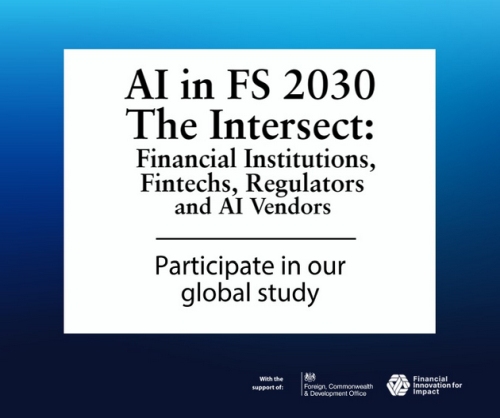
On November 4, 2025 the Cambridge Centre for Alternative Finance (CCAF) at Cambridge Judge Business School launched the AI in Financial Services 2030 Global Survey in collaboration with the World Bank, International Monetary Fund, Bank for International Settlements, and the World Economic Forum.
The National Crowdfunding & Fintech Association of Canada (NCFA) is happy to support this initiative as a survey partner inviting all professionals working in fintechs, banks, and other financial institutions to share their insights on how artificial intelligence is being planned, adopted, and managed across the sector. The survey takes about 25 minutes and explores governance, strategy, technology use, risk, and expectations for how AI will influence financial services by 2030.
This global initiative aims to build the most complete evidence base on AI’s real-world use in financial services. Findings will inform international policy and guide how innovation and regulation can support trust, access to capital, and sustainable growth.
By contributing, respondents will help ensure that fintech perspectives and diverse experiences are reflected in the data driving decisions at both policy and industry levels. The results will provide valuable benchmarks for AI adoption and readiness across different markets and institutions.
Take part in the Industry Survey for Fintechs and Financial Institutions: Access the AI in Financial Services 2030 Industry Survey
Other versions of the survey are available for regulators and AI vendors.
AI is moving incredibly fast, and this study gives everyone in the financial sector a chance to ground the conversation in real data and practical experience. By taking part, you’re helping ensure that future innovation in finance is guided by insight, accountability, and inclusion, values shared across the NCFA community.
The National Crowdfunding & Fintech Association (NCFA Canada) is a financial innovation ecosystem that provides education, market intelligence, industry stewardship, networking and funding opportunities and services to thousands of community members and works closely with industry, government, partners and affiliates to create a vibrant and innovative fintech and funding industry in Canada. Decentralized and distributed, NCFA is engaged with global stakeholders and helps incubate projects and investment in fintech, alternative finance, crowdfunding, peer-to-peer finance, payments, digital assets and tokens, artificial intelligence, blockchain, cryptocurrency, regtech, and insurtech sectors. Join Canada's Fintech & Funding Community today FREE! Or become a contributing member and get perks. For more information, please visit: www.ncfacanada.org
| | |
|---|---|---|
| | |
Crypto | Nov 7, 2025

Image courtesy of AI
On November 5 2025, Ripple announced a $500 million strategic raise led by Fortress and Citadel Securities at a $40 billion valuation. The company positioned the funding round as confirmation of its recent trajectory and a way to deepen ties with financial partners after its strongest year on record.
Brad Garlinghouse, CEO Ripple:
“This investment reflects both Ripple’s incredible momentum, and further validation of the market opportunity we’re aggressively pursuing by some of the most trusted financial institutions in the world. We started in 2012 with one use case payments and have expanded that success into custody, stablecoins, prime brokerage and corporate treasury, leveraging digital assets like XRP. Today, Ripple stands as the partner for institutions looking to access crypto and blockchain.”
Ripple points to six acquisitions completed in just over two years that expand Ripple's ecosystem from a payments specialist to a broader institutional platform spanning custody, prime brokerage and corporate treasury.
On May 17, 2023 Ripple acquired Metaco for approx $250 million, adding an institutional custody stack and tokenization tooling that supports enterprise use cases.
On June 11, 2024 Ripple officially acquired Standard Custody and Trust Company (M&A price undisclosed), following regulatory approvals, expanding Ripple’s portfolio of licences and custody capabilities.
On April 8, 2025 Ripple acquired Hidden Road for $1.25 billion (now operating as Ripple Prime). The deal gives Ripple a global multi asset prime broker serving hundreds of institutional clients and positions RLUSD for collateral and cross margin uses.
Then on August 7, 2025 Ripple acquired Rail for $200 million, a Toronto based stablecoin payments platform, strengthening Ripple Payments with virtual accounts, cross border flows and back office automation.
On October 16, 2025 Ripple acquired GTreasury for $1 billion, opening up the corporate treasury market to Ripple’s infrastructure and customers that want to use stablecoins and tokenized deposits at scale.
And on November 3, 2025 Ripple acquired Palisade for an undisclosed amount, adding wallet and custody technology designed for real time institutional payments and treasury use cases.
The Rail acquisition anchors part of Ripple’s stablecoin payments build in Toronto, tipping the hat that Canada can be a node for institutional stablecoin flows. For Canadian banks, credit unions and large corporates, the combination of Rail for payments, GTreasury for treasury systems and Ripple Prime for brokerage creates an end to end platform that could change how liquidity, collateral and settlements move across borders and time zones.
For regulators, Ripple’s accumulation of more than seventy licences via Standard Custody's acquisition suggest a regulatory path where custody, treasury and brokerage converge. This raises familiar questions about prudential oversight and new ones about stablecoin collateral, cross margining and non bank market infrastructure that interfaces with core payment systems.
Ripple continues to prioritize licensing and compliance as part of its core strategy. When announcing the Standard Custody deal in February 2024, CEO Brad Garlinghouse said the acquisition “underscores Ripple’s ongoing commitment to working closely with regulators and maintaining the highest standards of compliance.” That focus on regulatory engagement gives institutions and policymakers a clearer sense of how Ripple plans to connect custody, brokerage, and treasury activities within today’s legal frameworks.
Ripple’s institutional expansion now focuses on integrating custody, payments, and treasury capabilities gained through its recent acquisitions. The company said these additions strengthen its position as a full-service provider for financial institutions, combining secure custody infrastructure, stablecoin payment tools, and prime brokerage access within one platform.
Brad Garlinghouse, CEO Ripple when announcin the GTreasury deal:
“For too long, money has been stuck in slow, outdated payments systems and infrastructure, causing unnecessary delays, high costs, and roadblocks to entering new markets problems that blockchain technologies are ideally suited to solve,”
The National Crowdfunding & Fintech Association (NCFA Canada) is a financial innovation ecosystem that provides education, market intelligence, industry stewardship, networking and funding opportunities and services to thousands of community members and works closely with industry, government, partners and affiliates to create a vibrant and innovative fintech and funding industry in Canada. Decentralized and distributed, NCFA is engaged with global stakeholders and helps incubate projects and investment in fintech, alternative finance, crowdfunding, peer-to-peer finance, payments, digital assets and tokens, artificial intelligence, blockchain, cryptocurrency, regtech, and insurtech sectors. Join Canada's Fintech & Funding Community today FREE! Or become a contributing member and get perks. For more information, please visit: www.ncfacanada.org
| | |
|---|---|---|
| | |
CIX | Nov 6, 2025

Image courtesy of CIX
Applications have officially opened for the 2026 CIX Startup Awards, one of Canada’s most respected platforms for emerging and growth-stage companies. Run by the Canadian Innovation Exchange (CIX), the program celebrates leading tech startups that that create commercial or social value. A panel of more than 100 North American investors selects the winners, giving founders direct access to some of the most influential decision-makers in the industry.
Recognition through CIX can change everything for a young company. 78% of past winners that were raising capital secured funding within six months, and 86% within a year. On top of that, award recipients reported gaining roughly 35% more customers and partnerships globally after being featured. Those are the kinds of outcomes that make CIX a launchpad rather than just another award.
CIX is open to startups that are incorporated and headquartered in Canada. Companies must be privately held and not listed on any exchange. To be eligible, startups should have a strong technology foundation and a functional prototype or product already in the market. The company’s founder or CEO must also be available to present in person at the summit.
Each winning startup is invited to present live at CIX Summit 2026 in downtown Toronto on March 25, 2026. The experience includes exclusive one-on-one investor meetings, three complimentary passes to the summit, and a dedicated meeting table to connect with potential partners and clients. Winners are permanently listed on the CIX website and often featured in national media, expanding their credibility and visibility far beyond the event itself.
CIX has earned its reputation as a gateway to investors and growth. While it's great to be recognized, it's about visibility, validation, and opportunity. For many founders, presenting at CIX is the moment when their startup story reaches the right audience. With no cost to apply and a process that takes about twenty minutes, the upside is significant. If you’re building something innovative and ready to take the next step, this is your chance to get noticed.
The National Crowdfunding & Fintech Association (NCFA Canada) is a financial innovation ecosystem that provides education, market intelligence, industry stewardship, networking and funding opportunities and services to thousands of community members and works closely with industry, government, partners and affiliates to create a vibrant and innovative fintech and funding industry in Canada. Decentralized and distributed, NCFA is engaged with global stakeholders and helps incubate projects and investment in fintech, alternative finance, crowdfunding, peer-to-peer finance, payments, digital assets and tokens, artificial intelligence, blockchain, cryptocurrency, regtech, and insurtech sectors. Join Canada's Fintech & Funding Community today FREE! Or become a contributing member and get perks. For more information, please visit: www.ncfacanada.org
| | |
|---|---|---|
| | |
Federal Budget 2025 | Nov 5, 2025

Image courtesy of AI
On November 4, 2025, the Government of Canada tabled Budget 2025, announcing targeted investments in several fintech and related sectors of interest including open banking, digital assets, artificial intelligence, and venture capital to strengthen national competitiveness and expand innovation.
NCFA welcomes these measures that taken together, form a coordinated strategy to modernize Canada’s financial system and accelerate technology adoption across sectors. While there are many parts to the 493 page PDF document designed to modernize government, stimulate investment and support key sectors of the economy (especially those being adversely impacted by the weight of Washington's tariff policy), this article focuses on 6 select areas of the budget.
Budget 2025 confirms that Canada will move forward with the Consumer-Driven Banking Act to establish a national open banking framework. Oversight will rest with the Bank of Canada, which receives $19.3 million over two years to build and supervise the system. The $36.9 million previously allocated to the Financial Consumer Agency of Canada (FCAC) will be reprofiled to align with this transition. To support cybersecurity and national security functions, $25.7 million over five years and $5 million ongoing are provided to CSIS and the RCMP.
The government also commits that Canadians will not be subject to fees when accessing and sharing their financial data under the new regime. This right will be included in federal privacy legislation to protect consumers from banks charging for data portability.
Timeline:
The data access fee ban effectively aligns Canada with the UK and Australia, where accredited fintechs can access user-permitted financial data without paying incumbent banks, creating a more level playing field for startups.
Firms should focus on accreditation, API readiness, and user consent ecosystems now, while anticipating the full rollout with data portability and write-access functionality expected in 2027. The Bank of Canada’s new role brings institutional authority to open banking, aligning Canada’s model with prudential oversight practices seen in advanced financial systems.
Budget 2025 introduces a federal framework for fiat-backed stablecoins to protect consumers and ensure financial stability. Issuers must maintain adequate reserves, provide redemption rights, and follow strict disclosure and audit rules. The Bank of Canada will oversee compliance and receive $10 million over two years starting in 2026–27, with ongoing costs of about $5 million annually recovered from issuers. The Retail Payment Activities Act will be amended to extend oversight to payment service providers dealing in prescribed stablecoins.
This is Canada's first major step towards integrating digital assets within regulated finance. Fintechs and payment firms can soon align product design with national standards for reserve management and risk controls. The framework signals Canada’s preference for stablecoins backed by traditional assets and issued under domestic supervision, distinguishing it from more permissive global approaches.
Budget 2025 strengthens financial system integrity by modernizing the Proceeds of Crime (Money Laundering) and Terrorist Financing Act and the Personal Information Protection and Electronic Documents Act. The updates ban cash transactions over $10,000, prohibit third-party cash deposits, and authorize real-time information sharing through the new Integrated Money Laundering Intelligence Partnership. FINTRAC is added to the Financial Institutions Supervisory Committee, expanding coordination with the Bank of Canada, OSFI, and the Department of Finance.
This overhaul moves compliance toward continuous data exchange rather than static reporting. For regtech and fintech firms, it expands the market for monitoring, analytics, and automation tools. By embedding FINTRAC directly within the supervisory structure, the government is creating a multi-agency model similar to the UK’s Joint Money Laundering Intelligence Taskforce. These measures are foundational to supporting open banking and payments modernization safely.
Budget 2025 commits $925.6 million over five years starting in 2025–26 to build sovereign public AI infrastructure, including a Canadian sovereign cloud for compute capacity. Of this, $800 million comes from reallocated funds. The new Minister of Artificial Intelligence and Digital Innovation will coordinate partnerships with industry and direct investments through the Canada Infrastructure Bank. Statistics Canada receives $25 million over six years and $4.5 million ongoing for AI and digital measurement programs.
The budget also reforms the Scientific Research and Experimental Development (SR&ED) tax incentive. The annual enhanced credit limit rises from $4.5 million to $6 million, and companies can elect pre-claim approval for faster reimbursements, reducing average processing from 180 days to 90 days by April 2026.
This is the largest coordinated investment in Canada’s digital productivity to date. Sovereign compute and AI infrastructure will help domestic firms train and deploy large models while maintaining data residency. The SR&ED reform improves liquidity during tight capital cycles for startups, software developers, and AI ventures by accelerating access to refundable credits. These changes directly respond to longstanding calls from the innovation community for faster turnaround and broader eligibility for digital R&D.
To expand the growth capital ecosystem, Budget 2025 allocates $1 billion over three years starting in 2026–27 to the Business Development Bank of Canada (BDC) for the Venture and Growth Capital Catalyst Initiative. This fund will leverage pension and institutional investment to scale up Canadian venture capital and support new, diverse fund managers. Additional measures include:
These measures help close gaps between early-stage funding and commercialization. The Catalyst Initiative could attract more private capital into growth-stage companies, while IP and R&D supports strengthen Canada’s intangible economy. For fintechs, this capital mobilization aligns with efforts to improve scaling conditions, enabling firms to move beyond domestic pilots into global markets. By expanding the Canada Growth Fund Venture Program and the Venture Capital Catalyst Initiative, Ottawa is trying to fill the scale-up gap where private funding has been slow to follow through.
Budget 2025 targets long-standing consumer frustrations with high fees, slow transfers, and limited access to funds. The government will review ATM and Interac e-Transfer fees charged by federally regulated institutions and will report on corrective actions in 2026.
By spring 2026, the government will also ban investment and registered account transfer fees, which average $150 per account, and mandate faster, transparent transfers. Fintechs such as Wealthsimple and Questrade have supported these measures for years, arguing they will remove switching barriers and increase competition.
Consumer access to deposited funds will also improve. The Bank Act will be amended to raise immediate access for cheque deposits from $100 to $150, close the gap between in-person and digital deposits, and shorten cheque-hold times by raising the threshold for early release from $1,500 upward.
To strengthen competition, the public-holding threshold for smaller banks and credit unions will double from $2 billion to $4 billion, supported by a new voluntary code of conduct on brokered deposit access and fair distribution.
These reforms respond directly to public frustration with high account transfer costs, after firms like Wealthsimple and Questrade called for faster, cheaper asset portability. Lower fees, faster access to money, and easier account switching will force incumbents to compete on value. Fintech companies gain room to build better portability and payments solutions within a simpler and more open regulatory landscape.
Budget 2025 delivers the clearest roadmap for a more competitive financial services sector and digital economy. Open banking, AI, and venture capital measures finally intersect within a national policy framework designed to increase innovation and resilience. The obvious challenge now is delivery and execution. Timelines must hold, interoperability standards must stay open, and public-private coordination must translate funding into outcomes. Canada has a window to jump-start competitiveness by executing on what has already been announced rather than starting new consultations. The need is there. The foundation is set. It's now time to build and execute Canada.
Subscribe to NCFA Canada’s weekly newsletter for news, analysis and updates on fintech innovation, policy, and funding.
The National Crowdfunding & Fintech Association (NCFA Canada) is a financial innovation ecosystem that provides education, market intelligence, industry stewardship, networking and funding opportunities and services to thousands of community members and works closely with industry, government, partners and affiliates to create a vibrant and innovative fintech and funding industry in Canada. Decentralized and distributed, NCFA is engaged with global stakeholders and helps incubate projects and investment in fintech, alternative finance, crowdfunding, peer-to-peer finance, payments, digital assets and tokens, artificial intelligence, blockchain, cryptocurrency, regtech, and insurtech sectors. Join Canada's Fintech & Funding Community today FREE! Or become a contributing member and get perks. For more information, please visit: www.ncfacanada.org
| | |
|---|---|---|
| | |


August 26th, 2025

January 4th, 2024

June 1st, 2021

September 9th, 2020

July 9th, 2018

January 3rd, 2018

September 25th, 2017

June 20th, 2017

May 10th, 2017

December 14th, 2016