




Karsten Wenzlaff, Advisor
August 26th, 2025
Karsten Wenzlaff is a Crowdfunding and Fintech Expert from Germany. He is Secretary-General of Digit[...]


FT Partners Crypto and Blockchain Update | Oct 9, 2025
Source: Financial Technology Partners
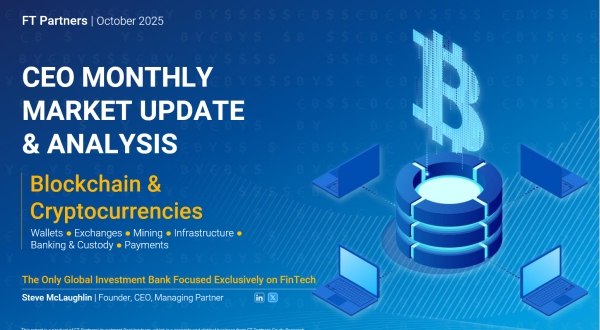
Financial Technology Partners (FT Partners) October 2025 Crypto and Blockchain Update shows that capital is flowing back into regulated digital asset infrastructure.
The Financial Technology Partners (FT Partners) October 2025 Blockchain and Cryptocurrencies Monthly report shows that digital asset M&A and financing activity has rebounded, led by exchanges, custody networks, and compliance technology. Institutional demand is piling into the market as regulated entities capture a growing share of capital and deal flow, with climbing valuations across regulated segments.
The FTP report data indicates that infrastructure remains the strongest and most resilient part of the market. Custody systems, settlement networks, and tokenization technology are attracting the largest investments as firms position to meet higher institutional and compliance standards. Transactions through 2025 is proof of how global players are consolidating around regulated platforms, liquidity access, and cross-border interoperability.
Ripple Labs acquired Standard Custody & Trust for $120 million in January, expanding its regulated tokenization and trust charter capabilities.
In April, Fireblocks raised $150 million at a $10 billion valuation to scale enterprise-grade custody and settlement systems. Komainu attracted $25 million in strategic investment during the same month to strengthen its institutional custody platform and compliance integrations.
May brought a $100 million raise for Anchorage Digital to expand its regulated digital asset banking and custody operations.
BitGo followed in June with a $100 million Series C round at a $1.75 billion valuation to deepen institutional tokenization services.
By September, Galaxy Digital acquired GK8 for $44 million, adding institutional self-custody and wallet management capabilities.
WonderFi completed a $100 million merger with Coinsquare and Bitbuy in January, forming one of Canada’s largest regulated crypto trading platforms.
Then later in March, Robinhood acquired WonderFi for C$250 million (around US$179 million), uniting Coinsquare and Bitbuy under its global exchange network.
Coinbase expanded twice, acquiring Circle’s European operations in February to enhance stablecoin settlement systems, then Deribit in August for $2.9 billion in cash and stock to extend crypto derivatives trading and clearing.
Chainalysis closed a $200 million Series F in June at a $4.2 billion valuation to expand blockchain intelligence and compliance monitoring.
A month later, Elliptic raised $50 million in a Series D extension to develop new anti–financial-crime tools for banks and exchanges.
Circle completed its acquisition of Archblock in February, integrating cross-chain USDC routing and compliance layers.
In May, Tether acquired Bitfinex Securities’ minority stake to reinforce its regulated token issuance network.
Ripple invested $285 million in August to expand global tokenization and CBDC settlement projects.
Kraken Ventures launched a $200 million fund in July focused on blockchain infrastructure and fintech platforms.
FT Partners’ 2025 data confirm that regulated infrastructure has become the foundation of digital finance. Valuations for infrastructure and compliance platforms now exceed eight times revenue, while consumer trading firms remain below four.
That spread shows that investors see real value in predictable, institutionally integrated systems rather than volatile retail flows. Institutional adoption continues through regulated products such as spot Bitcoin ETFs, tokenized funds, and custody-integrated settlement rails.
These channels represent a transition from speculative trading to reliable yield generation. Capital is rewarding throughput, compliance, and interoperability the same factors that define successful cross-border fintech models.
Growth will continue through robust compliance-oriented networks linking tokenized assets, stablecoins, and regulated exchanges. 2025 transactions signal global alignment toward clearer regulatory frameworks across Canada, Europe, and the United States. Taken together, these developments are building a more mature, data-driven digital finance ecosystem that's preparing for institutional scale.
 The National Crowdfunding & Fintech Association (NCFA Canada) is a financial innovation ecosystem that provides education, market intelligence, industry stewardship, networking and funding opportunities and services to thousands of community members and works closely with industry, government, partners and affiliates to create aa vibrant and innovative fintech and funding industry in Canada. Decentralized and distributed, NCFA is engaged with global stakeholders and helps incubate projects and investment in fintech, alternative finance, crowdfunding, peer-to-peer finance, payments, digital assets and tokens, artificial intelligence, blockchain, cryptocurrency, regtech, and insurtech sectors. Join Canada's Fintech & Funding Community today FREE! Or become a contributing member and get perks. For more information, please visit: www.ncfacanada.org
 |  |  |
|---|---|---|
 |  |  |
Oct 8, 2025

In today's world, where the majority of sales are now online, it is the speed of development that determines whether a company will be successful in selling online. For a large corporation, a delay of literally minutes or an error in the process can turn into a loss of several millions. That's why large-scale businesses choose Shopify Plus - a platform that not only gives the business a sense of stability, but is also ready for daily updates and upgrades.
In this article, we'll look at what challenges Shopify Plus can handle for large businesses.
When the store increases sales from several hundred to several thousand per day, the usual steps cease to bring the same result as before. The workload on employees increases, as a result of which errors may occur during the processing of orders.
Shopify Plus Solution: the platform, thanks to powerful tools, is ready to withstand tens of thousands of payments every day. Automation of the load on the servers is a guarantee of stable operation even at the time when the most purchases are made.
Result: customers are served quickly and without interruptions, and the company saves budget that could have been lost due to technical errors.
The ambitions of large corporations are always to enter the international market. But the language barrier, different currencies and payment systems often become an obstacle to the realization of this idea.
Shopify Plus Solution: built-in multicurrency and multilingualism allow you to serve customers from different parts of the world and not create a separate site for one or another country. The platform also integrates with local payment systems.
Result: the company quickly starts working on an international scale and develops new markets, without spending a lot of time and resources on it.
Marketing in large corporations is not only about banners and promotional offers. This is about complex work on many levels, thanks to which offers are built to meet the needs of different segments of customers.
Shopify Plus Solution: automation tools (Flow, Launchpad) help plan, launch and monitor campaigns. They allow you to segment customers according to their needs, automatically adjust discounts for them, and launch promotions at the right time.
Result: the company keeps the resource of its employees, but at the same time gets the desired result from each marketing strategy.
Flexible pricing and multi-level accounts are important to B2B companies.
Shopify Plus Solution: client orientation – individual conditions, personalized discounts, special conditions of cooperation. And also access to different representatives of the corporation with different rights.
Result: loyal relations with strategic partners and transparent conditions of cooperation are formed.
Big brands need to get accurate numbers to make certain decisions. Analytics makes it possible to understand which internal processes are slowing down and inhibiting development.
Shopify Plus Solution: integrations with analytical systems and advanced reports allow you to analyze customer behavior, conversions and profitability.
Result: the business quickly receives all the necessary data and quickly adjusts processes.

To fully utilize the Shopify Plus functionality, you need a team that knows not only technical parameters, but also is competent in business processes. It is this assistant Binary Future – experts in shopify ecommerce development, capable of creating scalable online platforms and integrating advanced analytics and marketing tools."
The team helps large corporations:
Binary Future's mission is to create seamless and intuitive shopping experiences that convert visitors into repeat customers and deliver measurable growth.
The National Crowdfunding & Fintech Association (NCFA Canada) is a financial innovation ecosystem that provides education, market intelligence, industry stewardship, networking and funding opportunities and services to thousands of community members and works closely with industry, government, partners and affiliates to create aa vibrant and innovative fintech and funding industry in Canada. Decentralized and distributed, NCFA is engaged with global stakeholders and helps incubate projects and investment in fintech, alternative finance, crowdfunding, peer-to-peer finance, payments, digital assets and tokens, artificial intelligence, blockchain, cryptocurrency, regtech, and insurtech sectors. Join Canada's Fintech & Funding Community today FREE! Or become a contributing member and get perks. For more information, please visit: www.ncfacanada.org
| | |
|---|---|---|
| | |
Oct 7, 2025

Image: Freepik/tonodiaz
The Indian stock market is often a reflection of investor sentiment, company fundamentals, and broader macroeconomic shifts. One of the indicators investors watch closely is the 52-week high and low levels of stocks. A stock trading near its 52-week low often sparks curiosity: Is it a bargain buy or a falling knife?
ITC has long been considered a safe bet for conservative investors. But with the stock hovering close to its 52-week low, the pressing question is: Should ITC be on your radar now? In this blog, we will explore whether investors should consider buying ITC stock at its 52-week low.
The stocks near 52 week low is the lowest price at which a stock has traded in the past year. For many investors, this is a signal that the stock may be undervalued. However, it could also indicate deeper structural challenges or declining investor confidence.
Hence, before considering ITC, it’s essential to look at its fundamentals, recent developments, and industry dynamics.
ITC has diversified revenue streams from cigarettes to FMCG, hotels, and agri-exports, which have helped it remain resilient, though growth in its non-cigarette business segments has been slower than rivals like HUL or Nestlé.
As of September 2025,the ITC share price is trading close to its 52-week low of ₹390.15, currently hovering around ₹410.65. It is still far below its 52-week peak of ₹528.50. In comparison to the broader index and its Nifty FMCG peers, it has underperformed with a decline of almost 15% in the last year.
There are several factors behind the ITC share falling to its 52-week low levels. Some of those reasons are:
Investors often rotate out of defensives like FMCG into higher-growth sectors (IT, auto, banks) when markets are bullish.
Compared to FMCG peers, ITC’s topline expansion remains moderate, particularly in branded foods and hotels.
After its multi-year rally (2021-2023), profit booking has amplified near-term declines.
Cigarettes remain under heavy scrutiny due to taxation and health regulations. Any potential tax hikes impact sentiment.
The company recently announced the demerger of its hotel business, which led to mixed reactions from the market.

ITC Near 52 Week Low
With ITC close to its 52-week low, investors may find it to be a risky but appealing entry point. The following is a discussion of the causes of both cases:
A stock hitting its 52-week low should not be the sole reason to buy or sell; it’s a signal that requires deeper analysis. In ITC’s case, while regulatory risks and slower growth weigh on sentiment, its dividend yield, diversified business, and defensive nature make it a strong option for conservative investors.
Therefore, ITC should be on the radar of those investors who seek stability, regular dividends, and a defensive play, and investors who are chasing aggressive growth and fast-moving stocks should not consider investing in ITC at its 52-week low share price.
The National Crowdfunding & Fintech Association (NCFA Canada) is a financial innovation ecosystem that provides education, market intelligence, industry stewardship, networking and funding opportunities and services to thousands of community members and works closely with industry, government, partners and affiliates to create aa vibrant and innovative fintech and funding industry in Canada. Decentralized and distributed, NCFA is engaged with global stakeholders and helps incubate projects and investment in fintech, alternative finance, crowdfunding, peer-to-peer finance, payments, digital assets and tokens, artificial intelligence, blockchain, cryptocurrency, regtech, and insurtech sectors. Join Canada's Fintech & Funding Community today FREE! Or become a contributing member and get perks. For more information, please visit: www.ncfacanada.org
| | |
|---|---|---|
| | |
Social Enterprise | Oct 7, 2025

Image: Freepik/creativeart
As reported by Devex on October 3, 2025, RemitHope is redefining how diaspora remittances fund local impact across Africa. A fintech-powered social enterprise and new digital giving platform founded by philanthropist Tsitsi Masiyiwa is transforming how remittances and local donations flow into African community development.
The platform’s launch follows the July fire at Mount Selinda Orphanage in Zimbabwe, which became RemitHope’s first campaign. In less than three weeks, over 1,000 donors from ten countries contributed $40,000, instantly doubled through matching funds to more than $81,000 to rebuild the orphanage, proving the platform’s model. Donations currently sit at over $81,500.
According to verified data from the World Bank, global remittance flows reached $685 billion in 2024, surpassing both foreign direct investment and overseas development assistance. The rise of platforms like RemitHope demonstrates how fintech can turn personal remittance flows into community scale development capital.
Founder Masiyiwa, who is also the co-founded Higherlife Foundation and Delta Philanthropies, described the goal as channeling diaspora generosity toward self sustaining, African led impact. As she said at launch:
“Now, as the aid from the Global North dwindles, we are stepping up. My audacious goal? $50 million in the next five years.”
RemitHope blends crowdfunding, remittance technology, and philanthropic matching. Each donation from diaspora or local givers is instantly doubled by partner foundations, currently Delta Philanthropies based in Zimbabwe (UK registered) and Higherlife Foundation.
This creates a direct incentive for micro giving, where even a $5 contribution becomes $10 expanding reach and impact. The platform enables donors to give through mobile payment channels such as EcoCash and is exploring integration with everyday transactions like ticket purchases or mobile top ups.
Every partner organization is vetted for transparency, governance, and measurable outcomes. Campaigns typically target around $10,000 per project, ensuring funds go directly to specific community priorities. It reframes remittances as an alternative finance mechanism bridging charity and investment.
The first wave of users includes grassroots community groups from thirteen countries, many in rural areas that typically fall outside formal aid pipelines. These organizations gain visibility through the platform, bypassing grant bureaucracy and connecting directly to diaspora and domestic donors.
The funding mix in the Mount Selinda case is revealing: about 900 local donors used EcoCash for small contributions, while around 100 diaspora donors contributed larger amounts, often over $50. This blend of micro local and macro diaspora support shows how new models of digital trust and peer giving are forming across borders.
Masiyiwa’s five year, $50 million target is backed by a vision that goes beyond charity. RemitHope is building infrastructure for African led giving that turns remittance networks into sustainable impact capital. The platform’s long term plan includes integrating data driven impact tracking, digital identity verification, and traceable giving records to strengthen accountability and transparency.
The founders see it as a catalyst for regional collaboration, a model of Africans funding Africans that redefines philanthropy as investment in capacity and innovation.
As operational head Musa Muleya said, “The question was what can we do as Africans to solve African problems.” That ethos aligns with NCFA’s advocacy for inclusive, technology driven financial ecosystems that bridge public trust with private initiatives.
For Canadian context, diaspora focused fintechs such as LemFi, which raised $53 million in January 2025, are expanding remittance and mobile finance infrastructure for African immigrants.
Platforms such as CAF Canada and Myriad Canada provide cross border philanthropic frameworks that could integrate similar matching or community led approaches. These examples show how Canadian fintech and charitable infrastructure could help scale Africa led innovation responsibly, aligning with Canada’s Africa Strategy for inclusive growth.
Many similar conversations could be overhead at the inaugural 2025 Canadian-Africa Fintech Summit where NCFA partnered to help support the development of a Canada-Africa fintech bridge that fosters cross-border collaboration, innovation, economic development and investment.
RemitHope remittances are a collaborative funding mechanism for social innovation. It's part of a new movement in Africa towards self-reliance and inclusive, locally-led social enterprise that strengthens trust and transparency between donors and recipients.
For Canada’s fintech and social finance ecosystem, it's a powerful model of cross border collaboration that merges technology, accountability, and community empowerment.
The National Crowdfunding & Fintech Association (NCFA Canada) is a financial innovation ecosystem that provides education, market intelligence, industry stewardship, networking and funding opportunities and services to thousands of community members and works closely with industry, government, partners and affiliates to create aa vibrant and innovative fintech and funding industry in Canada. Decentralized and distributed, NCFA is engaged with global stakeholders and helps incubate projects and investment in fintech, alternative finance, crowdfunding, peer-to-peer finance, payments, digital assets and tokens, artificial intelligence, blockchain, cryptocurrency, regtech, and insurtech sectors. Join Canada's Fintech & Funding Community today FREE! Or become a contributing member and get perks. For more information, please visit: www.ncfacanada.org
| | |
|---|---|---|
| | |
Fintech | Oct 3, 2025
Image: Freepik/newelement
On September 26, 2025, the Globe and Mail released its 2025 Report on Business ranking of Canada’s Top Growing Companies. The annual list tracks Canadian firms based on three-year revenue growth, offering a quick snapshot of where innovation is scaling fastest (think revenue, headcount, growth).
This year’s ranking features a great group of fintech and digital finance firms that are impacting how Canadians borrow, pay, invest, insure, and embed financial services into everyday life.
| Rank | Company | Sector | Description |
| #3 | Gearlay | Web3 / Blockchain | Blockchain-based enterprise financial software |
| #4 | Float | Lending & Embedded Finance | SME finance and corporate card platform |
| #5 | veritree | ESG & Green Finance | Digital carbon credits and reforestation finance |
| #11 | Novisto | ESG & Green Finance | ESG disclosure, data, and reporting platform |
| #24 | FundMore | Lending & AI | Automated mortgage underwriting |
| #32 | Quandri | AI & Automation / Insurtech | Insurance automation bots |
| #39 | Autocorp.ai | AI & Lending | AI-powered auto retail finance |
| #44 | Helcim | Payments | Merchant payment processing |
| #57 | CapIntel | WealthTech | Digital platform for advisors and wealth managers |
| #62 | PomeGran | Digital Infrastructure | Broadband and connectivity backbone |
| #65 | BOXX Insurance | Insurtech | Cyber insurance and protection |
| #72 | SWTCH Energy | Payments Infra / Energy | EV charging + payments integration |
| #86 | Makeship | Alternative Finance / Crowdfunding | Creator crowdfunding platform |
| #108 | Fintel Connect | Web3 / Marketing | Performance marketing for fintechs and crypto |
| #110 | Justwealth | WealthTech | Robo-advisor portfolio management |
| #112 | HONK | Payments | Contactless mobility/parking payments |
| #119 | Merchant Growth | Lending & SME Finance | Working capital financing |
| #129 | MindBridge | AI & Regtech | AI anomaly detection and audit |
| #137 | Loans Canada | Lending & Alt Finance | Loan marketplace and credit scoring |
| #140 | PolicyMe | Insurtech | Digital-first life insurance |
| #149 | Zum Rails | Open Banking & Payments | Open banking and payments APIs |
| #158 | Trolley | Payments | Global payouts and compliance |
| #204 | FundThrough | Lending & Alt Finance | Invoice financing and cash flow optimization |
While the Globe and Mail ranking provides a valuable view of Canadian fintech growth, it is far from exhaustive. Many high-growth firms remain absent because they operate in stealth mode, choose not to disclose financial data, or do not meet eligibility thresholds. Early-stage innovators, companies with holding structures abroad, and ventures acquired by larger incumbents also fall outside the ranking.
For NCFA’s community, this means the list represents only part of the country’s dynamic ecosystem of fintech, Web3, AI, alternative finance, and digital-first ventures that are scaling globally. For a broader view of Canada’s financial tech innovation landscape, see NCFA’s fintech directory at https://fintechcanada.io/.
Canadian fintech companies are excelling in lending, payments, Web3, insurtech, ESG, AI, digital infrastructure, and many other subcategories. These companies mirror how regulation, access to capital, and collaboration between industry and government is critical to ensure Canadian fintechs continue to thrive in an increasingly globally competitive landscape.
The National Crowdfunding & Fintech Association (NCFA Canada) is a financial innovation ecosystem that provides education, market intelligence, industry stewardship, networking and funding opportunities and services to thousands of community members and works closely with industry, government, partners and affiliates to create aa vibrant and innovative fintech and funding industry in Canada. Decentralized and distributed, NCFA is engaged with global stakeholders and helps incubate projects and investment in fintech, alternative finance, crowdfunding, peer-to-peer finance, payments, digital assets and tokens, artificial intelligence, blockchain, cryptocurrency, regtech, and insurtech sectors. Join Canada's Fintech & Funding Community today FREE! Or become a contributing member and get perks. For more information, please visit: www.ncfacanada.org
| | |
|---|---|---|
| | |
Crowdfunding | Oct 1, 2025

Image courtesy of AI
On March 7, 2025, Rugby Canada announced a bold public campaign to fund its women’s high performance team to England 2025. The campaign laid out a $1 million shortfall to cover the full season's program that costs $3.6 million (but the union's budget fell short). So to close the funding gap, they opened the doors to fans, alumni, and corporate donors and launched a dedicated donation portal for this effort: Mission: Win Rugby World Cup 2025 donation portal.
That night, the campaign thermometer sat at zero. By morning, it was alive as part financing tool and part storytelling engine that sparked a national movement in Canadian sport.
Rugby Canada needed more than dollars. They needed narrative. The early campaign push did three essential things well:
They didn't just ask for support but described the exact dollars missing and how each contributed dollar would map to camps, nutrition, recovery, and test matches.
Supporters weren’t just donors but they were treated as 'partners' in getting the Canadian Women's Rugby team ready for the World Cup 2025, a massive global sporting event.
Independent rugby media tracked progress. In April, RugbyPass ran a report noting the still‑open funding hole and provided key updates in how far along the drive had come, and how much further they still needed to go to achieve their mission.
As the 2025 Women's Rugby World Cup (hosted in England) drew closer and closer, media narratives framed Canada not just as underfunded underdogs but as gritty, scrappy, and deserving contenders. Sky Sports ran a feature titled “How non‑professional Canada crowdfunded its way to the final push,” saying pledges “reached 95 percent.”
Meanwhile, ESPN ran a narrative piece under the banner “Canada crowdfunded their way to the World Cup” juxtaposing the team’s funding shortfall with their on‑field ambitions.
Kudus to participating media that helped raise awareness for such an important Canadian funding drive. It really shows what's possible when the full ecosystem gets behind an initiative and drives momentum forward. There's a natural connection between executing a well timed and focused financing campaign and executing a key sports performance, and the public knows it. #ElbowsUp
When England 2025 kicked off, Canada stepped onto the pitch motivated by even greater purpose, not a team suffering by funding shortfall anxiety.
In pool play they went undefeated, carving out physical, disciplined performances that turned heads.
In the quarter final, they defeated a powerful Australia squad.
In the semi final, they shocked the rugby world by defeating New Zealand (perennial favourites) to reach their first Women’s Rugby World Cup final.
On September 27, before a packed Twickenham, Canada faced hosts England. They lost but not meekly. In the aftermath, coach Kevin Rouet and captain stressed that the match was decided on performance, not excuses, a point that resonates in Reuters’ coverage of the final.
Crowdfunding bought the players the chance to compete on equal footing, free of resource excuses. The lesson for Canada as a sporting nation was significant. When supports and fans step in to close gaps, institutions can't ignore the demand for sustainable, professionalized backing of women’s rugby.
Players adjusted their off season budgets and personal spending to show they were all in on the campaign narrative.
Coaching staff scheduled extra camps contingent on fundraising milestones, keeping the team in lockstep with the thermometer.
Each media checkpoint (50%, 80%, 95%) became a moment of drama as the story unfolded. Would the final stretch succeed or stall? That tension made the campaign itself a parallel storyline to the competition.
Critics wondered whether public fundraising blurred lines between sport and fandom but supporters embraced the risk, seeing their dollars as equity in national ambition at a time when Canada needs to buckle down and drive through the line.
When everyone's in the same boat, the winds will sail.
This was more than just a funding story. If you want one of those, feel free to read the real story of access to capital. It was about turning a resource gap (a modern day limitation) into shared ownership.
Canada’s women made their financial constraints visible, linked every dollar to performance outcomes, and invited supporters to become backers in the journey. That transparency changed how Canadians see women’s sport funding not as charity, but as investment with real returns.
The campaign also created accountability. Once the thermometer went public, the team owed backers results, not just thanks.
The story will not always be this dramatic, but the connections and motivations are real, and crowdfunding amplifies that blueprint. Define the gap, own the narrative, attach every contribution to a tangible outcome, and treat supporters as true partners.
Collaboration was at the core! Players, fans, alumni, sponsors, and media all carried their share of the work. As Canada’s women look beyond 2025, the responsibility now shifts to institutions, national sport bodies, sponsors, and public agencies to ensure future generations no longer need to crowdfund their path to the world stage, or maybe they should! #GoCanada
The National Crowdfunding & Fintech Association (NCFA Canada) is a financial innovation ecosystem that provides education, market intelligence, industry stewardship, networking and funding opportunities and services to thousands of community members and works closely with industry, government, partners and affiliates to create aa vibrant and innovative fintech and funding industry in Canada. Decentralized and distributed, NCFA is engaged with global stakeholders and helps incubate projects and investment in fintech, alternative finance, crowdfunding, peer-to-peer finance, payments, digital assets and tokens, artificial intelligence, blockchain, cryptocurrency, regtech, and insurtech sectors. Join Canada's Fintech & Funding Community today FREE! Or become a contributing member and get perks. For more information, please visit: www.ncfacanada.org
| | |
|---|---|---|
| | |
M&A | Oct 1, 2025

Image: Freepik
On September 18, 2025, US-based fundraising solutions provider RaiseRight announced the acquisition of Toronto-based FlipGive, a Certified B Corporation known for cashback shopping combined with community fundraising tools. Terms of the deal were not disclosed.
RaiseRight is based in Grand Rapids, Michigan and best known for scrip and gift card fundraising programs that direct spending power to local groups. The company cites more than $900 million raised with over 750 brand partners across 30 years of operations.
FlipGive first went public in 2013, self-described as a retailer-driven fundraising model for schools, sports teams and communities. When they first launched, the National Crowdfunding & Fintech Association of Canada listed FlipGive on it's original crowdfunding directory (not maintained since Jan 2019, as NCFA hosts a new fintech directory in Canada here. as crowdfunding for non profits through product sales and donations, a model that merged a crowdfunding ethos with shopping rewards and donations.
The focus evolved from one time pledges to everyday shopping that earns cash back for teams and community groups. Retailers and restaurants share a percentage of transactions, which turns routine purchases into a steady funding stream.
FlipGive later scaled embedded rewards and reported strong growth, including a $4 million Series B financing round in 2023 in an funding roundup mentioning FlipGive.
According to FlipGive’s own platform data, teams have raised more than $56.6 million through the service, converting everyday purchases into direct support for youth sports and community groups. This total reflects contributions generated from more than 50,000 teams (including my kids hockey team fundraisers!) via $425 million in sales across 900 brands, serving more than 900,000 FlipGive members.
These numbers clearly confirm the demand and impact of the cashback model and how it's grown into a significant funding source for local teams.
Nick Lee, Co-founder of FlipGive:
"From day one, our goal has been to support families and make team fundraising simple and effective. Joining RaiseRight, who shares our mission and values, ensures a future where even more families can benefit."
FlipGive’s brand and Canadian operations will continue while its technology integrates into RaiseRight’s broader platform. The combination adds white label rewards, scrip gift cards, online shopping, dining, and travel into one stack that organizations can use to fund sports, schools, and community programs.
Lou Agnese, CEO of RaiseRight:
"FlipGive has played a valuable role in shaping how communities approach fundraising through its technology and platform. We are excited to expand into the Canadian market and thrilled to welcome the FlipGive brand and team into the RaiseRight family. We will continue to build on FlipGive's innovations to deliver even greater value to the communities we serve across Canada and the United States."
This deal connects two complementary funding rails. FlipGive’s commerce driven crowdfunding roots evolved into cashback infrastructure with RaiseRight’s long running gift card model built to scale. Together they offer a cross-border platform that monetizes everyday spending for community funding while maintaining a social mission. For Canadian fintech and nonprofit stakeholders, the main questions are how will RaiseRight's acquisition steward FlipGive’s B Corporation identity and how integration will affect service for Canadian teams.
The National Crowdfunding & Fintech Association (NCFA Canada) is a financial innovation ecosystem that provides education, market intelligence, industry stewardship, networking and funding opportunities and services to thousands of community members and works closely with industry, government, partners and affiliates to create aa vibrant and innovative fintech and funding industry in Canada. Decentralized and distributed, NCFA is engaged with global stakeholders and helps incubate projects and investment in fintech, alternative finance, crowdfunding, peer-to-peer finance, payments, digital assets and tokens, artificial intelligence, blockchain, cryptocurrency, regtech, and insurtech sectors. Join Canada's Fintech & Funding Community today FREE! Or become a contributing member and get perks. For more information, please visit: www.ncfacanada.org
| | |
|---|---|---|
| | |


August 26th, 2025

January 4th, 2024

June 1st, 2021

September 9th, 2020

July 9th, 2018

January 3rd, 2018

September 25th, 2017

June 20th, 2017

May 10th, 2017

December 14th, 2016