




Karsten Wenzlaff, Advisor
August 26th, 2025
Karsten Wenzlaff is a Crowdfunding and Fintech Expert from Germany. He is Secretary-General of Digit[...]


Blockchain | Sep 2, 2025

Image: Freepik
On August 28, 2025, the U.S. Bureau of Economic Analysis (BEA) released its second quarter GDP report, and according to multiple reports including MarketsMedia , the Department of Commerce also provided a cryptographic hash of this report on nine blockchains. These include Bitcoin, Ethereum, Solana, TRON, Stellar, Avalanche, Arbitrum, Polygon, and Optimism. Each network now carries a verifiable record of America’s official economic data.
The Department explained that the information was published as a memo or as data embedded in a smart contract, depending on what each chain allowed. The BEA’s public API also provides the same data for those who want to verify the numbers directly. The move is a historic change in how the United States government shares economic data, and is the first time a federal agency has released official economic statistics onchain.
The rollout involved not just the Department of Commerce and BEA who supplied the official GDP data, but blockchain infrastructure providers Chainlink, Pyth, and exchanges Coinbase, Gemini, and Kraken who helped facilitate the Department’s publication by providing cryptocurrency for transaction fees.
Coindesk reported on Commerce Secretary Howard Lutnick's comments. Economic data is the foundation of global markets. By putting GDP figures on blockchain networks, the Department aims to make “America’s economic truth immutable and globally accessible.”
The decision is not only about protecting the accuracy of the numbers but also about showing how blockchain can strengthen transparency, accountability, and trust. It's a bold next step for crypto and also supports the Trump administration’s goal of positioning the United States as the blockchain capital of the world. Publishing GDP data on blockchain demonstrates a proof of concept for how governments can adopt decentralized infrastructure.
By publishing GDP data on blockchain, developers can now create financial products that tie directly to verified government statistics. Potential applications include inflation linked tokens, prediction markets, compliance tools, and real time economic dashboards. For decentralized finance (DeFi), the use of trusted GDP and inflation figures will help build safer and more transparent markets.
As reported by Decrypt, Industry leaders welcomed the move. Chainlink pointed to new opportunities for tokenized assets and DeFi applications, while Pyth emphasized how the initiative increases trust in public information systems. The market response was immediate. Pyth’s token price surged by nearly 70% within minutes of the news, adding close to $1 billion to its fully diluted valuation.
Canadian institutions such as Statistics Canada and the Bank of Canada have not yet explored similar approaches. However, now that the United States is publishing official statistics on the blockchain, Canadian policymakers should consider doing the same or Canadian innovators and fintech developers here may face a disadvantage compared to their US counterparts who can access official data directly on blockchain.
Why? Canadian fintech firms focused on open banking, tokenization, and decentralized finance depend on reliable data, and having real time, tamper proof access to GDP and inflation data would support innovation and competitiveness. Investors in Canadian markets also track American statistics closely, which means that the US decision to make data globally accessible onchain will indirectly impact Canadian investment strategies.
GDP may be just the beginning. Other high impact datasets could follow, such as inflation, consumer spending, and employment numbers. If this happens, blockchain could become a standard infrastructure layer for government data worldwide.
The NCFA community plays an important role in highlighting these gap and advocating for experiments in blockchain enabled transparency at the federal level in Canada. Doing so would help ensure that Canada doesn't fall further behind in the race to modernize data infrastructure.
By connecting official data with blockchain technology, the US Department of Commerce is setting a global precedent. The United States is no longer only regulating blockchain but also participating in it. This decision could motivate other governments to consider the way public information is shared and trusted.
 The National Crowdfunding & Fintech Association (NCFA Canada) is a financial innovation ecosystem that provides education, market intelligence, industry stewardship, networking and funding opportunities and services to thousands of community members and works closely with industry, government, partners and affiliates to create a vibrant and innovative fintech and funding industry in Canada. Decentralized and distributed, NCFA is engaged with global stakeholders and helps incubate projects and investment in fintech, alternative finance, crowdfunding, peer-to-peer finance, payments, digital assets and tokens, artificial intelligence, blockchain, cryptocurrency, regtech, and insurtech sectors. Join Canada's Fintech & Funding Community today FREE! Or become a contributing member and get perks. For more information, please visit: www.ncfacanada.org
 |  |  |
|---|---|---|
 |  |  |
VersaBank Release | Sep 2, 2025

Image: Freepik
On August 26, 2025, VersaBank that its U.S. subsidiary VersaBank USA has begun piloting a tokenized U.S. dollar deposit product called USDVB. The test program is designed to confirm that USDVB works smoothly, meets security standards, and complies with U.S. banking rules.
Testing will start with thousands of small internal transactions before expanding to selected external partners and their clients. The pilot is expected to continue through 2025, and if successful the bank will seek approval from the Office of the Comptroller of the Currency ahead of a commercial launch.
David Taylor, Founder and President, VersaBank:
“Our USDVB DDRs, developed in conjunction with law enforcement, represent the next step in the evolution of digital assets for both deposits and payments, and, importantly, a superior alternative to stablecoins based on their one‑for‑one representation of actual cash on deposit with our Bank, the legal ability to pay interest, and FDIC insurance.”
Unlike most stablecoins which are issued by private companies and may not always have full backing, USDVB is a direct digital version of deposits held at a federally chartered bank. That means:
VersaBank’s President, David Taylor, called USDVB one of the first real steps toward a tokenized deposit issued by a U.S. national bank. He noted that licensed banks are best positioned to keep digital assets safe while giving customers the benefits of regulated banking. For fintechs, payment providers, and financial institutions, USDVB offers a pathway into digital commerce with a solution that combines the trust of traditional banking with the flexibility of blockchain.
Bank-issued digital deposits are moving closer to reality, seeking to provide a more stable and compliant alternative to private stablecoins.
The National Crowdfunding & Fintech Association (NCFA Canada) is a financial innovation ecosystem that provides education, market intelligence, industry stewardship, networking and funding opportunities and services to thousands of community members and works closely with industry, government, partners and affiliates to create a vibrant and innovative fintech and funding industry in Canada. Decentralized and distributed, NCFA is engaged with global stakeholders and helps incubate projects and investment in fintech, alternative finance, crowdfunding, peer-to-peer finance, payments, digital assets and tokens, artificial intelligence, blockchain, cryptocurrency, regtech, and insurtech sectors. Join Canada's Fintech & Funding Community today FREE! Or become a contributing member and get perks. For more information, please visit: www.ncfacanada.org
| | |
|---|---|---|
| | |
Aug 29, 2025

The Ripple vs. SEC lawsuit has been one of the most closely watched legal battles in the cryptocurrency industry. After nearly five years of uncertainty, the U.S. Securities and Exchange Commission (SEC) reached a settlement with Ripple Labs in August 2025. Ripple agreed to pay a $125 million fine, ending a prolonged dispute over whether XRP should be classified as a security. For investors, institutions, and regulators alike, this decision marked a turning point for the digital asset.
In the wake of the settlement, XRP surged above $3.30 before stabilizing slightly lower, with trading volumes and institutional interest spiking sharply. With regulatory clarity now in place, the market is assessing whether XRP is poised for sustained growth or if short-term speculation is fueling most of the momentum.
This article explores the post-settlement price action, institutional adoption trends, technical analysis, and the risks investors should keep in mind when considering XRP’s market outlook.
The legal battle began in December 2020 when the SEC accused Ripple Labs of conducting an unregistered securities offering through sales of XRP. Ripple countered that XRP was a digital asset designed for payments, not an investment contract. For years, this uncertainty suppressed investor confidence and limited XRP’s integration into mainstream financial institutions.
On August 8, 2025, the SEC and Ripple reached a final settlement. Ripple agreed to pay a $125 million fine, without admitting or denying wrongdoing. Crucially, the deal provided regulatory clarity: XRP is not classified as a security when traded on secondary markets, removing a major barrier for U.S. exchanges, institutional investors, and payment providers.
This resolution immediately influenced market sentiment, driving a strong rally in XRP and opening the door for broader adoption.
Following the announcement, XRP surged above $3.25, peaking near $3.32 before stabilizing in the $3.14–$3.22 range. Trading volumes spiked more than 200% in 24 hours, surpassing $12 billion. This surge reflects renewed confidence from both retail and institutional investors.
For investors tracking digital assets, monitoring real-time benchmarks such as XRP price USD provides valuable insight into ongoing volatility and market sentiment. The legal clarity appears to have removed a key ceiling that previously capped XRP’s growth potential.
Additionally, derivatives markets saw a 15% increase in open interest, reaching nearly $6 billion. This suggests traders are positioning for further moves, with many anticipating bullish continuation.
One of the most significant outcomes of the settlement is the restoration of institutional confidence in XRP. For years, major U.S. exchanges delisted the token due to regulatory risk. Now, with clarity from the SEC, institutions are showing renewed interest.
Trading firms and liquidity providers have increased exposure, and some payment service providers are considering XRP as a cross-border settlement tool once again. This institutional momentum mirrors broader trends in the crypto market, where regulatory clarity often leads to higher participation. For context, comparing digital benchmarks such as Bitcoin price USD against XRP can provide perspective on how investors weigh opportunities between established leaders and high-upside altcoins.
Financial institutions are particularly interested in XRP’s utility as a bridge currency for remittances and international payments. With legal uncertainty resolved, the token could see renewed integration into enterprise-level payment solutions.
From a technical standpoint, XRP faces a critical resistance zone near $3.35. Analysts argue that if the token can establish this level as new support, the next upside target could reach between $4 and $5. Several market strategists point to bullish fractal patterns reminiscent of XRP’s rally during the 2017 bull market, which saw exponential gains.
Some analysts even project medium-term targets of $8, with long-term possibilities of $10 or more, provided XRP maintains strong momentum and adoption growth. These forecasts, however, remain speculative and depend on broader crypto market conditions, including Bitcoin’s trajectory and macroeconomic factors such as interest rates and regulatory policies.
Key technical indicators to watch include:
Several factors are contributing to XRP’s momentum:
With the SEC settlement finalized, U.S. exchanges can now list XRP without fear of litigation. This regulatory green light has major implications for liquidity and adoption.
Data shows a sharp increase in institutional trading volume, with open interest in derivatives markets climbing steadily. This suggests long-term players are taking positions rather than short-term speculation alone.
XRP’s rally is occurring in a context where Bitcoin and Ethereum continue to dominate the sector. If Bitcoin remains strong, it often sets the tone for altcoin performance, providing XRP with a favorable environment.
Unlike many altcoins driven purely by speculation, XRP has practical use cases in cross-border payments and settlement. This differentiates it from tokens that rely solely on hype cycles.
While optimism is high, it is important to recognize potential risks:
Investors should view XRP’s rally with cautious optimism and remember that cryptocurrency markets carry significant risk. This analysis is for educational purposes only and does not constitute investment advice.
The conclusion of the Ripple vs. SEC lawsuit marks a watershed moment for XRP. The settlement removes years of legal uncertainty, reigniting institutional interest and sparking renewed confidence in the token’s role as a payment-focused digital asset.
In the near term, XRP’s ability to hold support above $3.35 will be critical to sustaining momentum. If successful, analysts see the potential for XRP to target $4–$5, with more ambitious projections aiming for $8–$10 in the coming months or years.
For long-term adoption, regulatory clarity could pave the way for XRP’s deeper integration into the global payments industry, aligning with Ripple’s original vision. However, investors should remain mindful of the risks associated with crypto markets, particularly volatility and regulatory changes across different jurisdictions.
In summary, while the lawsuit’s end represents a significant milestone, XRP’s next chapter will be defined by market resilience, institutional adoption, and the broader trajectory of the digital asset ecosystem.
Always conduct independent research and consult financial professionals before making investment decisions. Cryptocurrency markets are volatile and carry substantial risks.
The National Crowdfunding & Fintech Association (NCFA Canada) is a financial innovation ecosystem that provides education, market intelligence, industry stewardship, networking and funding opportunities and services to thousands of community members and works closely with industry, government, partners and affiliates to create a vibrant and innovative fintech and funding industry in Canada. Decentralized and distributed, NCFA is engaged with global stakeholders and helps incubate projects and investment in fintech, alternative finance, crowdfunding, peer-to-peer finance, payments, digital assets and tokens, artificial intelligence, blockchain, cryptocurrency, regtech, and insurtech sectors. Join Canada's Fintech & Funding Community today FREE! Or become a contributing member and get perks. For more information, please visit: www.ncfacanada.org
| | |
|---|---|---|
| | |
M&A | Aug 29, 2025

Image: Freepik/zaozaa09
As reported on Aug 28, 2025 by the Investment Executive, Desjardins buys Guardian for $1.67 billion in an all cash deal that boosts scale, fintech investment, and global ambitions. It's one of the largest Canadian asset management deals in years. Priced at $68 per share, combines about $280 billion in assets under management and advisement, and is expected to close in early 2026 pending shareholder, court, and regulatory approvals.
The deal creates a stronger national player with greater resources and market reach. For financial professionals, size matters. Larger firms can spread compliance costs, expand distribution, and withstand market volatility. Mid-sized managers will feel pressure. Some may seek mergers. Others may need to specialize in niche strategies to stay competitive.
Guardian CEO George Mavroudis will lead the new firm. The leadership continuity provides stability and a clear path forward. With greater scale, Desjardins can challenge both domestic players and global firms targeting Canadian clients. For smaller firms, competition will tighten. Larger firms are better positioned to absorb costs and push new products.
Scale gives Desjardins-Guardian room to invest in technology. AI portfolio tools, robo-advisors, and digital wealth platforms will likelycontinue to expand. This opens space for fintechs that can deliver specialized tools or integrate into broader platforms. Partnerships are not new for Desjardins. Its joint venture in Aviso Wealth and its 2022 purchase of Guardian’s Worldsource businesses for about $750 million show a consistent approach of combining acquisitions with collaborations to build reach and capability.
Guardian’s international presence gives the new platform more reach outside Canada. International products can be scaled more effectively, especially in ESG, which already accounts for the majority of Canadian managed assets.
Institutional demand for sustainable finance is rising, and the combined firm can now deepen its offerings. Alternatives and private credit strategies are also likely to expand, appealing to both domestic and global investors.
Industry consolidation has surged in 2025, and Desjardin's acquisition of Guardian Capital is the clearest sign that Canadian managers are building the scale to compete globally. The timing matters. With inflation, compliance costs, and economic uncertainty, firms with bigger reserves and wider distribution networks are better placed to grow.
The National Crowdfunding & Fintech Association (NCFA Canada) is a financial innovation ecosystem that provides education, market intelligence, industry stewardship, networking and funding opportunities and services to thousands of community members and works closely with industry, government, partners and affiliates to create a vibrant and innovative fintech and funding industry in Canada. Decentralized and distributed, NCFA is engaged with global stakeholders and helps incubate projects and investment in fintech, alternative finance, crowdfunding, peer-to-peer finance, payments, digital assets and tokens, artificial intelligence, blockchain, cryptocurrency, regtech, and insurtech sectors. Join Canada's Fintech & Funding Community today FREE! Or become a contributing member and get perks. For more information, please visit: www.ncfacanada.org
| | |
|---|---|---|
| | |
AI Partnership | Aug 29, 2025

On August 28, 2025, IG Wealth Management and Canadian fintech interVal announced a new partnership to help small and medium business owners measure company value and identify opportunities for growth. The collaboration strengthens IG’s advisory network by embedding interVal’s AI driven valuation platform into client planning services, providing advisors with richer insights to guide strategic decisions.
Over the past year IG advisors have been using interVal’s software to deliver business valuations and health metrics that go beyond traditional reporting. The platform produces valuation ranges, saleability scores, and benchmarks on areas such as excess working capital, serviceable debt, and investable assets. These insights allow advisors to offer more proactive strategies for investment, credit, insurance, and succession planning, covering both business and personal wealth needs.
Damon Murchison, President and CEO, IG Wealth Management:
"Through the interVal platform, clients receive an accurate business valuation and tools to uncover what's driving, or impeding, their business value. This partnership further cements our commitment to serving business owners and helping them build better financial futures."
Founded in London Ontario, interVal was created to close the information gap between advisors and business owners. The company combines artificial intelligence, machine learning, and natural language processing to transform financial data from systems like QuickBooks and Xero into clear valuation analysis and growth indicators.
The platform is designed as a shared environment where both advisors and business owners can track value drivers, monitor benchmarks, and anticipate how changes in performance affect long term outlook. interVal’s culture emphasizes empathy, collaboration, and building tools that make advisory conversations more strategic and forward looking. Its leadership team blends expertise in finance, valuation, customer success, and technology to ensure the platform aligns with the needs of financial professionals and their clients.
The integration of interVal into IG’s services brings modern valuation technology to a national network of advisors serving nearly one million clients. With IG managing approximately $148.4 billion in assets under advisement as of July 31, 2025, the reach of this partnership has the potential to influence financial planning practices across Canada.
For small and medium business owners, the benefits are practical and beneficial. Instead of relying on static valuations or fragmented financial reports, they can now access dynamic assessments that reveal what is helping or hindering company value. This improves decision making on growth investments, cash management, and risk protection while also informing personal wealth strategies tied to the business.
The IG and interVal partnership highlights how fintech innovation is proliferating across advisory networks in Canada. As interVal’s AI powered tools scale within IG’s national network, more entrepreneurs will be able to plan with greater clarity and foresight. This improves the competitiveness of Canadian business owners and also strengthens the ability of financial advisors to deliver relevant and modern services (win-win for both parties).
Advisory practices are increasingly supported by real time data, predictive analytics, and shared insight platforms. By embedding fintech solutions like interVal, large financial institutions such as IG Wealth Management are setting new standards for integrated planning and business growth support.
The National Crowdfunding & Fintech Association (NCFA Canada) is a financial innovation ecosystem that provides education, market intelligence, industry stewardship, networking and funding opportunities and services to thousands of community members and works closely with industry, government, partners and affiliates to create a vibrant and innovative fintech and funding industry in Canada. Decentralized and distributed, NCFA is engaged with global stakeholders and helps incubate projects and investment in fintech, alternative finance, crowdfunding, peer-to-peer finance, payments, digital assets and tokens, artificial intelligence, blockchain, cryptocurrency, regtech, and insurtech sectors. Join Canada's Fintech & Funding Community today FREE! Or become a contributing member and get perks. For more information, please visit: www.ncfacanada.org
| | |
|---|---|---|
| | |
Competition | Aug 28, 2025
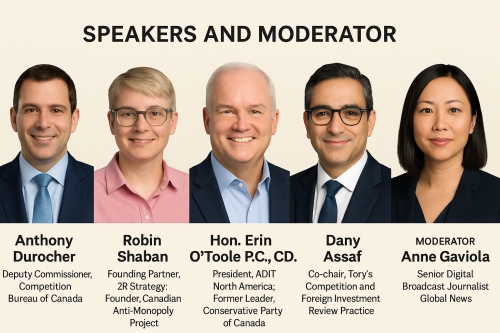
On October 8, 2025, the Rotman School of Management will host an in person debate on one of the most contested questions in Canada’s economy: Are Canada’s so called oligopolies standing in the way of a dynamic Canadian economy?
This debate is at the heart of whether concentrated industries in banking, telecom, airlines, and grocery are reducing competition and consumer choice or whether a few large firms are needed to sustain investment in a relatively small market.
Host: Rotman School of Management
Rotman Debate: Are Canada's So-Called "Oligopolies" Holding Us Back?
Date: October 8, 2025
Time/venue: 6:00 PM to 8:00 PM at Desautels Hall
Agenda: Live in-person debate followed by a networking reception
Anthony Durocher, Deputy Commissioner of the Competition Bureau, and Robin Shaban, economist and founder of the Canadian Anti Monopoly Project. They bring a competition policy and inclusive growth lens, pressing the case that concentration stifles productivity and affordability.
They will likely emphasize how concentrated markets in banking, telecom, grocery, and airlines restrict consumer choice, keep prices high, and hurt innovation. Both have deep expertise in competition policy, which will resonate with Canadians worried about affordability, productivity, rising costs, and declining foreign direct investment.
Erin O’Toole, former Leader of the Conservative Party and now President of ADIT North America, and Dany Assaf, co chair of Torys LLP’s competition and foreign investment practice. Their case focuses on the role of scale in driving resilience, capital inflows, and global competitiveness.
Expect them to argue that scale is necessary in Canada’s small market to attract global investment, maintain resilience, and provide stability. O’Toole brings political credibility and public speaking skills, while Assaf brings legal and transactional expertise from landmark competition cases.
The debate will be moderated by Anne Gaviola, senior broadcast journalist at Global News, who has more than 15 years covering Canada’s business and financial sectors.
For the NCFA Canada, this debate could not be more timely. The structure and size of Canada’s markets and levels of competition directly affects opportunities for new entrants in fintech and alternative finance. Concentrated industries can create barriers to entry. With productivity and affordability now central to Canada’s policy agenda, the insights from this debate will be directly relevant for startups, investors, and regulators. This is a ticketed event. Register now to secure your spot.
The National Crowdfunding & Fintech Association (NCFA Canada) is a financial innovation ecosystem that provides education, market intelligence, industry stewardship, networking and funding opportunities and services to thousands of community members and works closely with industry, government, partners and affiliates to create a vibrant and innovative fintech and funding industry in Canada. Decentralized and distributed, NCFA is engaged with global stakeholders and helps incubate projects and investment in fintech, alternative finance, crowdfunding, peer-to-peer finance, payments, digital assets and tokens, artificial intelligence, blockchain, cryptocurrency, regtech, and insurtech sectors. Join Canada's Fintech & Funding Community today FREE! Or become a contributing member and get perks. For more information, please visit: www.ncfacanada.org
| | |
|---|---|---|
| | |
M&A | Aug 28, 2025
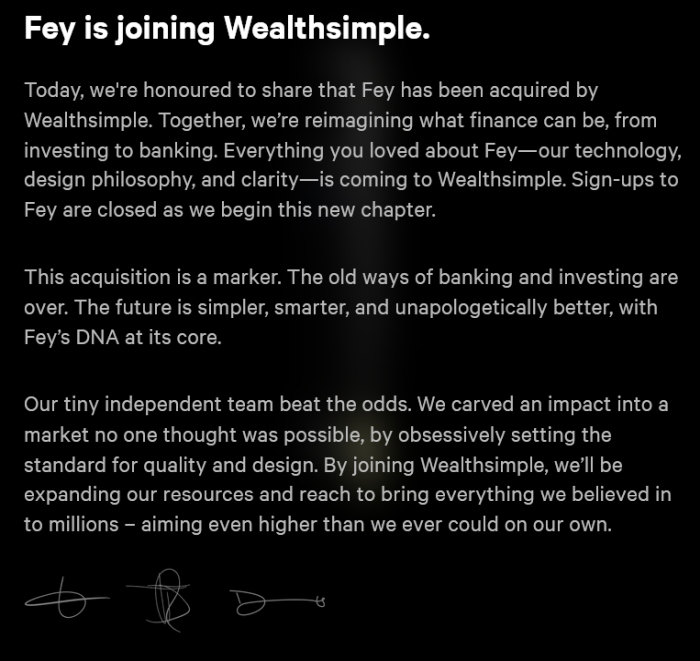
Image: Fey is joining Wealthsimple
On August 27, 2025, Wealthsimple announced the acquisition of Fey, a Montreal-based investment research startup founded in 2021 that built its reputation on elegant design and advanced AI trading tools. The financial terms of the deal weren't disclosed but it puts Wealthsimple in a position to offer millions of Canadians an enhanced trading experience, bridging the gap between simple apps and a more complex brokerage platform.
Wealthsimple now serves more than 3 million clients and manages over $84 billion CAD in assets, a 94% increase from the previous year. Earlier in 2025, Wealthsimple acquired San Francisco based platform Plenty, a wealth management platform for couples, as part of its strategy to expand capabilities and scale faster.
Fey emerged from the Montreal design studio Narative, founded by Thiago Costa, Dennis Brotzky, Thomas Russell, and Mack Mansouri. The team built Fey strategically with early venture backing from Maple VC, Inovia Capital, Yuri Sagalov of Wayfinder, and Abhinav Tiwari of Blank Ventures. Instead of a splashy launch, Fey garnished trader feedback on an invite-only access basis, which helped them refine features such as natural language stock screening, real-time earnings summaries, and a personalized news feed. Features that will soon become part of WS's self-directed investing platform.
As reported by BetaKit, Fey’s co-founders Costa, Brotzky, and Russell will join Wealthsimple’s self-directed investing group, and the Fey platform will shut down by September 30, with subscribers being refunded for any remaining balances.
For Wealthsimple’s 3 million clients, here's a look at how the integration of Fey's platform design and features will turn complex investing workflows into intuitive actions:
On Reddit, an early user described Fey as providing “a much nicer UI, the ability to sync portfolios across institutions, and quick access to key metrics when I didn’t have time to dig for them”.
Wealthsimple is aiming to create an all-in-one financial platform covering investing, trading, crypto, tax filing, and everyday banking services. Adding Fey’s research and design-first tools will help attract a younger generation of investors while strengthening its position against traditional brokerages and newer fintech challengers.
The National Crowdfunding & Fintech Association (NCFA Canada) is a financial innovation ecosystem that provides education, market intelligence, industry stewardship, networking and funding opportunities and services to thousands of community members and works closely with industry, government, partners and affiliates to create a vibrant and innovative fintech and funding industry in Canada. Decentralized and distributed, NCFA is engaged with global stakeholders and helps incubate projects and investment in fintech, alternative finance, crowdfunding, peer-to-peer finance, payments, digital assets and tokens, artificial intelligence, blockchain, cryptocurrency, regtech, and insurtech sectors. Join Canada's Fintech & Funding Community today FREE! Or become a contributing member and get perks. For more information, please visit: www.ncfacanada.org
| | |
|---|---|---|
| | |


August 26th, 2025

January 4th, 2024

June 1st, 2021

September 9th, 2020

July 9th, 2018

January 3rd, 2018

September 25th, 2017

June 20th, 2017

May 10th, 2017

December 14th, 2016